
Krantz W.B. Scaling Analysis in Modeling Transport and Reaction Processes: A Systematic Approach to Model Building and the Art of Approximation
Подождите немного. Документ загружается.

PRACTICE PROBLEMS 413
(c) Determine a, the interfacial area per unit volume of column, from the per-
formance data given in Figure 6.P.29-1.
(d) In which ranges of the reaction rate constant would it advantageous
to employ cocurrent (parallel) rather than countercurrent (antiparallel)
flow?

7 Applications in Process Design
The optimist looked at his glass and said to the bartender that it was half full.
The pessimist looked at his glass and said to the bartender that it was half empty.
The engineer looked at both glasses and said to the bartender that he would
◦
(1).
1
7.1 INTRODUCTION
The focus and organization of this chapter are a dramatic departure from those
of the preceding chapters. In Chapters 3 through 6 we focused primarily on using
scaling to justify classical approximations made in fluid dynamics, heat transfer,
mass transfer, and mass transfer with chemical reaction. As such, the thrust of the
preceding chapters was primarily pedagogical rather than application-oriented. In
contrast, in this chapter we show how scaling analysis has been applied to the
design of four practical engineering processes. Scaling analysis played a pivotal
role in advancing the technologies involved in these four examples. It not only
helped in simplifying the describing equations so that a tractable solution could be
developed but was also used to design the process; that is, to determine process
parameters such as the contact time, oscillation amplitude and frequency, vessel
length, adsorbent particle size, and wall temperature that insured effective and
efficient operation. We also demonstrate the utility of using
◦
(1) scaling analysis to
obtain optimal dimensionless groups for correlating experimental or numerical data.
In Section 7.2 we revisit the design of a membrane–lung oxygenator. In Section
5.10 the scaling approach to dimensional analysis was used to determine the dimen-
sionless groups required to correlate data for the performance enhancement that
could be achieved by applying axial vibrations of the hollow-fiber membranes in
this oxygenator. In this chapter,
◦
(1) scaling analysis is used to achieve the mini-
mum parametric representation. Subsequently, we will see that
◦
(1) scaling analysis
provides considerably more information than just the scaling analysis approach to
dimensional analysis or the Pi theorem. Section 7.3 applies scaling analysis to
1
Anonymous—attributed to a very practical engineer.
Scaling Analysis in Modeling Transport and Reaction Processes: A Systematic Approach
to Model Building and the Art of Approximation, By William B. Krantz
Copyright © 2007 John Wiley & Sons, Inc.
414
DESIGN OF A MEMBRANE–LUNG OXYGENATOR 415
the design of the pulsed pressure swing adsorption (PSA) process. This process
is of particular interest for use in portable oxygenators for people suffering from
severe respiratory problems or chronic obstructive pulmonary disease. This example
involves coupled flow through porous media and mass transfer. In Section 7.4
we consider the thermally induced phase-separation (TIPS) process for fabricating
semipermeable polymeric membranes. The TIPS process is used to make high flux
membranes for water desalination and reclamation as well as for solvent recovery.
This example involves coupled heat and mass transfer. In Section 7.5 we use scal-
ing analysis to design the fluid–wall aerosol flow reactor for converting methane
into hydrogen. The fluid–wall aerosol flow reactor is being developed to use solar
energy to drive the thermal decomposition of methane into hydrogen that can be
used as a clean-burning fuel to address the worldwide concern regarding global
warming. This example involves coupled fluid dynamics, heat transfer, mass trans-
fer, and chemical reactions in a two-phase system. The examples in Sections 7.3,
7.4, and 7.5 use the microscale–macroscale modeling methodology to handle het-
erogeneities such as particles or a dispersed phase. In Section 7.6 we summarize
the scaling principles employed in each of these examples and the role that scal-
ing analysis played in advancing each of these technologies. Unworked practice
problems related to each of the four examples are included at the end of the chapter.
7.2 DESIGN OF A MEMBRANE–LUNG OXYGENATOR
In Section 5.10 we applied the scaling approach to dimensional analysis to develop
a correlation for the performance enhancement achieved by applying axial oscilla-
tions to the hollow fibers in a membrane–lung oxygenator. Recall that the scaling
approach to dimensional analysis outlined in Section 2.4 does not provide as
much information as
◦
(1) scaling analysis for achieving the minimum paramet-
ric representation. In particular, it does not lead to groups whose magnitude can
be used to assess the relative importance of the various terms in the describing
equations. Moreover, it does not provide any insight into the fundamental mech-
anisms involved in the process. It also does not identify regions of influence or
boundary layers, which in some cases can reduce the number of dimensionless
groups. Here we apply
◦
(1) scaling analysis to design a membrane–lung oxygena-
tor. This example illustrates the value of using
◦
(1) scaling analysis to achieve the
minimum parametric representation in contrast to the simple scaling analysis or Pi
theorem approaches to dimensional analysis.
The membrane–lung oxygenator involves a bundle of permeable cylindrical
hollow-fiber membranes encased in a tubular housing. In this application the hollow-
fiber membranes do not cause any separation but rather, serve as a gas-permeable
barrier between the blood and the source of oxygen. The mass transfer of oxygen
is controlled on the blood side of the membrane because the hemoglobin “par-
ticles” that scavenge the oxygen are excluded from the wall region due to the
fluid dynamics. Hence, efforts to improve oxygenator performance have focused
on various means to reduce the resistance to mass transfer on the blood side of
the membrane. A very effective way to enhance the mass transfer is to oscillate
416 APPLICATIONS IN PROCESS DESIGN
the hollow fibers relative to the blood flow to increase the concentration gradients
adjacent to the membrane.
2
In this section we use
◦
(1) scaling analysis to design
an oxygenator that employs periodic oscillations of the hollow fibers to enhance
the mass transfer. It is sufficient to consider the effect of the oscillations on the
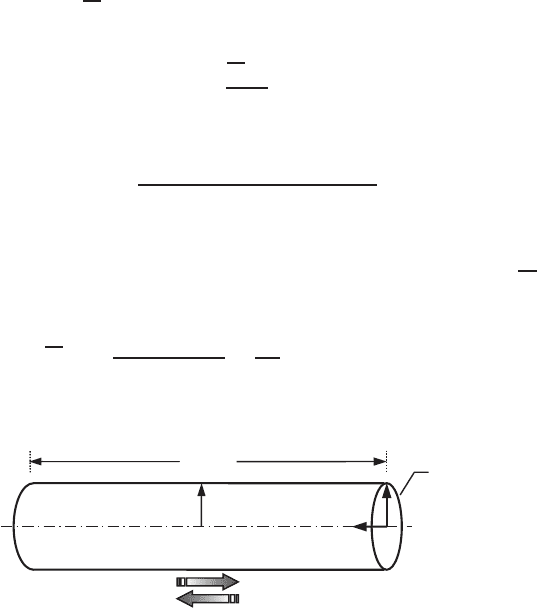
oxygen mass transfer to the blood flow in a single hollow-fiber membrane having
radius R and length L, as shown in Figure 7.2-1.
The initial steps involved in applying
◦
(1) scaling analysis to this problem are
similar to those used in the scaling analysis approach to dimensional analysis dis-
cussed in Section 5.10. One begins by writing the appropriate describing equations
for the oxygen mass transfer to the blood, which is assumed to be in fully devel-
oped periodically pulsed laminar flow (step 1). The effect of the oscillating wall
on the oxygen mass transfer is assessed in terms of the mass-transfer coefficient
k
•
L
defined in terms of N
Aw
, the time-average molar flux of oxygen at the inner
membrane wall, as follows:
k
•
L
≡
N
Aw
c
lm
(7.2-1)
where c
lm
is the log-mean concentration driving force, defined as
c
lm
≡
(c
Aw
− c
AL
) − (c
Aw
− c
A0
)
ln[(c
Aw
− c
AL
)/(c
Aw
− c
A0
)]
(7.2-2)
in which c
Aw
is the oxygen concentration at the blood side of the membrane
that is dictated by thermodynamic equilibrium considerations, c
A0
and c
AL
are the
average concentrations in the blood at z = 0andatz = L, respectively, and
N
Aw
is defined as
N
Aw
=
(
2π
/
ω
0
N
Aw
dt
(
2π
/
ω
0
dt
=
ω
2π
2π
/
ω
0
N
Aw
dt (7.2-3)
R
z
u
z
= Aw cos wt
r
L
Figure 7.2-1 Single hollow fiber of radius R and length L in a membrane–lung oxy-
genator; axial oscillations of amplitude A and angular frequency ω are used to increase
the concentration gradients at the interior wall where the resistance to mass transfer is
concentrated.
2
R. R. Bilodeau, R. J. Elgas, W. B. Krantz, and M. E. Voorhees, U.S. patent 5,626,759, issued May
6, 1997.

DESIGN OF A MEMBRANE–LUNG OXYGENATOR 417
where ω is the angular frequency of the wall oscillations. The molar flux N
Aw
in
equation (7.2-3) is the local molar flux averaged over the length of the hollow-fiber
membrane and is defined as
N
Aw
=
(
L
0
D
AB
(∂c
A
/∂r)
|
r=R
dz
(
L
0
dz
=
1
L
L
0
D
AB
∂c
A
∂r
r=R
dz (7.2-4)
where D
AB
is the binary diffusion coefficient for oxygen in blood, which is assumed
to be constant. The bulk flow contribution to the molar flux has been ignored
because the solutions are dilute. When equations (7.2-3) and (7.2-4) are substituted
into equation (7.2-1), we obtain
k
•
L
=
ωD
AB
2πLc
lm
2π
/
ω
0
L
0
∂c
A
∂r
r=R
dz dt (7.2-5)
Both c
AL
appearing in c
lm
and c
A
in equation (7.2-5) are obtained from a
solution to the axisymmetric form of the species-balance equation in cylindrical
coordinates given by equation (G.2-5) in the Appendices, which when simplified
appropriately for this unsteady-state convective diffusion problem assumes the form
∂c
A
∂t
+ u
z
∂c
A
∂z
=
D
AB
r
∂
∂r
r
∂c
A
∂r
(7.2-6)
When simplifying equation (G.2-5) to arrive at equation (7.2-6), note that each
term has been divided by the molecular weight, which can be assumed to be
constant for the dilute solutions. The axial diffusion term has also been neglected
in equation (7.2-6), owing to the small aspect ratio.
3
The mass-average velocity
u
z
is obtained from a solution to the equations of motion given by equations
(D.2-10) through (D.2-12) in the Appendices. If entrance and exit effects can be
ignored, this will be an unsteady-state fully developed flow for which the equations
of motion reduce to
ρ
∂u
z
∂t
=
P
L
+ μ
1
r
∂
∂r
r
∂u
z
∂r
(7.2-7)
The boundary and periodic solution conditions are given by
4
∂c
A
∂r
= 0atr = 0, 0 ≤ z ≤ L (7.2-8)
∂u
z
∂r
= 0atr = 0, 0 ≤ z ≤ L (7.2-9)
c
A
= c
Aw
at r = R, 0 ≤ z ≤ L (7.2-10)
u
z
= Aω cos ωt at r = R, 0 ≤ z ≤ L (7.2-11)
c
A
= c
A0
at z = 0 (7.2-12)
3
The criterion for ignoring this term is considered in Practice Problem 7.P.1.
4
The criterion for ignoring transient flow effects is considered in Practice Problem 7.P.2.

418 APPLICATIONS IN PROCESS DESIGN
c
A
|
t
= c
A
|
t+2π/ω
(7.2-13)
u
z
|
t
= u
z
|
t+2π/ω
(7.2-14)
where A is the amplitude of the wall oscillations.
In carrying out an
◦
(1) scaling analysis for this problem, one needs to recog-
nize that even in the absence of any axial oscillations, the mass-transfer problem
would involve a region of influence or boundary layer; that is, a solutal boundary
layer develops at the wall from the upstream edge of the hollow-fiber membrane.
The wall oscillations will influence the thickness of this solutal boundary layer by
altering the velocity profile near the wall. This suggests that our scaling analysis
should include a reference factor so that the coordinate system can be relocated
on the wall of the hollow-fiber membrane. A second consideration is that the axial
oscillations will define a hydrodynamic region of influence or momentum bound-
ary layer.
5
The momentum and solutal boundary-layer thicknesses need not be the
same; indeed, the high Schmidt numbers that characterize liquids imply that the
region of influence for the mass transfer will be considerably thinner than that for
the fluid flow. This then suggests that the radial coordinate in the equations of
motion should be scaled differently than those for the species-balance equation.
Another consideration is the scaling of the time derivative of the concentration.
Whereas the membrane oscillations clearly establish the amplitude of the velocity
at the wall, it is not clear what the amplitude of the concentration oscillations will
be. In particular, there is no reason to expect that this derivative will scale with
the characteristic concentration change divided by the characteristic time. Hence,
it is appropriate to introduce a separate scale for this time derivative. In view of
these considerations, the following dimensionless variables involving unspecified
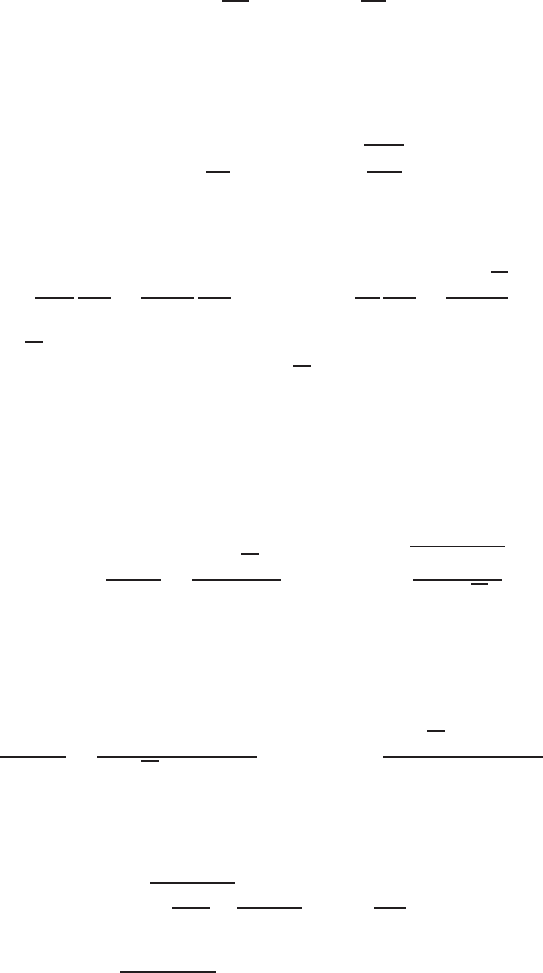
scale and reference factors are defined (steps 2, 3, and 4):
c
∗
A
≡
c
A
− c
Ar
c
As
;
∂c
A
∂t
∗
≡
1
˙c
As
∂c
A
∂t
; u
∗
≡
u
z
u
s
; y
∗
c
≡
r − r
r
δ
s
;
y
∗
m
≡
r − r
r
δ
m
; z
∗
≡
z
z
s
; t
∗
≡
t
t
s
(7.2-15)
where δ
s
and δ
m
are the solutal and momentum boundary-layer thicknesses, respec-
tively. Substitute these dimensionless variables into the describing equations and
divide through by the dimensional coefficient of one term in each equation (steps
5 and 6):
2πk
•
L
Lδ
s
ωD
AB
z
s
t
s
=−
1
c
∗
lm
1
0
1
0
∂c
∗
A
∂y
∗
c
y
∗
c
=(r
r
−R)/δ
s
dz
∗
dt
∗
(7.2-16)
c
∗
lm
≡
−c
∗
AL
+ (c
A0
− c
Ar
)/c
As
ln
c
Aw
− c
Ar
c
Aw
− c
A0
−
c
As
c
Aw
− c
A0
c
∗
AL
(7.2-17)
5
The region of influence associated with an oscillating boundary was discussed in Section 3.5.

DESIGN OF A MEMBRANE–LUNG OXYGENATOR 419
δ
2
s
˙c
As
D
AB
c
As
∂c
A
∂t
∗
+
u
zs
δ
2
s
D
AB
z
s
u
∗
z
∂c
∗
A
∂z
∗
=
1
(r
r
/δ
s
) − y
∗
c
∂
∂y
∗
c
r
r
δ
s
−y
∗
c
∂c
∗
A
∂y
∗
c
(7.2-18)
δ
2
m
νt
s
∂u
∗
z
∂t
∗
=
δ
2
m
μu
zs
P
L
+
1
(r
r
/δ
m
) − y
∗
m
∂
∂y
∗
m
r
r
δ
m
− y
∗
m
∂u
∗
z
∂y
∗
m
(7.2-19)
∂c
∗
A
∂y
∗
c
= 0aty
∗
c
=
y
r
δ
s
, 0 ≤ z
∗
≤
L
z
s
(7.2-20)
∂u
∗
z
∂y
∗
m
=0aty
∗
m
=
r
r
δ
m
, 0 ≤ z
∗
≤
L
z
s
(7.2-21)
c
∗
A
=
c
Aw
− c
Ar
c
As
at y
∗
c
=
y
r
− R
δ
s
, 0 ≤ z
∗
≤
L
z
s
(7.2-22)
u
∗
z
=
Aω
u
zs
cos ωt
s
t
∗
at y
∗
m
=
r
r
− R
δ
m
(7.2-23)
c
∗
A
=
c
A0
− c
r
c
As
at z
∗
= 0 (7.2-24)
c
∗
A
|
t
∗
= c
∗
A
|
t
∗
+2π/ωt
s
(7.2-25)
u
∗
z
|
t
∗
= u
∗
z
|
t
∗
+2π/ωt
s
(7.2-26)
The scale and reference factors are determined by bounding the dependent
variables, their derivatives, and the independent variables to be
◦
(1) (step 7). The
reference and scale factors for the concentration are determined by setting the
appropriate dimensionless groups in equations (7.2-22) and (7.2-24) equal to 1 and
zero, respectively, to obtain
c
A0
− c
r
c
As
= 0 ⇒ c
r
= c
A0
;
c
Aw
− c
Ar
c
As
= 1 ⇒ c
As
= c
Aw
− c
A0
(7.2-27)
The radial reference factor and axial length scale are determined by setting the
appropriate dimensionless groups in equation (7.2-22) equal to zero and 1, respec-
tively, to obtain
y
r
− R
δ
s
= 0 ⇒ y
r
= R;
L
z
s
= 1 ⇒ z
s
= L (7.2-28)
420 APPLICATIONS IN PROCESS DESIGN
The time scale is obtained by setting the dimensionless group appearing in equations
(7.2-25) and (7.2-26) equal to 1 to obtain
ωt
s
2π
= 1 ⇒ t
s
=
2π
ω
(7.2-29)
The radial length scale for the momentum equation is equal to the penetration
depth of the axial oscillations, which is determined by the viscous diffusion of
the wall motion into the fluid; hence, we set the following dimensionless group in
equation (7.2-19) equal to 1:
δ
2
m
νt
s
= 1 ⇒ δ
m
=
2πν
ω
(7.2-30)
The velocity scale is obtained by balancing the pressure term with the viscous term
in equation (7.2-19); hence, the following dimensionless group is set equal to 1:
δ
2
m
μu
zs
P
L
=
2πν
ωμu
zs
P
L
= 1 ⇒ u
zs
=
2π
ωρ
P
L
=
16πν
U
ωR
2
(7.2-31)
where
U is the average velocity for steady-state fully developed flow through a
circular tube; expressing u
zs
in terms of U is done so that the dimensionless groups
emanating form this
◦
(1) scaling analysis can be recast in terms of those obtained
via the simpler scaling analysis approach to dimensional analysis considered in
Section 5.10. The radial length scale for the species-balance equation is the solutal
boundary-layer thickness, which is determined by balancing the axial convection
and radial diffusion terms; hence, we set the following dimensionless group in
equation (7.2-18) equal to 1:
u
zs
δ
2
s
D
AB
z
s
=
16πν
Uδ
2
s
ωR
2
D
AB
L
= 1 ⇒ δ
s
=
ωR
2
D
AB
L
16πνU
(7.2-32)
Determining the proper scale for the time derivative of the concentration is prob-
lematic. An upper bound on this derivative can be obtained by balancing the
unsteady-state term with the radial diffusion term; hence, we set the following
dimensionless group in equation (7.2-18) equal to 1:
δ
2
s
˙c
As
D
AB
c
As
=
ωR
2
L ˙c
As
16πνU(c
Aw
− c
A0
)
= 1 ⇒˙c
As
=
16πν
U(c
Aw
− c
A0
)
ωR
2
L
(7.2-33)
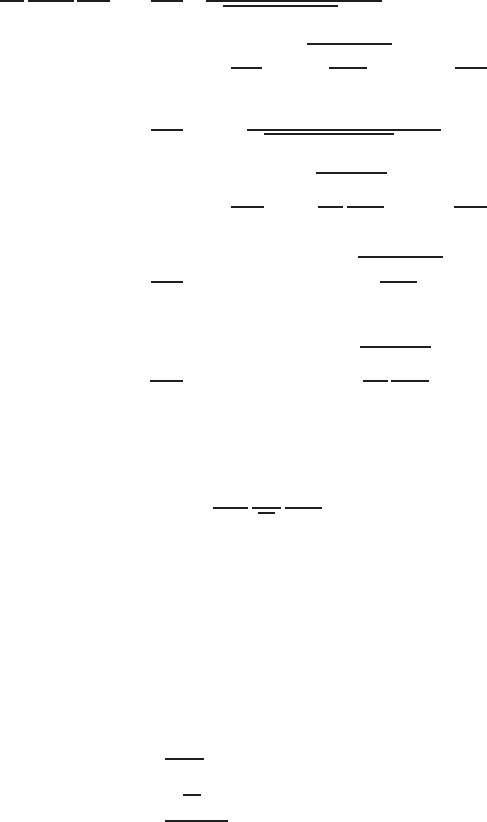
Substitute the scale and reference factors defined by equations (7.2-27) through
(7.2-33) into the describing equations given by (7.2-16) through (7.2-26) to obtain
the following:
Sh
v
=−
32
ν
ωR
2
Gz
1
(c
∗
lm
)
v
1
0
1
0
∂c
∗
A
∂y
∗
c
y
∗
c
=0
dz
∗
dt
∗
(7.2-34)
(c
∗
lm
)
v
≡
−c
∗
AL
ln(1 − c
∗
AL
)
(7.2-35)
DESIGN OF A MEMBRANE–LUNG OXYGENATOR 421
64π
Gz
Sc
ν
2
ω
2
R
4
∂c
∗
A
∂t
∗
+u
∗
z
∂c
∗
A
∂z
∗
=
1
32(ν/ωR
2
)Gz − y
∗
c
×
∂
∂y
∗
c
32
ν
ωR
2
Gz − y
∗
c
∂c
∗
A
∂y
∗
c
(7.2-36)
∂u
∗
z
∂t
∗
= 1 +
1
(1/2π)(ωR
2
/ν) − y
∗
m
×
∂
∂y
∗
m
⎡
⎣
⎛
⎝
1
2π
ωR
2
ν
− y
∗
m
⎞
⎠
∂u
∗
z
∂y
∗
m
⎤
⎦
(7.2-37)
∂c
∗
A
∂y
∗
c
= 0aty
∗
c
=
32
ν
ωR
2
Gz, 0 ≤ z
∗
≤ 1
(7.2-38)
∂u
∗
z
∂y
∗
m
= 0aty
∗
m
=
1
2π
ωR
2
ν
, 0 ≤ z
∗
≤ 1
(7.2-39)
c
∗
A
= 1aty
∗
c
= 0, 0 ≤ z
∗
≤ 1 (7.2-40)
u
∗
z
=
1
16π
Aω
U
ωR
2
ν
cos 2πt
∗
at y
∗
m
= 0 (7.2-41)
c
∗
A
= 0atz
∗
= 0 (7.2-42)
c
∗
A
|
t
∗
= c
∗
A
|
t
∗
+1
(7.2-43)
u
∗
z
|
t
∗
= u
∗
z
|
t
∗
+1
(7.2-44)
We have recast the describing equations in terms of the dimensionless groups
identified in Section 5.10, where
Sh ≡
k
•
L
R
D
AB
is the Sherwood number (7.2-45)
Gz ≡
π
UR
2
2D
AB
L
is the Graetz number (7.2-46)
and Sh
v
and (c
∗
lm
)
v
denote the Sherwood number and the dimensionless log-mean
concentration driving force, respectively, in the presence of axial oscillations. Step
8 in the procedure for
◦
(1) scaling analysis would involve assessing whether any
simplifications can be made in the dimensionless form of the describing equations.
Depending on the oscillation frequency, it might be possible to ignore curvature
effects in equations (7.2-36) and (7.2-37) and to apply the boundary conditions
given by equations (7.2-38) and (7.2-39) at infinity. However, owing to the range
of oscillation frequencies that must be considered, it is not possible in general
422 APPLICATIONS IN PROCESS DESIGN
to make these simplifications. Moreover, our interest here is not in simplifying
these equations, but rather, in developing a dimensional analysis correlation for the
performance enhancement.
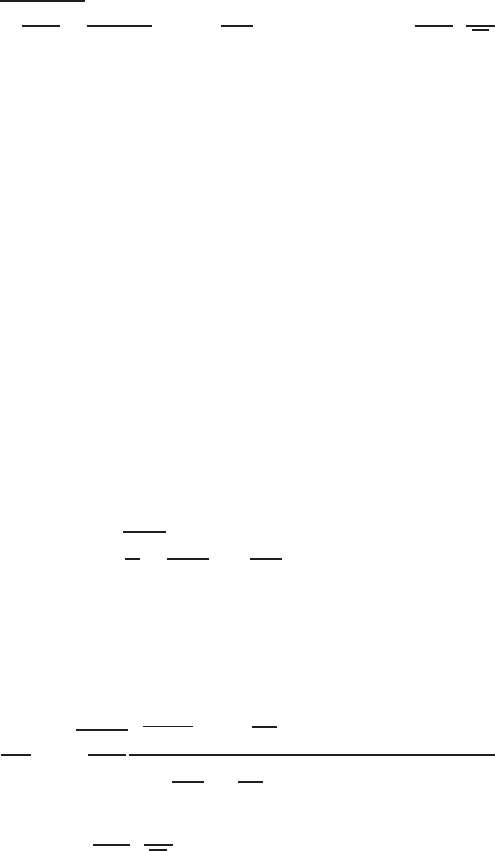
Equations (7.2-34) through (7.2-44) indicate that the Sherwood number for mass
transfer with applied axial oscillations will be a function of four dimensionless
groups; that is,
Sh
v
=−
32
ν
ωR
2
Gz
1
(c
∗
lm
)
v
1
0
1
0
∂c
∗
A
∂y
∗
c
y
∗
c
=0
dz
∗
dt
∗
=f
ωR
2
ν
,
Aω
U
, Gz, Sc
(7.2-47)
since the integral and (c
∗
lm
)
v
introduce only those dimensionless groups appear-
ing in equations (7.2-36) through (7.2-44). The scaling approach to dimensional
analysis developed in Section 5.10 also indicated that the Sherwood number was
a function of four dimensionless groups. However, the
◦
(1) scaling analysis result
carried out here provides additional information in identifying the momentum and
solutal boundary layers; that is, the mass transfer is confined to a region-of-influence
near the wall that is dictated by the effect of the oscillating boundary on the hydro-
dynamics in the wall region. The oscillating boundary changes the velocity profile
near the wall that in turn increases the concentration profiles in this region. Note
that the Schmidt number appeared explicitly only when we recast the temporal
concentration derivative (∂c
A
/∂t)
∗
in terms of ∂c
∗
A
/∂t
∗
; that is, to carry out the
time integration of equation (7.2-36) the concentration and time must be nondi-
mensionalized as they are in the other terms in the describing equations.
An effective way to assess the performance enhancement for this novel oxy-
genator design is to consider the ratio of the Sherwood number in the presence and
absence of axial oscillations. An
◦
(1) scaling analysis for a conventional oxygena-
tor that does not employ axial oscillations indicates that
Sh =
4
π
Gz
1
c
∗
lm
1
0
∂c
∗
A
∂y
∗
c
y
∗
c
=0
dz
∗
= f(Gz) (7.2-48)
That is, the Sherwood number is a function of only the Graetz number.
6
Hence, we
conclude that a correlation for the ratio of the Sherwood number in the presence
and absence of axial oscillations is of the form
Sh
v
Sh
=
8
πν
ωR
2
1
(c
∗
lm
)
v
(
1
0
(
1
0
∂c
∗
A
∂y
∗
c
y
∗
c
=0
dz
∗
dt
∗
with oscillations
1
c
∗
lm
(
1
0
∂c
∗
A
∂y
∗
c
y
∗
c
=0
dz
∗
without oscillations
= f
ωR
2
ν
,
Aω
U
, Gz, Sc
(7.2-49)
6
An
◦
(1) scaling analysis to obtain this result is considered in Practice Problem 7.P.4.