
Lehner G. Electromagnetic Field Theory for Engineers and Physicists
Подождите немного. Документ загружается.

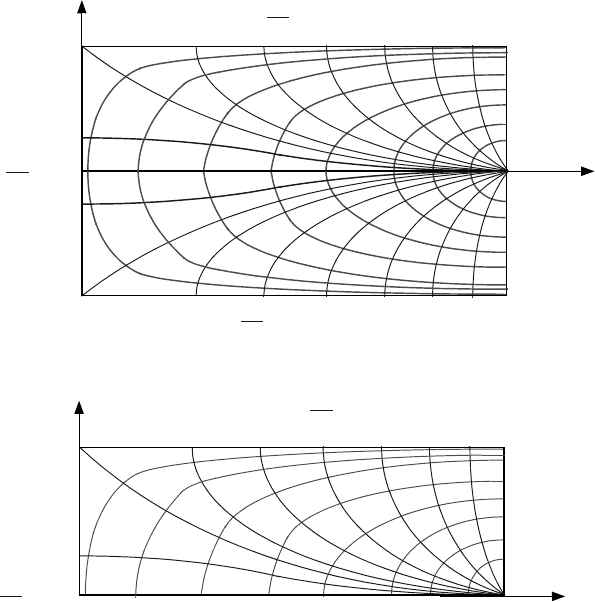
254 The Stationary Current Density Field
Fig. 4.23
ϕϕ–
0
=
ϕ 0=
x
y
b
2
---–
+
b
2
---
n∂
∂ϕ
0=
n∂
∂ϕ
0=
n∂
∂ϕ
0=
ϕϕ
0
=
a
Fig. 4.24
ϕ 0=
x
y
b
2
---
n∂
∂ϕ
0=
n∂
∂ϕ
0=
ϕϕ
0
=
a
y
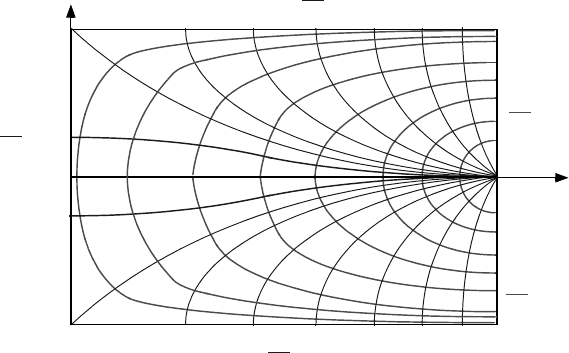
4.5 Some Current Density Fields 255
Fig. 4.25
ϕϕ–
0
=
x
y
b
2
---–
+
b
2
---
n∂
∂ϕ
0=
n∂
∂ϕ
0=
n∂
∂ϕ
0=
ϕϕ
0
=
a
ψ 0=
n∂
∂ψ
0=
n∂
∂ψ
0=
ψ 0=
ψ 0=

5 Basics of Magnetostatics
5.1 Basic Equations
Maxwell’s equations were introduced in Chapter 1 eq. (1.72). In the limit of just
time-independent problems, the system of Maxwell’s equations nicely splits into
two electrostatic and two magnetostatic equations. The latter consists of Ampere’s
law, and the fact that the magnetic field is always source free (i.e. solenoidal).
(5.1)
. (5.2)
Beyond that, we have to establish a relation between B and H
.
(5.3)
The relation for vacuum is
.
(5.4)
The B-field is perceivable because it exhibits a velocity dependent force on
charged particles (Lorentz force). If an electric field exists simultaneously, the force
becomes
.
(5.5)
Integrating eq. (5.1) over an arbitrary area gives its integral representation
.
Applying Stokes’s theorem gives
,
(5.6)
where I is the current through the respective area.
In the following, we calculate the magnetic fields for a variety of
arrangements. Simple cases with a high degree of symmetry allow one to almost
directly write down the magnetic fields from eq. (5.6). However, frequently more
laborious, formal methods need to be applied. This requires the introduction of the
vector potential A. Since the divergence of the curl vanishes for every vector
,
it is possible to write B in the form
.
(5.7)
This automatically satisfies eq. (5.2). Any given A uniquely determines B.
Conversely, there are many vector potentials for any given B-field. Obviously,
and
(5.8)
produce the same B-field. The reason is
,
where for any function the following identity holds
H∇× g =
B∇• 0 =
BBH()=
B µ
0
H=
F Q EvB×+()=
H∇×()Ad
A
∫
gAd
A
∫
=
H ds•
∫
°
I =
a∇×()∇• 0=
BA ∇×=
AA' A φ∇+=
A'∇× A∇× φ∇()∇×+ A∇×==
φ
G. Lehner, Electromagnetic Field Theory for Engineers and Physicists,
DOI 10.1007/978-3-540-76306-2_5, © Springer-Verlag Berlin Heidelberg 2010
5.1 Basic Equations 257
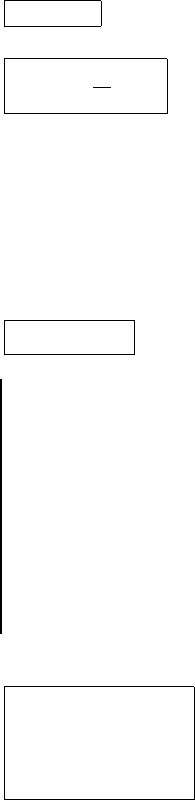
.
Consequently, every B-field can be represented by an infinite number of vector
potentials A. This allows one to impose additional restrictions on A. The proper
choice of satisfies these restrictions, which can be used as a gauge. The
transition from to in eq. (5.8) is termed a gauge transformation of the vector
potential. B remains unchanged and, thus, is said to be gauge invariant. The so-
called Coulomb gauge is very useful for static problems.
.
(5.9)
For time-dependent problems, the Lorentz gauge is usually used
.
(5.10)
Its importance will be made clear later.
From eqs. (5.1), (5.4). and (5.7) follows, that for currents in vacuum
.
Using the vector identity
(5.11)
and eq. (5.9) gives
.
(5.12)
For Cartesian coordinates we find
,
(5.13)
where represents the ordinary Laplacian or Laplace operator
The reader shall be cautioned in applying the Laplace operator to vec-
tors, since only for Cartesian coordinates the result is simply an applica-
tion of the double derivative to the individual components. This can
easily be verified by applying the gradient, divergence, and curl in cur-
vilinear coordinates (as we have discussed in Sections 3.1 through 3.3),
and use eq. (5.11) to calculate , i.e.,
.
It is recommended to eliminate in this way when using curvilinear
coordinates.
φ∇()∇× 0=
φ
AA'
A∇• 0 =
A∇• µε
t∂
∂ϕ
+0 =
H∇×
B
µ
0
------
∇×
1
µ
0
------
A∇×()∇×
1
µ
0
------
A∇×()∇× g====
A∇×()∇× A∇•()∇∇
2
A– A∇•()∇∆A–==
∇
2
A µ
0
g –=
∇
2
A
∇
2
AA∇•()∇ A∇×()∇×–=
∇
2
A
∇
2
A
x
r() µ
0
g
x
– r()=
∇
2
A
y
r() µ
0
g
y
r()–=
∇
2
A
z
r() µ
0
g
z
r()–=
∇
2
258 Basics of Magnetostatics
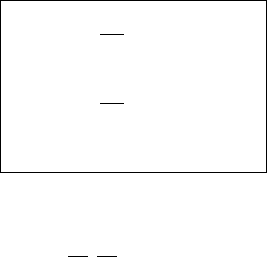
.
The equation in cylindrical coordinates is
,
(5.14)
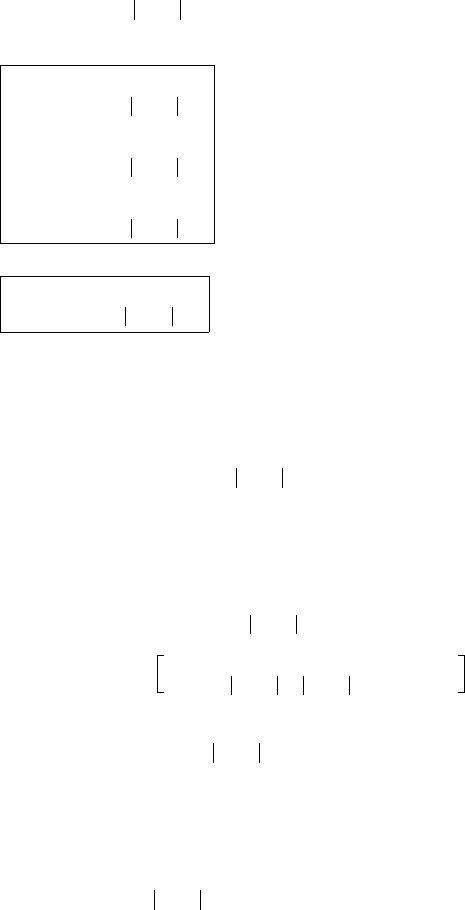
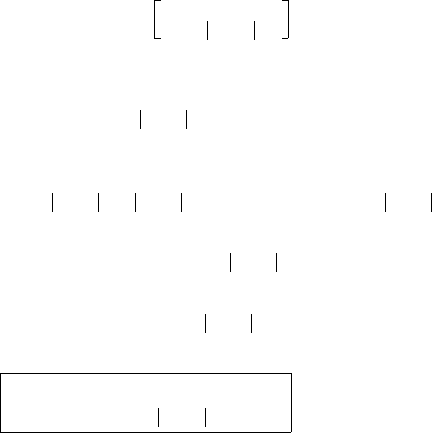
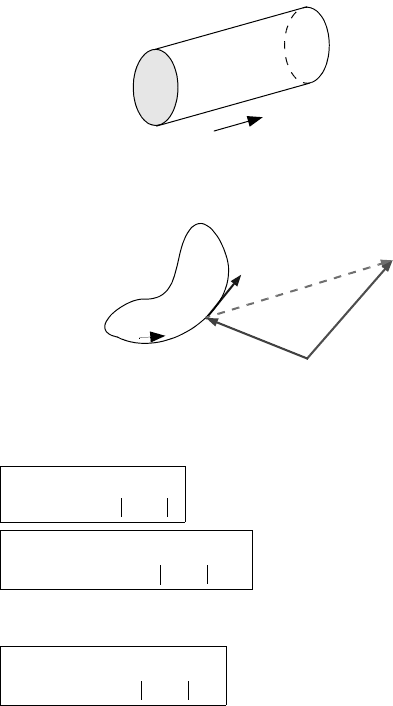
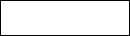
where again represents the ordinary Laplace operator, whose form is given by
eq. (3.33):
Now we see that it would be wrong to attempt splitting eq. (5.12) in its cylindrical
components and write it in the form
FALSE!
The reason for all this lies in the fact that the basis vectors for curvilinear
coordinates are functions of the location, for instance in cylindrical coordinates
and (not , however), which results in additional terms when differentiating.
In Cartesian coordinates we have
,
while for cylindrical coordinates we get
,
where
.
To calculate the related fields when the currents g(r) are given, requires one
to solve eq. (5.12), which in Cartesian coordinates is represented by the three scalar
equations of (5.13), and for cylindrical coordinates by the three scalar equations
given by (5.14). For formal reasons, we will initially restrict ourselves to Cartesian
coordinates. We know already the solution of the three equations (5.13). These are
three scalar Poisson equations. We have shown in electrostatics that the equation
∇
2
∂
2
∂x
2
--------
∂
2
∂y
2
--------
∂
2
∂z
2
--------++=
∇
2
A
r
2
r
2
-----
ϕ∂
∂A
ϕ
A
r
r
2
-----–– µ
0
g
r
–=
∇
2
A
ϕ
2
r
2
-----
ϕ∂
∂A
r
A
ϕ
r
2
------–+ µ
0
g
ϕ
–=
∇
2
A
z
µ
0
g
z
–=
∇
2
∇
2
1
r
---
r∂
∂
r
r∂
∂ 1
r
2
-----
∂
2
∂ϕ
2
---------
∂
2
∂z
2
--------++=
∇
2
A
r
µ
0
g
r
–=
∇
2
A
ϕ
µ
0
g
ϕ
–=
∇
2
A
z
µ
0
g
z
–=
e
r
e
ϕ
e
z
∇
2
A ∇
2
A
x
e
x
A
y
e
y
A
z
e
z
++()e
x
∇
2
A
x
e
y
∇
2
A
y
e
z
∇
2
A
z
++==
∇
2
A ∇
2
A
r
e
r
A
ϕ
e
ϕ
A
z
e
z
++()e
r
∇
2
A()
r
e
ϕ
∇
2
A()
ϕ
e
z
∇
2
A()
z
++==
∇
2
A()
r
∇
2
A
r
≠ , ∇
2
A()
ϕ
∇
2
A
ϕ
≠
∇
2
ϕ r()
ρ r()
ε
0
-----------–=
5.1 Basic Equations 259
can be solved by the potential (see eq. (2.20))
.
Similarly, from eq. (5.13) follows:
.
(5.15)
Of course we may combine these three equations into one vector equation
.
(5.16)
However, important to remember is that this equation is valid only in Cartesian
coordinates.
What remains to be proven is that the vector potential eq. (5.16) is indeed
source-free, as our gauge (5.9) requires. We find
,
having used the vector identity
and the fact that g(r’) is independent of the field point r. Furthermore
,
because for stationary currents
.
And finally, because of Gauss’ theorem
.
The reason is that the integral covers the entire space and there will be no currents
crossing a sufficiently distant surface. Note that we use da for the surface element
here and whenever confusion with the vector potential A is possible.
ϕ r()
1
4πε
0
------------
ρ r'()
rr'–
---------------
τ'd
V
∫
=
A
x
r()
µ
0
4π
------
g
x
r'()
rr'–
---------------
τ' d
V
∫
=
A
y
r()
µ
0
4π
------
g
y
r'()
rr'–
---------------
τ' d
V
∫
=
A
z
r()
µ
0
4π
------
g
z
r'()
rr'–
---------------
τ' d
V
∫
=
Ar()
µ
0
4π
------
gr'()
rr'–
---------------
τ' d
V
∫
=
A∇• r()
µ
0
4π
------
gr'() ∇
r
1
rr'–
---------------
•τ' d
V
∫
=
af()∇• a f∇()• f a∇•()+=
A∇• r()
µ
0
4π
------
gr'()∇
r'
1
rr'–
---------------
•τ' d
V
∫
–=
µ–
0
4π
---------
(∇ ) •
r'
gr'()
rr'–
---------------
1
rr'–
---------------
(∇ ) •
r'
gr'()– τ'd
V
∫
=
A∇• r()
µ
0
4π
------
(∇ ) •
r'
gr'()
rr'–
---------------
τ' d
V
∫
=
g∇• 0=
A∇• r()
µ
0
4π
------
gr'()
rr'–
---------------
da'•
∫
°
–0==
260 Basics of Magnetostatics
One needs to beware of a false conclusion, here. We already saw that
when . However, this does not mandate that we select the
Coulomb gauge when dealing with magnetostatic problems, where we have, of
course, . It only means that our approach does not bear any contradiction.
Our assumption was the Coulomb gauge ( ). Any different result would
constitute a contradiction. On the other hand, if we choose current densities that are
not source free ( ), then we end up with a contradiction. Since always
,
the following must also be true
Therefore, it should not be a surprise that for , we obtain a wrong vector
potential
.
When choosing a different gauge, then the vector potential calculated for a given
current distribution satisfies this other gauge if and only if .
In principle, this solves the calculation of magnetic fields due to any current
distribution. In an actual case, this may still turn out to be difficult.
Instead of the vector potential, the field may be directly expressed by an
integral. From eqs. (5.16) and (5.7) we obtain
,
or
.
We use
and therefore
.
(5.17)
This is the so-called Biot-Savart’s law in its most general form. If there are only
currents in relatively narrow conductors we may approximate (Fig. 5.1)
.
A∇• 0= g∇• 0=
g∇• 0=
A∇• 0=
g∇• 0≠
A∇×()∇× µ
0
g=
A∇×()∇×()∇• 0 µ
0
g∇•==
g∇• 0 .=
g∇• 0≠
A∇• 0≠
g∇• 0=
BA ∇×
µ
0
4π
------
gr'()
rr'–
---------------
τ'd
V
∫
∇×==
B
µ
0
4π
------
()∇×
r
gr'()
rr'–
---------------
τ' d
V
∫
=
()∇×
r
gr'()
rr'–
---------------
1
rr'–
---------------
()∇×
r
gr'() gr'() ∇×
r
1
rr'–
---------------
–=
gr'()
rr'–
rr'–
3
------------------
–
×–=
gr'()
rr'–
rr'–
3
------------------
×=
B r()
µ
0
4π
------
gr'() rr'–()×
rr'–
3
-----------------------------------
τ' d
V
∫
=
gr'()dτ' gr'()dA'ds' Ids'==
5.1 Basic Equations 261
This changes eqs. (5.16) and (5.17) to now read
,
(5.18)
. (5.19)
These integrals extend over the entire, closed current loop or all the closed current
loops (Fig. 5.2). Frequently, it is said that the line element creates the field
.
(5.20)
Often, this is also called the Biot-Savart law. Unfortunately, this form is
mistakable, we might almost say even wrong. Indeed, the field expressed by
eq. (5.20) is a possible field, as it is source free. The related current density field is
obtained from
.
Taking the divergence on both sides reveals that it is always source free:
.
However, the current I in the line element is not source free. This constitutes an
apparent contradiction. Nevertheless, the correct current density field can be
calculated immediately. To simplify and make this easier to understand, just
assume that the line element is located at the origin and is oriented along the
positive z-axis. When using spherical coordinates, dB and dH have only a ϕ-
component
Fig. 5.1
gr'()
dA'
I
ds'
Ar()
µ
0
I
4π
--------
s'd
rr'–
---------------
∫
°
=
Br()
µ
0
I
4π
--------–
rr'–()ds'×
rr'–
3
------------------------------
∫
°
=
ds'
dB
µ
0
I
4π
--------–
rr'–()ds'×
rr'–
3
------------------------------
=
gH∇×=
g∇• H∇×()∇• 0==
Fig. 5.2
ds'
r
r'
rr'–
I
ds'
ds'
262 Basics of Magnetostatics
.
This makes
We know the electrostatic analogue of this field very well. It represents the dipole
field given by eq. (2.63). Thus, it describes the current I within a line element with
the point-like isotropic current sources +I at its upper end and -I at its lower end,
that is, a “dipole current density” which occupies the entire space. It is rotationally
symmetric. Therefore, by using Ampere’s law, one can show that this flux exactly
causes the given magnetic field. It is furthermore apparent that all positive and
negative point sources cancel each other when integrating over a closed contour,
thereby leaving only the current I in the closed conductor. This explanation
plausibly clarifies the integral result (5.19), which we had obtained in a purely
formal manner.
To go beyond the current magnetostatic treatment of this problem and to
regard it as time dependent problem is also possible. Currents with sources are now
permissible, which however, requires time dependent volume charges, because of
the charge conservation (continuity equation). Besides the magnetic field, one
needs to consider also time dependent electric fields and thereby displacement
current densities, i.e., the current densities above are replaced by displacement
current densities. We will not elaborate on this subject here.
To use the Biot-Savart law in its integral form (5.19) is advisable in
magnetostatics. Nevertheless, the differential form can be used as well, if
interpreted in the correct way, as just outlined.
Oftentimes, the vector potential is very useful to calculate the magnetic flux.
Because of
,
and using Stokes’ theorem we obtain:
.
(5.21)
The vector potential was introduced as an auxiliary quantity to calculate B. At
this point it is frequently said that only B has real meaning, while A has no
significance beyond its role as an auxiliary quantity. This is not correct because in
quantum mechanics, the field A is necessary and is a real field. The experiment by
Bohm and Aharonov, interpreted in a quantum mechanical way shows for example,
that the A field is important in certain regions (e.g., outside of infinitely long coils,
dH
ϕ
Ids' θsin
4πr
2
--------------------=
dg dH∇×
dg
r
Ids'
4πr
3
------------
2 θcos=
dg
θ
Ids'
4πr
3
------------
θsin=
dg
ϕ
0 .=
==
φ Bad•
a
∫
∇ A×()ad•
a
∫
==
φ As d•
∫
°
=
5.1 Basic Equations 263
see Section 5.2.3), where even when , the A field remains . The
Bohm-Aharonov experiment shall not be discussed here. Details can be found in
Appendix A.3.
Besides the vector potential, there is also a scalar magnetic potential, whose
usefulness is restricted to describe magnetic fields in regions that are current free.
If in a region , then
.
Therefore, H can be obtained from a scalar potential by taking the gradient (note
that here is not related to the previously discussed flux function).
(5.22)
is a unique function in a simply connected region and shares most
properties with the electric potential . When multiply connected regions enclose
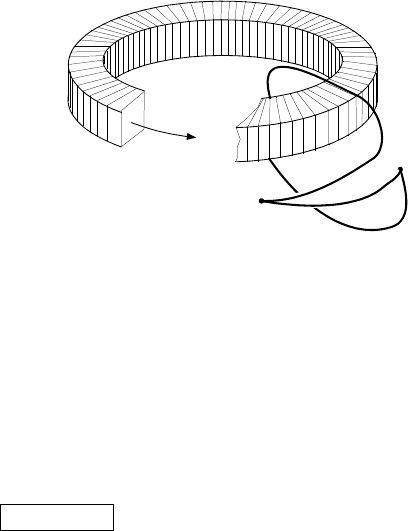
currents, becomes ambiguous (Fig. 5.3). Consider a current carrying toroidal
region. We pick the two points A and B in the current-free space and the two
different paths C
0
and C
1
, both starting at A and ending at B. Together C
0
and C
1
enclose the current carrying region. Ampere’s law (5.6) states
,
that is
.
More generally, we could be interested in a path that loops n times around the
current I (Fig. 5.4). Then we get
.
(5.23)
B 0= A 0≠
g 0=
H∇× 0=
ψ
ψ
H ψ ∇–=
ψ
ϕ
ψ
Fig. 5.3
A
B
C
1
C
0
I
H ds•
B
A
∫
C
1
()
H ds•
A
B
∫
C
0
()
+ I =
H ds•
A
B
∫
C
1
()
H ds•
A
B
∫
C
0
()
I– =
H ds•
A
B
∫
C
n
()
H ds•
A
B
∫
C
0
()
nI– =