
Lehner G. Electromagnetic Field Theory for Engineers and Physicists
Подождите немного. Документ загружается.

234 The Stationary Current Density Field
.
(4.9)
This is a consequence of the Helmholtz theorem (which will be discussed in
Appendix A.5)
However, to create stationary currents is possible by using an impressed electric
field such as batteries produce. This results in
,
(4.10)
i.e., there must be a voltage source which provides an electromotive force (EMF).
Putting things together gives
,
(4.11)
and therefore
i.e.,
.
(4.12)
It is then
,
(4.13)
which may be regarded as the definition for resistance R. R depends on the
geometry and the material, but not on the current. If we separate the resistance into
an external part and an internal one for the voltage source , then
.
(4.14)
The definition
,
(4.15)
and eq. (4.13) yields
.
(4.16)
If we do not integrate over the closed circuit, but just the section outside the voltage
source, then we find for
.
(4.17)
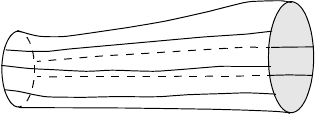
Fig. 4.3,makes it obvious that the actual integration path is irrelevant, since in any
case
.
Also irrelevant is the choice of the cross section, since the current
g 0=
V E
e
ds•
∫
°
0≠=
g κ EE
e
+()=
g ds•
∫
°
κ E ds•
∫
°
κ E
e
ds•
∫
°
+=
V
1
κ
---
g ds•
∫
°
=
1
κ
---
g ds•
∫
°
IR=
R
x
R
i
VIRIR
x
R
i
+()==
I g dA•
A
∫
°
=
R
1
κ
---
g ds•
∫
°
g dA•
A
∫
----------------------
=
R
x
R
x
1
κ
---
g ds•
x
∫
g dA•
A
∫
----------------------
=
1
κ
---
g ds•
x
∫
Eds•
1
2
∫
ϕ
2
ϕ
1
–==
4.2 Relaxation Time 235
in the stationary case is the same for every cross section. This simplifies for a
conductor with uniform cross section and uniform current density:
,
(4.18)
which is the familiar formula for the resistance.
This shows that one can create a stationary current density by means of an
EMF. The fact that this is not strictly true for an actual EMF (i.e. after its depletion)
is immaterial. What matters is that it should be possible to maintain the current
density for a time period that is longer than the characteristic times of the system
and the relaxation time in particular, which we will discuss in the next section (the
relaxation time is very short for good conductors).
The unit of resistance in the MKSA system is 1 Ohm ( ):
.
(4.19)
One finds the unit for conductivity from eq. (4.18)
.
(4.20)
Good conductors are metals such as Silver and Copper with values
4.2 Relaxation Time
Charges and their related fields decay in a conductive medium. In the pure
electrostatic case, the final state is one where the inside of the conductor is free of
any field, and all charges are located at its surface. Consequently, is a function of
and
.
Fig. 4.3
ϕ
1
ϕ
2
I g dA•
A
∫
=
R
x
1
κ
---
dl
x
∫
°
Ad
A
∫
------------
l
κA
-------==
1Ω
1Ω
1V
1A
-------=
1m
1Ω 1m
2
⋅
----------------------
1
1Ω 1m⋅
--------------------=
κ
Ag
6.17 10
7
Ωm()
1–
⋅=
κ
Cu
5.80 10
7
Ωm()
1–
,⋅=
ρ
r t
ρρr t,()=

236 The Stationary Current Density Field
From
,
,
and
,
follows that
.
(4.21)
This allows for the introduction of the dimensionless time
,
(4.22)
which gives time in units of the so-called relaxation time
.
(4.23)
Thus
.
(4.24)
Trying
yields
i.e.,
and
For this simplifies to
and then
.
(4.25)
Consequently, the charges decay with the relaxation time . Depending on the
material, may take on a wide range of values. The following examples shall
illustrate this
g∇•
t∂
∂ρ
+0=
g κE
κD
ε
-------==
D∇• ρ=
κ
ε
---
ρ
t∂
∂ρ
+0=
τ t
κ
ε
---
t
εκ⁄
---------
t
t
r
---== =
t
r
ε
κ
---=
ρ
τ∂
∂ρ
+0=
ρ h r()f τ()=
f τ()
τ∂
∂
f τ()+0=
f τ() C τ–()exp=
ρ Chr() τ–()exp=
τ 0=
ρ r 0,()Chr()=
ρ r t,() ρr 0,() τ–()exp ρ r 0,() tt
r
⁄–()exp==
t
r
t
r
4.3 Boundary Conditions 237
good conductor:
poor conductor: distilled water:
Insulator: molten quartz :
4.3 Boundary Conditions
The continuity equation for charges (eq. (4.2)) applied to the boundary between
two media yields a relation between the normal components of g and the surface
charge (Fig. 4.4). Integrating this equation over a small slice of the volume (i.e., an
area) gives
,
or when cancelling the dA
.
(4.26)
It was assumed here that there is no surface current, which means that all
conductivities are finite.
The relation for the stationary case is
,
and therefore the boundary condition for g
.
(4.27)
Notice that this does not require for to be zero and, as we shall see soon,
sometimes this has to be different from zero. A consequence of (4.27) is that
(4.28)
Furthermore, it is necessary that
εε
0
=()
Silver t
r
1.4 10
19–
s⋅≈
Copper t
r
1.5 10
19–
s⋅≈
t
r
10
6–
s≈
t
r
10
6
s10days≈≈
Fig. 4.4
2
1
dA–
g
2n
g
1n
κ
2
κ
1
dA
g
2n
dA g
1n
dA
∂σ
dt
------
dA+–0=
g
2n
g
1n
∂σ
dt
------+–0 =
∂σ
dt
------ 0=
g
2n
g
1n
=
σ
κ
2
E
2n
κ
1
E
1n
=
238 The Stationary Current Density Field
.
(4.29)
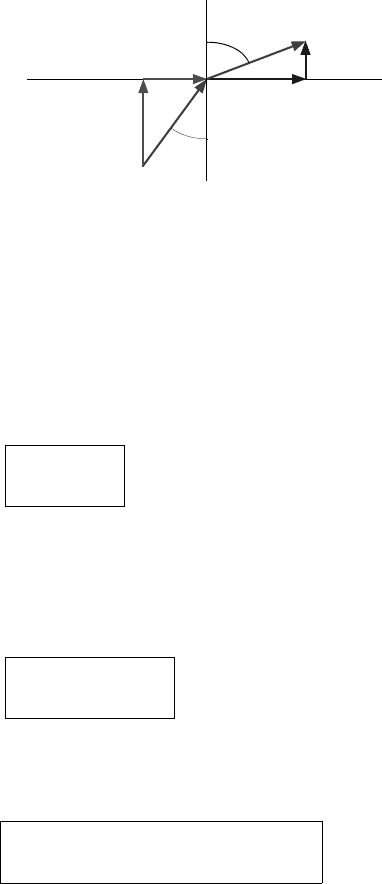
Putting the two together yields the law of refraction for g and E lines (Fig. 4.5):
or
.
(4.30)
On the other hand, eq. (2.120) with a surface charge on the boundary between the
two media 1 and 2, and letting gives
.
(4.31)
The two eqs eq. (4.30) and eq. (4.31) are compatible only, if
that is, if
(4.32)
This is a rather peculiar result. It says that a stationary condition without
surface charges on the boundary, can only occur if both relaxation times are
identical. Conversely, if , then the stationary condition is reached only after
reaches the value mandated by eq. (4.32) (if it was initially different from that).
The time it takes to reach equilibrium depends on the geometry of the set-up and
the quantities , and . The law of refraction (4.30) does not apply before
E
2t
E
1t
=
Fig. 4.5
E
2n
E
1n
α
2
E
2t
α
1
E
1t
2
1
α
1
tan
α
2
tan
--------------
E
1t
E
1n
---------
E
2t
E
2n
---------
---------
E
2n
E
1n
---------==
α
1
tan
α
2
tan
--------------
κ
1
κ
2
-----
=
dτ
ds
----- 0=
α
1
tan
α
2
tan
--------------
ε
1
ε
2
-----
σ
ε
2
E
1n
--------------+=
κ
1
κ
2
-----
ε
1
ε
2
-----
σ
ε
2
E
1n
--------------
+=
σε
2
E
1n
κ
1
κ
2
-----
ε
1
ε
2
-----
–
ε
2
κ
1
-----
g
1n
κ
1
κ
2
-----
ε
1
ε
2
-----
–
==
σ g
1n
ε
2
κ
2
-----
ε
1
κ
1
-----
–
g
1n
t
r2
t
r1
–() ==
t
r1
t
r2
≠
σ
ε
1
ε
2
κ
1
,, κ
2
4.3 Boundary Conditions 239
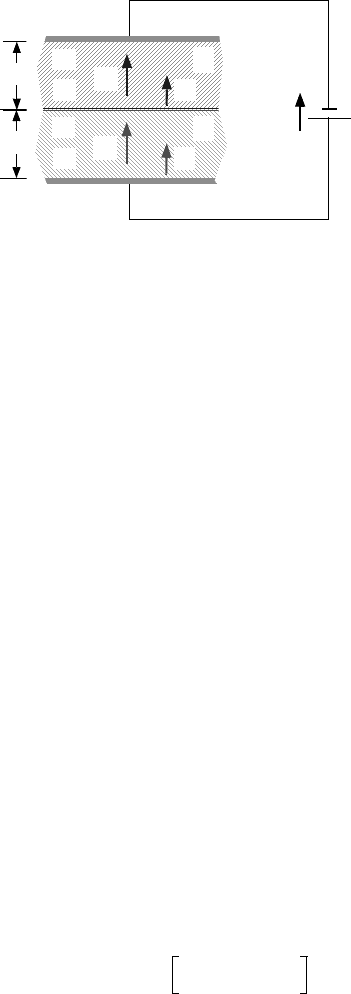
the equilibrium is reached. During the transition, eq. (4.31) and the actual values of
have to be used. As an illustrative example, consider that at , a voltage is
abruptly applied to a layered resistor, extending to infinity (Fig. 4.6). For this
voltage is constant. The initial surface charge shall be The following
three formulas apply:
(4.33)
(4.34)
.(4.35)
The first two equations yield and
.
(4.36)
Substituting this in eq. (4.35) results in the differential equation
,
(4.37)
where
,
(4.38)
with the solution
.
(4.39)
σ t 0=
Fig. 4.6
b
V
2
E
2
g
2
κ
2
ε
2
a
1
E
1
g
1
κ
1
ε
1
σ t()
t 0≥
σ 0() 0=
aE
1
t() bE
2
t()+ V=
ε
1
E
1
t()– ε
2
E
2
t()+ σ t()=
κ
1
E
1
t()– κ
2
E
2
t()
∂σ t()
∂t
-------------++ 0=
E
1
t() E
2
t()
E
1
t()
Vε
2
bσ t()–
aε
2
bε
1
+
-----------------------------=
E
2
t()
Vε
1
aσ t()+
aε
2
bε
1
+
-----------------------------=
∂σ t()
∂t
-------------
σ t()
t
12
----------+ V
ε
2
κ
1
ε
1
κ
2
–
aε
2
bε
1
+
-----------------------------
=
t
12
aε
2
bε
1
+
aκ
2
bκ
1
+
------------------------=
σ t() V
ε
2
κ
1
ε
1
κ
2
–
aκ
2
bκ
1
+
-----------------------------
1
t
t
12
------
–
exp–=
240 The Stationary Current Density Field
After a very long time, this becomes
.
By (4.36), the related electric fields are
,
(4.40)
and the related current density is
(4.41)
and
(4.42)
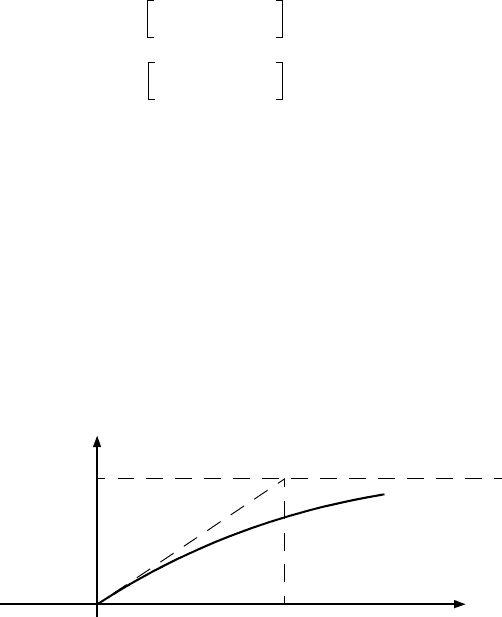
which is illustrated in Fig. 4.7.
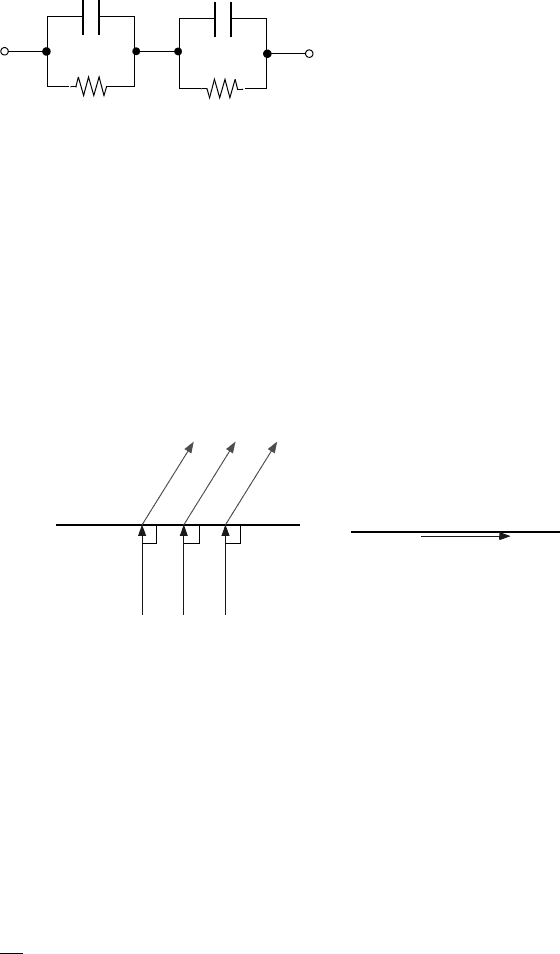
The stationary state described by eqs. (4.27), (4.30), and (4.32), is reached only
after the typical time when the relaxation process has subsided. A circuit of
capacitors and resistors as shown in Fig. 4.8 allows one to simulate this transition.
If A is the cross sectional area (assumed to be very large) between the layered
resistors (or layered capacitor) of Fig. 4.6, then one can write
.
(4.43)
σ
∞
V
ε
2
κ
1
ε
1
κ
2
–
aκ
2
bκ
1
+
-----------------------------
=
E
1∞
V
κ
2
aκ
2
bκ
1
+
------------------------
=
E
2∞
V
κ
1
aκ
2
bκ
1
+
------------------------
=
g
∞
g
1∞
g
2∞
V
κ
1
κ
2
aκ
2
bκ
1
+
------------------------
===
σ t() g
∞
ε
2
κ
2
-----
ε
1
κ
1
-----–
1
t
t
12
------
–
exp–=
g
∞
t
r2
t
r1
–()1
t
t
12
------
–
exp– .=
Fig. 4.7
σ
∞
g
∞
t
r2
t
r1
–()=
t
12
σ t()
t
t
12
C
1
ε
1
A
a
---------
;= C
2
ε
2
A
b
---------=
R
1
a
κ
1
A
---------
;= R
2
b
κ
2
A
---------=
4.3 Boundary Conditions 241
Calculating the circuit of Fig. 4.8 leads to the same results as the field-theoretical
derivation. Without going into the details, let it be noted that the relaxation time
results in the expression
.
(4.44)
which is again eq. (4.38).
An important special case of the law of refraction (4.30) results from
,
which occurs when while remains finite. This forces and
the g-lines become perpendicular to the surface (Fig. 4.9). Conversely, if
then the g-lines become parallel to the boundary (Fig. 4.10). Thus, the boundary to
a conductor with infinite conductivity is an equipotential surface, i.e.,
(4.45)
Conversely, the boundary towards an insulator is characterized by
.
(4.46)
Fig. 4.8
C
1
C
2
R
1
R
2
t
12
C
1
C
2
+
1
R
1
------
1
R
2
------+
-------------------
ε
1
A
a
---------
ε
2
A
b
---------+
κ
1
A
a
---------
κ
2
A
b
---------+
--------------------------
ε
1
b ε
2
a+
κ
1
b κ
2
a+
------------------------== =
Fig. 4.10
g
1
κ
1
finite
κ
2
0=
Fig. 4.9
g
1
g
2
κ
1
finite
κ
2
∞→
κ
1
κ
2
-----
0→
κ
2
∞→κ
1
α
1
tan 0=
κ
2
0=
ϕ const.=
n∂
∂ϕ
0=

242 The Stationary Current Density Field
4.4 The formal analogy between D and g
We have learned that
Furthermore
One concludes that there is complete formal analogy between electrostatic fields D,
on one hand, and the stationary current density fields g, on the other hand. This is
an important observation because it allows to apply most of the results from
Chapters 2 and 3 to current density fields. This is particularly true for the formal
methods developed in Chapter 3, which may now be directly reused to solve
boundary value problems of current density fields by separation or conformal
mapping. Based on eqs. (4.45) and (4.46), there is a twofold application of these
results. First, we obtain a Dirichlet problem when conductors are confined by ideal
conductors. Second, for conductors that are terminated by ideal non-conductors
(insulators), we obtain a Neumann problem. Of course, a combination of the two
gives a mixed boundary value problem.
.
In the charge-free space In the stationary case
therefore in a uniform space we have
.
The normal components at the boundary are then
,
while because of , the tangential components are
.
This results in the law of refraction
.
E ϕ∇–=
D εE=
D εϕ∇–=
g κE=
g κϕ .∇–=
D∇• 0= g∇• 0=
∇
2
ϕ 0=
D
2n
D
1n
= g
2n
g
1n
=
E
2t
E
1t
=
D
2t
ε
2
--------
D
1t
ε
1
--------
=
g
2t
κ
2
-------
g
1t
κ
1
-------
=
α
1
tan
α
2
tan
--------------
ε
1
ε
2
-----=
α
1
tan
α
2
tan
--------------
κ
1
κ
2
-----=
4.5 Some Current Density Fields 243
4.5 Some Current Density Fields
4.5.1 Point-like Current Source in Space
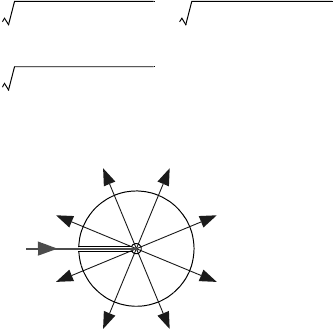
A current density emerging from a point-like source inside an infinitely large,
uniform medium is illustrated in Fig. 4.11.
For symmetry reasons it must be
that is
(4.47)
and
.
(4.48)
All other components of g and E vanish. Of course, the assumption of spherical
symmetry is an idealization because of the current supply. For the potential, we get
.
(4.49)
The image method allows to analyze the case of a point-like source in a volume
that consists of two half spaces, where each of which has a different conductivity
(Fig. 4.12).
We might try to solve this for region 1 by considering the (real) source I and the
image source I’ in region 2, while the solution for region 2 uses the image source
I’’ located in region 1. One writes:
,
.
Fig. 4.11
g
I
κ
gAd•
A
∫
4πr
2
g
r
I==
g
r
I
4πr
2
------------=
E
r
g
r
κ
-----
I
4πκr
2
---------------==
ϕ r()
I
4πκr
------------=
ϕ
1
1
4πκ
1
------------
I
xa–()
2
y
2
z
2
++
----------------------------------------------
I '
xa+()
2
y
2
z
2
++
-----------------------------------------------+
=
ϕ
2
1
4πκ
2
------------
I ''
xa–()
2
y
2
z
2
++
----------------------------------------------
=