
Lehner G. Electromagnetic Field Theory for Engineers and Physicists
Подождите немного. Документ загружается.

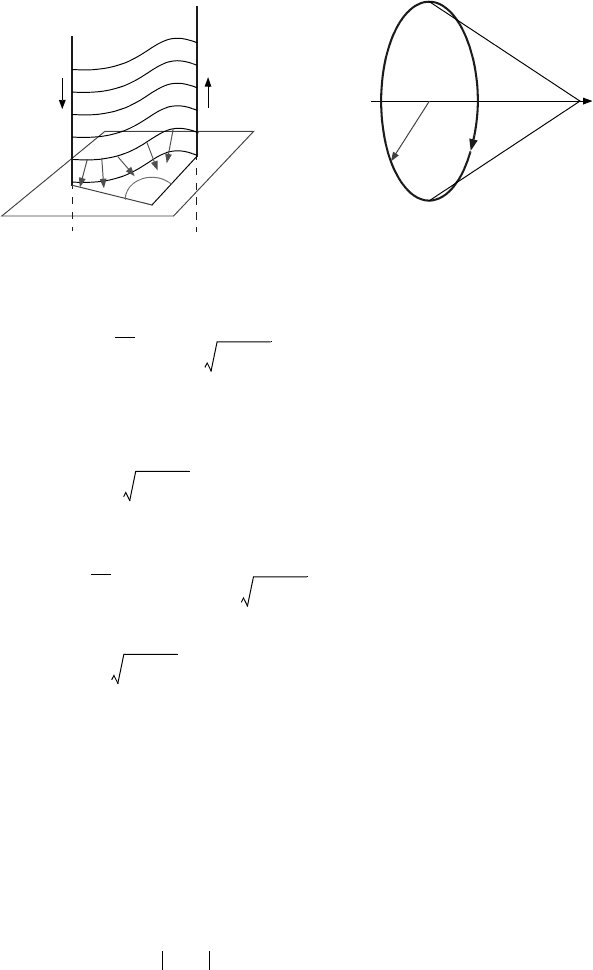
284 Basics of Magnetostatics
and the field on the axis becomes
.
(5.61)
Of course, this result can also be derived from (5.48). The relations for r and k
close to the axis are and . Therefore
and
.
as before. In particular, the field at the center of the circle , is
.
(5.62)
5.2.6 The Field of a Conducting Loop in its Plane
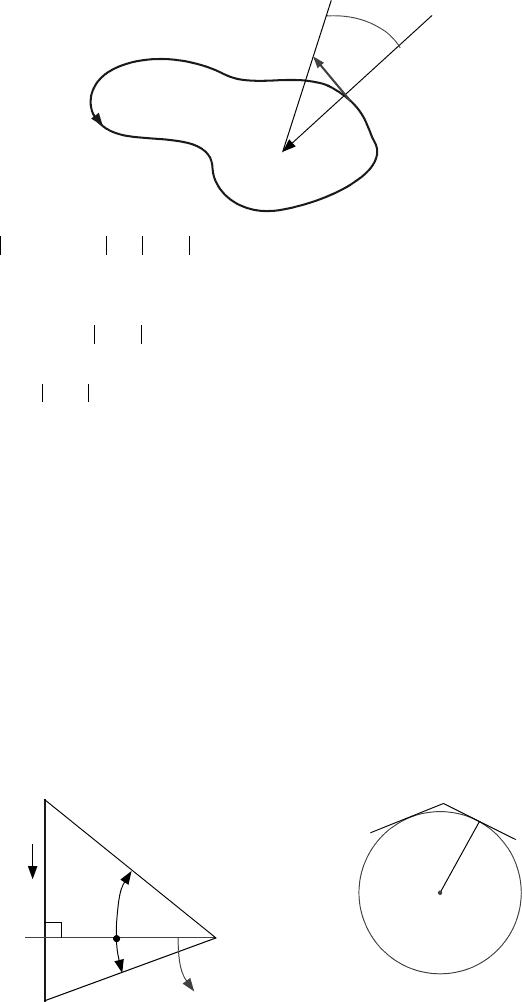
The magnetic field in the plane of a plane conducting loop is a simple but useful
application of Biot-Savart’s law (Fig. 5.25). From
it follows that B is perpendicular to the plane of the loop (= paper plane in
Fig. 5.25). From a magnitude perspective, we have
Fig. 5.24
z
r
0
I
Fig. 5.23
α
m
I
I
B
z
µ
0
z∂
∂ψ
–
µ
0
I
2
--------
r
0
2
r
0
2
z
2
+
3
-----------------------
==
A
ϕ
rr
0
2
« k
2
1«
A
ϕ
µ
0
Ir
0
2
4
--------------
r
r
0
2
z
2
+
--------------------
≈
B
z
1
r
---
r∂
∂
rA
ϕ
()
µ
0
Ir
0
2
4r
--------------
2r
r
0
2
z
2
+
3
-----------------------
==
µ
0
I
2
--------
r
0
2
r
0
2
z
2
+
3
-----------------------
=
r 0= z 0=
B
z
µ
0
I
2r
0
--------
=
B
µ
0
I
4π
--------
rr'–()ds'×
rr'–
3
------------------------------
∫
°
–=
5.2 Some Magnetic Fields 285
.
Therefore, the magnitude of B is
,
(5.63)
where
.
If, for example, the loop consists of pieces of straight wire that form a polygon,
then we need to add the contribution of each piece. When using
,
the individual sections yield the following contribution (Fig. 5.26).
Finally:
.
(5.64)
Fig. 5.25
I
rr'–
dα
ds
a
rr'–()ds'× rr'–
2
dα=
B
µ
0
I
4π
--------
dα
rr'–
---------------
∫
°
µ
0
I
4π
--------
dα
a
-------
∫
°
==
a rr'–=
a αcos a
s
=
B
µ
0
I
4π
--------
dα
a
-------
α
a
α
e
∫
µ
0
I
4π
--------
αdcos α
a
s
--------------------
α
a
α
e
∫
==
µ
0
I
4πa
s
------------
αdcos α
α
a
α
e
∫
µ
0
I
4πa
s
------------
αsin[]
α
a
α
e
== .
B
µ
0
I
4πa
s
------------
α
e
sin α
a
sin–[]=
Fig. 5.27
a
s
Fig. 5.26
α–
a
α
e
I
a
s
α

286 Basics of Magnetostatics
If the conductor is infinitely long, then
and in accord with our previous result
.
The field at the center of a regular n-polygon (n sides) with the inside radius is
.
For , this becomes
.
This is the same result as for a circle, which we already know: eq. (5.62) with
. It is also possible to write this result immediately:
.
5.3 Magnetization
Several times already, we came to the conclusion that based on our current
knowledge there are no “magnetic charges”, which is the reason why B is source-
free or solenoidal:
.
However, for convenience we will introduce the formal concept of fictitious
magnetic charges. The reason is that it will simplify certain problems.
Nevertheless, the physical source of static magnetic fields is always found in
currents, i.e., moving electric charges (disregarding the spin of particles). We have
already found that all such fields can be thought of as being created by
superposition of suitable dipole fields. The spin of elementary particles causes a
magnetic moment, which has no explanation in classical physics. Consequently, we
can say that all static magnetic fields are ultimately caused by magnetic dipoles.
Magnetic dipoles are also fundamental in connection with the question about
interaction between matter and magnetic fields. We will need to discuss this too. In
doing so, we will again find a formal, broad analogy between electric and magnetic
effects (see Sect. 5.5). First, we will deal with the field of a volume distribution of
magnetic dipoles. It is convenient to define the magnetization as
.
(5.65)
α
e
90°,= α
a
90°–=
B
µ
0
I
4πa
s
------------
2⋅
µ
0
I
2πa
s
------------==
a
s
Bn
µ
0
I
4πa
s
------------
2
π
n
---
sin
nµ
0
I
2πa
s
------------
π
n
---
sin==
n 1»
B
µ
0
I
2a
s
--------=
a
s
r
0
=
B
µ
0
I
4π
--------
dα
a
-------
∫
°
µ
0
I
4πr
0
-----------
dα
∫
°
µ
0
I
4πr
0
-----------
2π
µ
0
I
2r
0
--------== ==
B∇• 0=
M
τd
dm
=
5.3 Magnetization 287
This represents the magnetic analogue to the electrostatic polarization P. Based on
eq. (5.56), one concludes that a volume distribution of dipoles with the density
creates the vector potential
.
(5.66)
Written in a sightly different form gives
,
(5.67)
where the grad operator now operates on r’, which causes the sign change versus
(5.56). Then we use the vector theorem
,
which results in
.
The first of the two integrals can be further modified by applying the integral
theorem
,
(5.68)
which is a variant of Gauss’ theorem
.
and we obtain it from that by substituting
,
where the vector c depends on the location while d is location independent.
i.e., it holds for every vector d that
.
This proves (5.68). We obtain finally
.
(5.69)
This is an important result. Comparing (5.69) and (5.16) reveals that a volume
distribution of dipoles corresponds to a distribution of bound volume current
densities
(5.70)
Mr()
A r()
1
4π
------
Mr'() rr'–()×
rr'–
3
--------------------------------------
τ'd
V
∫
=
A r()
1
4π
------
Mr'() ∇
r'
1
rr'–
---------------
×τ'd
V
∫
=
∇ bϕ()×ϕ∇b×()b ϕ∇()×–=
A r()
1
4π
------
∇
r'
Mr'()
rr'–
---------------
×τ'd
V
∫
–
1
4π
------
∇
r'
Mr'()×
rr'–
----------------------------
τ'd
V
∫
+=
c∇×()τd
V
∫
c da×
∫
°
–=
b∇•()τd
V
∫
bda•
∫
°
=
bcd×=
cd×()∇• τd
V
∫
d ∇ c×()•τd
V
∫
c ∇ d×()•τd
V
∫
–=
d ∇ c×()τd
V
∫
• cd×()da• .
∫
°
==
cd×()∇• τd
V
∫
dcda×()•
∫
°
– dcda×
∫
°
•–==
d ∇ c×()τd
V
∫
• dcda×
∫
°
•–=
Ar()
1
4π
------
∇
r'
Mr'()×
rr'–
----------------------------
τ'd
V
∫
1
4π
------
Mr'() da'×
rr'–
----------------------------
∫
°
+=
g
mag
r()
1
µ
0
------
∇ Mr()× =

288 Basics of Magnetostatics
and an additional distribution of bound surface current densities
.
(5.71)
The bound volume current density , corresponding to the
magnetization M is called magnetization current density. We refer to a surface
current density when currents of infinite current density flow in a surface, where
the current per unit length remains finite. This results plausibly form the limit
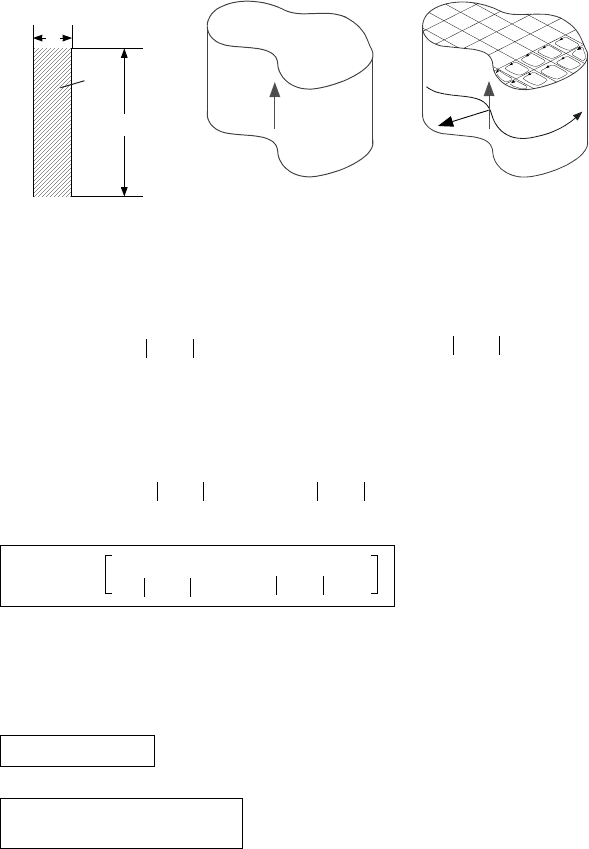
illustrated in Fig. 5.28. Consider a current of density g flowing perpendicular to the
paper plane within the thin layer of width d. In a section of length l, one finds the
current
or per unit length
.
If we let while , but leaving finite, then we obtain a surface
current with the surface current density
, .
These formal results are justified as follows. Fig. 5.29 shows a “magnetized”
volume, i.e., a volume filled with dipoles. Let M be perpendicular to the upper and
lower surface. If M is constant in the entire volume, then all internal currents
cancel (Fig. 5.29b). All that remains is a surface current which has the direction of
the cross product (vector product) of M and n. If M is not uniform, then there are
also bound volume currents inside the volume. These are connected to the
circulation of M ().
A simple example is a circular cylinder of infinite length which is filled with
uniform dipoles whose axes are oriented along the cylinder axis. There shall be no
free currents inside. However, its surface shall carry surface currents. These are
purely azimuthal. This problem is identical to the infinitely long coil of section
5.2.3, Fig. 5.12. With the magnetization M, we get for the azimuthal component of
the surface current density:
and the field inside is
or
.
k
mag
1
µ
0
------
Mr()
da
da
------
×
1
µ
0
------
Mr() n× ==
1 µ
0
⁄()∇M×
gld
gd
g ∞→ d 0→ gd
kgd= k[]
A
m
----=
∇ M×
k
ϕmag
M
µ
0
------=
H
zi
k
ϕmag
M
µ
0
------==
B
zi
µ
0
H
zi
M==
5.3 Magnetization 289
We can also calculate the scalar potential of a volume distribution of dipoles. By
eq. (5.55) we have
,
Because of the vector theorem
,
this becomes
,
and finally with Gauss’ theorem
.
(5.72)
From a formal perspective, this equation is entirely analogous to eq. (2.65).
Therefore, it may be interpreted as being the potential of magnetic volume and
surface charges. Of course, these are merely fictitious and only have a formal
significance. In analogy to eqs. (2.66) and (2.67), one can define the (bound)
magnetic volume charge density
(5.73)
and the (bound) magnetic surface charge density
.
(5.74)
From a formal perspective and in total analogy to electrostatics, the entire
magnetostatics can now be built on these concepts. We may now define magnetic
charges
and even write Coulomb’s law for these
Fig. 5.29
M
a)
M
k
n
b)
Fig. 5.28
g
d
l
ψ
1
4πµ
0
-------------
Mr'() rr'–()•
rr'–
3
-------------------------------------
τ'd
V
∫
1
4πµ
0
-------------
Mr'() ∇
r'
1
rr'–
---------------
•τ'd
V
∫
==
bϕ()∇• b ϕ∇()•ϕb∇•()+=
ψ
1
4πµ
0
-------------
∇
r'
Mr'()
rr'–
---------------
•τ'd
V
∫
1
4πµ
0
-------------
1
rr'–
---------------
∇
r'
Mr'()•τ'd
V
∫
–=
ψ
1
4πµ
0
-------------
Mr'() da'•
rr'–
---------------------------
∫
°
∇
r'
Mr'()•
rr'–
---------------------------
τ'd
V
∫
– =
ρ
mag
M ∇•–=
σ
mag
M
da
da
------
• Mn• ==
Q
mag
ρ
mag
τd
V
∫
=
290 Basics of Magnetostatics
,
or show that the force in the magnetic field is
,
and so forth. While eqs. (5.72) through (5.74) are valuable tools to calculate fields,
the other analogues, for example Coulombs law, are not specifically relevant, not
even from a formal perspective, thus, shall not be discussed any further.
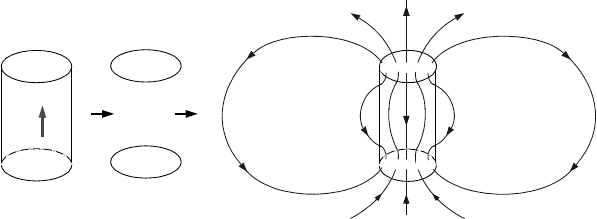
As an example, consider a cylinder of finite length, uniformly filled with
dipoles. It has no (bound) magnetic volume charges, however, there are (bound)
magnetic surface charges at the top and bottom. They create an H field which
compares to the electric field of two uniformly charged disks (Fig. 5.30). It only
describes the field outside of the cylinder. We will need to discuss the inside field
later.
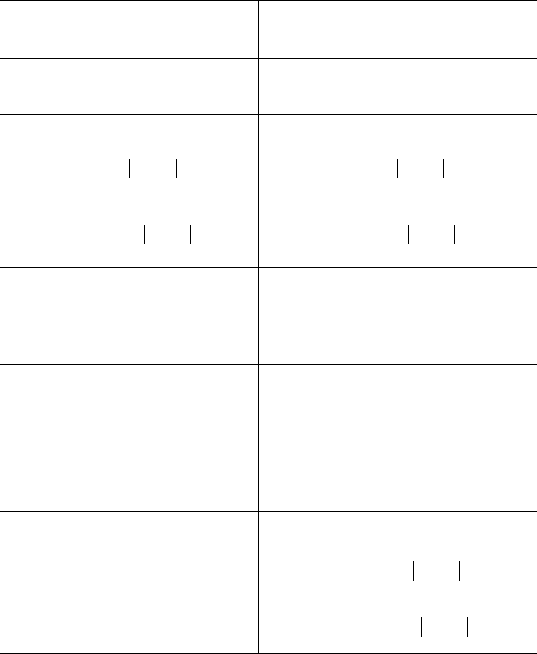
In concluding this section, we summarize the most important results, side by
side with the corresponding results from electrostatics in Table 5.1.
To minimize misunderstandings, the reader is cautioned that in literature
these terms and quantities are not standardized. Frequently, the magnetic dipole
moment in eq. (5.52) is defined without the factor . This also impacts the
magnetization if we consider it to be the volume density of magnetic dipoles, i.e. it
also lacks the factor . The quantity that is multiplied by is then called
magnetic polarization (it corresponds to the magnetization in this text). There is no
need to distinguish between magnetic polarization and magnetization. This
distinction relates to the historically understandable, nevertheless needless,
distinction between an “elementary current theory” and a “bulk-magnetization
theory” of magnetism. The former rests on eqs. (5.69) through (5.71), while the
latter is based on eqs. (5.72) through (5.74). For us, these are not two different
theories on magnetism, but just two equivalent formal consequences of the same
theory, or the same thereby described physical reality. It is a question about the
equivalence of eddy ring and a dipole layer, which we have met several times (for
instance, in Sect. 5.2.5, where we thought of the field of a current loop as being the
field of a dipole layer). This equivalence is what frequently allows to treat
F
Q
mag 1
Q
mag2
4πr
2
µ
0
----------------------------------=
F Q
mag
H=
+ + + +
+ + +
Fig. 5.30
H
+ + + + +
- - - - -
+ + + + +
M
+ + + +
+ + +
- - - -
- - -
- - - - -
- - - -
- - -
µ
0
µ
0
µ
0
5.4 Forces on Dipoles in Magnetic Fields 291
magnetostatic problems as if they were electrostatic ones and vice versa (notice
that this also allows to treat an electric dipole layer as if it were a current loop
where currents of fictitious magnetic charges flow).
5.4 Forces on Dipoles in Magnetic Fields
A moving charge in a magnetic field experiences the force
.
If we observe the motion of a charge density distribution , then the force per
unit volume, also called force density, is
.
electrostatic magnetostatic
Table 5.1
PM
ϕ
1
4πε
0
------------
Pr'() n'•
rr'–
----------------------
a'd
∫
°
=
1
4πε
0
------------
∇
r'
Pr'()•
rr'–
-------------------------
τ'd
∫
–
ψ
1
4πµ
0
-------------
Mr'() n'•
rr'–
------------------------
da'
∫
°
=
1
4πµ
0
-------------
∇
r'
Mr'()•
rr'–
---------------------------
τ'd
V
∫
–
ρ
b
P∇•–=
σ
b
P n•=
ρ
mag
M∇•–=
σ
mag
Mn•=
g
mag
1
µ
0
------
∇ Mr()×=
k
mag
1
µ
0
------
Mr() n×=
Ar()
1
4π
------
∇
r'
Mr'()×
rr'–
----------------------------
τ'd
V
∫
=
+
1
4π
------
Mr'() da'×
rr'–
----------------------------
∫
°
F QvB×=
ρ r()
f ρvB×=
292 Basics of Magnetostatics
Since
is just the current density, we write
.
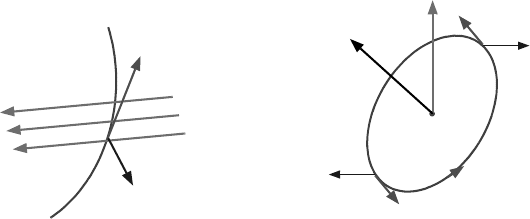
Integrating this equation over the cross section of a current carrying wire
gives the force per unit length at a location of the wire
,
where I is a vector quantity pointing in the direction of a wire element, having the
magnitude of the total current I (Fig. 5.31). First, consider a dipole, i.e., a current
loop within a uniform magnetic field (Fig. 5.32). Clearly, all forces cancel – there
is no net force. What remains is a force pair with a torque, trying to orient m into
the direction of B. It shall be noted without proof that this torque is
.
(5.75)
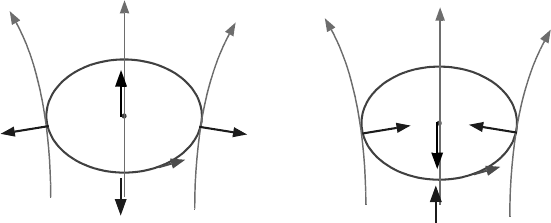
If the magnetic field is not uniform, then there is a net force besides the torque.
Fig. 5.33 illustrates that the net force points in the direction where the field
increases when m is oriented parallel to B. If m is oriented anti-parallel to B, then
the net force points in the direction of the decreasing field (Fig. 5.34). Again
without proof, it shall be noted that the force on a dipole m in a field B where
is
.
(5.76)
Fig. 5.32
B
I
F
F
m
I
I
Fig. 5.31
B
I
F
ρvg=
fgB×=
Fr()
l
----------- Ir() Br()×=
1
µ
0
------
mB×
B∇× 0=
F
net
m ∇•()B
µ
0
------------------------
1
µ
0
------
mB•()∇==
5.5 B and H in Magnetizable Media 293
5.5 B and H in Magnetizable Media
So far, we discussed only fields in vacuum and how they are created by given
currents or dipole distributions. If one brings any matter into an “external”
magnetic field or applies a magnetic field to a space filled with matter, then this
matter becomes “magnetized” and it thereby influences the net magnetic field.
There are a number of concurrent effects, which results in a rather complicated
overall picture. In the context of a phenomenological and macroscopic theory,
these issues can only be touched briefly.
All matter consists of atoms, molecules, etc. and the shell electrons move
around the nucleus according to certain laws (which can only be understood
quantum mechanically). These moving charges cause currents and magnetic
moments. Depending on the internal structure of a particular material, these
magnetic moments may cancel each other or not, i.e., a material might exhibit
magnetic moments even without an applied field.
It shall be added, that besides the just discussed magnetic moments caused by
circulating currents, there are other, elementary magnetic dipole moments which
can only be explained in a quantum mechanical context (that is, they do not
correspond to circulating currents, at least as far as we know today), just as the spin
of elementary particles (electrons in particular), which also can only be explained
quantum mechanically.
First, we consider a material that has no net magnetic dipole moment as long
as there is no applied field. This kind of material is called diamagnetic. If we now
apply a magnetic field that increases over time, then by the law of induction (see
Sect. 1.11), a voltage is induced, which causes currents and thereby dipole
moments. We then say that the medium is magnetized. Similarly as for the electric
polarization (Sect. 2.8), in a first approximation we can assume a linear
relationship between the magnetic field and the thereby caused magnetization. A
consequence of the law of induction is that the induced B field weakens the applied
field (Fig. 5.35). Formally, this is a consequence of the negative sign in the law of
Fig. 5.34
B
I
F
m
F
B
B
F
net
Fig. 5.33
B
I
F
m
F
B
B
F
net