
Lehner G. Electromagnetic Field Theory for Engineers and Physicists
Подождите немного. Документ загружается.

264 Basics of Magnetostatics
If one defines the scalar potential
,
(5.24)
then is determined but for whole number multiples of I. However, one can make
unique by introducing a cut in the space, so that a simply connected region
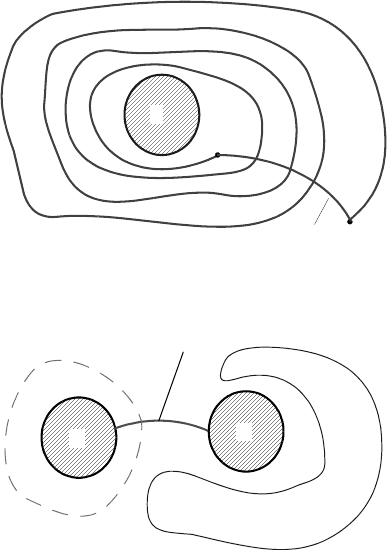
emerges (Fig. 5.5). This cut represents a separating surface through which no
integration path may go. By Ampere’s law, along all permissible integration paths,
this gives
.
This makes unique. The scalar potential is important because it allows one to
reduce many magnetostatic problems to problems whose solution is already known
from electrostatics. The formal analogue between magnetostatics and electrostatics
will be highlighted even more below. Specifically, Laplace’s equation now applies:
.
or
Fig. 5.4
A
B
C
0
C
n
I
ψ B() ψA() H ds•
A
B
∫
–=
ψ
ψ
Fig. 5.5
-I
+I
separating surface
permitted path
forbidden path
H ds•
∫
°
0=
ψ
B∇• µ
0
H∇• µ
0
ψ∇()∇•==
5.2 Some Magnetic Fields 265
.
(5.25)
Therefore, the formal methods (separation, conformal mapping) which we have
discussed in detail in conjunction with electrostatics, are also of great consequence
in magnetostatics.
5.2 Some Magnetic Fields
5.2.1 The Field of a Straight, Concentrated Current
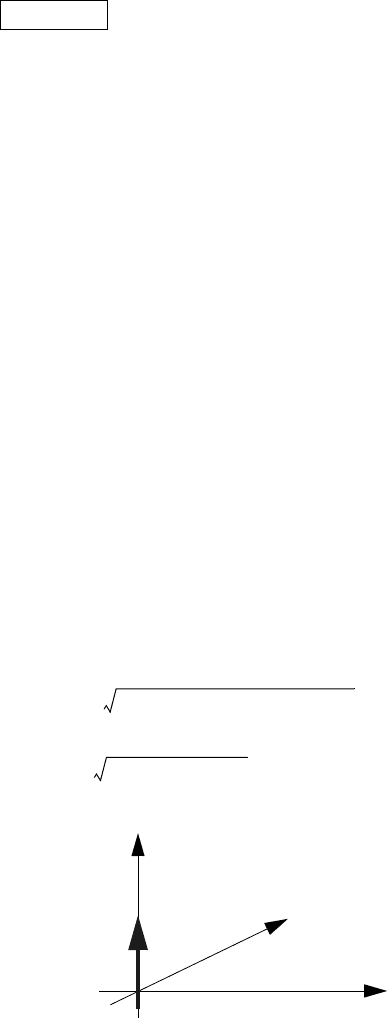
Consider a current flowing along the z-axis of a Cartesian coordinate system, as
shown in Fig. 5.6. Currents in magnetostatics are always source free. In this
section, this is initially not the case. However, intuitively one can imagine the
current to somehow form a closed loop at infinity, which would not provide any
contributions to the magnetic field. To illustrate the methodology of the previous
section, we will calculate the related magnetic field in three different ways: using
the vector potential, by Biot-Savart’s law, and by Ampere’s law. The current
density is
(5.26)
First, we start with the vector potential. With (5.15) follows
and
∇
2
ψ 0 =
Fig. 5.6
I
z
y
x
g
g
x
0=
g
y
0=
g
z
Iδ x()δy() .=
=
A
x
A
y
0==
A
z
µ
0
I
4π
--------
δ x'()δy'()x'dy'dz'd
xx'–()
2
yy'–()
2
zz'–()
2
++
----------------------------------------------------------------------------
V
∫
=
µ
0
I
4π
--------
z'd
x
2
y
2
zz'–()
2
++
-----------------------------------------------
.
∫
=
266 Basics of Magnetostatics
The current along the z-axis could, for instance, be part of a circuit that includes the
z-axis from to . However, the current can as well flow from to
. In any case, one needs to calculate the integral
.
Substituting gives
Taking the limit , gives
.
Now, for arbitrary values of and , one obtains for the vector potential
.
Except for a very large, yet insignificant constant, the vector potential for the case
of the “infinitely long current” is
.
Finally one obtains for the vector potential
za= zb= ∞–
+∞
z'd
x
2
y
2
zz'–()
2
++
-----------------------------------------------
a
b
∫
zz'– ζ=
ζd
x
2
y
2
ζ
2
++
---------------------------------
za–
z
b
–
∫
– ζ x
2
y
2
ζ
2
+++()ln
za–
zb–
–=
za– x
2
y
2
za–()
2
+++
zb– x
2
y
2
zb–()
2
+++
----------------------------------------------------------------
.ln=
a ∞–→ b +∞→
za– x
2
y
2
za–()
2
+++
zb– x
2
y
2
zb–()
2
+++
----------------------------------------------------------------ln
a ∞–→
b + ∞→
lim
a– a 1
x
2
y
2
+
a
2
-----------------++
b– b 1
x
2
y
2
+
b
2
-----------------++
---------------------------------------------------ln
a ∞–→
b + ∞→
lim=
a– a 1
x
2
y
2
+
a
2
-----------------+–
b– b 1
x
2
y
2
+
b
2
-----------------++
------------------------------------------------ln
a ∞–→
b + ∞→
lim=
2a–
b– b
x
2
y
2
+
2b
-----------------++
----------------------------------------ln
a ∞–→
b + ∞→
lim=
4 a–()b
x
2
y
2
+
-----------------ln=
x
0
y
0
A
z
µ
0
I
4π
--------
4 a–()b
x
2
y
2
+
-----------------ln
µ
0
I
4π
--------
4 a–()b
x
0
2
y
0
2
+
-----------------
ln
µ
0
I
4π
--------
x
2
y
2
+
x
0
2
y
0
2
+
-----------------
ln–==
A
z
µ
0
I
4π
--------
x
2
y
2
+
x
0
2
y
0
2
+
-----------------
ln–=
5.2 Some Magnetic Fields 267
,
(5.27)
and for the magnetic field:
.
(5.28)
The second method of solution is by means of the Biot-Savart law eq. (5.17). Here
one starts with
.
The magnetic field is
Finally, as before one obtains
.
In a similar way, calculating leads to the previously obtained result.
One may also use cylindrical coordinates to calculate the field components
where
A 00
µ
0
I
4π
--------
x
2
y
2
+
x
0
2
y
0
2
+
-----------------
ln–,,〈〉=
B
x
y∂
∂A
z
z∂
∂A
y
–
y∂
∂A
z
µ
0
I
2π
--------
y
x
2
y
2
+
-----------------
–===
B
y
z∂
∂A
x
x∂
∂A
z
–
x∂
∂A
z
–+
µ
0
I
2π
--------
x
x
2
y
2
+
-----------------
===
B
z
x∂
∂A
y
y∂
∂A
x
–0==
gr'() rr'–()×
e
x
e
y
e
z
00Iδ x()δy()
xx'– yy'– zz'–
=
yy'–()– xx'–()0,,〈〉Iδ x()δy()⋅=
B
x
µ
0
I
4π
--------–
yy'–()δx'()δy'()x'dy'dz'd
xx'–()
2
yy'–()
2
zz'–()
2
++
3
------------------------------------------------------------------------------
V
∫
=
µ
0
Iy
4π
-----------–
z'd
x
2
y
2
zz'–()
2
++
3
-------------------------------------------------
∞–
+∞
∫
µ
0
Iy
4π
-----------–
ζd
x
2
y
2
ζ
2
++
3
------------------------------------
∞–
+∞
∫
==
µ
0
Iy
4π
-----------–
ζ
x
2
y
2
+()x
2
y
2
ζ
2
++
-------------------------------------------------------
∞–
+∞
µ
0
Iy
4π
-----------
2
x
2
y
2
+
-----------------
.–==
B
x
µ
0
I
2π
--------
y
x
2
y
2
+
-----------------
–=
B
y
B
r
B
x
ϕcos B
y
ϕsin+=
B
ϕ
B
x
ϕsin– B
y
ϕcos+=
ϕcos
x
r
--
x
x
2
y
2
+
---------------------==
268 Basics of Magnetostatics
and
Here, the components of the magnetic field are:
.
(5.29)
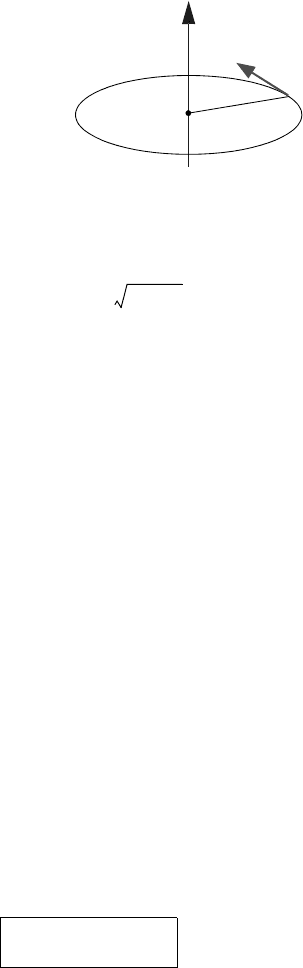
Thus, the magnetic field B has only an azimuthal component, which has already
been used in Chapter 1. Thirdly, one can now calculate the field for this problem
again using Ampere’s law. We already know based on the rotational symmetry, that
there is only an azimuthal component (Fig. 5.7).
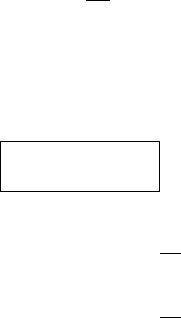
Then, can not depend on , which means that it has to be:
i.e.,
and as already proven
.
Using
and (5.24), one may describe the field by means of a scalar potential
.
(5.30)
ϕsin
y
r
--
y
x
2
y
2
+
---------------------==
B
r
0=
B
ϕ
µ
0
I
2πr
---------=
B
z
0=
Fig. 5.7
I
B
ϕ
r
B
ϕ
ϕ
µ
0
H ds•
∫
°
B ds•
∫
°
µ
0
I==
B
ϕ
2πr µ
0
I=
B
ϕ
µ
0
I
2πr
---------=
H
ϕ
I
2πr
---------=
ψ
I
2π
------
ϕϕ
0
–() –=
5.2 Some Magnetic Fields 269
This shows that the half-planes that originate at the z-axis and for which
are equipotential surfaces. Conversely, from these equipotentials we
find
.
If one chooses a Cartesian coordinate system, such that
,
then
,
(5.31)
from which one finds the magnetic field:
One might also write in the form
.
(5.32)
Notice that this tells us that is constant on concentric circles ( )
surrounding the current. These circles also represent the field lines. They are
perpendicular to the equipotential surfaces ( ). This allows one to view
as the flux function. The lines and the lines generate
an orthogonal grid, parallel to the x-y plane. This is no coincidence, but a property
of all “plane fields” and justifies the introduction of the complex potential, as well
as the use of conformal mapping, similarly as we did for the electrostatic case. If
one defines
,
(5.33)
then for the current case, one obtains
.
(5.34)
This yields
ϕ constant=
H
ϕ
1
r
---
ϕ∂
∂ψ
–
I
2πr
---------==
ϕϕ
0
–()tan
y
x
--=
ψ
I
2π
------
y
x
--
atan–=
B
x
µ
0
H
x
µ
0
x∂
∂ψ
–
µ
0
I
2π
--------
y
x
2
y
2
+
-----------------
–== =
B
y
µ
0
H
y
µ
0
y∂
∂ψ
–+
µ
0
I
2π
--------
x
x
2
y
2
+
-----------------
== =
B
z
0 .=
A
z
A
z
µ
0
I
4π
--------
r
r
0
----
2
ln–
µ
0
I
2π
--------
r
r
0
----
ln–==
A
z
r const.=
ψ const.=
A
z
A
z
const.= ψ const.=
wz()
A
z
µ
0
------ iψ+=
wz()
I
2π
------
z
z
0
----
ln–=
270 Basics of Magnetostatics
Conversely, we could have introduced as the real and as the imaginary
part of the complex potential.
The analogy between the complex potential (5.34) and the electric line
charges (Sect. 3.12, Example 1) is obvious. However, notice that equipotential
surfaces and field lines exchange their roles.
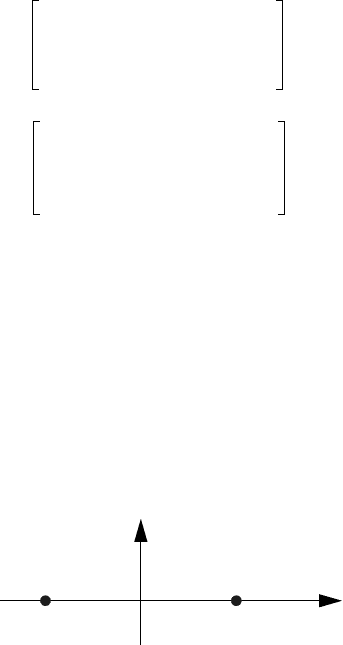
Of course, the fields of multiple currents can be superposed. For instance,
consider the task to find the field of a current parallel to the z-axis, when
passes through the x-y plane at , and a second current , also
parallel to the z-axis, when passes through the x-y plane at ,
(see Fig. 5.8). Then, by (5.28)
.
As before in electrostatics, it is useful to find the stagnation points of the field, i.e.,
the points where
.
This scenario is independent of z. There is not only a stagnation point, but a whole
“stagnation line” which consists entirely of stagnation points. Its coordinates are
wz()
I
2π
------
riϕ()exp
r
0
iϕ
0
()exp
----------------------------ln–
I
2π
------
r
r
0
----ln–
I
2π
------
i ϕϕ
0
–()[]expln–==
I
2π
------
r
r
0
----ln– i
I
2π
------
ϕϕ
0
–() .–=
ψ A
z
µ
0
⁄
I
1
I
1
x +d 2⁄= y 0= I
2
I
2
xd2⁄–= y 0=
Fig. 5.8
y
x
d
2
---–
+
d
2
---
I
2
I
1
B
x
µ
0
2π
------–
I
1
y
x
d
2
---–
2
y
2
+
-------------------------------
I
2
y
x
d
2
---+
2
y
2
+
--------------------------------+=
B
y
+
µ
0
2π
------
I
1
x
d
2
---–
x
d
2
---–
2
y
2
+
-------------------------------
I
2
x
d
2
---+
x
d
2
---+
2
y
2
+
--------------------------------+=
B
x
B
y
0==
x
s
d
2
---
I
2
I
1
–
I
2
I
1
+
---------------
=
y
s
0 .=
5.2 Some Magnetic Fields 271
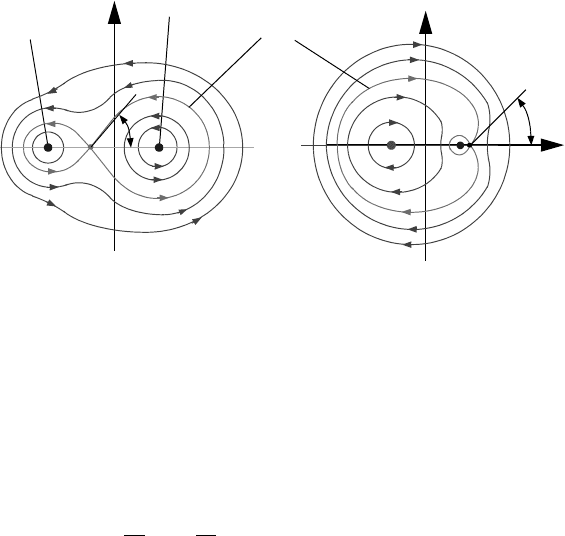
If the currents have the same sign, then the stagnation point lies between the
currents. For currents of opposite sign, it lies to the right or left of both currents
(Fig. 5.9). The field is identical to that of two line charges, where again the field
lines and the equipotentials exchange their role. The magnetic field lines in Fig. 5.9
correspond to the electric equipotentials of the line charges. is constant along
the magnetic field lines, i.e., may be regarded as flux function:
.
This produces the complex potential
.
This result is the same as we would expect from superposing two potentials of the
type (5.34), after shifting their center by , .
5.2.2 Field of a Rotationally Symmetric Current Distribution in Cylin-
drical Conductors
Consider a cylindrical conductor as shown in Fig. 5.10, with the current density
.
This produces a magnetic field that has only an azimuthal component which only
depends on r. With Ampere’s law one obtains (inside)
Fig. 5.9
separatrix
I
2
I
1
45°
I
2
I
1
45°
currents of same sign:
I
1
2I
2
=
currents of opposite sign:
I
2
3I
1
–=
A
z
A
z
B A
z
∇• B
x
x∂
∂A
z
B
y
y∂
∂A
z
+ B
x
B
y
–()B
y
B
x
+0== =
wz()
I
1
2π
------
zd2⁄–
z
0
------------------
ln–
I
2
2π
------
zd2⁄+
z
0
------------------
ln–0==
xd2⁄±= y 0=
g
z
g
z
r()=
rr
0
: µ
0
Ir()≤µ
0
g
z
r'()2πr' r'd
0
r
∫
=
2πrB
ϕ
r()=
272 Basics of Magnetostatics
(5.35)
and for the field outside
.
(5.36)
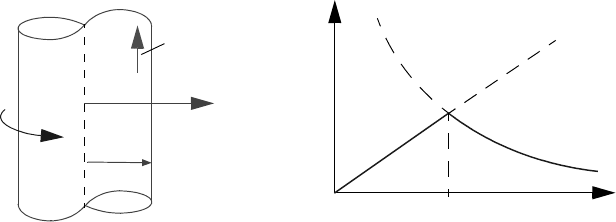
I(r) is the current flowing inside a cylinder of radius r. For a uniform current
density inside the conductor one gets
(5.37)
and for
.
(5.38)
The field inside the conductor increases linearly with the radius and it falls outside
as (see Fig. 5.11).
5.2.3 The Field of a simple Coil
The field of an infinitely long and ideal, densely wound coil (or solenoid) can
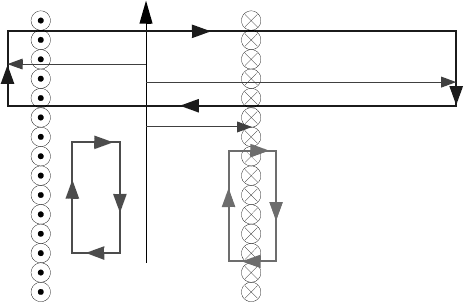
easily be calculated using Ampere’s law. Convince yourself that the field has to be
parallel to the coil’s axis and independent of both z and ϕ, i.e., only does not
vanish. The integral over the closed path of Fig. 5.12 is zero, i.e.,
.
The field outside the solenoid has to be constant, i.e., independent of the radius.
The same is true for the inside field when integrating along . The inside field
is independent of r. This requires that the outside field vanishes all
together. The reasons is that has to vanish for . Finally, integrating
along the closed loop gives.
B
ϕ
µ
0
r
------
g
z
r'()r' r'd
0
r
∫
=
rr
0
: B
ϕ
≥
µ
0
g
z
r'()r' r'd
0
r
0
∫
r
-------------------------------------
µ
0
I
2πr
---------==
rr
0
: B
ϕ
≤
µ
0
g
z
r
-----------
r
2
2
-----
µ
0
g
z
r
2
--------------
µ
0
Ir
2πr
0
2
------------===
rr
0
: B
ϕ
≥
µ
0
I
2πr
---------=
1 r⁄
Fig. 5.11
B
ϕ
r()
r∼
1
r
---
∼
r
0
Fig. 5.10
r
B
ϕ
r()
g
z
r()
r
0
H
z
C
1
H ds•
C
1
∫
°
0H
zo
r
1
()H
zo
r
2
()–[]ds•==
C
2
H
zi
H
zo
H
zo
r ∞→
C
3
5.2 Some Magnetic Fields 273
,
where n represents the number of turns per unit length and I is the current per turn.
Then
,
(5.39)
The vector potential only has an azimuthal component , which is easily
calculated from (5.21)
.
The flux inside the solenoid along a circular loop of radius r is
and therefore
.
Outside the solenoid one has
and
.
The radial dependency of and is shown in Fig. 5.13.
Notice that although outside the solenoid, still is not zero. We
have already mentioned that the outside field is significant and for example, has to
be considered in Quantum Mechanics (see Appendix A.3).
H
zi
ds ndsI=
H
zi
nI=
A
ϕ
Fig. 5.12
z
C
1
C
2
r
1
r
2
r
0
C
3
I
I
A
ϕ
r()
φ r()
2πr
----------=
φ r() nIµ
0
r
2
π=
A
ϕ
r()
µ
0
nI
2
-----------
r=
φ r() µ
0
nIr
0
2
π=
A
ϕ
r()
µ
0
nIr
0
2
2r
-----------------=
B
z
A
ϕ
B
z
0= A
ϕ