
Lehner G. Electromagnetic Field Theory for Engineers and Physicists
Подождите немного. Документ загружается.

224 Formal Methods of Electrostatics
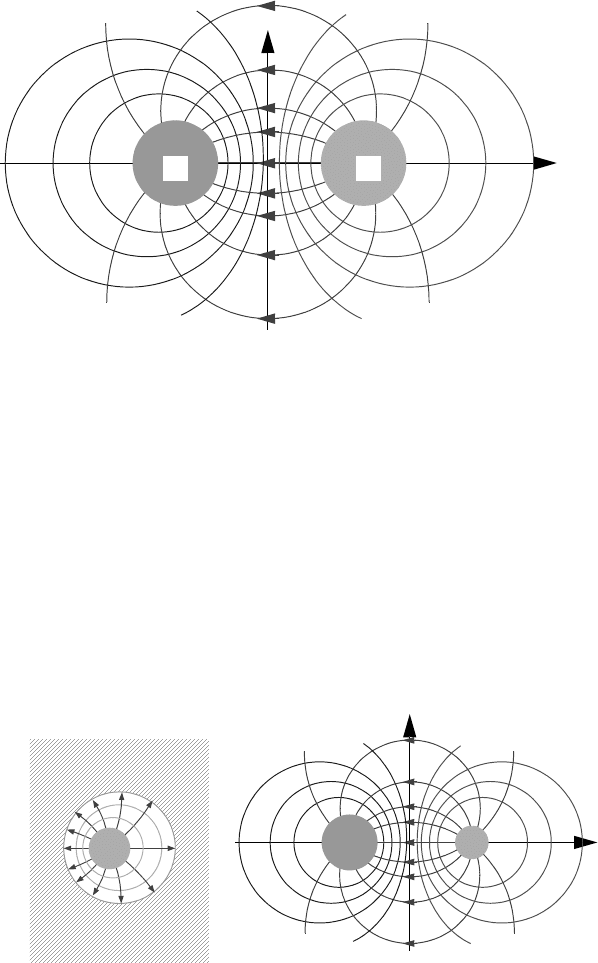
that is, the equation for a circle whose center is at the y-axis. Both sets of curves
consist of circles (Fig. 3.37). The thereby described field has many applications.
By appropriate choice of the parameters, one can obtain for example, the field of an
eccentric cylindrical capacitor (Fig. 3.38a) or that of a conductor made from two
cylinders (Fig. 3.38b). This resembles the previously discussed problem of
imaging a line charge on a cylinder (Sect. 2.6.3).
Example 4
Fig. 3.37
y
x
-Q
+Q
Fig. 3.38
y
x
ab
wz()
qd
2πε
0
z
--------------=
3.12 The Complex Potential 225
If we start from Example 3 and take the limit to a line dipole ( ,
) then one finds
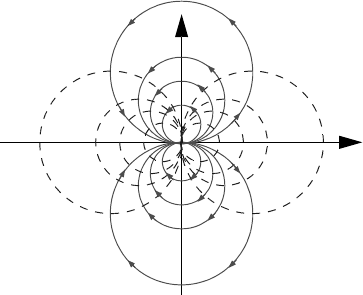
This is the complex potential of a line dipole.
,
,
.
From this one finds the equipotentials to be circles through the origin (centered on
the x-axis) and the flux lines are also circles through the origin (centered on y-axis)
as illustrated in Fig. 3.39, (which may also be regarded as being a result of taking
the limit of Fig. 3.37).
Example 5
i.e.,
d 0 q ∞→,→
qd finite
wz()
q
2πε
0
------------
1
d
2z
-----+
1
d
2z
-----–
---------------ln
q
2πε
0
------------
1
d
2z
-----+
1
d
2z
-----+
ln≈=
q
2πε
0
------------
1
d
z
---+
ln
qd
2πε
0
z
--------------
.≈≈
wz()
qd
2πε
0
z
--------------
qdz
*
2πε
0
zz
*
--------------------
qd x iy–()
2πε
0
x
2
y
2
+()
----------------------------------== =
uxy,()
qd
2πε
0
------------
x
x
2
y
2
+
-----------------
=
vxy,()
qd
2πε
0
------------
y
x
2
y
2
+
-----------------
–=
Fig. 3.39
y
x
wCz
p
=
wCz
p
Cx iy+()
p
Cr iϕ()exp[]
p
Cr
p
ipϕ()exp== = =
uCr
p
pϕ()cos=
226 Formal Methods of Electrostatics
The lines , i.e.,
characterize special equipotential surfaces ( ), for example, for and
, this gives
.
The lines , i.e.,
,
are special flux lines ( ), for instance
.
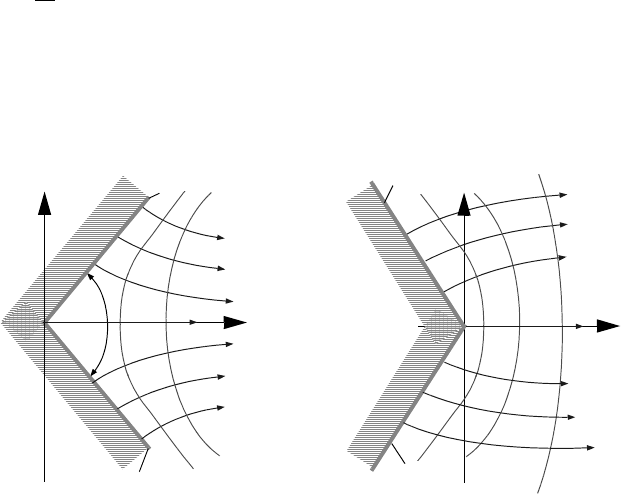
When using surfaces of conductors, which are a possible implementation of
equipotential surfaces, one obtains fields like those illustrated in Fig. 3.40 (p > 1)
and Fig. 3.41 (p < 1).
For the case of Fig. 3.41 (p < 1), the derivative
,
diverges at the origin. Therefore, the electric field becomes infinitely large. This is
a typical characteristic of tips, and is also of great practical significance. Figs. 3.30
and 3.31 are special cases where p=1/2 and p=2, respectively.
vCr
p
pϕ()sin=
pϕcos 0=
p
ϕ
2n 1–
2
---------------
π=
u 0= n 0=
n 1=
ϕ
π
2p
------
±=
pϕsin 0=
p
ϕ nπ=
v 0=
ϕ 0=
zd
dw
Cpz
p 1–
Cp
z
1 p–
------------==
x
p<1
y
ϕ=π/2p
ϕ= −π/2p
Fig. 3.41
Fig. 3.40
x
y
π/p
p>1
ϕ=π/2p
ϕ= −π/2p
3.12 The Complex Potential 227
Example 6
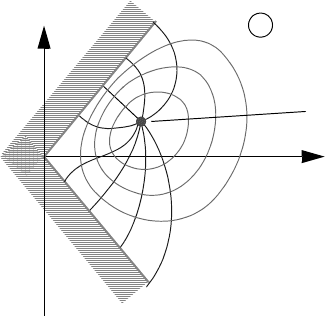
We may stage conformal mappings. For instance, we want to calculate the field of a
line charge inside a wedge-shaped area, like that of Fig. 3.40. As long as is an
even number multiple of the opening angle, we are able to solve this problem by
multiple imaging steps, as indicated for the for point charges in Figs. 2.34 and 2.35,
where the opening angle is and .
The imaging method can not be used for arbitrary angles. However, one may
approach this problem as follows. First, by writing
,
one obtains the field of two line charges in the -plane, which differ from
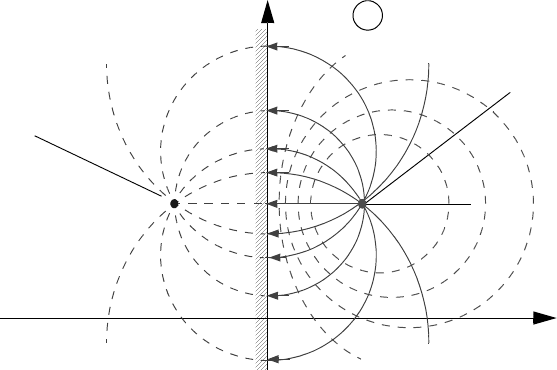
Example 3 only by a shift parallel to the -axis (Fig. 3.42), where the -axis has
to be seen as the equipotential surface (conductor surface) and -q is the image
charge. Now applying the mapping of Example 5 already solves the problem
(Fig. 3.43):
,
and
wz()
q
2πε
0
------------
z
p
z
0
*p
+
z
p
z
0
p
–
-------------------
ln=
2π
ππ2⁄
w
q
2πε
0
------------
ζζ
0
*
+
ζζ
0
–
---------------
ln=
ζ
η
Fig. 3.42
η
ξ
+q
ζ
0
*
– ξ
0
– iη
0
+=
ζ
0
ξ
0
iη
0
+=
ζ
-q
η
z
p
ζ z
p
=
228 Formal Methods of Electrostatics
where
,
is the location of the line charge in Fig. 3.42 and its location in Fig. 3.43.
Example 7
,
i.e.,
,
or
so that
,
Fig. 3.43
y
z
x
z
0
x
0
iy
0
+=
wz()
q
2πε
0
------------
z
p
z
0
*p
+
z
p
z
0
p
–
-------------------
ln=
ζ
0
z
0
p
=
z
0
za
w
w
0
------cosh=
w
w
0
------cosh uiv+()cosh
1
2
---
uiv+()exp u– iv–()exp+[]==
1
2
---
u()exp vcos ivsin+[]u–()exp vcos ivsin–[]+{}=
vcos ucosh iv u ,sinhsin+=
zxiy+ avcos ucosh ia v usinhsin+==
xavcos ucosh=
yav u ,sinhsin=
vcos
2
vsin
2
+1
x
2
a
2
ucosh
2
-----------------------
y
2
a
2
usinh
2
----------------------+==
3.12 The Complex Potential 229
and
.
This shows us that the equipotentials ( ) are elliptical cylinders and the
flux lines ( ) are hyperbolic cylinders. They are all confocal because for
an ellipse, we have the relation
.
and the relation for a hyperbola is
.
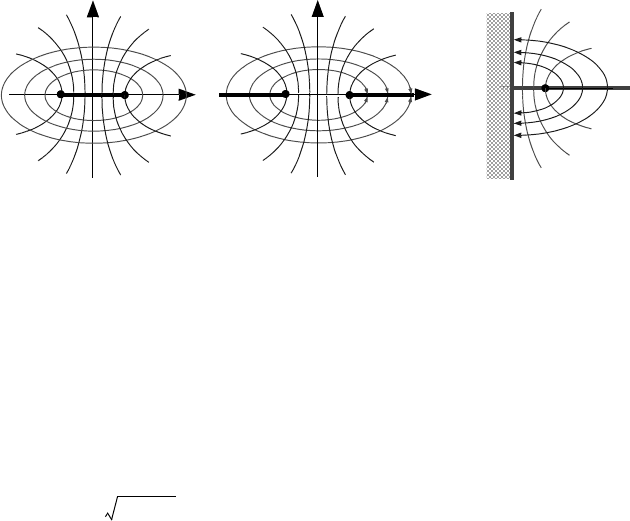
Their graph is given in Fig. 3.44. Special cases are, for example, the field between
two opposite edges (Fig. 3.45), or the field of an edge opposite a plane (Fig. 3.46).
Furthermore, the mapping
is remarkable because u and v, together with z constitute an orthogonal system in
the three-dimensional space, which allows for the separation of variables for
Laplace’s equation (coordinates of the elliptical cylinder).
Example 8
This rather simple looking mapping exhibits peculiar properties and shall serve
here as an example for many of similar kind.
Squaring gives
,
i.e.,
and
.
ucosh
2
usinh
2
–1
x
2
a
2
vcos
2
--------------------
y
2
a
2
vsin
2
-------------------–==
u const=
v const=
e
2
a
2
ucosh
2
a
2
usinh
2
– a
2
==
e
2
a
2
vcos
2
a
2
vsin
2
+ a
2
==
Fig. 3.44
x
-a
+a
y
Fig. 3.46
+a
Fig. 3.45
x
-a
+a
y
uuxy,()=
vvxy,()=
wz() z
2
B
2
+=
w
2
u
2
v
2
– i2uv+ z
2
B
2
+ x
2
y
2
– B
2
i2xy++===
u
2
v
2
– x
2
y
2
– B
2
+=
uv xy=
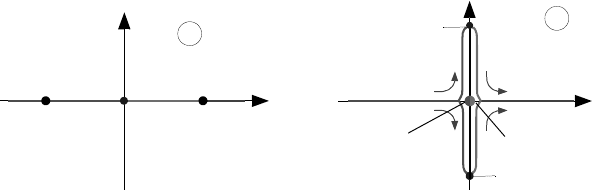
230 Formal Methods of Electrostatics
If (u-axis) then
Thus, it has to be either or . The case yields
and the case yields
,
which is always the case. This now, results in a peculiar behavior of the u-axis in
the z-plane. The range , (i.e., that part of the negative u-axis), maps to
the negative x-axis. Similarly, for the range , (i.e., that part of the
positive u-axis), maps to the positive x-axis ( ). Both points
map onto the origin of the z-plane. The section of the u-axis between -B and +B
maps onto the points between -B and +B on the y-axis. For , the image
points on the y-axis move from the origin towards the points +B and -B. For
, the image points on the y-axis move back towards the origin
Conversely, we find for (v-axis)
.
Here, y = 0 is impossible because this would require
,
which is not possible since v has to be real. Hence, and
.
i.e.,
.
This means either
v 0=
0 u
2
≤ x
2
y
2
– B
2
+=
xy 0=
x 0= y 0= x 0=
0 y
2
– B
2
+≤
y
2
B
2
≤ x 0=()
y 0=
0 x
2
B
2
+≤ y 0=()
∞– uB–≤<
Bu≤ +∞<
0 x +∞<≤ uB±=
Bu0≤≤–
0 u +B≤≤
Fig. 3.47
v
-B
+B
u
w
x
y
z
u=-B
u<-B
u>+B
u=+B
u=0
u=0
+B
-B
u 0=
0
v
2
–≥ x
2
y
2
– B
2
+=
xy 0=
v
2
– x
2
B
2
+=
x 0=
v
2
– y
2
– B
2
+=
y
2
B
2
v
2
+ B
2
≥=
yB>
3.12 The Complex Potential 231
or
.
Now, the v-axis maps onto the part of the y-axis that lacks the range from -B to +B.
The current conformal mapping is an example of an interesting category of
mappings, the Schwarz-Christoffel mappings.
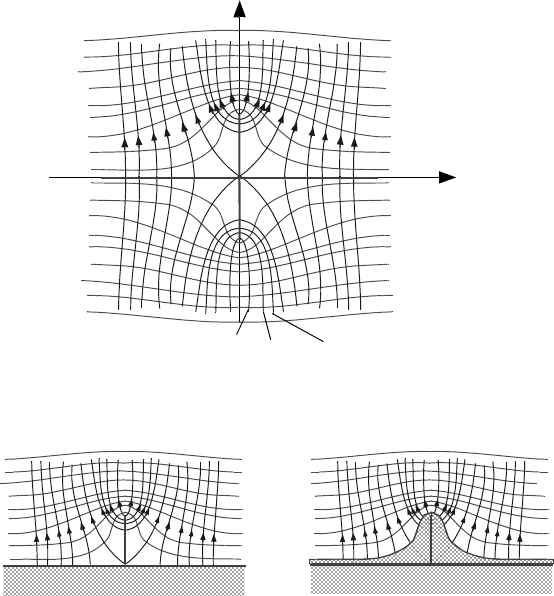
Fig. 3.48 illustrates this configuration, which is suitable to determine the
fields for a more or less sharp edge (Fig. 3.49).
yB–<
Fig. 3.48
x
y
v=v
1
v=v
2
v=v
3
v=v
4
u=u
1
u=u
2
u=u
3
Fig. 3.49
a
b

4 The Stationary Current Density Field
The following shall discuss the field of the stationary electric currents, or more
precisely, the field generated by the current density g. By certain simplifying
assumptions, we may reduce the current density problems to electrostatic problems
of Chapter 2 and 3.
4.1 The Basic Equations
For electric currents inside metallic conductors to exist, Ohm’s law requires that
there be an electric field present, such that
,
(4.1)
where is the specific electric conductivity. It shall be emphasized that this simple
form of Ohm’s law is not always valid. Oftentimes, it has to be replaced by much
more complicated relations. Even if eq. (4.1) is applicable in the given form,
may still depend on the location, i.e., for some heterogeneous material, or even in a
homogeneous material, if a non-uniform magnetic field is applied, which is a
property that is frequently exploited to measure magnetic fields. This shall not be
our concern here, however. We assume that is at least piece wise constant.
We have already derived the continuity equation, or the principle of charge
conservation (1.58):
,
(4.2)
which reduces in the stationary case to
.
(4.3)
From (4.1) and (4.2) follows
.
Letting be constant and using
gives
,
or
.
(4.4)
For an arbitrary volume, this results in
.
(4.5)
g κE=
κ
κ
κ
g∇•
t∂
∂ρ
+0=
g∇• 0=
κE()∇• 0=
κ
E ϕ∇–=
κ E∇• κ ϕ∇()∇•–0==
∇
2
ϕ 0=
g∇• τd
V
∫
g dA•
A
∫
°
0==
G. Lehner, Electromagnetic Field Theory for Engineers and Physicists,
DOI 10.1007/978-3-540-76306-2_4, © Springer-Verlag Berlin Heidelberg 2010
4.1 The Basic Equations 233
This means that for the stationary case, the sum of all currents emerging from the
volume have to vanish. A special case of this is Kirchhoff’s first theorem (Fig. 4.1).
.
(4.6)
This is a fundamental relation in electric circuits theory.
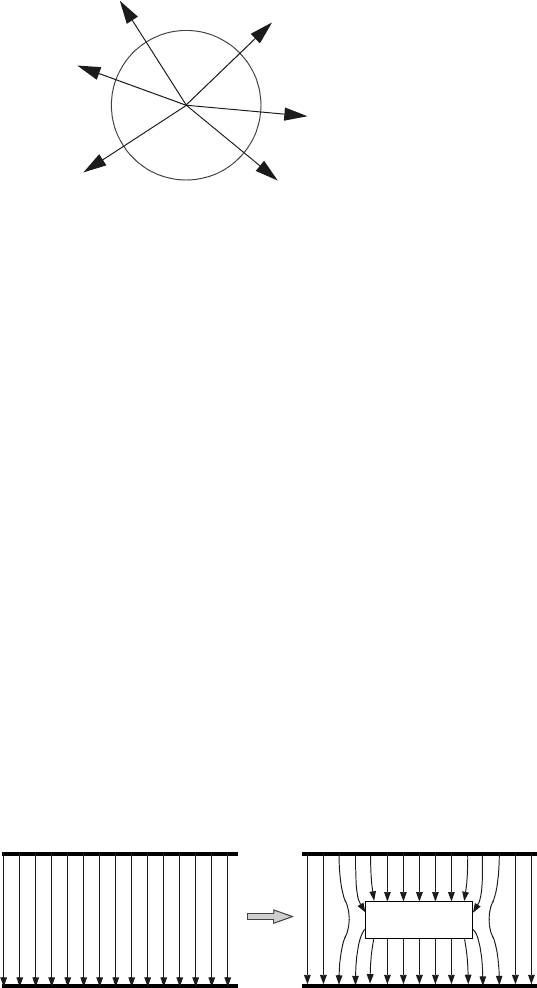
The question whether stationary currents actually exist arises. Based on our
previous knowledge, one might get the impression that they did not. To find the
answer, consider a charged capacitor within which one introduces a conductor
(Fig. 4.2). Initially, there is a field inside the conductor that causes currents. This
represents moving charges, which will cease moving only, when the field inside the
conductor has vanished, that is, when influence charges appear. The current in the
conductor decays. The time for this to occur is the relaxation time and depends on
the conductivity (see Sect. 4.2). Similar considerations lead to decay of currents in
every “electrostatic” situation. Since
or
(4.7)
and therefore
.
(4.8)
In a stationary, closed circuit, this can only be satisfied if
Fig. 4.1
I
2
I
1
I
3
I
n
I
i
i 1=
n
∑
0=
Fig. 4.2
E∇× 0=
E ds•
∫
°
0=
g ds•
∫
°
0=