
Lehner G. Electromagnetic Field Theory for Engineers and Physicists
Подождите немного. Документ загружается.

294 Basics of Magnetostatics
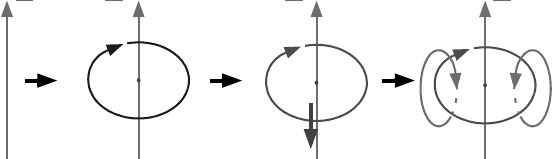
induction (1.67), which is referred to as Lenz’s law. Macroscopic, induced currents
generally decay over time because of Ohmic resistance which any medium usually
has. Superconductivity is an exception. The microscopic currents that cause
magnetization (Ampere's molecular currents) do not decay. These flow without
resistance and persist for as long as the external field remains. This is the reason
why there is a unique relation between magnetization and magnetic field for which
we may write
.
(5.77)
is called the magnetic susceptibility. Because of Lenz’s law is negative.
The specific formulation of (5.77) makes dimensionless. The magnetization M
is oriented anti-parallel to B. This allows to identify a diamagnetic material by the
fact that in an inhomogeneous magnetic field, it experiences a force in the direction
where the field decreases.
The molecules of a so-called paramagnetic material exhibit net magnetic
moments even without an applied field. However, there is no preferred direction
without an applied field and therefore no magnetization. The individual dipoles are
statistically oriented in all directions and cancel each other on average (spatial and
time average). An applied field causes a torque, which then tries to align the
individual dipoles parallel to the external field. Still, temperature acts to mis-align
the individual dipoles. This mis-alignment is more successful the higher the
temperature. Nevertheless, partial orientation along the external field is achieved.
The diamagnetic effect of induction applies simultaneously, in an attempt to
decrease the magnetization. If paramagnetism is present in that material, then it
prevails over diamagnetism and the same Ansatz as (5.77) can be made, now with
positive . This is the reason why paramagnetic material is drawn toward the side
where an inhomogeneous field increases. for paramagnetic materials is
temperature dependent, while for diamagnetic materials does not depend on
temperature.
There are many more magnetic phenomena. Particularly important is
ferromagnetism, especially for electrical engineering. It is related to the spin of
electrons and like paramagnetism, can qualitatively be described by the orientation
of the related magnetic dipole moments. In contrast to paramagnetism, the
Fig. 5.35
t∂
∂B
B B
t∂
∂B
t∂
∂B
t∂
∂B
E
I
m
field changes → induced E-field → magnetization →
weakened field
M µ
0
χ
m
H=
χ
m
χ
m
χ
m
χ
m
χ
m
χ
m

5.5 B and H in Magnetizable Media 295
magnetization due to ferromagnetism is several orders of magnitude higher and the
relation between applied field and magnetization is not linear, not even unique (i.e.,
it is not a single-valued function). This means that magnetization is not only a
function of the external field but also of its previous states (i.e., it depends on its
history). Because of its non-linearity, a description of ferromagnetic materials by
susceptibility depends on the current state which, from a theoretical perspective,
does not necessarily make it useful. The susceptibility of diamagnetic and
paramagnetic materials is very small ( ), while the numbers for
ferromagnetism may reach some . Examples:
The reader is alerted about the non-standardized definitions of when
comparing these numbers with other sources.
The fact that ferromagnetism can not be described by a linear relation has
formal, far reaching consequences. The methods we have developed apply only to
linear problems. There are hardly any mathematical methods available to treat non-
linear problems analytically. Then, numerical methods need to be applied.
In the presence of magnetized media, it is possible to calculate the magnetic
field as in vacuum, if one explicitly considers all currents, including those bound
currents that originate from magnetization. We write
,
where
.
Therefore
,
or
.
(5.78)
We define the magnetic field strength for magnetizable media
.
(5.79)
This results in our previous relation between H and B for vacuum if .
Conversely
Oxygen (O
2
) at 18°C (64°F)
Palladium at 18°C (64°F)
Nitrogen (N
2
)
Bismuth
χ
m
1«
10
4
χ
m
1.8 10
6–
⋅=
χ
m
782 10
6–
⋅=
paramagnetic
χ
m
0.07–10
6–
⋅=
χ
m
160–10
6–
⋅=
diamagnetic
χ
m
∇ B×µ
0
g=
gg
free
g
bound
+ g
free
1
µ
0
------
∇ M×+==
∇ B×µ
0
g
f
∇ M×+=
∇
BM–
µ
0
---------------
× g
f
=
H
BM–
µ
0
---------------
=
M 0=

296 Basics of Magnetostatics
,
(5.80)
a relation which holds for any medium, for example, even for a permanent magnet
which has a magnetization that persists even without an applied field. From (5.78)
and (5.79) follows that
.
(5.81)
This means that H is irrotational as long as there are only bound currents. However,
B is not irrotational in this case, but rather
.
For “linear media” follows from (5.80) that
.
Defining the relative permeability
(5.82)
and the (absolute) permeability
(5.83)
allows to write
.
(5.84)
When calculating H, only free currents are relevant, while the bound currents are
hidden in the relation between B and H. This approach is similar to the one in
electrostatics, where only the free charges are relevant when calculating D and the
impact of bound charges is hidden in the relation between D and E.
The B field is always source free and it is therefore always
.
The consequence is that H is not necessarily source free, namely if , then:
.
We have introduced as the fictitious magnetic charges eq. (5.73)
,
which gives
.
(5.85)
The implication is that the H field originates from, or ends at bound magnetic
charges. Because of
,
we can also write
,
B µ
0
HM +=
∇ H× g
f
=
∇ B×∇M×=
B µ
0
H µ
0
χ
m
H+ µ
0
1 χ
m
+()H==
µ
r
1 χ
m
+=
µµ
0
µ
r
=
B µH =
B∇• 0=
M∇• 0≠
H∇•
BM–
µ
0
---------------
∇•
1
µ
0
------
M∇•–==
M∇•–
ρ
mag
M∇•–=
H∇•
1
µ
0
------
ρ
mag
=
H ψ∇–=
ψ∇–()∇• ∇
2
ψ–+
1
µ
0
------
ρ
mag
==

5.5 B and H in Magnetizable Media 297
i.e.,
.
(5.86)
This represents the magnetic Poisson equation.
These properties of B and H can be confusing and are therefore summarized
in Table 5.2 for three cases.
The field of a cylindrical, uniformly magnetized permanent magnet shall
serve as an example. The H field can be calculated like the electric field of two
circular plates with a surface charge. This gives
.
The B field can be calculated like the field of a coil of finite length with the surface
current
or also as shown in Fig. 5.36 and Fig. 5.37, by calculating
.
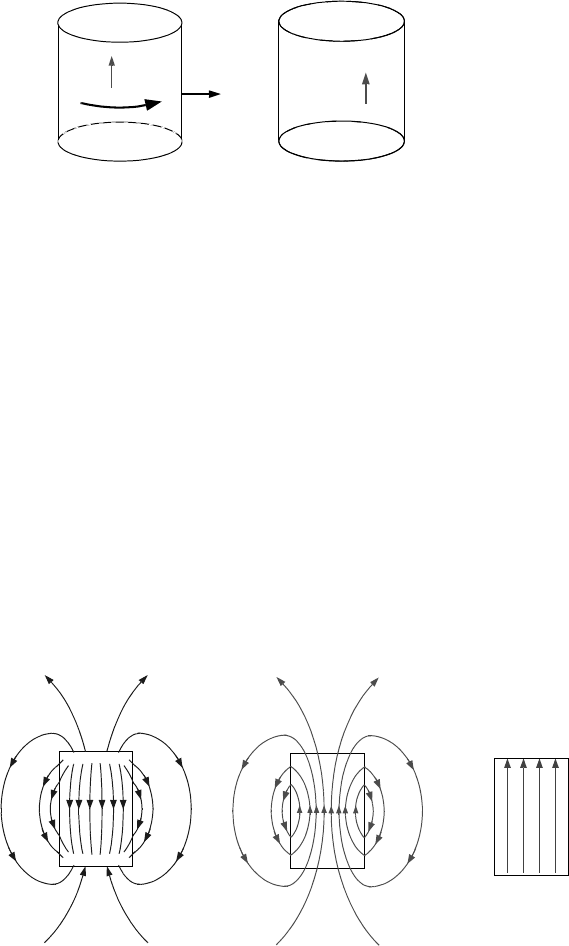
The field of H in Fig. 5.37a) is irrotational but has sources and sinks in the form of
bound magnetic charges at the top and bottom surfaces, respectively. The field of B
in Fig. 5.37b) is source free but has curl in the form of bound azimuthal currents in
the cylinder wall. M in Fig. 5.37c) is neither source free nor curl free. Its curl is in
the cylinder wall (as for B) and its sources are at the top and bottom surfaces (as for
H). It shall be noted that Fig. 5.30 is not representing a magnetized material, but
rather the vacuum field created by given dipoles, which can only be calculated
outside of the cylinder. However, Fig. 5.37 is based on the now generalized
Table 5.2
Fields of free currents
Fields of magnetized matter
Fields of free currents and
fields of magnetized matter
H, B both
source free, but
not curl free
H not source free, but
curl free
B source free, but
not curl free
H neither source free
nor curl free
B source free, but
not curl free
∇
2
ψ
1
µ
0
------
ρ
mag
–=
B∇• 0=
H∇• 0=
B∇× µ
0
g
f
=
H∇× g
f
=
B∇• 0=
H∇• ρ
mag
µ
0
⁄=
B∇× M∇×=
H∇× 0=
B∇• 0=
H∇• ρ
mag
µ
0
⁄=
B∇× µ
0
g
f
M∇×+=
H∇× g
f
=
σ
mag
Mn•=
k k
ϕ
e
ϕ
1
µ
0
------
Mn×==
B µ
0
HM+=
298 Basics of Magnetostatics
definition of H as of eq. (5.79). Only this new definition defines H inside a
magnetizable medium.
There are also anisotropic linear media for which and become a tensor.
The relation in this case reads:
,
(5.87)
or in short
.
(5.88)
The tensor is symmetric, i.e.,
.
(5.89)
Fig. 5.36
M
+ + + +
+ + +
+ + + + +
+ + + +
+ + +
- - - -
- - -
- - - - -
- - - -
- - -
k
ϕ
n
M
Fig. 5.37
B
M
H
a) b) c)
+ + + + +
- - - - -
χ
m
µ
B
x
µ
xx
H
x
µ
xy
H
y
µ
xz
H
z
++=
B
y
µ
yx
H
x
µ
yy
H
y
µ
yz
H
z
++=
B
z
µ
zx
H
x
µ
zy
H
y
µ
zz
H
z
++=
B m H⋅=
m
µ
ik
µ
ki
=
5.6 Ferromagnetism 299
5.6 Ferromagnetism
Ferromagnetism is a property of iron, cobalt, nickel, and certain alloys. The
relationship between M and H or B and H is very complicated for these materials.
As previously mentioned, it is neither linear nor unique. It depends on the history
of the medium and is also rather different for the various kinds of iron. The exact
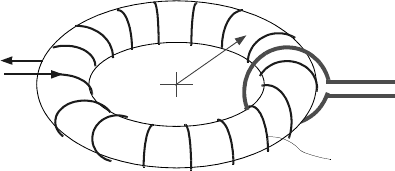
relation has to be established by measurements. In principle, the measurement
could be carried out as illustrated in Fig. 5.38. For simplicity reasons, it shall be
assumed that the cross section of the coil is very small compared to its radius r. The
primary current in the coil creates the field
,
where N is the total number of turns the current path (primary loop) takes around
the toroid. This creates an EMF in the induction loop (secondary loop) of
magnitude
.
Integrating the EMF over time gives
.
Measuring the corresponding values of I and V
i
provides the corresponding values
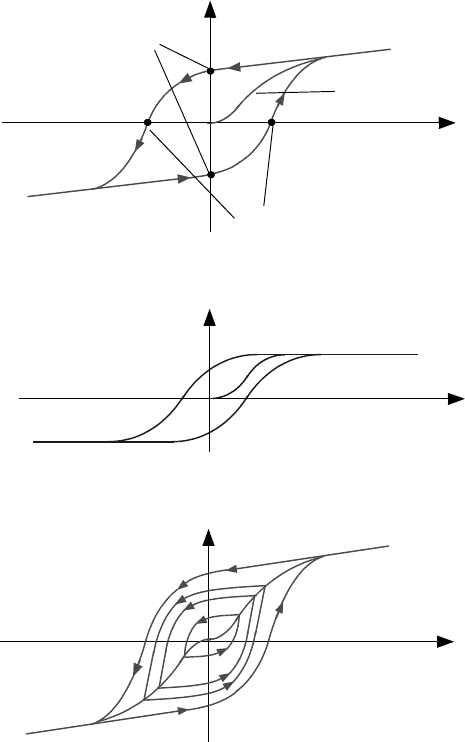
of B and H. Charting these values gives the so-called hysteresis loop (Fig. 5.39).
If we expose a material that has not been magnetized to a H-field that
increases, starting from zero, then B goes through the so-called new curve or initial
curve until it reaches a region that is called saturation. Saturation is characterized
by the fact that the related magnetization does not increase any more. The
magnetization is shown in Fig. 5.40.
Now, letting H decrease, results not in a curve that is merely reversing
direction, but it takes a different path. B or M decrease less than what they had
increased when H was increased. The result is that even when H is zero, B still has
a finite value (remanence or remanent field). To bring B to zero requires a negative
Fig. 5.38
I
ferromagnetic ring
induction loop
r
exciting current
(secondary loop)
(primary
loop)
H
NI
2πr
---------=
V
i
φ
·
B
·
A==
V
i
td
∫
BA=
300 Basics of Magnetostatics
field (the so-called coercivity or coercive force). Sufficiently large negative fields
lead to saturation in the other direction. When increasing H thereafter, B will take
the path through the other part of the hysteresis loop, eventually arriving again at
the positive side of saturation. Smaller hysteresis loops are achieved when not
going all the way to saturation (Fig. 5.41). The shape of the hysteresis loop
depends on the material and can be wide or narrow, more or less tilted, or almost
rectangular. There are materials with specific hysteresis loops that are more or less
useful for any particular of the multitude of applications in electrical engineering.
An important feature is the area enclosed when passing through an entire hysteresis
loop, since this area represents the losses when changing magnetization. This is
s
a
t
u
ra
t
i
o
n
remanence
coercivity
s
a
t
u
ra
t
i
o
n
initial curve
H
B
Hysteresis loop
Fig. 5.39
H
MBµ
0
H–=
Fig. 5.40
M
Fig. 5.41
H
B
5.6 Ferromagnetism 301
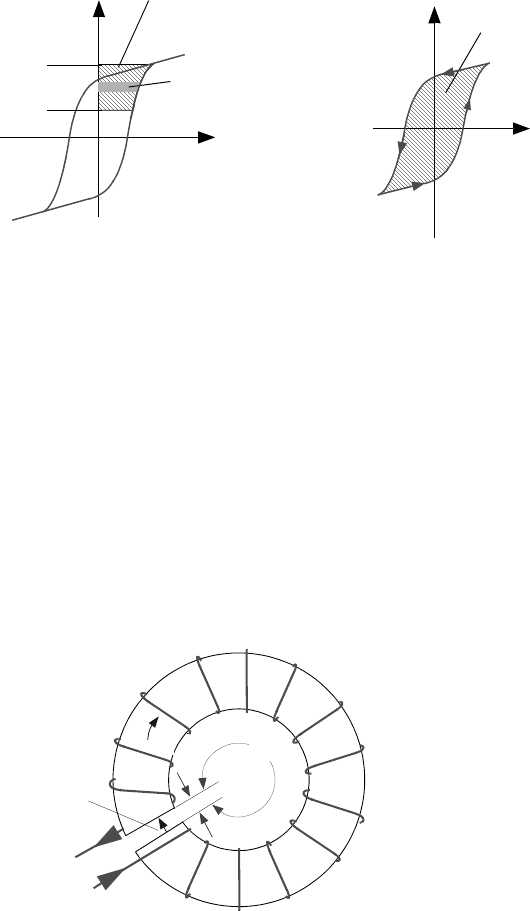
plausible: The work done per unit of time, i.e., the power necessary to create the
field given in Fig. 5.38 is
,
where is the voltage in the primary turns
.
Therefore
.
is the volume of the ferromagnetic ring. The necessary power needed per unit
volume is
or
(5.90)
and
.
W is the work necessary to establish the field starting at . It corresponds per
unit volume to the shaded area of Fig. 5.42.
The area of the integral for an entire loop is shown in Fig. 5.43
.
(5.91)
This means that a wide hysteresis curve, which is characteristic of so-called “hard
materials”, leads to large losses during re-magnetization. Thus, hard materials are
not suited for transformers, for which “soft materials”, with a narrow hysteresis
loop are better suited.
dW
dt
-------- IV
e
=
V
e
V
e
Nφ
·
NA
dB
dt
-------
==
dW
dt
-------- INA
dB
dt
-------
IN
2πr
---------
A2πr
dB
dt
-------
Hτ
dB
dt
-------
== =
τ
1
τ
---
dW
dt
--------
H
dB
dt
-------
=
1
τ
---
dW HdB=
W
τ
----- HdB
B
1
B
2
∫
=
B
2
B
1
W
τ
----- HdB
∫
°
H µ
0
dH dM+()
∫
°
HdM
∫
°
== =
302 Basics of Magnetostatics
Although from a purely formal perspective, the relation between B and H is
rather complicated, we can write the constitutive equation in this form
,
where or are now functions of H and its previous states. When subsequently
using this terminology, it shall not be understood to suggest any kind of linearity.
Rather a specific condition shall be characterized by a corresponding factor.
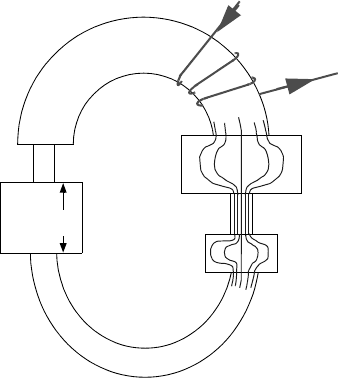
An electromagnet with a ferromagnetic core and a small air gap (Fig. 5.44)
shall serve as an example. As long as the toroid is relatively slim and the gap
sufficiently small, we may consider the fields inside the core and in the air-
gap approximately uniform and can also neglect that the different force lines have
different lengths. Then we may write
Fig. 5.43
HdB
∫
°
H
B
Fig. 5.42
B
2
H
B
dB
B
1
HdB
B
1
B
2
∫
B µ
0
µ
r
H µH==
µ
r
µ
Fig. 5.44
I
l
1
l
2
H
1
H
2
H
1
H
2
H ds•
∫
°
H
1
l
1
H
2
l
2
+ NI==
5.6 Ferromagnetism 303
and furthermore
.
The reason is that the perpendicular components of B must be continuous at the
boundary, which will be demonstrated in the next section. This leads to
,
and furthermore
,
or
.
(5.92)
This represents a very simple example of a so-called magnetic circuit. In
general, such a circuit may consist of several pieces of different length, different
cross section, and different permeability (Fig. 5.45). We approximate that
the flux is the same through each piece, which is equivalent to neglecting the flux
leakage (fringe effects). One writes:
,
,
B
1
B
2
B==
µ
1
H
1
µ
0
H
2
B==
B
µ
1
------
l
1
B
µ
0
------
l
2
+ NI=
B
NI
l
1
µ
1
------
l
2
µ
0
------+
-------------------=
l
i
A
i
µ
i
,,
Fig. 5.45
I
A
i
µ
i
l
i
NI H
i
l
i
i 1=
n
∑
=
H
i
B
i
µ
i
-----
φ
A
i
µ
i
----------==