
Lehner G. Electromagnetic Field Theory for Engineers and Physicists
Подождите немного. Документ загружается.

314 Basics of Magnetostatics
guided by the broad analogy between electrostatics and magnetostatics above, then
we might suppose that the problem can be solved using image currents I’ and I’’
(compare sects. 2.11.2 and 4.5.1.). Therefore, we try (and also show that this is
correct) to express the field in region 1 as the superposition of the fields of and
, and in region 2 as the field of . According to eq. (5.28), the field of a current
has the field
,
for the current , the field is
,
and for the current , the field is
.
Therefore, we write for the field in region 1:
.
(5.112)
and for region 2:
.
(5.113)
Because for , both and have to be continuous, it has to be
.
When cancelling common terms we get
.
(5.114)
Solving for and gives
I
I ' I''
Ix a= y 0=,()
H
I
2π xa–()
2
y
2
+[]
------------------------------------------
y– xa–0,,〈〉=
I' xa–= y 0=,()
H'
I '
2π xa+()
2
y
2
+[]
-------------------------------------------
y– xa+0,,〈〉=
I'' xa= y 0=,()
H''
I''
2π xa–()
2
y
2
+[]
------------------------------------------
y– xa–0,,〈〉=
H
1x
Iy
2π xa–()
2
y
2
+[]
------------------------------------------–
I'y
2π xa+()
2
y
2
+[]
-------------------------------------------–=
H
1y
+
Ix a–()
2π xa–()
2
y
2
+[]
------------------------------------------
I' xa+()
2π xa+()
2
y
2
+[]
-------------------------------------------+=
H
2x
I ''y
2π xa–()
2
y
2
+[]
------------------------------------------–=
H
2y
+
I '' xa–()
2π xa–()
2
y
2
+[]
------------------------------------------
=
x 0= H
y
B
x
µH
x
=
Ia
2π a
2
y
2
+[]
-----------------------------–
I 'a
2π a
2
y
2
+[]
-----------------------------+
I''a
2π a
2
y
2
+[]
-----------------------------–=
Iyµ
1
2π a
2
y
2
+[]
-----------------------------–
I '' yµ
1
2π a
2
y
2
+[]
-----------------------------–
I''yµ
2
2π a
2
y
2
+[]
-----------------------------–=
I'' II'–=
µ
2
I'' µ
1
II'+()=
I' I''
5.9 Imaging at a Plane 315
.
(5.115)
Notice when comparing these results with the corresponding electrostatic problems
of Sect. 2.11.2, that the relations become the same when replacing by (not
).
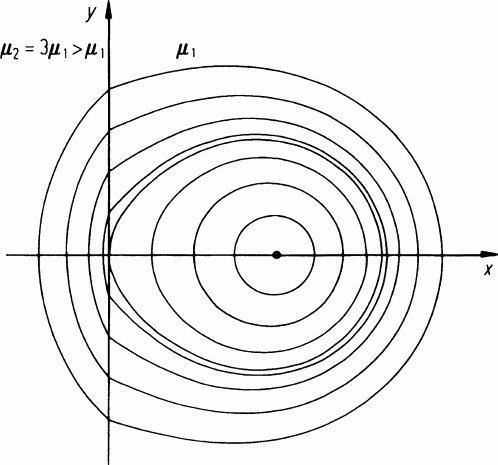
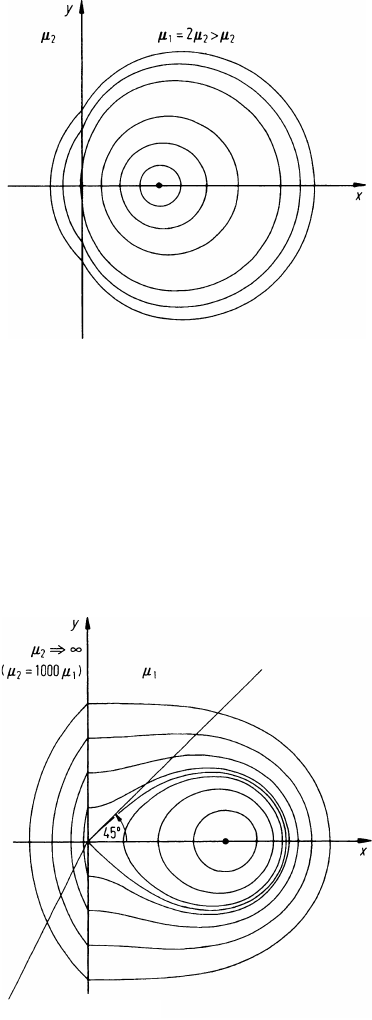
The field in region 2 is the result of two currents, in the same manner as it was
discussed in Sect. 5.2.1, Fig. 5.9. The currents and are parallel when
and they are anti-parallel when . The field lines in region 2 are concentric
circles. The fields are planar, i.e., they are independent of z and the fieldlines are in
planes parallel to . Figs. 5.56 through 5.58 show examples of such fields.
Shown are the lines of B, which are source-free at the boundary.
We have solved the problem with the Ansatz (5.112) and (5.113) by formally
applying the boundary conditions. This disguises what really happens. The current
I magnetizes both materials. The result are magnetization currents at the boundary
at and also in the vicinity of the current I.
We start with the boundary between the two materials at . Using
eq. (5.77) and with the fields described in (5.112) and (5.113), we find for the
boundary
I '
µ
2
µ
1
–
µ
1
µ
2
+
------------------
I=
I''
2µ
1
µ
1
µ
2
+
------------------
I=
ε 1 µ⁄
µ
Fig. 5.56
II' µ
1
µ
2
<
µ
1
µ
2
>
z 0=
x 0=
x 0=
316 Basics of Magnetostatics
(5.116)
and
Fig. 5.57
Fig. 5.58
stagnation point S
M
1x
µ
1
µ
0
–()y
2π a
2
y
2
+()
-----------------------------
II'+()–=
M
1y
µ
1
µ
0
–()a
2π a
2
y
2
+()
-----------------------------
II'–()–=
M
1z
0=
5.9 Imaging at a Plane 317
.
(5.117)
The surface current density of the magnetization current in the surface results from
(5.71)
.
where
and
.
Thus, k has only a z-component, namely
.
(5.118)
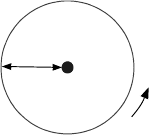
Now, we look at the neighborhood of the current itself. It flows inside the center of
a small cylindrical vacuum, which is removed from the surrounding medium ( )
(see Fig. 5.59). At the surface of the medium one has
.
or
.
This results in the surface current density
M
2x
µ
2
µ
0
–()y
2π a
2
y
2
+()
-----------------------------
I''–=
M
2y
µ
2
µ
0
–()a
2π a
2
y
2
+()
-----------------------------
I''–=
M
2z
0=
k
1
µ
0
------
M
1
n
1
× M
2
n
2
×+()=
n
1
1–00,,〈〉=
n
2
+100,,〈〉=
k
z
y()
µ
1
aI'
µ
0
π a
2
y
2
+()
--------------------------------=
µ
1
Fig. 5.59
µ
0
µ
1
I
ρ
H
ϕ
H
ϕ
I
2πρ
----------=
M
ϕ
µ
1
µ
0
–()I
2πρ
-------------------------=
k
z
µ
1
µ
0
–()
µ
0
2πρ
-----------------------
I=
318 Basics of Magnetostatics
and the magnetization current
.
The total or effective current, including I is now
.
(5.119)
This does not change, even if we let the radius approach zero. Compare this
result with the effective charge of Sect. 2.11.1. Again,
replaces .
Eqs. (5.118) and (5.119) define all currents. It is possible to calculate their
magnetic field B, which will manifest itself in the field given by eqs. (5.112),
(5.113), and (5.115). First, we calculate the field caused by the surface current .
By (5.28) and (5.118), we write
.
(5.120)
These two integrals can be solved with the usual methods of calculus. After some
cumbersome algebra we obtain
(5.121)
. (5.122)
Finally for , this results in
(5.123)
and for
.
(5.124)
The field of the current at needs to be added. By (5.28)
k
z
2πρ
µ
1
µ
0
------1–
I=
I
eff
µ
1
µ
0
------
I µ
r
I==
ρ
Q' Q
eff
Q ε
r
⁄== µ
1 ε⁄
k
z
B
x
µ
1
aI'
2π
2
------------
yy'–()y'd–
x
2
y' y–()
2
+[]a
2
y'
2
+[]
------------------------------------------------------------
∞–
+∞
∫
=
B
y
µ
1
aI 'x
2π
2
---------------
y'd
x
2
y' y–()
2
+[]a
2
y'
2
+[]
------------------------------------------------------------
∞–
+∞
∫
=
y' y–()y'd
x
2
y' y–()
2
+[]a
2
y'
2
+[]
------------------------------------------------------------
∞–
+∞
∫
πy
ay
2
ax+()
2
+[]
------------------------------------------–=
y'd
x
2
y' y–()
2
+[]a
2
y'
2
+[]
------------------------------------------------------------
∞–
+∞
∫
π ax+()
ax y
2
ax+()
2
+[]
------------------------------------------------=
x 0>
B
x
µ
1
I '
2π
---------
y
y
2
xa+()
2
+
-------------------------------
–=
B
y
+
µ
1
I '
2π
---------
xa+
y
2
xa+()
2
+
-------------------------------
=
x 0<
B
x
µ
1
I '
2π
---------
y
y
2
xa–()
2
+
------------------------------
–=
B
y
+
µ
1
I '
2π
---------
xa–
y
2
xa–()
2
+
------------------------------
=
µ
1
µ
0
⁄()Ixay, 0==
5.9 Imaging at a Plane 319
.
(5.125)
The total field in region 1 ( ) is finally
and in region 2 ( ), when using (5.114)
.
As expected, this is exactly our previous result of (5.112), (5.113), and (5.115).
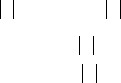
Formally, one can utilize the fictitious magnetic charges which are caused by
magnetization. One can imagine that the entire field is created by the current I on
one hand, and the fictitious magnetic charges on the other. The fictitious magnetic
charges are located exclusively on the boundary . According to (5.74), these
surface charges are
.
(5.126)
These can be thought of as parallel line charges in z-direction. An individual line
charge causes the field
,
(5.127)
which can be shown by analogy to electrostatics using (5.85) and symmetry
arguments. Therefore, the field is
B
x
µ
1
Iy
2π y
2
xa–()
2
+[]
------------------------------------------–=
B
y
+
µ
1
Ix a–()
2π y
2
xa–()
2
+[]
------------------------------------------
=
x 0>
B
1x
µ
1
I 'y
2π y
2
xa+()
2
+[]
-------------------------------------------
Iy
2π y
2
xa–()
2
+[]
------------------------------------------+
– µ
1
H
1x
==
B
1y
+ µ
1
I ' xa+()
2π y
2
xa+()
2
+[]
-------------------------------------------
Ix a–()
2π y
2
xa–()
2
+[]
------------------------------------------+
µ
1
H
1y
==
x 0<
B
2x
µ
1
I ' I+()y
2π y
2
xa–()
2
+[]
------------------------------------------–
µ
2
I''y
2π y
2
xa–()
2
+[]
------------------------------------------– µ
2
H
2x
===
B
2y
+
µ
1
I ' I+()xa–()
2π y
2
xa–()
2
+[]
------------------------------------------
+
µ
2
I'' xa–()
2π y
2
xa–()
2
+[]
------------------------------------------
µ
2
H
2y
===
x 0=
σ
mag
M
1
n
1
• M
2
n
2
•+ µ
0
I 'y
π a
2
y
2
+()
-------------------------
–==
σ
mag
y'()dy'
dH
x
σ
mag
y'()dy'
2πµ
0
-----------------------------
x
x
2
yy'–()
2
+[]
------------------------------------
=
dH
y
σ
mag
y'()dy'
2πµ
0
-----------------------------
yy'–()
x
2
yy'–()
2
+[]
------------------------------------
=
320 Basics of Magnetostatics
.
(5.128)
These integrals can, for the most part, be reduced to the ones we had before (5.121)
and (5.122).
(5.129)
. (5.130)
Then, the field of the fictitious magnetic charges alone for is
(5.131)
and for
.
(5.132)
The field of current I is
Combining all these fields gives the field of eqs. (5.112), (5.113), and (5.115).
With this example, and in harmony with the general theory, we have shown
that the impact of a magnetized medium can be calculated by magnetization
currents or by fictitious magnetic charges, both rendering the same result.
It shall be noted that the case of allows, at least formally, for an
interesting interpretation. In anticipation of the discussion on the skin effect in
Chapter 6, consider an ideal conductor in region 2. Then no B-field can penetrate
this medium from outside (there could be pre-existing fields inside, however).
Suddenly applying a current I outside (region 1), causes induced currents at the
surface (of an infinitely conductive medium in region 2) which are such,
that they exactly cancel all fields that this current otherwise would have created
internally (in region 2). In case of finite conductivity, these currents decay
gradually, which allows the external field to gradually penetrate the conductor.
However, in case of infinite conductivity, these currents do not decay and the fields
H
x
I 'x
2π
2
---------
y' y'd
x
2
yy'–()
2
+[]a
2
y'
2
+[]
------------------------------------------------------------
∞–
+∞
∫
–=
H
y
I '
2π
2
---------
yy'–()y' y'd
x
2
yy'–()
2
+[]a
2
y'
2
+[]
------------------------------------------------------------
∞–
+∞
∫
–=
y' y'd
x
2
y' y–()
2
+[]a
2
y'
2
+[]
------------------------------------------------------------
∞–
+∞
∫
πy
xy
2
ax+()
2
+[]
---------------------------------------------=
y' yy'–()y'd
x
2
y' y–()
2
+[]a
2
y'
2
+[]
------------------------------------------------------------
∞–
+∞
∫
π ax+()–
y
2
ax+()
2
+[]
---------------------------------------=
x 0>
H
x
I 'y
2π y
2
xa+()
2
+[]
-------------------------------------------
–=
H
y
+
I ' xa+()
2π y
2
xa+()
2
+[]
-------------------------------------------
=
x 0<
H
x
+
I 'y
2π y
2
xa–()
2
+[]
------------------------------------------
=
H
y
I ' xa–()
2π y
2
xa–()
2
+[]
------------------------------------------–=
H
x
Iy
2π y
2
xa–()
2
+[]
------------------------------------------–=
H
y
+
Ix a–()
2π y
2
xa–()
2
+[]
------------------------------------------
.=
µ
2
0=
x 0=

5.10 Planar Problems 321
remain excluded. The proof of this will be provided in Chapter 6. Nevertheless, we
can discuss the corresponding image problem already. Although a material with
infinite conductivity may posses any permeability, we may still formally satisfy the
condition that all B-fields vanish in region 2, by letting in above result.
This yields from (5.115)
,
(5.133)
and from (5.118) with we get
(5.134)
where
.
(5.135)
Of course in reality, there is no current in region 2. There is only a surface current
(5.134) at the surface at , which according to (5.135) just totals the image
current -I. Calculating the field of the current in region 2, using (5.124),
(5.133), and gives
,
and the field of the current I
,
is, in deed, exactly canceled.
5.10 Planar Problems
For an arbitrary distribution of currents in z-direction
,
(5.136)
the vector potential is by (5.15)
.
(5.137)
The corresponding magnetic field B is
.
(5.138)
µ
2
0=
I ' I–=
µ
1
µ
0
=
k
z
y()
aI
π a
2
y
2
+()
-------------------------–=
k
z
y()yd
∞–
+∞
∫
aI
π
-----
yd
a
2
y
2
+
-----------------
∞–
+∞
∫
– I–==
x 0=
k
z
y()
µ
1
µ
0
=
B
x
+
µ
0
Iy
2π y
2
xa–()
2
+[]
------------------------------------------
=
B
y
µ
0
Ix a–()
2π y
2
xa–()
2
+[]
------------------------------------------–=
B
x
µ
0
Iy
2π y
2
xa–()
2
+[]
------------------------------------------–=
B
y
+
µ
0
Ix a–()
2π y
2
xa–()
2
+[]
------------------------------------------
=
g 00g
z
xy,(),,〈〉=
A 00A
z
xy,(),,〈〉=
BA∇×
y∂
∂A
z
x∂
∂A
z
–0,,〈〉==

322 Basics of Magnetostatics
is constant along a force line, i.e., can take the role of the flux function:
.
(5.139)
On the other hand, the situation outside of the current carrying region it is
.
(5.140)
where
.
(5.141)
The lines are perpendicular to the field lines. Therefore, the lines
and the lines establish an orthogonal grid (see Sect. 3.10
through 3.12). We obtain
.
(5.142)
Therefore, the functions and satisfy the Cauchy-Riemann
equations (3.380) and thus, may be considered as the real and imaginary part of a
complex potential (see also (5.33)):
.
(5.143)
The consequence is that the methods of conformal mapping apply to
magnetostatics as well.
We have already met the example of the complex potential of an infinitely
long, straight wire in Sect. 5.2.1, eq. (5.34).
5.11 Cylindrical Boundary Value Problems
5.11.1 Separation of Variables
The separation of variables method is also important in solving magnetostatic
problems. It will suffice to discus a few examples in cylindrical coordinates.
In Sect. 5.1, we have restricted ourselves to Cartesian coordinates, which
enabled us to use the known solution of the scalar Poisson equation to solve
Poisson’s vector equation (5.12). It is also possible to use curvilinear coordinates,
for example, cylindrical coordinates. Then one needs to solve the set of equations
A
z
A
z
B A
z
∇• B
x
x∂
∂A
z
B
y
y∂
∂A
z
B
z
z∂
∂A
z
++=
y∂
∂A
z
x∂
∂A
z
x∂
∂A
z
y∂
∂A
z
–0+0==
H ψ∇–=
ψψxy,()=
ψ const.=
ψ const.= A
z
const.=
H
x
1
µ
0
------
y∂
∂A
z
x∂
∂ψ
–==
H
y
1
µ
0
------
x∂
∂A
z
–
y∂
∂ψ
–==
1 µ
0
⁄()A
z
xy,() ψxy,()
wz()
wz()
A
z
xy,()
µ
0
------------------- iψ xy,()+=

5.11 Cylindrical Boundary Value Problems 323
given in (5.14). For simplicity reasons, we restrict ourselves to rotationally
symmetric fields, and assume that there are only azimuthal currents.
.
(5.144)
Based on Sect. 5.2.4, one concludes that A also has only an azimuthal component
.
(5.145)
According to (5.14) it is for :
.
In particular for the current-free space
,
(5.146)
or written more explicitly using (3.33):
.
(5.147)
In order to solve this equation by separation of variables, we write the Ansatz
,
(5.148)
as before in Sect. 3.7, and obtain
(5.149)
and
,
(5.150)
with the solution
(5.151)
or
(5.152)
and
.
(5.153)
Alternatively, one may use
(5.154)
to obtain
.
(5.155)
and
g 0 g
ϕ
rz,()0,,〈〉=
A 0 A
ϕ
rz,()0,,〈〉=
A
ϕ
∇
2
A
ϕ
rz,()
A
ϕ
rz,()
r
2
--------------------– µ
0
g
ϕ
rz,()–=
∇
2
A
ϕ
A
ϕ
r
2
-------–0=
1
r
---
r∂
∂
r
r∂
∂
A
ϕ
rz,()
∂
2
∂z
2
--------
A
ϕ
rz,()
A
ϕ
rz,()
r
2
--------------------–+0=
A
ϕ
rz,()Rr()Zz()=
z
2
2
∂
∂
Zz() k
2
Zz()=
1
r
---
r∂
∂
r
r∂
∂
Rr() k
2
1
r
2
-----–
Rr()+0=
Zz() A
1
kz()cosh A
2
kz()sinh+=
Zz() A
˜
1
kz()exp A
˜
2
kz–()exp+=
Rr() C
1
J
1
kr()C
2
N
1
kr()+=
z
2
2
∂
∂
Zz() k
2
Zz()–=
Zz() A
1
kz()cos A
2
kz()sin+=