
Lehner G. Electromagnetic Field Theory for Engineers and Physicists
Подождите немного. Документ загружается.


304 Basics of Magnetostatics
and
,
or
.
(5.93)
For comparison, we write Ohm’s law for a circuit of several resistors in
series.
.
(5.94)
Notice the close formal analogy. NI replaces the voltage, which is why this relation
is sometimes called the magnetomotive force. The flux replaces the current I.
The sum
,
represents the resistance and is therefore called magnetic resistance . For an
individual element we have now
.
(5.95)
Permeability is the formal equivalent of conductivity and may therefore be
interpreted as magnetic conductivity. This analogy can be generalized to apply to
entire networks with branching magnetic “currents”. However, necessary is to
remember that these are simply approximations, which are not necessarily
accurate. To estimate accuracy may be difficult at times. Nevertheless, these kind
of approximations may be acceptable when exact field theoretical calculations
become too difficult.
5.7 Boundary Conditions for B and H, and the Refraction of
Magnetic Force Lines
It always holds that
,
.
These relations allow one to derive the boundary conditions that H and B have to
satisfy.
NI
φ
A
i
µ
i
----------
l
i
i 1=
n
∑
=
NI φ
l
i
A
i
µ
i
----------
i 1=
n
∑
=
VI
l
i
A
i
κ
i
----------
i 1=
n
∑
=
φ
l
i
A
i
µ
i
----------
i 1=
n
∑
R
mag
R
mag i,
l
i
A
i
µ
i
----------=
H∇× g
f
=
B∇• 0=
305
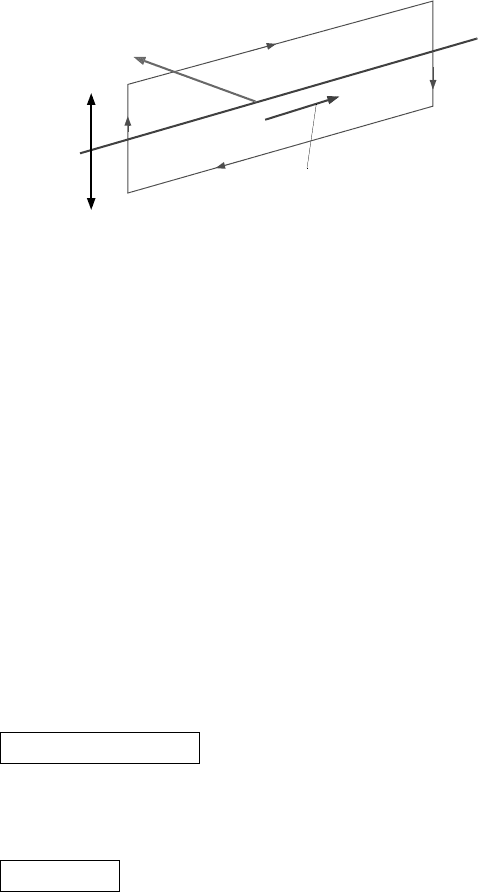
Consider the area element , where the vector lies in the boundary, i.e.
the area element is perpendicular to the boundary (Fig. 5.46). One writes the
integral
where is the surface current density in the boundary (note that does not
contain any magnetization currents). Therefore
or
.
This is true for every surface element on the boundary and therefore
.
(5.96)
If there is no free current in the surface this reduces to
or
,
(5.97)
that is, the tangential components of H are continuous. The presence of a surface
current density causes a discontinuity of the tangential components.
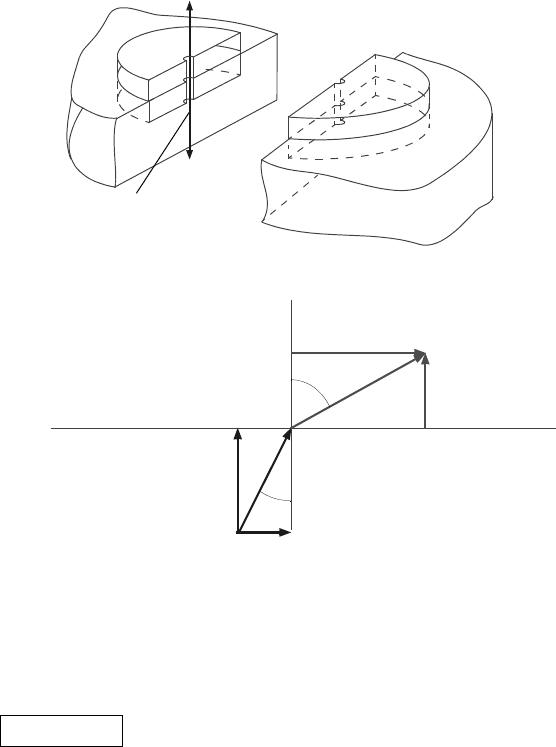
Now, consider the small slice of volume as illustrated in Fig. 5.47. Here, we
have
dA dA
dA
Fig. 5.46
n
2
n
1
n
2
dA×
dA
C
region 1
region 2
H∇×()Ad•
A
∫
H ds•
C
∫
°
=
H
2
n
2
dA×
dA
-------------------
• ds H
1
n
2
dA×
dA
-------------------
• ds–=
g
f
Ad•
A
∫
k
f
Ad
Ad
-------
sd•==
k
f
k
f
H
2
H
1
–()
n
2
dA×
dA
-------------------
ds• k
f
Ad
Ad
-------
sd•=
H
2
H
1
–()n
2
Ad•× k
f
Ad•=
H
2
H
1
–()n
2
× k
f
=
k
f
0=
H
2
H
1
–()n
2
× 0=
H
2t
H
1t
=
5.7 Boundary Conditions for B and H
306 Basics of Magnetostatics
i.e.,
or
.
(5.98)
The normal components of B are always continuous.
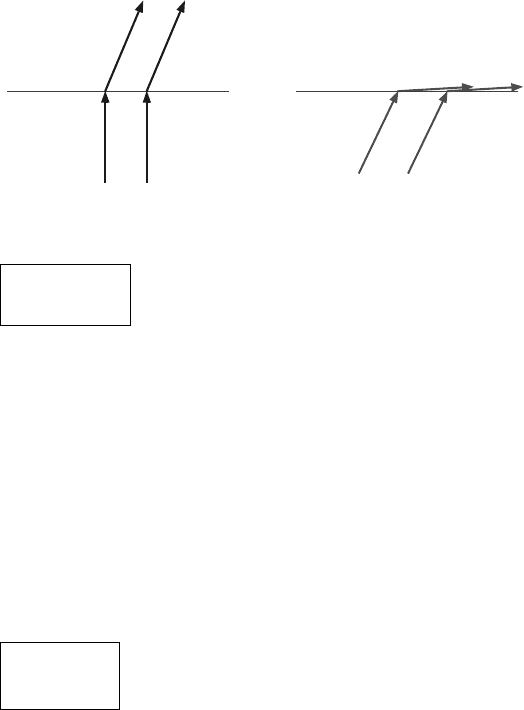
From eqs. (5.97) and (5.98) follows the law of refraction for magnetic field
lines. For simplicity reasons, we assume no free currents in the surface. Using
Fig. 5.48, we find
that is
Fig. 5.47
dAn
2
dAn
1
–=
2
1
dAn
1
B∇•()τd
∫
BdA•
∫
°
B
2
B
1
–()n
1
• dA 0== =
B
2
B
1
–()n
1
• 0=
B
2n
B
1n
=
Fig. 5.48
µ
2
µ
1
B
2
B
2t
B
2n
B
1t
B
1
B
1n
α
2
α
1
α
1
tan
α
2
tan
--------------
B
1t
B
1n
---------
B
2t
B
2n
---------
---------
B
1t
B
2t
--------
µ
1
H
1t
µ
2
H
2t
---------------===
5.8 Plate, Sphere, Hollow Sphere in a Uniform Magnetic Field 307
.
(5.99)
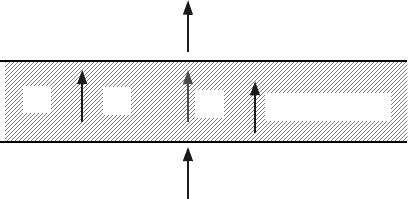
If (for example at the boundary between a ferromagnetic material and
vacuum) then we have either or . This means that the force lines
either enter the ferromagnetic material perpendicularly, or they are tangential to its
surface (Fig. 5.49).
The formulas derived above do not consider possible effects of dipole layers.
As before in the electrostatic case, dipole layers modify the boundary conditions.
Sometimes, the boundary conditions for A are needed. Because of
and
,
similar considerations as before lead to the result that both, the tangential and the
normal components of A have to be continuous at the boundary:
.
(5.100)
The following sections are dedicated to illustrate the boundary conditions by some
examples.
5.8 Plate, Sphere, Hollow Sphere in a Uniform Magnetic Field
5.8.1 The Planar Plate
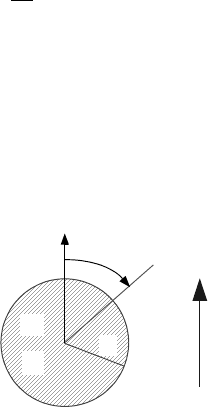
Consider a planar plate of magnetic material ( ) be placed inside a uniform field
which is perpendicular to the plates (Fig. 5.50). This causes a uniform
magnetization inside the plate
.
α
1
tan
α
2
tan
--------------
µ
1
µ
2
------
=
µ
1
µ
2
«
α
2
90°≈α
1
0°≈
Fig. 5.49
µ
2
µ
1
vacuum
ferromagnetic
µ
2
µ
1
α
1
0°≈
α
2
90°≈
A∇• 0=
A∇× B=
A
1n
A
2n
=
A
1t
A
2t
=
µ
H
a
M µ
0
χ
m
H
i
=
308 Basics of Magnetostatics
The magnetization M causes an opposing field (more precisely, this field
weakens the applied field in ferro- and paramagnetic materials, while it amplifies
the applied field in diamagnetic materials). The resulting net field inside is
.
And so for the magnetization:
.
Now we determine the field caused by M. At the surface, M causes fictitious
magnetic charges (for example for paramagnetism + on top and - at the
bottom). The result for paramagnetism is a field pointing downward.
.
Any case, it is always true
.
(5.101)
Therefore
i.e.,
,
(5.102)
and
.
(5.103)
Analogous to the definition of the de-electrification factor in Sect. 2.12.4,
eq. (2.141), one may now define the de-magnetization factor of the plate ( ).
With eq. (5.103) one obtains
.
i.e.,
Fig. 5.50
H
a
H
i
H
a
H
g
+=
µ
0
H
g
M
µ
µ
0
H
a
H
g
H
a
H
i
H
a
H
g
+=
M µ
0
χ
m
H
a
µ
0
χ
m
H
g
+=
H
g
ρ
mag
±
H
g
M
µ
0
------=
H
g
M
µ
0
------–=
M µ
0
χ
m
H
a
χ
m
M–=
M
µ
0
χ
m
H
a
1 χ
m
+
---------------------=
H
i
H
a
M
µ
0
------–=
1 µ
0
⁄
H
i
H
a
M
µ
0
------– H
a
χ
m
H
a
1 χ
m
+
----------------–
H
a
1 χ
m
+
----------------== =
5.8 Plate, Sphere, Hollow Sphere in a Uniform Magnetic Field 309
.
(5.104)
This shows that for a paramagnetic plate ( ) and for a diamagnetic
plate ( ) , as mentioned above already. Furthermore,
,
that is, B is continuous, as necessary. We could have used this fact to directly obtain
eq. (5.104).
5.8.2 The Sphere
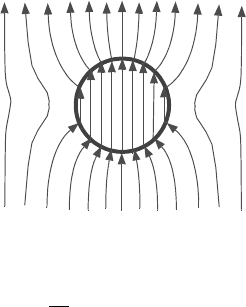
Consider a sphere (of ) in a space (of ) and placed in an applied uniform field
extending to infinity (Fig. 5.51). As for the electrostatic case, we can solve
this problem by superposition of a dipole field on the outside and a uniform field
inside. This solution is also the only one possible. We try the following Ansatz
.
(5.105)
Two constants and C need to be determined. They result from the boundary
conditions at the sphere’s surface , where and have to be
continuous. We start with
,
i.e.,
and
H
i
H
a
µ
r
-------=
µ
r
1> H
i
H
a
<
µ
r
1< H
i
H
a
>
B
i
µH
i
µ
r
µ
0
H
i
µ
r
µ
0
H
a
µ
r
------
µ
0
H
a
B
a
== = = =
µ
i
µ
a
H
a ∞,
Fig. 5.51
z
µ
a
H
a ∞,
µ
i
ψ
i
r
s
θ
ψ
a
ψ
a
H
a ∞,
r θcos–
C θcos
r
2
----------------+=
ψ
i
H
i
r θcos–=
H
i
rr
s
= B
r
H
θ
H
θ
1
r
---
θ∂
∂ψ
–=
H
θa
H
a ∞,
θsin–
C θsin
r
3
---------------+=
H
θi
H
i
θsin–=
310 Basics of Magnetostatics
,
i.e., the B field outside and inside is
.
This determines the boundary conditions to be
.
The result for after eliminating C becomes
(5.106)
and
.
(5.107)
Those results are, again, entirely analogous to those obtained in electrostatics. Only
replacing by gives the previous results from electrostatics. The field inside is
uniform, which is only the case for ellipsoids and their limiting cases.
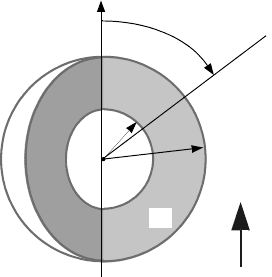
If (ferromagnetic sphere in vacuum, see Fig. 5.52), then
,
i.e., the field is magnified by a factor of 3. However, becomes very small
B
r
µ
r∂
∂ψ
–=
B
ra
+µ
a
H
a ∞,
θcos 2µ
a
C θcos
r
3
----------------
+=
B
ri
+µ
i
H
i
θcos=
H
a ∞,
–
C
r
s
3
-----+ H
i
–=
+µ
a
H
a ∞,
2µ
a
C
r
s
3
-----
++µ
i
H
i
=
H
i
H
i
3µ
a
2µ
a
µ
i
+
--------------------
H
a ∞,
=
B
i
3µ
i
2µ
a
µ
i
+
--------------------
B
a ∞,
=
εµ
µ
i
µ
a
»
Fig. 5.52
µ
a
µ
i
«
B
i
3B
a ∞,
≈
H
i
5.8 Plate, Sphere, Hollow Sphere in a Uniform Magnetic Field 311
.
The force lines outside are perpendicular to the surface. The field is equivalent to
the electric field of a conductive sphere in a uniform external field.
For a sphere in vacuum the relation is and therefore, we can write
in the following form:
(5.108)
where, of course,
.
The de-magnetization factor of the sphere is therefore . This relates to the
fact that the field of a uniformly polarized sphere (M) creates the field inside
.
5.8.3 The Hollow Sphere
The problem of a hollow sphere in a uniform, applied field can be solved in a
similar manner (Fig. 5.53). There are three regions with the permeabilities
. For the potentials, we try the Ansatz
.
(5.109)
H
i
3
µ
a
µ
i
------
H
a ∞,
≈
µ
a
µ
0
=
H
i
H
i
H
a ∞,
1
3µ
0
---------
M–=
M µ
0
χ
mi
H
i
µ
0
µ
ri
1–()H
i
µ
i
µ
0
–()H
i
== =
13µ
0
⁄
H
M–
3µ
0
---------=
H
a ∞,
Fig. 5.53
r
1
r
2
µ
i
µ
m
H
a ∞,
z
θ
µ
a
µ
a
µ
m
µ
i
,,
ψ
a
H
a ∞,
r θcos–
C θcos
r
2
----------------+=
ψ
m
H
m
r θcos–
D θcos
r
2
----------------+=
ψ
i
H
i
r θcos–=

312 Basics of Magnetostatics
The four constants are determined in the familiar way by two
boundary conditions at and two at . They result in these equations:
.
(5.110)
Cramer’s rule may be used to solve for . We skip the laborious, but trivial
algebra. The final result is
.
(5.111)
The previously calculated case of the sphere is a special case of this. Letting
gives again eq. (5.106). Another interesting case is for
(vacuum), . Now the field is
.
For a uniform ferromagnetic hollow sphere we have and therefore
.
If also , then
.
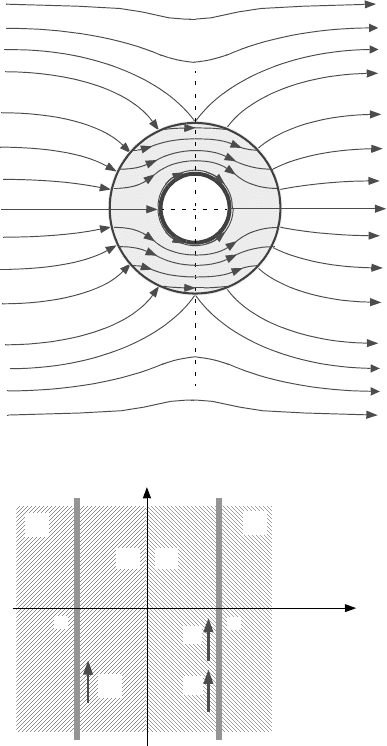
This is an important and handy result. Since may take on values of the order of
, i.e., is by 3 to 4 orders of magnitude smaller than the outside field. This
means that highly permeable materials allow for the shielding of external fields
(Fig. 5.54). Of course, the B field is:
CDH
m
H
i
,, ,
rr
1
= rr
2
=
H
a ∞,
–
C
r
2
3
-----+ H
m
–
D
r
2
3
-----+=
H
m
–
D
r
1
3
-----+ H
i
–=
µ
a
H
a ∞,
2µ
a
C
r
2
3
-----
+ µ
m
H
m
2µ
m
D
r
2
3
-----
+=
µ
m
H
m
2µ
m
D
r
1
3
-----
+ µ
i
H
i
=
H
i
H
i
H
a ∞,
1
2
3
---
µ
i
3µ
a
---------
2 µ
m
µ
i
–()µ
m
µ
a
–()
9µ
m
µ
a
--------------------------------------------------
1
r
1
r
2
----
3
–++
------------------------------------------------------------------------------------------------------------
=
r
1
r
2
= µ
i
µ
a
µ
0
==
µ
m
µ
0
≠
H
i
H
a ∞,
1
1
2
µ
m
µ
0
-------1–
2
9
µ
m
µ
0
-------
---------------------------
1
r
1
r
2
----
3
–+
---------------------------------------------------------------------
=
µ
m
µ
0
»
H
i
9H
a ∞,
2
µ
m
µ
0
-------
1
r
1
r
2
----
3
–
------------------------------------------=
r
1
r
2
⁄()
3
1«
H
i
9H
a ∞,
2
µ
m
µ
0
-------
----------------
≈
µ
m
10
4
µ
0
H
i
5.9 Imaging at a Plane 313
.
5.9 Imaging at a Plane
The next problem considered deals with the magnetic field of an infinitely long,
straight, current carrying wire. The wire shall be parallel to a boundary that
separates two materials of different permeability (Fig. 5.55). If we let ourselves be
Fig. 5.54
µ
m
µ
0
»
µ
0
µ
0
B
a
B
i
9B
a ∞,
2
µ
m
µ
0
-------
---------------
≈
Fig. 5.55
µ
1
I '
a
µ
2
a–
I ''
I
x
1
2
z