
Lehner G. Electromagnetic Field Theory for Engineers and Physicists
Подождите немного. Документ загружается.


324 Basics of Magnetostatics
.
(5.156)
To calculate the scalar potential is possible. The relation for the current-free
space is then
,
(5.157)
or
.
(5.158)
Using the separation Ansatz
(5.159)
gives the same result as before, except that for all cylinder functions, the index 1 is
replaced by 0.
The choice here is to either pick Z as of (5.151) or (5.152) with
(5.160)
or pick Z as of (5.155) with
.
(5.161)
Before discussing examples of boundary value problems in detail, we shall provide
some insight into rotationally symmetric fields.
5.11.2 Structure of Rotationally Symmetric Magnetic Fields
The function is constant along field lines. From
follows with (5.145) that
.
Therefore, for rotational symmetry , it is:
This means that is the flux function of the rotationally symmetric field.
The lines are the field lines laying in the r-z plane
()
The field used initially based on g as of eq. (5.144) is not the most general
rotationally symmetric field, which is rather
,
which yields
Rr() C
1
I
1
kr()C
2
K
1
kr()+=
ψ
∇
2
ψ 0=
1
r
---
r∂
∂
r
r∂
∂
ψ
∂
2
∂z
2
--------
ψ+0=
ψ rz,()Rr()Zz()=
Rr() C
1
J
0
kr()C
2
N
0
kr()+=
Rr() C
1
I
0
kr()C
2
K
0
kr()+=
rA
ϕ
rz,()
BA∇×=
B
∂
∂z
-----
A
ϕ
–0
1
r
---
r∂
∂
rA
ϕ
(),,〈〉=
∂∂ϕ⁄ 0=
B rA
ϕ
()∇• B
r
r∂
∂
rA
ϕ
()B
z
∂
∂z
-----
rA
ϕ
()+=
∂
∂z
-----
A
ϕ
–
r∂
∂
rA
ϕ
()
1
r
---
r∂
∂
rA
ϕ
()
∂
∂z
-----
rA
ϕ
()+0 .==
rA
ϕ
rz,()
rA
ϕ
rz,()const.=
ϕ const.=
g g
r
rz,()g
ϕ
rz,()g
z
rz,(),,〈〉=

5.11 Cylindrical Boundary Value Problems 325
.
Both vector fields are source-free:
.
Both conditions are satisfied by two arbitrary functions and when
calculating the r- and z-components of g and B as follows:
.
(5.162)
This allows one to calculate:
.
Thereby, G is constant along the field lines and F along the current density lines.
Furthermore, from
follows that
(5.163)
The term can be regarded as the magnetic flux through a disk of radius r,
oriented perpendicular to the z-axis and the term as the current through this
region.
.
Therefore, by Ampere’s law
B B
r
rz,()B
ϕ
rz,()B
z
rz,(),,〈〉=
g∇•
1
r
---
r∂
∂
rg
r
()
z∂
∂
g
z
()+0==
B∇•
1
r
---
r∂
∂
rB
r
z∂
∂
B
z
()+0==
Frz,() Grz,()
g
r
1
r
---
z∂
∂F
– ,= g
z
1
r
---
r∂
∂F
=
B
r
1
r
---
z∂
∂G
– ,= B
z
1
r
---
r∂
∂G
=
g F∇•
1
r
---
z∂
∂F
r∂
∂F
– g
ϕ
0⋅
1
r
---
r∂
∂F
z∂
∂F
++ 0==
B G∇•
1
r
---
z∂
∂G
r∂
∂G
– B
ϕ
0⋅
1
r
---
r∂
∂G
z∂
∂G
++ 0==
BA∇×=
g
1
µ
0
------
B∇×=
Grz,() rA
ϕ
rz,()=
Frz,()
1
µ
0
------
rB
ϕ
rz,() .=
2πG
2πF
φ B
z
Ad
A
∫
B
z
2πr' r'd
0
r
∫
2πr'
1
r'
---
r'∂
∂G
r'd
0
r
∫
2πGrz,()== = =
Ig
z
Ad
A
∫
g
z
2πr' r'd
0
r
∫
2πr'
1
r'
---
r'∂
∂F
r'd
0
r
∫
2πFrz,()== = =
326 Basics of Magnetostatics
and because of eq. (5.21)
which makes the eqs. (5.163) plausible.
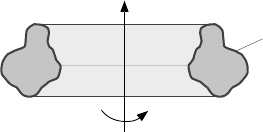
The fields lines run entirely on the surface , i.e., on toroidal,
rotationally symmetric surfaces with a cross section for example, as shown in
Fig. 5.60. Thus, a given force line never leaves this surface. There is no azimuthal
field if and then, all field lines lie on the surface When
superposing azimuthal fields , then the field lines spiral around the toroidal
surfaces This makes it possible that the field lines close
themselves after a number of loops. However, that has to be regarded as the
exception. We emphasize this here because of the frequent misconception that in
order for B to be source free, the B lines have to either close or go to infinity. This
is wrong. Field lines can remain in the finite space and still never close up, for
example, on a toroidal surface as in Fig. 5.60 whereby filling the surface arbitrarily
dense. We could rightfully state that a field line, when it does not close, creates the
toroidal surface (the so-called magnetic surface). Of course, if we were to trace a
field line from a starting point through sufficiently many loops, then we would find
that this line will come arbitrarily close to the starting point and thus, the line
“nearly” closes.
5.11.3 Examples
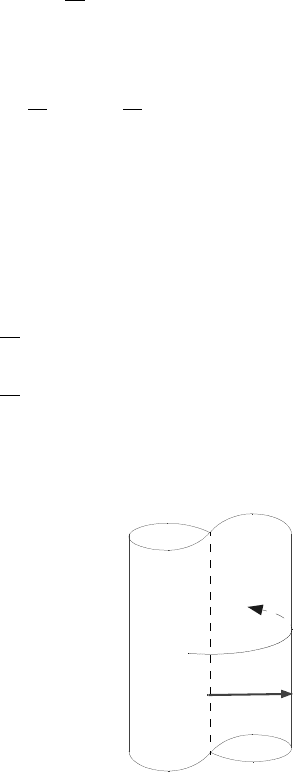
5.11.3.1 Cylinder with an Azimuthal Surface Current
Consider a cylinder of radius carrying the azimuthal surface current ,
where
.
(5.164)
Then one writes for in the regions 1 and 2 (shown in Fig. 5.61)
B
ϕ
µ
0
I
2πr
---------
µ
0
2πF
2πr
-----------------
µ
0
F
r
----------== =
A
ϕ
φ
2πr
---------
2πG
2πr
-----------
G
r
----== =
Grz,() const.=
Frz,() 0= ϕ const.=
F 0≠
Grz,() const.=
Fig. 5.60
z
Grz,() const.=
r
0
k
ϕ
z()
k
ϕ
z() k
ϕ
z–()=
A
ϕ
5.11 Cylindrical Boundary Value Problems 327
.
(5.165)
Arguments of the kind used in Sect. 3.7 serve to justify this statement. Use of
alone, without , is a result of the symmetry (5.164). Furthermore,
notice that diverges at the origin, while diverges at infinity. The functions
and are determined by the boundary conditions at , where
has to be continuous and the z-components of the field have to fit the current, that
is, according to (5.96) it must be
.
(5.166)
Continuity of results in
i.e.,
.
(5.167)
Using (5.166) and
(5.168)
(5.169)
gives
Fig. 5.61
12
r
0
k
ϕ
z()
A
ϕ
1()
f
1
k()I
1
kr() kz()cos kd
0
∞
∫
=
A
ϕ
2()
f
2
k()K
1
kr() kz()cos kd
0
∞
∫
=
kz()cos kz()sin
K
1
I
1
f
1
f
2
rr
0
=
B
r
z∂
∂A
ϕ
–=
1
r
---
r∂
∂
rA
ϕ
1()
1
r
---
r∂
∂
rA
ϕ
2()
–
rr
0
=
B
z1
B
z2
– µ
0
k
ϕ
z()==
B
r
f
1
k()I
1
kr
0
()f
2
k()K
1
kr
0
()–[]kkz()sin kd
0
∞
∫
0=
f
1
k()I
1
kr
0
()f
2
k()K
1
kr
0
()=
zd
d
zI
1
z()()zI
0
z()=
zd
d
zK
1
z()()zK
0
z()–=
328 Basics of Magnetostatics
where is the Fourier transform of , and then
.
(5.170)
Eqs (5.167) and (5.170) allow to calculate the two functions and .
Specifically, if
(5.171)
(see eq. (3.198)), then
.
(5.172)
When applying
this gives and
and ,
and for the vector potential
.
(5.173)
Similar considerations allow to calculate the scalar potential. The calculation is left
for the reader as an exercise. The scalar potential for the loop current (5.171) is
.
(5.174)
Compatibility of the two results is easy to verify. It has to be
f
1
k()I
0
kr
0
()f
2
k()K
0
kr
0
()+[]kkz()cos kd
0
∞
∫
µ
0
k
ϕ
z() µ
0
k
˜
ϕ
k() kz()cos kd
0
∞
∫
==
k
˜
ϕ
k() k
ϕ
z()
f
1
k()I
0
kr
0
()f
2
k()K
0
kr
0
()+
µ
0
k
˜
ϕ
k()
k
--------------------=
f
1
k() f
2
k()
k
ϕ
z() Iδ z()
I
π
---
kz()cos kd
0
∞
∫
==
k
˜
ϕ
k()
I
π
---=
I
0
z()K
1
z() K
0
z()I
1
z()+
1
z
---=
f
1
f
2
f
1
µ
0
Ir
0
π
-------------
K
1
kr
0
()=
f
2
µ
0
Ir
0
π
-------------
I
1
kr
0
()=
A
ϕ
1()
µ
0
Ir
0
π
-------------
K
1
kr
0
()I
1
kr() kz()cos kd
0
∞
∫
=
A
ϕ
2()
µ
0
Ir
0
π
-------------
I
1
kr
0
()K
1
kr() kz()cos kd
0
∞
∫
=
ψ
1()
Ir
0
π
-------
K
1
kr
0
()I
0
kr() kz()sin kd
0
∞
∫
–=
ψ
2()
+
Ir
0
π
-------
I
1
kr
0
()K
0
kr() kz()sin kd
0
∞
∫
=
5.11 Cylindrical Boundary Value Problems 329
.
(5.175)
Indeed, both and result in the same field
,
(5.176)
where besides eqs. (5.168) and (5.169), the following relations are also needed
,
(5.177)
. (5.178)
Obviously, from (5.176) it follows that these fields exhibit the correct symmetry
relative to z. The radial components are anti-symmetric in the case of symmetric
current distributions and the longitudinal components are symmetric. This behavior
is a result of (5.175) if is stated as a symmetric and as an anti-symmetric
function.
Of course, this special case (5.171) corresponds to the current loop, discussed
previously in detail (Sect. 5.2.4). The vector potential (5.173) is initially just a
rather complicated Fourier series of the previously found vector potential (5.48).
Both equations are equivalent. Nevertheless, the Fourier series (5.173) is much
more useful when solving boundary value problems than the other, much handier
equation (5.48). An example shall serve to illustrate this (Sect. 5.11.3.3). However,
in the following example (Sect. 5.11.3.2), we will first derive another form of the
same potential.
B
r
z∂
∂A
ϕ
– µ
0
r∂
∂ψ
–==
B
z
1
r
---
r∂
∂
rA
ϕ
µ
0
z∂
∂ψ
–==
A
ϕ
ψ
B
r
1()
+
µ
0
I
π
--------
K
1
kr
0
()I
1
kr()kr
0
kz()sin kd
0
∞
∫
=
B
r
2()
+
µ
0
I
π
--------
I
1
kr
0
()K
1
kr()kr
0
kz()sin kd
0
∞
∫
=
B
z
1()
+
µ
0
I
π
--------
K
1
kr
0
()I
0
kr()kr
0
kz()cos kd
0
∞
∫
=
B
z
2()
µ
0
I
π
--------
I
1
kr
0
()K
0
kr()kr
0
kz()cos kd
0
∞
∫
–=
zd
d
I
0
I
1
z()=
zd
d
K
0
K
1
z()–=
A
ϕ
ψ
330 Basics of Magnetostatics
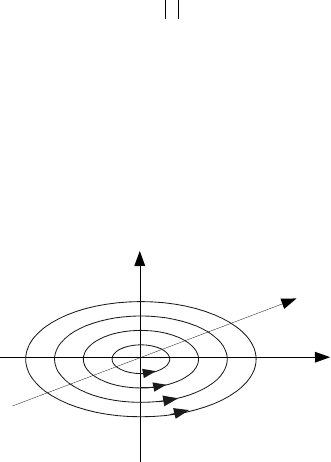
5.11.3.2 Azimuthal Surface Currents in the x-y-Plane
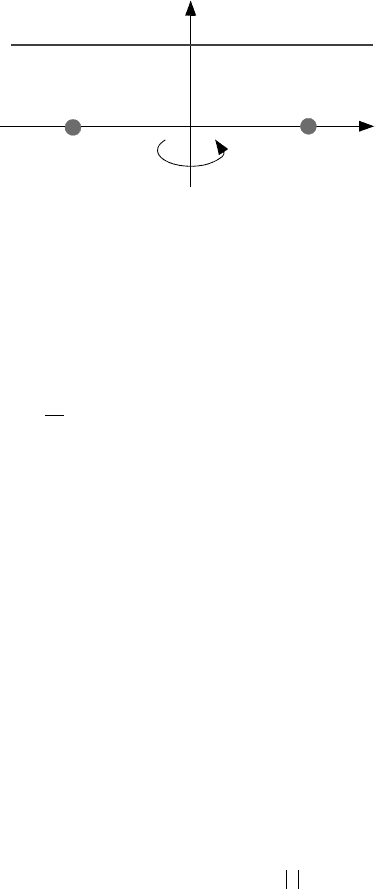
Let an azimuthal surface current flow in the plane and let it depend only on
r (Fig. 5.62). This is an opportunity to use the other solution (5.151) through
(5.153) and (5.155), (5.156), respectively. The example of Sect. 5.11.3.1 required
one to use the second form, since a function of z was given on a cylinder, which
required a Fourier transform with respect to z and thereby the Ansatz with the
trigonometric functions. In the current example, a function of r is given. This
requires a Hankel transform, which is possible with the first of the two trial
functions. To satisfy the boundary conditions for , where the fields have to
vanish, we write
,
(5.179)
where the index 1 addresses the region and the index 2 the region .
First, for is must be
,
from which results
.
(5.180)
This allows to combine the two trial functions of (5.179) into
.
(5.181)
The task is now to find for such that (see (5.96))
.
(5.182)
Based on (3.224), we introduce the Hankel transformed function
(5.183)
where by (3.225)
z 0=
Fig. 5.62
k
ϕ
k()
x
y
z
1
2
z ∞±→
A
ϕ
1()
f
1
k()J
1
kr() kz–()exp kd
0
∞
∫
=
A
ϕ
2()
f
2
k()J
1
kr() +kz()exp kd
0
∞
∫
=
z 0≥ z 0≤
z 0=
B
z
1()
B
z
2()
=
f
1
k() f
2
k() fk()==
A
ϕ
fk()J
1
kr() kz–()exp kd
0
∞
∫
=
fk() z 0=
B
r
1()
B
r
2()
– µ
0
k
ϕ
r()=
k
˜
ϕ
k() rk
ϕ
r()J
1
kr()rd
0
∞
∫
=
5.11 Cylindrical Boundary Value Problems 331
.
(5.184)
Then for
.
(5.185)
Using
gives for
.
or
.
(5.186)
In particular, consider the current loop I at
.
(5.187)
Then by (5.183)
and in our case
,
(5.188)
i.e.,
.
(5.189)
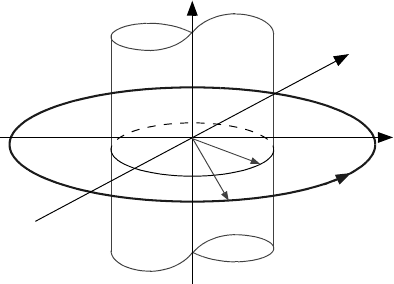
This is yet another representation of the potential of a current loop. It is equivalent
to the two previous ones, (5.48) and (5.173). Certain boundary value problems
require this form. Such a problem would, for instance, be that of a current loop
located in the plane at , opposite to a plane boundary at between two
media of different permeability ( ), as illustrated in Fig. 5.63. We will skip
k
ϕ
r() kk
˜
ϕ
k()J
1
kr()kd
0
∞
∫
=
z 0=
B
r
1()
B
r
2()
– µ
0
kk
˜
ϕ
k()J
1
kr()kd
0
∞
∫
=
B
r
z∂
∂A
ϕ
–=
z 0=
fk()J
1
kr()kfk()J
1
kr()k+[]kd
0
∞
∫
µ
0
kk
˜
ϕ
k()J
1
kr()kd
0
∞
∫
=
2fk() µ
0
k
˜
ϕ
k()=
rr
0
=
k
ϕ
Iδ rr
0
–()=
k
˜
ϕ
k() rIδ rr
0
–()J
1
kr()rd
0
∞
∫
Ir
0
J
1
kr
0
()==
fk()
µ
0
Ir
0
J
1
kr
0
()
2
--------------------------------=
A
ϕ
µ
0
Ir
0
2
-------------
J
1
kr
0
()J
1
kr() kz–()exp kd
0
∞
∫
=
z 0= zz
0
=
µ
1
µ
2
,
Fig. 5.63 current loop vis-à-vis a plane boundary
µ
2
µ
1
plane zz
0
=
r
z
plane z 0=
332 Basics of Magnetostatics
this problem here, except to note that it can be solved in a similar way as the
problem in the next example.
5.11.3.3 Current Loop and Magnetizable Cylinder
Let the space contain two media of different permeability. Permeability in
region 1( ) is and for region 2 ( ). Region 1 hosts a circular
current loop with the current I. Its radius is (Fig. 5.64). We want to find the
behavior of the fields in the two regions.
There are no currents in region 2. This is equivalent to a vacuum field. We try
,
(5.190)
The current I needs to be considered in region 1, i.e., the inhomogeneous equation
(5.146) needs to be solved. We already know the special solution for the ring
current I. The solution for the general solution is just the superposition of that
particular solution, and the solution of the homogeneous equation, i.e., the solution
for the vacuum. Therefore for :
(5.191)
and for
.
(5.192)
For , this gives exactly the field of the current I alone, i.e., and
describe the effect caused by the existence of the second medium ( ). In other
words: and express the magnetization currents on the boundary at .
and are determined by the boundary conditions at , which are:
,
(5.193)
Fig. 5.64
12
I
x
y
z
µ
2
µ
1
r
1
r
0
rr
1
>µ
1
µ
2
rr
1
<
r
0
A
ϕ
2()
µ
1
Ir
0
π
-------------
f
2
k() K
1
kr
0
()+[]I
1
kr() kz()cos kd
0
∞
∫
=
r
1
rr
0
≤≤
A
ϕ
1()
µ
1
Ir
0
π
-------------
f
1
k()K
1
kr()K
1
kr
0
()I
1
kr()+[]kz()cos kd
0
∞
∫
=
r
0
r≤
A
ϕ
1()
µ
1
Ir
0
π
-------------
f
1
k()K
1
kr()I
1
kr
0
()K
1
kr()+[]kz()cos kd
0
∞
∫
=
f
1
f
2
0==
f
1
f
2
µ
2
f
1
f
2
rr
1
=
f
1
f
2
rr
1
=
B
r
1()
B
r
2()
=

5.11 Cylindrical Boundary Value Problems 333
and
.
(5.194)
This gives
(5.195)
and
.
(5.196)
Solving for and gives
(5.197)
. (5.198)
This basically solves the problem. Of course, the special case of with
is just the field of a current loop in a uniform medium.
As before in Sect. 5.9, it is possible to calculate the magnetization currents in
the surface and show that these currents just represent the additional field
created by and . First
where with
(5.199)
and applying the already frequently used formula
(5.200)
yields
1
µ
1
------
B
z
1()
1
µ
2
------
B
z
2()
=
f
2
k()I
1
kr
1
()K
1
kr
0
()I
1
kr
1
()+ f
1
k()K
1
kr
1
()K
1
kr
0
()I
1
kr
1
()+=
f
2
k()I
0
kr
1
()K
1
kr
0
()I
0
kr
1
()+
µ
2
----------------------------------------------------------------------------
K
1
kr
0
()I
0
kr
1
()f
1
k()K
0
kr
1
()–
µ
1
----------------------------------------------------------------------------=
f
1
f
2
f
1
k()
µ
2
µ
1
------1–
K
1
kr
0
()I
0
kr
1
()I
1
kr
1
()
K
1
kr
1
()I
0
kr
1
()
µ
2
µ
1
------
K
0
kr
1
()I
1
kr
1
()+
-----------------------------------------------------------------------------------------=
f
2
k()
µ
2
µ
1
------1–
K
1
kr
0
()I
0
kr
1
()K
1
kr
1
()
K
1
kr
1
()I
0
kr
1
()
µ
2
µ
1
------
K
0
kr
1
()I
1
kr
1
()+
-----------------------------------------------------------------------------------------=
µ
1
µ
2
=
f
1
f
2
0==
rr
1
=
f
1
f
2
k
ϕ
z()
M
z
2()
M
z
1()
–
µ
0
-----------------------------
rr
1
=
µ
2
µ
0
–
µ
2
µ
0
------------------
B
z
2()
µ
1
µ
0
–
µ
1
µ
0
------------------
B
z
1()
–
rr
1
=
==
1
µ
0
------
B
z
2()
B
z
1()
–[]
rr
1
=
,=
B
z
1
r
---
r∂
∂
rA
ϕ
()=
K
1
z()I
0
z() K
0
z()I
1
z()+
1
z
---=