
Lopes H.S., Cruz L.M. (eds.) Computational Biology and Applied Bioinformatics
Подождите немного. Документ загружается.

5
MicroArray Technology - Expression Profiling of
MRNA and MicroRNA in Breast Cancer
Aoife Lowery, Christophe Lemetre, Graham Ball and Michael Kerin
1
Department of Surgery, National University of Ireland Galway,
2
John Van Geest Cancer Research Centre, School of Science & Technology,
Nottingham Trent University, Nottingham
1
Ireland
2
UK
1. Introduction
Breast cancer is the most common form of cancer among women. In 2009, an estimated
194,280 new cases of breast cancer were diagnosed in the United States; breast cancer was
estimated to account for 27% of all new cancer cases and 15% of cancer-related mortality in
women (Jemal et al, 2009). Similarly, in Europe in 2008, the disease accounted for some 28%
and 17% of new cancer cases and cancer-related mortality in women respectively (Ferlay et
al, 2008). The increasing incidence of breast cancer worldwide will result in an increased
social and economic burden; for this reason there is a pressing need from a health and
economics perspective to develop and provide appropriate, patient specific treatment to
reduce the morbidity and mortality of the disease. Understanding the aetiology, biology and
pathology of breast cancer is hugely important in diagnosis, prognostication and selection of
primary and adjuvant therapy. Breast tumour behaviour and outcome can vary
considerably according to factors such as age of onset, clinical features, histological
characteristics, stage of disease, degree of differentiation, genetic content and molecular
aberrations. It is increasingly recognised that breast cancer is not a single disease but a
continuum of several biologically distinct diseases that differ in their prognosis and
response to therapy (Marchionni et al, 2008; Sorlie et al, 2001). The past twenty years has
seen significant advances in breast cancer management. Targeted therapies such as
hormonal therapy for estrogen receptor (ER) positive breast tumours and trastuzumab for
inhibition of HER2/neu signalling have become an important component of adjuvant
therapy and contributed to improved outcomes (Fisher et al, 2004; Goldhirsch et al, 2007;
Smith et al, 2007). However, our understanding of the molecular basis underlying breast
cancer heterogeneity remains incomplete. It is likely that there are significant differences
between breast cancers that reach far beyond the presence or absence of ER or HER2/neu
amplification. Patients with similar morphology and molecular phenotype based on ER, PR
and HER2/neu receptor status can have different clinical courses and responses to therapy.
There are small ER positive tumours that behave aggressively while some large high grade
ER negative, HER2/neu receptor positive tumours have an indolent course. ER-positive
tumours are typically associated with better clinical outcomes and a good response to

Computational Biology and Applied Bioinformatics
88
hormonal therapies such as tamoxifen (Osborne et al, 1998). However, a subset of these
patients recur and up to 40% develop resistance to hormonal therapy (Clarke et al, 2003).
Furthermore, clinical studies have shown that adding adjuvant chemotherapy to tamoxifen
in the treatment of node negative, ER positive breast cancer improves disease outcome
(Fisher et al, 2004). Indeed, treatment with tamoxifen alone is only associated with a 15%
risk of distant recurrence, indicating that 85% of these patients would do well without, and
could be spared the cytotoxic side-effects of adjuvant chemotherapy.
The heterogeneity of outcome and response to adjuvant therapy has driven the discovery of
further molecular predictors. Particular attention has focused on those with prognostic
significance which may help target cancer treatment to the group of patients who are likely
to derive benefit from a particular therapy. There has been a huge interest in defining the
gene expression profiles of breast tumours to further understand the aetiology and progression
of the disease in order to identify novel prognostic and therapeutic markers. The sequencing
of the human genome and the advent of high throughput molecular profiling has facilitated
comprehensive analysis of transcriptional variation at the genomic level. This has resulted in
an exponential increase in our understanding of breast cancer molecular biology. Gene
expression profiling using microarray technology was first introduced in 1995 (Schena et al,
1995). This technology enables the measurement of expression of tens of thousands of
mRNA sequences simultaneously and can be used to compare gene expression within a
sample or across a number of samples. Microarray technology has been productively
applied to breast cancer research, contributing enormously to our understanding of the
molecular basis of breast cancer and helping to achieve the goal of individualised breast
cancer treatment. However as the use of this technology becomes more widespread, our
understanding of the inherent limitations and sources of error increases. The large amount
of data produced from such high throughput systems has necessitated the use of complex
computational tools for management and analysis of this data; leading to rapid
developments in bioinformatics.
This chapter provides an overview of current gene expression profiling techniques, their
application to breast cancer prognostics and the bioinformatic challenges that must be
overcome to generate meaningful results that will be translatable to the clinical setting. A
literature search was performed using the PubMed database to identify publications
relevant to this review. Citations from these articles were also examined to yield further
relevant publications.
2. Microarray technology – principles & technical considerations
2.1 High throughput genomic technology
There are a multitude of high throughput genomic approaches which have been developed
to simultaneously measure variation in thousands of DNA sequences, mRNA transcripts,
peptides or metabolites:
• DNA microarray measures gene expression
• Microarray comparative genomic hybridisation (CGH) measures genomic gains and
losses or identifies differences in copy number for genes involved in pathological states
(Oosterlander et al, 2004)
• Single nucleotide polymorphism (SNP) microarray technology (Huang et al, 2001) has
been developed to test for genetic aberrations that may predispose an individual to
disease development.

MicroArray Technology - Expression Profiling of MRNA and MicroRNA in Breast Cancer
89
• CpG arrays (Yan et al , 2000) can be used to determine whether patterns of specific
epigenetic alterations correlate with pathological parameters.
• Protein microarrays (Stoll et al, 2005) consisting of antibodies, proteins, protein
fragments, peptides or carbohydrate elements, are used to detect patterns of protein
expression in diseased states.
• ChIP-on-chip (Oberley et al, 2004) combines chromatin immunoprecipitation (ChIP)
with glass slide microarrays (chip) to detect how regulatory proteins interact with the
genome.
All of these approaches offer unique insights into the genetic and molecular basis of disease
development and progression.
This chapter focuses primarily on gene expression profiling and cDNA microarrays,
however many of the issues raised, particularly in relation to bioinformatics are also
applicable to the other “-omic” technologies.
Gene expression which is a measurement of gene “activity” can be determined by the
abundance of its messenger RNA (mRNA) transcripts or by the expression of the protein
which it encodes. ER, PR and HER2/neu receptor status are determined in clinical practice
using immunohistochemistry (IHC) to quantitate protein expression or fluorescence in situ
hybridisation (FISH) to determine copy number. These techniques are semi-quantitative and
are optimal when determining the expression of individual or a small number of genes.
Microarray technology is capable of simultaneously measuring the expression levels of
thousands of genes in a biological sample at the mRNA level. The abundance of individual
mRNA transcripts in a sample is a reflection of the expression levels of corresponding genes.
When a complementary DNA (cDNA) mixture reverse transcribed from the mRNA is
labelled and hybridised to a microarray, the strength of the signal produced at each address
shows the relative expression levels of the corresponding gene.
cDNA microarrays are miniature platforms containing thousands of DNA sequences which
act as gene specific probes, immobilised on a solid support (nylon, glass, silicon) in a parallel
format. They are reliant on the complementarity of the DNA duplex i.e. reassembly of
strands with base pairing A to T and C to G which occurs with high specificity. There are
microarray platforms available containing bound librarys of oligonucleotides representing
literally all known human genes e.g. Affymetrix GeneChip (Santa Clara, CA), Agilent array
(Santa Clara, CA), Illumina bead array (San Diego, CA). When fluorescence-labelled cDNA
is hybridised to these arrays, expression levels of each gene in the human genome can be
quantified using laser scanning microscopes. These microscopes measure the intensity of the
signal generated by each bound probe; abundant sequences generate strong signals and rare
sequences generate weaker signals. Despite differences in microarray construction and
hybridization methodologies according to manufacturing, microarray-based measurements
of gene expression appear to be reproducible across a range of different platforms when the
same starting material is used, as demonstrated by the MicroArray Quality Control project
(Shi et al, 2006).
2.2 Experimental approach
There are experimental design and quality control issues that must be considered when
undertaking a microarray experiment. The experiment should be designed appropriately to
answer a specific question and samples must be acquired from either patients or cultured
cells which are appropriate to the experimental setup. If the aim of a microarray experiment
Computational Biology and Applied Bioinformatics
90
is to identify differentially expressed genes between two groups of samples i.e.
“experiment” and “control”, it is critical that the largest source of variation results from the
phenotype under investigation (e.g. patient characteristic or treatment). The risk of
confounding factors influencing the results can be minimised by ensuring that the groups of
samples being compared are matched in every respect other than the phenotype under
investigation. Alternatively, large sample numbers can be used to increase the likelihood
that the experimental variable is the only consistent difference between the groups.
For a microarray experiment, fresh frozen tissue samples are required which have been
snap-frozen in liquid nitrogen or collected in an RNARetain
™
or RNA Later
TM
solution to
preserve the quality of the RNA. Formalin-fixed and paraffin embedded tissue samples are
generally unsuitable for microarray studies as the RNA in the sample suffers degradation
during tissue processing (Cronin et al, 2004; Masuda et al, 1999, Paik et al, 2005).
Due to the omnipresence of ribonucleases and the inherent instability of RNA, it is essential to
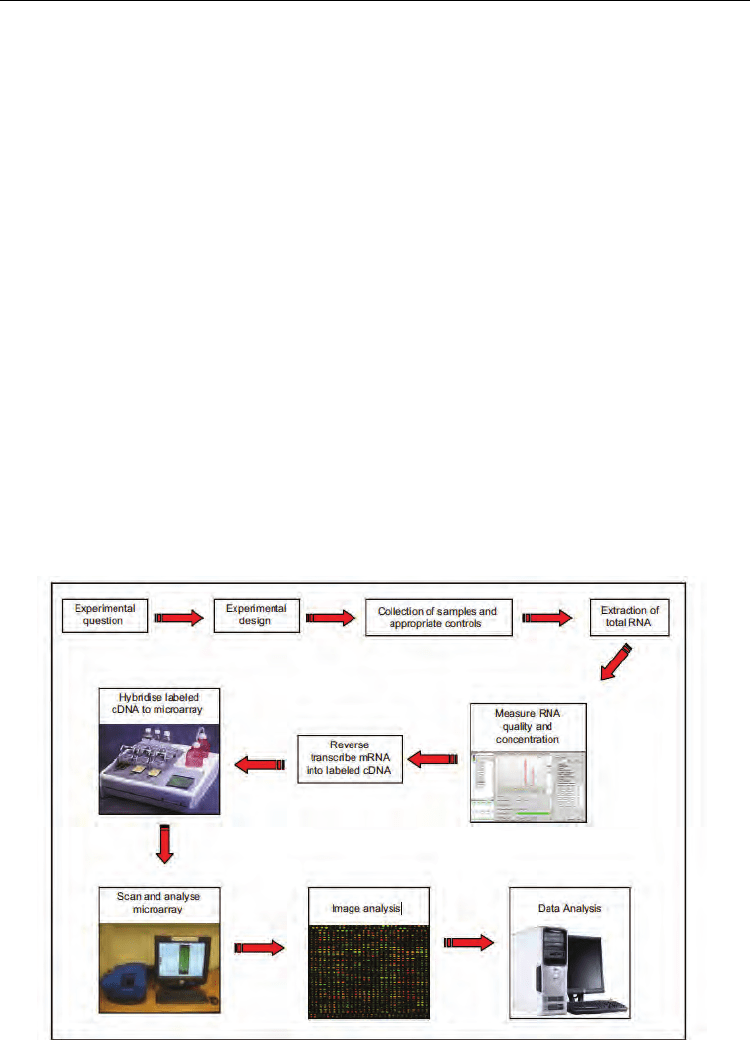
measure the integrity of RNA after extraction. Only samples of the highest integrity should be
considered for reverse transcription to cDNA and hybridisation to the microarray platform
(figure 1). Once obtained, intensity readings must be background adjusted and transformed;
this data is then normalised and analysed and results are generally interpreted according to
biological knowledge. The success of microarray experiments is highly dependent on
replication. Technical replication refers to the repeated assaying of the same biological sample
to facilitate quality assessment. Even more important is biological replication on larger sample
sets. The accuracy of microarray expression measurements must be confirmed using a reliable
independent technology, such as real-time quantitative PCR, and validated on a larger set of
independent biological samples. It is independent validation studies that determine the
strength or clinical relevance of a gene expression profile.
Fig. 1. The steps involved in a cDNA microarray experiment

MicroArray Technology - Expression Profiling of MRNA and MicroRNA in Breast Cancer
91
3. Molecular profiling – unlocking the heterogeneity of breast cancer
Breast cancer researchers were quick to adopt high throughput microarray technology,
which is unsurprising considering the opportunity it provides to analyse thousands of
genes simultaneously.
3.1 Class discovery
Microarray studies can be used in three different manners;
• class comparison
• class prediction
• class discovery (Simon et al, 2003)
All of these approaches have been applied to the study of breast cancer.
Class discovery involves analyzing a given set of gene expression profiles with the goal of
discovering subgroups that share common features. The early gene expression profiling
studies of breast cancer (Perou et al, 2000; Sorlie et al, 2001) were class discovery studies.
Researchers used an unsupervised method of analysis, in which tumours were clustered
into subgroups by a 496-gene “intrinsic” gene set that reflects differences in gene expression
between tumours without using selection criteria. The tumour subtype groupings consist of
luminal like subtypes which are predominantly ER and PR positive, basal-like subtypes
which are predominantly triple negative for ER, PR and HER2/neu, HER2/neu-like
subtypes which have increased expression of the HER2/neu amplicon and a normal-like
subtype (Perou et al, 2000). Subsequent studies from the same authors, on a larger cohort of
patients with follow-up data showed that the luminal subgroup could be further subdivided
into at least two groups, and that these molecular subtypes were actually associated with
distinct clinical outcomes (Sorlie et al 2001). These molecular subtypes of breast cancer have
been confirmed and added to in subsequent microarray datasets (Hu et al, 2006; Sorlie et al,
2003; Sotiriou et al, 2003). Given the importance of the ER in breast cancer biology, it is not
surprising that the most striking molecular differences were identified between the ER-
positive (luminal) and ER-negative subtypes. These differences have been repeatedly
identified and validated with different technologies and across different platforms (Fan et al,
2006; Farmer et al, 2005; Sorlie et al, 2006). The luminal subgroup has been subdivided into
two subgroups of prognostic significance:
• luminal A tumours which have high expression of ER –activated genes, and low
expression of proliferation related genes
• luminal B tumours which have higher expression of proliferation related genes and a
poorer prognosis than luminal A tumours (Geyer et al, 2009; Paik et al, 2000; Parker et
al, 2009; Sorlie et al, 2001, 2003).
The ER negative tumours are even more heterogeneous and comprise the:
• basal-like subgroup which lack ER and HER2/neu expression and feature more frequent
overexpression of basal cytokeratins, epidermal growth factor receptor and c-Kit
(Nielsen et al, 2004)
• HER2/neu subgroup which overexpress HER2/neu and genes associated with the
HER2/neu pathway and/or the HER2/neu amplicon on chromosome 17.
The HER2/neu and basal-like subtypes have in common an aggressive clinical behaviour
but appear to be more responsive to neoadjuvant chemotherapy than the luminal subtypes
(Carey et al, 2007; Rouzier et al, 2005). Also clustering with the ER negative tumours are the
normal-like breast cancers; these are as yet poorly characterised and have been shown to

Computational Biology and Applied Bioinformatics
92
cluster with fibroadenoma and normal breast tissue samples (Peppercorn et al, 2008). It is
important at this point to acknowledge the limitations of this molecular taxonomy;
intrasubtype heterogeneity has been noted despite the broad similarities defined by these
large subtypes (Parker et al, 2009). In particular the basal-like subgroup can be divided into
multiple additional subgroups (Kreike et al, 2007; Nielsen et al, 2004). Additionally,
although the luminal tumours have been separated into subgroups of prognostic
significance, meta-analysis of published expression data has suggested that these luminal
tumours actually form a continuum and their separation based on expression of
proliferation genes may be subjective (Shak et al, 2006; Wirapati et al, 2008). Furthermore,
the clinical significance of the normal-like subtype is yet to be determined; it has been
proposed that this subgroup may in fact represent an artefact of sample contamination with
a high content of normal breast tissue (Parker et al, 2009; Peppercorn et al, 2008). Due to
these limitations and the subjective nature of how the molecular subtypes were identified,
the translation of this taxonomy to the clinical setting as a definitive classification has been
difficult (Pustzai et al, 2006). The development of a prognostic test based on the intrinsic
subtypes has not been feasible to date. However, the seminal work by Sorlie and Perou
(Perou et al, 2000; Sorlie et al, 2001) recognized for the first time the scale of biological
heterogeneity within breast cancer and led to a paradigm shift in the way breast cancer is
perceived.
3.2 Class comparison
A number of investigators undertaking microarray expression profiling studies in breast
cancer have since adopted class comparison studies. These studies employ supervised
analysis approaches to determine gene expression differences between samples which
already have a predefined classification. The “null hypothesis” is that a given gene on the
array is not differentially expressed between the two conditions or classes under study. The
alternative hypothesis is that the expression level of that gene is different between the two
conditions. An example of this approach is the microarray experiments that have been
undertaken to define differences between invasive ductal and invasive lobular carcinomas
(Korkola, 2003; Weigelt, 2009; Zhao, 2004), between hereditary and sporadic breast cancer
(Berns, 2001; Hedenfalk, 2001) and between different disease stages of breast cancer
(Pedraza, 2010).
3.3 Class prediction
Perhaps the most clinically relevant use of this technology, however, are the microarray
class prediction studies which have been designed to answer specific questions regarding
gene expression in relation to clinical outcome and response to treatment. The latter
approach attempts to identify predictive markers, as opposed to the prognostic markers
which were identified in the “intrinsic gene-set”. There is frequently some degree of
confusion regarding the terms of “prognostic” and “predictive biomarkers”. This is partially
due to the fact that many prognostic markers also predict response to adjuvant therapy. This
is particularly true in breast cancer where, for example, the ER is prognostic, and predictive
of response to hormonal therapy, but also predictive of a poorer response to chemotherapy
(Carey 2007; Kim, 2009; Rouzier 2005,).
One of the first microarray studies designed to identify a gene-set predictive of prognosis in
breast cancer was that undertaken by van’t Veer and colleagues (van’t Veer et al, 2002). They

MicroArray Technology - Expression Profiling of MRNA and MicroRNA in Breast Cancer
93
developed a 70-gene set capable of predicting the development of metastatic disease in a
group of 98 patients made up of 34 who had developed metastasis within 5-years of follow-
up, 40 patients who remained disease-free at 5-years, 18 patients with a BRCA-1 mutation,
and 2 patients with a BRCA-2 mutation. The 70-gene signature was subsequently validated
in a set of 295 breast cancers, including the group used to train the model, and shown to be
more accurate than standard histopathological parameters at predicting outcome in these
breast cancer patients (van de Vijver et al, 2002). The signature includes many genes
involved in proliferation, and genes associated with invasion, metastasis, stromal integrity
and angiogenesis are also represented. This 70-gene prognostic signature classifies patients
based on correlation with a “good-prognosis” gene expression profile; a coefficient of
greater than 0.4 is classified as good prognosis. The signature was initially criticised for the
inclusion of some patients in both the discovery and validation stages (van de Vijver et al,
2002). However, it has been subsequently validated in multiple cohorts of node-positive and
node-negative patients and has been shown to outperform traditional clinical and
histological parameters at predicting prognosis (Buyse et al, 2006; Mook et al, 2009).
3.3.1 Mammaprint assay
The 70-gene signature was approved by the FDA to become the MammaPrint Assay
(Agendia BV, Amsterdam, The Netherlands); the first fully commercialized microarray
based multigene assay for breast cancer. This prognostic tool is now available and can be
offered to women under the age of 61 years with lymph node negative breast cancer. The
MammaPrint test results are dichotomous, indicating either a high or low risk of disease
recurrence, and the test performs best at the extremes of the spectrum of disease outcome
i.e. identifying patients with a very good or a very poor prognosis.
The MammaPrint signature is a purely prognostic tool, and its role as a predictive marker
for response to therapy was not examined at the time it was developed. Its’ clinical utility is
currently being assessed, however, in a prospective clinical trial called microarray in node
negative and 1 to 3 positive lymph node disease may avoid chemotherapy (MINDACT) trial
(Cardoso et al, 2008). The trial aims to recruit 6000 patients, all of whom will be assessed by
standard clinicopathologic prognostic factors and by the MammaPrint assay. In cases where
there is concordance between the standard prognostic factors and the molecular assay,
patients will be treated accordingly with adjuvant chemotherapy with or without endocrine
therapy for poor prognosis patients. If both assays predict a good prognosis, no adjuvant
chemotherapy is given, and adjuvant hormonal therapy is given alone where indicated. In
cases where there is disconcordance between the standard clinicopathological prognostic
factors and the MammaPrint assays’ prediction of prognosis the patients are randomised to
receive adjuvant systemic therapy based on either the clinicopathological or the
MammaPrint prognostic prediction results. The expected outcome is that there will be a
reduction of 10-15% in the number of patients requiring adjuvant chemotherapy based on
the MammaPrint assay prediction. It is envisaged that this trial will answer the questions of
what patients can be spared chemotherapy and still have a good prognosis, thus
accelerating progress towards the goal of more tailored therapy for breast cancer patients.
3.3.2 Oncotype Dx assay
While MammaPrint was developed as a prognostic assay, the other most widely established
commercialized multigene assay Oncotype Dx was developed in a more context specific

Computational Biology and Applied Bioinformatics
94
manner as a prognostic and predictive test to determine the benefit of chemotherapy in
women with node-negative, ER-positive breast cancer treated with tamoxifen (Paik et al,
2004). The authors used published microarray datasets, including those that identified the
intrinsic breast cancer subtypes and the 70-gene prognostic signature identified by the
Netherlands group to develop real time quantitative polymerase chain reaction (RQ-PCR)
tests for 250 genes. Research undertaken by the National Surgical Adjuvant Breast and
Bowel Project (NSABP) B14 protocol using three independent clinical series, resulted in the
development of an optimised 21-gene predictive assay (Paik et al, 2004). The assay has been
commercialised as Oncotype® DX by Genomic Health Inc
1
and consists of a panel of 16
discriminator genes and 5 endogenous control genes which are detected by RQ-PCR using
formalin-fixed paraffin embedded (FFPE) sections from standard histopathology blocks. The
ability to use FFPE tissue facilitates clinical translation and has allowed retrospective
analysis of archived tissue in large cohorts with appropriate follow up data. The assay has
been used to generate Recurrence Scores (RS) by differentially weighting the constituent
genes which are involved in:
• proliferation (MKI67, STK15, BIRC5/Survivin, CCNB1, MYBL2)
• estrogen response (ER, PGR, SCUBE2)
• HER2/neu amplicon (HER2/neu/ERBB2, GRB7),
• invasion (MMP11, CTSL2)
• apoptosis (BCL2, BAG1)
• drug metabolism (GSTM1)
• macrophage response (CD68).
The assay was evaluated in 651 ER positive lymph node negative breast cancer patients who
were treated with either tamoxifen or tamoxifen and chemotherapy as part of the NSABP
B20 protocol (Paik et al, 2006). It was found that patients with high recurrence scores had a
large benefit from chemotherapy, with a 27.6% mean decreased in 10 year distance
recurrence rates, while those with a low recurrence score derived virtually no benefit from
chemotherapy. The RS generated by the expression of the 21 genes is a continuous variable
ranging from 1-100, but has been divided into three groups for clinical decision making; low
(<18), intermediate (18-31) and high (>31). It has been shown in a number of independent
datasets that ER positive breast cancer patients with a low RS have a low risk of recurrence
and derive little benefit from chemotherapy. Conversely, ER positive patients with high RS
have a high risk of recurrence but do benefit from chemotherapy (Goldstein, 2006; Habel,
2006; Mina, 2007; Paik, 2006). The ability of the 21-gene signature to so accurately predict
prognosis has led to the inclusion of the Oncotype Dx assay in American Society of Clinical
Oncology (ASCO) guidelines on the use of tumour markers in breast cancer as a predictor of
recurrence in ER-positive, node-negative patients. However, despite the accurate
performance of the assay for high and low risk patients, there remains uncertainty regarding
the management of patients with intermediate RS (18-31). This issue is being addressed in a
prospective randomized trial assigning individual options for treatment (TAILORx)
sponsored by the National Cancer Institute (Lo et al, 2007). This multicentre trial aims to
recruit 10,000 patients with ER –positive, lymph node negative breast cancer who are
assigned to one of three groups based on their RS; low<11, intermediate 11-25 and high >25.
Notably, the RS criteria have been changed for the TAILORx trial, with the intermediate
1
http://www.genomichealth.com/OncotypeDX

MicroArray Technology - Expression Profiling of MRNA and MicroRNA in Breast Cancer
95
range being changed from RS 18-30 to RS 11-25 to avoid exluding patients who may derive a
small benefit from chemotherapy (Sparano et al, 2006). Patients in the intermediate RS
group are randomly assigned to receive either adjuvant chemotherapy and hormonal
therapy, or hormonal therapy alone. The primary aim of the trial is to determine if ER
positive patients with an intermediate RS benefit from adjuvant chemotherapy or not.
The MammaPrint and Oncotype Dx gene signatures both predict breast cancer behaviour,
however there are fundamental differences between them (outlined in table 1). This chapter
has focused on these signatures as they were the first to be developed, have been extensively
validated, and are commercially available. However it is important to note that there are
other multi-gene based assays that have been developed and commercialized but are not
discussed in detail as they are not yet as widely utilized (Loi et al, 2007; Ma et al, 2008; Ross
et al, 2008; Wang et al, 2005 ).
Assay MammaPrint Oncotype Dx
Manufacturer
Agendia BV Genomic Health, Inc.
Development of Signature
From candidate set of 25,000
genes in 98 patients
From candidate set of 250
genes in 447 patients
Gene signature
70 genes 21 genes
Patient cohort
Stage I & II breast cancer
Lymph node negative
<55yrs
Stage I & II breast cancer
Lymph node negative
ER positive
Receiving Tamoxifen
Platform
cDNA Microarray RQ-PCR
Sample requirements
Fresh frozen tissue or
collected in RNA
preservative
FFPE tissue
Outcome
5-year distant relapse free
survival
10-year distant relapse free
survival
Test Results
Dichotomous correlation
coefficient
>4.0 = good prognosis
<4.0 = poor prognosis
Continuous recurrence score
<18 = low risk
18-31= intermediate risk
>31 = high risk
Predictive
No; purely prognostic Yes
Prospective Trial
MINDACT TAILORx
FDA approved
Yes No
ASCO Guidelines
No Yes
Table 1. Comparison of commercially available prognostic assays MammaPrint and
Oncotype Dx
4. Microarray data integration
4.1 Setting standards for microarray experiments
It must be acknowledged that despite the multitude of breast cancer prognostic signatures
available, the overlap between the gene lists is minimal (Ahmed, 2005; Brenton, 2005; Fan et

Computational Biology and Applied Bioinformatics
96
al, 2006; Michiels et al, 2005). This lack of concordance has called into question the
applicability of microarray analysis across the entire breast cancer population. In order to
facilitate external validation of signatures and meta-analysis in an attempt to devise more
robust signatures, it is important that published microarray data be publicly accessible to
the scientific community. In 2001 the Microarray Gene Expression Data Society proposed
experimental annotation standards known as minimum information about a microarray
experiment (MIAME), stating that raw data supporting published studies should be made
publicly available in one of a number of online repositories (table 2), these standards are
now upheld by leading scientific journals and facilitating in depth interrogation of multiple
datasets simultaneously.
Public Database
for Microarray
Data
URL Organization Description
Array Express http://www.ebi.ac.uk/arrayexpress/ European
Bioinformatics
Institute (EBI)
Public data
deposition and
queries
GEO Gene
Expression
Omnibus
http://www.ncbi.nlm.nih.gov/geo/ National Centre for
Biotechnology
Information (NCBI)
Public data
deposition and
queries
CIBEX Center
for Information
Biology Gene
Expression
Database
http://cibex.nig.ac.jp/index.jsp National Institute
of Genetics
Public data
deposition and
queries
ONCOMINE
Cancer Profiling
Database
http://www.oncomine.org/main/
index.jsp
University of
Michigan
Public queries
PUMAdb
Princeton
University
MicroArray
database
http://puma.princeton.edu/ Princeton
University
Public queries
SMD Stanford
Microarray
Database
http://genome-
www5.stanford.edu/
Stanford Univeristy Public queries
UNC Chapel
Hill Microarray
database
https://genome.unc.edu/ Universit
y
of North
Carolina at Chapel
Hill
Public queries
Table 2. List of Databases with Publicly Available Microarray Data
4.2 Gene ontology
The volume of data generated by high throughput techniques such as microarray poses the
challenge of how to integrate the genetic information obtained from large scale experiments
with information about specific biological processes, and how genetic profiles relate to
functional pathways. The development of the Gene Ontology (GO) as a resource for