
Lopes H.S., Cruz L.M. (eds.) Computational Biology and Applied Bioinformatics
Подождите немного. Документ загружается.

4
In Silico Analysis of Golgi Glycosyltransferases:
A Case Study on the LARGE-Like Protein Family
Kuo-Yuan Hwa
1,2
, Wan-Man Lin and Boopathi Subramani
Institute of Organic & Polymeric Materials
1
Department of Molecular Science and Engineering
2
Centre for Biomedical Industries
National Taipei University of Technology, Taipei,
Taiwan, ROC
1. Introduction
Glycosylation is one of the major post-translational modification processes essential for
expression and function of many proteins. It has been estimated that 1% of the open reading
frames of a genome is dedicated to glycosylation. Many different enzymes are involved in
glycosylation, such as glycosyltransferases and glycosidases.
Traditionally, glycosyltransferases are classified based on their enzymatic activities by
Enzyme Commission (http://www.chem.qmul.ac.uk/iubmb/enzyme/). Based on the
activated donor type, glycosyltransferases are named, for example glucosyltransferase,
mannosyltransferase and N-acetylglucosaminyltransferases. However, classification of
glycosyltransferases based on the biochemical evidence is a difficult task since most of the
enzymes are membrane proteins. Reconstruction of enzymatic assay for the membrane
proteins are intrinsically more difficult than soluble proteins. Thus the purification of
membrane-bound glycosyltransferase is a difficult task. On the other hand, with the recent
advancement of genome projects, DNA sequences of an organism are readily available.
Furthermore, bioinformatics annotation tools are now commonly used by life science
researchers to identify the putative function of a gene. Hence, new approaches based on in
silico analysis for classifying glycosyltransferase have been used successfully. The best
known database for classification of glycosyltransferase by in silico approach is the CAZy
(Carbohydrate- Active enZymes) database (http://afmb.cnrs-mrs.fr/CAZy/) (Cantarel et al.,
2009).
Glycosyltransferases are enzymes involved in synthesizing sugar moieties by transferring
activated saccharide donors into various macro-molecules such as DNA, proteins, lipids and
glycans. More than 100 glycosyltransferases are localized in the endoplasmic reticulum (ER)
and Golgi apparatus and are involved in the glycan synthesis (Narimatsu, H., 2006). The
structural studies on the ER and golgi glycosyltransferases has revealed several common
domains and motifs present between them. The glycosyltransferases are grouped into
functional subfamilies based on similarities of sequence, their enzyme characteristics, donor
specificity, acceptor specificity and the specific donor and acceptor linkages (Ishida et al.,
2005). The glycosyltransferase sequences comprise of 330-560 amino acids long and share
the same type II transmembrane protein structure with four functional domains: a short

Computational Biology and Applied Bioinformatics
68
cytoplasmic domain, a targeting / membrane anchoring domain, a stem region and a
catalytic domain (Fukuda et al., 1994). Mammals utilize only 9 sugar nucleotide donors for
glycosyltransferases such as UDP-glucose, UDP-galactose, UDP-GlcNAc, UDP-GalNAc,
UDP-xylose, UDP-glucuronic acid, GDP-mannose, GDP-fucose, and CMP-sialic acid. Other
organisms have an extensive range of nucleotide sugar donors (Varki et al., 2008). Based on
the structural studies, we have designed an intelligent platform for the LARGE protein, a
golgi glycosyltransferase. The LARGE is a member of glycosyltransferase which has been
studied in protein glycosylation (Fukuda & Hindsgaul, 2000). It was originally isolated from
a region in chromosome 22 of the human genome which was frequently deleted in human
meningiomas with alteration in glycosphingolipid composition. This led to a suggestion that
the LARGE may have possible role in complex lipid glycosylation (Dumanski et al., 1987;
Peyrard et al., 1999).
2. LARGE
LARGE is one of the largest genes present in the human genome and it is comprised of 660
kb of genomic DNA and contains 16 exons encoding a 756-amino-acid protein. It showed
98% amino acid identity to the mouse homologue and similar genomic organization. The
expression of LARGE is ubiquitous but the highest levels of LARGE mRNA are present in
heart, brain and skeletal muscle (Peyrard et al., 1999).
LARGE encodes a protein which has an N-terminal transmembrane anchor, coiled coil motif
and two putative catalytic domains with a conserved DXD (Asp-any-Asp) motif typical of
many glycosyltransferases that uses nucleoside diphosphate sugars as donors (Longman et
al., 2003 & Peyrard et al., 1999). The proximal catalytic domain in the LARGE was most
homologous to the bacterial glycosyltransferase family 8 (GT8 in CAZy database) members
(Coutinho et al., 2003). The members of this family are mainly involved in the synthesis of
bacterial outer membrane lipopolysaccharide. The distal domain resembled the human β1,3-
N-acetytglucosaminyltransferase (iGnT), a member of GT49 family. The iGnT enzyme is
required for the synthesis of the poly-N-acetyllactosamine backbone which is part of the
erythrocyte i antigen (Sasaki et al., 1997). The presence of two catalytic domains in the
LARGE is extremely unusual among the glycosyltransferase enzymes.
2.1 Functions of LARGE
2.1.1 Dystroglycan glycosylation
The Dystroglycan (DG) is an important constituent of the dystrophin-glycoprotein complex
(DGC). This complex plays an essential role in the maintaining the stability of the muscle
membrane and for the correct localization and/or ligand-binding activity, the glycosylation
of some of these components are required (Durbeej et al., 1998). The DG comprises of two
subunits, the extracellular α-DG and the transmembrane β-DG (Barresi, 2004). Various
components present in the extracellular matrix including laminin (Smalheiser & Schwartz
1987), agrin (Gee et al., 1994), neurexin, (Sugita et al., 2001), and perlecan (Peng et al., 1998)
interacts with α-DG. The carbohydrate moieties present in the α-DG are essential to bind
with laminin and other ligands. The α-DG is modified by three different types of glycans
such as: mucin type O-glycosylation, O-mannosylation, and N-glycosylation. The
glycosylated α-DG is essential for the protein’s ability to bind the laminin globular domain-
containing proteins of the Extracellular Matrix (Kanagawa, 2005). LARGE is required for the
generation of functional, properly glycosylated forms of α-DG (Barresi, 2004).

In Silico Analysis of Golgi Glycosyltransferases: A Case Study on the LARGE-Like Protein Family
69
2.1.2 Human LARGE and α-Dystroglycan
The α-DG functional glycosylation by LARGE is likely to be involved in the generation of a
glycan polymer which gives rise to the broad molecular weight range observed for α-DG
detected by VIA4-1 and IIH6 antibodies. Both the human and mouse LARGE C-terminal
glycosyltransferase domain is similar to β3GnT6, which adds GlcNAc to Gal to generate
linear polylactosamine chains (Sasaki et al., 1997), the chain formed by LARGE might also be
composed of GlcNAc and Glc.
In 1963, Myodystrophy, myd, was first described (Lane et al., 1976) as a recessive myopathy
mapping to chromosome (Chr) 8, was identified as an intragenic deletion within the
glycosyltransferase gene, LARGE. In Large
myd
and enr mice, the hypoglycosylation of α-DG
in DGC was due to the mutation in LARGE (Grewal et al., 2001). The α-DG function was
restored in Large
myd
skeletal muscle and ameliorates muscular dystrophy when LARGE
gene was transferred, which indicated that adjustment in the glycosylation status of α-DG
can improve the muscle phenotype.
The patients with clinical spectrum ranging from severe congenital muscular dystrophy
(CMD), structural brain and eye abnormalities [Walker-Warburg syndrome (WWS), MIM
236670] to a relative mild form of limb-girdle muscular dystrophy (LGMD2I, MIM 607155)
are linked to the abnormal O-linked glycosylation of α-DG (van Reeuwijk et al., 2005). A
study made by Barresi R. et al. (2004) revealed the existence of dual and concentration
dependent functions of LARGE. In physiological concentration, LARGE may be involved in
regulating the α-DG O-mannosylation pathway. But when the LARGE is expressed by force,
it may trigger some other alternative pathways for the O-glycosylation of α-DG which can
generate a type of repeating polymer of variable lengths, such as glycosaminoglycan-like or
core 1 or core 2 structures. This alternative glycan mimics the O-mannose glycan in its
ability to bind α-DG ligands and can compensate for the defective tetrasaccharide. The
functional LARGE protein is also required for neuronal migration during CNS development
and it rescues α-DG in MEB fibroblasts and WWS cells (Barresi R. et al., 2004).
2.1.3 LARGE in visual signal processing
The role of LARGE in proper visual signal processing was studied from the retina retinal
pathology in Large
myd
mice. The functional abnormalities of the retina was investigated by a
sensitive tool called Electroretinogram (ERG). In Large
myd
mice, the normal a-wave indicated
that the mutant glycosyltransferase does not have any effect on its photoreceptor function.
But the alteration in b-wave may have resulted in downstream retinal circuitry with altered
signal processing (Newman & Frishman, 1991). The DGC may also have a possible role in
this aspect of the phenotype. The abnormal b-wave was responsible for the loss of retinal
isoforms of dystrophin in humans and mice similar to the Large
myd
mice.
2.2 LARGE homologues
A homologous gene to LARGE was identified and named as LARGE2. It is found to be
involved in α-DG maturation as like LARGE, according to Fujimura et al., (2005). It is still not
well understood whether these two proteins are compensatory or cooperative. The co-
expression of LARGE and LARGE2 did not increase the maturation of α-DG in comparison
with either one of them alone and it proved that for the maturation of α-DG, the function of
LARGE2 is compensatory and not cooperative. Gene therapy for muscular dystrophy using
the LARGE gene is a current topic of research (Barresi R. et al., 2004; Braun, 2004). When
compared to LARGE, LARGE2 gene may be more effective because it can glycosylate heavily
than LARGE and it also prevents the harmful and immature α-DG production.

Computational Biology and Applied Bioinformatics
70
The closely related homologues of LARGE are found in the human genome,
(glycosyltransferase-like 1B; GYLTL1B), mouse genome (Glylt1b; also called LARGE-Like or
LargeL) and in some other vertebrate species (Grewal & Hewitt, 2002). The homologue gene
is positioned on the chromosome 11p11.2 of the human genome and it encodes 721 amino
acid protein which has 67% identity with LARGE, suggests that the two genes may have
risen by gene duplication. Like LARGE, it is also predicted to have two catalytic domains,
though it lacks the coiled-coiled motif present in the former protein. The hyperglycosylation
of α-dystroglycan by the overexpression of GYLTL1B increased its ability to bind laminin
and both the genes showed the same level of increase in laminin binding ability
(Brockington, et al., 2005).
3. Bioinformatics workflow and platform design
Many public databases and bioinformatics tools have been developed and are currently
available for use (Ding & Berleant, 2002). The primary goal of bioinformaticians is to
develop reliable databases and effective analysis tools capable of handling bulk amount of
biological data. But the objective of laboratory researchers is to study specific areas within
the life sciences, which requires only a limited set of databases and analysis tools. Thus the
existing free bioinformatics tools are sometimes too complicated for the biologists to choose.
One solution is to have an expert team who are familiar with both bioinformatics databases
and to know the needs of a research group in a particular field. The expert team will
recommend a workflow by using selected bioinformatics tools and databanks and also helps
the scientists with the complicated issue of tools and databases. Moreover, such a team
could organize large number of heterogeneous sources of biological information into a
specific, expertly annotated databank.
The team can also regularly and systematically update the information essential to help
biologists overcome the problems of integrating and keeping up-to-date with heterogeneous
biological information (Gerstein, 2000).
We have built a novel information management platform, LGTBase (Hyperlink).This
composite knowledge management platform includes the “LARGE-like GlcNAc Transferase
Database” by integrating specific public databases like CAZy database, and the workflow
analysis combined the usage of specific, public & designed bioinformatics tools to identify
the members of the LARGE-like protein family.
4. Tools and database selection
To analyze a novel protein family, biologists need to understand many different types of
information. Moreover, the speed of discovery in biology has been expanding exponentially
in recent years. So the biologists have to pick the right information available from the vast
resources available. To overcome these obstacles, a bioinformatics workflow can be
designed for analysing a specific protein family. In our study, a workflow was designed
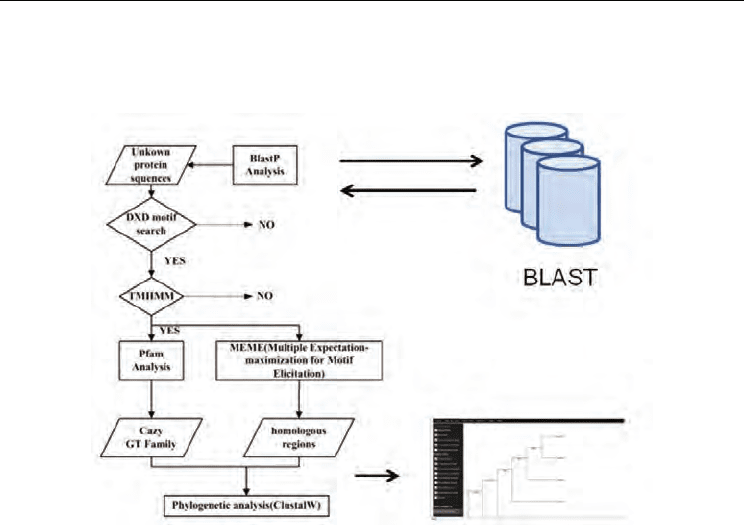
based on the structure and characteristics of LARGE protein as shown in Figure 1 (Hwa et
al., 2007). The unknown DNA/protein sequences will be first identified as members of the
known gene families by using the Basic Local Alignment Search Tool (BLAST). The blastp
search tool is used to look for new LARGE-like proteins present in different organisms. The
researchers who wish to use our platform can obtain the protein sequences either from the
experimental data or through the blastp results. The search results were then analyzed with
In Silico Analysis of Golgi Glycosyltransferases: A Case Study on the LARGE-Like Protein Family
71
the following tools. To begin with, the sequences are searched for the aspartate-any residue-
aspartate (DXD) motif. The DXD motifs present in some glycosyltransferase families are
essential for its enzyme activity.
Fig. 1. Bioinformatics workflow of LGTBase.
The DXD motif prediction was then followed by the transmembrane domain prediction by
using the TMHMM program (version 2.0; Center for Biological Sequence Analysis, Technical
University of Denmark [http://www.cbs.dtu.dk/services/TMHMM-2.0/]). The
transmembrane domain is a characteristic feature of the Golgi enzymes.
The sequence motifs are then identified by MEME (Multiple Expectation-maximization for
Motif Elicitation) program (version 3.5.4; San Diego Supercomputer Center, UCSD
[http://meme.sdsc.edu/meme/]).
This program finds the motif-homology between the target sequence and other known
glycosyltransferases. In addition to all the above mentioned tools, the Pfam search (Sanger
Institute [http://www.sanger.ac.uk/Software/Pfam/search.shtml]) can also be used to find
the multiple sequence alignments and hidden Markov models in many existing protein
domains and families. The Pfam results will indicate what kind of protein family the peptide
belongs to. If it is a desired protein, investigators can then identify the evolutionary
relationships by using phylogenetic analysis.
4.1 LARGE-like GlcNAc transferase database
The specific annotation entries used in the LGTBase are currently being used in a
configuration that uses the information retrieved from several databases.
In CAZy database (Carbohydrate- Active enZymes) database ([http://afmb.cnrs-
mrs.fr/CAZY/]), the glycosyltransferases are classified as families, clans, and folds based on
their structural and sequence similarities, and also on their mechanistic investigation. The
other databases used in this platform were listed in Table 1.

Computational Biology and Applied Bioinformatics
72
Database Description Website
EntrezGene NCBI's repository for gene-specific
information
http://www.ncbi.nlm.nih.gov/sites
/entrez?db=gene
GenBank NIH genetic sequence database, an
annotated collection of all publicly
available DNA sequences
http://www.ncbi.nlm.nih.gov/sites
/entrez?db=nucleotide
Dictybase Database for model organism
Dictyostelium discoideum
http://dictybase.org/
UniProtKB/S
wiss-Prot
High-quality, manually annotated,
non-redundant protein sequence
database
http://www.uniprot.org/
InterPro Database of protein families,
domains and functional sites
http://www.ebi.ac.uk/interpro/
MGI Database provides inte
g
rated
g
enetic,
genomic, and biological data of the
laboratory mouse
http://www.informatics.jax.org/
Ensembl It provides genome- annotation
information
http://www.ensembl.org/index.htm
l
HGMD Human Gene Mutation Database
(HGMD) provides comprehensive
data on human inherited disease
mutations
http://www.hgmd.cf.ac.uk/ac/inde
x.php
UniGene NCBI database of the transcriptome http://www.ncbi.nlm.nih.gov/unige
ne
GeneWiki The database transfers information
on human genes to Wikipedia article
http://en.wikipedia.org/wiki/Gene
_Wiki
TGDB Database with information about the
genes involved in cancers
http://www.tumor-
gene.org/TGDB/tgdb.html
HUGE The database provides the results of
the Human cDNA project at the
Kazusa DNA Research Institute
http://zearth.kazusa.or.jp/huge/
RGD Database with collection of genetic
and genomic information on the rat
http://rgd.mcw.edu/
OMIM Database provides information on
human genes and genetic disorders.
http://www.ncbi.nlm.nih.gov/sites
/entrez?db=omim
CGAP Information of gene expression
profiles of normal, precancer, and
cancer cells.
http://cgap.nci.nih.gov/
PubMed Database with 20 million citations for
biomedical literature from medical
journals, life science journals, related
books.
http://www.ncbi.nlm.nih.gov/Pub
Med/
GO Representation of gene and gene
product attributes across all species
http://www.geneontology.org/
Table 1. The information sources of LARGE-like GlcNAc Transferase Database
In Silico Analysis of Golgi Glycosyltransferases: A Case Study on the LARGE-Like Protein Family
73
All the information related to the LARGE-like protein family was retrieved from the
different biological databases. In order to confirm that the information obtained was
reliable, the data was scrutinized at two levels. First the information was selected from the
above mentioned biological databases with customized programs (using the perl compatible
regular expressions). Then the obtained information was annotated and validated by experts
in glycobiology and bioinformatics.
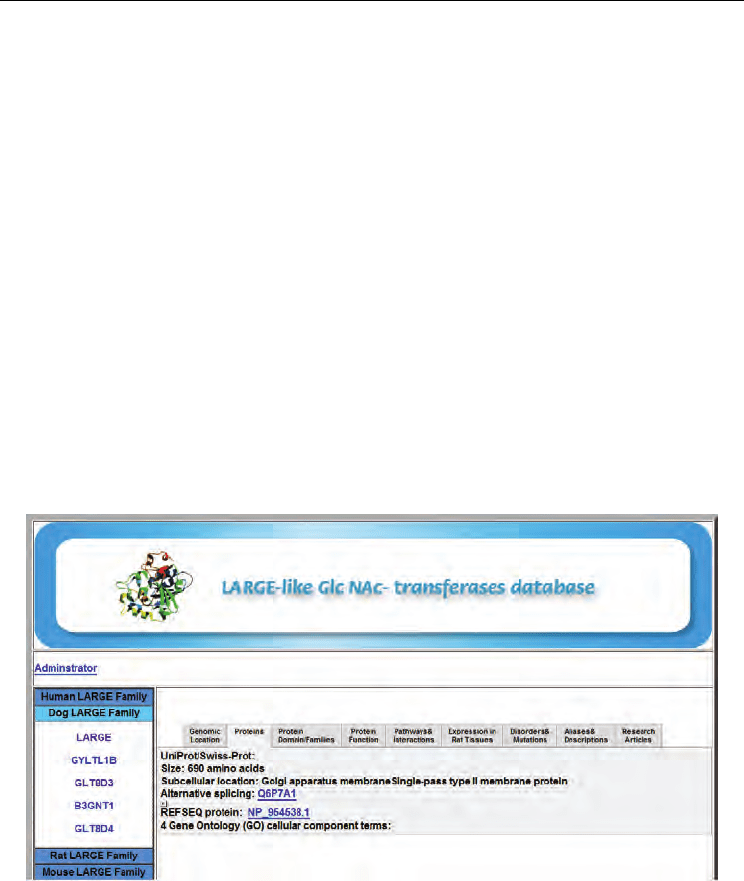
The annotated data in the LGTBase database was divided into nine categories (Figure 2).
The first category is related to genomic location, displays the chromosome, the cytogenetic
band and the map location of the gene. The second is related to aliases and descriptions,
displays synonyms and aliases for the relevant gene, and descriptions of its function,
cellular localization and effect on phenotype. The third category on proteins provides
annotated information about the proteins encoded by the relevant genes. The fourth is about
protein domains and families, provides annotated information about protein domains and
families and the fifth on protein function which provides annotated information about gene
function. The sixth category is related to pathways and interactions, provides links to
pathways and interactions followed by the seventh on disorders and mutations which
draws its information from OMIM and UniProt. The eighth category is on expression in
specific tissues, shows that the tissue expression values are available for a given gene. The
last category is about research articles, lists the references related to the proteins which are
studied. In addition, the investigator can also use DNA or protein sequences to assemble the
dataset for the analysis using this workflow.
Fig. 2. The contents of LGTBase database
4.2 LARGE-like GlcNAc transferase workflow
4.2.1 Reference sequences search
The unknown DNA/protein sequences are identified as members of the known gene
families using the Basic Local Alignment Search Tool (BLAST). BlastP is one of the BLAST
programs and it searches protein databases using a protein query. We used BlastP to look
for new LARGE-like proteins from different species and gathered the protein sequences of

Computational Biology and Applied Bioinformatics
74
LARGE like GlcNAc Transferases and built a protein database of ‘LARGE-like protein’. This
database would assist in search for more reference sequences of LARGE-like protein.
4.2.2 DXD motif search
In several glycosyltransferase families, the DXD motif is essential for the enzymatic activity
(Busch et al. 1998). So we first searched for aspartate-any residue-aspartate (DXD) motif,
commonly found in glycosyltransferase. Therefore, the ‘DXD Motif Search’ tool was
designed. The input protein sequences are loaded or pasted in this tool and the results
indicate the presence or absence of DXD motif.
4.2.3 Transmembrane helices search
The LARGE protein is a member of the N-acetylglucosaminyltransferase family. The
presence of transmembrane domain is a characteristics feature of this family. TMHMM
program is used to predict the transmembrane helices based on the hidden Markov model.
The prediction gives the most probable location and orientation of transmembrane helices in
the sequence. TMHMM can predict the location of transmembrane alpha helices and the
location of intervening loop regions. This program also predicts the location of the loops
that are present between the helices either inside or outside of the cell or organelle. The
program is designed based on a 20 amino acids long alpha helix which contains
hydrophobic amino acids that can span through a cell membrane.
4.2.4 MEME analysis
A motif is a sequence pattern that occurs repeatedly in a group of related protein or DNA
sequences. MEME (Multiple Expectation-maximization for Motif Elicitation) represents
motifs as position-dependent letter-probability matrices which describe the probability of
each possible letter at each position in the pattern. The program can search for homologous
sequences among the input protein sequences.
4.2.5 Protein families search
The Pfam HMM search was used to identify the protein family to which the input protein
sequences belong. The Pfam database contains the information about most of the protein
domains and families. The results from the Pfam HMM search will show the relation of
input protein sequences with the existing protein families and domains.
4.2.6 Phylogenetic analysis
The phylogenetic analysis was performed to find any significant evolutionary relationship
between the new protein sequences and the LARGE protein family and to support our
previous findings. ClustalW, a multiple alignment program which aligns two or more
sequences to determine any significant consensus sequences between them (Thompson et
al., 1994). This approach can also be used for searching patterns in the sequence. The
phylogenetic tree was constructed by using PHYLIP program (v.3.6.9) and viewed by
Treeview software (v.1.6.6). In GlcNAc-transferase phylogenetic analysis, once the multiple
alignment of all GlcNAc-transferase has been done, it can be used to construct the
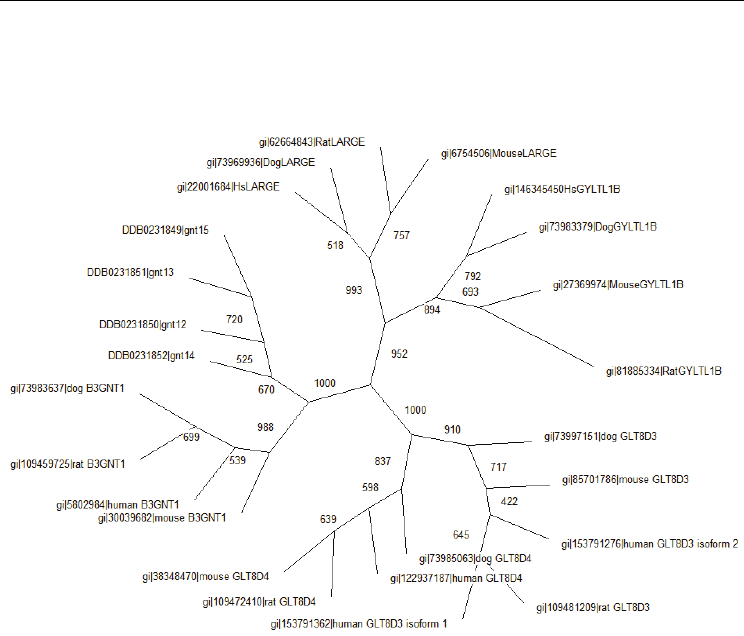
phylogenetic tree. About 25 protein sequences were identified as the LARGE-like protein
family. By using the neighbor joining distance method, the phylogenetic tree showed that
these proteins can be divided into 6 groups (Figure 3). The evolutionary history inferred
In Silico Analysis of Golgi Glycosyltransferases: A Case Study on the LARGE-Like Protein Family
75
from phylogenetic analysis is usually depicted as branching, tree-like diagrams which
represents an estimated pedigree of the inherited relationships among the protein sequences
from different species. These evolutionary relationships can be viewed either as Cladograms
(Chenna et al., 2003) or Phylograms (Radomski & Slonimski, 2001).
Fig. 3. Phylogenetic tree of LARGE-like Protein Family
4.3 Organization of the LGTBase platform
The data obtained from the analyses were stored in a MySQL relational database and the
web interface was built by using PHP and CGI/Java scripts. According to the characteristics
of LARGE-like GlcNAc transferase proteins, the workflow was designed and developed by
using Java language and several open source bioinformatics programs. Tools with different
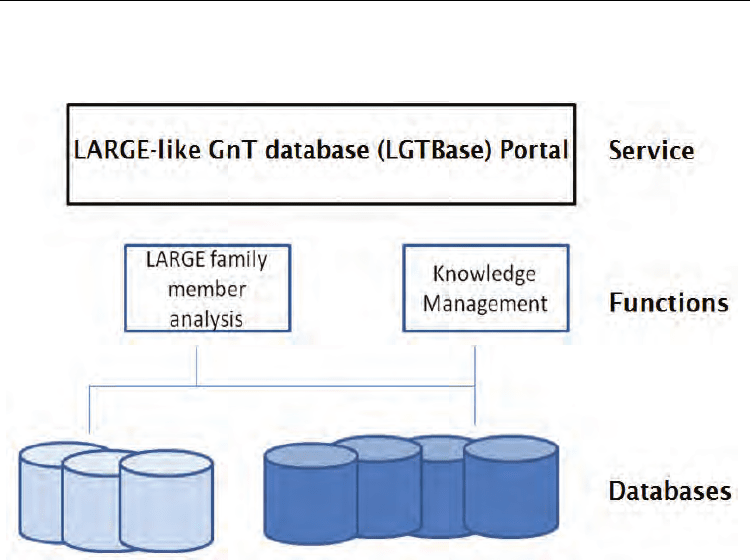
languages, C, perl, java were integrated by using Java language (Figure 4). Adjustable
parameters of the tools were reserved to fulfill the needs in future.
5. Application with LARGE protein family
A protein sequence (fasta format) can be entered into the BlastP assistant interface, enabling
the other known proteins with similar sequences to be identified (Figure 5). The investigator
can select all the resulting sequences or use only some of them. The data can then be
transferred to the DXD analysis page (Figure 6). The rationale behind choosing the DXD
analysis was since they are represented in many families of glycosyltransferases and it will
be easy to narrow down the analysis of putative protein sequences to particular protein
families or domains. There were many online tools available for the identification and
Computational Biology and Applied Bioinformatics
76
characterization of unknown protein sequences. So depending upon the target protein of
study, one can pick the tools to characterize it.
Fig. 4. Database selected for construction of the knowledge management platform
The sequences are analyzed with the DXD motif search tool (Figure 6), which selects those
sequences containing the DXD motif for the TMHMM analysis. The transmembrane helices
can be predicted with TMHMM analysis (Figure 7). The transmembrane domains are
predicted by the hydrophobic nature of the proteins and mainly used to identify the cellular
location of the proteins. Similar to transmembrane domain prediction, there were several
other domains that can be predicted based on the protein’s characters like hydrophobic,
hydrophilic etc., The dataset containing DXD motifs and transmembrane helices are then
selected for MEME (Figure 8) and Pfam analysis (Figure 9). Some sequence motifs occur
repeatedly in the data set and are conjectured to have a biological significance are predicted
by MEME analysis. This application plays a significant role in characterization of the
putative protein sequences after the initial studies with the DXD motif, transmembrane
domain, and other tools. This tool can be used for all kind of protein sequences since its
prediction is based on the pattern of sequences present in the study. The protein sequences
in the dataset can be identified to the known protein families by Pfam analysis. The pfam
classification can also be used for almost all the putative protein sequences because of its
large collection of protein domain families represented by multiple sequence alignments
and Hidden Markov Models. After the MEME and Pfam analysis were done, ClustalW and
Phylip programs were used for Phylogenetic Analysis (Figure 9) to see the evolutionary
relationship among the data sets (Figure 10). Finally, these results can be used to design
experiments to be performed in the laboratory.