
Lopes H.S., Cruz L.M. (eds.) Computational Biology and Applied Bioinformatics
Подождите немного. Документ загружается.

Molecular Evolution & Phylogeny: What, When, Why & How?
17
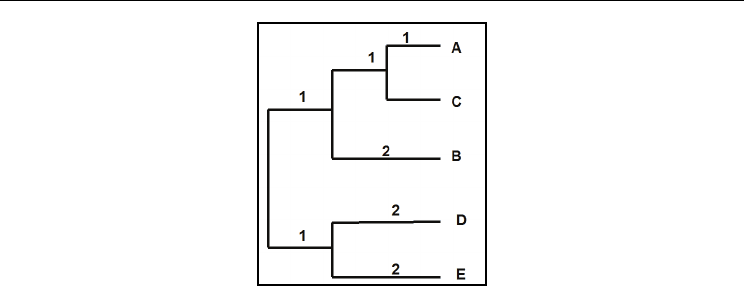
Fig. 11. The phylogenetic tree obtained using N-J algorithm for distance matrix in Fig 4.
Numbers on the branches indicate branch length.
6.2 Character-based methods of phylogeny reconstruction
The most commonly used character-based methods in molecular phylogenetics are
Maximum parsimony and Maximum likelihood. Unlike the distance-based MPA, character-
based methods use character information in alignment data as an input for tree building.
The aligned data is in the form of character-state matrix where the nucleotide or amino acid
symbols represent the states of characters. These character-based methods employ
optimality criterion with the explicit definition of objective function to score the tree
topology in order to infer the optimum tree. Hence, these methods are comparatively slower
than distance-based clustering algorithms, which are simply based on a set of rules and
operations for clustering. But character based methods are advantageous in the sense that
they provide a precise mathematical background to prefer one tree over another unlike in
distance-based clustering algorithms.
6.2.1 Maximum parsimony
The Maximum parsimony (MP) method is based on the simple principle of searching the
tree or collection of trees that minimizes the number of evolutionary changes in the form of
change of one character state into other, which are able to describe observed differences in
the informative sites of OTUs. There are two problems under the parsimony criterion, a)
determining the length of the tree i.e. estimating the number of changes in character states,
b) searching overall possible tree topologies to find the tree that involves minimum number
of changes. Finally all the trees with minimum number of changes are identified for each of
the informative sites. Fitch’s algorithm is used for the calculation of changes for a fixed tree
topology (Fitch, 1971). If the number of OTUs, N is moderate, this algorithm can be used to
calculate the changes for all possible tree topologies and then the most parsimonious rooted
tree with minimum number of changes is inferred. However, if N is very large it becomes
computationally expensive to calculate the changes for the large number of possible rooted
trees. In such cases, a branch and bound algorithm is used to restrict the search space of tree
topologies in accordance with Fitch’s algorithm to arrive at parsimonious tree (Hendy &
Penny, 1982). However, this approach may miss some parsimonious topologies in order to
reduce the search space.
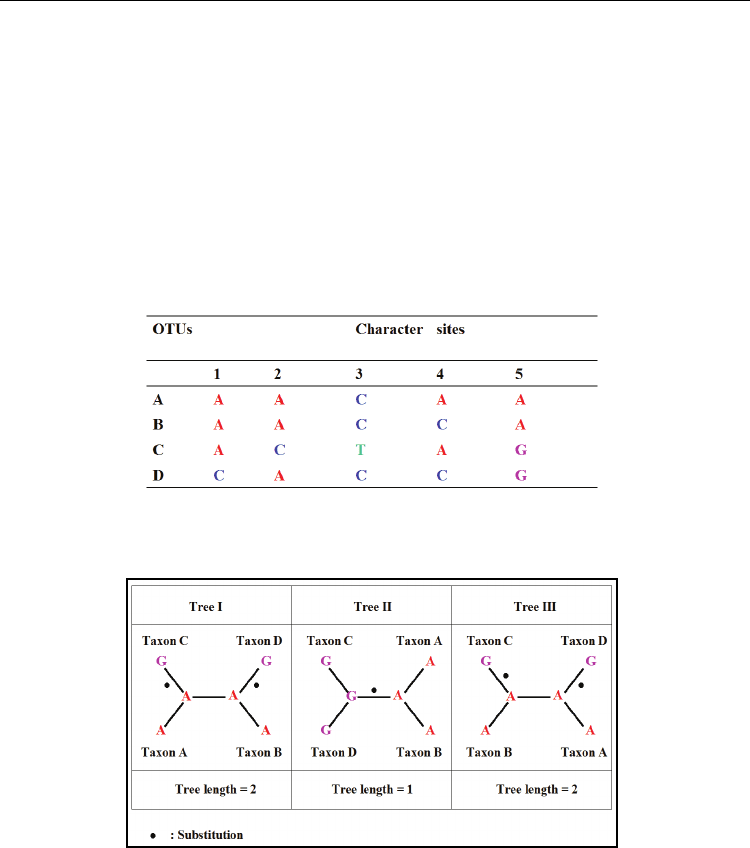
An illustrative example of phylogeny analysis using Maximum parsimony is shown in Table
5 and Fig. 12. Table 5 shows a snapshot of MSA of 4 sequences where 5 columns show the
Computational Biology and Applied Bioinformatics
18
aligned nucleotides. Since there are four taxa (A, B, C & D), three possible unrooted trees
can be obtained for each site. Out of 5 character sites, only two sites, viz., 4 & 5 are
informative i.e. sites having at least two different types of characters (nucleotides/amino
acids) with a minimum frequency 2. In the Maximum parsimony method, only informative
sites are analysed. Fig. 12 shows the Maximum parsimony phylogenetic analysis of site 5
shown in Table 5. Three possible unrooted trees are shown for site 5 and the tree length is
calculated in terms of number of substitutions. Tree II is favoured over trees I and III as it
can explain the observed changes in the sequences just with a single substitution. In the
same way unrooted trees can be obtained for other informative sites such as site 4. The most
parsimonious tree among them will be selected as the final phylogenetic tree. If two or more
trees are found and no unique tree can be inferred, trees are said to be equally
parsimonious.
Table 5. Example of phylogenetic analysis from 5 aligned character sites in 4 OTUs using
Maximum parsimony method.
Fig. 12. Example showing various tree topologies based on site 5 in Table 5 using the
Maximum parsimony method.
This method is suitable for a small number of sequences with higher similarity and was
originally developed for protein sequences. Since this method examines the number of
evolutionary changes in all possible trees it is computationally intensive and time
consuming. Thus, it is not the method of choice for large sized genome sequences with high
variation. The unequal rates of variation in different sites can lead to erroneous parsimony
tree with some branches having longer lengths than others as parsimony method assumes
the rate of change across all sites to be equal.

Molecular Evolution & Phylogeny: What, When, Why & How?
19
6.2.2 Maximum likelihood
As mentioned in the beginning, another character based method for the MPA is the
Maximum likelihood method. This method is based on probabilistic approach to phylogeny.
This approach is different from the methods discussed earlier. In this method probabilistic
models for phylogeny are developed and the tree would be reconstructed using Maximum
likelihood method or by sampling method for the given set of sequences. The main
difference between this method and some of the available methods discussed before is that
it ranks various possible tree topologies according to their likelihood. The same can be
obtained by either using the frequentist approach (using the probability (data|tree)) or by
using the Baysian approach (likelihood based on the posterior probabilities i.e. by using
probability (tree|data)). This method also facilitates computing the likelihood of a sub-tree
topology along the branch.
To make the method operative, one must know how to compute P(x*|T,t*) probability of set
of data given tree topology T and set of branch length t*. The tree having maximum
probability or the one, which maximizes the likelihood would be chosen as the best tree. The
maximization can also be based on the posterior probability P(tree|data) and can be carried
out by obtaining required probability using P(x*|T,t*)=P(data|tree) and by applying the
Baye’s theorem.
The exercise of maximization involves two steps:
a. A search over all possible tree topologies with order of assignment of sequences at the
leaves specified.
b. For each topology, a search over all possible lengths of edges in t*
As mentioned in the chapter earlier, the number of rooted trees for given number of
sequences (N) grows very rapidly even as N increases to 10. An efficient search procedure
for these tasks is required, which was proposed by Felsenstein (1981) and is extensively
being used in the MPA. The maximization of likelihood of edge lengths can be carried out
using various optimization techniques.
An alternative method is to search stochastically over trees by sampling from posterior
distribution P(T,t*|x*). This method uses techniques such as Monte Carlo method, Gibb’s
sampling etc. The results of this method are very promising and are often recommended.
Having briefly reviewed the principles, merits and limitations of various methods available
for reconstruction of phylogenetic trees using molecular data, it becomes evident that the
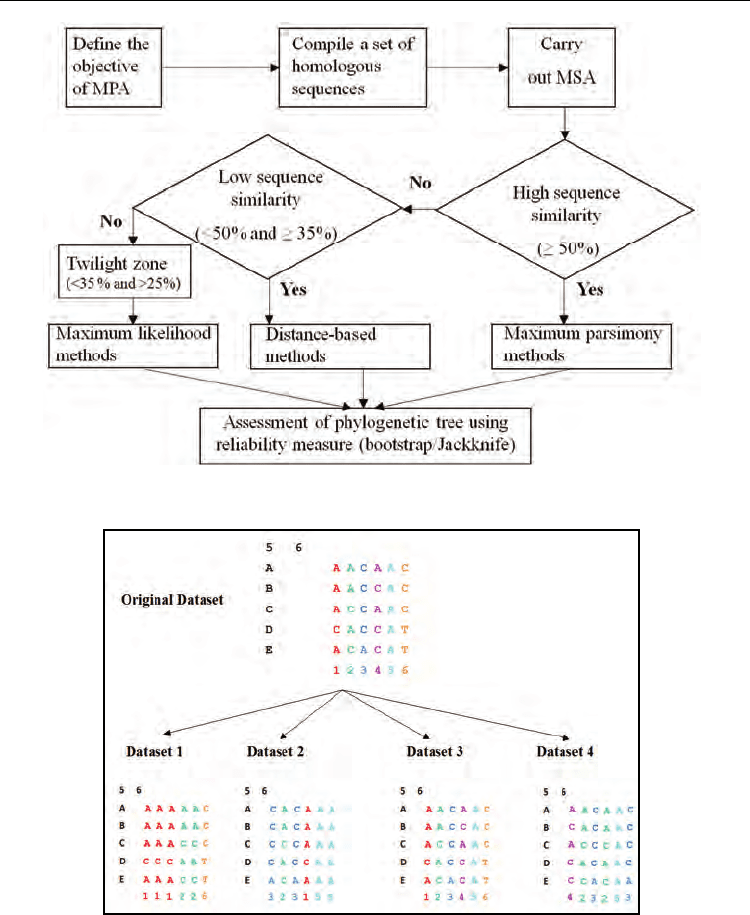
choice of method for MPA is very crucial. The flowchart shown in Fig. 13 is intended to
serve as a guideline to choose a method based on extent of similarity between the sequences.
However, it is recommended that one uses multiple methods (at least two) to derive the
trees. A few programs have also been developed to superimpose trees to find out
similarities in the branching pattern and tree topologies.
7. Assessing the reliability of phylogenetic tree
The assessment of the reliability of phylogenetic tree is an important part of MPA as it helps
to decide the relationships of OTUs with a certain degree of confidence assigned by
statistical measures. Bootstrap and Jackknife analyses are the major statistical procedures to
evaluate the topology of phylogenetic tree (Efron, 1979; Felsenstein, 1985).
In bootstrap technique, the original aligned dataset of sequences is used to generate the
finite population of pseudo-datasets by “sampling with replacement” protocol. Each
pseudo-dataset is generated by sampling n character sites (columns in the alignment)
Computational Biology and Applied Bioinformatics
20
Fig. 13. Flowchart showing the analysis steps involved in phylogenetic reconstruction.
Fig. 14. The procedure to generate pseudo-replicate datasets of original dataset using
bootstrap is shown above. The character sites are shown in colour codes at the bottom of
datasets to visualize “sampling with replacement protocol”.
randomly from original dataset with a possibility of sampling the same site repeatedly, in
the process of regular bootstrap. This leads to generation of population of datasets, which
are given as an input to tree building methods thus giving rise to population of phylogenetic

Molecular Evolution & Phylogeny: What, When, Why & How?
21
trees. The consensus phylogenetic tree is then inferred by the majority rule that groups those
OTUs, which are found to cluster most of the times in the population of trees. The branches
in consensus phylogenetic tree are labelled with bootstrap support values enabling the
significance of the relationship of OTUs as depicted using a branching pattern. The
procedure for regular bootstrap is illustrated in the Fig. 14. It shows the original dataset
along with four pseudo-replicate datasets.
The sites in the original dataset are colour coded to visualize the “sampling with
replacement protocol” used in generation of pseudo-replicate datasets 1-4. Seqboot program
in PHYLIP package was used for this purpose with choice of regular bootstrap. For
example, pseudo-replicate dataset 1 contains the site 1 (red) from original dataset sampled 3
times. In the general practice, usually 100 to 1000 datasets are generated and for each of the
datasets phylogenetic tree is obtained. The consensus phylogenetic tree is then obtained by
majority rule. The reliability of the consensus tree is assessed from the “branch times” value
displayed along the branches of tree.
In Jackknife procedure, the pseudo-datasets are generated by “sampling without replacement”
protocol. In this process, sampling (<n) character sites randomly from original dataset
generates each pseudo dataset. This leads to generation of population of datasets, which are
given as an input to tree building methods thus giving rise to population of phylogenetic trees.
The consensus phylogenetic tree is inferred by the majority rule that groups those OTUs,
which are found to be clustered most of the times in the population of trees.
8. The case study of Mumps virus phylogeny
We have chosen a case study of Mumps virus (MuV) phylogeny using the amino acid
sequences of surface hydrophobic (SH) proteins. There are 12 different known genotypes of
MuV, which are designated through A to L, based on the sequence similarity of SH gene
sequences. Recently a new genotype of MuV, designated as M, has been identified during
parotitis epidemic 2006-2007 in the state of São Paulo, Brazil (Santos et al., 2008). Extensive
phylogenetic analysis of newly discovered genotype with existing genotypes of reference
strains (A-L) has been used for the confirmation of new genotype using character-based
Maximum likelihood method (Santos et al., 2008). In the case study to be presented here, we
have used distance-based Neighbor-Joining method with an objective to re-confirm the
presence of new MuV genotype M. The dataset reported in Santos et al., (2008) is used for
the re-confirmation analysis. The steps followed in the MPA are listed below.
a. Compilation and curation of sequences: The sequences of SH protein of the strains of
reference genotypes (A to L) as well as newly discovered genotype (M) of MuV were
retrieved using GenBank accession numbers as given in Santos et al., (2008). Sequences
were saved in Fasta format.
b. Multiple sequence alignment (MSA): SH proteins were aligned using ClustalW (See Fig.
2). MSA was saved in Phylip or interleaved (.phy) format.
c. Bootstrap analysis: 100 pseudo-replicate datasets of the original MSA data (obtained in
step b) were generated using regular bootstrap methods in Seqboot program of PHYLIP
package.
d. Derivation of distance: The distances between sequences in each dataset were calculated
using Dayhoff PAM model assuming uniform rate of variation at all sites. The ‘outfile’
generated by Seqboot program was used as an input to Protdist program in PHYLIP
package.
Computational Biology and Applied Bioinformatics
22
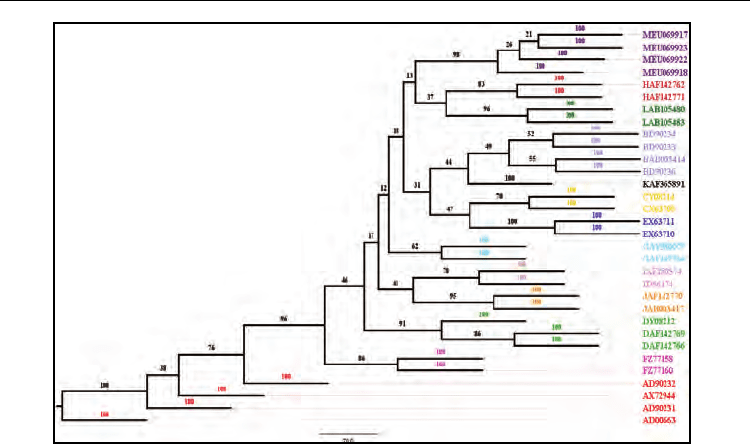
Fig. 15. The unrooted consensus phylogenetic tree obtained for Mumps virus genotypes
using Neighbor-Joining method. The first letter in OTU labels indicates the genotype (A-M),
which is followed by the GenBank accession numbers for the sequences. The OTUs are also
colour coded according to genotypes as following, A: red; B: light blue; C: yellow; D: light
green; E: dark blue; F: magenta; G: cyan; H: brick; I: pink; J: orange; K: black; L: dark green;
M: purple. All of the genotypes have formed monophyletic clades with high bootstrap
support values shown along the branches. The monophyletic clade of M genotypes (with 98
bootstrap support at its base) separated from the individual monophyletic clades of other
genotypes (A-L) re-confirms the detection of new genotype M.
e. Building phylogenetic tree: The distance matrices obtained in the previous step were
given as an input to N-J method to build phylogenetic trees. The ‘outfile’ generated by
Protdist program containing distance matrices was given as an input to Neighbor
program in PHYLIP package.
f. The consensus phylogenetic tree was then obtained using Consense program. For this
purpose the ‘outtree’ file (in Newick format) generated by Neighbor program was given
as an input to Consense program.
g. The consensus phylogenetic tree was visualized using FigTree software (available from
http://tree.bio.ed.ac.uk/software/figtree/). The consensus unrooted phylogenetic tree
is shown in Fig. 15.
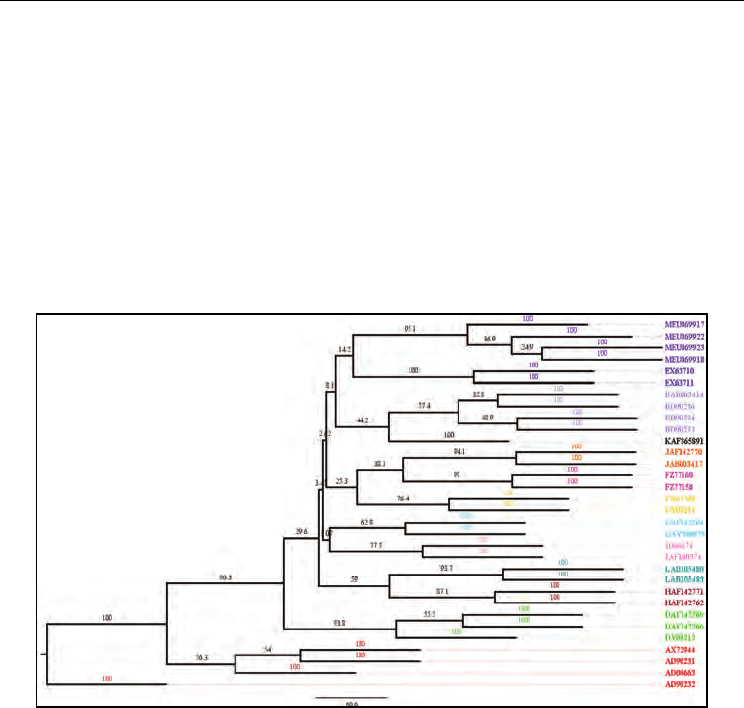
The phylogenetic tree for the same dataset was also obtained by using Maximum parsimony
method, implemented as the Protpars program in PHYLIP by carrying out MSA and
bootstrap as detailed above. The consensus phylogenetic tree is shown in Fig. 16.
Comparison of the trees shown in Fig. 15 & Fig. 16 with that of the published tree re-
confirms the emergence of new MuV genotype M during the epidemic in São Paulo, Brazil
(Santos et al., 2008), as the members of genotype M have formed a distinct monophyletic
clade similar to the known genotypes (A-L). But, a keen observer would note the differences
in ordering of clades in the two phylograms obtained using two different methods viz., N-J
Molecular Evolution & Phylogeny: What, When, Why & How?
23
and MP. For example, the clade of genotype J is close to the clade of genotype I in the N-J
phylogram (see Fig. 15) whereas in the MP phylogram (Fig. 16) the clade of genotype J is
shown to cluster with the clade of genotype F. Such differences in the ordering of clades are
observed some times as these methods (N-J & MP) employ different assumptions and
models of evolution. The user can interpret the results with reasonable confidence where the
similar clustering pattern of clades is observed in trees drawn using multiple methods. The
user, on the other hand, should refrain from over interpretation of sub-tree topolologies,
where branching order doesn’t match in the trees drawn using different methods. Similarly,
a lot of case studies pertaining to the emergence of new species as well as evolution of
individual genes/proteins have been published. It is advisable to re-run through a few case
studies, which are published, to understand the way in which the respective authors have
interpreted the results on the basis of phylogenetic analyses.
Fig. 16. The unrooted consensus phylogenetic tree obtained for Mumps virus genotypes
using Maximum parsimony method. The labelling of OTUs and colour coding is same as in
Fig. 15.
9. Challenges and opportunities in phylogenomics
The introduction of next-generation sequencing technology has totally revived the pace of
genome sequencing. It has inevitably posed challenges on traditional ways of molecular
phylogeny analysis based on single gene, set of genes or markers. Currently the phylogeny
based on molecular markers such as 16S rRNA, mitochondrial, nuclear genes etc. provide
the taxonomic backbone for Tree of Life (http://tolweb.org/tree/phylogeny.html). But the
single gene based phylogeny does not necessarily reflect the phylogenetic history among the
genomes of organisms from which these genes are derived. Also the types of evolutionary
events such as lateral gene transfer, recombination etc. may not be revealed through the
phylogeny of single gene. Thus whole genome based phylogeny analyses become important
for deeper understanding of the evolutionary pattern in the organisms (Konstantinidis &

Computational Biology and Applied Bioinformatics
24
Tiedje, 2007). But whole genome based phylogeny poses many challenges to the traditional
methods of MPA, major concerns of them being the size, memory and computational
complexity involved in alignment of genomes (Liu et al., 2010).
The methods of MSA developed so far are adequate to handle the requirements of limited
amount of data viz. individual gene or protein sequences from various organisms. The
increased size of data in terms of the whole genome sequences, however, poses constrains
on use and applicability of currently available methods of MSA as they become
computationally intensive with requirement of higher memory. The uncertainty associated
with alignment procedures, which leads to variations in the inferred phylogeny, has also
been pointed out to be the cause of concern (Wong et al., 2008). The benchmark datasets are
made available to validate performance of multiple sequence alignment methods (Kemena
& Notredame, 2009). These challenges have opened up opportunities for development of
alternative approaches for MPA with emergence of alignment-free methods for the same
(Kolekar et al., 2010; Sims et al., 2009; Vinga & Almeida, 2003). The field of MPA is also
evolving with attempts to develop novel methods based on various data mining techniques
viz. Hidden Markov Model (HMM) (Snir & Tuller, 2009), Chaos game theory (Deschavanne
et al., 1999), Return Time Distributions (Kolekar et al., 2010) etc. The recent approaches are
undergoing refinement and will have to be evaluated with the benchmark datasets before
they are routinely used. However, sheer dimensionality of genomic data demands their
application. These approaches along with the conventional approaches are extensively
reviewed elsewhere (Blair & Murphy, 2010; Wong & Nielsen, 2007).
10. Conclusion
The chapter provides excursion of molecular phylogeny analyses for potential users. It gives
an account of available resources and tools. The fundamental principles and salient features
of various methods viz. distance-based and character-based are explained with worked out
examples. The purpose of the chapter will be served if it enables the reader to develop
overall understanding, which is critical to perform such analyses involving real data.
11. Acknowledgment
PSK acknowledges the DBT-BINC junior research fellowship awarded by Department of
Biotechnology (DBT), Government of India. UKK acknowledges infrastructural facilities and
financial support under the Centre of Excellence (CoE) grant of DBT, Government of India.
12. References
Adachi, J. & Hasegawa, M. (1996) Model of amino acid substitution in proteins encoded by
mitochondrial DNA. Journal of Molecular Evolution 42(4):459-468.
Aniba, M.; Poch, O. & Thompson J. (2010) Issues in bioinformatics benchmarking: the case
study of multiple sequence alignment. Nucleic Acids Research 38(21):7353-7363.
Batzoglou, S. (2005) The many faces of sequence alignment. Briefings in Bioinformatics 6(1):6-
22.
Benson, D.; Karsch-Mizrachi, I.; Lipman, D.; Ostell, J. & Sayers, E. (2011) GenBank. Nucleic
Acids Research 39(suppl 1):D32-D37.

Molecular Evolution & Phylogeny: What, When, Why & How?
25
Blair, C. & Murphy, R. (2010) Recent Trends in Molecular Phylogenetic Analysis: Where to
Next? Journal of Heredity 102(1):130.
Bruno, W.; Socci, N. & Halpern A. (2000) Weighted neighbor joining: a likelihood-based
approach to distance-based phylogeny reconstruction. Molecular Biology and
Evolution 17(1):189.
Cavalli-Sforza, L. & Edwards, A. (1967) Phylogenetic analysis. Models and estimation
procedures. American Journal of Human Genetics 19(3 Pt 1):233.
Cole, J.; Wang, Q.; Cardenas, E.; Fish, J.; Chai, B.; Farris, R.; Kulam-Syed-Mohideen, A.;
McGarrell, D.; Marsh, T.; Garrity, G. & others. (2009) The Ribosomal Database
Project: improved alignments and new tools for rRNA analysis. Nucleic Acids
Research 37(suppl 1):D141-D145.
Deschavanne, P.; Giron, A.; Vilain, J.; Fagot, G. & Fertil, B. (1999) Genomic signature:
characterization and classification of species assessed by chaos game representation
of sequences. Mol Biol Evol 16(10):1391-9.
Edgar, R.(2004). MUSCLE: a multiple sequence alignment method with reduced time and
space complexity. BMC Bioinformatics 5:113
Efron, B. (1979) Bootstrap Methods: Another Look at the Jackknife. Ann. Statist. 7:1-26.
Felsenstein, J. (1981) Evolutionary trees from DNA sequences: a maximum likelihood
approach. J. Mol Evol 17:368-376.
Felsenstein, J. (1985) Confidence Limits on Phylogenies: An Approach Using the Bootstrap.
Evolution 39 783-791.
Felsenstein, J.(1989). PHYLIP-phylogeny inference package (version 3.2). Cladistics 5:164-166
Felsenstein, J. (1996) Inferring phylogenies from protein sequences by parsimony, distance,
and likelihood methods. Methods Enzymol 266:418-27.
Fitch, W. (1971) Toward Defining the Course of Evolution: Minimum Change for a Specific
Tree Topology. Systematic Zoology 20(4):406-416.
Gascuel, O. (1997) BIONJ: an improved version of the NJ algorithm based on a simple model
of sequence data. Molecular Biology and Evolution 14(7):685-695.
Hall, T. (1999). BioEdit: A user-friendly biological sequence alignment editor and analysis
program for Windows 95/98/NT. Nucleic Acids Symp Ser 41:95-98.
Hendy, M. & Penny, D. (1982) Branch and bound algorithms to determine minimal
evolutionary trees. Mathematical Biosciences 59(2):277-290.
Henikoff, S. & Henikoff, J. (1992) Amino acid substitution matrices from protein blocks.
Proceedings of the National Academy of Sciences of the United States of America
89(22):10915.
Jones, D.; Taylor, W. & Thornton, J. (1994) A mutation data matrix for transmembrane
proteins. FEBS Letters 339(3):269-275.
Jukes, T. & Cantor, C. (1969) Evolution of protein molecules. In “Mammalian Protein
Metabolism”(HN Munro, Ed.). Academic Press, New York.
Kaminuma, E.; Kosuge, T.; Kodama, Y.; Aono, H.; Mashima, J.; Gojobori, T.; Sugawara, H.;
Ogasawara, O; Takagi, T.; Okubo, K. & others. (2011). DDBJ progress report.
Nucleic Acids Research 39(suppl 1):D22-D27
Katoh, K.; Kuma, K.; Toh, H. & Miyata T (2005) MAFFT version 5: improvement in accuracy
of multiple sequence alignment. Nucleic Acid
s Res 33:511 - 518
Kemena, C. & Notredame, C. (2009) Upcoming challenges for multiple sequence alignment
methods in the high-throughput era. Bioinformatics 25(19):2455-2465.

Computational Biology and Applied Bioinformatics
26
Kimura, M. (1980) A simple method for estimating evolutionary rates of base substitutions
through comparative studies of nucleotide sequences. Journal of Molecular Evolution
16(2):111-120.
Kolekar, P.; Kale, M. & Kulkarni-Kale, U. (2010) `Inter-Arrival Time' Inspired Algorithm and
its Application in Clustering and Molecular Phylogeny. AIP Conference Proceedings
1298(1):307-312.
Konstantinidis, K. & Tiedje, J. (2007) Prokaryotic taxonomy and phylogeny in the genomic
era: advancements and challenges ahead. Current Opinion in Microbiology 10(5):504-
509.
Kuiken, C.; Leitner, T.; Foley, B.; Hahn, B.; Marx, P.; McCutchan, F.; Wolinsky, S.; Korber, B.;
Bansal, G. & Abfalterer, W. (2009) HIV sequence compendium 2009. Document LA-
UR:06-0680
Kuiken, C.; Yusim, K.; Boykin, L. & Richardson, R. (2005) The Los Alamos hepatitis C
sequence database. Bioinformatics 21(3):379.
Kulkarni-Kale, U.; Bhosle, S.; Manjari, G. & Kolaskar, A. (2004) VirGen: a comprehensive
viral genome resource. Nucleic Acids Research 32(suppl 1):D289.
Kumar, S.; Nei, M.; Dudley, J. & Tamura, K. (2008) MEGA: a biologist-centric software for
evolutionary analysis of DNA and protein sequences. Brief Bioinform, 9(4):299-306.
Leinonen, R.; Akhtar, R.; Birney, E.; Bower, L.; Cerdeno-Tárraga, A.; Cheng, Y.; Cleland, I.;
Faruque, N.; Goodgame, N.; Gibson, R. & others. (2011) The European Nucleotide
Archive. Nucleic Acids Research 39(suppl 1):D28-D31.
Lio, P. & Goldman, N. (1998) Models of molecular evolution and phylogeny. Genome Res
8(12):1233-44.
Liu, K.; Linder, C. & Warnow, T. (2010) Multiple sequence alignment: a major challenge to
large-scale phylogenetics. PLoS Currents 2.
Luo, A.; Qiao, H.; Zhang, Y.; Shi, W.; Ho, S.; Xu, W.; Zhang, A. & Zhu, C. (2010) Performance
of criteria for selecting evolutionary models in phylogenetics: a comprehensive
study based on simulated datasets. BMC Evolutionary Biology 10(1):242.
Morgenstern, B.; French, K.; Dress, A. & Werner, T. (1998). DIALIGN: finding local
similarities by multiple sequence alignment. Bionformatics 14:290 - 294
Needleman, S. & Wunsch, C. (1970) A general method applicable to the search for
similarities in the amino acid sequence of two proteins. Journal of Molecular Biology
48(3):443-453.
Nicholas, H.; Ropelewski, A. & Deerfield DW. (2002) Strategies for multiple sequence
alignment. Biotechniques 32(3):572-591.
Notredame, C.; Higgins, D. & Heringa, J. (2000) T-Coffee: A novel method for fast and
accurate multiple sequence alignment. Journal of Molecular Biology 302:205 - 217
Parry-Smith, D.; Payne, A.; Michie, A.& Attwood, T. (1998). CINEMA--a novel colour
INteractive editor for multiple alignments. Gene 221(1):GC57-GC63
Pearson, W.; Robins, G. & Zhang, T. (1999) Generalized neighbor-joining: more reliable
phylogenetic tree reconstruction. Molecular Biology and Evolution 16(6):806.
Phillips, A. (2006) Homology assessment and molecular sequence alignment. Journal of
Biomedical Informatics 39(1):18-33.
Ronquist, F. & Huelsenbeck, J. (2003). MrBayes 3: Bayesian phylogenetic inference under
mixed models.
Bioinformatics
19(12):1572-1574