
Lopes H.S., Cruz L.M. (eds.) Computational Biology and Applied Bioinformatics
Подождите немного. Документ загружается.


Molecular Evolution & Phylogeny: What, When, Why & How?
27
Rzhetsky, A. (1995) Estimating substitution rates in ribosomal RNA genes. Genetics
141(2):771.
Saitou, N. & Nei, M. (1987) The neighbor-joining method: a new method for reconstructing
phylogenetic trees. Mol Biol Evol 4(4):406-25.
Santos, C.; Ishida, M.; Foster, P.; Sallum, M.; Benega, M.; Borges, D.; Corrêa, K.; Constantino,
C.; Afzal, M. & Paiva, T. (2008) Detection of a new mumps virus genotype during
parotitis epidemic of 2006–2007 in the State of São Paulo, Brazil. Journal of Medical
Virology 80(2):323-329.
Sayers, E.; Barrett, T.; Benson, D.; Bolton, E.; Bryant, S.; Canese, K.; Chetvernin, V.; Church,
D.; DiCuccio, M.; Federhen, S. & others. (2011). Database resources of the National
Center for Biotechnology Information. Nucleic Acids Research 39(suppl 1):D38-D51.
Schwartz, R. & Dayhoff, M. (1979) Matrices for detecting distant relationships. M. 0. Dayhoff
(ed.), Atlas of protein sequence and structure 5:353-358.
Schmidt, H.; Strimmer, K.; Vingron, M. & Von Haeseler A. (2002). TREE-PUZZLE:
maximum likelihood phylogenetic analysis using quartets and parallel computing.
Bioinformatics 18(3):502.
Sims, G.; Jun, S.; Wu, G. & Kim, S. (2009) Alignment-free genome comparison with feature
frequency profiles (FFP) and optimal resolutions. Proc Natl Acad Sci U S A
106(8):2677-82.
Snir, S. & Tuller, T. (2009) The net-hmm approach: phylogenetic network inference by
combining maximum likelihood and hidden Markov models. Journal of
bioinformatics and computational biology 7(4):625-644.
Sokal, R. & Michener, C. (1958) A statistical method for evaluating systematic relationships.
Univ. Kans. Sci. Bull. 38:1409-1438.
Tamura, K. (1992) Estimation of the number of nucleotide substitutions when there are
strong transition-transversion and G+C-content biases. Molecular Biology and
Evolution 9(4):678-687.
Tamura, K. & Nei, M. (1993) Estimation of the number of nucleotide substitutions in the
control region of mitochondrial DNA in humans and chimpanzees. Molecular
Biology and Evolution 10(3):512-526.
The UniProt Consortium. (2011). Ongoing and future developments at the Universal Protein
Resource. Nucleic Acids Research 39(suppl 1):D214-D219.
Thompson, J.; Higgins, D. & Gibson, T. (1994) CLUSTAL W: improving the sensitivity of
progressive multiple sequence alignment through sequence weighting, position-
specific gap penalties and weight matrix choice. Nucleic Acids Res 22(22):4673-80.
Thompson, J.; Linard, B.; Lecompte, O. & Poch, O. (2011) A Comprehensive Benchmark
Study of Multiple Sequence Alignment Methods: Current Challenges and Future
Perspectives. PLoS ONE 6(3):e18093.
Thorne, J.; Goldman, N. & Jones, D. (1996) Combining protein evolution and secondary
structure. Molecular Biology and Evolution 13(5):666-673.
Vinga, S. & Almeida, J. (2003) Alignment-free sequence comparison-a review. Bioinformatics
19(4):513-23.
Wilgenbusch, J. & Swofford, D. (2003). Inferring Evolutionary Trees with PAUP*. Current
Protocols in Bioinformatics. 6.4.1–6.4.28
Wong, K.; Suchard, M. & Huelsenbeck, J. (2008) Alignment Uncertainty and Genomic
Analysis. Science 319(5862):473-476.

Computational Biology and Applied Bioinformatics
28
Wong, W. & Nielsen, R. (2007) Finding cis-regulatory modules in Drosophila using
phylogenetic hidden Markov models. Bioinformatics 23(16):2031-2037.
Xia, X. & Xie, Z. (2001). DAMBE: software package for data analysis in molecular biology
and evolution. Journal of Heredity 92(4):371
2
Understanding Protein Function - The Disparity
Between Bioinformatics and Molecular Methods
Katarzyna Hupert-Kocurek
1
and Jon M. Kaguni
2
1
University of Silesia
2
Michigan State University
1
Poland
2
United States of America
1. Introduction
Bioinformatics has its origins in the development of DNA sequencing methods by Alan
Maxam and Walter Gilbert (Maxam and Gilbert, 1977), and by Frederick Sanger and
coworkers (Sanger et al., 1977). By entirely different approaches, the first genomes
determined at the nucleotide sequence level were that of bacteriophage φX174, and the
recombinant plasmid named pBR322 composed of about 5,400 (Sanger et al., 1977), or 4,400
base pairs (Sutcliffe, 1979), respectively. In contrast, two articles that appeared in February
2001 reported on the preliminary DNA sequence of the human genome, which corresponds
to 3 billion nucleotides of DNA sequence information (Lander et al., 2001; Venter et al.,
2001). Only two years later, the GenBank sequence database contained more than 29.3
billion nucleotide bases in greater than 23 million sequences. With the development of new
technologies, experts predict that the cost to sequence an individual’s DNA will be about
$1000. This reduction in cost suggests that efforts in the area of comparative genomics will
increase substantially, leading to an enormous database that vastly exceeds the existing one.
By way of comparative genomics approaches, computational methods have led to the
identification of homologous genes shared among species, and their classification into
superfamilies based on amino acid sequence similarity. In combination with their
evolutionary relatedness, superfamily members have been clustered into clades. In addition,
high throughput sequencing of small RNAs and bioinformatics analyses have contributed to
the identification of regions between genes that can code small RNAs (siRNA, microRNA,
and long noncoding RNA), which act during the development of an organism to modulate
gene expression at the post-transcriptional level (Fire et al., 1998; Hamilton and Baulcombe,
1999) reviewed in Elbashir et al., 2001; Ghildiyal and Zamore, 2009; Christensen et al., 2010).
An emerging area is functional genomics whereby gene function is deduced using large-
scale methods by identifying the involvement of specific genes in metabolic pathways. More
recently, phenotype microarray methods have been used to correlate the functions of genes
of microbes with cell phenotypes under a variety of growth conditions (Bochner, 2009).
These methods contrast with the traditional approach of mapping a gene via the phenotype
of a mutation, and deducing the function of the gene product based on its biochemical
analysis in concert with physiological studies. Such studies have been performed to confirm
the functional importance of conserved residues shared by superfamily members, and also

Computational Biology and Applied Bioinformatics
30
to determine the role of specific residues for a given protein. In comparison, comparative
genomics methods are unable to distinguish if a nonconserved amino acid among
superfamily members is functionally important, or simply reflects sequence divergence due
to the absence of selection during evolution. Without functional information, it is not
possible to determine if a nonconserved amino acid is important.
2. Bioinformatics analysis of AAA+ proteins
On the basis of bioinformatics analysis, P-loop nucleotide hydrolases compose a very large
group of proteins that use an amino acid motif named the phosphate binding loop (P-loop)
to hydrolyze the phosphate ester bonds of nucleotides. A positively charged group in the
side chain of an amino acid (often lysine) in the P-loop promotes nucleotide hydrolysis by
interacting with the phosphate of the bound nucleotide. Additional bioinformatics analysis
of this group of proteins led to a category of nucleotidases containing the Walker A and B
motifs, as well as additional motifs shared by the AAA (ATPases Associated with diverse
cellular Activities) superfamily (Beyer, 1997; Swaffield and Purugganan, 1997). These
diverse activities include protein unfolding and degradation, vesicle transport and
membrane fusion, transcription and DNA replication. The additional motifs of the AAA
superfamily differentiate its members from the larger set of P-loop nucleotidases. Neuwald
et al., and Iyer et al. then integrated structural information with bioinformatics analysis to
classify members of the AAA+ superfamily into clades (Neuwald et al., 1999; Iyer et al.,
2004). These clades are the clamp loader clade, the DnaA/CDC6/ORC clade, the classical
AAA clade, the HslU/ClpX/Lon/ClpAB-C clade, and the Helix-2 insert clade. The last two
clades have been organized into the Pre-sensor 1 hairpin superclade.
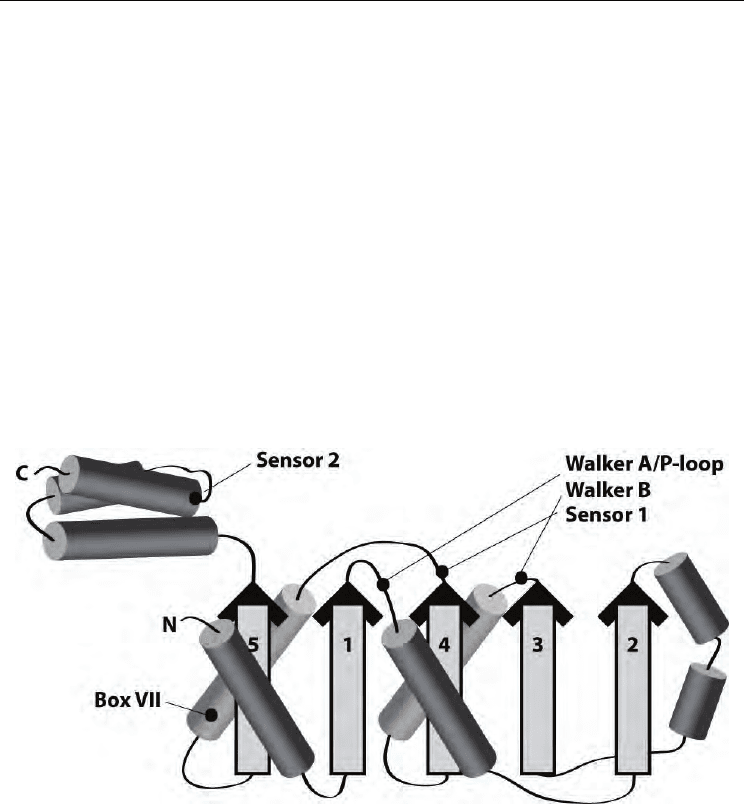
Members of the superfamily of AAA+ ATPases carry a nucleotide-binding pocket called the
AAA+ domain that ranges from 200 to 250 amino acids, which is formed by an αβα-type
Rossmann fold followed by several α helices (Figure 1) (Lupas and Martin, 2002; Iyer et al.,
2004; Hanson and Whiteheart, 2005). Such proteins often assemble into ring-shaped or
helical oligomers (Davey et al., 2002; Iyer et al., 2004; Erzberger and Berger, 2006). Using the
nomenclature of Iyer et al., the Rossmann fold is formed by a β sheet of parallel strands
arranged in a β5-β1-β4-β3-β2 series. Its structure resembles a wedge. An α helix preceding
the β1 strand and a loop that is situated across the face of the β sheet is a distinguishing
feature of the AAA+ superfamily. Another characteristic is the position of several α helices
positioned above the wide end of the wedge. The P-loop or the Walker A motif (GX
4
GKT/S
where X is any amino acid) is located between the β1 strand and the following α helix. The
Walker B motif (φφφφDE where φ is a hydrophobic amino acid) coordinates a magnesium
ion complexed with the nucleoside triphosphate via the conserved aspartate residue. The
conserved glutamate is thought to interact with a water molecule to make it a better
nucleophile for nucleotide hydrolysis.
AAA+ proteins also share conserved motifs named the Sensor 1, Box VII, and Sensor 2
motifs that coordinate ATP hydrolysis with a change in conformation (Figure 1) (Lupas and
Martin, 2002; Iyer et al., 2004; Hanson and Whiteheart, 2005). Relative to the primary amino
acid sequence, these motifs are on the C-terminal side of the Walker B motif. The Sensor 1
motif contains a polar amino acid at the end of the β4 strand. On the basis of the X-ray
crystal structure of N-ethylmaleimide-sensitive factor, an ATPase involved in intracellular
vesicle fusion (Beyer, 1997; Swaffield and Purugganan, 1997), this amino acid together with
Understanding Protein Function -
The Disparity Between Bioinformatics and Molecular Methods
31
the acidic residue in the Walker B motif interacts with and aligns the activated water
molecule during nucleotide hydrolysis. The Box VII motif, which is also called the SRH
(Second Region of Homology) motif, contains an arginine named the arginine finger by its
analogous function with the corresponding arginine of GTPase activator proteins that
interacts with GTP bound to a small G protein partner to promote GTP hydrolysis. The
crystal structures of several AAA+ proteins have shown that the Box VII motif in an
individual molecule is located some distance away from the nucleotide binding pocket. In
AAA+ proteins that assemble into ring-shaped or helical oligomers, the Box VII motif of one
protomer directs an arginine residue responsible for interaction with the γ phosphate of
ATP toward the ATP binding pocket of the neighboring molecule. It is proposed that this
interaction or lack thereof coordinates ATP hydrolysis with a conformational change. The
Sensor 2 motif, which resides in one of the α helices that follow the Rossmann fold, also
contains a conserved arginine. For proteins whose structures contain the bound nucleoside
triphosphate or a nucleotide analogue, this amino acid interacts with the γ phosphate of the
nucleotide. As reviewed by Ogura (Ogura et al., 2004), this residue is involved in ATP
binding or its hydrolysis in some but not all AAA+ proteins. Like the arginine finger
residue, this arginine is thought to coordinate a change in protein conformation with
nucleotide hydrolysis.
Fig. 1. Structural organization of the AAA+ domain, and the locations of the Walker A/P-
loop, Walker B, Sensor 1, Box VII and Sensor 2 motifs are shown (adapted from ref.
(Erzberger and Berger, 2006)).
Because this chapter focuses on members of the DnaA/CDC6/ORC or initiator clade, the
following summarizes properties of this clade and not others. Like the clamp loader clade,
proteins in the initiator clade as represented by DnaA and DnaC have a structure
resembling an open spiral on the basis of X-ray crystallography (Erzberger et al., 2006; Mott
et al., 2008). In comparison, oligomeric proteins in the remaining clades form closed rings. A
characteristic feature of proteins in the initiator clade is the presence of two α helices
between the β2 and β3 strands (Figure 1). Compared with the function of DnaA in the
initiation of E. coli DNA replication, DnaC plays a separate role. Their functions are

Computational Biology and Applied Bioinformatics
32
described in more detail below. The ORC/CDC6 group of eukaryotic proteins in the
initiator clade, like DnaA and DnaC, act to recruit the replicative helicase to replication
origins at the stage of initiation of DNA replication (Lee and Bell, 2000; Liu et al., 2000). The
origin recognition complex (ORC) is composed of six related proteins named Orc1p through
Orc6p, and likely originated along with Cdc6p from a common ancestral gene.
Bioinformatics analysis of DnaC suggests that this protein is a paralog of DnaA, arising by
gene duplication and then diverging with time to perform a separate role from DnaA during
the initiation of DNA replication (Koonin, 1992). This notion leads to the question of what
specific amino acids are responsible for the different functions of DnaA and DnaC despite
the shared presence of the AAA+ amino acid sequence motifs. Presumably, specific amino
acids that are not conserved between these two proteins have critical roles in determining
their different functions, but how are these residues identified and distinguished from those
that are not functionally important? In addition, some amino acids that are conserved
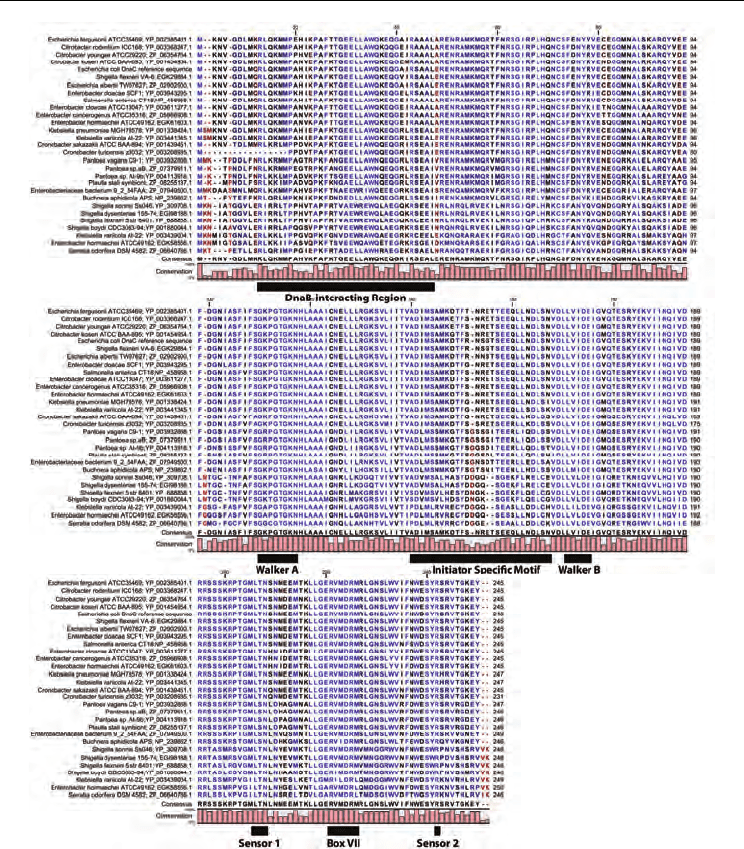
among homologous DnaC proteins, which were identified by multiple sequence alignment
of twenty-eight homologues (Figure 2), are presumable responsible for the unique activities
of DnaC, but what are these unique activities? These issues underscore the limitation of
deducing the biological function of protein by relying only on bioinformatics analysis.
3. Reverse genetics as an approach to identify the function of an unknown
gene
Using various amino acid sequence alignment methods for a particular gene, the postulated
function for this gene remains unknown if amino acid sequence homology is not obtained
relative to a gene of known function. In such cases, the general approach is to employ
reverse genetics to attempt to correlate a phenotype with a mutation in the gene. By way of
comparison, forward genetics begins with a phenotype caused by a specific mutation at an
unknown site in the genome. The approximate position of the gene can be determined by
classical genetic methods that involve its linkage to another mutation that gives rise to a
separate phenotype. Refined linkage mapping can localize the gene of interest, followed by
PCR (polymerase chain reaction) amplification of the region and DNA sequence analysis to
determine the nature of the mutation. As a recent development, whole genome sequencing
has been performed to map mutations, dispensing with the classical method of genetic
linkage mapping (Lupski et al., 2010; Ng and Kirkness, 2010). The DNA sequence obtained
may reveal that the gene and the corresponding gene product have been characterized in the
same or different organism, and disclose its physiological function.
In a reverse genetics approach with a haploid organism, the standard strategy is to
inactivate the gene with the hope that a phenotype can be measured. Inactivation can be
achieved either by deleting the gene or by insertional mutagenesis, usually with a
transposon. As examples, transposon mutagenesis has been performed with numerous
microbial species, and with Caenorhabditis elegans (Vidan and Snyder, 2001; Moerman and
Barstead, 2008; Reznikoff and Winterberg, 2008). Using E. coli or S. cerevisiae as model
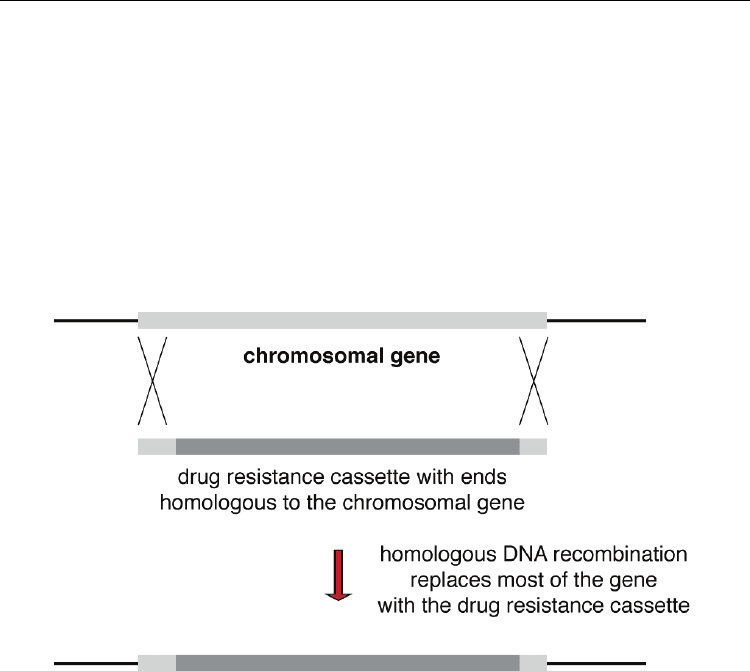
organisms for gene disruption, one method relies on replacing most of the gene with a drug
resistance cassette, or a gene that causes a detectable phenotype. The technique of gene
disruption relies on homologous recombination in which the drug resistance gene, for
example, has been joined to DNA sequences that are homologous to the ends of the target
gene (Figure 3). After introduction of this DNA into the cell, recombination between the
ends of the transfected DNA and the homologous regions in the chromosome leads to
Understanding Protein Function -
The Disparity Between Bioinformatics and Molecular Methods
33
Fig. 2. Multiple sequence alignment of dnaC homologues using the Constraint-based
Multiple Alignment Tool reveals amino acids that are highly conserved. The Walker A,
Walker B, Sensor I, Sensor II and Box VII motifs shared among the AAA+ family of ATPases
are shown below the alignment. These motifs are involved in ATP binding, ATP hydrolysis,
and coordinating a conformational change with ATP hydrolysis. The figure also shows the
region of DnaC near the N-terminus that is involved in interaction with DnaB helicase
(Ludlam et al., 2001; Galletto et al., 2003; Mott et al., 2008), and the ISM (Initiator/loader-
Specific Motif), which corresponds to two α helices between the β2 and β3 strands, that
distinguishes members of the DnaA/CDC6/ORC clade from other AAA+ clades. The ISM
causes DnaC assembled as oligomers to form a spiral structure (Mott et al., 2008).
Computational Biology and Applied Bioinformatics
34
replacement of the chromosomal copy of the gene with the drug resistance cassette, after
which the excised copy of the chromosomal gene is lost. In both E. coli and S. cerevisiae, this
approach has been used in seeking to correlate a phenotype with genes of unknown
function, and to identify those that are essential for viability (Winzeler et al., 1999; Baba et
al., 2006). By either gene disruption or transposon mutagenesis, genetic mapping of the
mutation can be performed by inverse PCR where primers complementary to a sequence
near the ends of the drug resistance cassette or the transposon are used. This approach first
involves partially digesting the chromosomal DNA with a restriction enzyme followed by
ligation of the resulting fragments to form a collection of circular DNAs. DNA sequence
analysis of the amplified DNA with the primers described above followed by comparison of
the nucleotide sequence with the genomic DNA sequence can identify the site of the
disrupted gene, or the site of insertion of the transposon.
Fig. 3. DNA recombination between the chromosomal gene and homologous DNA at ends
of the drug resistance gene leads to replacement of the chromosomal copy of the gene with
the drug resistance cassette. The chromosomal gene, and homologous DNA at the ends of
the drug resistance cassette are indicated by the lighter shaded rectangles. The drug
resistance gene is indicated by the darker rectangles. The thin line represents chromosomal
DNA flanking the gene.
With a multicellular organism, a similar strategy that relies on homologous recombination is
used to delete a gene. The type of cell to introduce the deletion is usually an embryonic stem
cell so that the effect of deletion can be measured in the whole organism. Many eukaryotic
organisms have two complete sets of chromosomes. Because the process of homologous
recombination introduces the deletion mutation in one of the two pairs of chromosomes,
yielding a heterozygote, the presence of the wild type copy on the sister chromosome may
conceal the biological effect of the deletion. Thus, the ideal objective is to delete both copies
of a gene in order to measure the associated phenotype. To attempt to obtain an organism in
which both copies of a gene have been “knocked out,” the standard strategy is to mate
heterozygous individuals. By Mendelian genetics, one-fourth of the progeny should carry
the deletion in both copies of the gene. The drawback with the approach of deleting a gene

Understanding Protein Function -
The Disparity Between Bioinformatics and Molecular Methods
35
is that it may be essential for viability as suggested if a homozygous knockout organism
cannot be obtained. Another pitfall is that it may not be possible to construct a heterozygous
knockout because the single wild type copy is insufficient to maintain viability. In either
case, no other hint of gene function is obtained except for the requirement for life.
Another complication with attempting to determine the role of a eukaryotic gene by
deleting it is the existence of gene families where a specific biochemical function is provided
by allelic variants. Hence, to correlate a phenotype by introducing a mutation into a specific
allelic variant requires inactivation of all other members of the family. A further
complication with eukaryotic organisms is that a product formed by an enzyme of interest
in one biochemical pathway may be synthesized via an alternate pathway that involves a
different set of proteins. In these circumstances, deletion of the gene does not yield a
measurable phenotype.
In the event that deletion of a gene is not possible, an alternate approach to characterize the
function of an unknown gene is by RNA interference (reviewed in Carthew and Sontheimer,
2009; Fischer, 2010; Krol et al., 2010). This strategy exploits a natural process that acts to
repress the expression of genes during development, or as cells progress through the cell
cycle (Fire et al., 1998; Ketting et al., 1999; Tabara et al., 1999). Small RNA molecules named
microRNA (miRNA) and small interfering RNA (siRNA) become incorporated into a large
complex called the RNA-inducing silencing complex (RISC), which reduces the expression
of target genes by facilitating the annealing of the RNA with the complementary sequence in
a messenger RNA (Liu et al., 2003). The duplex RNA is recognized by a component of the
RISC complex, followed by degradation of the messenger RNA to block its expression. The
RNA interference pathway has been adapted as a method to reduce or “knockdown” the
expression of a specific gene in order to explore its physiological function. Compared with
other genetic methods that examine the effect of a specific amino acid substitution on a
particular activity of a multifunctional protein, the knockout and knockdown approaches
are not as refined in that they measure the physiological effect of either the reduced
function, or the loss of function of the entire protein.
4. E. coli as a model organism for structure-function studies
Escherichia coli is a rod-shaped bacterium (0.5 micron x 2 microns in the nongrowing state)
that harbors a 4.4 x 10
6
base pair genome encoding more than 4,000 genes. By transposon-
based insertional mutagenesis and independently by systematic deletion of each open
reading frame, these genes have been separated into those that are essential for viability,
and those that are considered nonessential (Baba et al., 2006). Of the total, about 300 genes
are of undetermined function, including 37 genes that are essential. BLAST analysis
indicates that some of the genes of unknown function are conserved among bacteria,
suggesting their functional importance.
In comparison, many of the genes of known function have been studied extensively. Among
these are the genes required for duplication of the bacterial chromosome, including a subset
that acts at the initiation stage of DNA replication. The following section describes a specific
example that focuses on DnaC protein. Studies on this protein take advantage of
bioinformatics in combination with its X-ray crystallographic structure, molecular genetic
analysis, and the biochemical characterization of specific mutant DnaC proteins to obtain
new insight into its role in DNA replication.
Computational Biology and Applied Bioinformatics
36
5. Molecular analysis of E. coli DnaC, an essential protein involved in the
initiation of DNA replication, and replication fork restart
DNA replication is the basis for life. Occurring only once per cell cycle, DNA replication
must be tightly coordinated with other major cellular processes required for cell growth so
that each progeny cell receives an accurate copy of the genome at cell division (reviewed in
DePamphilis and Bell, 2010). Improper coordination of DNA replication with cell growth
leads to aberrant cell division that causes cell death in severe cases. In addition, the failure to
control the initiation process leads to excessive initiations, followed by the production of
double strand breaks that apparently arise due to head-to-tail fork collisions. In eukaryotes,
aneuploidy and chromosome fusions appear if the broken DNA is not fixed that can lead to
malignant growth.
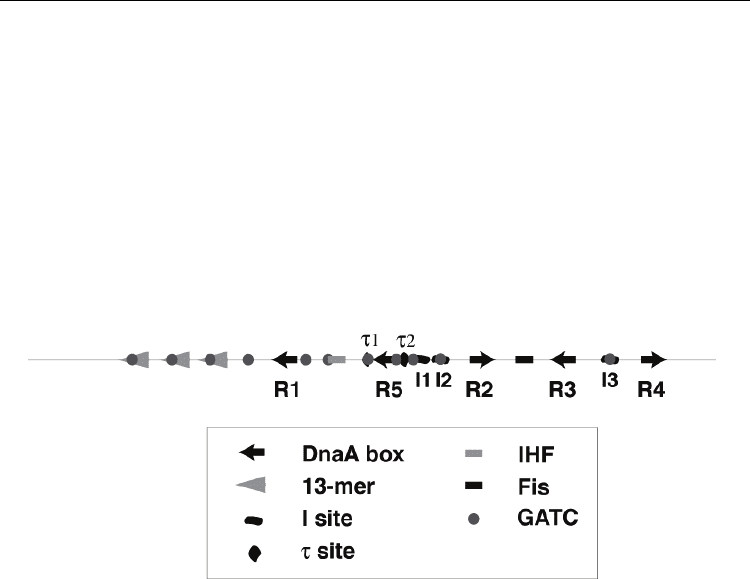
In bacteria, chromosomal DNA replication starts at a specific locus called oriC (Figure 4).
Fig. 4. Organization of DNA sequence motifs in the E. coli replication origin (oriC). Near the
left border are 13-mer motifs that are unwound by DnaA complexed to ATP. Sites
recognized by DnaA are the DnaA boxes (arrow), I-sites (warped oval), and τ-sites (warped
circle). Sites recognized by IHF (shaded rectangle), Fis (filled rectangle), and DNA adenine
methyltransferase (shaded circle) are also indicated.
Recent reviews describe the independent mechanisms that control the frequency of
initiation from this site (Nielsen and Lobner-Olesen, 2008; Katayama et al., 2010). In
Escherichia coli, the minimal oriC sequence of 245 base pairs contains DNA-binding sites for
many different proteins that either act directly in DNA replication, or modulate the
frequency of this process (reviewed in Leonard and Grimwade, 2009). One of them is DnaA,
which is the initiator of DNA replication, and has been placed in one of the clades of the
AAA+ superfamily via bioinformatics analysis (Koonin, 1992; Erzberger and Berger, 2006).
DnaA binds to a consensus 9 base pair sequence known as the DnaA box. There are five
DnaA boxes individually named R1 through R5 within oriC that are similar in sequence and
are recognized by DnaA (Leonard and Grimwade, 2009). In addition to these sites, DnaA
complexed to ATP specifically recognizes three I- sites and τ-sites in oriC, which leads to the
unwinding of three AT-rich 13-mer repeats located in the left half of oriC. Binding sites are
also present for IHF protein (integration host factor) and FIS protein (factor for inversion
stimulation). As these proteins induce bends in DNA, their apparent ability to modulate the
binding of DnaA to the respective sites in oriC may involve DNA bending. Additionally,
oriC carries 11 GATC sequences recognized by DNA adenine methyltransferase, and sites