
Lopes H.S., Cruz L.M. (eds.) Computational Biology and Applied Bioinformatics
Подождите немного. Документ загружается.

3
In Silico Identification of Regulatory
Elements in Promoters
Vikrant Nain
1
, Shakti Sahi
1
and Polumetla Ananda Kumar
2
1
Gautam Buddha University, Greater Noida
2
National Research Centre on Plant Biotechnology, New Delhi
India
1. Introduction
In multi-cellular organisms development from zygote to adult and adaptation to different
environmental stresses occur as cells acquire specialized roles by synthesizing proteins
necessary for each task. In eukaryotes the most commonly used mechanism for maintaining
cellular protein environment is transcriptional regulation of gene expression, by recruiting
required transcription factors at promoter regions. Owing to the importance of
transcriptional regulation, one of the main goals in the post-genomic era is to predict gene
expression regulation on the basis of presence of transcription factor (TF) binding sites in the
promoter regions. Genome wide knowledge of TF binding sites would be useful to build
transcriptional regulatory networks model that result in cell specific differentiation. In
eukaryotic genomes only a fraction (< 5%) of total genome codes for functional proteins or
RNA, while remaining DNA sequences consist of non-coding regulatory sequences, other
regions and sequences still with unknown functions.
Since the discovery of trans-acting factors in gene regulation by Jacob and Monads in lac
operon of E. coli, scientists had an interest in finding new transcription factors, their specific
recognition and binding sequences. In DNAse footprinting (or DNase protection assay);
transcription factor bound regions are protected from DNAse digestion, creating a
"footprint" in a sequencing gel. This methodology has resulted in identification of hundreds
of regulatory sequences. However, limitation of this methodology is that it requires the TF
and promoter sequence (100-300 bp) in purified form. Our knowledge of known
transcription factors is limited and recognition and binding sites are scattered over the
complete genome. Therefore, in spite of high degree of accuracy in prediction of TF binding
site, this methodology is not suitable for genome wide or across the genomes scanning.
Detection of TF binding sites through phylogenetic footprinting is gradually becoming
popular. It is based on the fact that random mutations are not easily accepted in functional
sequences, while they continuously keep on tinkering non functional sequences. Many
comparative genomics studies have revealed that during course of evolution regulatory
elements remain conserved while the non-coding DNA sequences keep on mutating. With
an ever increasing number of complete genome sequence from multiple organisms and
mRNA profiling through microarray and deep sequencing technologies, wealth of gene
expression data is being generated. This data can be used for identification of regulatory

Computational Biology and Applied Bioinformatics
48
elements through intra and inter species comparative genomics. However, the identification
of TF binding sites in promoters still remains one of the major challenges in bioinformatics
due to following reasons:
1. Very short (5-15 nt) size of regulatory motifs that also differ in their number of
occurrence and position on DNA strands with respect to transcription start site. This
wide distribution of short TF binding sites makes their identification with commonly
used sequence alignment programmes challenging.
2. A very high degree of conservation between two closely related species generally
shows no clear signature of highly conserved motifs.
3. Absence of significant similarities between highly diverse species hinders the alignment
of functional sequences.
4. Sometimes, functional conservation of gene expression is not sufficient to assure the
evolutionary preservation of corresponding cis-regulatory elements (Pennacchio and
Rubin, 2001).
5. Transcription factors binding sites are often degenerate.
In order to overcome these challenges, in the last few years novel approaches have been
developed that integrate comparative, structural, and functional genomics with the
computational algorithms. Such interdisciplinary efforts have increased the sensitivity of
computational programs to find composite regulatory elements.
Here, we review different computational approaches for identification of regulatory
elements in promoter region with seed specific legumin gene promoter analysis as an
example. Based on the type of DNA sequence information the motif finding algorithms are
classified into three major classes: (1) methods that use promoter sequences from co
regulated genes from a single genome, (2) methods that use orthologous promoter
sequences of a single gene from multiple species, also known as phylogenetic footprinting
and (3) methods that use promoter sequences of co regulated genes as well as phylogenetic
footprinting (Das and Dai, 2007).
2. Representation of DNA motifs
In order to discover motifs of unknown transcription factors, models to represent motifs are
essential (Stormo, 2000).There are three models which are generally used to describe a motif
and its binding sites:
1. string representation (Buhler and Tompa, 2002)
2. matrix representation (Bailey and Elkan, 1994) and
3. representation with nucleotide dependency (Chin and Leung, 2008)
2.1 String representation
String representation is the basic representation using string of symbols or nucleotides A, C,
G and T of length-l to describe a motif. Wildcard symbols are introduced into the string to
represent choice from a subset of symbols at a particular position. The International Union
of Pure and Applied Chemistry (IUPAC) nucleic acid codes (Thakurta and Stormo, 2007) are
used to represent the information about degeneracy for example: W = A or T (‘Weak’ base
pairing); S= C or G (‘Strong’ base pairing); R= A or G (Purine); Y= C or T (Pyrimidine); K= G
or T (Keto group on base); M= A or C (Amino group on base); B= C, G, or T; D= A, G, or T ;
H= A, C, or T ; V= A, C, or G; N= A, C, G, or T.

In Silico Identification of Regulatory Elements in Promoters
49
2.2 Matrix representation
In matrix representation, motifs of length l are represented by position weight matrices
(PWMs) or position specific scoring matrices (PSSMs) of size 4x l. This gives the occurrence
probabilities of each of the four nucleotides at a position j. The score of any specific sequence
is the sum of the position scores from the weight matrix corresponding to that sequence.
Using this representation an entire genome can be scanned by a matrix and the score at
every position obtained (Stormo, 2000). Any sequence with score that is higher than the
predefined cut-off is a potential new binding site. A consensus sequence is deduced from a
multiple alignment of input sequences and then converted into a position weight matrix.
A PWM score is the sum of position-specific scores for each symbol in the substring. The
matrix has one row for each symbol of the alphabet, and one column for each position in the
pattern. The score assigned by a PWM to a substring
(
)
1
N
j
j
SS
=
=
, is defined as
,
1
N
s
jj
j
m
=
∑
where j represents position in the substring, s
j
is the symbol at position j in the substring,
and m
α,j
is the score in row α, column j of the matrix.
Although matrix representation appears superior, the solution space for PWMs and PSSMs,
which consists of 4l real numbers is infinite in size, and there are many local optimal
matrices, thus, algorithms generally either produce a suboptimal motif matrix or take too
long to run when the motif is longer than 10 bp (Francis and Henry, 2008).
2.3 Representation with nucleotide dependency
The interdependence between neighboring nucleotides with similar number of parameters
as string and matrix representations is described by Scored Position Specific Pattern (SPSP).
A set of length-l binding site patterns can be described by a SPSP representation P, which
contains c (c ≤ l) sets of patterns Pi, 1 ≤ i ≤ c, where each set of patterns Pi contains length-li
patterns
P
i,j
of symbols A, C, G, and T and ∑
i
l
i
= l. Each length- l
i
pattern P
i,j
is associated
with a score s
i,j that
represents the “closeness” of a pattern to be a binding site. The lower the
score, the pattern is more likely a binding site (Henry and Fracis, 2006).
3. Methods of finding TF binding sites in a DNA sequence
3.1 Searching known motifs
Development of databases of complete information on experimentally validated TF binding
site is indispensable for promoter sequence analysis. Information about TF binding sites
remain scattered in literature. In the last one and half decade phenomenal increase in
computational power, cheaper electronic storage with faster communication technologies,
have resulted in development of a range of web accessible databases having experimentally
validated TF binding sites. These TF binding site databases are not only highly useful for
identification of putative TF binding sites in new promoter sequences (Table1), but also are
valuable for providing positive dataset required for improvement and validation of new TF
binding site prediction algorithms.
3.1.1 TRANSFAC
TRANSFAC is the largest repository of transcription factors binding sites. TRANSFAC
(TRANSFAC 7.0, 2005) web accessible database consists of 6,133 factors with 7,915 sites,
while professional version (TRANSFAC 2008.3) consists of 11,683 factors with 30,227 sites.
TRANSFAC database is composed of six tables SITE, GENE, FACTOR, CELL, CLASS and

Computational Biology and Applied Bioinformatics
50
MATRIX. GENE table gives a short explanation of the gene where a site (or group of sites)
belongs to; FACTOR table describes the proteins binding to these sites. CELL gives brief
information about the cellular source of proteins that have been shown to interact with the
sites. CLASS contains some background information about the transcription factor classes,
while the MATRIX table gives nucleotide distribution matrices for the binding sites of
transcription factors. This database is most frequently used as reference for TFB sites as well
as for development of new algorithms. However, new users find it difficult to access the
database because it requires search terms to be entered manually. There is no criterion to
select the organism, desired gene or TF from a list, so web interface is not user friendly.
Other web tools such as TF search and Signal Scan overcome this limitation to certain extent.
3.1.2 Signal Scan
Signal Scan finds and lists homologies of published TF binding site signal sequences in the
input DNA sequence by using TRANSFAC, TFD and IMD databases. It also allows to select
from different classes viz mammal, bird, amphibian, insect, plant, other eukaryotes,
prokaryote, virus (TRANSFAC only), insect and yeast (TFD only).
3.1.3 TRRD
The transcription regulatory region database (TRRD) is a database of transcription
regulatory regions of the eukaryotic genome. The TRRD database contains three
interconnected tables: TRRDGENES (description of the genes as a whole), TRRDSITES
(description of the sites), and TRRDBIB (references). The current version, TRRD 3.5,
comprises of the description of 427 genes, 607 regulatory units (promoters, enhancers, and
silencers), and 2147 transcription factor binding sites. The TRRDGENES database compiles
the data on human (185 entries), mouse (126), rat (69), chicken (29), and other genes.
Developmental/Environmental
stimulus
Transcription
factor binding
site
Position
Sequence
Core promoter
TATA Box -33 tcccTATAaataa
Cat Box -49 gCCAAc
Stress responsive
G Box -66 tgACGgtgt
ABRE -76 acaccttctttgACTGtccatccttc
ABI4 -245 CACCg
Pathogen defense
W Box -72 cttctTTGAcgtgtcca
TCA gAGAAgagaa
Light Response I box -302 gATATga
Wound specific
WUN -348 tAATTacac
TCA -646 gAGAAgagaa
Seed Specific
Legumin -118 tccatacCCATgcaagctgaagaatgtc
Opaque-2 -348 TAATtacacatatttta
Prolamine box -385 TTaaaTGTAAAAgtAa
AAGAA-motif -294 agaAAGAa
Table 1. In silico analysis of pigeonpea legumin gene promoter for identification of
regulatory elements. Database search reveals that it consist of regulatory elements that can
direct its activation under different envirnmental conditions and developmental stages.

In Silico Identification of Regulatory Elements in Promoters
51
3.1.4 PlantCARE
PlantCARE is database of plant specific cis-Acting regulatory elements in the promoter
regions (Lescot et al., 2002). It generates a sequence analysis output on a dynamic webpage,
on which TF binding sites are highlighted in the input sequence. The database can be
queried on names of transcription factor (TF) sites, motif sequence, function, species, cell
type, gene, TF and literature references. Information regarding TF site, organism, motif
position, strand, core similarity, matrix similarity, motif sequence and function are listed
whereas the potential sites are mapped on the query sequence.
3.1.5 PLACE
PLACE is another database of plant cis-acting regulatory elements extracted from published
reports (Higo et al., 1999). It also includes variations in the motifs in different genes or plant
species. PLACE also includes non-plant cis-elements data that may have homologues with
plant. PLACE database also provides brief description of each motif and links to
publications.
3.1.6 RegulonDB
RegulonDB is a comprehensive database of gene regulation and interaction in E. coli. It
consists of data on almost every aspect of gene regulation such as terminators, promoters,
TF binding sites, active and inactive transcription factor conformations, matrices alignments,
transcription units, operons, regulatory network interactions, ribosome binding sites (rbs),
growth conditions, gene product and small RNAs.
3.1.7 ABS
ABS is a database of known TF binding sites identified in promoters of orthologous
vertebrate genes. It has 650 annotated and experimental validated binding sites from 68
transcription factors and 100 orthologous target genes in human, mouse, rat and chicken
genome sequences. Although it’s a simple and easy-to-use web interface for data retrieval
but it does not facilitate either analysis of new promoter sequence or mapping user defined
motif in the promoter.
3.1.8 MatInspector
MatInspector identifies cis-acting regulatory elements in nucleotide sequences using
library of weight matrices (Cartharius et al., 2005). It is based on novel matrix family
concept, optimized thresholds, and comparative analysis that overcome the major limitation
of large number of redundant binding sites predicted by other programs. Thus it increases
the sensitivity of reducing false positive predictions. MatInspector also allows integration of
output with other sequence analysis programs e.g. DiAlignTF, FrameWorker,
SequenceShaper, for an in-depth promoter analysis and designing regulatory sequences.
MatInspector library contains 634 matrices representing one of the largest libraries available
for public searches.
3.1.9 JASPAR
JASPAR is the another open access database that compete with the commercial TF binding
site databases such as TRANSFAC (Portales-Casamar et al., 2009). The latest release has a

Computational Biology and Applied Bioinformatics
52
collection of 457 non-redundant, curated profiles. It is a collection of smaller databases, viz
JASPAR CORE, JASPAR FAM, JASPAR PHYLOFACTS, JASPAR POLII and others, among
which JASPAR CORE is most commonly used. The JASPAR CORE database contains a
curated, non-redundant set of profiles, derived from published collections of experimentally
determined transcription factor binding sites for multicellular eukaryotes (Portales-Casamar
et al., 2009). The JASPAR database can also be accessed remotely through external
application programming interface (API).
3.1.10 Cister: cis-element cluster finder
Cister is based on the technique of posterior decoding, with Hidden Markov model and
predicts regulatory regions in DNA sequences by searching for clusters of cis-elements
(Frith et al., 2001). The Cister input page consists of 16 common TF sites to define a cluster
and additional user defined PWM or TRANSFAC entries can also be entered. For web based
analysis maximum input sequence length is 100 kb, however, the program is downloadable
for standalone applications and analysis of longer sequences.
3.1.11 MAPPER
MAPPER stands for Multi-genome Analysis of Positions and Patterns of Elements of
Regulation It is a platform for the computational identification of TF binding sites in
multiple genomes (Marinescu et al., 2005). The MAPPER consists of three modules, the
MAPPER database, the Search Engine, and rSNPs and combines TRANSFAC
and JASPAR
data. However, MAPPER database is limited to TFBSs found only in the promoter of genes
from the human, mouse and D.melanogaster genomes.
3.1.12 Stubb
Like Cister, Stubb also uses hidden Markov models (HMM) to obtain a statistically
significant score for modules (Sinha et al., 2006). STUBB is more suitable for finding
modules over genomic scales with small set of transcription factors whose binding sites are
known. Stubb differs from MAPPER in that the application of latter is limited to binding
sites of a single given motif in an input sequence.
3.1.13 Clover
Clover is another program for identifying functional sites in DNA sequences. It take a set of
DNA sequences that share a common function, compares them to a library of sequence
motifs (e.g. transcription factor binding patterns), and identifies which, if any, of the motifs
are statistically overrepresented in the sequence set (Frith et al., 2004). It requires two input
files one for sequences in fasta format and another for sequence motif. Clover provides
JASPAR core collection of TF binding sites that can be converted to clover format. Clover is
also available as standalone application for windows, Linux as well as Mac operating
systems.
3.1.14 RegSite
Regsite consists of plant specific largest repository of transcription factor binding sites.
Current RegSite release contains 1816 entries. It is used by transcription start site prediction
programs (Sinha et al., 2006).
In Silico Identification of Regulatory Elements in Promoters
53
3.1.15 JPREdictor
JPREdictor is a JAVA based cis-regulatory TF binding site prediction program (Fiedler and
Rehmsmeier, 2006). The JPREdictor can use different types of motifs: Sequence Motifs,
Regular Expression Motifs, PSPMs as well as PSSMs and the complex motif type
(MultiMotifs). This tool can be used for the prediction of cis-regulatory elements on a
genome-wide scale.
3.2 Motif finding programs
3.2.1 Phylogenetic footprinting
Comparative DNA sequence analysis shows local difference in mutation rates and reveals a
functional site by virtue of its conservation in a background of non-functional sequences. In
the phylogenetic equivalent, regulatory elements are protected from random drift across
evolutionary time by selection. Orthologous noncoding DNA sequences from multiple
species provide a strong base for identification of regulatory elements by Phylogenetic
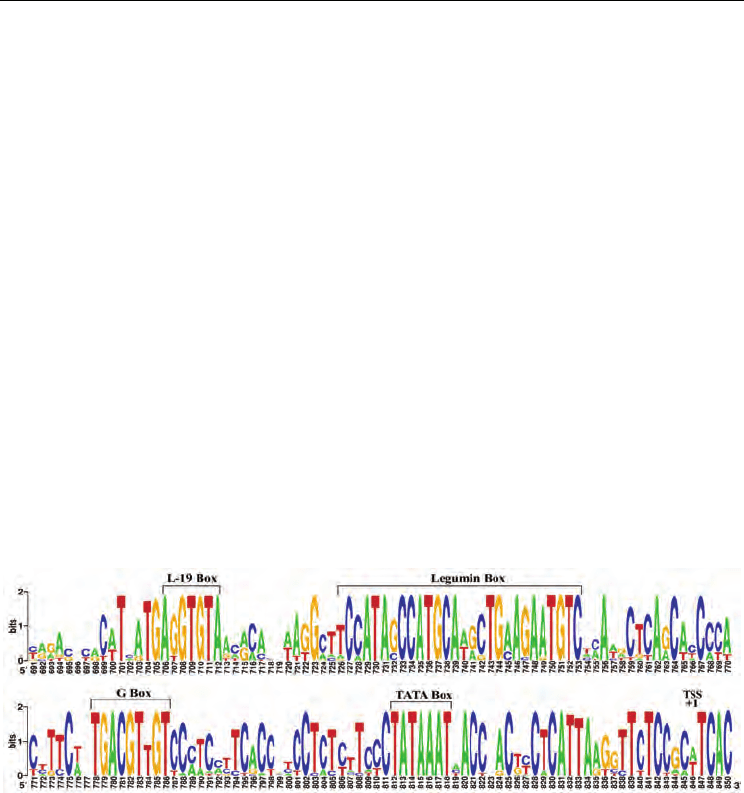
footprinting (Fig. 1) (Rombauts et al., 2003).
The major advantage of phylogenetic footprinting over the single genome is that multigene
approach requires data of co regulated genes. While phylogenetic footprinting can
identifying regulatory elements present in single gene, that remain conserved during the
course of divergence of two species under investigation. With steep increase in available
complete genome sequences, across species comparisons for a wide variety of organisms has
become possible (Blanchette and Tompa, 2002; Das and Dai, 2007). A multiple sequence
alignment algorithm suited for phylogenetic footprinting should be able to indentify small
(5-15 bp) sequence in a background of highly diverse sequences.
Fig. 1. Identification of new regulatory elements (L-19) in legumin gene promoters by
phylogenetic footprinting.
3.2.1.1 Clustal W, LAGAN, AVID
In phylogenetic footprinting primary aim is to construct global multiple alignment of the
orthologous promoter sequences and then identify a region conserved across orthologous
sequences. Alignment algorithms, such as ClustalW (Thompson et al., 1994), LAGAN
(Brudno et al., 2003), AVID (Bray et al., 2003) and Bayes-Block Aligner (Zhu edt al., 1998),
have proven useful for phylogenetic footprinting, but the short length of the conserved
motif compared to the length of the non-conserved background sequence; and their variable
position in a promoter hampers the alignment of conserved motifs. Moreover multiple
sequence alignment does not reveal meaningful biological information if the species used
Computational Biology and Applied Bioinformatics
54
for comparison are too closely related. If the species are too distantly related, it is difficult to
find an accurate alignment. It requires computational tools that bypass the requirement of
sequence alignment completely and have the capabilities to identify short and scattered
conserved regions.
3.2.1.2 MEME, Consensus, Gibbs sampler, AlignAce
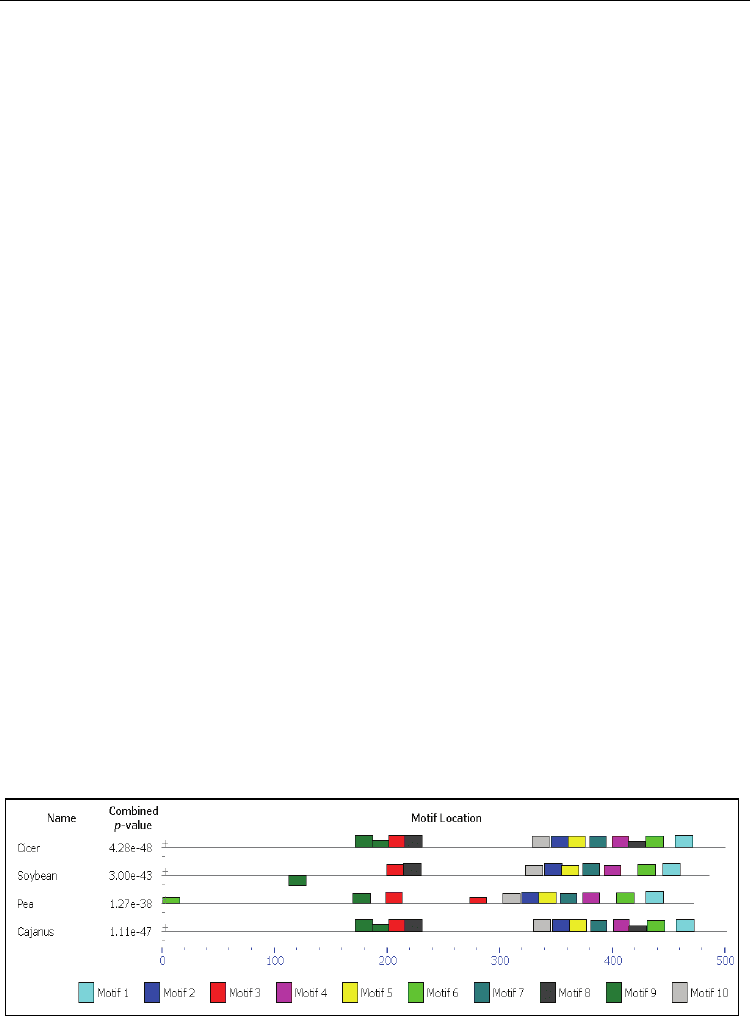
In cases where multiple alignment algorithms fails, motif finding algorithms such as MEME,
Consensus and Gibbs sampler have been used (Fig. 2). The feasibility of using comparative
DNA sequence analysis to identify functional sequences in the genome of S. cerevisiae, with
the goal of identifying regulatory sequences and sequences specifying nonprotein coding
RNAs was investigated (Cliften et al., 2001). It was found that most of the DNA sequences of
the closely related Saccharomyces species aligned to S.cerevisiae sequences and known
promoter regions were conserved in the alignments. Pattern search algorithms like
CONSENSUS (Hertz et al., 1990), Gibbs sampling (Lawrence et al., 1993) and AlignAce
(Roth et al., 1998) were useful for identifying known regulatory sequence elements in the
promoters, where they are conserved through the most diverged Saccharomyces species.
Gibbs sampler was used for motif finding using phylogenetic footprinting in proteobacterial
genomes (McCue et al., 2001). These programs employ two approaches for motif finding.
One approach is to employ a training set of transcription factor binding sites and a scoring
scheme to evaluate predictions. The scoring scheme is often based on information theory
and the training set is used to empirically determine a score threshold for reporting of the
predicted transcription factor binding sites. The second method relies on a rigorous
statistical analysis of the predictions, based upon modeled assumptions. The statistical
significance of a sequence match to a motif can be accessed through the determination of p-
value. P-value is the probability of observing a match with a score as good or better in a
randomly generated search space of identical size and nucleotide composition. The smaller
the p-value, the lesser the probability that the match is due to chance alone. Since the motif
finding algorithms assume the input sequences to be independent, therefore, they are
limited by the fact that the data sets containing a mixture of some closely related species will
have an unduly high weight in the results of motifs reported.
Multiple genome sequences were compared that are as optimally diverged as possible in
Saccharomyces genomes. Phylogenetic footprints were searched among the genome
sequences of six Saccharomyces species using the sequence alignment tool CLUSTAL W and
many statistically significant conserved sequence motifs (Cliften et al., 2003) were found.
Fig. 2. Combined Block diagram of an MEME output highlighting conserved motifs in
promoter regions of legumin seed storage protein genes of four different species.

In Silico Identification of Regulatory Elements in Promoters
55
3.2.1.3 Footprinter
This promising novel algorithm was developed to overcome the limitations imposed by
motif finding algorithms. This algorithm identifies the most conserved motifs among the
input sequences as measured by a parsimony score on the underlying phylogenetic tree
(Blanchette and Tompa, 2002). It uses dynamic programming to find most parsimonious k-
mer from each of the input sequences where k is the motif length. In general, the algorithm
selects motifs that are characterized by a minimal number of mismatches and are conserved
over long evolutionary distances. Furthermore, the motifs should not have undergone
independent losses in multiple branches. In other words, the motif should be present in the
sequences of subsequent taxa along a branch. The algorithm, based on dynamic
programming, proceeds from the leaves of the phylogenetic tree to its root and seeks for
motifs of a user-defined length with a minimum number of mismatches. Moreover, the
algorithm allows a higher number of mismatches for those sequences that span a greater
evolutionary distance. Motifs that are lost along a branch of the tree are assigned an
additional cost because it is assumed that multiple independent losses are unlikely in
evolution. To compensate for spurious hits, statistical significance is calculated based on a
random set of sequences in which no motifs occur.
3.2.1.4 CONREAL
CONREAL (Conserved Regulatory Elements Anchored Alignment Algorithm) is another
motif finding algorithm based on phylogenetic footprinting (Berezikov et al., 2005). This
algorithm uses potential motifs as represented by positional weight matrices (81 vertebrate
matrices form JASPAR database and 546 matrices from TRANSFAC database) to establish
anchors between orthologous sequences and to guide promoter sequence alignment.
Comparison of the performance of CONREAL with the global alignment
programs LAGAN
and AVID using a reference data set, shows that
CONREAL performs equally well for
closely related species like
rodents and human, and has a clear added value for aligning
promoter elements of more divergent species like human and fish,
as it identifies conserved
transcription-factor binding sites
that are not found by other methods.
3.2.1.5 PHYLONET
The PHYLONET computational approach identifies conserved regulatory motifs directly
from whole genome sequences of related species without reliance on additional information
was developed by (Wang and Stormo, 2005). The major steps involved are: i) construction of
phylogenetic profiles for each promoter , ii) searching through the entire profile space of all
the promoters in the genome to identify conserved motifs and the promoters that contain
them using algorithm like BLAST, iii) determination of statistical significance of motifs
(Karlin and Altschul, 1990). By comparing promoters using phylogenetic profiles (multiple
sequence alignments of orthologous promoters) rather than individual sequences, together
with the application of modified Karlin– Altschul statistics, they readily distinguished
biologically relevant motifs from background noise. When applied to 3524 Saccharomyces
cerevisiae promoters with Saccharomyces mikatae, Saccharomyces kudriavzevii, and Saccharomyces
bayanus sequences as references PHYLONET identified 296 statistically significant motifs
with a sensitivity of >90% for known transcription factor binding sites. The specificity of the
predictions appears very high because most predicted gene clusters have additional
supporting evidence, such as enrichment for a specific function, in vivo binding by a known
TF, or similar expression patterns.

Computational Biology and Applied Bioinformatics
56
However, the prediction of additional transcription factor binding sites by comparison of a
motif to the promoter regions of an entire genome has its own problems due to the large
database size and the relatively small width of a typical transcription factor binding site.
There is an increased chance of identification of many sites that match the motif and the
variability among the transcription factor binding sites permits differences in the level of
regulation, due to the altered intrinsic affinities for the transcription factor (Carmack et al.,
2007).
3.2.1.6 Phyloscan
PhyloScan combines evidence from matching sites found in orthologous data from several
related species with evidence from multiple sites within an intergenic region.The
orthologous sequence data may be multiply aligned, unaligned, or a combination of aligned
and unaligned. In aligned data, PhyloScan statistically accounts for the phylogenetic
dependence of the species contributing data to the alignment and, in unaligned data; the
evidence for sites is combined assuming phylogenetic independence of the species. The
statistical significance of the gene predictions is calculated directly, without employing
training sets (Carmack et al., 2007). The application of the algorithm to real sequence data
from seven Enterobacteriales species identifies novel Crp and PurR transcription factor
binding sites, thus providing several new potential sites for these transcription factors.
3.3 Software suites for motif discovery
3.3.1 BEST
BEST is a suite of motif-finding programs that include four motif-finding programs:
AlignACE (Roth et al., 1998), BioProspector(Liu et al., 2001), Consensus(Hertz and Stormo,
1999), MEME (Bailey et al., 2006) and the optimization program BioOptimizer (Jensen and
Liu, 2004). BEST was compiled on Linux, and thus it can only be run on Linux machines
(Che et al., 2005).
3.3.2 Seqmotifs
Seqmotifs is a suite of web based programs to find regulatory motifs in coregulated genes of
both prokaryotes and eukaryotes. In this suite BioProspector (Liu et al., 2001) is used for
finding regulatory motifs in prokaryote or lower eukaryote sequences while
CompareProspector(Liu et al., 2002) is used for higher eukaryotes. Another program Mdscan
(Liu et al., 2002) is used for finding protein-DNA interaction sites from ChIP-on-chip targets.
These programs analyze a group of sequences of coregulated genes so they may share
common regulatory motifs and output a list of putative motifs as position-specific probability
matrices, the individual sites used to construct the motifs, and the location of each site on the
input sequences. CompareProspector has been used for identification of transcription factors
Mef2, My, Srf, and Sp1 motifs from a human-muscle-specific co regulated genes. Additionally
in a C. elegans–C briggsae comparison, CompareProspector found the PHA-4 motif and the
UNC-86 motif.(Liu et al., 2004) Another C. Elegans CompareProspector analysis showed that
intestine genes have GATA transcription factor binding motif that was latter experimentally
validated (Pauli et al., 2006).
3.3.3 RSAT
The Regulatory Sequence Analysis Tools (RSAT) is an integrated online tool to analyze
regulatory sequences in co regulated genes (Thomas-Chollier et al., 2008). The only input