
Lopes H.S., Cruz L.M. (eds.) Computational Biology and Applied Bioinformatics
Подождите немного. Документ загружается.


Molecular Evolution & Phylogeny: What, When, Why & How?
7
a global alignment. Such regions possess ‘low’ information content to favour a tree topology
over the other. The inferiority of input dataset interferes with the analysis and interpretation
of the MPA. Thus, compilation of well-curated sequences, for the problem at hand, plays a
crucial role in MPA.
The concept of homology is central to MPA. Sequences are said to be homologous if they share
a common ancestor and are evolutionarily related. Thus, homology is a qualitative description
of the relationship and the term %homology has no meaning. However, supporting data for
deducing homology comes from the extent of sequence identity and similarity, both of which
are quantitative terms and are expressed in terms of percentage.
The homologous sequences are grouped into three types, viz., orthologs (same gene in
different species), paralogs (the genes that originated from duplication of an ancestral gene
within a species) and xenologs (the genes that have horizontally transferred between the
species). The orthologous protein sequences are known to fold into similar three-dimensional
shapes and are known to carry out similar functions. For example, haemoglobin alpha in horse
and human. The paralogous sequences are copies of the ancestral genes evolving within the
species such that nature can implement a modified function. For example haemoglobin alpha
and beta in horse. The xenologs and horizontal transfer events are extremely difficult to be
proved only on the basis of sequence comparison and additional experimental evidence to
support and validate the hypothesis is needed. The concepts of sequence alignments,
similarity and homology are extensively reviewed by Phillips (2006).
4. Multiple sequence alignments (MSA)
MSA is one of the most common and critical steps of classical MPA. The objective of MSA is to
juxtapose the nucleotide or amino acid residues in the selected dataset of homologous
sequences such that residues in the column of MSA could be used to derive the sequence of
the common ancestor. The MSA algorithms try to maximize the matching residues in the given
set of sequences with a pre-defined scoring scheme. The MSA produces a matrix of characters
with species in the rows and character sites in columns. It also introduces the gaps, simulating
the events of insertions and deletions (also called as indels). Insertion of gaps also helps in
making the lengths of all sequences same for the sake of comparison. All the MSA algorithms
are guaranteed to produce optimal alignment above a threshold value of detectable sequence
similarity. The alignment accuracy is observed to decrease when sequence similarity drops
below 35% towards the twilight (<35% but > 25%) and moonlight zones (<25%) of similarity.
The character matrix obtained in MSA reveals the pattern of conservation and variability
across the species, which in turn reveals the motifs and the signature sequences shared by
species to retain the fold and function. The analysis of variations can be gainfully used to
identify the changes that explain functional and phenotypic variability, if any, across OTUs.
Many algorithms have been specially developed for MSA and subsequently improved to
achieve higher accuracy. One of the popular heuristics-based MSA approach follows
progressive alignment procedure, in which sequences are compared in a pair wise fashion to
build a distance matrix containing percent identity values. A clustering algorithm is then
applied to distance matrix to generate a guide tree. The algorithm then follows a guide tree
to add the pair wise alignments together starting from the leaf to root. This ensures the
sequences with higher similarity are aligned initially and distantly related sequences are
progressively added to the alignment of aligned sequences. Thus, the gaps inserted are
always retained. A suitable scoring function, sum-of-pairs, consensus, consistency-based etc.

Computational Biology and Applied Bioinformatics
8
is employed to derive the optimum MSA (Nicholas et al., 2002; Batzoglou, 2005). Most of the
MSA packages use Needleman and Wunsch (1970) algorithm to compute pair wise sequence
similarity. The ClustalW is the widely used MSA package (Thompson et al., 1994). Recently
many alternative MSA algorithms are also being developed, which are enlisted in Table 2.
The standard benchmark datasets are used for comparative assessment of the alternative
approaches (Aniba et al., 2010; Thompson et al., 2011). Irrespective of the proven
performance of MSA methods for individual genes and proteins, some of the challenges and
issues regarding computational aspects involved in handling genomic data are still the
causes of concern (Kemena & Notredame, 2009).
Alignment
programs
Algorithm description Available at / Reference
ClustalW Progressive
http://www.ebi.ac.uk/Tools/msa/clustalw2/ ;
Thompson et al., 1994
MUSCLE Progressive/iterative
http://www.ebi.ac.uk/Tools/msa/muscle/ ;
Ed
g
ar, 2004
T-COFFEE Progressive
http://www.ebi.ac.uk/Tools/msa/tcoffee/ ;
Notredame et al., 2000
DIALIGN2 Segment-based
http://bibiserv.techfak.uni-bielefeld.de/diali
g
n/ ;
Mor
g
enstern et al., 1998
MAFFT Progressive/iterative
http://mafft.cbrc.
j
p/ali
g
nment/software/ ;
Katoh et al., 2005
Alignment visualization programs
*BioEdit
http://www.mbio.ncsu.edu/bioedit/bioedit.html
; Hall, 1999
MEGA5
http://www.me
g
asoftware.net/ ;
Kumar et al., 2008
DAMBE
http://dambe.bio.uottawa.ca/dambe.asp ;
Xia & Xie, 2001
CINEMA5
http://ai
g
.cs.man.ac.uk/research/utopia/cinema ;
Parr
y
-Smith et al., 1998
*: Not updated since 2008, but the last version is available for use.
Table 2. List of commonly used multiple sequence alignment programs and visualization
tools.
The MSA output can also be visualized and edited, if required, with the software like
BioEdit, DAMBE etc. Multiple alignment output shows the conserved and variable sites,
usually residues are colour coded for the ease of visualisation, identification and analysis.
The character sites in MSA can be divided as conserved (all the sequences have same
residue or base), variable-non-informative (singleton site) and variable-informative sites.
The sites containing gaps in all or majority of the species are of no importance from the
evolutionary point of view and are usually removed from MSA while converting MSA data
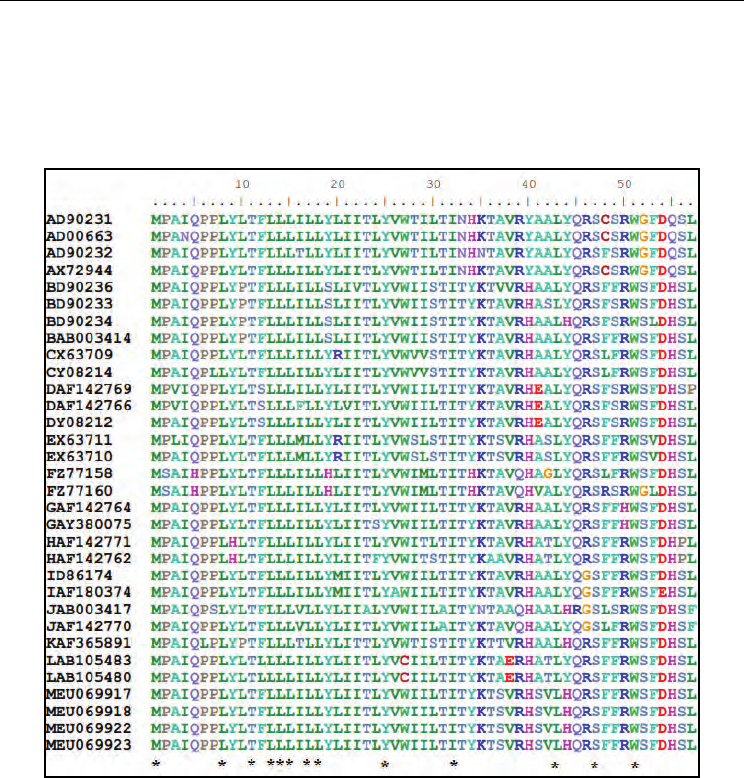
to input data for MPA. A sample MSA is shown in Fig. 2. The sequences of surface
hydrophobic (SH) protein from various genotypes (A to M) of Mumps virus, are aligned. A
careful visual inspection of MSA allows us to locate the patterns and motifs (LLLXIL) in a
given set of sequences. Apart from MPA, the MSA data in turn can be used for the
construction of position specific scoring matrix (PSSM), generation of consensus sequence,
Molecular Evolution & Phylogeny: What, When, Why & How?
9
sequence logos, identification and prioritisation of potential B- and T-cell epitopes etc.
Nowadays the databases of curated, pre-computed alignments of reference species are also
being made available, which can be used for the benchmark comparison, evaluation purpose
(Thompson et al., 2011) and it also helps to keep the track of changes that get accumulated in
the species over a period of time. For example, in case of viruses, observed changes are
correlated with emergence of new genotypes (Kulkarni-Kale et al., 2004; Kuiken et al., 2005).
Fig. 2. The complete multiple sequence alignment of the surface hydrophobic (SH) proteins
of Mumps virus genotypes (A to M) carried out using ClustalW. The MSA is viewed using
BioEdit. The species labels in the leftmost column begin with genotype letter (A-M) followed
by GenBank accession numbers. The scale for the position in alignment is given at the top of
the alignment. The columns with conserved residues are marked with an “*” in the last row.
5. Selection of a suitable model of evolution
The existing MPA methods utilize the mathematical models to describe the evolution of
sequence by incorporating the biological, biochemical and evolutionary considerations.
These mathematical models are used to compute genetic distances between sequences. The
use of appropriate model of evolution and statistical tests help us to infer maximum
evolutionary information out of sequence data. Thus, the selection of the right model of

Computational Biology and Applied Bioinformatics
10
sequence evolution becomes important as a part of effective MPA. Two types of approaches
are adapted for the building of models, first one is empirical i.e. using the properties
revealed through comparative studies of large datasets of observed sequences, and the other
is parametrical, which uses biological and biochemical knowledge about the nucleic acid
and protein sequences, for example the favoured substitution patterns of residues.
Parametric models obtain the parameters from the MSA dataset under study. Both types of
approaches result in the models based on the Markov process, in the form of matrix
representing the rate of all possible transitions between the types of residues (4 nucleotides
in nucleic acids and 20 amino acids in proteins). According to the type of sequence (nucleic
acid or protein), two categories of models have been developed.
5.1 Models of nucleotide substitution
The nucleotide substitution models are based on the parametric approach with the use of
mainly three parameters i) nucleotides frequencies, ii) rate of nucleotide substitutions and
iii) rate heterogeneity. Nucleotide frequencies, account for the compositional sequence
constraints such as GC content. These are subsequently used in a model to allow the
substitutions of a certain type to occur more likely than others. The nucleotide substitution
parameter is used to represent a measure of biochemical similarity. Higher the similarity
between the nucleotide bases, the more is the rate of substitution between them, for
example, the transitions are more frequent than transversions. A parameter of rate
heterogeneity accounts for the unequal rates of substitution across the variable sites, which
can be correlated with the constraints of genetic code, selection for the gene function etc. The
site variability is modelled by gamma distribution of rates across sites. The shape parameter
of gamma distribution determines amount of heterogeneity among sites, larger values of
shape parameter gives a bell shaped distribution suggesting little or no rate variation across
the sites whereas small values of it gives J-shaped distribution indicating high rate variation
among sites along with low rates of evolution at many sites.
Varieties of nucleotide substitution models have been developed with a set of assumptions
and parameters described as above. Some of the well-known models of nucleotide
substitutions include Jukes-Cantor (JC) one-parameter model (Jukes & Cantor, 1969),
Kimura two-parameter model (K2P) (Kimura, 1980), Tamura’s model (Tamura, 1992),
Tamura and Nei model (Tamura & Nei, 1993) etc. These models make use of different
biological properties such as, transitions, transversions, G+C content etc. to compute
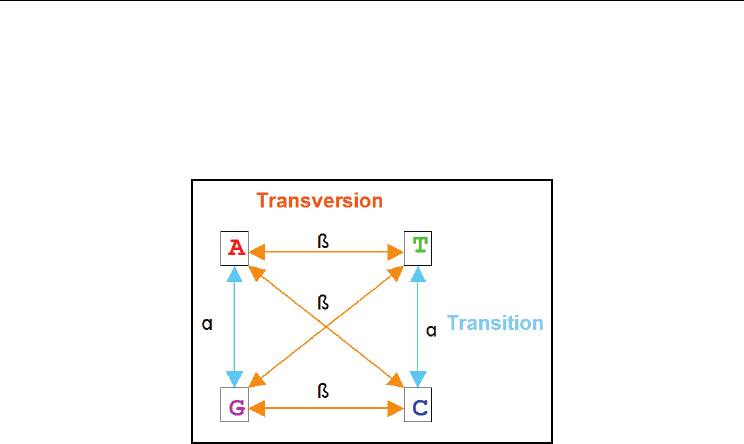
distances between nucleotide sequences. The substitution patterns of nucleotides for some
of these models are shown in Fig. 3.
5.2 Models of amino acid replacement
In contrast to nucleotide substitution models, amino acid replacement models are developed
using empirical approach. Schwarz and Dayhoff (1979) developed the most widely used
model of protein evolution in which, the replacement matrix was obtained from the alignment
of globular protein sequences with 15% divergence. The Dayhoff matrices, known as PAM
matrices, are also used by database searching methods. The similar methodology was adopted
by other model developers but with specialized databases. Jones et al., (1994) have derived a
replacement matrix specifically for membrane proteins, which has values significantly
different from Dayhoff matrix suggesting the remarkably different pattern of amino acid
replacements observed in the membrane proteins. Thus, such a matrix will be more
Molecular Evolution & Phylogeny: What, When, Why & How?
11
appropriate for the phylogenetic study of membrane proteins. On the other hand, Adachi and
Hasegawa (1996) obtained a replacement matrix using mitochondrial proteins across 20
vertebrate species and can be effectively used for mitochondrial protein phylogeny. Henikoff
and Henikoff (1992) derived the series of BLOSUM matrices using local, ungapped alignments
of distantly related sequences. The BLOSUM matrices are widely used in similarity searches
against databases than for phylogenetic analyses.
Fig. 3. The types of substitutions in nucleotides. α denotes the rate of transitions and β
denotes the rate of transversions. For example, in the case of JC model α=β while in the case
of K2P model α>β.
Recently, structural constraints of the nucleic acids and proteins are also being incorporated in
the building of models of evolution. For example, Rzhetsky (1995) contributed a model to
estimate the substitution patterns in ribosomal RNA genes with the account of secondary
structure elements like stem-loops in ribosomal RNAs. Another approach introduced a model
with the combination of protein secondary structures and amino acid replacement (Lio &
Goldman, 1998; Thorne et al., 1996). The overview of different models of evolution and the
criteria for the selection of models is also provided by Lio & Goldman (1998); Luo et al. (2010).
6. Reconstruction of a phylogenetic tree
The phylogeny reconstruction methods result in a phylogenetic tree, which may or may not
corroborate with the true phylogenetic tree. There are various methods of phylogeny
reconstruction that are divided into two major groups viz. character-based and distance-
based.
Character-based methods use a set of discrete characters, for example, in case of MSA data
of nucleotide sequences, each position in alignment is reffered as “character” and nucleotide
(A, T, G or C) present at that position is called as the “state” of that “character”. All such
characters are assumed to evolve independent of each other and analysed separately.
Distance-based methods on other hand use some form of distance measure to compute the
dissimilarity between pairs of OTUs, which subsequently results in derivation of distance
matrix that is given as an input to clustering methods like Neighbor-Joining (N-J) and
Unweighted Pair Group Method with Arithmetic mean (UPGMA) to infer phylogenetic tree.
The character-based and distance-based methods follow exhaustive search and/or stepwise
clustering approach to arrive at an optimum phylogenetic tree, which explains the

Computational Biology and Applied Bioinformatics
12
evolutionary pattern of the OTUs under study. The exhaustive search method examines
theoretically all possible tree topologies for a chosen number of species and derives the best
tree topology using a set of certain criteria. Table 3 shows the possible number of rooted and
unrooted trees for n number of species/OTUs.
Number of
OTUs
Number of
unrooted trees
Number of
rooted trees
2 1 1
3 1 3
4 3 15
5 15 105
6 105 945
10 2027025 34459425
Table 3. The number of possible rooted and unrooted trees for a given number of OTUs. The
number of possible unrooted trees for n OTUs is given by (2n-5)!/[2
n-3
(n-3)!]; and rooted
trees is given by (2n-3)!/[2
n-2
(n-2)!]
Whereas, stepwise clustering methods employ an algorithm, which begins with the
clustering of highly similar OTUs. It then combines the clustered OTUs such that it can be
treated as a single OTU representing the ancestor of combined OTUs. This step reduces the
complexity of data by one OTU. This process is repeated and in a stepwise manner adding
the remaining OTUs until all OTUs are clustered together. The stepwise clustering approach
is faster and computationally less intensive than the exhaustive search method.
The most widely used distance-based methods include N-J & UPGMA and character-based
methods include Maximum Parsimony (MP) and Maximum Likelihood (ML) methods
(Felsenstein, 1996). All of these methods make particular assumptions regarding
evolutionary process, which may or may not be applicable to the actual data. Thus, before
selection of a phylogeny reconstruction method, it is recommended to take into account the
assumptions made by the method to infer the best phylogenetic tree. The list of widely used
phylogeny inference packages is given in Table 4.
Package Available from / Reference
PHYLIP
http://evolution.genetics.washington.edu/phylip.html ;
Felsenstein, 1989
PAUP
http://paup.csit.fsu.edu/ ;
Wilgenbusch & Swofford, 2003
MEGA5
http://www.megasoftware.net/ ;
Kumar et al., 2008
MrBayes
http://mrbayes.csit.fsu.edu/ ;
Ronquist & Huelsenbeck, 2003
TREE-PUZZLE
http://www.tree-puzzle.de/ ;
Schmidt et al., 2002
Table 4. The list of widely used packages for molecular phylogeny.
Molecular Evolution & Phylogeny: What, When, Why & How?
13
6.1 Distance-based methods of phylogeny reconstruction
The distance-based phylogeny reconstruction begins with the computation of pair wise genetic
distances between molecular sequences with the use of appropriate substitution model, which
is built on the basis of evolutionary assumptions, discussed in section 4. This step results in
derivation of a distance matrix, which is subsequently used to infer a tree topology using the
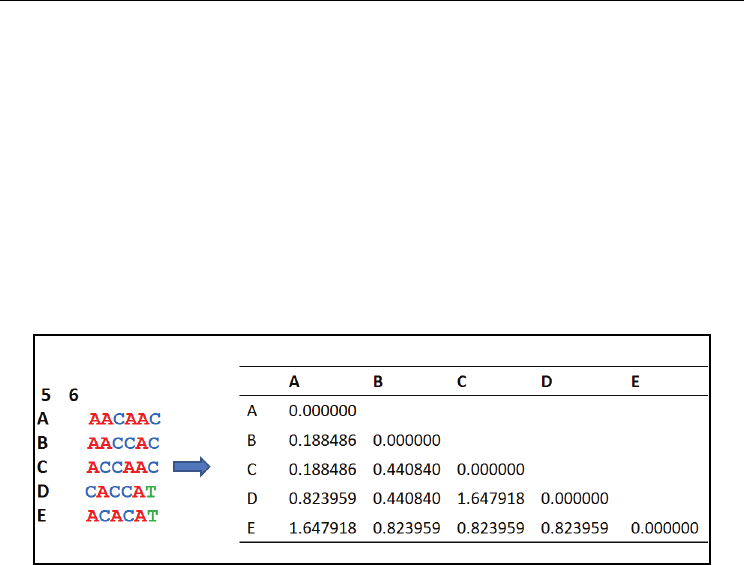
clustering method. Fig. 4 shows the distance matrix computed for a sample sequence dataset
of 5 OTUs with 6 sites using Jukes-Cantor distance measure. A distance measure possesses
three properties, (a) a distance of OTU from itself is zero, D(i, i) = 0; (b) the distance of OTU i
from another OTU j must be equal to the distance of OTU j from OTU i, D(i, j) = D(j, i); and (c)
the distance measure should follow the triangle inequality rule i.e. D(i, j) ≤ D(i, k) + D(k, j). The
accurate estimation of genetic distances is a crucial requirement for the inference of correct
phylogenetic tree, thus choice of the right model of evolution is as important as the choice of
clustering method. The popular methods used for clustering are UPGMA and N-J.
Fig. 4. The distance matrix obtained for a sample nucleotide sequence dataset using Jukes-
Cantor model. Dataset contains 5 OTUs (A-E) and 6 sites shown in Phylip format. Dnadist
program in PHYLIP package is used to compute distance matrix.
6.1.1 UPGMA method for tree building
The UPGMA method was developed by Sokal and Michener (1958) and is the most widely
used clustering methodology. The method is based on the assumptions that the rate of
substitution for all branches in the tree is constant (which may not hold true for all data) and
branch lengths are additive. It employs hierarchical agglomerative clustering algorithm,
which produces ultrametric tree in such a way that every OTU is equidistant from the root.
The clustering process begins with the identification of the highly similar pair of OTUs (i & j)
as decided from the distance value D(i, j) in distance matrix. The OTUs i and j are clustered
together and combined to form a composite OTU ij. This gives rise to new distance matrix
shorter by one row and column than initial distance matrix. The distances of un-clustered
OTUs remain unchanged. The distances of remaining OTUs (for e.g. k) from composite OTUs
are represented as the average of the initial distances of that OTU from the individual
members of composite OTU (i.e. D(ij, k) = [D(i, k) + D(j, k)]/2). In this way a new distance
matrix is calculated and in the next round, the OTUs with least dissimilarity are clustered
together to form another composite OTU. The remaining steps are same as discussed in the
first round. This process of clustering is repeated until all the OTUs are clustered.
The sample calculations and steps involved in UPGMA clustering algorithm using distance
matrix shown in Fig. 4 are given below.
Computational Biology and Applied Bioinformatics
14
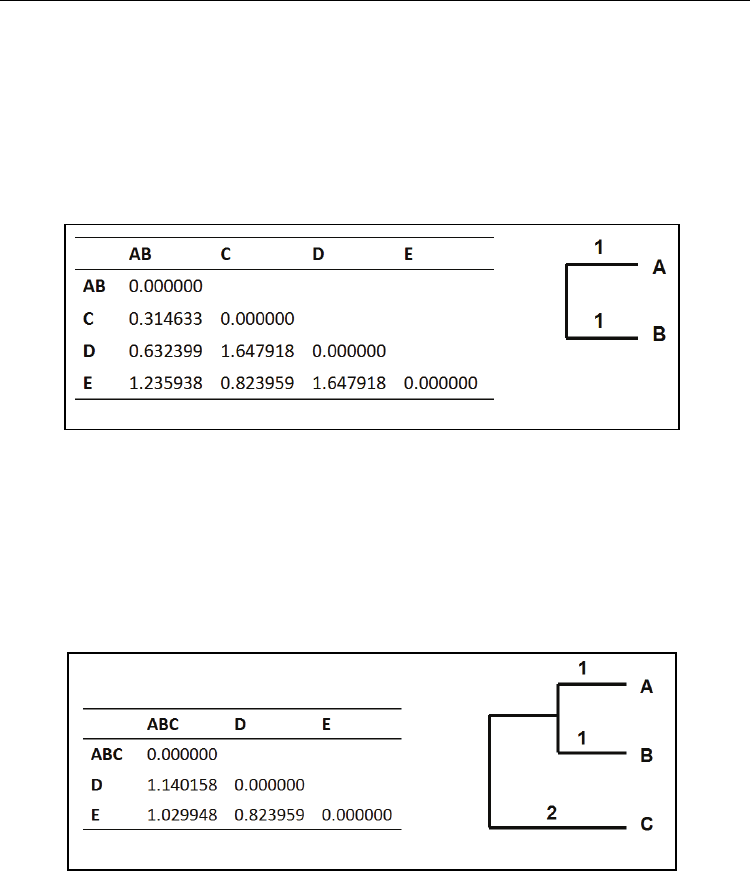
Iteration 1: OTU A is minimally equidistant from OTUs B and C. Randomly we select the
OTUs A and B to form one composite OTU (AB). A and B are clustered together. Compute
new distances of OTUs C, D and E from composite OTU (AB). The distances between
unclustered OTUs will be retained. See Fig. 4 for initial distance matrix and Fig. 5 for
updated matrix after first iteration of UPGMA.
d(AB,C) = [d(A,C) + d(B,C)]/2 = [0.188486 + 0.440840]/2 = 0.314633
d(AB,D) = [d(A,D) + d(B,D)]/2 = [0.823959 + 0.440840]/2 = 0.632399
d(AB,E) = [d(A,E) + d(B,E)]/2 = [1.647918 + 0.823959]/2 = 1.235938
Fig. 5. The updated distance matrix and clustering of A and B after the 1
st
iteration of
UPGMA.
Iteration 2: OTUs (AB) and C are minimally distant. We select these OTUs to form one
composite OTU (ABC). AB and C are clustered together. We then compute new distances of
OTUs D and E from composite OTU (ABC). See Fig. 5 for distance matrix obtained in
iteration 1 and Fig. 6 for updated matrix after the second iteration of UPGMA.
d(ABC,D) = [d(AB,D) + d(C,D)]/2 = [0.632399 + 1.647918]/2 = 1.140158
d(ABC,E) = [d(AB,E) + d(C,E)]/2 = [1.235938 + 0.823959]/2 = 1.029948
Fig. 6. The updated distance matrix and clustering of A, B and C after the 2
nd
iteration of
UPGMA.
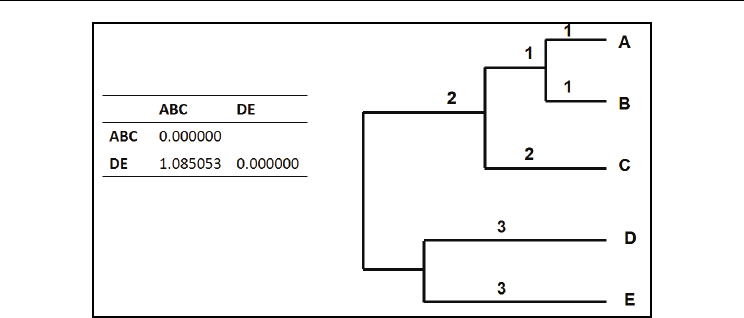
Iteration 3: OTUs D and E are minimally distant. We select these OTUs to form one
composite OTU (DE). D and E are clustered together. Compute new distances of OTUs
(ABC) and (DE) from each other. Finally the remaining two OTUs are clustered together. See
Fig. 6 for distance matrix obtained in iteration 2 and Fig. 7 for updated matrix after third
iteration of UPGMA.
d(ABC,DE) = [d(ABC,D) + d(ABC,E)]/2 = [1.140158 + 1.029948]/2 = 1.085053
Molecular Evolution & Phylogeny: What, When, Why & How?
15
Fig. 7. The updated distance matrix and clustering of OTUs after the 3
rd
iteration of
UPGMA. Numbers on the branches indicate branch lengths, which are additive.
6.1.2 N-J method for tree building
The N-J method for clustering was developed by Saitou and Nei (1987). It reconstructs the
unrooted phylogenetic tree with branch lengths using minimum evolution criterion that
minimizes the lengths of tree. It does not assume the constancy of substitution rates across
sites and does not require the data to be ultrametric, unlike UPGMA. Hence, this method is
more appropriate for the sites with variable rates of evolution.
N-J method is known to be a special case of the star decomposition method. The initial tree
topology is a star. The input distance matrix is modified such that the distance between
every pair of OTUs is adjusted using their average divergence from all remaining OTUs. The
least dissimilar pair of OTUs is identified from the modified distance matrix and is
combined together to form single composite OTU. The branch lengths of individual
members, clustered in composite OTU, are computed from internal node of composite OTU.
Now the distances of remaining OTUs from composite OTU are redefined to give a new
distance matrix shorter by one OTU than the initial matrix. This process is repeated till all
the OTUs are grouped together, while keeping track of nodes, which results in a final
unrooted tree topology with minimized branch lengths. The unrooted phylogenetic tree,
thus obtained can be rooted using an outgroup species. The BIONJ (Gascuel 1997),
generalized N-J (Pearson et al., 1999) and Weighbor (Bruno et al., 2000) are some of the
recently proposed alternative versions of N-J algorithm. The sample calculation and steps
involved in N-J clustering algorithm, using distance matrix shown in Fig. 4, are given below.
Iteration 1: Before starting the actual process of clustering the vector r is calculated as
following with N=5, refer to the initial distance matrix given in Fig. 4 for reference values.
r(A) = [d(A,B)+ d(A,C)+ d(A,D)+ d(A,E)]/(N-2) = 0.949616
r(B) = [d(B,A)+ d(B,C)+ d(B,D)+ d(B,E)]/(N-2) = 0.631375
r(C) = [d(C,A)+ d(C,B)+ d(C,D)+ d(C,E)]/(N-2) = 1.033755
r(D) = [d(D,A)+ d(D,B)+ d(D,C)+ d(D,E)]/(N-2) = 1.245558
r(E) = [d(E,A)+ d(E,B)+ d(E,C)+ d(E,D)]/(N-2) = 1.373265
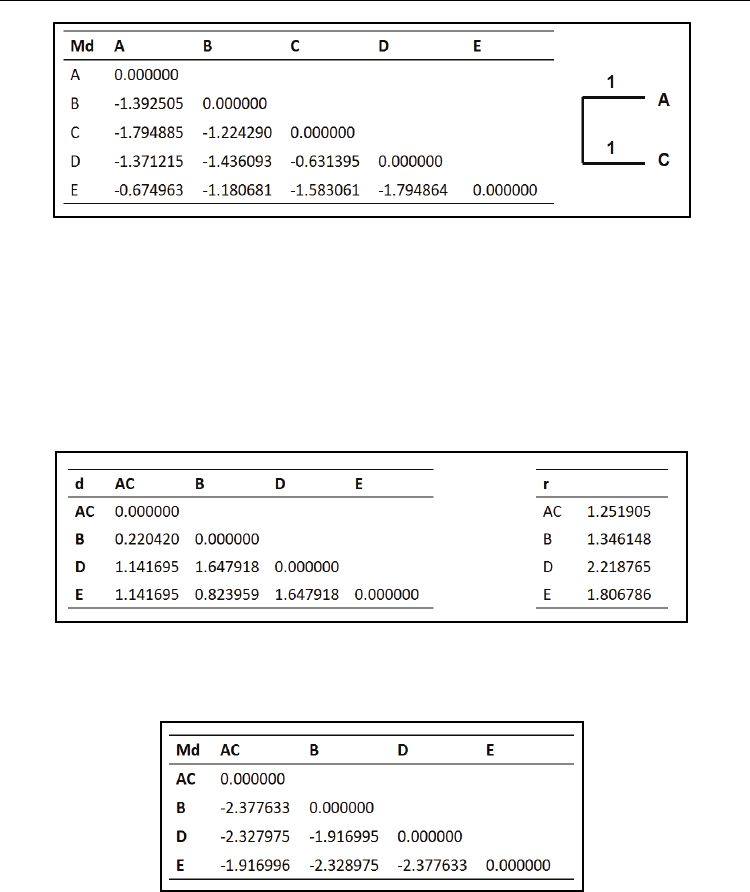
Using these r values, we construct a modified distance matrix, Md, such that
MD(i,j) = d(i,j) – (ri + rj).
See Fig. 8 for Md.
Computational Biology and Applied Bioinformatics
16
Fig. 8. The modified distance matrix Md and clustering for iteration 1 of N-J.
As can be seen from Md in Fig. 8, OTUs A and C are minimally distant. We select the OTUs
A and C to form one composite OTU (AC). A and C are clustered together.
Iteration 2: Compute new distances of OTUs B, D and E from composite OTU (AC).
Distances between unclustered OTUs will be retained from the previous step.
d(AC,B) = [d(A,B) + d(C,B)-d(A,C)]/2 = 0.22042
d(AC,D) = [d(A,D) + d(C,D) -d(A,C)]/2 = 1.141695
d(AC,E) = [d(A,E) + d(C,E) -d(A,C)]/2 = 1.141695
Compute r as in the previous step with N=4. See Fig. 9 for new distance matrix and r vector.
Fig. 9. The new distance matrix D and vector r obtained for NJ algorithm iteration 2.
Now, we compute the modified distance matrix, Md as in the previous step and cluster the
minimally distant OTUs. See Fig. 10
Fig. 10. The modified distance matrix Md, obtained during N-J algorithm iteration 2.
In this step, AC & B and D & E are minimally distant, so we cluster AC with B and D with E.
Repeating the above steps we will finally get the following phylogenetic tree, Fig. 11.
Both the distance-based methods, UPGMA and N-J, are computationally faster and hence
suited for the phylogeny of large datasets. N-J is the most widely used distance-based
method for phylogenetic analysis. The results of these methods are highly dependent on the
model of evolution selected a priori.