
Lopes H.S., Cruz L.M. (eds.) Computational Biology and Applied Bioinformatics
Подождите немного. Документ загружается.

15
Classifying TIM Barrel Protein Domain Structure
by an Alignment Approach Using Best Hit
Strategy and PSI-BLAST
Chia-Han Chu
1
, Chun Yuan Lin
2
, Cheng-Wen Chang
1
,
Chihan Lee
3
and Chuan Yi Tang
4
1
National Tsing Hua University,
2
Chang Gung University,
3
Chipboud Technology Corporation,
4
Providence University
Taiwan
1. Introduction
High-tech large-scale sequencing projects have identified a massive number of amino acid
sequences for both known and putative proteins, but information on the three-dimensional
(3D) structures of these proteins is limited. Several structure databases, such as the
Structural Classification of Proteins (SCOP (Andreeva et al., 2008), release version 1.73) and
the Class, Architecture, Topology, and Homologous superfamily (CATH (Cuff et al., 2009),
release version 3.2.0), contain fewer than 60,000 entries in the Protein Data Bank (PDB
(Berman et al., 2000), released on 12 May, 2009). This number of entries constitutes only
about 15% of entries in Swiss-Prot (Bairoch et al., 2004), release version 57.2, with more than
400,000 entries). Either X-ray diffraction or NMR can be used to determine the 3D structure
of a protein, but each method has its limitation (Dubchak et al., 1995). As such, extracting
structural information from sequence databases is an important and complementary
alternative to these experimental methods, especially when swiftly determining protein
functions or discovering new compounds for medical or therapeutic purposes.
From ASTRAL SCOP 1.73, it has been estimated that ~10% of known enzymes have
triosephosphate isomerase (TIM) barrel domains. Moreover, TIM barrel proteins have been
identified in five of six enzyme classes, oxidoreductases, transferases, hydrolases, lyases and
isomerases, in the Enzyme nomenclature (ENZYME (Bairoch, 2000), released on 5 May,
2009) database; the ligases class does not contain TIM barrel protein. TIM barrel proteins are
diverse in sequence and functionality and thus represent attractive targets for protein
engineering and evolutionary studies. It is therefore important to examine TIM barrel
protein domain structure classification in SCOP and ENZYME.
In SCOP, there are six levels of hierarchy: class, fold, superfamily, family, protein domain
and species. The classification of protein structures has, more recently, been facilitated by
computer-aided algorithms. Previous research (Chou & Zhang, 1995; Dubchak et al., 1995;
Lin et al., 2005, 2007) has shown that an overall prediction accuracy rate of 70-90% can be

Computational Biology and Applied Bioinformatics
288
easily achieved by using only amino acid sequence information to classify most of proteins
into four major classes in SCOP (all-alpha (α), all-beta (β), alpha/beta (α/β) and alpha+beta
(α+β)) (Murzin, 1995). For the α/β class (constituting TIM barrel proteins), the overall
prediction accuracy rate achieved 97.9% (Lin et al., 2005, 2007). However, less optimal
results were obtained if a more complicated category was used, such as protein folding
patterns. The overall prediction accuracy rate for classifying 27 fold categories in SCOP only
achieved only 50-70% using amino acid sequence information (Ding & Dubchak, 2001;
Huang et al., 2003; Lin et al., 2005, 2007; Shen & Chou, 2006; Vapnik, 1995; Yu et al., 2003).
Although the classification for the SCOP fold category is still a challenge, the overall
prediction accuracy rate for the TIM barrel fold is 93.8% (Yu et al., 2003). Based on the above
results, it is possible to further classify TIM barrel proteins into the SCOP superfamily and
family categories. Four projection methods, PRIDE (Carugo & Pongor, 2002; Gáspári et al.,
2005), SGM (Rogen & Fain, 2003), LFF (Choi et al., 2004) and SSEF (Zotenko et al., 2006,
2007), have been proposed for protein structure comparisons. Zotenko et al. (Zotenko et al.,
2006) compared these four methods for classifying proteins into the SCOP fold, superfamily
and family categories and showed that the SSEF method had the best overall prediction
accuracy rate. The SSEF method utilizes 3D structure information to generate the triplet of
secondary structure elements as the footprints in the comparisons.
Hence, in this chapter, an alignment approach using the pure best hit strategy, denoted
PBH, is proposed to classify the TIM barrel protein domain structures in terms of the
superfamily and family categories in SCOP. This approach requires only amino acid
sequence information to generate alignment information, but secondary and 3D structure
information is also applied in this approach, respectively, to compare the performances with
each other. This work is also used to perform the classification for the class category in
ENZYME. Two testing data sets, TIM40D and TIM95D from ASTRAL SCOP 1.71
(Chandonia et al., 2004), were tested to evaluate this alignment approach. First, for any two
proteins, we adopt the tools CLUSTALW (Thompson et al., 1994), SSEA (Fontana et al.,
2005) and CE (Shindyalov & Bourne, 1998) to align the amino acid sequences, secondary and
3D structures, respectively, to obtain the scores of sequence identity, secondary structure
identity and RMSD. These scores are then used to build an alignment-based protein-protein
identity score network. Finally, a PBH strategy is used to determine the prediction result of
a target protein by selecting the protein having the best score for the target protein
according to this network. This score can be calculated by a single parameter, such as
sequence identity, or mixed parameters by combing two or three single parameters, such as
combining sequence identity and secondary structure identity. In this chapter, we only
consider the single parameter. To verify the stability of the proposed alignment approach,
we also use the novel TIM barrel proteins in TIM40D and TIM95D from ASTRAL SCOP 1.73
that do not existed in ASTRAL SCOP 1.71. For this test, the alignment-based protein-protein
identity score network constructed by the TIM barrel proteins from ASTRAL SCOP 1
.71 and
the PBH strategy are used to predict the classification result for each novel TIM barrel
protein. In addition, we further adopt the PSI-BLAST method as a filter for the PBH
strategy, denoted the BHPB strategy, to reduce the number of false positives. The
experimental results demonstrated that the alignment approach with the PBH strategy or
BHPB strategy is a simple and stable method for TIM barrel protein domain structure
classification, even when only the amino acid sequence information is available.

Classifying TIM Barrel Protein Domain Structure by an
Alignment Approach Using Best Hit Strategy and PSI-BLAST
289
2. Materials
2.1 TIM barrel proteins from ASTRAL SCOP 1.71
Two data sets, TIM40D and TIM95D, were used to evaluate the proposed PBH and BHPB
alignment strategies. TIM40D contains 272 TIM barrel protein domain sequences (abbreviated
to TIM sequences) extracted from the 40D set in ASTRAL SCOP 1.71, in which any two
proteins must have ≤40% sequence identity based on PDB SEQRES records. TIM95D contains
439 TIM sequences extracted from the 95D set in ASTRAL SCOP 1.71, in which any two
proteins must have ≤95% sequence identity based on PDB SEQRES records. For TIM40D and
TIM95D, we directly retrieved amino acid sequences and 3D structures from ASTRAL SCOP
1.71 but excluded redundant and possible mutant data. Secondary structure information for
each TIM barrel protein with eight states (H, I, G, E, B, S, T and _) was first derived from the
digital shape sampling and processing (DSSP (Kabsch & Sander, 1983)) program. Then the
eight states for each TIM barrel protein were then reduced to three states (H, E and C)
Superfamily categories Index N
40D
* N
95D
*
Triosephosphate isomerise (TIM) 1 3 16
Ribulose-phosphate binding barrel 2 19 30
Thiamin phosphate synthase 3 2 2
FMN-linked oxidoreductases 4 15 22
Inosine monophosphate dehydrogenase (IMPDH) 5 3 5
PLP-binding barrel 6 8 10
NAD(P)-linked oxidoreductase 7 8 21
(Trans)glycosidases 8 82 134
Metallo-dependent hydrolases 9 18 22
Aldolase 10 31 48
Enolase C-terminal domain-like 11 12 24
Phosphoenolpyruvate/pyruvate domain 12 12 22
Malate synthase G 13 1 2
RuBisCo, C-terminal domain 14 4 10
Xylose isomerise-like 15 7 15
Bacterial luciferase-like 16 7 9
Nicotinate/Quinolinate PRTase C-terminal domain-like 17 4 5
PLC-like phosphodiesterases 18 5 5
Cobalamin (vitamin B12)-dependent enzymes 19 5 6
tRNA-guanine transglycosylase 20 2 2
Dihydropteroate synthetase-like 21 4 6
UROD/MetE-like 22 4 4
FAD-linked oxidoreductase 23 3 3
Pyridoxine 5’-phosphate synthase 24 1 1
Monomethylamine methyltransferase MtmB 25 1 1
Homocysteine S-methyltransferase 26 2 3
(2r)-phospho-3-sulfolactate synthase ComA 27 1 2
Radical SAM enzymes 28 3 3
GlpP-like 29 1 1
CutC-like 30 1 1
ThiG-like 31 1 2
TM1631-like 32 2 2
*N
40D
: the number of TIM sequences in TIM40D
*N
95D
: the number of TIM sequences in TIM95D
Table 1. Non-redundant data sets, TIM40D and TIM95D, of superfamily categories in SCOP

Computational Biology and Applied Bioinformatics
290
Index N
40D
* N
95D
* Index N
40D
* N
95D
* Index N
40D
* N
95D
*
1.1 3 16 9.6 4 5 16.3 2 3
2.1 2 5 9.7 1 1 16.4 2 2
2.2 2 4 9.8 1 1 17.1 2 3
2.3 4 7 9.9 1 1 17.2 2 2
2.4 10 13 9.11 1 1 18.1 1 1
2.5 1 1 9.12 1 1 18.2 2 2
3.1 2 2 9.13 1 1 18.3 2 2
4.1 15 22 10.1 18 29 19.1 2 2
5.1 3 5 10.2 2 3 19.2 1 1
6.1 7 9 10.3 3 5 19.3 1 2
6.2 1 1 10.4 3 6 19.4 1 1
7.1 8 21 10.5 3 3 20.1 2 2
8.1 25 48 10.6 2 2 21.1 2 4
8.3 26 41 11.1 1 6 21.2 2 2
8.4 4 12 11.2 11 18 22.1 2 2
8.5 13 18 12.1 1 5 22.2 2 2
8.6 3 3 12.2 1 2 23.1 2 2
8.7 2 2 12.3 1 2 23.2 1 1
8.8 3 3 12.5 4 4 24.1 1 1
8.9 1 1 12.7 4 6 25.1 1 1
8.10 1 2 12.8 1 3 26.1 2 3
8.11 1 1 13.1 1 2 27.1 1 2
8.12 1 1 14.1 4 10 28.1 1 1
8.13 1 1 15.1 1 1 28.2 1 1
8.14 1 1 15.2 1 1 28.3 1 1
9.1 1 2 15.3 2 10 29.1 1 1
9.1 2 2 15.4 1 1 30.1 1 1
9.2 1 3 15.5 1 1 31.1 1 2
9.3 2 2 15.6 1 1 32.1 2 2
9.4 1 1 16.1 2 2 - - -
9.5 1 1 16.2 1 2 - - -
*N
40D
: the number of TIM sequences in TIM40D
*N
95D
: the number of TIM sequences in TIM95D
Table 2. Non-redundant data sets, TIM40D and TIM95D, of family categories in SCOP
Class categories Index N
40D
* N
95D
*
Oxidoreductases 1 27 46
Transferases 2 31 53
Hydrolases 3 68 106
Lyases 4 58 97
Isomerases 5 23 49
undefined - 67 91
*N
40D
: the number of TIM sequences in TIM40D
*N
95D
: the number of TIM sequences in TIM95D
The sum of N
40D
and N
95D
are 274 and 442, respectively. TIM sequences:
“d1pii_2” and “d1pii_1” in TIM40D and TIM95D have multiple EC numbers for class categories;
“d1b9ba_” and “d1jvna1” in TIM95D have multiple EC numbers for class categories
Table 3. Non-redundant data sets, TIM40D and TIM95D, of class categories in ENZYME
Classifying TIM Barrel Protein Domain Structure by an
Alignment Approach Using Best Hit Strategy and PSI-BLAST
291
according to the scheme outlined by Jones (Jones, 1999). The TIM sequence “d1cwn_” (SCOP
id) in TIM95D was excluded because of lack of secondary structure information (only 438 TIM
sequences in TIM95D were tested). The TIM barrel proteins (from ASTRAL SCOP 1.71 and the
Universal Protein Resource (UniProt (Bairoch et al., 2005))) for each of TIM40D and TIM95D
were classified into 32 superfamily categories, 91 family categories and 5 class categories
(Tables 1, 2 and 3; supplemental Table S1(Chu, 2011)).
2.2 Novel TIM barrel proteins from ASTRAL SCOP 1.73
Novel TIM barrel proteins from ASTRAL SCOP 1.73 that do not exist in ASTRAL SCOP 1.71
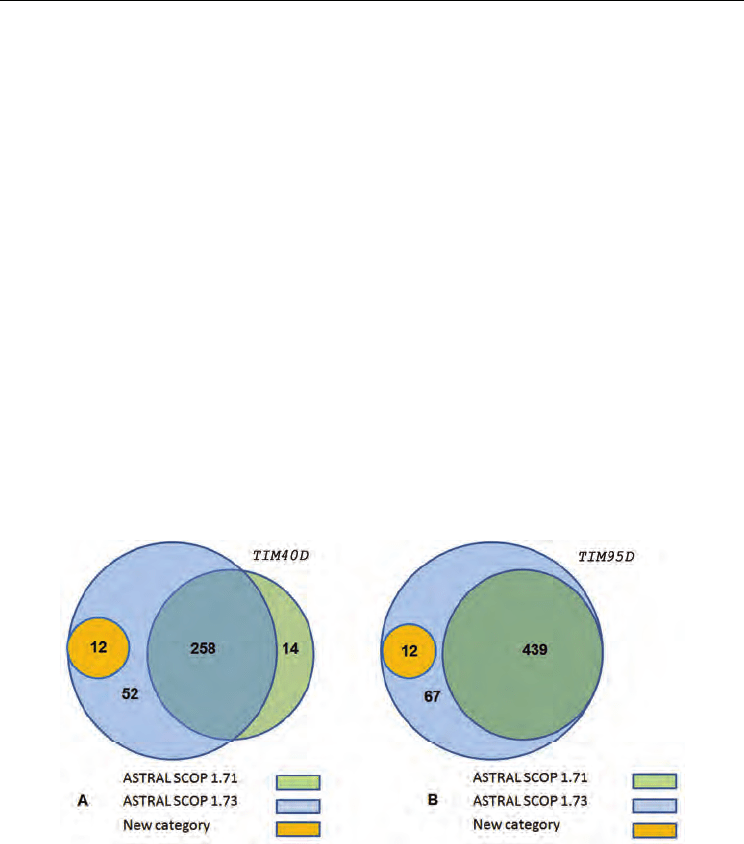
were also tested. The intersection among the TIM barrel proteins from ASTRAL SCOP 1.71
and 1.73 for TIM40D (Figure 1(A)) and TIM95D (Figure 1(B)) are shown. The number of TIM
sequences are represented in green (ASTRAL SCOP 1.71), light blue (ASTRAL SCOP 1.73)
and orange (ASTRAL SCOP 1.73 that are not presented in 1.71). In TIM40D (Figure 1(A)),
we identified 258 TIM sequences (ASTRAL SCOP 1.71 and 1.73), 14 TIM sequences
(exclusively ASTRAL SCOP 1.71) and 64 novel TIM sequences (exclusively ASTRAL SCOP
1.73: 12 of 64 were categorized as new). In TIM95D (Figure 1(B)), we identified 439 TIM
sequences (ASTRAL SCOP 1.71 and 1.73) and 79 novel TIM sequences (exclusively ASTRAL
SCOP 1.73: 12 of 79 were categorized as new). These 12 novel TIM sequences within the new
categories were identical and thus were excluded in the alignment approach. Hence, 52
(TIM40D) and 67 (TIM95D) novel TIM sequences from ASTRAL SCOP 1.73 were used to
evaluate the stability of the proposed PBH alignment strategy, respectively. (see
supplemental Table S2 (Chu, 2011)).
Fig. 1. Intersection among TIM sequences for TIM40D and TIM95D between ASTRAL SCOP
1.71 and 1.73. (A) In TIM40D, there are 272 (ASTRAL SCOP 1.71) and 322 (ASTRAL SCOP
1.73) TIM sequences. (B) In TIM95D, there are 439 (ASTRAL SCOP 1.71) and 518 (ASTRAL
SCOP 1.73) TIM sequences.
3. Results and discussion
3.1 Performance analysis
The standard percentage prediction accuracy rate Q
i
(Rost & Sander, 1993) was used to
evaluate the proposed alignment approach and Q
i
is defined as

Computational Biology and Applied Bioinformatics
292
Q
i
=
p
i
n
i
¯100, (1)
where
n
i
is the number of test proteins in the ith superfamily/family/class category and p
i
is
the number of test proteins being correctly predicted in the
ith superfamily/family/class.
The overall prediction accuracy rate
Q is given by
Q =
1
k
q
Q
ii
i
∑
=
, (2)
where
q
i
= n
i
/K, where K is the total number of test proteins. Q
i
is equivalent to Recall
(Gardy et al., 2003), which is defined as
Recall
i
=
()
TP
i
TP FN
ii
+
, (3)
where TP
i
(true positives) is the number of correctly predicted proteins in the ith
superfamily/family/class category, and FN
i
(false negatives) is the number of missed
proteins in the ith superfamily/family/class category. Precision (Gardy et al., 2003) was also
used to evaluate the proposed alignment approach. Precision is defined as
Precision
i
=
()
TP
i
TP FP
ii
+
, (4)
where FP
i
(false positives) is the number of pseudo proteins predicted in the ith
superfamily/family/class category. In addition, the Matthews Correlation Coefficient (MCC
for short) (Matthews, 1975) was used to measure the prediction quality of classifications by
utilizing the proposed PBH and BHPB alignment strategies. MCC accounts for TP
i
, FP
i
, TN
i
and FN
i
as a balanced measure, which can be used for categories with varying sizes. MCC
returns a value +1 for the perfect prediction quality, 0 for the average random prediction
quality, or -1 for an inverse prediction quality. The formula of MCC is defined as
MCC =
TP TN FP FN
iiii
(TP FP ) (TP FN ) (TN FP ) (TN FN )
ii i i ii i i
×−×
+×+ × +× +
(5)
3.2 Alignment approach with the PBH strategy
Zotenko et al. (Zotenko et al., 2006) compared four projection methods, PRIDE, SGM, LFF
and SSEF, to classify the 40D data set (ASTRAL SCOP 1.69) into superfamily and family
categories in SCOP. There are 246 TIM barrel proteins classified into 24 superfamily
categories and 210 TIM barrel proteins classified into 42 family categories. Based on the
overall Q values, SSEF outperformed LFF, SGM and PRIDE for TIM barrel protein structure
classification (Table 4).
For the proposed PBH alignment strategy, the overall Q values for TIM40D and TIM95D
from ASTRAL SCOP 1.71 are shown in Table 5. In Table 5, the threshold (see Methods) is
determined without decreasing the Q value, which is achieved without a threshold. The Q

Classifying TIM Barrel Protein Domain Structure by an
Alignment Approach Using Best Hit Strategy and PSI-BLAST
293
Method
SSEF
Q (%)
LFF
Q (%)
SGM
Q (%)
PRIDE
Q (%)
Superfamily* 78.0 73.6 63.0 41.5
Family* 74.3 72.9 57.1 45.2
*: the performances of SSEF, LFF, SGM and PRIDE are extracted from the additional file (Zotenko et al.,
2006)
Table 4. Overall Q values for SSEF, LFF, SGM and PRIDE in TIM40D (ASTRAL SCOP 1.69)
value will decrease when a score, which is higher or lower than the threshold given in Table
5, is assigned as the threshold. For TIM40D, the best Q value (84.2%) for the superfamily
classification is derived according to secondary structure identity, 76.1% for the family
classification is derived according to sequence identity and 48.2% for the class classification
is derived according to sequence identity (Table 5). The Q value of 48.2% for the class
classification is not valid. In TIM40D, 67 of 274 TIM sequences with undefined class
categories (derived from UniProt) were initially assumed to be false negatives before the test
(see Discussion). Using amino acid sequence or secondary structure information, the PBH
alignment strategy yields results as good as SSEF (footprint information). This alignment
approach will be useful for TIM barrel proteins lacking 3D structure information. Moreover,
for the class classification, the Q value of 48.2% is better than the Q value of 35% (under
Rank 1 condition) by a non-alignment method proposed by Dobson and Doig (Dobson &
Doig, 2005). For TIM95D, the best Q value (93.2%) for the superfamily classification is
derived according to secondary structure identity, 90.0% for the family classification is
derived according to sequence identity and 65.2% for the class classification is derived
according to secondary structure identity. Similarly, for the class classification, 91 of 442
TIM sequences with undefined class categories in TIM95D were initially assumed to be false
negatives before the test.
Method Sequence identity
Secondary structure
identity
RMSD
Q (%)
Threshold
Q (%)
Threshold
Q (%)
Threshold
TIM40D
Superfamily 83.1 <14 84.2 <67 40.4 >1.9
Family 76.1 <14 75.0 <67 37.1 >1.9
Class
(ENZYME)
48.2 <13 47.4 <67 21.2 >1.8
TIM95D
Superfamily 92.5 <14 93.2 <68 68.0 >2.0
Family 90.0 <14 89.3 <68 66.4 >2.0
Class
(ENZYME)
64.0 <16 65.2 <72 48.0 >1.8
Table 5. Overall Q values for the PBH alignment strategy in TIM40D and TIM95D (ASTRAL
SCOP 1.71)
Overall, the Q values of the PBH alignment strategy using secondary structure information
are similar to those using amino acid sequence information in TIM40D and TIM95D. For
practical purposes, however, it may be best to use only amino acid sequence information. In
addition, the Q values of the PBH alignment strategy using the RMSD do not yield valid
results. The RMSD (global alignment result in this chapter) may not be a valid feature for

Computational Biology and Applied Bioinformatics
294
the alignment approach to perform TIM barrel protein domain structure classification. In
Table 5, the threshold is too low for sequence identity, suggesting that the sequence identity
of the target and its selected proteins (within the same category) is low. When the threshold
is set higher than the above sequence identity, the target protein becomes a false negative
and then the Q value under the “no threshold” condition will decrease. The threshold is
high for secondary structure identity, suggesting that the secondary structure identity of the
target and its selected proteins (within the same category) is high. These results imply that
although TIM barrel proteins have diverse sequences they have very similar secondary
structures. This inference matches the recent observation for the TIM barrel proteins.
Tables 6 and 7 show overall Q and Precision values for various categories in TIM40D and
TIM95D from ASTRAL SCOP 1.71, respectively. Only the categories with more than ten TIM
sequences are listed; tests for RMSD were omitted because the results were invalid. In
Tables 6 and 7, the threshold is determined with the best Precision value without decreasing
the Q value, which is achieved without a threshold. Precision values with the threshold
outperform or are equals to those without the threshold. However, it is very difficult to
determine the appropriate threshold to obtain the best Precision value for routine alignment
practices. This problem may be omitted by the BHPB strategy to reduce the number of false
positives.
Method Sequence identity Secondary structure identity
Index
Q (%)
Precision
1
(%)
Precision
2
(%)
Q (%)
Precision
1
(%)
Precision
2
(%)
Superfamily
2 94.7 64.3 78.3(17) 84.2 64.0 84.2(78)
4 73.3 78.6 100.0(18-22) 73.3 100.0 100.0(<77)
8 87.8 92.3 93.5(13) 86.6 95.9 95.9(<67)
9 83.3 78.9 78.9(<15) 72.2 86.7 92.9(68-70)
10 83.9 78.8 81.3(16) 96.8 78.9 81.0(74)
11 83.3 76.9 100.0(17-18) 91.7 91.7 100.0(73-75)
12 75.0 90.0 100.0(15) 83.3 100.0 100.0(<77)
Family
2.4 100.0 66.7 100.0(19-29) 100.0 71.4 100.0(80-86)
4.1 73.3 78.6 100.0(18-22) 73.3 100.0 100.0(<77)
8.1 88.0 84.6 88.0(13) 92.0 95.8 95.8(<67)
8.3 84.6 95.7 95.7(<17) 84.6 88.0 88.0(<73)
8.5 100.0 86.7 100.0(17) 92.3 100.0 100.0(<75)
10.1 83.3 78.9 100.0(18-19) 88.9 72.7 84.2(76)
11.2 90.9 76.9 100.0(17-18) 90.9 83.3 100.0(76-79)
Class
(ENZYME)
1 66.7 64.3 85.7(21-22) 74.1 71.4 71.4(<72)
2 45.2 58.3 58.3(<13) 45.2 66.7 70.0(64-66)
3 60.3 60.3 62.1(14) 54.4 61.7 63.8(68-70)
4 77.6 65.2 71.4(16) 75.9 62.0 69.8(74)
5 61.0 53.8 61.0(15-16) 65.2 45.5 48.4(70-71)
Table 6. Overall Q and Precision values for the PBH alignment strategy in TIM40D
(ASTRAL SCOP 1.71)

Classifying TIM Barrel Protein Domain Structure by an
Alignment Approach Using Best Hit Strategy and PSI-BLAST
295
Method Sequence identity Secondary structure identity
Index
Q (%)
Precision
1
(%)
Precision
2
(%)
Q (%)
Precision
1
(%)
Precision
2
(%)
Superfamily
1 100.0 94.1 100.0(17-44) 100.0 88.9 94.1(80-85)
2 96.7 78.4 82.9(17) 90.0 84.4 96.4(79)
4 90.9 87.0 90.9(15-16) 86.4 95.0 100.0(70-81)
6 90.0 100.0 100.0(<22) 100.0 100.0 100.0(<84)
7 100.0 95.2 100.0(16-23) 100.0 100.0 100.0(<82)
8 91.8 98.4 98.4(<14) 95.5 98.5 98.5(<68)
9 81.8 94.7 94.7(<16) 77.3 89.5 94.4(68-74)
10 95.8 86.8 88.5(16) 97.9 87.0 94.0(76-77)
11 100.0 96.0 100.0(17-21) 100.0 96.0 100.0(74-80)
12 100.0 100.0 100.0(<26) 100.0 100.0 100.0(<79)
14 100.0 100.0 100.0(<31) 100.0 83.3 100.0(74-85)
15 93.3 82.4 82.4(<16) 93.3 93.3 93.3(<76)
Family
1.1 100.0 94.1 100.0(17-44) 100.0 88.9 94.1(80-85)
2.4 100.0 76.5 100.0(20-29) 100.0 86.7 100.0(77-86)
4.1 90.9 87.0 90.9(15-16) 86.4 95.0 100.0(70-81)
7.1 100.0 95.2 100.0(16-23) 100.0 100.0 100.0(<82)
8.1 95.8 97.9 97.9(<14) 97.9 97.9 97.9(<68)
8.3 92.7 100.0 100.0(<17) 92.7 92.7 95.0(73-74)
8.4 100.0 92.3 100.0(16-35) 100.0 100.0 100.0(<85)
8.5 100.0 90.0 100.0(17) 94.4 94.4 100.0(72-74)
10.1 96.6 87.5 100.0(18-19) 96.6 84.8 93.3(76-77)
11.2 100.0 94.7 100.0(17-21) 100.0 94.7 100.0(74-80)
14.1 100.0 100.0 100.0(<31) 100.0 83.3 100.0(74-85)
15.3 100.0 66.7 100.0(18-67) 100.0 90.9 100.0(76-95)
Class
(ENZYME)
1 89.1 80.4 91.1(21-23) 89.1 80.4 82.0(70-71)
2 77.4 75.9 75.9(<16) 79.2 87.5 87.5(<73)
3 67.0 71.7 72.4(14-15) 69.8 71.2 73.3(72-73)
4 91.8 80.2 84.0(17) 90.7 79.3 80.7(73)
5 83.7 78.8 82.0(15) 87.8 79.6 79.6(<72)
Table 7. Overall Q and Precision values for the PBH alignment strategy in TIM95D
(ASTRAL SCOP 1.71)
The Q values for Ribulose-phosphate binding barrel, (Trans)glycosidases, Aldolase and
Enolase C-terminal domain-like in the superfamily categories were above 84.2%, whereas
FMN-linked oxidoreductases, Metallo-dependent hydrolases, and
Phosphoenolpyruvate/pyruvate domain had lower Q values (Table 6). All of family
categories except for FMN-linked oxidoreductases had Q values above 76.1%. Only one of
the class categories, Transferases, had a Q value below 48.2%. For the superfamily
categories, Ribulose-phosphate binding barrel, (Trans)glycosidases and Metallo-dependent
hydrolases, the Q values derived according to sequence identity were better than those
derived according to secondary structure identity. In contrast, the Q values of Aldolase,
Enolase C-terminal domain-like and Phosphoenolpyruvate/pyruvate domain derived

Computational Biology and Applied Bioinformatics
296
according to secondary structure identity were better than those derived according to
sequence identity. FMN-linked oxidoreductases yielded the same Q values based on
sequence identity and secondary structure identity. For the family category, Type II
chitinase had a better Q value derived according to sequence identity than derived
according to secondary structure identity. Amylase, catalytic domain and Class I aldolase
produced better Q values derived according to secondary structure identity than derived
according to sequence identity. Tryptophan biosynthesis enzymes, FMN-linked
oxidoreductases, beta-glycanases and D-glucarate dehydratase-like had the same Q values
derived according to sequence identity and secondary structure identity. For the class
categories, the Q values of Hydrolases and Lyases derived according to sequence identity
were better than those derived according to secondary structure. Oxidoreductases and
Isomerases yielded better Q values derived according to secondary structure identity than
derived according to sequence identity. The remaining category, Transferases, had the same
Q values derived according to sequence identity and secondary structure identity. These
results demonstrated that the proposed PBH alignment strategy is more useful for certain
TIM barrel proteins than others.
In TIM95D superfamily categories, FMN-linked oxidoreductases and Metallo-dependent
hydrolases yielded Q values less than 93.2% (Table 7); others all yielded Q values above
93.2%. All of family categories obtained Q values above 90.0% and no class category
obtained Q values below 65.2%. For the superfamily categories, Ribulose-phosphate binding
barrel, FMN-linked oxidoreductases and Metallo-dependent hydrolases, and for the family
categories, FMN-linked oxidoreductases and Type II chitinase, the Q values derived
according to sequence identity were better than those derived according to secondary
structure identity. For other superfamily and family categories, the same Q values were
obtained using sequence identity and secondary structure identity. For the class categories,
Transferases, Hydrolases and Isomerases had better Q values derived according to
secondary structure identity than those derived according to sequence identity; Lyases had
a better Q value derived according to sequence identity than that derived according to
secondary structure identity. The last category, Oxidoreductases, produced the same Q
values derived according to sequence identity and secondary structure identity.
3.3 Estimating stability using the PBH alignment strategy
Novel TIM sequences in TIM40D (n=52) and TIM95D (n=67) from ASTRAL SCOP 1.73
were used to estimate the stability of the proposed PBH alignment strategy. Table 8
presents the overall Q values for novel TIM sequences. The definition and observation of
the threshold in Table 8 is the same as that in Table 5. In Table 8, the best Q values for the
superfamily, family and class classifications in TIM40D and TIM95D from ASTRAL SCOP
1.73 were derived according to sequence identity. For TIM40D, the best Q value was
94.2% for superfamily, 90.4% for family and 40.4% for class; for TIM95D, the best Q value
was 91.0% for superfamily, 88.1% for family and 47.8% for class. Similarly, for the class
classification, 20 of 52 (TIM40D) and 25 of 67 (TIM95D) novel TIM sequences with
undefined class categories were initially assumed to be false negatives before the test (see
supplemental Table S3 (Chu, 2011)). These results suggest that the proposed PBH
alignment strategy is stable and suitable for TIM barrel protein domain structure
classification.