
Lowe D. Networking For Dummies
Подождите немного. Документ загружается.


Chapter 8: Going Virtual
In This Chapter
✓ Examining the basics of virtualization
✓ Weighing the benefits of virtualization
✓ Installing VMWare Player
✓ Creating and using virtual machines
V
irtualization is one of the hottest trends in networking today.
According to some industry pundits, virtualization is the best thing to
happen to computers since the invention of the transistor. If you haven’t
already begun to virtualize your network, you’re standing on the platform
watching as the train is pulling out.
This chapter is a brief introduction to virtualization, with an emphasis on
using it to leverage your network server hardware to provide more servers
using less hardware. In addition to the general concepts of virtualization,
you find out how to experiment with virtualization using VMWare’s free vir-
tualization product, called VMWare Player.
Mastering a virtualization environment calls for a book of its own — I
recommend Virtualization For Dummies by Bernard Golden or VMWare
Infrastructure 3 For Dummies by William Lowe (no relation, honest).
Understanding Virtualization
The basic idea behind virtualization is to use software to simulate the exis-
tence of hardware. This powerful idea enables you to run more than one
independent computer system on a single physical computer system. For
example, suppose your organization requires a total of 12 servers to meet
its needs. You could run each of these 12 servers on a separate computer,
in which case you would have 12 computers in your server room. Or, you
could use virtualization to run these 12 servers on just two computers. In
effect, each of those computers would simulate six separate computer sys-
tems, each running one of your servers.
17_625873-bk02ch08.indd 15717_625873-bk02ch08.indd 157 9/21/10 10:12 PM9/21/10 10:12 PM
158
Understanding Virtualization
Each of the simulated computers is called a virtual machine or VM. For all
intents and purposes, each virtual machine appears to be a complete, self-
contained computer system with its own processor (or, more likely, proces-
sors), memory, disk drives, CD-ROM/DVD drives, keyboard, mouse, monitor,
network interfaces, USB ports, and so on.
Like a real computer, each virtual machine requires an operating system to
do productive work. In a typical network server environment, each virtual
machine runs its own copy of Windows Server 2008 (or an earlier version).
The operating system has no idea that it’s running on a virtual machine
rather than on a real machine.
Here are a few terms you need to be familiar with if you expect to discuss
virtualization intelligently:
✦ Host: The actual physical computer on which one or more virtual
machines run.
Kids these days think they invented everything,
including virtualization.
Little do they know.
Virtualization was developed for PC-based
computers in the early 1990s, around the
time Captain Picard was flying the Enterprise
around in Star Trek: The Next Generation.
But the idea is much older than that.
The first virtualized server computers predate
Captain Picard by about 20 years. In 1972, IBM
released an operating system called simply VM
which had nearly all of the basic features found
in today’s virtualization products.
VM allowed the administrators of IBM’s
System/370 mainframe computers to create
multiple independent virtual machines, each
of which was called (you guessed it) a virtual
machine or VM. This terminology is still in use
today.
Each VM could run one of the various guest
operating systems that were compatible with
the System/370 and appeared to this guest
operating system to be a complete, indepen-
dent System/370 computer with its own pro-
cessor cores, virtual memory, disk partitions,
and input/output devices.
The core of the VM system itself was called
the hypervisor, another term that persists to
this day.
The VM product IBM released in 1972 was
actually based on an experimental product
they released on a limited basis in 1967.
So whenever someone tells you about this
new technology called virtualization, you can
tell them that it was invented when Star Trek
was on the air. When they ask, “you mean the
one with Picard?” you can say, “No, the one
with Kirk.”
The Roots of Virtualization
17_625873-bk02ch08.indd 15817_625873-bk02ch08.indd 158 9/21/10 10:12 PM9/21/10 10:12 PM
Book II
Chapter 8
Going Virtual
159
Looking at the Benefits of Virtualization
✦ Bare Metal: Another term for the host computer that runs one or more
virtual machines.
✦ Guest: Another term for a virtual machine running on a host.
✦ Guest Operating System: An operating system that runs within a virtual
machine. By itself, a guest is just a machine; it requires an operating
system to run. The guest operating system is what brings the guest to life.
As far as licensing is concerned, Microsoft treats each virtual machine
as a separate computer. Thus, if you run six guests on a single host and
each guest runs Windows Server 2008, you need six licenses of Windows
Server 2008.
✦ Hypervisor: The virtualization operating system that creates and runs
virtual machines.
There are two basic types of hypervisors: Type 1 and Type 2. A Type 1
hypervisor is a hypervisor that itself runs directly on the bare metal. A
Type 2 hypervisor is a hypervisor that runs within an operating system,
which in turn runs on the bare metal.
For production use, you should always use a Type 1 hypervisor because
they’re much more efficient than Type 2 hypervisors. However, Type 1
hypervisors are considerably more expensive than Type 2 hypervisors.
As a result, many people use inexpensive or free Type 2 hypervisors to
experiment with virtualization before making a commitment to purchase
an expensive Type 1 hypervisor.
Looking at the Benefits of Virtualization
You might suspect that virtualization is inefficient because a real computer
is inherently faster than a simulated computer. Although it’s true that real
computers are faster than simulated computers, virtualization technology
has become so advanced that the performance penalty for running on a vir-
tualized machine rather than a real machine is only a few percent.
The small amount of overhead imposed by virtualization is usually more
than made up for by the simple fact that even the most heavily utilized
servers spend most of their time twiddling their digital thumbs, waiting for
something to do. In fact, many servers spend nearly all of their time doing
nothing. As computers get faster and faster, they spend even more of their
time with nothing to do.
Virtualization is a great way to put all of this unused processing power to
good use.
Besides this basic efficiency benefit, there are several other compelling ben-
efits to virtualization:
17_625873-bk02ch08.indd 15917_625873-bk02ch08.indd 159 9/21/10 10:12 PM9/21/10 10:12 PM

160
Looking at the Benefits of Virtualization
✦ Hardware cost: You can typically save a lot of money by reducing
hardware costs when you use virtualization. For example, suppose you
replace ten servers that cost $4,000 each with one host server. Granted,
you’ll probably spend more than $4,000 on that server, because it needs
to be maxed out with memory, processor cores, network interfaces, and
so on. So you’ll probably end up spending $15,000 or $20,000 for the
host server. And you’ll end up spending something like $5,000 for the
hypervisor software. But that’s still a lot less than the $40,000 you would
have spent on ten separate computers at $4,000 each.
✦ Energy costs: Many organizations have found that going virtual has
reduced their overall electricity consumption for server computers by
80 percent. This savings is a direct result of using less computer hard-
ware to do more work. For example, one host computer running ten vir-
tual servers uses approximately one tenth of the energy used if each of
the ten servers were run on separate hardware.
✦ Recoverability: One of the biggest benefits of virtualization is not the
cost savings, but the ability to quickly recover from hardware failures.
For example, suppose your organization has ten servers each running on
separate hardware. If any one of those servers goes down due to a hard-
ware failure — say a bad motherboard — that server will remain down
until you can fix the computer. On the other hand, if those ten servers
are running as virtual machines on two different hosts and one of the
hosts fails, the virtual machines that were running on the failed host can
be brought up on the other host in a matter of minutes.
Granted, the servers will run less efficiently on a single host than they
would have on two hosts, but the point is that they’ll all be running after
only a short downtime.
In fact, with the most advanced hypervisors available, the transfer from
a failing host to another host can be done automatically and instanta-
neously, so downtime is all but eliminated.
✦ Disaster recovery: Besides the benefit of recoverability when hardware
failures occur, an even bigger benefit of virtualization comes into play in
a true disaster recovery situation. For example, suppose your organiza-
tion’s sever infrastructure consists of 20 separate servers. In the case of
a devastating disaster, such as a fire in the server room that destroys all
hardware, how long will it take you to get all 20 of those servers back up
and running on new hardware? Quite possibly the recovery time will be
measured in weeks.
In contrast, virtual machines are actually nothing more than files that
can be backed up onto tape. As a result, in a disaster-recovery situation,
all you have to do is rebuild a single host computer and reinstall the
hypervisor software. Then you can restore the virtual machine backups
from tape, restart the virtual machines, and be back up and running in a
matter of days instead of weeks.
17_625873-bk02ch08.indd 16017_625873-bk02ch08.indd 160 9/21/10 10:12 PM9/21/10 10:12 PM
Book II
Chapter 8
Going Virtual
161
Getting Started with Virtualization
Getting Started with Virtualization
Virtualization is a complex subject, and mastering the ins and outs of work-
ing with a full-fledged virtualization system like VMWare Infrastructure is a
topic that’s beyond the scope of this book. However, you can dip your toes
into the shallow end of the virtualization pond by downloading and experi-
menting with VMWare’s free virtualization product, called VMWare Player.
You can download it from www.vmware.com.
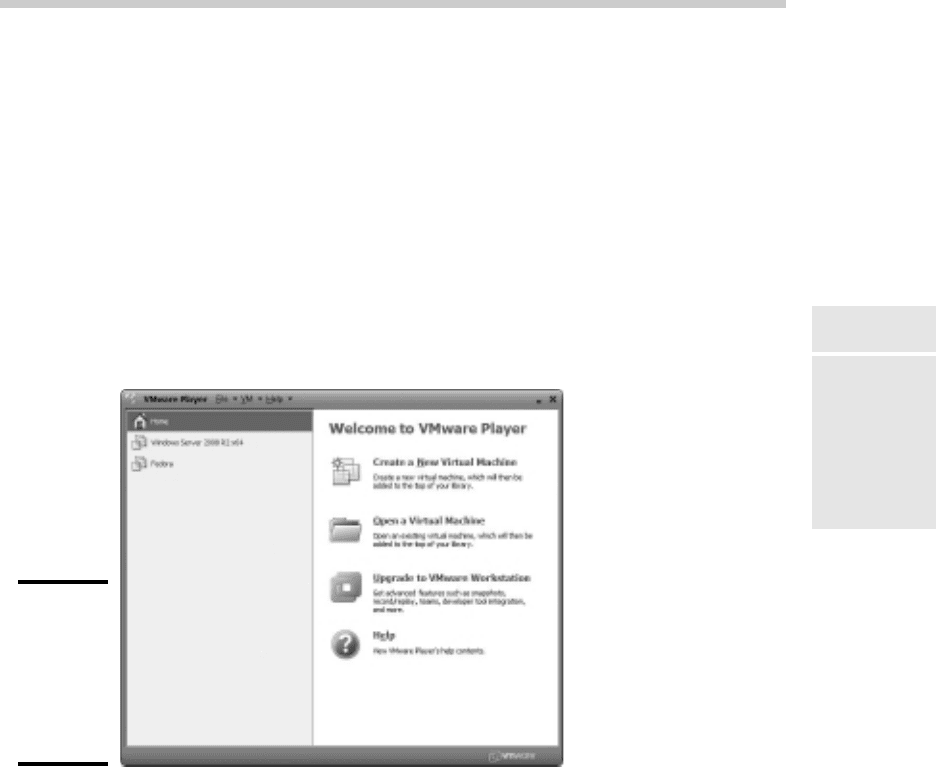
Figure 8-1 shows VMWare Player’s main screen. From this screen, you can
create a new virtual machine or run one of the virtual machines you have
already created. As you can see, I’ve created two virtual machines so far:
one running Windows Server 2008 R2, the other running Linux.
Figure 8-1:
VMWare
Player
lets you
experiment
with
virtualization.
You can run an existing virtual machine by selecting the VM and clicking
Play Virtual Machine. This launches the virtual machine, which opens in a
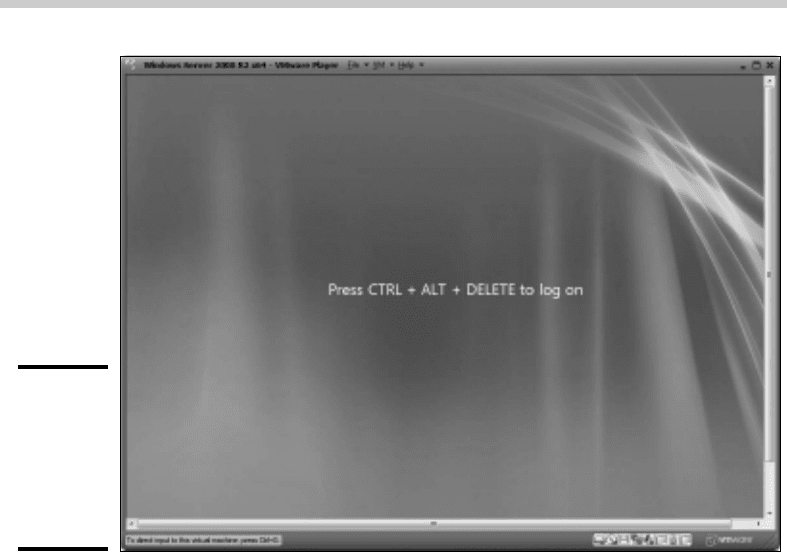
new window, as shown in Figure 8-2. When you launch a virtual machine, the
VM behaves exactly as a real computer would when you power it up: First it
initializes its virtual hardware devices and then it loads the guest operating
system that has been installed in the VM. In the figure, Windows Server 2008
has booted up and is waiting for you to press Ctrl+Alt+Del to log on.
The prompt to press Ctrl+Alt+Del shown in Figure 8-2 illustrates one of the
peculiar details of running a virtual machine within a host operating system
(in this case, running Windows Server 2008 R2 within Windows 7 Ultimate):
When you press Ctrl+Alt+Del, which operating system — the host or the
guest — responds? The answer is that the host operating system responds
to the Ctrl+Alt+Del, so the guest operating system never sees it.
17_625873-bk02ch08.indd 16117_625873-bk02ch08.indd 161 9/21/10 10:12 PM9/21/10 10:12 PM
162
Creating a Virtual Machine
Figure 8-2:
A virtual
machine
running
Windows
Server 2008
R2.
To get around this limitation, VMWare uses the special keyboard short-
cut Ctrl+Alt+End to send a Ctrl+Alt+Del to the guest operating system.
Alternatively, you can use the VM pull-down menu that appears in the menu
bar above the virtual machine menu. This menu lists several actions that can
be applied to the virtual machine, including Send Ctrl+Alt+Del.
Another detail you should know about when working with a VM is that when
you click in the virtual machine’s window, the VM captures your mouse
and keyboard so that your input will be directed to the virtual machine
rather than the host computer. If you want to break the bonds of the virtual
machine and return to the host computer, press Ctrl and Alt.
Creating a Virtual Machine
Creating a new virtual machine in VMWare Player is relatively easy. In fact,
the most challenging part is that you’ll need the installation disk for the
operating system you want to install on the VM. Remember that a virtual
machine is useless without a guest operating system, so you need to have
the installation disk available before you create the virtual machine.
17_625873-bk02ch08.indd 16217_625873-bk02ch08.indd 162 9/21/10 10:12 PM9/21/10 10:12 PM
Book II
Chapter 8
Going Virtual
163
Creating a Virtual Machine
If you just want to experiment with virtualization and don’t have extra
licenses of a Windows server operating system, you can always download
an evaluation copy of Windows Server 2008 R2 from www.microsoft.com/
windowsserver2008. The evaluation period is six months, so you’ll have
plenty of time to experiment.
The downloadable trial version of Windows Server 2008 R2 comes in the
form of an .iso file, which is an image of a DVD file that you can mount
within your virtual machine as if it were a real disk.
Once you have your .iso file or installation disk ready to go, you can create a
new virtual machine by following these steps:
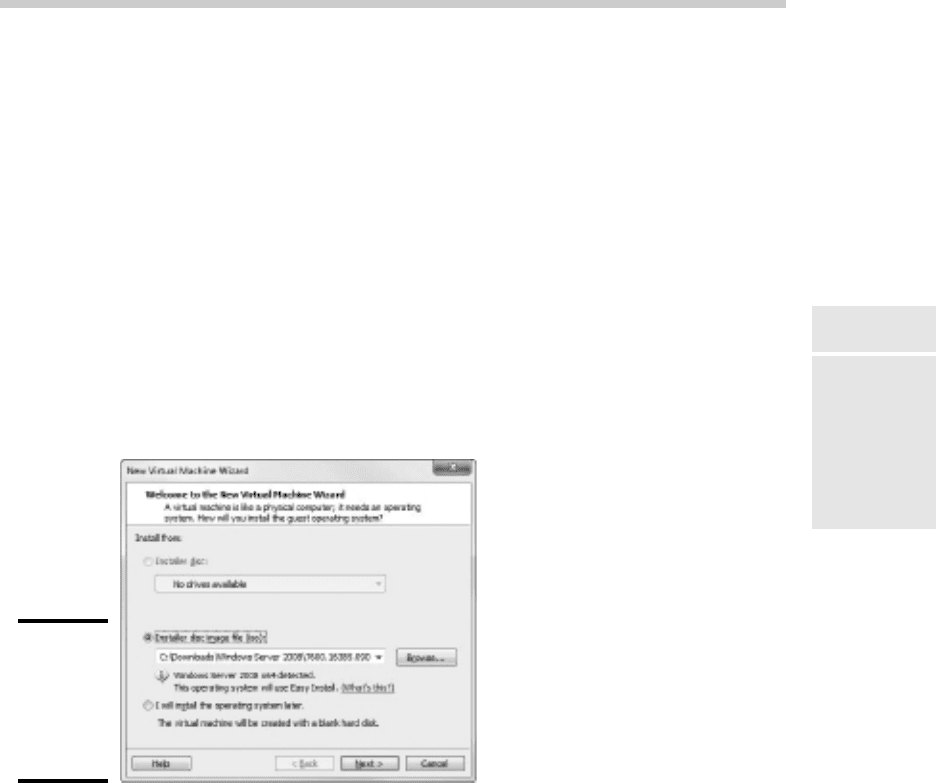
1. Click Create a New Virtual Machine from the VMWare Player home
screen.
This brings up the New Virtual Machine Wizard, as shown in Figure 8-3.
Figure 8-3:
The first
page of the
New Virtual
Machine
Wizard.
2. Choose the installation option you want to use.
There are three choices:
• Select Installer Disc and then choose the drive you will install from if
you want to install from an actual CD or DVD.
• Select Install Disc Image File (iso) and then click the Browse button
and browse to the iso file for the operating system installation disc if
you want to install from an iso file.
• Select I Will Install the Operating System Later if you want to create
the virtual machine but install the operating system later.
17_625873-bk02ch08.indd 16317_625873-bk02ch08.indd 163 9/21/10 10:12 PM9/21/10 10:12 PM
164
Creating a Virtual Machine
Note that the remaining steps in this procedure assume that you
selected a Windows Server 2008 R2 iso file as the installation option.
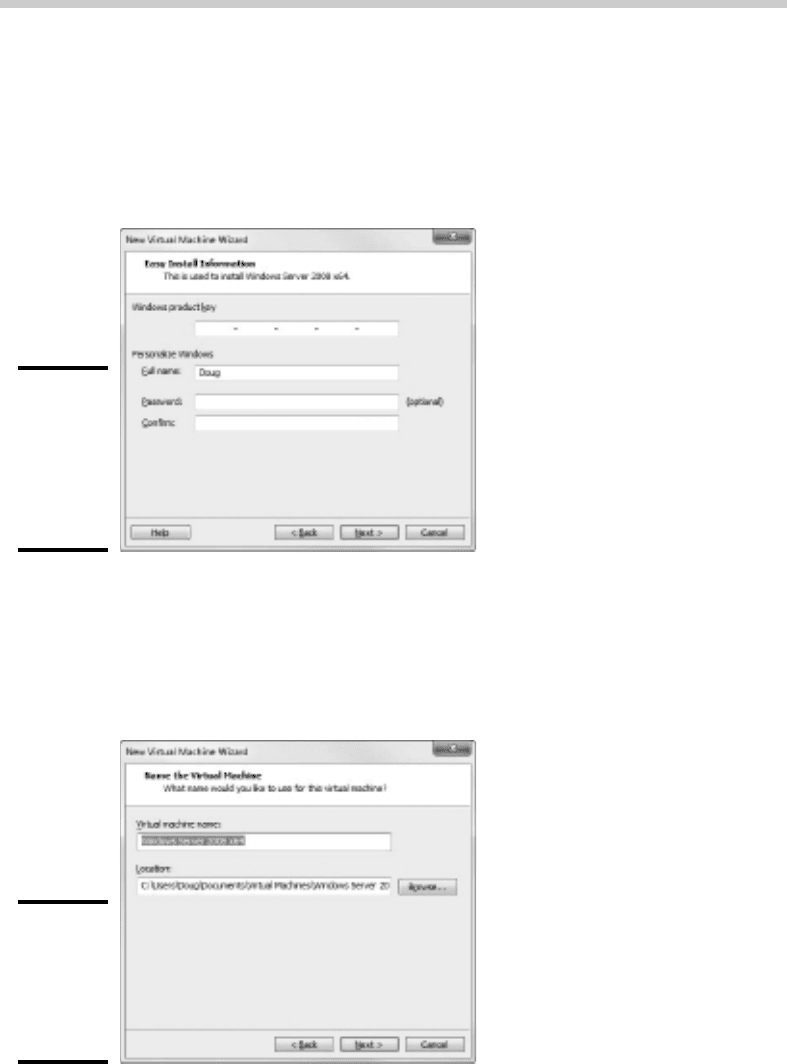
3. Click Next.
The screen shown in Figure 8-4 appears. You can enter the product key
now or skip this step until later.
Figure 8-4:
The New
Virtual
Machine
Wizard asks
for your
product key.
4. If you have the Windows product key, enter it and click Next.
Otherwise just click Next.
You can always enter the product key later if you don’t have it handy
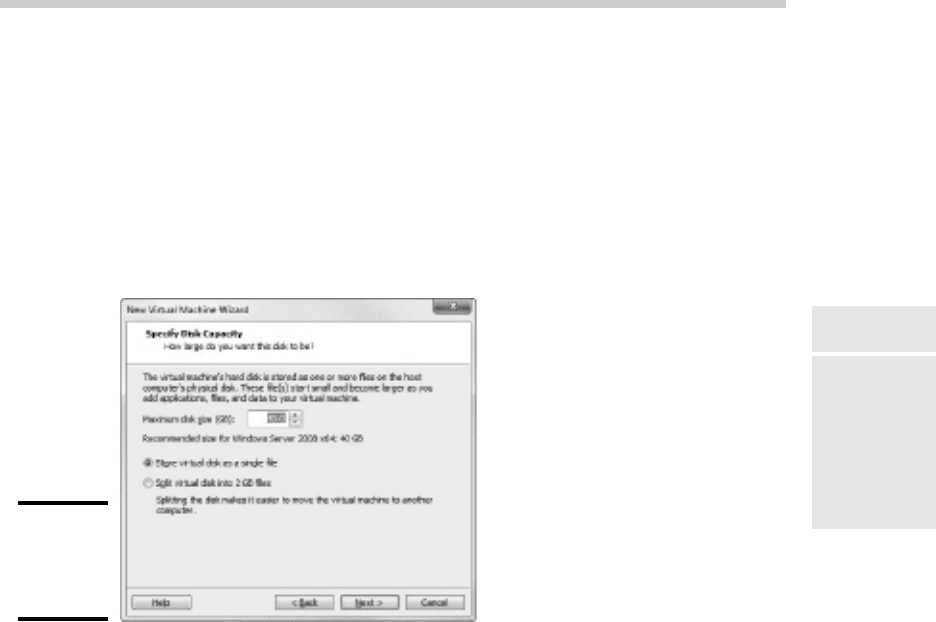
now. Either way, the screen shown in Figure 8-5 appears next.
Figure 8-5:
Creating a
name and
specifying
the VM disk
location.
17_625873-bk02ch08.indd 16417_625873-bk02ch08.indd 164 9/21/10 10:12 PM9/21/10 10:12 PM
Book II
Chapter 8
Going Virtual
165
Creating a Virtual Machine
5. Enter a name for the virtual machine.
6. Enter the location for the virtual machine’s disk file.
If you want, you can click the Browse button and browse to the folder
where you want to create the file.
7. Click Next.
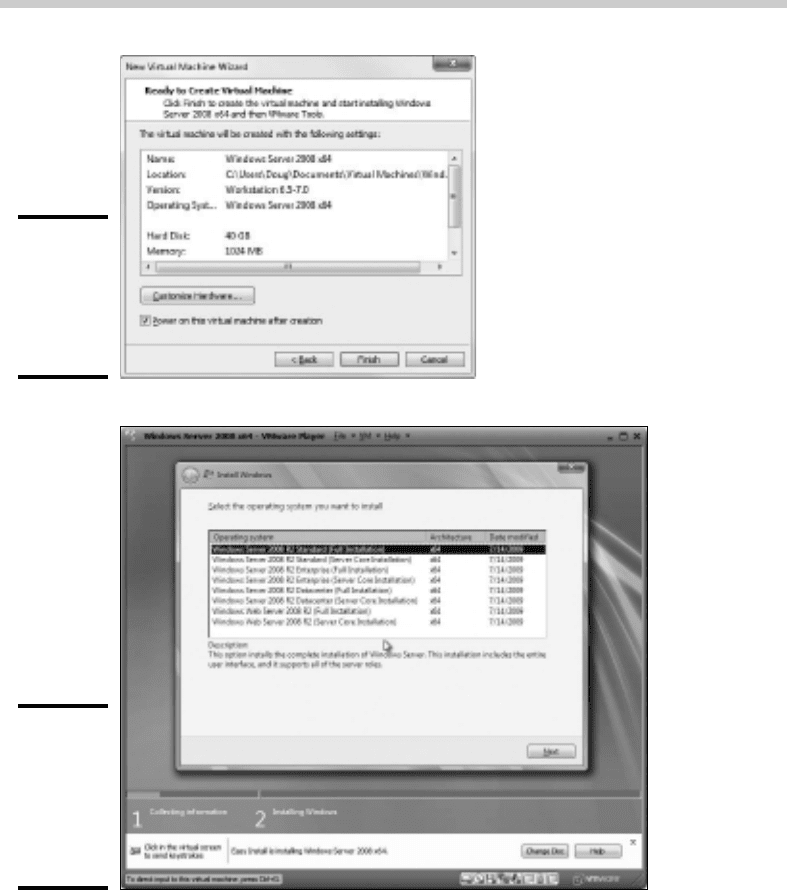
The Wizard asks for the size of the disk to create for the virtual machine,
as shown in Figure 8-6.
Figure 8-6:
Specifying
the VM disk
size.
8. Set the size of the virtual machine’s hard drive.
The default setting is 40GB, but you can change this depending on your
needs. Note that you must have sufficient space available on the host
computer’s disk drive.
9. Click Next.
The Wizard displays a final confirmation page, as shown in Figure 8-7.
10. Click Finish.
The Wizard creates the virtual machine and then starts it. Because the
machine doesn’t have an operating system installed, it boots from the
CD/DVD installation image you specified back in Step 2. In this case,
I booted with the Windows Server 2008 R2 evaluation software disk
image, so the new virtual machine displays the Install Windows screen,
as shown in Figure 8-8.
17_625873-bk02ch08.indd 16517_625873-bk02ch08.indd 165 9/21/10 10:12 PM9/21/10 10:12 PM
166
Creating a Virtual Machine
Figure 8-7:
VMWare
is ready
to create
the virtual
machine.
Figure 8-8:
Installing
Windows
Server
2008 R2 in
a virtual
machine.
11. Follow the steps to install the operating system.
Installing an operating system in a virtual machine is exactly the same as
installing it on a physical computer, except that the installation screens
appear within a virtual machine window.
17_625873-bk02ch08.indd 16617_625873-bk02ch08.indd 166 9/21/10 10:12 PM9/21/10 10:12 PM