
Lowe D. Networking For Dummies
Подождите немного. Документ загружается.

Book II
Chapter 4
Configuring
Windows Clients
127
Configuring Network Connections
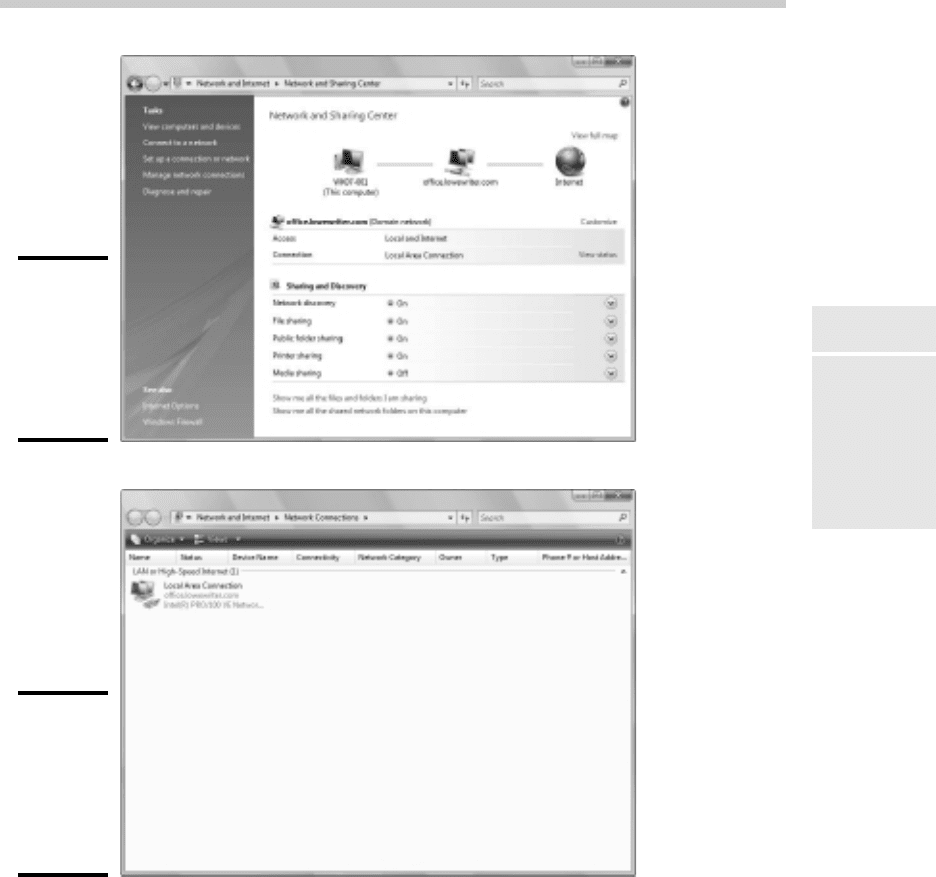
Figure 4-5:
The
Network
and Sharing
Center
(Windows
Vista).
Figure 4-6:
The
Network
Connections
folder
(Windows
Vista).
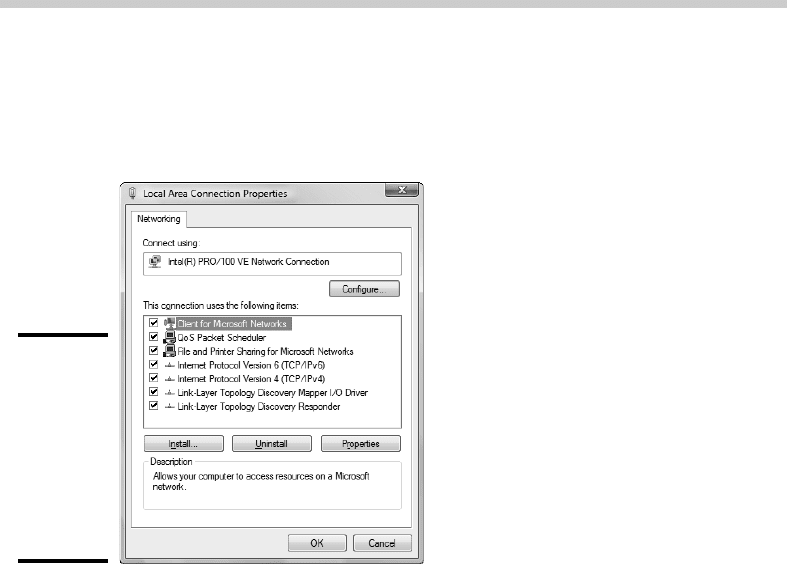
The Properties dialog box for the network connection appears, as shown
in Figure 4-7. If you compare this dialog box with the dialog box that was
shown earlier, in Figure 4-2, you see that they’re the same.
5. Click Configure to configure the network connection.
13_625873-bk02ch04.indd 12713_625873-bk02ch04.indd 127 9/21/10 10:10 PM9/21/10 10:10 PM
128
Configuring Network Connections
From this point, the steps for configuring the network connection are
the same as they are for Windows XP. As a result, you can continue,
beginning with Step 4 in the previous section, “Configuring Windows XP
network connections.”
Figure 4-7:
The
Properties
dialog
box for a
network
connection
(Windows
Vista).
Configuring Windows 7 network connections
The procedure to configure a Windows 7 network connection is similar to the
Windows Vista procedure, with just a few minor variations. Here are the steps:
1. Choose Start➪Control Panel to open the Control Panel.
The Control Panel appears.
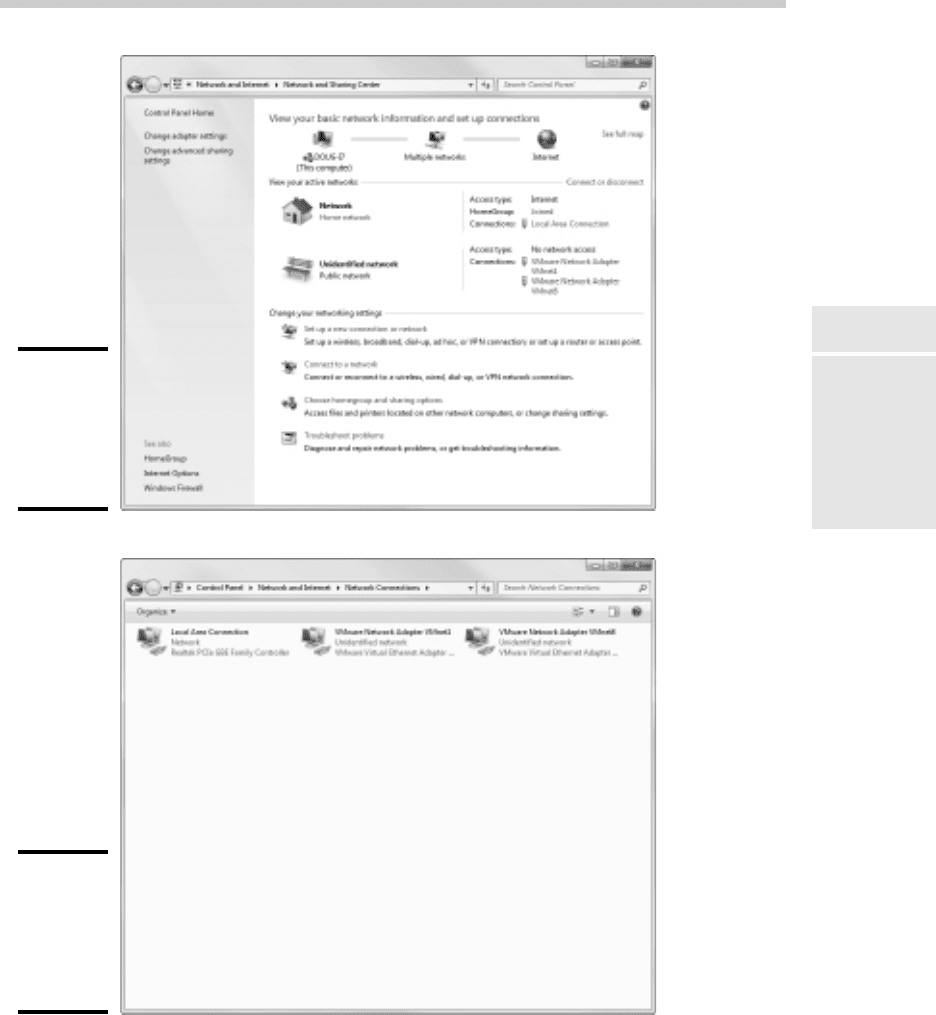
2. Choose View Network Status and Tasks under the Network and
Internet heading.
This step opens the Network and Sharing Center, shown in Figure 4-8.
3. Click the Change Adapter Settings link on the left.
The Network Connections folder appears, as shown in Figure 4-9.
4. Right-click the connection that you want to configure and then choose
Properties from the menu that appears.
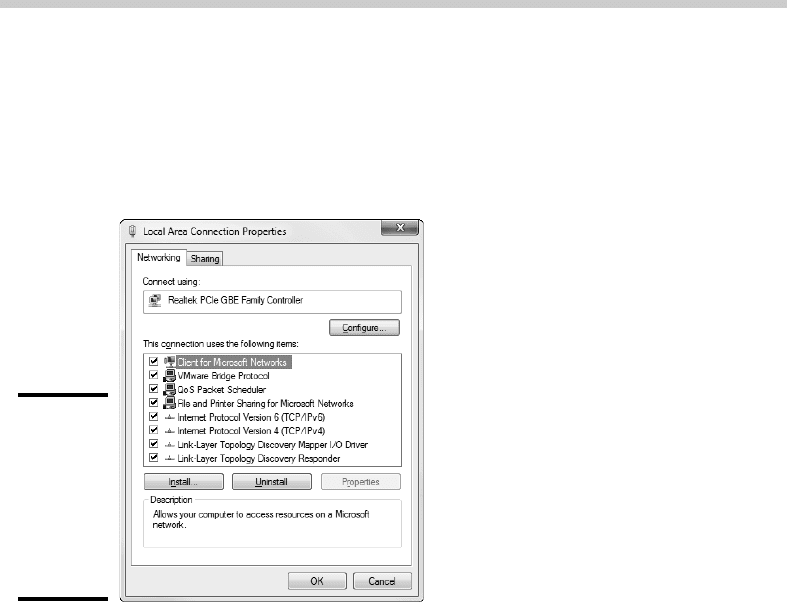
The Properties dialog box for the network connection appears, as shown
in Figure 4-10. If you compare this dialog box with the dialog box that
was shown earlier, in Figure 4-2, you see that they’re the same.
13_625873-bk02ch04.indd 12813_625873-bk02ch04.indd 128 9/21/10 10:10 PM9/21/10 10:10 PM
Book II
Chapter 4
Configuring
Windows Clients
129
Configuring Network Connections
Figure 4-8:
The
Network
and Sharing
Center
(Windows 7).
Figure 4-9:
The
Network
Connections
folder
(Windows 7).
13_625873-bk02ch04.indd 12913_625873-bk02ch04.indd 129 9/21/10 10:10 PM9/21/10 10:10 PM
130
Configuring Client Computer Identification
5. Click Configure to configure the network connection.
From this point, the steps for configuring the network connection are
the same as they are for Windows XP. As a result, you can continue,
beginning with Step 4 in the earlier section, “Configuring Windows XP
network connections.”
Figure 4-10:
The
Properties
dialog
box for a
network
connection
(Windows 7).
Configuring Client Computer Identification
Every client computer must identify itself to participate in the network.
The computer identification consists of the computer’s name, an optional
description, and the name of either the workgroup or the domain to which
the computer belongs.
The computer name must follow the rules for NetBIOS names; it may be 1 to 15
characters long and may contain letters, numbers, or hyphens but no spaces
or periods. For small networks, it’s common to make the computer name
the same as the username. For larger networks, you may want to develop a
naming scheme that identifies the computer’s location. For example, a name
such as C-305-1 may be assigned to the first computer in Room 305 of
Building C. Or MKTG010 may be a computer in the Marketing department.
If the computer will join a domain, you need to have access to an
Administrator account on the domain, unless the administrator has already
created a computer account on the domain. Note that only the following ver-
sions of Windows have the ability to join a domain:
13_625873-bk02ch04.indd 13013_625873-bk02ch04.indd 130 9/21/10 10:10 PM9/21/10 10:10 PM
Book II
Chapter 4
Configuring
Windows Clients
131
Configuring Client Computer Identification
✦ Windows 7 Professional, Enterprise, or Ultimate
✦ Windows Vista Business, Enterprise, or Ultimate
✦ Windows XP Professional
When you install Windows on the client system, the Setup program asks for
the computer name and workstation or domain information. You can change
this information later, if you want. The procedure varies depending on the
Windows version you’re using.
Configuring Windows XP computer identification
To change the computer identification in Windows XP, follow these steps:
1. Open the Control Panel and double-click the System icon to open the
System Properties dialog box.
2. Click the Computer Name tab.
The computer identification information is displayed.
3. Click the Change button.
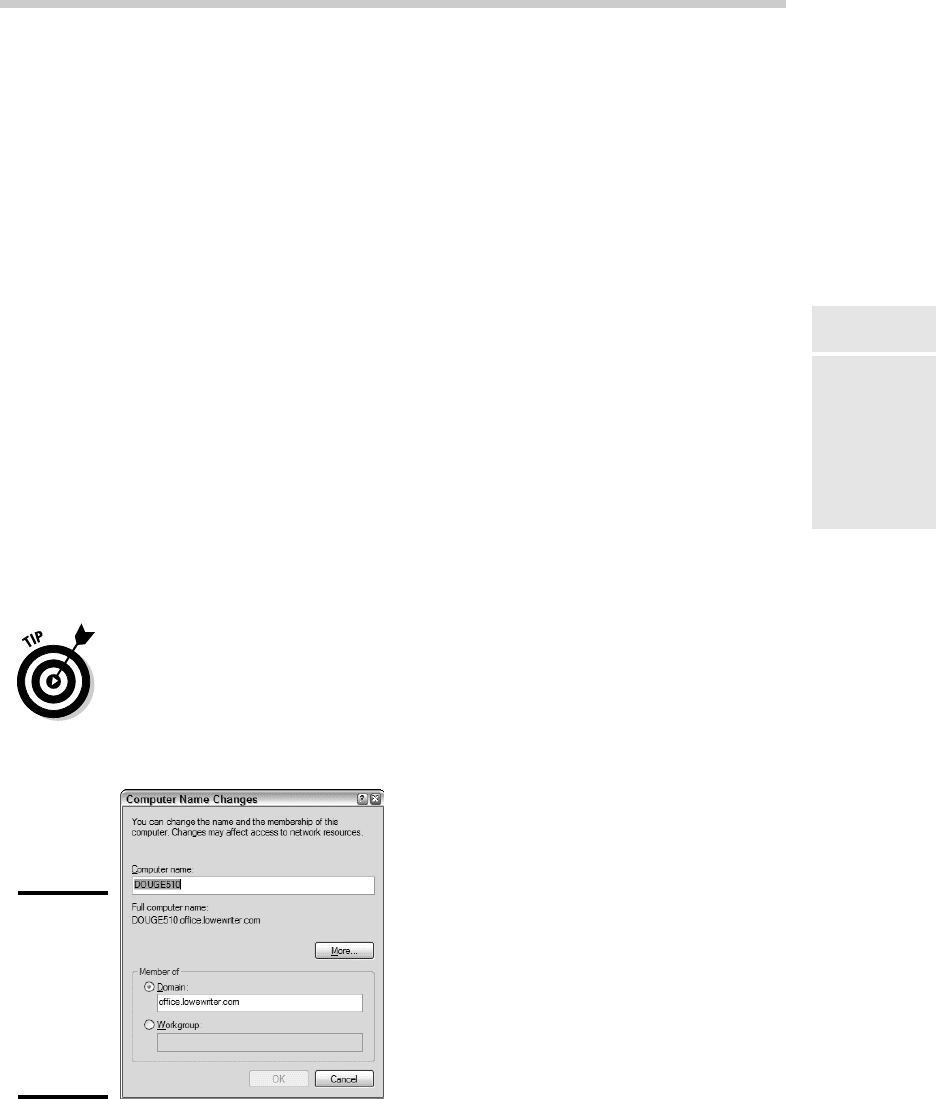
This step displays the Computer Name Changes dialog box, as shown in
Figure 4-11.
4. Type the new computer name and then specify the workgroup or
domain information.
To join a domain, select the Domain radio button and type the domain
name into the appropriate text box. To join a workgroup, select the
Workgroup radio button and type the workgroup name in the corre-
sponding text box.
5. Click OK.
Figure 4-11:
The
Computer
Name
Changes
dialog box
(Windows
XP).
13_625873-bk02ch04.indd 13113_625873-bk02ch04.indd 131 9/21/10 10:10 PM9/21/10 10:10 PM
132
Configuring Client Computer Identification
6. If you’re prompted, enter the username and password for an
Administrator account.
You’re asked to provide this information only if a computer account has
not already been created for the client computer.
7. When a dialog box appears, informing you that you need to restart the
computer, click OK. Then restart the computer.
You’re done!
Configuring Windows Vista or Windows 7
computer identification
To change the computer identification in Windows Vista or Windows 7,
follow these steps:
1. Click the Start button, and then right-click Computer and choose
Properties.
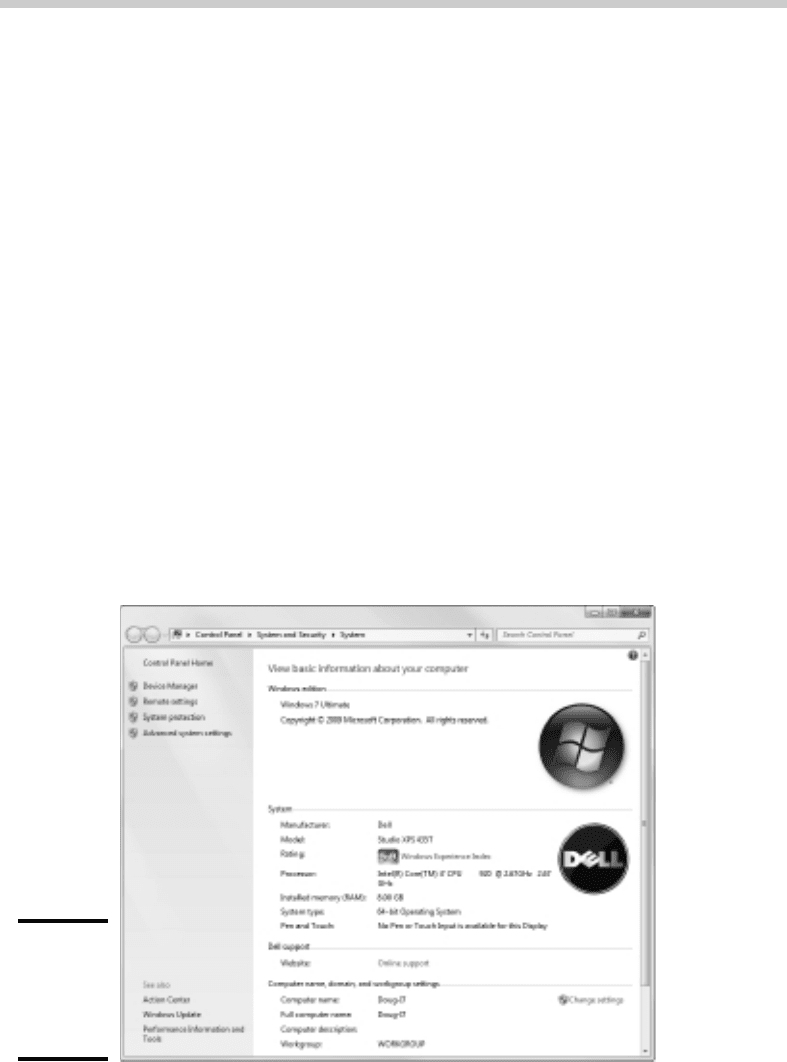
This step displays the System information window, as shown in Figure
4-12. Notice the section that lists computer name, domain, and work-
group settings.
2. Click the Change Settings link in the lower-right.
Figure 4-12:
The System
information
window
(Windows 7).
13_625873-bk02ch04.indd 13213_625873-bk02ch04.indd 132 9/21/10 10:10 PM9/21/10 10:10 PM
Book II
Chapter 4
Configuring
Windows Clients
133
Configuring Client Computer Identification
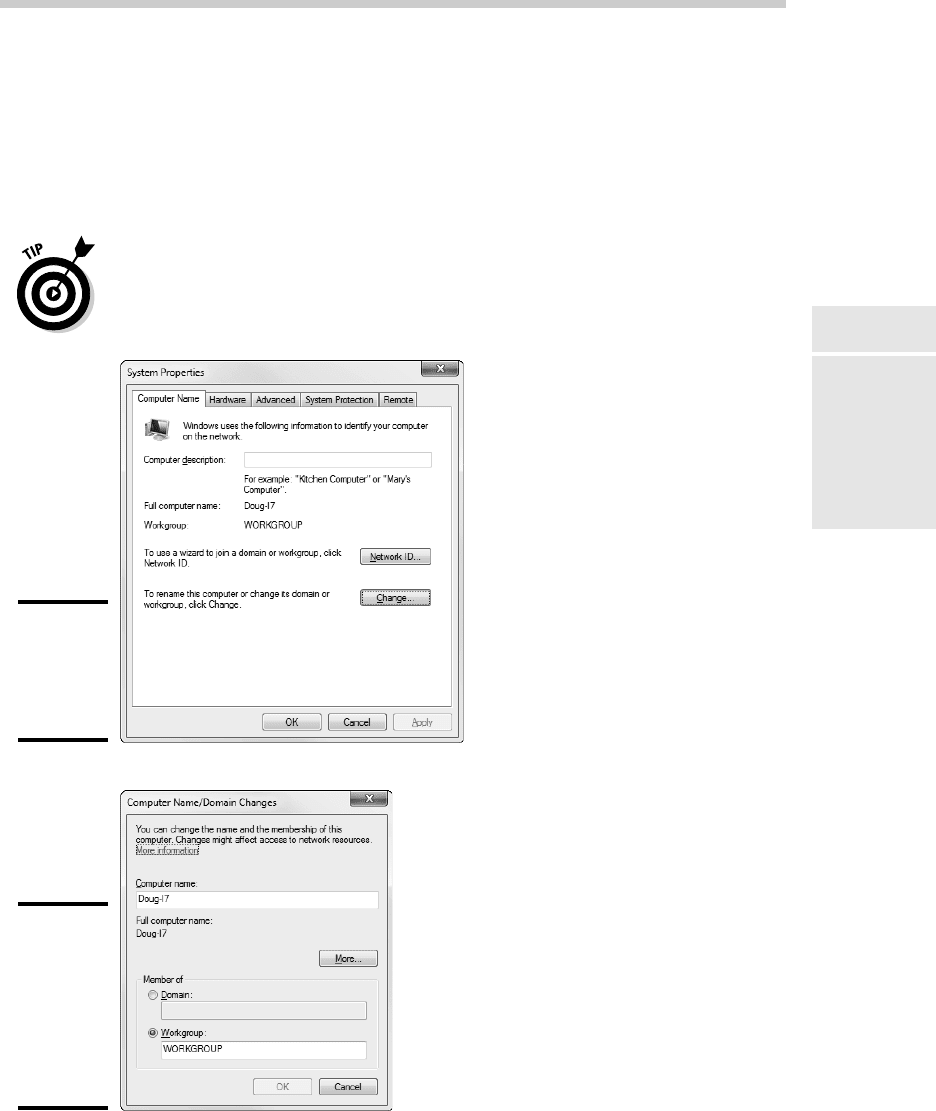
If a dialog box appears and asks for your permission to continue, click
Continue. The System Properties dialog box then appears, as shown in
Figure 4-13.
3. Click the Change button.
This step displays the Computer Name/Domain Changes dialog box, as
shown in Figure 4-14.
4. Enter the computer name and the workgroup or domain name.
If you want to join a domain, choose the Domain option button and type
the domain name. To join a workgroup, choose the Workgroup option
button and type the workgroup name.
Figure 4-13:
The System
Properties
dialog box
(Windows 7).
Figure 4-14:
The
Computer
Name/
Domain
Changes
dialog box
(Windows 7).
13_625873-bk02ch04.indd 13313_625873-bk02ch04.indd 133 9/21/10 10:10 PM9/21/10 10:10 PM

134
Configuring Network Logon
5. Click OK.
6. Enter the username and password for an Administrator account when
prompted.
You’re asked to provide this information only if a computer account
hasn’t already been created for the client computer.
7. When a dialog box appears, informing you that you need to restart the
computer, click OK. Then restart the computer.
The computer is then added to the domain or workgroup.
Configuring Network Logon
Every user who wants to access a domain-based network must log on to the
domain by using a valid user account. The user account is created on the
domain controller — not on the client computer.
Network logon isn’t required to access workgroup resources. Instead, work-
group resources can be password-protected to restrict access.
When you start a Windows computer that’s been configured to join
a domain, as described in the section “Configuring Client Computer
Identification,” earlier in this chapter, the Log On to Windows dialog box is
displayed. The user can use this dialog box to log on to a domain by entering
a domain username and password and then selecting the domain that she
wants to log on to (from the Log On To drop-down list).
You can create local user accounts in Windows that allow users to access
resources on the local computer. To log on to the local computer, the user
selects This Computer from the Log On To drop-down list and enters the
username and password for a local user account. When a user logs on by
using a local account, he isn’t connected to a network domain. To log on to a
domain, the user must select the domain from the Log On To drop-down list.
If the computer isn’t part of a domain, Windows can display a friendly logon
screen that displays an icon for each of the computer’s local users. The user
can log on simply by clicking the appropriate icon and entering a password.
(This feature isn’t available for computers that have joined a domain.)
Note that if the user logs on by using a local computer account rather than a
domain account, she can still access domain resources. A Connect To dialog
box appears whenever the user attempts to access a domain resource. Then
the user can enter a domain username and password to connect to the
domain.
13_625873-bk02ch04.indd 13413_625873-bk02ch04.indd 134 9/21/10 10:10 PM9/21/10 10:10 PM

Chapter 5: Macintosh Networking
In This Chapter
✓ Hooking up a Macintosh network
✓ Using a Macintosh network
✓ Mixing Macs and PCs
T
his book dwells on networking Windows-based computers, as if
Microsoft were the only game in town. (Hah! They wish.) To be politi-
cally correct, I should at least acknowledge the existence of a different
breed of computer: the Apple Macintosh.
This chapter presents what you need to know to hook up a Macintosh
network, use a Macintosh network, and mix Macintoshes and Windows
PCs on the same network. This chapter isn’t a comprehensive tome on
Macintoshes, but it’s enough to start.
What You Need to Know to Hook
Up a Macintosh Network
The following sections present some key things you should know about net-
working Macintosh computers before you start plugging in cables.
Mac networking protocols
Every Macintosh ever built, even an original 1984 model, includes network-
ing support. Of course, newer Macintosh computers have better built-in
networking features than older Macintosh computers. The newest Macs
include built-in gigabit Ethernet adapters and sophisticated networking sup-
port built in to the operating system — similar to the networking features
that come with Windows. Because the network support is built in, you don’t
have to fuss with installing and configuring the network.
Originally, Macintosh computers used a set of networking protocols collec-
tively known as AppleTalk. In the mid 1990s, AppleTalk was supplanted by a
networking scheme called Open Transport.
14_625873-bk02ch05.indd 13514_625873-bk02ch05.indd 135 9/21/10 10:10 PM9/21/10 10:10 PM

136
What You Need to Know to Hook Up a Macintosh Network
The current generation of Macintosh computers uses industry-standard
TCP/IP networking. The only protocol left over from the AppleTalk days that
is still in widespread use is AFP, used to enable file sharing. For a brief expla-
nation of this protocol, see the sidebar “Who’s winning in the AFP West?”
Mac OS X Server
Apple offers a dedicated network operating system known as Mac OS
X Server (the X is pronounced “Ten,” not “Ex”), which is designed for
PowerMac G3 or later computers. Mac OS X Server is based on a Unix
operating-system kernel known as Mach. Mac OS X Server can handle many
network-server tasks as efficiently as any other network operating system,
including Windows 2000, NetWare, and Unix.
Mac OS X Server is the server version of the Mac OS X operating system,
which is the current operating system version for client Macintosh computers.
The Mac OS X Server includes the following features:
✦ Apache Web server, which also runs on Windows and Linux systems
✦ NetBoot, a feature that simplifies the task of managing network client
computers
✦ File services using AFP
✦ WebObjects, a high-end tool for creating Web sites
✦ QuickTime Streaming Server, which lets the server broadcast multime-
dia programs over the network
Who’s winning in the AFP West?
AFP is not a division of the NFL but an abbrevia-
tion for AppleTalk Filing Protocol. It’s the part
of AppleTalk that governs how files are stored
and accessed on the network. AFP allows files
to be shared with non-Macintosh computers.
You can integrate Macintoshes into any net-
work operating system that recognizes AFP.
NetWare and all versions of Windows since
Windows 95 use AFP to support Macintoshes
in their networks.
In case you’re interested (and you shouldn’t
be), AFP is a Presentation layer protocol. (See
Book I, Chapter 2, if you don’t have a clue about
what I’m talking about.)
14_625873-bk02ch05.indd 13614_625873-bk02ch05.indd 136 9/21/10 10:10 PM9/21/10 10:10 PM