
Lowe D. Networking For Dummies
Подождите немного. Документ загружается.

Book I
Chapter 1
Understanding
Networks
17
Network Topology
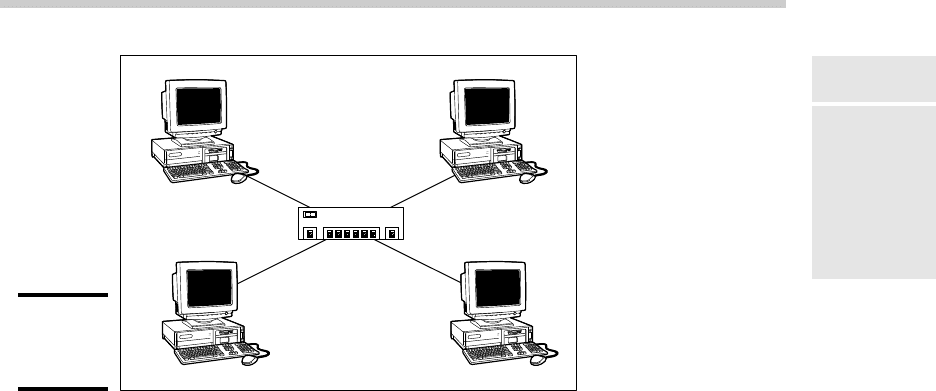
Figure 1-2:
Star
topology.
Hub
Strictly speaking, only networks that use switches have a true star topology.
If the network uses a hub, the network topology has the physical appear-
ance of a star, but is actually a bus. That’s because when a hub is used, each
computer on the network sees all the packets sent over the network, just
like in a bus topology. In a true star topology, as when a switch is used, each
computer sees only those packets that were sent specifically to it, as well as
packets that were specifically sent to all computers on the network (those
types of packets are called broadcast packets).
Expanding stars
Physicists say that the universe is expanding, and network administrators
know they’re right. A simple bus or star topology is suitable only for small
networks, with a dozen or so computers. But small networks inevitably
become large networks as more computers are added. For larger networks,
it’s common to create more complicated topologies that combine stars and
buses.
For example, a bus can be used to connect several stars. In this case, two
or more hubs or switches are connected to each other using a bus. Each
of these hubs or switches is then the center of a star that connects two or
more computers to the network. This type of arrangement is commonly used
in buildings that have two or more distinct workgroups. The bus that con-
nects the switches is sometimes called a backbone.
Another way to expand a star topology is to use a technique called daisy-
chaining. When you use daisy-chaining, a switch is connected to another
switch as if it were one of the nodes on the star. Then, this second switch
serves as the center of a second star.
05_625873-bk01ch01.indd 1705_625873-bk01ch01.indd 17 9/21/10 10:05 PM9/21/10 10:05 PM
18
Network Topology
Ring topology
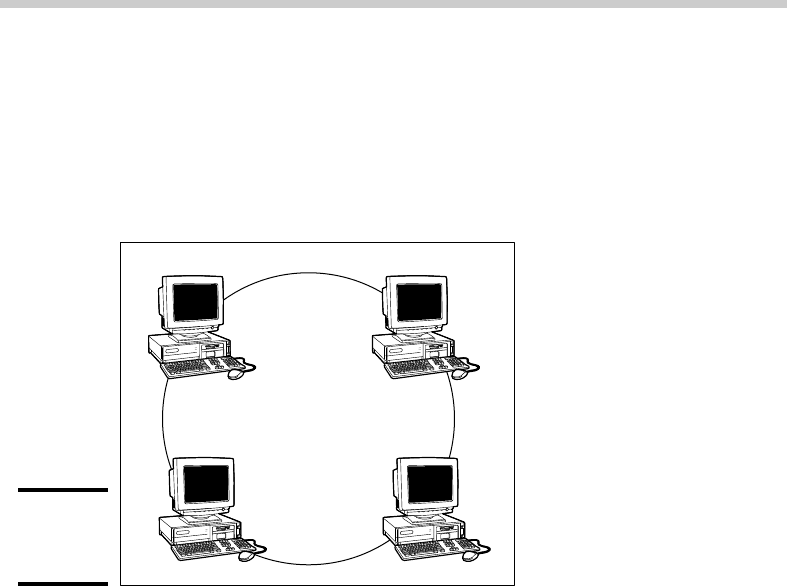
A third type of network topology is called a ring, shown in Figure 1-3. In a
ring topology, packets are sent around the circle from computer to com-
puter. Each computer looks at each packet to decide whether the packet
was intended for it. If not, the packet is passed on to the next computer in
the ring.
Figure 1-3:
Ring
topology.
Years ago, ring topologies were common in LANs, as two popular network-
ing technologies used rings: ARCNET and Token Ring. ARCNET is still used
for certain applications such as factory automation, but is rarely used in
business networks. Token Ring is still a popular network technology for IBM
midrange computers. Although plenty of Token Ring networks are still in
existence, not many new networks use Token Ring any more.
Ring topology was also used by FDDI, one of the first types of fiber-optic
network connections. FDDI has given way to more efficient fiber-optic tech-
niques, however. So ring networks have all but vanished from business
networks.
Mesh topology
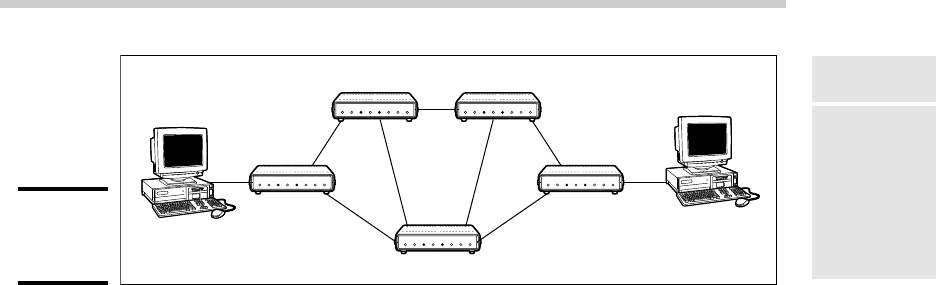
A fourth type of network topology, known as mesh, has multiple connec-
tions between each of the nodes on the network, as shown in Figure 1-4. The
advantage of a mesh topology is that if one cable breaks, the network can
use an alternative route to deliver its packets.
05_625873-bk01ch01.indd 1805_625873-bk01ch01.indd 18 9/21/10 10:05 PM9/21/10 10:05 PM
Book I
Chapter 1
Understanding
Networks
19
Network Topology
Figure 1-4:
Mesh
topology.
Router Router
Router
Router
Router
Computer
Computer
Mesh networks aren’t very practical in a LAN setting. For example, to net-
work eight computers in a mesh topology, each computer would have
to have seven network interface cards, and 28 cables would be required
to connect each computer to the seven other computers in the network.
Obviously, this scheme isn’t very scalable.
However, mesh networks are common for metropolitan or wide area net-
works. These networks use devices called routers to route packets from
network to network. For reliability and performance reasons, routers are
usually arranged in a way that provides multiple paths between any two
nodes on the network in a meshlike arrangement.
05_625873-bk01ch01.indd 1905_625873-bk01ch01.indd 19 9/21/10 10:05 PM9/21/10 10:05 PM

Book I: Networking Basics
20
05_625873-bk01ch01.indd 2005_625873-bk01ch01.indd 20 9/21/10 10:05 PM9/21/10 10:05 PM

Chapter 2: Understanding Network
Protocols and Standards
In This Chapter
✓ Deciphering the layers of the OSI reference model
✓ Understanding an Ethernet
✓ Getting the inside scoop on TCP/IP and IPX/SPX
✓ Finding out about other important protocols
P
rotocols and standards are what make networks work together.
Protocols make it possible for the various components of a network to
communicate with each other. Standards also make it possible for network
components manufactured by different companies to work together. This
chapter introduces you to the protocols and standards that you’re most
likely to encounter when building and maintaining a network.
Understanding Protocols
A protocol is a set of rules that enables effective communications to occur.
You encounter protocols every day. For example, when you pay for grocer-
ies with a debit card, the clerk first tells you how much the groceries cost.
You then swipe your debit card in the card reader, punch in your security
code, indicate whether you want cash back, enter the amount of the cash
back if you so indicated, then verify the total amount. You then cross your
fingers behind your back and say a quiet prayer while the machine autho-
rizes the purchase. Assuming the amount is authorized, the machine prints
out your receipt.
Here’s another example of an everyday protocol: making a phone call. You
probably take most of the details of the phone-calling protocol for granted,
but it’s pretty complicated if you think about it:
✦ When you pick up a phone, you must listen for a dial tone before dialing
the number (unless you’re using a cell phone). If you don’t hear a dial
tone, you know that either (1) someone else in your family is talking on
the phone or (2) something is wrong with your phone.
06_625873-bk01ch02.indd 2106_625873-bk01ch02.indd 21 9/21/10 10:06 PM9/21/10 10:06 PM

22
Understanding Protocols
✦ When you hear the dial tone, you initiate the call by dialing the number
of the party you want to reach. If the person you want to call is in the
same area code as you, most of the time you simply dial that person’s
seven-digit phone number. If the person is in a different area code, you
dial a one, the three-digit area code, and the person’s seven-digit phone
number.
✦ If you hear a series of long ringing tones, you wait until the other person
answers the phone. If the phone rings a certain number of times with no
answer, you hang up and try again later. If you hear a voice say, “Hello,”
you begin a conversation with the other party. If the person on the
other end of the phone has never heard of you, you say, “Sorry, wrong
number,” hang up, and try again.
✦ If you hear a voice that rambles on about how they’re not home but they
want to return your call, you wait for a beep and leave a message.
✦ If you hear a series of short tones, you know the other person is talking
to someone else on the phone. So you hang up and try again later.
✦ If you hear a sequence of three tones that increase in pitch, followed by
a recorded voice that says “We’re sorry . . .” you know that the number
you dialed is invalid. Either you dialed the number incorrectly, or the
number has been disconnected.
I can go on and on, but I think you probably get the point. Exchanges such
as using debit cards or making phone calls follow the same rules every time
they happen.
Computer networks depend upon many different types of protocols in order
to work. These protocols are very rigidly defined, and for good reason.
Network cards must know how to talk to other network cards in order to
exchange information, operating systems must know how to talk to network
cards in order to send and receive data on the network, and application pro-
grams must know how to talk to operating systems in order to know how to
retrieve a file from a network server.
Protocols come in many different types. At the lowest level, protocols define
exactly what type of electrical signal represents a one and what type of
signal represents a zero. At the highest level, protocols allow a computer
user in the United States to send an e-mail to another computer user in New
Zealand. And in between are many other levels of protocols. You find out
more about these levels of protocols (which are often called layers) in the
section, “The Seven Layers of the OSI Reference Model,” later in this chapter.
Various protocols tend to be used together in matched sets called protocol
suites. The two most popular protocol suites for networking are TCP/IP and
Ethernet. TCP/IP was originally developed for Unix networks and is the
06_625873-bk01ch02.indd 2206_625873-bk01ch02.indd 22 9/21/10 10:06 PM9/21/10 10:06 PM

Book I
Chapter 2
Understanding
Network Protocols
and Standards
23
Understanding Standards
protocol of the Internet and most local-area networks. Ethernet is a low-
level protocol that spells out the electrical characteristics of the network
hardware used by most local-area networks. A third important protocol is
IPX/SPX, which is an alternative to TCP/IP that was originally developed for
NetWare networks. In the early days of networking, IPX/SPX was widely
used in local area networks, but TCP/IP is now the preferred protocol.
Understanding Standards
A standard is an agreed-upon definition of a protocol. In the early days of
computer networking, each computer manufacturer developed its own net-
working protocols. As a result, you weren’t able to easily mix equipment
from different manufacturers on a single network.
Then along came standards to save the day. Standards are industry-wide
protocol definitions that are not tied to a particular manufacturer. With stan-
dard protocols, you can mix and match equipment from different vendors.
As long as the equipment implements the standard protocols, it should be
able to coexist on the same network.
Many organizations are involved in setting standards for networking. The
five most important organizations are
✦ American National Standards Institute (ANSI): The official standards
organization in the United States. ANSI is pronounced AN-see.
✦ Institute of Electrical and Electronics Engineers (IEEE): An interna-
tional organization that publishes several key networking standards —
in particular, the official standard for the Ethernet networking system
(known officially as IEEE 802.3). IEEE is pronounced eye-triple-E.
✦ International Organization for Standardization (ISO): A federation of
more than 100 standards organizations from throughout the world. If
I had studied French in high school, I’d probably understand why the
acronym for International Organization for Standardization is ISO, and
not IOS.
✦ Internet Engineering Task Force (IETF): The organization responsible
for the protocols that drive the Internet.
✦ World Wide Web Consortium (W3C): An international organization that
handles the development of standards for the World Wide Web.
Table 2-1 lists the Web sites for each of these standards organizations.
06_625873-bk01ch02.indd 2306_625873-bk01ch02.indd 23 9/21/10 10:06 PM9/21/10 10:06 PM

24
The Seven Layers of the OSI Reference Model
Table 2-1 Web Sites for Major Standards Organizations
Organization Web Site
ANSI (American National Standards Institute)
www.ansi.org
IEEE (Institute of Electrical and Electronic Engineers)
www.ieee.org
ISO (International Organization for Standardization)
www.iso.org
IETF (Internet Engineering Task Force)
www.ietf.org
W3C (World Wide Web Consortium)
www.w3c.org
The Seven Layers of the OSI Reference Model
OSI sounds like the name of a top-secret government agency you hear about
only in Tom Clancy novels. What it really stands for in the networking world
is Open Systems Interconnection, as in the Open Systems Interconnection
Reference Model, affectionately known as the OSI model.
The OSI model breaks the various aspects of a computer network into seven
distinct layers. These layers are kind of like the layers of an onion: Each suc-
cessive layer envelops the layer beneath it, hiding its details from the levels
above. The OSI model is also like an onion in that if you start to peel it apart
to have a look inside, you’re bound to shed a few tears.
The OSI model is not a networking standard in the same sense that Ethernet
and TCP/IP are networking standards. Rather, the OSI model is a framework
into which the various networking standards can fit. The OSI model specifies
what aspects of a network’s operation can be addressed by various network
standards. So, in a sense, the OSI model is sort of a standard of standards.
Table 2-2 summarizes the seven layers of the OSI model.
Table 2-2 The Seven Layers of the OSI Model
Layer Name Description
1 Physical Governs the layout of cables and devices such as
repeaters and hubs.
2 Data Link Provides MAC addresses to uniquely identify net-
work nodes and a means for data to be sent over the
Physical layer in the form of packets. Bridges and
switches are layer 2 devices.
3 Network Handles routing of data across network segments.
06_625873-bk01ch02.indd 2406_625873-bk01ch02.indd 24 9/21/10 10:06 PM9/21/10 10:06 PM

Book I
Chapter 2
Understanding
Network Protocols
and Standards
25
The Seven Layers of the OSI Reference Model
Layer Name Description
4 Transport Provides for reliable delivery of packets.
5 Session Establishes sessions between network applications.
6 Presentation Converts data so that systems that use different data
formats can exchange information.
7 Application Allows applications to request network services.
The first three layers are sometimes called the lower layers. They deal with
the mechanics of how information is sent from one computer to another
over a network. Layers 4 through 7 are sometimes called the upper layers.
They deal with how application software can relate to the network through
application programming interfaces.
The following sections describe each of these layers in greater detail.
The seven layers of the OSI model are a somewhat idealized view of how
networking protocols should work. In the real world, actual networking
protocols don’t follow the OSI model to the letter. The real world is always
messier than we’d like. Still, the OSI model provides a convenient — if not
completely accurate — conceptual picture of how networking works.
The Physical Layer
The bottom layer of the OSI model is the Physical layer. It addresses the
physical characteristics of the network, such as the types of cables used to
connect devices, the types of connectors used, how long the cables can be,
and so on. For example, the Ethernet standard for 10BaseT cable specifies
the electrical characteristics of the twisted-pair cables, the size and shape of
the connectors, the maximum length of the cables, and so on. The star, bus,
ring, and mesh network topologies described in Book I, Chapter 1 apply to
the Physical layer.
Another aspect of the Physical layer is the electrical characteristics of the
signals used to transmit data over the cables from one network node to
another. The Physical layer doesn’t define any meaning to those signals
other than the basic binary values of zero and one. The higher levels of
the OSI model must assign meanings to the bits that are transmitted at the
Physical layer.
One type of Physical layer device commonly used in networks is a repeater.
A repeater is used to regenerate the signal whenever you need to exceed
the cable length allowed by the Physical layer standard. 10BaseT hubs are
also Physical layer devices. Technically, they’re known as multiport repeat-
ers because the purpose of a hub is to regenerate every packet received on
06_625873-bk01ch02.indd 2506_625873-bk01ch02.indd 25 9/21/10 10:06 PM9/21/10 10:06 PM
26
The Seven Layers of the OSI Reference Model
any port on all of the hub’s other ports. Repeaters and hubs don’t examine
the contents of the packets that they regenerate. If they did, they would be
working at the Data Link layer, and not at the Physical layer.
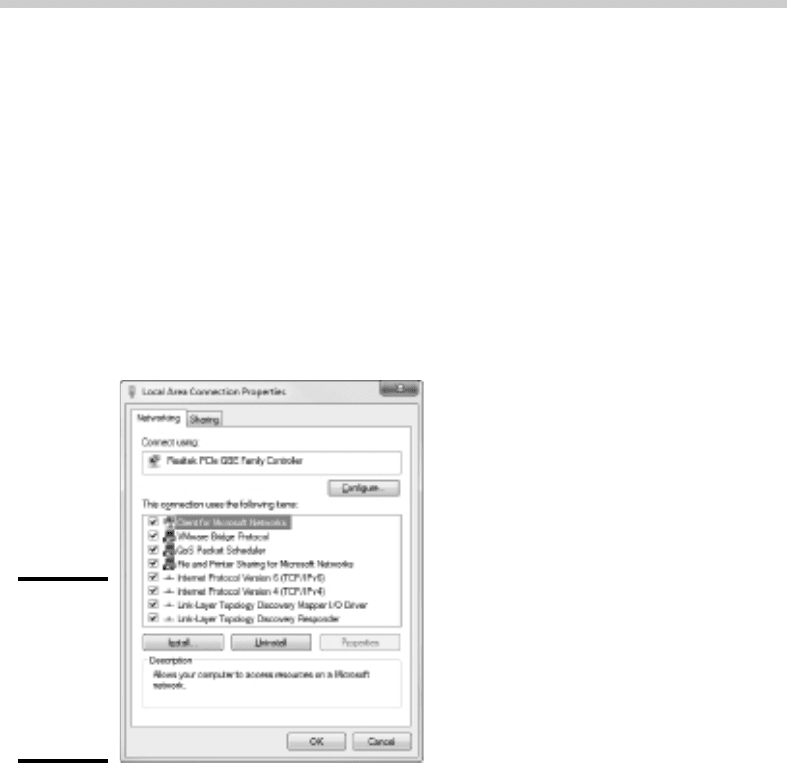
The network adapter (also called a network interface card or NIC) that’s
installed in each computer on the network is a Physical layer device. You
can display information about the network adapter (or adapters) installed
in a Windows computer by displaying the adapter’s Properties dialog box,
as shown in Figure 2-1. To access this dialog box in Windows 7 or Vista,
open the Control Panel, choose Network and Internet, choose View Network
Status and Tasks, and choose Change Adapter Settings. Then, right-click
the Local Area Connection icon and choose Properties from the menu that
appears.
Figure 2-1:
The
Properties
dialog
box for a
network
adapter.
The Data Link Layer
The Data Link layer is the lowest layer at which meaning is assigned to the
bits that are transmitted over the network. Data link protocols address
things such as the size of each packet of data to be sent, a means of address-
ing each packet so that it’s delivered to the intended recipient, and a way to
ensure that two or more nodes don’t try to transmit data on the network at
the same time.
The Data Link layer also provides basic error detection and correction to
ensure that the data sent is the same as the data received. If an uncorrect-
able error occurs, the data link standard must specify how the node is to be
informed of the error so that it can retransmit the data.
06_625873-bk01ch02.indd 2606_625873-bk01ch02.indd 26 9/21/10 10:06 PM9/21/10 10:06 PM