
Lowe D. Networking For Dummies
Подождите немного. Документ загружается.

Book I
Chapter 2
Understanding
Network Protocols
and Standards
27
The Seven Layers of the OSI Reference Model
At the Data Link layer, each device on the network has an address known as
the Media Access Control address, or MAC address. This address is actually
hard-wired into every network device by the manufacturer. MAC addresses
are unique; no two network devices made by any manufacturer anywhere in
the world can have the same MAC address.
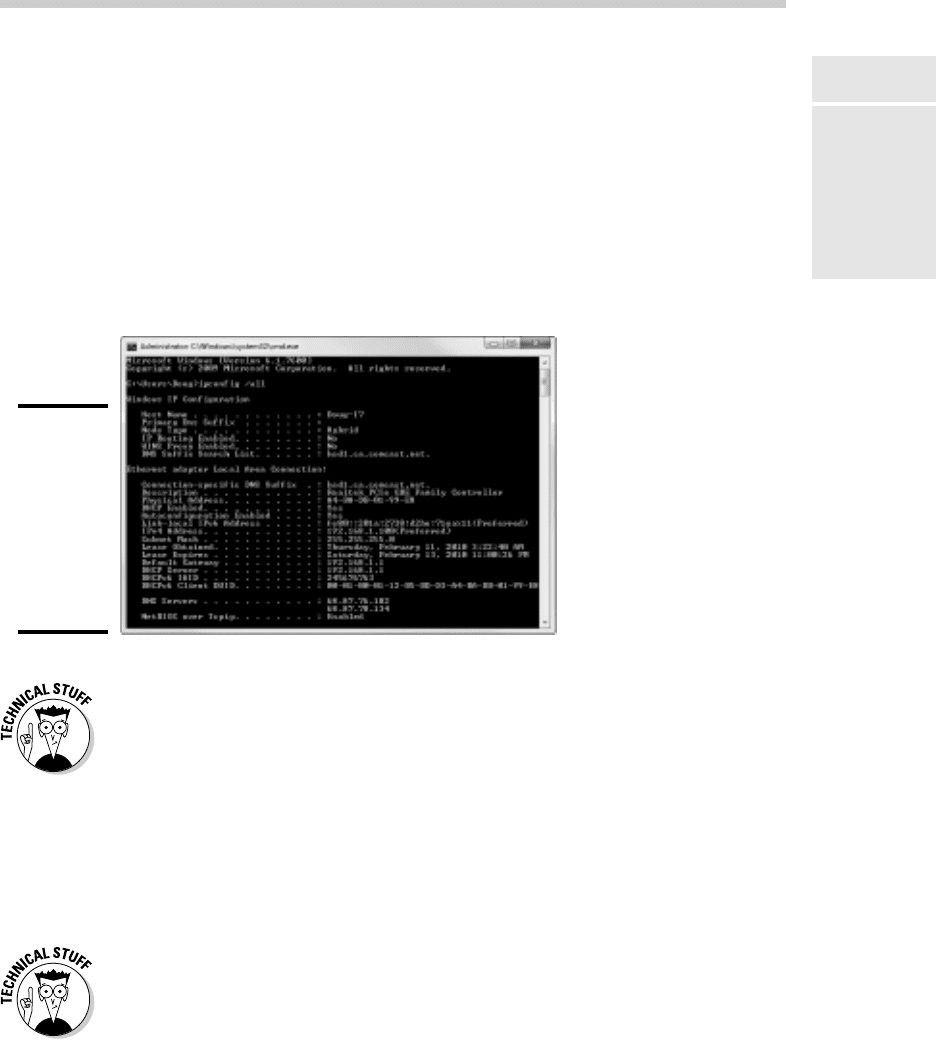
You can see the MAC address for a computer’s network adapter by opening
a command window and running the ipconfig /all command, as shown
in Figure 2-2. In this example, the MAC address of the network card is A4-BA-
DB-01-99-E8. (The ipconfig command refers to the MAC address as the
physical address.)
Figure 2-2:
Using the
ipconfig /all
command
to display
the MAC
address of
a network
adapter.
One of the most import functions of the Data Link layer is to provide a way
for packets to be sent safely over the physical media without interference
from other nodes attempting to send packets at the same time. The two
most popular ways to do this are CSMA/CD and token passing. Ethernet net-
works use CSMA/CD, and Token Ring networks use token passing.
Two types of Data Link layer devices are commonly used on networks: bridges
and switches. A bridge is an intelligent repeater that is aware of the MAC
addresses of the nodes on either side of the bridge and can forward packets
accordingly. A switch is an intelligent hub that examines the MAC address of
arriving packets in order to determine which port to forward the packet to.
An important function of the Data Link layer is to make sure that two com-
puters don’t try to send packets over the network at the same time. If they
do, the signals will collide with each other, and the transmission will be
garbled. Ethernet accomplishes this feat by using a technique called CSMA/
CD, which stands for carrier sense multiple access with collision detection.
06_625873-bk01ch02.indd 2706_625873-bk01ch02.indd 27 9/21/10 10:06 PM9/21/10 10:06 PM

28
The Seven Layers of the OSI Reference Model
This phrase is a mouthful, but if you take it apart piece by piece, you’ll get
an idea of how it works.
Carrier sense means that whenever a device wants to send a packet over the
network media, it first listens to the network media to see whether anyone
else is already sending a packet. If it doesn’t hear any other signals on
the media, the computer assumes that the network is free, so it sends the
packet.
Multiple access means that nothing prevents two or more devices from
trying to send a message at the same time. Sure, each device listens before
sending. However, suppose that two devices listen, hear nothing, and then
proceed to send their packets at the same time? Picture what happens
when you and someone else arrive at a four-way stop sign at the same time.
You wave the other driver on, he or she waves you on, you wave, he or she
waves, you both wave, and then you both go at the same time.
Collision detection means that after a device sends a packet, it listens care-
fully to see whether the packet crashes into another packet. This is kind of
like listening for the screeching of brakes at the four-way stop. If the device
hears the screeching of brakes, it waits a random period of time and then
tries to send the packet again. Because the delay is random, two packets
that collide are sent again after different delay periods, so a second collision
is unlikely.
CSMA/CD works pretty well for smaller networks. After a network hits about
30 computers, however, packets start to collide like crazy, and the network
slows to a crawl. When that happens, the network should be divided into
two or more separate sections that are sometimes called collision domains.
The Network Layer
The Network layer handles the task of routing network messages from one
computer to another. The two most popular layer 3 protocols are IP (which
is usually paired with TCP) and IPX (normally paired with SPX for use with
Novell and Windows networks).
Network layer protocols provide two important functions: logical addressing
and routing. The following sections describe these functions.
Logical addressing
As you know, every network device has a physical address called a MAC
address, which is assigned to the device at the factory. When you buy a
network interface card to install into a computer, the MAC address of that
card is fixed and can’t be changed. But what if you want to use some other
06_625873-bk01ch02.indd 2806_625873-bk01ch02.indd 28 9/21/10 10:06 PM9/21/10 10:06 PM
Book I
Chapter 2
Understanding
Network Protocols
and Standards
29
The Seven Layers of the OSI Reference Model
addressing scheme to refer to the computers and other devices on your
network? This is where the concept of logical addressing comes in; a logi-
cal address lets you access a network device by using an address that you
assign.
Logical addresses are created and used by Network layer protocols such as
IP or IPX. The Network layer protocol translates logical addresses to MAC
addresses. For example, if you use IP as the Network layer protocol, devices
on the network are assigned IP addresses such as 207.120.67.30. Because
the IP protocol must use a Data Link layer protocol to actually send packets
to devices, IP must know how to translate the IP address of a device to the
device’s MAC address.
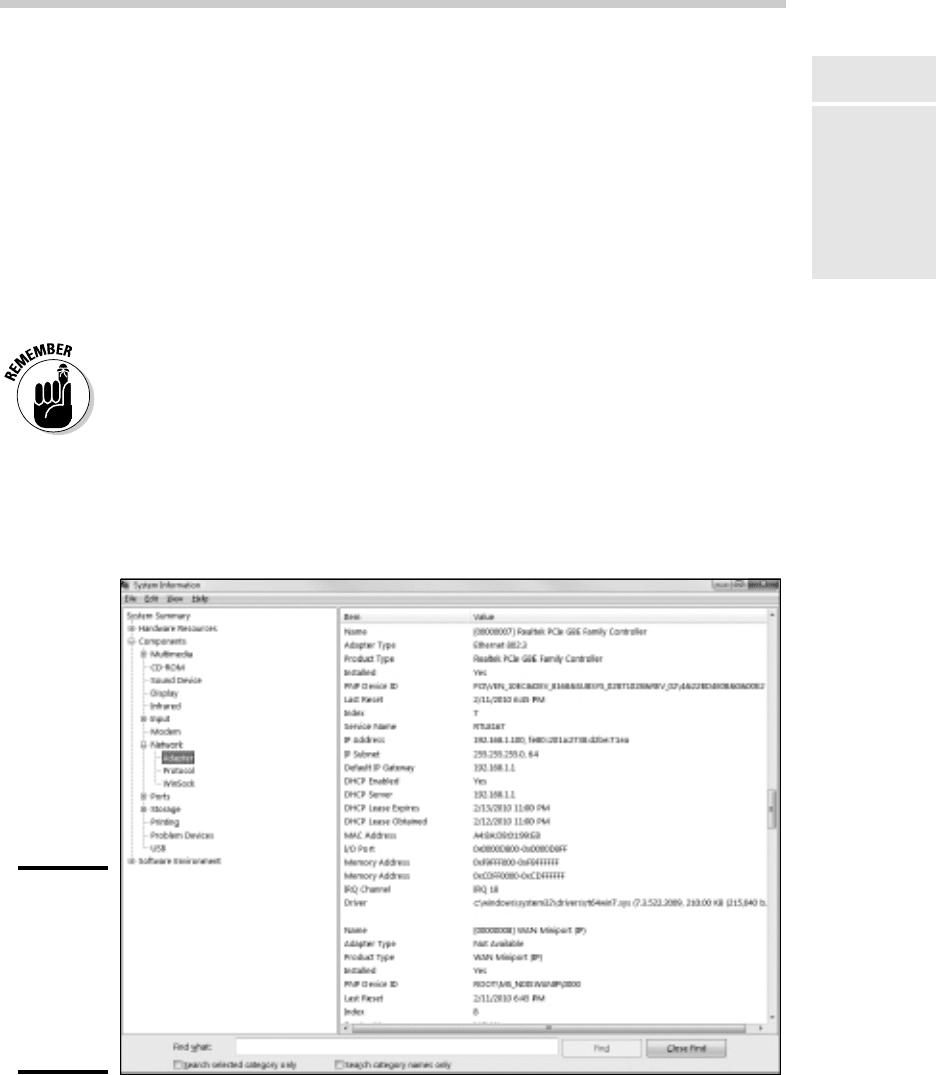
You can use the ipconfig command shown earlier in Figure 2-2 to see the
IP address of your computer. The IP address shown in the figure is
192.168.1.100. Another way to display this information is to use the System
Information command, found on the Start menu under Start➪All Programs➪
Accessories➪System Tools➪System Information. The IP address is high-
lighted in Figure 2-3. Notice that the System Information program displays a
lot of other useful information about the network besides the IP address. For
example, you can also see the MAC address, what protocols are being used,
and other information.
Figure 2-3:
Displaying
network
information
using the
System
Information
program.
06_625873-bk01ch02.indd 2906_625873-bk01ch02.indd 29 9/21/10 10:06 PM9/21/10 10:06 PM

30
The Seven Layers of the OSI Reference Model
Although the exact format of logical addresses varies depending on the pro-
tocol being used, most protocols divide the logical address into two parts:
a network address and a device address. The network address identifies
which network the device resides on, and the device address then identi-
fies the device on that network. For example, in a typical IP address, such
as 192.168.1.102, the network address is 192.168.1, and the device address
(called a host address in IP) is 102.
Similarly, IPX addresses consist of two parts: a network address and a
node address. In an IPX address, the node address is the same as the MAC
address. As a result, IPX doesn’t have to translate between layer 3 and layer
2 addresses.
Routing
Routing comes into play when a computer on one network needs to send
a packet to a computer on another network. In this case, a device called
a router is used to forward the packet to the destination network. In some
cases, a packet may actually have to travel through several intermediate net-
works in order to reach its final destination network. You can find out more
about routers in Book I, Chapter 3.
An important feature of routers is that you can use them to connect net-
works that use different layer 2 protocols. For example, a router can be used
to send a packet from an Ethernet to a Token Ring network. As long as both
networks support the same layer 3 protocol, it doesn’t matter whether their
layer 1 and layer 2 protocols are different.
A protocol is considered routable if it uses addresses that include a net-
work part and a host part. Any protocol that uses physical addresses isn’t
routable because physical addresses don’t indicate to which network a
device belongs.
The Transport Layer
The Transport layer is the layer where you’ll find two of the most well-known
networking protocols: TCP (normally paired with IP) and SPX (normally
paired with IPX). As its name implies, the Transport layer is concerned with
the transportation of information from one computer to another.
The main purpose of the Transport layer is to ensure that packets are
transported reliably and without errors. The Transport layer does this task
by establishing connections between network devices, acknowledging the
receipt of packets, and resending packets that aren’t received or are cor-
rupted when they arrive.
06_625873-bk01ch02.indd 3006_625873-bk01ch02.indd 30 9/21/10 10:06 PM9/21/10 10:06 PM
Book I
Chapter 2
Understanding
Network Protocols
and Standards
31
The Seven Layers of the OSI Reference Model
In many cases, the Transport layer protocol divides large messages into
smaller packets that can be sent over the network efficiently. The Transport
layer protocol reassembles the message on the receiving end, making sure
that all the packets that comprise a single transmission are received so that
no data is lost.
For some applications, speed and efficiency are more important than reli-
ability. In such cases, a connectionless protocol can be used. A connection-
less protocol doesn’t go to the trouble of establishing a connection before
sending a packet. Instead, it simply sends the packet. TCP is a connection-
oriented Transport layer protocol. The connectionless protocol that works
alongside TCP is called UDP.
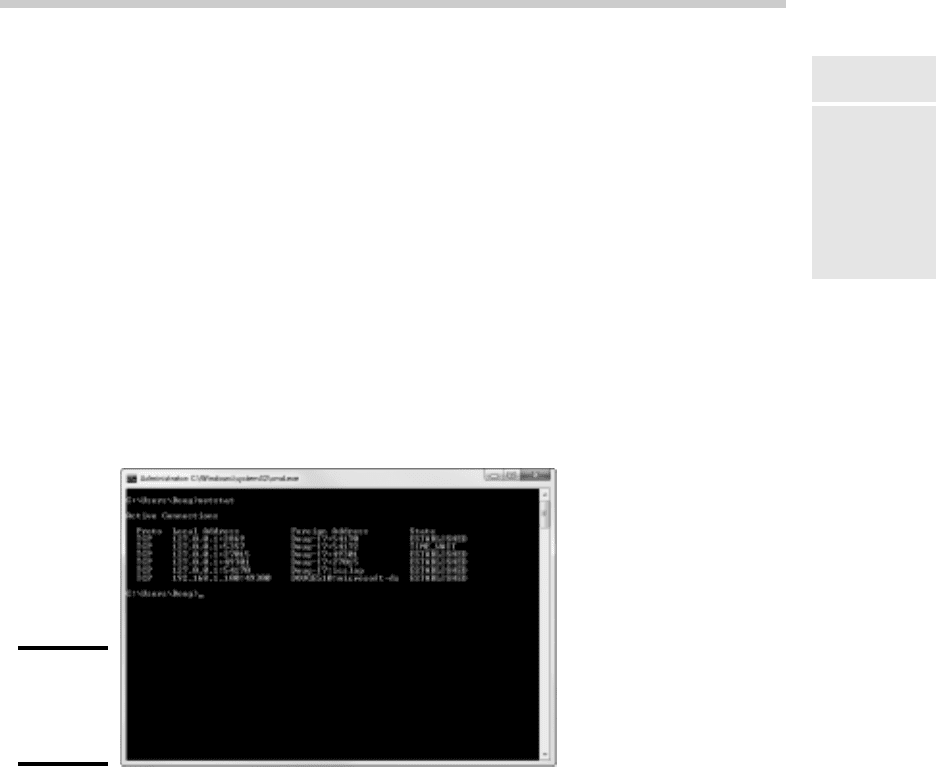
In Windows XP or Vista, you can view information about the status of TCP
and UDP connections by running the Netstat command from a command
window, as Figure 2-4 shows. In the figure, you can see that several TCP con-
nections are established.
Figure 2-4:
Using the
Netstat
command.
In fact, you can use the command Netstat /N to see the numeric network
addresses instead of the names. With the /N switch, the output in Figure 2-4
would look like this:
Active Connections
Proto Local Address Foreign Address State
TCP 127.0.0.1:2869 127.0.0.1:54170 ESTABLISHED
TCP 127.0.0.1:5357 127.0.0.1:54172 TIME_WAIT
TCP 127.0.0.1:27015 127.0.0.1:49301 ESTABLISHED
TCP 127.0.0.1:49301 127.0.0.1:27015 ESTABLISHED
TCP 127.0.0.1:54170 127.0.0.1:2869 ESTABLISHED
TCP 192.168.1.100:49300 192.168.1.101:445 ESTABLISHED
06_625873-bk01ch02.indd 3106_625873-bk01ch02.indd 31 9/21/10 10:06 PM9/21/10 10:06 PM

32
The Seven Layers of the OSI Reference Model
TCP is a connection-oriented Transport layer protocol. UDP is a connection-
less Transport layer protocol.
The Session Layer
The Session layer establishes conversations known as sessions between net-
worked devices. A session is an exchange of connection-oriented transmis-
sions between two network devices. Each of these transmissions is handled
by the Transport layer protocol. The session itself is managed by the
Session layer protocol.
A single session can include many exchanges of data between the two com-
puters involved in the session. After a session between two computers has
been established, it is maintained until the computers agree to terminate the
session.
The Session layer allows three types of transmission modes:
✦ Simplex: In this mode, data flows in only one direction.
✦ Half-duplex: In this mode, data flows in both directions, but only in one
direction at a time.
✦ Full-duplex: In this mode, data flows in both directions at the same time.
In actual practice, the distinctions in the Session, Presentation, and
Application layers are often blurred, and some commonly used protocols
actually span all three layers. For example, SMB — the protocol that is the
basis of file sharing in Windows networks — functions at all three layers.
The Presentation Layer
The Presentation layer is responsible for how data is represented to appli-
cations. Most computers — including Windows, Unix, and Macintosh
computers — use the American Standard Code for Information Interchange
(ASCII) to represent data. However, some computers (such as IBM main-
frame computers) use a different code, known as Extended Binary Coded
Decimal Interchange Code (EBCDIC). ASCII and EBCDIC aren’t compatible
with each other. To exchange information between a mainframe computer
and a Windows computer, the Presentation layer must convert the data
from ASCII to EBCDIC and vice versa.
Besides simply converting data from one code to another, the Presentation
layer can also apply sophisticated compression techniques so that fewer
bytes of data are required to represent the information when it’s sent over
the network. At the other end of the transmission, the Presentation layer
then uncompresses the data.
06_625873-bk01ch02.indd 3206_625873-bk01ch02.indd 32 9/21/10 10:06 PM9/21/10 10:06 PM
Book I
Chapter 2
Understanding
Network Protocols
and Standards
33
Following a Packet through the Layers
The Presentation layer can also scramble the data before it is transmitted
and unscramble it at the other end by using a sophisticated encryption tech-
nique that even Sherlock Holmes would have trouble breaking.
The Application Layer
The highest layer of the OSI model, the Application layer, deals with the
techniques that application programs use to communicate with the network.
The name of this layer is a little confusing. Application programs such as
Microsoft Office or QuickBooks aren’t a part of the Application layer. Rather,
the Application layer represents the programming interfaces that applica-
tion programs such as Microsoft Office or QuickBooks use to request net-
work services.
Some of the better-known Application layer protocols are
✦ DNS (Domain Name System) for resolving Internet domain names.
✦ FTP (File Transfer Protocol) for file transfers.
✦ SMTP (Simple Mail Transfer Protocol) for e-mail.
✦ SMB (Server Message Block) for file sharing in Windows networks.
✦ NFS (Network File System) for file sharing in Unix networks.
✦ Telnet for terminal emulation.
Following a Packet through the Layers
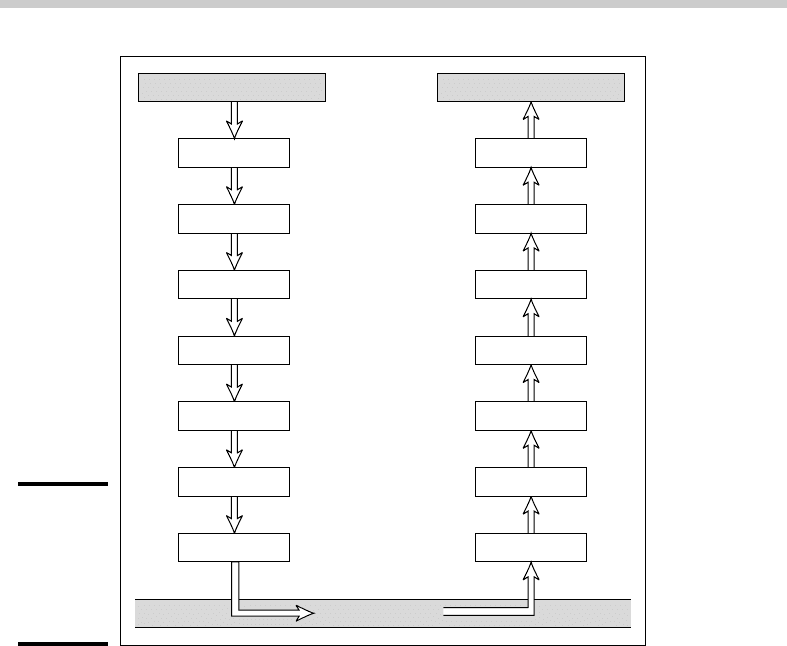
Figure 2-5 shows how a packet of information flows through the seven layers
as it travels from one computer to another on the network. The data begins
its journey when an end-user application sends data to another network
computer. The data enters the network through an Application layer inter-
face, such as SMB. The data then works its way down through the protocol
stack. Along the way, the protocol at each layer manipulates the data by
adding header information, converting the data into different formats, com-
bining packets to form larger packets, and so on. When the data reaches the
Physical layer protocol, it’s actually placed on the network media (in other
words, the cable) and sent to the receiving computer.
When the receiving computer receives the data, the data works its way up
through the protocol stack. Then, the protocol at each layer reverses the
processing that was done by the corresponding layer on the sending com-
puter. Headers are removed, data is converted back to its original format,
packets that were split into smaller packets are recombined into larger mes-
sages, and so on. When the packet reaches the Application layer protocol,
it’s delivered to an application that can process the data.
06_625873-bk01ch02.indd 3306_625873-bk01ch02.indd 33 9/21/10 10:06 PM9/21/10 10:06 PM
34
The Ethernet Protocol
Figure 2-5:
How data
travels
through
the seven
layers.
Application
Presentation
Session
Transport
Network
Data Link
Physical
Data sent by user
Layer 7
Layer 6
Layer 5
Layer 4
Layer 3
Layer 2
Layer 1
Network Media
Application
Presentation
Session
Transport
Network
Data Link
Physical
Data received by user
The Ethernet Protocol
As you know, the first two layers of the OSI model deal with the physical
structure of the network and the means by which network devices can send
information from one device on a network to another. By far, the most popu-
lar set of protocols for the Physical and Data Link layers is Ethernet.
Ethernet has been around in various forms since the early 1970s. (For a
brief history of Ethernet, see the sidebar, “Ethernet folklore and mythology,”
later in this chapter.) The current incarnation of Ethernet is defined by the
IEEE standard known as 802.3. Various flavors of Ethernet operate at differ-
ent speeds and use different types of media. However, all the versions of
Ethernet are compatible with each other, so you can mix and match them on
the same network by using devices such as bridges, hubs, and switches to
link network segments that use different types of media.
06_625873-bk01ch02.indd 3406_625873-bk01ch02.indd 34 9/21/10 10:06 PM9/21/10 10:06 PM
Book I
Chapter 2
Understanding
Network Protocols
and Standards
35
The Ethernet Protocol
The actual transmission speed of Ethernet is measured in millions of bits per
second, or Mbps. Ethernet comes in three different speed versions: 10 Mbps,
known as Standard Ethernet; 100 Mbps, known as Fast Ethernet; and 1,000
Mbps, known as Gigabit Ethernet. Keep in mind, however, that network trans-
mission speed refers to the maximum speed that can be achieved over the
network under ideal conditions. In reality, the actual throughput of an
Ethernet network rarely reaches this maximum speed.
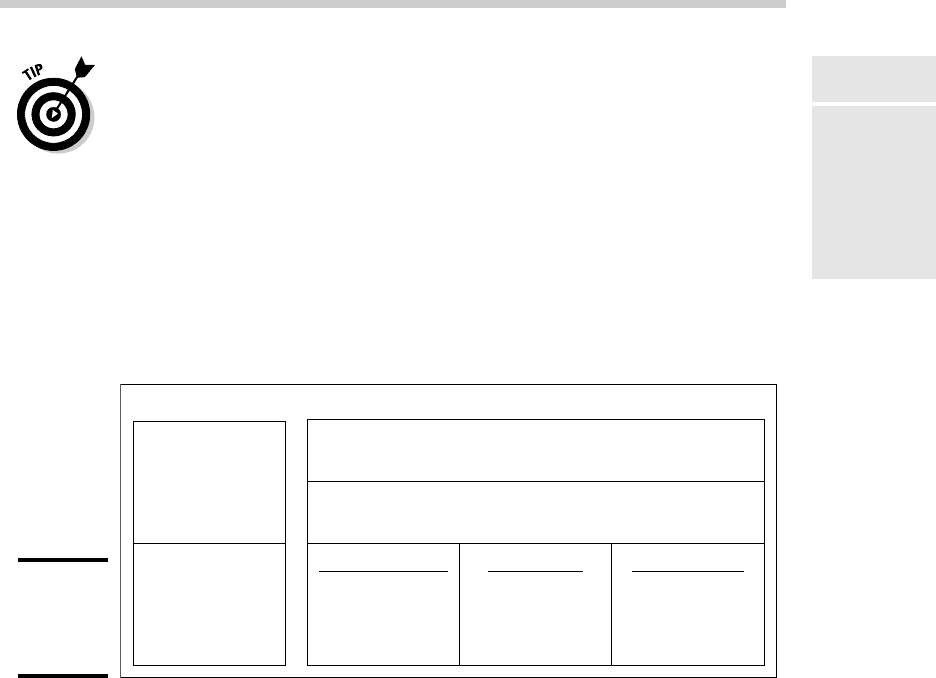
Ethernet operates at the first two layers of the OSI model — the Physical
and the Data Link layers. However, Ethernet divides the Data Link layer into
two separate layers known as the Logical Link Control (LLC) layer and the
Medium Access Control (MAC) layer. Figure 2-6 shows how the various ele-
ments of Ethernet match up to the OSI model.
Figure 2-6:
Ethernet
and the OSI
model.
Standard Ethernet
10Base5
10Base2
10BaseT
10BaseFX
Medium Access Control (MAC)
Fast Ethernet
100BaseTX
100BaseT4
100BaseFX
Gigabit Ethernet
1000BaseT
1000BaseLX
Logical Link Control (LLC)
Data Link Layer
OSI Ethernet
Physical Layer
The following sections describe Standard Ethernet, Fast Ethernet, and
Gigabit Ethernet in more detail.
Standard Ethernet
Standard Ethernet is the original Ethernet. It runs at 10 Mbps, which was
considered fast in the 1970s but is pretty slow by today’s standards.
Although there is still plenty of existing Standard Ethernet in use, it is con-
sidered obsolete and should be replaced by Gigabit Ethernet as soon as
possible.
Standard Ethernet comes in four incarnations, depending on the type of
cable used to string the network together:
06_625873-bk01ch02.indd 3506_625873-bk01ch02.indd 35 9/21/10 10:06 PM9/21/10 10:06 PM

36
The Ethernet Protocol
✦ 10Base5: The original Ethernet cable was thick (about as thick as
your thumb), heavy, and difficult to work with. It’s seen today only in
museums.
✦ 10Base2: This thinner type of coaxial cable (it resembles television
cable) became popular in the 1980s and lingered into the early 1990s.
Plenty of 10Base2 cable is still in use, but it’s rarely installed in new net-
works. 10Base2 (like 10Base5) uses a bus topology, so wiring a 10Base2
network involves running cable from one computer to the next until all
the computers are connected in a segment.
✦ 10BaseT: Unshielded twisted-pair cable (also known as UTP) became
popular in the 1990s because it’s easier to install, lighter, and more
reliable, and it offers more flexibility in how networks are designed.
10BaseT networks use a star topology with hubs at the center of
each star. Although the maximum length of 10BaseT cable is only 100
meters, hubs can be chained together to extend networks well beyond
the 100-meter limit.
10BaseT cable has four pairs of wires that are twisted together through-
out the entire span of the cable. However, 10BaseT uses only two of
these wire pairs, so the unused pairs are spares.
✦ 10BaseFL: Fiber-optic cables were originally supported at 10 Mbps by
the 10BaseFL standard. However, because faster fiber-optic versions of
Ethernet now exist, 10BaseFL is rarely used.
Fast Ethernet
Fast Ethernet refers to Ethernet that runs at 100 Mbps, which is ten times
the speed of Standard Ethernet. The following are the three varieties of Fast
Ethernet:
✦ 100BaseT4: The 100BaseT4 protocol allows transmission speeds of
100 Mbps over the same UTP cable as 10BaseT networks. To do this, it
uses all four pairs of wire in the cable. 100BaseT4 simplifies the task of
upgrading an existing 10BaseT network to 100 Mbps.
✦ 100BaseTX: The most commonly used standard for office networks
today is 100BaseTX, which transmits at 100 Mbps over just two pairs of
a higher grade of UTP cable than the cable used by 10BaseT. The higher-
grade cable is referred to as Category 5. Most new networks are wired
with Category 5 or better cable.
✦ 100BaseFX: The fiber-optic version of Ethernet running at 100 Mbps
is called 100BaseFX. Because fiber-optic cable is expensive and tricky
to install, it isn’t used much for individual computers in a network.
However, it’s commonly used as a network backbone. For example, a
fiber backbone is often used to connect individual workgroup hubs to
routers and servers.
06_625873-bk01ch02.indd 3606_625873-bk01ch02.indd 36 9/21/10 10:06 PM9/21/10 10:06 PM