
Mann U. Principles of Chemical Reactor Analysis and Design: New Tools for Industrial Chemical Reactor Operations
Подождите немного. Документ загружается.


5
ENERGY BALANCES
This chapter covers the fourth fundamental concept used in the analysis and design of
chemical rea ctors—conservation of energy (the first law of thermodynamics). We use
energy balances to express the temperature variations during reactor operations.
Section 5.1 provides a brief overview of basic thermodynamic quantities and relations
used in reactor design. We define the heat of reaction and equilibrium constant of a
chemical reaction and discuss how they vary with temperature and pressure. In
Section 5.2, we apply the firs t law of thermodynamics to deriv e the energy balance
equation for closed and open systems. W e reduce these equations to dimensionless
forms and derive the energy balance equations for the three ideal reactorconfigurations:
ideal ba tch r ea ctor, plug-flo w rea ctor, and continuous stirred-tank reactor (CSTR).
5.1 REVIEW OF THERMODYNAMIC RELATIONS
5.1.1 Heat of Reaction
The heat of reaction, or more accurately, the enthalpy change during a chemical
reaction, DH
ˆ
8
R
, indicates the amount of energy being absorbed or released when a
chemical transformation takes place at given operating atmosphere and temperature
of 298 K. The standard molar heat of reaction of a chemical reaction (expressed in
energy per mole extent) is denoted by D
^
H8
R
298
. It is calculated by
D
^
H8
R
298
¼
X
J
j
s
j
H8
f
j
(5:1:1)
Principles of Chemical Reactor Analysis and Design, Second Edition. By Uzi Mann
Copyright # 2009 John Wiley & Sons, Inc.
131
where
^
H8
f
j
is the standard molar heat of formation of species j at 298 K, and s
j
is the
stoichiometric coefficient of species j. The superscript “o” indicates a standard
pressure of 1 atm. The values of
^
H8
f
j
’s of many species are tabulated in thermodyn-
amic textbooks and handbooks. We adopt the common convention in applying the
first law of thermodynamics—heat added to a system is positive and heat removed
from a system is negative. Therefore, for exothermic reactions, D
^
H8
R
is negative,
and, for endothermic reactions, D
^
H8
R
is positive.
The heat of reaction is a function of temperature and pressure. Since enthalpy is a
state quantity, we relate the heat of reaction at any temperature and the standard
pressure of 1 atm, to the standard heat of reaction at 298 K by
D
^
H8
R
(T) ¼ D
^
H8
R
298
þ
ð
T
298
X
J
j
s
j
^
c
p
j
dT (5:1:2)
where
^
c
p
j
is the specific molar heat capacity of species j. Note that Eq. 5.1.2 rep-
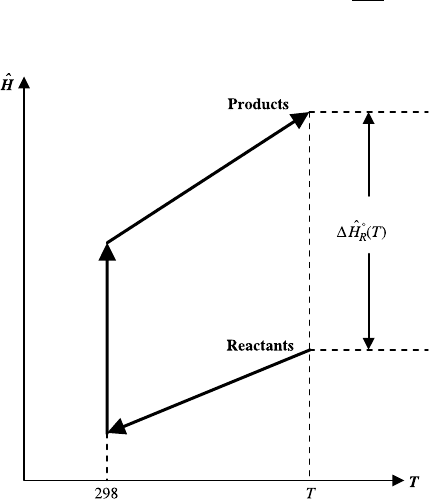
resents the calculation of D
^
H8
R
by cooling the reactants from T to 298 K, carrying
out the reaction at 298 K, and then heating up the products from 298 K to T,as
shown schematically in Figure 5.1. Once the heat of reaction at temperature T
and at standard pressure (1 atm) is known, we can calculate the heat of reaction
at T and any pressure P by
D
^
H
R
(T, P) ¼ D
^
H8
R
(T ) þ
X
J
j
s
j
ð
P
1
^
V
j
T
@
^
V
j
@T
P
dP (5:1:3)
Figure 5.1 Determination of the standard heat of reaction at temperature T.
132 ENERGY BALANCES

where V
ˆ
j
is the specific molar volume of species j. The term inside the integral indi-
cates the change in the enthalpy of species j due to the change in pressure at temp-
erature T. In most applications, this term is small, and, unless the reactor is operated
at a very high pressure (several hundred bars or higher), we can approximate the
heat of reaction by DH
ˆ
8
R
(T ), the heat of reaction at 1 atm.
Example 5.1 Determine the heat of combustion of n-octane at 6208C and
1 atm. The heats of formations of the various species and their heat capacities
are given below. Data: The standard heats of formation of the species
(at 298 K) are
C
8
H
18
(g) ¼208:70 J=mol
CO
2
(g) ¼393:509 J=mol
H
2
O(g) ¼241:818 J=mol
The specific molar heat capacities
^
c
p
j
(assumed constant) are
C
8
H
18
(g) ¼254 J=mol K
O
2
(g) ¼30:2J=mol K
CO
2
(g) ¼40:3J=mol K
H
2
O(g) ¼34:0J=mol K
Solution The chemical reaction is
C
8
H
18
(g) þ 12:5O
2
(g) ! 8CO
2
(g) þ 9H
2
O(g)
and the stoichiometric coefficients are
s
C
8
H
18
¼1 s
O
2
¼12:5 s
CO
2
¼ 8 s
H
2
O
¼ 9 D ¼ 3:5
We determine the standard heat of reaction by Eq. 5.1.1, noting that the heat of
formation of an element is, by definition, zero:
D
^
H8
R
298
¼
X
J
j
s
j
^
H8
f
j
¼ (1)
^
H8
f
C
8
H
18
þ (12:5)
^
H8
f
O
2
þ (8)
^
H8
f
CO
2
þ (9)
^
H8
f
H
2
O
¼ (1)(208,750) þ (12:5)(0) þ (8)(393,509) þ (9)(241:818)
¼5115:68 kJ=mol (a)
5.1 REVIEW OF THERMODYNAMIC RELATIONS 133

Since DH
ˆ
8
R
is negative, the reaction is exothermic. Next, we determine the heat of
reaction at 6208C by using (a) and Eq. 5.1.2. For this case, the individual species
heat capacities are constant; therefore, the term inside the integral is independent
of temperature:
X
J
j
s
j
^
c
p
j
¼ (1)(254) þ (12:5)(30:2) þ (8)(40:3) þ (9)(34:0)
¼3:10 J=mol K (b)
Substituting the values from (a) and (c) into Eq. 5.1.2,
D
^
H8
R
(893 K) ¼5115:68 10
3
þ
ð
893
298
(3:10) dT ¼5117:52 kJ=mol (c)
Note that, in this case, because the difference between the heat capacity of the
reactants and the heat capacity of the products is small, the heat of reaction
changes very slightly with temperature.
5.1.2 Effect of Temperature on Reaction Equilibrium Constant
The equilibrium constant, K, of a chemical reaction relates to the heat of reaction by
d(ln K)
dT
¼
D
^
H8
R
(T)
RT
2
(5:1:4)
To express how the reaction equilibrium constant varies with temperature, we
separate the variables and integrate:
ln
K(T)
K(T
0
)
¼
ð
T
T
0
D
^
H8
R
(T)
RT
2
dT (5:1:5)
In many instances, the heat of reaction is essentially constant, and Eq. 5.1.5
reduces to
ln
K(T)
K(T
0
)
¼
D
^
H8
R
(T
0
)
R
1
T
1
T
0
(5:1:6)
The equilibrium constant, K, relates to the composition of the individual species at
equilibrium. For a general chemical reaction of the form bB þ cC ! rR þ sS,
K ¼
a
r
R
a
s
S
a
b
B
a
c
C
(5:1:7)
where a
j
is the activity coefficient of species j.
134 ENERGY BALANCES

5.2 ENERGY BALANCES
The first law of thermodynamics is concerned with the conservation of energy. In
its most general form, it is written as the following statement:
Rate
energy
enters
system by
streams
8
>
>
>
>
>
>
<
>
>
>
>
>
>
:
9
>
>
>
>
>
>
=
>
>
>
>
>
>
;
þ
Rate heat
energy
enters
system
8
>
>
>
<
>
>
>
:
9
>
>
>
=
>
>
>
;
¼
Rate
energy
leaves
system by
streams
8
>
>
>
>
>
>
<
>
>
>
>
>
>
:
9
>
>
>
>
>
>
=
>
>
>
>
>
>
;
þ
Rate
work
done by
system
8
>
>
>
<
>
>
>
:
9
>
>
>
=
>
>
>
;
þ
Rate
energy
accumulates
in
system
8
>
>
>
<
>
>
>
:
9
>
>
>
=
>
>
>
;
(5:2:1)
When applying Eq. 5.2.1, we have to consider all forms of energy and account for
all types of work. We usually derive simplified and useful relations by imposing
certain assumptions and incorporating other thermodynamic relations (equation
of state, Maxwell’s equations, etc.) into the energy balance equation. Therefore,
it is essential to identify all the assumptions made and examine whether they
are valid.
Let E denote the total amount of energy, in all its forms, contained in a system,
and let e denote the specific energy (energy per unit mass). In most chemical pro-
cesses, electric, magnetic, and nuclear energies are negligible. Therefore, we
restrict the treatment of the first law of thermodynamics to systems where energy
is present in three forms: internal energy (U ), kinetic energy (KE), and potential
(gravitational) energy (PE); hence,
E ¼ U þ KE þ PE (5:2:2)
The specific energy (energy per unit mass) is
e ¼ u þ
1
2
v
2
þ gz (5:2:3)
where u is the specific internal energy, v is the linear velocity, and z is the vertical
elevation.
Below, we apply the energy balances for macroscopic systems. First, we derive
the energy balance equation for closed systems (batch reactors) and then for open
systems (flow reactors). Microscopic energy balances, used to describe point-to-
point temperature variations inside a chemical reactor, are outside the scope of
this book.
5.2 ENERGY BALANCES 135
5.2.1 Batch Reactors
For batch reactors (closed systems), the energy balance is written in the common
form of the first law of thermodynamics:
DE(t) ¼ Q(t) W(t)(5:2:4)
where DE(t) ¼ E(t) 2 E(0) is the change in the energy of the system, Q(t) is the
heat added to the system, and W(t) is the work done by the system on the surround-
ings during operating time t. For a stationary system, the only energy changed is
internal energy; hence, DE(t) ¼ DU(t), and Eq. 5.2.4 reduces to
DU( t) ¼ Q(t) W(t)(5:2:5)
For batch reactors, the work term consists of two components: shaft work (work
done by a mechanical device such as a stirrer) and work done by expanding the
boundaries of the system against the surroundings:
W ¼ W
sh
þ
ð
PdV (5:2:6)
Expressing the internal energy in terms of the enthalpy (recall, H ; U þ PV and
dH ¼ dU þ pdVþ Vdp)
DU ¼ DH
ð
PdV
ð
VdP
and, substituting into Eq. 5.2.6, the energy balance becomes
DH(t) ¼ Q(t) W
sh
(t) þ
ð
VdP (5:2:7)
Most chemical reactors operate at isobaric or near isobaric conditions. Also, in gen-
eral, the enthalpy is a weak function of the pressure. Hence, the last term is rela-
tively small, and the energy balance equation reduces to
DH(t) ¼ Q(t) W
sh
(t)(5:2:8)
In many instances, the reacting fluid is not viscous, and the shaft work is small in
comparison with the heat added to the system; hence
DH(t) Q(t)(5:2:9)
It is important to note that Eq. 5.2.9 is applicable only when all the assumptions
made in its derivation are valid: negligible kinetic, potential and electric energies,
negligible effect of pressure, and negligible viscous work.
For closed systems with chemical reactions, the enthalpy varies due to changes
in both composition and temperature. We usually select a reference state at some
136 ENERGY BALANCES
convenient composition and temperature T
0
. Assuming no phase change, the
change in the enthalpy of the reactor in operating time t is
DH(t) ¼
X
n
I
m
DH
R
m
(T
0
)X
m
(t) þ
ð
T(t)
T
0
X
J
j
(N
j
^
c
p
j
)
t
dT
ð
T(0)
T
0
X
J
j
(N
j
^
c
p
j
)
0
dT (5:2:10)
where
P
J
j
(N
j
^
c
p
j
)
t
and
P
J
j
(N
j
^
c
p
j
)
0
indicate the heat capacity of the reacting fluid
initially and at time t, respectively. The first term on the right-hand side of Eq.
5.2.10 represents the change in enthalpy due to composition changes (by chemical
reactions) at the reference temperature, T
0
, whereas the other two terms indicate the
change in the “sensible heat” (enthalpy change due to variation in temperature).
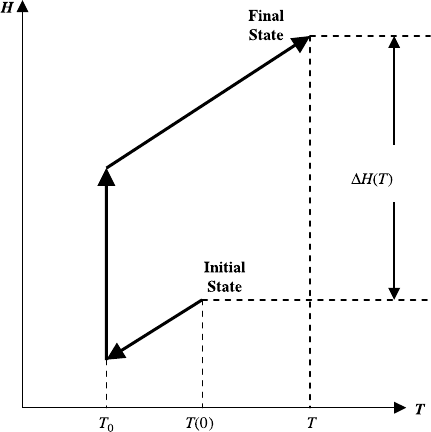
Note that since the enthalpy is a state quantity, the calculation of the enthalpy
difference is shown schematically in Figure 5.2. Also note that the summation in
the first term on the right is over the independent reactions.
Substituting Eq. 5.2.10 into Eq. 5.2.8, the general energy balance equation of
closed systems becomes
Q(t) ¼
X
n
I
m
DH
R
m
(T
0
)X
m
(t) þ
ð
T(t )
T
0
X
J
j
(N
j
^
c
p
j
)
t
dT
ð
T(0)
T
0
X
J
j
(N
j
^
c
p
j
)
0
dT
þ W
sh
(t)(5:2:11)
Figure 5.2 Determination of enthalpy change for reacting systems.
5.2 ENERGY BALANCES 137

It is convenient to select the initial temperature as the reference temperature, T
0
¼
T(0), and Eq. 5.2.11 reduces to
Q(t) ¼
X
n
I
m
DH
R
m
(T
0
)X
m
(t) þ
ð
T(t )
T
0
X
J
j
(N
j
^
c
p
j
) dT þ W
sh
(t)(5:2:12)
Equation 5.2.12 is the integral form of the energy balance equation for batch reac-
tors, relating the reactor temperature, T(t), to the extents of the independent reac-
tions, X
m
(t), the heat added to the reactor, Q(t), and the mechanical work done
by the system, W
sh
(t), during operating time t.
The differential form of the energy balance equation is obtained by differentiat-
ing Eq. 5.2.12 with respect to time:
dQ
dt
¼
_
Q(t) ¼
X
n
I
m
DH
R
m
(T
0
)
dX
m
dt
þ
X
J
j
(N
j
^
c
p
j
)
dT
dt
þ
_
W
sh
(t)(5:2:13)
where Q
˙
(t) is the rate heat is added to the reactor, and W
˙
sh
(t) is the rate of mech-
anical work done by the reactor at time t. For an ideal batch reactor, the temperature
is uniform throughout the reactor, and the rate of heat transfer is expressed by
_
Q(t) ¼ US(t)[T
F
T(t)] (5:2:14)
where U is the overall heat transfer coefficient, S(t) is the heat transfer area at time t,
and T
F
is the temperature of the external heating (or cooling) medium. The heat
transfer area S(t) relates to the reactor volume by
S(t) ¼
S
V
V
R
(t)(5:2:15)
where (S/V) is the heat transfer area per unit volume, a system characteristic that
depends on the geometry of the reactor and the heat exchange area (wall, coil,
etc.). Substituting Eqs. 5.2.14 and 5.2.15 into Eq. 5.2.13 and rearranging,
dT
dt
¼
UV
R
(t)
P
J
j
(N
j
^
c
p
j
)
S
V
[T
F
T(t)]
X
n
I
m
DH
R
m
(T
0
)
P
J
j
(N
j
^
c
p
j
)
dX
m
dt
_
W
sh
(t)
P
J
j
(N
j
^
c
p
j
)
(5:2:16)
Equation 5.2.16 expresses the changes in the reactor temperature during the reactor
operation. The first term on the right-hand side represents the rate heat transferred to
the reactor at time t divided by the heat capacity of the reacting fluid:
_
Q(t)
P
J
j
(N
j
^
c
p
j
)
¼
UV
R
(t)
P
J
j
(N
j
^
c
p
j
)
S
V
[T
F
T(t)] (5:2:17)
138 ENERGY BALANCES

To reduce Eq. 5.2.16 to a dimensionless form, we use the dimensionless temp-
erature, defined by Eq. 3.3.4, u ¼ T/T
0
, the dimensionless extent, defined by
Eq. 2.7.1, Z
m
¼ X
m
/(N
tot
)
0
, and the dimensionless operating time, defined by
Eq. 4.4.3, t ¼ t/t
cr
. Dividing both sides of Eq. 5.2.16 by T
0
and (N
tot
)
0
and multi-
plying both sides by the characteristic reaction time, t
cr
, we obtain
du
dt
¼
UV
R
t
cr
P
J
j
(N
j
^
c
p
j
)
S
V
(u
F
u)
(N
tot
)
0
T
0
P
J
j
(N
j
^
c
p
j
)
X
n
I
m
DH
R
m
(T
0
)
dZ
m
dt
1
T
0
P
J
j
(N
j
^
c
p
j
)
dW
sh
dt
(5:2:18)
Equation 5.2.18 is the dimensionless, differential energy balance equation of ideal
batch reactors, relating the reactor dimensionless temperature, u(t), to the dimen-
sionless extents of the independent reactions, Z
m
(t), at dimensionless operating
time t. Note that individual dZ
m
/dt’s are expressed by the reaction-based design
equations derived in Chapter 4.
Equation 5.2.18 is not conveniently used because the heat capacity of the react-
ing fluid,
P
J
j
(N
j
^
c
p
j
), is a function of the temperature and reaction extents, and con-
sequently, it varies during the operation. To simplify the equation and obtain
dimensionless quantities for heat transfer, we define a heat capacity of the reference
state and relate the heat capacity of the reacting fluid at any instant to it by
Heat capacity
of the reacting
fluid
0
@
1
A
;
Heat capacity
of the
reference state
0
@
1
A
Correction
factor
Mathematically, it is written as
X
J
j
(N
j
^
c
p
j
) ; (N
tot
)
0
^
c
p
0
CF(Z
m
, u)(5:2:19)
where
^
c
p
0
is the specific molar heat capacity of the reference state and CF(Z
m
, u)isa
correction factor that adjusts the value of the heat capacity of the reacting fluid as
Z
m
and u vary. We discuss the determination of
^
c
p
0
in detail below. Substituting
Eq. 5.2.19 into Eq. 5.2.18 and noting that (N
tot
)
0
¼ C
0
V
R
0
,
du
dt
¼
1
CF(Z
m
, u)
Ut
cr
C
0
^
c
p
0
S
V
V
R
V
R
0
(u
F
u)
1
CF(Z
m
, u)
X
n
I
m
DH
R
m
(T
0
)
T
0
^
c
p
0
dZ
m
dt
þ
d
dt
W
sh
T
0
(N
tot
)
0
^
c
p
0
()
(5:2:20)
5.2 ENERGY BALANCES 139