
Mann U. Principles of Chemical Reactor Analysis and Design: New Tools for Industrial Chemical Reactor Operations
Подождите немного. Документ загружается.

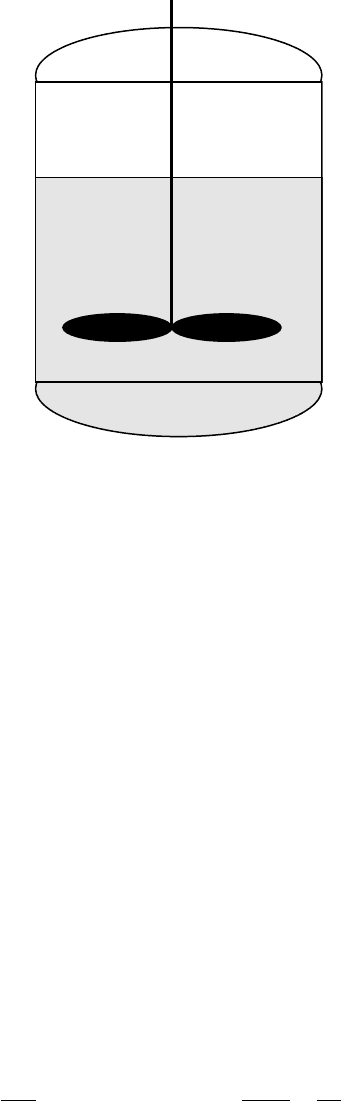
chapter, we cover numerous applications of batch reactors of increased level of
complexity. Sections 6.2 and 6.3 are concerned with isothermal operations,
where only the design equations should be solved. Section 6.2 covers operations
with single reactions, where one-design equations should be solved. Section 6.3
covers isothermal operations with multiple chemical reactions, where we solve mul-
tiple design equations without the need to solve the energy balance equation.
Section 6.4 covers the general case (nonisothermal with multiple reactions),
where we solve multiple design equations simultaneously with the energy balance
equation. Since Sections 6.2 and 6.3 cover special, simplified cases of the general
case, readers familiar with the operations of ideal batch reactors can proceed
directly from Section 6.1 to Section 6.4. Readers who wish to develop an insight
of key concepts and methods of the design formulation are encouraged to cover
Sections 6.2 and 6.3 first.
6.1 DESIGN EQUATIONS AND AUXILIARY RELATIONS
The differential design equation of an ideal batch reactor, written for the mth-
independent reaction, was derived in Section 4.4:
dZ
m
dt
¼ r
m
þ
X
n
D
k
a
km
r
k
!
V
R
(t)
V
R
0
t
cr
C
0
(6:1:1)
Figure 6.1 Schematic description of batch reactor.
160 IDEAL BATCH REACTOR

Recall that Z
m
is the dimensionless extent of the mth-independent chemical reaction
defined by
Z
m
;
X
m
(N
tot
)
0
(6:1:2)
and t is the dimensionless oper a ting time defined by
t ;
t
t
cr
(6:1:3)
where t
cr
is a conveniently selected chara cteris tic reaction time, defined by Eq. 3.5.1
and discussed in Section 3.5. Also, C
0
is the refer ence concentra tion defined by
C
0
;
(N
tot
)
0
V
R
0
(6:1:4)
where (N
tot
)
0
is the total molar content of the r efer ence state, and V
R
0
is the volume of
a conveniently selected r eference state (usually , the initial state).
As discussed in Chapter 4, in order to describe the operation of a reactor with
multiple chemical reactions, we have to write the design equation (Eq. 6.1.1) for
each independent chemical reaction. Also, to solve the design equations (to
obtain relationships between Z
m
’s and t), we have to express V
R
(t) and the rates
of the chemical reactions, r
m
’s and r
k
’s, in terms of Z
m
’s and t. The auxiliary
relations needed to express the design equations explicitly in terms of Z
m
’s and
t, are derived next.
The volume-based rate of the ith chemical reaction, r
i
, is generally expressed by
(see Section 3.3)
r
i
¼ k
i
(T
0
)e
g
i
(u1)=u
h
i
(C
j
’s) (6:1:5)
where k
i
(T
0
) is the reaction rate constant at the reference temperature T
0
, g
i
is the
dimensionless activation energy, defined by
g
i
;
E
a
i
RT
0
where u is the dimensionless temperature, and h
i
(C
j
’s) is a function of the species
concentrations, given by the rate expression. To express h
i
(C
j
’s) in terms of Z
m
’s
and t, we have to relate the species concentrations to Z
m
’s and t. For ideal batch
reactors, the concentration of species j at operating time t is
C
j
(t) ;
N
j
(t)
V
R
(t)
(6:1:6)
6.1 DESIGN EQUATIONS AND AUXILIARY RELATIONS 161

Using Eq. 2.7.3, the molar content of species j in the reactor at operating time t is
N
j
(t) ¼ (N
tot
)
0
N
tot
(0)
(N
tot
)
0
y
j
(0) þ
X
n
I
m
(s
j
)
m
Z
m
(t)
"#
(6:1:7)
where y
j
(0) is the molar fraction of species j at the beginning of the operation:
y
j
(0) ;
N
j
(0)
N
tot
(0)
(6:1:8)
Substituting Eq. 6.1.7 into Eq. 6.1.6, the concentration of species j at time t is
N
j
(t) ¼
(N
tot
)
0
V
R
(t)
N
tot
(0)
(N
tot
)
0
y
j
(0) þ
X
n
I
m
(s
j
)
m
Z
m
(t)
"#
(6:1:9)
Let us consider now the denominator in Eq. 6.1.9. V
R
(t) can be expressed by
V
R
(t) ¼
V
R
(t)
V
R
(0)
V
R
(0)
V
R
0
V
R
0
(6:1:10)
where V
R
(0) and V
R
0
are, respectively, the initial volume and the volume of the
reference state. If the reactor volume does not vary during the operation, V
R
(t) ¼
V
R
(0), Eq. 6.1.9 becomes
C
j
(t) ¼ C
0
V
R
0
V
R
(0)
N
tot
(0)
(N
tot
)
0
y
j
(0) þ
X
n
I
m
(s
j
)
m
Z
m
(t)
"#
(6:1:11)
where C
0
is the reference concentration defined by Eq. 6.1.4. In most batch reactor
applications, it is convenient to select the initial state as the reference state, V
R
0
¼
V
R
(0), and (N
tot
)
0
¼ N
tot
(0), and Eq. 6.1.11 reduces to
C
j
(t) ¼ C
0
y
j
(0) þ
X
n
I
m
(s
j
)
m
Z
m
(t)
"#
(6:1:12)
Equation 6.1.12 provides the species concentrations in terms of the extents of the
independent reactions for constant-volume batch reactors.
For gas-phase variable-volume batch reactors, like the one shown schematically
in Figure 6.2, V
R
(t) varies during the operation. Assuming ideal gas behavior, the
162 IDEAL BATCH REACTOR
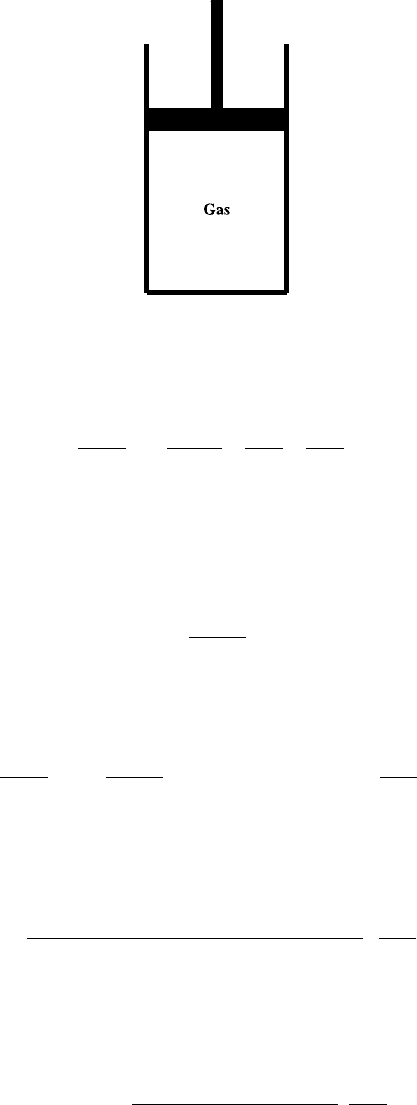
reactor volume at time t is
V
R
(t)
V
R
0
¼
N
tot
(t)
(N
tot
)
0
T(t)
T
0
P
0
P(t)
(6:1:13)
where T
0
and P
0
are, respectively, the temperature and pressure of the reference
state. Using stoichiometric relation (Eq. 2.7.5) to express the total number of
moles in terms of the extents of the independent chemical reactions,
N
tot
(t) ¼ (N
tot
)
0
N
tot
(0)
(N
tot
)
0
þ
X
n
I
m
D
m
Z
m
(t)
"#
Equation 6.1.13 becomes
V
R
(t)
V
R
0
¼
N
tot
(0)
(N
tot
)
0
þ
X
n
I
m
D
m
Z
m
(t)
"#
u(t)
P
0
P(t)
(6:1:14)
where u(t) is the dimensionless temperature at time t. Substituting Eqs. 6.1.7 and
6.1.14 into Eq. 6.1.6, for gaseous, variable-volume, ideal batch reactors,
C
j
(t) ¼ C
0
[N
tot
(0)=(N
tot
)
0
]y
j
(0) þ
P
n
I
m
(s
j
)
m
Z
m
(t)
{[N
tot
(0)=(N
tot
)
0
] þ
P
n
I
m
D
m
Z
m
(t)}u(t)
P(t)
P
0
(6:1:15)
In most applications, we select the initial state as the reference state, (N
tot
)
0
¼ N
tot
(0),
and Eq. 6.1.15 reduces to
C
j
(t) ¼ C
0
y
j
(0) þ
P
n
I
m
(s
j
)
m
Z
m
(t)
1 þ
P
n
I
m
D
m
Z
m
(t)
u(t)
P(t)
P
0
(6:1:16)
Figure 6.2 Variable-volume gas-phase batch reactor.
6.1 DESIGN EQUATIONS AND AUXILIARY RELATIONS 163

Equation 6.1.16 provides the species concentrations in terms of the extents of the
independent reactions for variable-volume, gaseous batch reactors.
The design equations and the species concentration relations contain another
dependent variable, u, the dimensionless temperature, whose variation during the
reactor operation is expressed by the energy balance equation. For ideal batch reac-
tors with negligible mechanical shaft work, the energy balance equation, derived in
Section 5.2, is
du
dt
¼
1
CF(Z
m
, u)
HTN
V
R
(t)
V
R
0
(u
F
u)
X
n
I
m
DHR
m
dZ
m
dt
"#
(6:1:17)
where HTN is the dimensionless heat-transfer number of the reactor, defined by
HTN ;
Ut
cr
C
0
^
c
p
0
S
V
(6:1:18)
DHR
m
is of the dimensionless heat of reaction of the mth-independent chemical
reaction, defined by
DHR
m
;
DH
R
m
(T
0
)
^
c
p
0
T
0
(6:1:19)
and CF(Z
m
, u) is the correction factor of the heat capacity, defined by Eq. 5.2.19.
Recall that the first term inside the bracket of Eq. 6.1.17 represents the rate of heat
transfer to the reactor:
d
dt
Q
(N
tot
)
0
^
c
p
0
T
0
¼ HTN
V
R
(t)
V
R
0
(u
F
u)(6:1:20)
where
Q
(N
tot
)
0
^
c
p
0
T
0
(6:1:21)
is the dimensionless heat transferred to the reactor. The second term inside the
bracket of Eq. 6.1.17 represents the heat generated (or consumed) by the chemical
reactions. The specific molar heat capacity of the reference state,
^
c
p
0
, is defined dif-
ferently for gas-phase and liquid-phase reactions. For gas phase it is defined by
^
c
p
0
;
X
J
j
y
j
0
^
c
p
j
(T
0
)(6:1:22)
164 IDEAL BATCH REACTOR

and for liquid phase it is defined by
^
c
p
0
;
M
0
c
p
(N
tot
)
0
(6:1:23)
To solve the energy balance equation (Eq. 6.1.17), we have to specify the value
of HTN. However, its value depends on the selection of the reference state, C
0
, and
the selection of the characteristic reaction time, t
cr
. Also note that HTN is pro-
portional to the heat-transfer coefficient, U, which depends on the flow conditions,
the properties of the fluid, and the heat-transfer area per unit volume (S/V ). These
quantities are not known a priori. Therefore, we develop a procedure to estimate the
range of HTN. For isothermal operation (du/dt ¼ 0), and we can determine the
HTN at any instance from Eq. 6.1.17 (taking the operating temperature as the refer-
ence temperature, u ¼ 1):
HTN
iso
(t) ¼
V
R
0
V
R
(t)
1
u
F
1
X
n
I
m
DHR
m
dZ
m
dt
(6:1:24)
Since dZ
m
/dt varies with time, the value of HTN varies during the operation. We
define an average HTN for isothermal operation by
HTN
ave
;
1
t
op
ð
t
op
0
HTN(t) dt (6:1:25)
where
t
op
is the operating time. Recall that for adiabatic operation HTN ¼ 0.
Hence, in practice, the heat-transfer number would be
0 , HTN HTN
ave
(6:1:26)
Note that Eq. 6.1.25 provides only an estimate on the range of the value of HTN.
We select a specific value after examining the reactor performance for different
values of HTN. It is important to examine the reactor design for different values
of HTN, since, when multiple reactions occur, it is difficult to predict the effect
of the heat transfer on the relative rates of the individual reactions. Once the phys-
ical reactor vessel has been designed, it is necessary to verify that its configuration
(S/V) and the agitation conditions actually provide the desired value of HTN.
For convenience, Tables A.3a and A.3b in Appendix A provide the design
equation and the auxiliary relations for ideal batch reactors. Table A.4 provides
the energy balance equation.
6.1 DESIGN EQUATIONS AND AUXILIARY RELATIONS 165

6.2 ISOTHERMAL OPERATIONS WITH SINGLE REACTIONS
We start the analysis of ideal batch reactors by considering isothermal operations
with single reactions. Note that isothermal operation is a mathematical condition
imposed on the design equation and the energy balance equation, (du/dt ¼ 0).
In practice, isothermal operations rarely occur because they require that, at any
instance, the rate of heat generated (or consumed) by the chemical reactions be
identical to the rate of heat removal (or supplied). However, examining isothermal
operations provides an insight on the application of the design equation and the
auxiliary relations.
When a single chemical reaction takes place in the reactor, the operation is
described by a single design equation, and Eq. 6.1.1 reduces to
dZ
dt
¼ r
V
R
(t)
V
R
0
t
cr
C
0
(6:2:1)
where Z is the dimensionless extent of the reaction and r is its rate. For isothermal
operations, since the temperature is constant, we have to solve only the design
equation. (The energy balance equation provides the heating, or cooling,
load necessary to maintain the reactor isothermal.) Furthermore, for isothermal
operations, the reaction rates depend only on the species concentrations, and
Eq. 6.1.5 reduces to
r
i
¼ k
i
(T
0
)h
i
(C
j
’s) (6:2:2)
The solution of the design equation, Z(t) versus t, provides the dimensionless
reaction operating curve of the reactor. It describes the progress of the chemical
reaction with time. Furthermore, once Z( t) is known, we can apply stoichiometric
relation (Eq. 6.1.7) to obtain the composition of each species at time t. Also, if one
prefers to express the design equation in terms of the actual operating time t, rather
than the dimensionless time t, using Eq. 6.1.3, the design equation becomes
dZ
dt
¼ r
V
R
(t)
V
R
0
1
C
0
(6:2:3)
Note that Eq. 6.2.1 has three variables: the operating time t, the reaction extent
Z, and the reaction rate r. The design equation is applied to determine any one of
these variables when the other two are known. A typical design problem involves
the determination of the operating time necessary to obtain a specified extent for a
given reaction rate. The second application involves the determination of the extent
obtained in a specified operating time t for a given reaction rate. The third appli-
cation involves the determination of the reaction rate when the extent is provided
as a function of time. Below, we will consider each of these applications.
166 IDEAL BATCH REACTOR
6.2.1 Constant-Volume Reactors
First, consider constant-volume batch reactors (reactors whose volumes do not
change during the operation), V
R
(t) ¼ V
R
(0). In practice, this condition is satisfied
either for gas-phase reactions when the walls of the reactor are stationary or when
the reaction takes place in a liquid phase. In the latter case, the assumption is that
the density of the liquid does not vary during the operation. For most liquid-phase
reactions, the density variations are indeed quite small.
For constant-volume batch reactors with single reactions, and selecting the initial
state as the reference state, the design equation, Eq. 6.2.1, reduces to
dZ
dt
¼ r
t
cr
C
0
(6:2:4)
We can solve Eq. 6.2.4 when the reaction rate r is expressed in terms of t and Z.
This is an initial value problem to be solved for the initial value, Z(0) ¼ 0, and
Z(t) indicates the reaction extent during the operation. When the rate expression
depends only on Z, the design equation can be solved by separating the variables
and integrating
t ¼
C
0
t
cr
ð
Z(t)
0
dZ
r
(6:2:5)
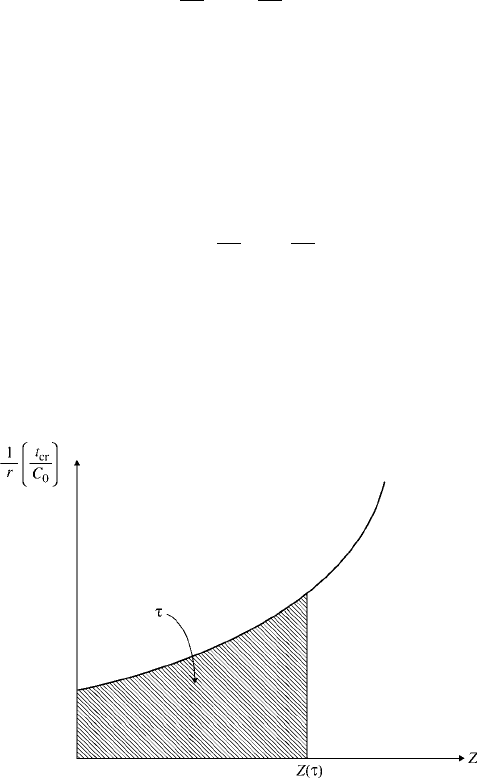
Equation 6.2.5 is the integral form of the design equation for an ideal, constant-
volume batch reactor. Figure 6.3 shows the graphical presentation of this design
equation. To solve the design equations, we have to express the reaction rate r in
Figure 6.3 Graphical presentation of the design equation for constant-volume batch
reactor.
6.2 ISOTHERMAL OPERATIONS WITH SINGLE REACTIONS 167

terms of the dimensionless extent Z. Below, we analyze the operation of constant-
volume, isothermal reactors with single reactions for chemical reactions with differ-
ent forms of rate expressions.
First, we consider the application of the design equation for chemical reactions
of the general form
A ! Products
whose rate expression is of the form r ¼ kC
a
A
. For these reactions, s
A
¼ 2 1. If only
reactant A is charged into the reactor, and selecting the initial state as the reference
state, C
0
¼ C
A
(0) and y
A
(0) ¼ 1. Using Eq. 6.1.12, the concentration of reactant
Ais
C
A
(t) ¼ C
0
[1 Z(t)] (6:2:6)
Hence, the reaction rate is
r ¼ kC
0
a
(1 Z)
a
(6:2:7)
Substituting Eq. 6.2.7 in Eq. 6.2.4, the design equation becomes
dZ
dt
¼ kC
0
a
(1 Z)
a
t
cr
C
0
(6:2:8)
Next, we select the characteristic reaction time, t
cr
,tobe
t
cr
¼
1
kC
0
a1
(6:2:9)
(Note that this t
cr
is identical to the one obtained by the procedure described in
Section 3.5.) Using Eq. 6.2.9, the design equation reduces to
dZ
dt
¼ (1 Z)
a
(6:2:10)
where the dimensionless operating time is
t ¼
t
t
cr
¼ kC
0
a1
t (6:2:11)
We have to solve Eq. 6.2.10, subject to the initial condition that at t ¼ 0, Z(0) ¼ 0.
An analytical solution is obtained by separating the variables and integrating,
t ¼
ð
Z(t)
0
dZ
(1 Z)
a
168 IDEAL BATCH REACTOR
The solution is
Z(t) ¼ 1 e
t
for a ¼ 1(6:2:12a)
and
Z(t) ¼ 1
1
1 þ (a 1)t
1=a1
for a = 1(6:2:12b)
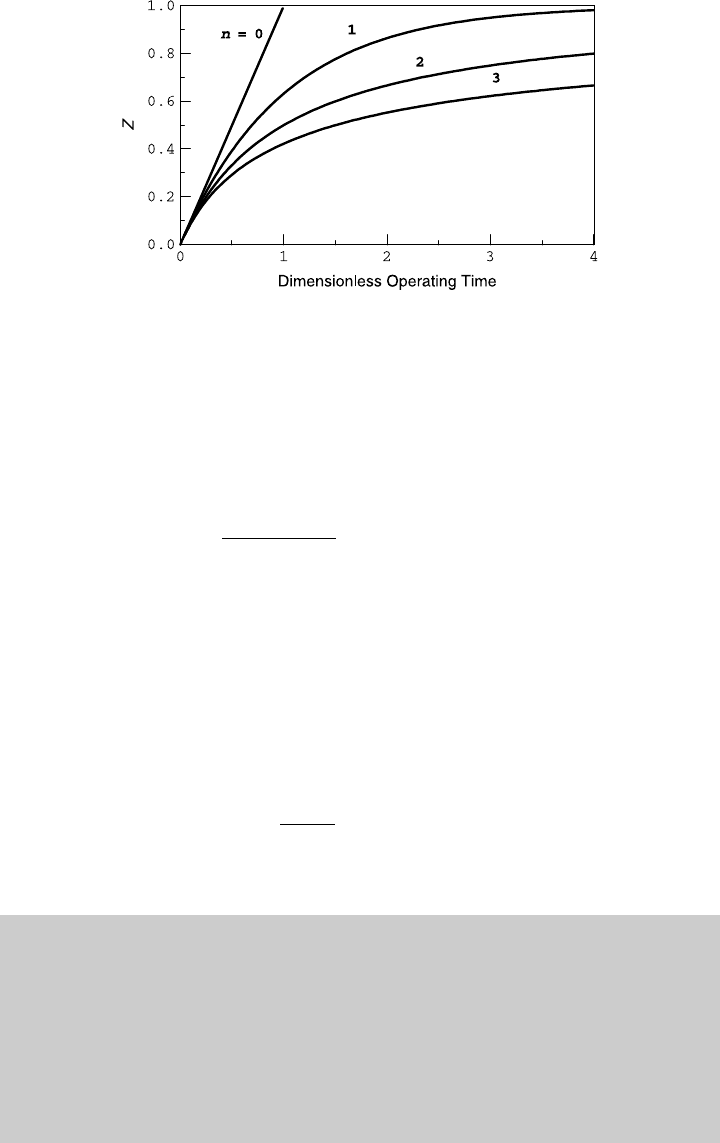
Figure 6.4 shows the reaction operating curve for different values of a. Note that
each reaction order is represented by a curve that is independent of the specific
value of the rate constant and the initial reactant concentration. We determine the
reaction time needed to achieve a certain extent by reading from the chart the
value of t for the respective order and then calculating the actual operating time
t, using Eq. 6.2.11. Once Z(t) is known, we can use Eq. 2.7.4 to determine the con-
tent of reactant A in the reactor at any time t:
N
A
(t)
(N
tot
)
0
¼ 1 Z(t)
Example 6.1 Consider the liquid-phase dimerization reaction
2A ! B
The reaction is second order and the rate constant is k ¼ 0.5 L/mol h. The initial
concentration of reactant A is 4 mol /L.
a. Derive and solve the design equation.
b. Derive expressions for the species contents as a function of operating time.
Figure 6.4 Reaction operating curves for nth-order reaction of the form A ! products.
6.2 ISOTHERMAL OPERATIONS WITH SINGLE REACTIONS 169