
Mann U. Principles of Chemical Reactor Analysis and Design: New Tools for Industrial Chemical Reactor Operations
Подождите немного. Документ загружается.


Equation 5.2.20 is a dimensionless differential energy balance equation of batch
reactors and can be simplified further by defining two dimensionless groups:
du
dt
¼
1
CF(Z
m
, u)
HTN
V
R
V
R
0
(u
F
u)
X
n
I
m
DHR
m
dZ
m
dt
d
dt
W
sh
(N
tot
)
0
^
c
p
0
T
0
()
(5:2:21)
where HTN is the dimensionless heat-transfer number of the reactor, defined by
HTN ;
Ut
cr
C
0
^
c
p
0
S
V
(5:2:22)
and DHR
m
is the dimensionless heat of reaction of the mth-independent reaction,
defined by
DHR
m
;
DH
R
m
(T
0
)
T
0
^
c
p
0
(5:2:23)
The dimensionless heat-transfer number lumps together all the effects related to the
heat transfer in relation to the time scale of the chemical reaction. Note that the
HTN is proportional to the heat transfer coefficient, U, which depends on the
flow conditions, the properties of the fluid, and to the heat-transfer area per unit
volume (S/V ). The DHR
m
is a characteristic of the chemical reaction, the reference
temperature, and the composition of the reference state.
The first term in the bracket of Eq. 5.2.21 represents the dimensionless heat-
transfer rate with a dimensionless driving force, (u
F
2 u),
d
dt
Q
(N
tot
)
0
^
c
p
0
T
0
¼ HTN
V
R
(t)
V
R
0
(u
F
u)(5:2:24)
where
Q
(N
tot
)
0
^
c
p
0
T
0
(5:2:25)
is the dimensionless heat transferred to the reactor. The second term in the bracket
of Eq. 5.2.21 represents the dimensionless heat of reactions. The third term in the
bracket of Eq. 5.2.21 represents the dimensionless shaft work,
W
sh
(N
tot
)
0
^
c
p
0
T
0
(5:2:26)
140 ENERGY BALANCES

The definition of the specific molar heat capacity of the reference state,
^
c
p
0
, and
the determination of the correction factor, CF(Z
m
,
u
), are discussed next. The
specific molar heat capacity of the reference state,
^
c
p
0
, is defined by
Specific molar
heat capacity of
the reference state
0
@
1
A
;
Heat capacity of reference state
Total number of moles of the reference state
(5:2:27)
and mathematically it is written as
^
c
p
0
;
P
J
j
(N
j
c
p
j
)
0
(N
tot
)
0
(5:2:28)
As discussed in Section 2.7, for gas-phase reactions, (N
tot
)
0
is taken as the total
number of moles, including inert species, and
X
J
j
(N
j
^
c
p
j
)
0
¼ (N
tot
)
0
X
J
j
y
j
0
^
c
p
j
(T
0
)
Hence, from Eq. 5.2.28
^
c
p
0
¼
X
J
j
y
j
0
^
c
p
j
(T
0
)(5:2:29)
where y
j
0
is the molar fraction of species j in the reference state.
For liquid-phase reactions, the heat capacity is expressed on a mass basis. Hence,
X
J
j
(N
j
^
c
p
j
)
0
; M
0
c
p
0
(5:2:30)
where M
0
is the total mass of the reference state, and
c
p
0
is its specific mass-based
heat capacity. The specific molar-based heat capacity of the reference state is
^
c
p
0
¼
M
0
c
p
(N
tot
)
0
(5:2:31)
Note that Eq. 5.2.31 converts the specific mass-based heat capacity to molar-based
specific heat capacity. Also recall from Section 2.7 that for liquid-phase reactions,
(N
tot
)
0
includes all the reactants and products, but not a solvent (inert species).
Hence, the numerical value of
^
c
p
0
is usually large since it also accounts for the
heat capacity of the solvent.
5.2 ENERGY BALANCES 141

Next, we derive an expression for the correction factor of the heat capacity,
CF(Z
m
, u). First consider gas-phase reactions. From Eq. 2.7.3 the content of species
j in the reactor is
N
j
¼ (N
tot
)
0
N
tot
(0)
(N
tot
)
0
y
j
(0) þ
X
n
I
m
(s
j
)
m
Z
m
()
and the heat capacity of the reacting fluid is
X
J
j
(N
j
^
c
p
j
) ¼ (N
tot
)
0
N
tot
(0)
(N
tot
)
0
X
J
j
y
j
(0)
^
c
p
j
(u) þ
X
J
j
^
c
p
j
(u)
X
n
I
m
(s
j
)
m
Z
m
()
Using Eq. 5.2.27 and Eq. 5.2.28,
CF(Z
m
, u) ¼
1
^
c
p
0
N
tot
(0)
(N
tot
)
0
X
J
j
y
j
(0)
^
c
p
j
(u) þ
X
J
j
^
c
p
j
(u)
X
n
I
m
(s
j
)
m
Z
m
()
(5:2:32)
For liquid-phase reactions, the heat capacity of the reacting fluid usually does not
change. Hence, for batch reactors
X
J
j
(N
j
^
c
p
j
) ¼ M
c
p
where M is the mass of the reacting fluid and Eq. 5.2.28 reduces to
CF(Z
m
, u) ¼
M
c
p
M
0
c
p
0
(5:2:33)
Note that when the initial state is taken as the reference state and the heat capacity of
the liquid is constant, CF(Z
m
, u) ¼ 1.
In practice, we encounter three levels of complexities in applying the energy bal-
ance equation:
1. The heat capacity of the reacting fluid is independent of both the composition
and the temperature. In this case, CF(Z
m
, u) ¼ 1. This situation commonly
occurs in liquid-phase reactions as well as in gas-phase reactions where the
heat capacities of the products are close to that of the reactants and do not
vary with temperature.
2. The heat capacity of the reacting fluid depends on the composition but is
independent of temperature. In this case, the species heat capacities do not
142 ENERGY BALANCES

vary with temperature. Therefore,
^
c
p
j
(u) ¼
^
c
p
j
(T
0
) for all species, and Eq.
5.2.32 reduces to
CF(Z
m
, u) ¼ 1 þ
1
^
c
p
0
X
J
j
^
c
p
j
(T
0
)
X
n
I
m
(s
j
)
m
Z
m
(5:2:34)
This situation occurs in gas-phase reactions when the specific heat capacities
of the individual species do not vary with temperature.
3. The heat capacity of the reacting fluid depends on both the composition and
the temperature. This situation occurs in gas-phase reactions, where the
species heat capacities vary with temperature. In this case, the specific heat
capacities of the individual species are usually expressed in the form
^
c
p
j
R
¼ A
j
þ B
j
T þ C
j
T
2
þ D
j
T
2
(5:2:35)
where T is the temperature and A
j
, B
j
, C
j
, and D
j
are tabulated constants,
characteristic to each species, and R is the universal gas constant. The specific
molar heat capacity of species j at dimensionless temperature u is
^
c
p
j
(u) ¼ RA
j
þ (B
j
T
0
)u þ (C
j
T
2
0
)u
2
þ
D
j
T
2
0
u
2
(5:2:36)
and these functions should be substituted in Eq. 5.2.32 to determine the
values of CF(Z
m
, u). This is readily done numerically. Once CF(Z
m
, u)is
known, the energy balance equation, Eq. 5.2.21, can be solved simul-
taneously with the dimensionless design equations.
For isothermal operations, du/dt ¼ 0, and for batch reactors with negligible
shaft work, Eq. 5.2.26 reduces to
d
dt
Q
(N
tot
)
0
^
c
p
0
T
0
¼
X
n
I
m
DHR
m
dZ
m
dt
(5:2:37)
which, using Eq. 5.2.25, can be further simplified to
dQ ¼ (N
tot
)
0
X
n
I
m
DH
R
m
(T
0
) dZ
m
(5:2:38)
Equation 5.2.38 provides the heating (or cooling) load needed to maintain isother-
mal conditions.
5.2 ENERGY BALANCES 143

For adiabatic operations HTN ¼ 0 (no heat-transfer area), and assuming negli-
gible shaft work Eq. 5.2.21 reduces to
du
dt
¼
1
CF(Z
m
, u)
X
n
I
m
DHR
m
dZ
m
dt
(5:2:39)
which can be further simplified to
du ¼
1
CF(Z
m
, u)
X
n
I
m
DHR
m
dZ
m
(5:2:40)
Equation 5.2.40 relates changes in the temperature to the extents of the independent
reactions in adiabatic operations.
Example 5.2 The following gas-phase chemical reactions take place in a batch
reactor:
Reaction 1: A þ B ! C
Reaction 2: C þ B ! D
Initially, the reactor is at 420 K and 2 atm and it contains a mixture of 45% A,
45% B, and 10% I (by mole). Based on the data below, determine:
a. The average specific molar heat capacity of the reference state.
b. The dimensionless heat of reaction of each chemical reaction.
c. The correction factor of heat capacity.
d. Derive the energy balance equation for adiabatic operation.
Data: At 420 K, D H
R
1
¼11,000 cal=mol extent
DH
R
2
¼8000 cal=mol extent
^
c
p
A
¼ 20 cal=mol K
^
c
p
B
¼ 7 cal=mol K
^
c
p
C
¼ 22 cal=mol K
^
c
p
D
¼ 25 cal=mol K
^
c
p
I
¼ 14 cal=mol K
Solution The two chemical reactions are independent, and their stoichiometric
coefficients are
s
A
1
¼1 s
B
1
¼1 s
C
1
¼ 1 s
D
1
¼ 0 D
1
¼1
s
A
2
¼ 0 s
B
2
¼1 s
C
2
¼1 s
D
2
¼ 1 D
2
¼1
We select the initial temperature as the reference temperature; hence,
T
0
¼ T(0) ¼ 420 K.
144 ENERGY BALANCES

a. For gas-phase reactions, the specific molar heat capacity of the reference state
is determined using Eq. 5.2.29:
^
c
p
0
¼ y
A
0
^
c
p
A
(1) þ y
B
0
^
c
p
B
(1) þ y
C
0
^
c
p
C
(1) þ y
D
0
^
c
p
D
(1) þ y
I
0
^
c
p
I
(1)
¼ (0:45)20 þ(0:45)7 þ (0:0)22 þ (0:1)14 ¼ 13:55 cal=mol K
b. Using Eq. 5.2.23, the dimensionless heat of reactions of the two reactions are
DHR
1
¼
DH
R
1
(T
0
)
T
0
^
c
p
0
¼
(11 10
3
)
(420)(13:55)
¼1:933
DHR
2
¼
DH
R
2
(T
0
)
T
0
^
c
p
0
¼
(8 10
3
)
(420)(13:55)
¼1:406
c. For gas-phase reactions, the correction factor of heat capacity, CF(Z
m
, u), is
determined by Eq. 5.2.32. In this case, the species heat capacities are inde-
pendent of the temperature; hence
CF(Z
m
, u) ¼ 1 þ
1
^
c
p
0
X
J
j
^
c
p
j
X
n
I
m
(s
j
)
m
Z
m
!
¼ 1 þ
1
13:55
^
c
p
A
s
A
1
Z
1
þ
^
c
p
B
(s
B
1
Z
1
þ s
B
2
Z
2
)
þ
^
c
p
C
(s
C
1
Z
1
þ s
C
2
Z
2
) þ
^
c
p
D
s
D
2
Z
2
¼ 1 þ
1
13:55
20(1)Z
1
þ 7[(1)Z
1
þ (1)Z
2
]
þ22[(1)Z
1
þ (1)Z
2
] þ 25(1)Z
2
¼
13:55 5Z
1
4Z
2
13:55
d. For adiabatic operations, HTN ¼ 0. Substituting the values calculated
above in Eq. 5.2.26, when the shaft work is negligible, the energy balance
equation is
du
dt
¼
13:55
13:555Z
1
4Z
2
(1:933)
dZ
1
dt
þ (1 :406)
dZ
2
dt
where dZ
1
/dt and dZ
2
/dt are the design equations.
5.2 ENERGY BALANCES 145

Example 5.3 The following simultaneous chemical reactions take place in an
aqueous solution in a batch reactor:
Reaction 1: 2A ! B
Reaction 2: 2B ! C
Two hundreds liters of a 4-mol/L solution of reactant A are charged into a batch
reactor. The density of the solution is 1.05 kg/L, and its initial temperature is
310 K. Based on the data below, determine:
a. The specific molar heat capacity of the reference state.
b. The dimensionless heat of reaction of each chemical reaction.
c. The correction factor of heat capacity.
d. Derive the energy balance equation for adiabatic operation.
Data: At 310 K, DH
R
1
¼9000 cal=mol A, DH
R
2
¼8000 cal=mol B
The heat capacity of the solution is that of water (1 kcal/kg K) and it does not
vary with the solution composition or the temperature.
Solution The two chemical reactions are independent, and their stoichiometric
coefficients are
s
A
1
¼2 s
B
1
¼ 1 s
C
1
¼ 0
s
A
2
¼ 0 s
B
2
¼2 s
C
2
¼ 1
We select the initial reactor content as the reference state; hence T
0
¼ T(0) ¼
310 K, V
R
0
¼ V
R
(0) ¼ 200 L, and the mass of the reacting fluid is M ¼ M
0
¼
V
R
0
r ¼ 210 kg. Since only reactant A is initially present in the reactor, the
reference concentration is C
0
¼ C
A
(0) ¼ 4 mol=L. Therefore, (N
tot
)
0
¼
C
0
V
R
0
¼ 800 mol.
a. For liquid-phase reactions, the specific molar heat capacity of the reference
state is defined by Eq. 5.2.31:
^
c
p
0
¼
M
0
(N
tot
)
0
c
p
¼
210 kg
(800 mol)
(1000 cal=kg K) ¼ 262:5 cal=mol K (a)
b. The heats of reactions are given per mole of reactants A and B, respectively,
but the selected reactions contain 2 mol of A and B, respectively. Hence,
for the selected reactions, D
^
H
R
1
¼18,000 cal=mol extent and D
^
H
R
2
¼
16,000 cal=mol extent. Using E q. 5.2.24, the dimensionless heats of
146 ENERGY BALANCES
reactions of the two chemical reactions are
DHR
1
¼
DH
R
1
(T
0
)
T
0
^
c
p
0
¼
(18 10
3
)
(3 10)(262:5)
¼0:221
DHR
2
¼
DH
R
2
(T
0
)
T
0
^
c
p
0
¼
(16 10
3
)
(3 10)(262:5)
¼0:197
c. For liquid-phase reactions with the initial state selected as the reference state
and a fluid whose heat capacity is independent of composition and tempera-
ture, CF(Z
m
, u) ¼ 1.
d. For adiabatic operations, HTN ¼ 0. Substituting the values calculated above
in Eq. 5.2.26, the energy balance equation for negligible shaft work is
du
dt
¼ (0:221)
dZ
1
dt
þ (0:197)
dZ
2
dt
where dZ
1
/dt and dZ
2
/dt are formulated by the design equations.
5.2.2 Flow Reactors
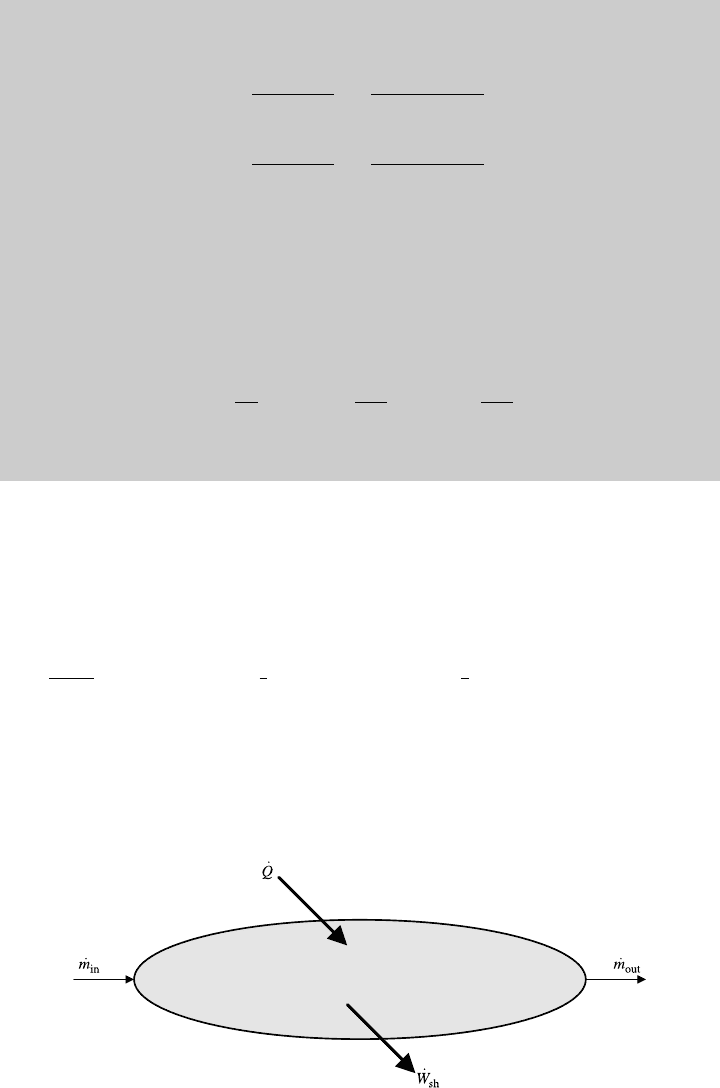
Consider a general flow system with one inlet and one outlet as shown schemati-
cally in Figure 5.3. We write Eq. 5.2.1 for this system:
dE
sys
dt
¼
_
Q
_
W þ u þ
1
2
v
2
þ gz
in
_
m
in
u þ
1
2
v
2
þ gz
out
_
m
out
(5:2:41)
where E
sys
is the total energy of the system, and m
˙
in
and m
˙
out
are, respectively, the
mass flow rates in and out of the system. The work rate term, W
˙
, in Eq. 5.2.41, con-
sists of three components: rate of work the system is doing on the surroundings by a
Figure 5.3 General flow system.
5.2 ENERGY BALANCES 147

mechanical device (shaft work), W
˙
sh
, rate of viscous work, W
˙
vis
, and work done by
pushing the streams in and out of the system:
_
W ¼
_
W
sh
þ
_
W
vis
þ
P
r
in
_
m
in
P
r
out
_
m
out
(5:2:42)
where r is the density of the fluid. Using the definition of the specific enthalpy, h,
(in energy/mass)
h ¼ u þ
P
r
(5:2:43)
and substituting Eqs. 5.2.42 and 5.2.43 into Eq. 5.2.41, the energy balance equation
becomes
dE
sys
dt
¼
_
Q
_
W
sh
_
W
vis
þ h þ
1
2
v
2
þ gz
in
_
m
in
h þ
1
2
v
2
þ gz
out
_
m
out
(5:2:44)
Equation 5.2.44 is the general energy balance equation for flow systems. For steady
operations, dE
sys
/dt ¼ 0, m
˙
in
¼ m
˙
out
¼ m
˙
, and Eq. 5.2.44 reduces to
_
Q
_
W
sh
_
W
vis
¼ h þ
1
2
v
2
þ gz
out
h þ
1
2
v
2
þ gz
in
_
m (5:2:45)
For most chemical processes, the kinetic and potential energy of the streams are
negligible in comparison to the enthalpy, and the viscous work is usually small;
hence, Eq. 5.2.45 reduces to
_
Q
_
W
sh
¼ (h
out
h
in
)
_
m ¼ D
_
H (5:2:46)
For flow systems with chemical reactions, the enthalpy varies due to changes in
composition and temperature. We select the reference state as one atmosphere and
temperature T
0
. Assuming no phase change, the enthalpy difference between the
outlet and the inlet is
D
_
H ¼
X
n
I
m
DH
R
m
(T
0
)(
_
X
m
out
_
X
m
in
) þ
ð
T
out
T
0
X
J
j
(F
j
^
c
p
j
)
out
dT
ð
T
in
T
0
X
J
j
(F
j
^
c
p
j
)
in
dT (5:2:47)
148 ENERGY BALANCES

where (
_
X
m
out
_
X
m
in
) is the extent per unit time of the mth-independent reaction
in the reactor. Hence, the general energy balance equation for steady flow
reactors is
_
Q
_
W
sh
¼
X
n
I
m
DH
R
m
(T
0
)(
_
X
m
out
_
X
m
in
) þ
ð
T
out
T
0
X
J
j
(F
j
^
c
p
j
)
out
dT
ð
T
in
T
0
X
J
j
(F
j
^
c
p
j
)
in
dT (5:2:48)
Equation 5.2.48 is the integral form of the energy balance equation for steady-flow
reactors. In most cases, it is convenient to select the inlet temperature as the refer-
ence temperature, and in this case the last term vanishes.
The differential energy balance equation for steady-flow reactors with no
mechanical work is obtained by differentiating Eq. 5.2.48 over a reactor volume
element dV
R
:
d
_
Q
dV
R
¼
X
n
I
m
DH
R
m
(T
0
)
d
_
X
m
dV
R
þ
X
J
j
(F
j
^
c
p
j
)
dT
dV
R
(5:2:49)
The rate heat added to the differential reactor element, dQ
˙
,is
d
_
Q ¼ UdS(T
F
T)(5:2:50)
where U is the overall heat-transfer coefficient, dS, is the heat-transfer area, and T
F
is the temperature of the external heating (or cooling) fluid. The heat-transfer area,
dS, relates to the reactor volume by
dS ¼
S
V
dV
R
(5:2:51)
where (S/V ) is the heat-transfer area per unit volume, a characteristic that depends
on the geometry of the reactor. For cylindrical reactors of diameter D,(S/V) ¼
4/D. Substituting Eqs. 5.2.50 and 5.2.51 into Eq. 5.2.49 and rearranging, we obtain
dT
dV
R
¼
U
P
J
j
(F
j
^
c
p
j
)
S
V
(T
F
T)
X
n
I
m
DH
R
m
(T
0
)
P
J
j
(F
j
^
c
p
j
)
d
_
X
m
dV
R
(5:2:52)
Equation 5.2.52 relates the changes in temperature to the reactor volume.
5.2 ENERGY BALANCES 149