
Manning Ch. D., Raghavan P., Sch?tze H. Introduction to Information Retrieval - Введение в информационный поиск
Подождите немного. Документ загружается.

Online edition (c)2009 Cambridge UP
106 5 Index compression
Subsection 5.3.1 is based on (Scholer et al. 2002). The authors find that
variable byte codes process queries two times faster than either bit-level
compressed indexes or uncompressed indexes with a 30% penalty in com-
pression ratio compared with the best bit-level compression method. They
also show that compressed indexes can be superior to uncompressed indexes
not only in disk usage, but also in query processing speed. Compared with
VB codes, “variable nibble” codes showed 5% to 10% better compression
and up to one third worse effectiveness in one experiment (Anh and Moffat
2005). Trotman (2003) also recommends using VB codes unless disk space is
at a premium. In recent work, Anh and Moffat (2005; 2006a) and Zukowski
et al. (2006) have constructed word-aligned binary codes that are both faster
in decompression and at least as efficient as VB codes. Zhang et al. (2007) in-
vestigate the increased effectiveness of caching when a number of different
compression techniques for postings lists are used on modern hardware.
δ codes (Exercise
5.9) and γ codes were introduced by Elias (1975), who
proved that both codes are universal. In addition, δ codes are asymptotically
optimal for H(P ) → ∞. δ codes perform better than γ codes if large num-
bers (greater than 15) dominate. A good introduction to information theory,
including the concept of entropy, is (Cover and Thomas 1991). While Elias
codes are only asymptotically optimal, arithmetic codes (Witten et al. 1999,
Section 2.4) can be constructed to be arbitrarily close to the optimum H(P)
for any P.
Several additional index compression techniques are covered by Witten et
al. (1999; Sections 3.3 and 3.4 and Chapter 5). They recommend using param-PARAMETERIZED CODE
eterized codes for index compression, codes that explicitly model the probabil-
ity distribution of gaps for each term. For example, they show that GolombGOLOMB CODES
codes achieve better compression ratios than γ codes for large collections.
Moffat and Zobel (1992) compare several parameterized methods, including
LLRUN (Fraenkel and Klein 1985).
The distribution of gaps in a postings list depends on the assignment of
docIDs to documents. A number of researchers have looked into assign-
ing docIDs in a way that is conducive to the efficient compression of gap
sequences (Moffat and Stuiver 1996; Blandford and Blelloch 2002; Silvestri
et al. 2004; Blanco and Barreiro 2006; Silvestri 2007). These techniques assign
docIDs in a small range to documents in a cluster where a cluster can consist
of all documents in a given time period, on a particular web site, or sharing
another property. As a result, when a sequence of documents from a clus-
ter occurs in a postings list, their gaps are small and can be more effectively
compressed.
Different considerations apply to the compression of term frequencies and
word positions than to the compression of docIDs in postings lists. See Scho-
ler et al. (2002) and Zobel and Moffat (2006). Zobel and Moffat (2006) is
recommended in general as an in-depth and up-to-date tutorial on inverted
Online edition (c)2009 Cambridge UP
5.4 References and further reading 107
indexes, including index compression.
This chapter only looks at index compression for Boolean retrieval. For
ranked retrieval (Chapter
6), it is advantageous to order postings according
to term frequency instead of docID. During query processing, the scanning
of many postings lists can then be terminated early because smaller weights
do not change the ranking of the highest ranked k documents found so far. It
is not a good idea to precompute and store weights in the index (as opposed
to frequencies) because they cannot be compressed as well as integers (see
Section
7.1.5, page 140).
Document compression can also be important in an efficient information re-
trieval system. de Moura et al. (2000) and Brisaboa et al. (2007) describe
compression schemes that allow direct searching of terms and phrases in the
compressed text, which is infeasible with standard text compression utilities
like gzip and compress.
?
Exercise 5.14
[⋆]
We have defined unary codes as being “10”: sequences of 1s terminated by a 0. In-
terchanging the roles of 0s and 1s yields an equivalent “01” unary code. When this
01 unary code is used, the construction of a γ code can be stated as follows: (1) Write
G down in binary using b = ⌊log
2
j⌋+ 1 bits. (2) Prepend (b − 1) 0s. (i) Encode the
numbers in Table
5.5 in this alternative γ code. (ii) Show that this method produces
a well-defined alternative γ code in the sense that it has the same length and can be
uniquely decoded.
Exercise 5.15 [⋆ ⋆ ⋆]
Unary code is not a universal code in the sense defined above. However, there exists
a distribution over gaps for which unary code is optimal. Which distribution is this?
Exercise 5.16
Give some examples of terms that violate the assumption that gaps all have the same
size (which we made when estimating the space requirements of a γ-encoded index).
What are general characteristics of these terms?
Exercise 5.17
Consider a term whose postings list has size n, say, n = 10,000. Compare the size of
the γ-compressed gap-encoded postings list if the distribution of the term is uniform
(i.e., all gaps have the same size) versus its size when the distribution is not uniform.
Which compressed postings list is smaller?
Exercise 5.18
Work out the sum in Equation (5.7) and show it adds up to about 251 MB. Use the
numbers in Table
4.2, but do not round Lc, c, and the number of vocabulary blocks.
Online edition (c)2009 Cambridge UP
Online edition (c)2009 Cambridge UP
DRAFT! © April 1, 2009 Cambridge University Press. Feedback welcome. 109
6
Scoring, term weight ing and the
vector space model
Thus far we have dealt with indexes that support Boolean queries: a docu-
ment either matches or does not match a query. In the case of large document
collections, the resulting number of matching documents can far exceed the
number a human user could possibly sift through. Accordingly, it is essen-
tial for a search engine to rank-order the documents matching a query. To do
this, the search engine computes, for each matching document, a score with
respect to the query at hand. In this chapter we initiate the study of assigning
a score to a (query, document) pair. This chapter consists of three main ideas.
1. We introduce parametric and zone indexes in Section 6.1, which serve
two purposes. First, they allow us to index and retrieve documents by
metadata such as the language in which a document is written. Second,
they give us a simple means for scoring (and thereby ranking) documents
in response to a query.
2. Next, in Section 6.2 we develop the idea of weighting the importance of a
term in a document, based on the statistics of occurrence of the term.
3. In Section 6.3 we show that by viewing each document as a vector of such
weights, we can compute a score between a query and each document.
This view is known as vector space scoring.
Section
6.4 develops several variants of term-weighting for the vector space
model. Chapter
7 develops computational aspects of vector space scoring,
and related topics.
As we develop these ideas, the notion of a query will assume multiple
nuances. In Section
6.1 we consider queries in which specific query terms
occur in specified regions of a matching document. Beginning Section 6.2 we
will in fact relax the requirement of matching specific regions of a document;
instead, we will look at so-called free text queries that simply consist of query
terms with no specification on their relative order, importance or where in a
document they should be found. The bulk of our study of scoring will be in
this latter notion of a query being such a set of terms.
Online edition (c)2009 Cambridge UP
110 6 Scoring, term weighting and the vector space model
6.1 Parametric and zone indexes
We have thus far viewed a document as a sequence of terms. In fact, most
documents have additional structure. Digital documents generally encode,
in machine-recognizable form, certain metadat a associated with each docu-METADATA
ment. By metadata, we mean specific forms of data about a document, such
as its author(s), title and date of publication. This metadata would generally
include fields such as the date of creation and the format of the document, asFIELD
well the author and possibly the title of the document. The possible values
of a field should be thought of as finite – for instance, the set of all dates of
authorship.
Consider queries of the form “find documents authored by William Shake-
speare in 1601, containing the phrase alas poor Yorick”. Query processing then
consists as usual of postings intersections, except that we may merge post-
ings from standard inverted as well as parametric indexes. There is one para-PARAMETRIC INDEX
metric index for each field (say, date of creation); it allows us to select only
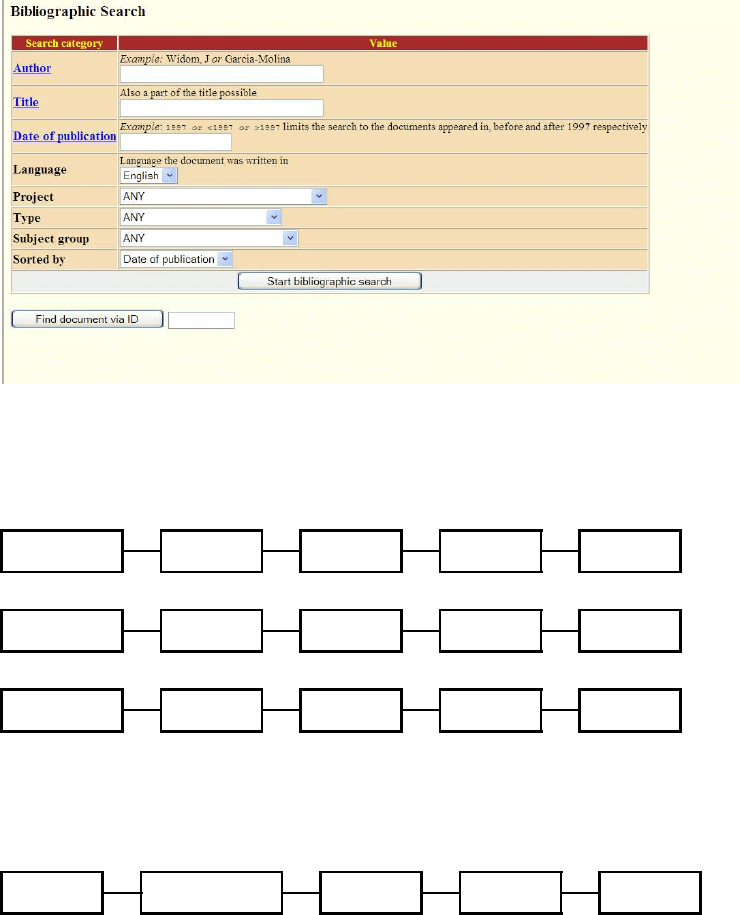
the documents matching a date specified in the query. Figure
6.1 illustrates
the user’s view of such a parametric search. Some of the fields may assume
ordered values, such as dates; in the example query above, the year 1601 is
one such field value. The search engine may support querying ranges on
such ordered values; to this end, a structure like a B-tree may be used for the
field’s dictionary.
Zones are similar to fields, except the contents of a zone can be arbitraryZONE
free text. Whereas a field may take on a relatively small set of values, a zone
can be thought of as an arbitrary, unbounded amount of text. For instance,
document titles and abstracts are generally treated as zones. We may build a
separate inverted index for each zone of a document, to support queries such
as “find documents with merchant in the title and william in the author list and
the phrase gentle rain in the body”. This has the effect of building an index
that looks like Figure
6.2. Whereas the dictionary for a parametric index
comes from a fixed vocabulary (the set of languages, or the set of dates), the
dictionary for a zone index must structure whatever vocabulary stems from
the text of that zone.
In fact, we can reduce the size of the dictionary by encoding the zone in
which a term occurs in the postings. In Figure
6.3 for instance, we show how
occurrences of william in the title and author zones of various documents are
encoded. Such an encoding is useful when the size of the dictionary is a
concern (because we require the dictionary to fit in main memory). But there
is another important reason why the encoding of Figure
6.3 is useful: the
efficient computation of scores using a technique we will call weighted zoneWEIGHTED ZONE
SCORING
scoring.
Online edition (c)2009 Cambridge UP
6.1 Parametric and zone indexes 111
◮
Figure 6.1 Parametric search. In this example we have a collection with fields al-
lowing us to select publications by zones such as Author and fields such as Language.
william.author
2
3 5 8
william.title
2 4
8 16
william.abstract
11 121 1441
1729
- - - -
- - - -
- - - -
◮
Figure 6.2 Basic zone index ; zones are encoded as extensions of dictionary en-
tries.
william
2.author,2.title
3.author 4.title 5.author
- - - -
◮
Figure 6.3 Zone index in which the zone is encoded in the postings rather than
the dictionary.
Online edition (c)2009 Cambridge UP
112 6 Scoring, term weighting and the vector space model
6.1.1 Weighted zon e scoring
Thus far in Section
6.1 we have focused on retrieving documents based on
Boolean queries on fields and zones. We now turn to a second application of
zones and fields.
Given a Boolean query q and a document d, weighted zone scoring assigns
to the pair (q, d) a score in the interval [0, 1], by computing a linear combina-
tion of zone scores, where each zone of the document contributes a Boolean
value. More specifically, consider a set of documents each of which has ℓ
zones. Let g
1
, . . . , g
ℓ
∈ [0, 1] such that
∑
ℓ
i=1
g
i
= 1. For 1 ≤ i ≤ ℓ, let s
i
be the
Boolean score denoting a match (or absence thereof) between q and the ith
zone. For instance, the Boolean score from a zone could be 1 if all the query
term(s) occur in that zone, and zero otherwise; indeed, it could be any Boo-
lean function that maps the presence of query terms in a zone to 0, 1. Then,
the weighted zone score is defined to be
ℓ
∑
i=1
g
i
s
i
.
(6.1)
Weighted zone scoring is sometimes referred to also as ranked Boolean re-RANKED BOOLEAN
RETRIEVAL
trieval.
✎
Example 6.1: Consider the query shakespeare in a collection in which each doc-
ument has three zones: author, ti tle and body. The Boolean score function for a zone
takes on the value 1 if the query term shakespeare is present in the zone, and zero
otherwise. Weighted zone scoring in such a collection would require three weights
g
1
, g
2
and g
3
, respectively corresponding to the au thor, title and body zones. Suppose
we set g
1
= 0.2, g
2
= 0.3 and g
3
= 0.5 (so that the three weights add up to 1); this cor-
responds to an application in which a match in the author zone is least important to
the overall score, the title zone somewhat more, and the body contributes even more.
Thus if the term shakespeare were to appear in the title and body zones but not the
author zone of a document, the score of this document would be 0.8.
How do we implement the computation of weighted zone scores? A sim-
ple approach would be to compute the score for each document in turn,
adding in all the contributions from the various zones. However, we now
show how we may compute weighted zone scores directly from inverted in-
dexes. The algorithm of Figure
6.4 treats the case when the query q is a two-
term query consisting of query terms q
1
and q
2
, and the Boolean function is
AND: 1 if both query terms are present in a zone and 0 otherwise. Following
the description of the algorithm, we describe the extension to more complex
queries and Boolean functions.
The reader may have noticed the close similarity between this algorithm
and that in Figure
1.6. Indeed, they represent the same postings traversal,
except that instead of merely adding a document to the set of results for

Online edition (c)2009 Cambridge UP
6.1 Parametric and zone indexes 113
ZONESCORE(q
1
, q
2
)
1 float scores[N] = [0]
2 constant g [ℓ]
3 p
1
← postings(q
1
)
4 p
2
← postings(q
2
)
5 // scores[] is an array with a score entry for each document, initialized to zero.
6 //p
1
and p
2
are initialized to point to the beginning of their respective postings.
7 //Assume g[] is initialized to the respective zone weights.
8 while p
1
6= NIL and p
2
6= NIL
9 do if docID(p
1
) = docID(p
2
)
10 then scores[docID(p
1
)] ← WEIGHTEDZONE(p
1
, p
2
, g)
11 p
1
← next(p
1
)
12 p
2
← next(p
2
)
13 else if docID(p
1
) < docID(p
2
)
14 then p
1
← next(p
1
)
15 else p
2
← next(p
2
)
16 return scores
◮
Figure 6.4 Algorithm for computing the weighted zone score from two postings
lists. Function WEIGHTEDZONE (not shown here) is assumed to compute the inner
loop of Equation 6.1.
a Boolean AND query, we now compute a score for each such document.
Some literature refers to the array scores[] above as a set of accumulators. TheACCUMULATOR
reason for this will be clear as we consider more complex Boolean functions
than the AND; thus we may assign a non-zero score to a document even if it
does not contain all query terms.
6.1.2 Learning weights
How do we determine the weights g
i
for weighted zone scoring? These
weights could be specified by an expert (or, in principle, the user); but in-
creasingly, these weights are “learned” using training examples that have
been judged editorially. This latter methodology falls under a general class
of approaches to scoring and ranking in information retrieval, known as
machine-learned relevance. We provide a brief introduction to this topic hereMACHINE-LEARNED
RELEVANCE
because weighted zone scoring presents a clean setting for introducing it; a
complete development demands an understanding of machine learning and
is deferred to Chapter
15.
1. We are provided with a set of training examp les, each of which is a tu-
ple consisting of a query q and a document d, together with a relevance
Online edition (c)2009 Cambridge UP
114 6 Scoring, term weighting and the vector space model
judgment for d on q. In the simplest form, each relevance judgments is ei-
ther Relevant or Non-relevant. More sophisticated implementations of the
methodology make use of more nuanced judgments.
2. The weights g
i
are then “learned” from these examples, in order that the
learned scores approximate the relevance judgments in the training exam-
ples.
For weighted zone scoring, the process may be viewed as learning a lin-
ear function of the Boolean match scores contributed by the various zones.
The expensive component of this methodology is the labor-intensive assem-
bly of user-generated relevance judgments from which to learn the weights,
especially in a collection that changes frequently (such as the Web). We now
detail a simple example that illustrates how we can reduce the problem of
learning the weights g
i
to a simple optimization problem.
We now consider a simple case of weighted zone scoring, where each doc-
ument has a title zone and a body zone. Given a query q and a document d, we
use the given Boolean match function to compute Boolean variables s
T
(d, q)
and s
B
(d, q), depending on whether the title (respectively, body) zone of d
matches query q. For instance, the algorithm in Figure
6.4 uses an AND of
the query terms for this Boolean function. We will compute a score between
0 and 1 for each (document, query) pair using s
T
(d, q) and s
B
(d, q) by using
a constant g ∈ [0, 1], as follows:
score(d, q) = g ·s
T
(d, q) + (1 − g)s
B
(d, q).
(6.2)
We now describe how to determine the constant g from a set of t raining ex-
amples, each of which is a triple of the form Φ
j
= (d
j
, q
j
, r(d
j
, q
j
)). In each
training example, a given training document d
j
and a given training query q
j
are assessed by a human editor who delivers a relevance judgment r(d
j
, q
j
)
that is either Relevant or Non-relevant. This is illustrated in Figure
6.5, where
seven training examples are shown.
For each training example Φ
j
we have Boolean values s
T
(d
j
, q
j
) and s
B
(d
j
, q
j
)
that we use to compute a score from (
6.2)
score(d
j
, q
j
) = g · s
T
(d
j
, q
j
) + (1 − g)s
B
(d
j
, q
j
).
(6.3)
We now compare this computed score to the human relevance judgment for
the same document-query pair (d
j
, q
j
); to this end, we will quantize each
Relevant judgment as a 1 and each Non-relevant judgment as a 0. Suppose
that we define the error of the scoring function with weight g as
ε(g, Φ
j
) = (r(d
j
, q
j
) − score(d
j
, q
j
))
2
,
Online edition (c)2009 Cambridge UP
6.1 Parametric and zone indexes 115
Example DocID Query s
T
s
B
Judgment
Φ
1
37 linux 1 1 Relevant
Φ
2
37 penguin 0 1 Non-relevant
Φ
3
238 system 0 1 Relevant
Φ
4
238 penguin 0 0 Non-relevant
Φ
5
1741 kernel 1 1 Relevant
Φ
6
2094 driver 0 1 Relevant
Φ
7
3191 driver 1 0 Non-relevant
◮
Figure 6.5 An illustration of training examples.
s
T
s
B
Score
0 0 0
0 1 1 − g
1 0 g
1 1 1
◮
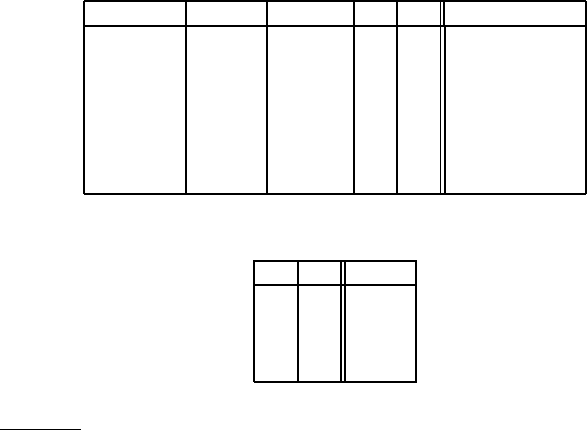
Figure 6.6 The four possible combinations of s
T
and s
B
.
where we have quantized the editorial relevance judgment r(d
j
, q
j
) to 0 or 1.
Then, the total error of a set of training examples is given by
∑
j
ε(g, Φ
j
).
(6.4)
The problem of learning the constant g from the given training examples
then reduces to picking the value of g that minimizes the total error in (6.4).
Picking the best value of g in (
6.4) in the formulation of Section 6.1.3 re-
duces to the problem of minimizing a quadratic function of g over the inter-
val [0, 1]. This reduction is detailed in Section
6.1.3.
✄
6.1.3 The optimal weight g
We begin by noting that for any training example Φ
j
for which s
T
(d
j
, q
j
) = 0
and s
B
(d
j
, q
j
) = 1, the score computed by Equation (
6.2) is 1 − g. In similar
fashion, we may write down the score computed by Equation (6.2) for the
three other possible combinations of s
T
(d
j
, q
j
) and s
B
(d
j
, q
j
); this is summa-
rized in Figure
6.6.
Let n
01r
(respectively, n
01n
) denote the number of training examples for
which s
T
(d
j
, q
j
) = 0 and s
B
(d
j
, q
j
) = 1 and the editorial judgment is Relevant
(respectively, Non-relevant). Then the contribution to the total error in Equa-
tion (
6.4) from training examples for which s
T
(d
j
, q
j
) = 0 and s
B
(d
j
, q
j
) = 1