
Manning Ch. D., Raghavan P., Sch?tze H. Introduction to Information Retrieval - Введение в информационный поиск
Подождите немного. Документ загружается.


Online edition (c)2009 Cambridge UP
136 7 Computing scores in a complete search system
FASTCOSINESCORE(q)
1 float Scores[N] = 0
2 for each d
3 do Initialize Length[d] to the length of doc d
4 for each query term t
5 do calculate w
t,q
and fetch postings list for t
6 for each pair(d, tf
t,d
) in postings list
7 do add wf
t,d
to Scores[d]
8 Read the array Length[d]
9 for each d
10 do Divide Scores[d] by Length[d]
11 return Top K components of Scores[]
◮
Figure 7.1 A faster algorithm for vector space scores.
two documents d
1
, d
2
~
V(q) ·~v(d
1
) >
~
V(q) ·~v(d
2
) ⇔~v(q) ·~v(d
1
) > ~v(q) ·~v(d
2
).
(7.1)
For any document d, the cosine similarity
~
V(q) ·~v(d) is the weighted sum,
over all terms in the query q, of the weights of those terms in d. This in turn
can be computed by a postings intersection exactly as in the algorithm of
Figure
6.14, with line 8 altered since we take w
t,q
to be 1 so that the multiply-
add in that step becomes just an addition; the result is shown in Figure
7.1.
We walk through the postings in the inverted index for the terms in q, accu-
mulating the total score for each document – very much as in processing a
Boolean query, except we assign a positive score to each document that ap-
pears in any of the postings being traversed. As mentioned in Section
6.3.3
we maintain an idf value for each dictionary term and a tf value for each
postings entry. This scheme computes a score for every document in the
postings of any of the query terms; the total number of such documents may
be considerably smaller than N.
Given these scores, the final step before presenting results to a user is to
pick out the K highest-scoring documents. While one could sort the complete
set of scores, a better approach is to use a heap to retrieve only the top K
documents in order. Where J is the number of documents with non-zero
cosine scores, constructing such a heap can be performed in 2J comparison
steps, following which each of the K highest scoring documents can be “read
off” the heap with log J comparison steps.
Online edition (c)2009 Cambridge UP
7.1 Efficient scoring and ranking 137
7.1.1 Inexact top K document retrieval
Thus far, we have focused on retrieving precisely the K highest-scoring doc-
uments for a query. We now consider schemes by which we produce K doc-
uments that are likely to be among the K highest scoring documents for a
query. In doing so, we hope to dramatically lower the cost of computing
the K documents we output, without materially altering the user’s perceived
relevance of the top K results. Consequently, in most applications it suffices
to retrieve K documents whose scores are very close to those of the K best.
In the sections that follow we detail schemes that retrieve K such documents
while potentially avoiding computing scores for most of the N documents in
the collection.
Such inexact top-K retrieval is not necessarily, from the user’s perspective,
a bad thing. The top K documents by the cosine measure are in any case not
necessarily the K best for the query: cosine similarity is only a proxy for the
user’s perceived relevance. In Sections
7.1.2–7.1.6 below, we give heuristics
using which we are likely to retrieve K documents with cosine scores close
to those of the top K documents. The principal cost in computing the out-
put stems from computing cosine similarities between the query and a large
number of documents. Having a large number of documents in contention
also increases the selection cost in the final stage of culling the top K docu-
ments from a heap. We now consider a series of ideas designed to eliminate
a large number of documents without computing their cosine scores. The
heuristics have the following two-step scheme:
1. Find a set A of documents that are contenders, where K < |A| ≪ N. A
does not necessarily contain the K top-scoring documents for the query,
but is likely to have many documents with scores near those of the top K.
2. Return the K top-scoring documents in A.
From the descriptions of these ideas it will be clear that many of them require
parameters to be tuned to the collection and application at hand; pointers
to experience in setting these parameters may be found at the end of this
chapter. It should also be noted that most of these heuristics are well-suited
to free text queries, but not for Boolean or phrase queries.
7.1.2 Index elimination
For a multi-term query q, it is clear we only consider documents containing at
least one of the query terms. We can take this a step further using additional
heuristics:
1. We only consider documents containing terms whose idf exceeds a preset
threshold. Thus, in the postings traversal, we only traverse the postings
Online edition (c)2009 Cambridge UP
138 7 Computing scores in a complete search system
for terms with high idf. This has a fairly significant benefit: the post-
ings lists of low-idf terms are generally long; with these removed from
contention, the set of documents for which we compute cosines is greatly
reduced. One way of viewing this heuristic: low-idf terms are treated as
stop words and do not contribute to scoring. For instance, on the query
catcher in the rye, we only traverse the postings for catcher and rye. The
cutoff threshold can of course be adapted in a query-dependent manner.
2. We only consider documents that contain many (and as a special case,
all) of the query terms. This can be accomplished during the postings
traversal; we only compute scores for documents containing all (or many)
of the query terms. A danger of this scheme is that by requiring all (or
even many) query terms to be present in a document before considering
it for cosine computation, we may end up with fewer than K candidate
documents in the output. This issue will discussed further in Section
7.2.1.
7.1.3 Champion lists
The idea of champion lists (sometimes also called fancy lists or top docs) is to
precompute, for each term t in the dictionary, the set of the r documents
with the highest weights for t; the value of r is chosen in advance. For tf-
idf weighting, these would be the r documents with the highest tf values for
term t. We call this set of r documents the cha mpion list for term t.
Now, given a query q we create a set A as follows: we take the union
of the champion lists for each of the terms comprising q. We now restrict
cosine computation to only the documents in A. A critical parameter in this
scheme is the value r, which is highly application dependent. Intuitively, r
should be large compared with K, especially if we use any form of the index
elimination described in Section
7.1.2. One issue here is that the value r is set
at the time of index construction, whereas K is application dependent and
may not be available until the query is received; as a result we may (as in the
case of index elimination) find ourselves with a set A that has fewer than K
documents. There is no reason to have the same value of r for all terms in the
dictionary; it could for instance be set to be higher for rarer terms.
7.1.4 Static quality scores and ordering
We now further develop the idea of champion lists, in the somewhat more
general setting of static quality scores. In many search engines, we have avail-STATIC QUALITY
SCORES
able a measure of quality g(d) for each document d that is query-independent
and thus static. This quality measure may be viewed as a number between
zero and one. For instance, in the context of news stories on the web, g(d)
may be derived from the number of favorable reviews of the story by web
Online edition (c)2009 Cambridge UP
7.1 Efficient scoring and ranking 139
◮
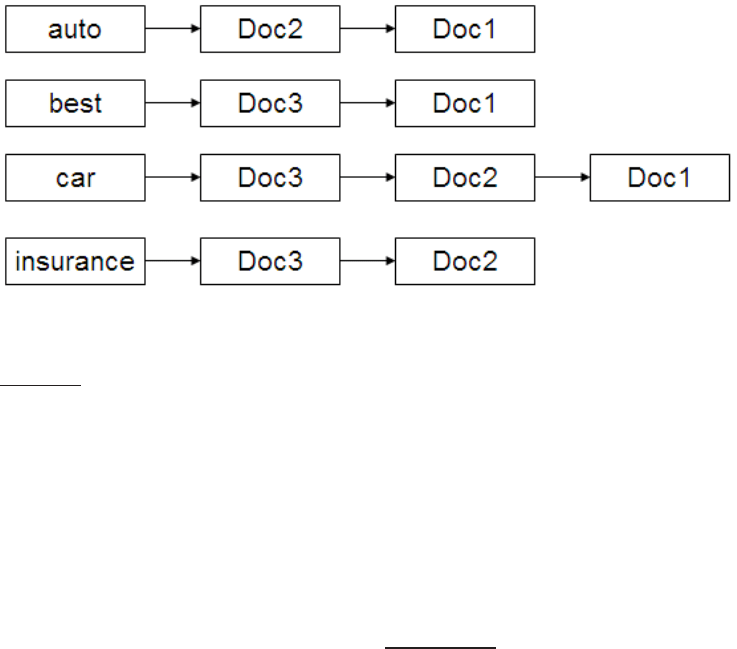
Figure 7.2 A static quality-ordered index. In this example we assume that Doc1,
Doc2 and Doc3 respectively have static quality scores g(1) = 0.25, g(2) = 0.5, g(3) =
1.
surfers. Section 4.6 (page 80) provides further discussion on this topic, as
does Chapter 21 in the context of web search.
The net score for a document d is some combination of g(d) together with
the query-dependent score induced (say) by (
6.12). The precise combination
may be determined by the learning methods of Section
6.1.2, to be developed
further in Section 15.4.1; but for the purposes of our exposition here, let us
consider a simple sum:
net-score(q , d) = g(d) +
~
V(q) ·
~
V(d)
|
~
V(q)||
~
V(d)|
.(7.2)
In this simple form, the static quality g(d) and the query-dependent score
from (
6.10) have equal contributions, assuming each is between 0 and 1.
Other relative weightings are possible; the effectiveness of our heuristics will
depend on the specific relative weighting.
First, consider ordering the documents in the postings list for each term by
decreasing value of g(d). This allows us to perform the postings intersection
algorithm of Figure
1.6. In order to perform the intersection by a single pass
through the postings of each query term, the algorithm of Figure 1.6 relied on
the postings being ordered by document IDs. But in fact, we only required
that all postings be ordered by a single common ordering; here we rely on the
g(d) values to provide this common ordering. This is illustrated in Figure
7.2,
where the postings are ordered in decreasing order of g(d).
The first idea is a direct extension of champion lists: for a well-chosen
value r, we maintain for each term t a global champion list of the r documents
Online edition (c)2009 Cambridge UP
140 7 Computing scores in a complete search system
with the highest values for g(d) + tf-idf
t,d
. The list itself is, like all the post-
ings lists considered so far, sorted by a common order (either by document
IDs or by static quality). Then at query time, we only compute the net scores
(
7.2) for documents in the union of these global champion lists. Intuitively,
this has the effect of focusing on documents likely to have large net scores.
We conclude the discussion of global champion lists with one further idea.
We maintain for each term t two postings lists consisting of disjoint sets of
documents, each sorted by g(d) values. The first list, which we call high ,
contains the m documents with the highest tf values for t. The second list,
which we call low, contains all other documents containing t. When process-
ing a query, we first scan only the high lists of the query terms, computing
net scores for any document on the high lists of all (or more than a certain
number of) query terms. If we obtain scores for K documents in the process,
we terminate. If not, we continue the scanning into the low lists, scoring doc-
uments in these postings lists. This idea is developed further in Section 7.2.1.
7.1.5 Impact ordering
In all the postings lists described thus far, we order the documents con-
sistently by some common ordering: typically by document ID but in Sec-
tion
7.1.4 by static quality scores. As noted at the end of Section 6.3.3, such a
common ordering supports the concurrent traversal of all of the query terms’
postings lists, computing the score for each document as we encounter it.
Computing scores in this manner is sometimes referred to as document-at-a-
time scoring. We will now introduce a technique for inexact top-K retrieval
in which the postings are not all ordered by a common ordering, thereby
precluding such a concurrent traversal. We will therefore require scores to
be “accumulated” one term at a time as in the scheme of Figure
6.14, so that
we have term-at-a-time scoring.
The idea is to order the documents d in the postings list of term t by
decreasing order of tf
t,d
. Thus, the ordering of documents will vary from
one postings list to another, and we cannot compute scores by a concurrent
traversal of the postings lists of all query terms. Given postings lists ordered
by decreasing order of tf
t,d
, two ideas have been found to significantly lower
the number of documents for which we accumulate scores: (1) when travers-
ing the postings list for a query term t, we stop after considering a prefix
of the postings list – either after a fixed number of documents r have been
seen, or after the value of tf
t,d
has dropped below a threshold; (2) when ac-
cumulating scores in the outer loop of Figure
6.14, we consider the query
terms in decreasing order of idf, so that the query terms likely to contribute
the most to the final scores are considered first. This latter idea too can be
adaptive at the time of processing a query: as we get to query terms with
lower idf, we can determine whether to proceed based on the changes in

Online edition (c)2009 Cambridge UP
7.1 Efficient scoring and ranking 141
document scores from processing the previous query term. If these changes
are minimal, we may omit accumulation from the remaining query terms, or
alternatively process shorter prefixes of their postings lists.
These ideas form a common generalization of the methods introduced in
Sections
7.1.2–7.1.4. We may also implement a version of static ordering in
which each postings list is ordered by an additive combination of static and
query-dependent scores. We would again lose the consistency of ordering
across postings, thereby having to process query terms one at time accumu-
lating scores for all documents as we go along. Depending on the particular
scoring function, the postings list for a document may be ordered by other
quantities than term frequency; under this more general setting, this idea is
known as impact ordering.
7.1.6 Cluster pruning
In cluster pruning we have a preprocessing step during which we cluster the
document vectors. Then at query time, we consider only documents in a
small number of clusters as candidates for which we compute cosine scores.
Specifically, the preprocessing step is as follows:
1. Pick
√
N documents at random from the collection. Call these leaders.
2. For each document that is not a leader, we compute its nearest leader.
We refer to documents that are not leaders as followers. Intuitively, in the par-
tition of the followers induced by the use of
√
N randomly chosen leaders,
the expected number of followers for each leader is ≈ N/
√
N =
√
N. Next,
query processing proceeds as follows:
1. Given a query q, find the leader L that is closest to q. This entails comput-
ing cosine similarities from q to each of the
√
N leaders.
2. The candidate set A consists of L together with its followers. We compute
the cosine scores for all documents in this candidate set.
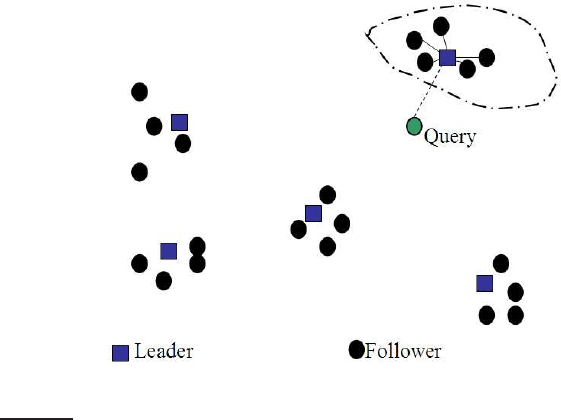
The use of randomly chosen leaders for clustering is fast and likely to re-
flect the distribution of the document vectors in the vector space: a region
of the vector space that is dense in documents is likely to produce multi-
ple leaders and thus a finer partition into sub-regions. This illustrated in
Figure
7.3.
Variations of cluster pruning introduce additional parameters b
1
and b
2
,
both of which are positive integers. In the pre-processing step we attach
each follower to its b
1
closest leaders, rather than a single closest leader. At
query time we consider the b
2
leaders closest to the query q. Clearly, the basic
scheme above corresponds to the case b
1
= b
2
= 1. Further, increasing b
1
or
Online edition (c)2009 Cambridge UP
142 7 Computing scores in a complete search system
◮
Figure 7.3 Cluster pruning.
b
2
increases the likelihood of finding K documents that are more likely to be
in the set of true top-scoring K documents, at the expense of more compu-
tation. We reiterate this approach when describing clustering in Chapter
16
(page 354).
?
Exercise 7.1
We suggested above (Figure 7.2) that the postings for static quality ordering be in
decreasing order of g(d). Why do we use the decreasing rather than the increasing
order?
Exercise 7.2
When discussing champion lists, we simply used the r documents with the largest tf
values to create the champion list for t. But when considering global champion lists,
we used idf as well, identifying documents with the largest values of g(d) + tf-idf
t,d
.
Why do we differentiate between these two cases?
Exercise 7.3
If we were to only have one-term queries, explain why the use of global champion
lists with r = K suffices for identifying the K highest scoring documents. What is a
simple modification to this idea if we were to only have s-term queries for any fixed
integer s > 1?
Exercise 7.4
Explain how the common global ordering by g(d) values in all high and low lists
helps make the score computation efficient.
Online edition (c)2009 Cambridge UP
7.2 Components of an information retrieval system 143
Exercise 7.5
Consider again the data of Exercise 6.23 with nnn.atc for the query-dependent scor-
ing. Suppose that we were given static quality scores of 1 for Doc1 and 2 for Doc2.
Determine under Equation (
7.2) what ranges of static quality score for Doc3 result in
it being the first, second or third result for the query best car insurance.
Exercise 7.6
Sketch the frequency-ordered postings for the data in Figure 6.9.
Exercise 7.7
Let the static quality scores for Doc1, Doc2 and Doc3 in Figure 6.11 be respectively
0.25, 0.5 and 1. Sketch the postings for impact ordering when each postings list is
ordered by the sum of the static quality score and the Euclidean normalized tf values
in Figure
6.11.
Exercise 7.8
The nearest-neighbor problem in the plane is the following: given a set of N data
points on the plane, we preprocess them into some data structure such that, given
a query point Q, we seek the point in N that is closest to Q in Euclidean distance.
Clearly cluster pruning can be used as an approach to the nearest-neighbor problem
in the plane, if we wished to avoid computing the distance from Q to every one of
the query points. Devise a simple example on the plane so that with two leaders, the
answer returned by cluster pruning is incorrect (it is not the data point closest to Q ).
7.2 Components of an information retrieval system
In this section we combine the ideas developed so far to describe a rudimen-
tary search system that retrieves and scores documents. We first develop
further ideas for scoring, beyond vector spaces. Following this, we will put
together all of these elements to outline a complete system. Because we con-
sider a complete system, we do not restrict ourselves to vector space retrieval
in this section. Indeed, our complete system will have provisions for vector
space as well as other query operators and forms of retrieval. In Section
7.3
we will return to how vector space queries interact with other query opera-
tors.
7.2.1 Tiered indexes
We mentioned in Section 7.1.2 that when using heuristics such as index elim-
ination for inexact top-K retrieval, we may occasionally find ourselves with
a set A of contenders that has fewer than K documents. A common solution
to this issue is the user of tiered indexes, which may be viewed as a gener-TIERED INDEXES
alization of champion lists. We illustrate this idea in Figure
7.4, where we
represent the documents and terms of Figure 6.9. In this example we set a tf
threshold of 20 for tier 1 and 10 for tier 2, meaning that the tier 1 index only
has postings entries with tf values exceeding 20, while the tier 2 index only
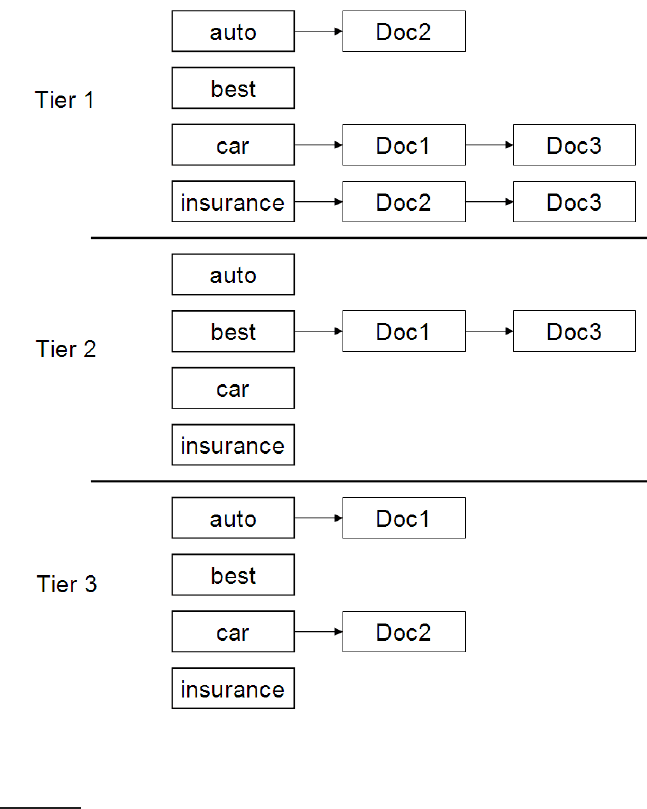
Online edition (c)2009 Cambridge UP
144 7 Computing scores in a complete search system
◮
Figure 7.4 Tiered indexes. If we fail to get K results from tier 1, query processing
“falls back” to tier 2, and so on. Within each tier, postings are ordered by document
ID.
has postings entries with tf values exceeding 10. In this example we have
chosen to order the postings entries within a tier by document ID.
7.2.2 Query-term proximity
Especially for free text queries on the web (Chapter 19), users prefer a doc-
ument in which most or all of the query terms appear close to each other,
Online edition (c)2009 Cambridge UP
7.2 Components of an information retrieval system 145
because this is evidence that the document has text focused on their query
intent. Consider a query with two or more query terms, t
1
, t
2
, . . . , t
k
. Let ω
be the width of the smallest window in a document d that contains all the
query terms, measured in the number of words in the window. For instance,
if the document were to simply consist of the sentence The quality of mercy
is not strained, the smallest window for the query strained mercy would be 4.
Intuitively, the smaller that ω is, the better that d matches the query. In cases
where the document does not contain all of the query terms, we can set ω
to be some enormous number. We could also consider variants in which
only words that are not stop words are considered in computing ω. Such
proximity-weighted scoring functions are a departure from pure cosine sim-
ilarity and closer to the “soft conjunctive” semantics that Google and other
web search engines evidently use.
How can we design such a proximity-weighted scoring function to dependPROXIMITY WEIGHTING
on ω? The simplest answer relies on a “hand coding” technique we introduce
below in Section
7.2.3. A more scalable approach goes back to Section 6.1.2 –
we treat the integer ω as yet another feature in the scoring function, whose
importance is assigned by machine learning, as will be developed further in
Section
15.4.1.
7.2.3 Designing parsing and scoring functions
Common search interfaces, particularly for consumer-facing search applica-
tions on the web, tend to mask query operators from the end user. The intent
is to hide the complexity of these operators from the largely non-technical au-
dience for such applications, inviting free text queries. Given such interfaces,
how should a search equipped with indexes for various retrieval operators
treat a query such as rising interestrates? More generally, given the various fac-
tors we have studied that could affect the score of a document, how should
we combine these features?
The answer of course depends on the user population, the query distri-
bution and the collection of documents. Typically, a query parser is used to
translate the user-specified keywords into a query with various operators
that is executed against the underlying indexes. Sometimes, this execution
can entail multiple queries against the underlying indexes; for example, the
query parser may issue a stream of queries:
1. Run the user-generated query string as a phrase query. Rank them by
vector space scoring using as query the vector consisting of the 3 terms
rising interest rates.
2. If fewer than ten documents contain the phrase rising interest rates, run the
two 2-term phrase queries rising interest and interest rates; rank these using
vector space scoring, as well.