
Manning Ch. D., Raghavan P., Sch?tze H. Introduction to Information Retrieval - Введение в информационный поиск
Подождите немного. Документ загружается.

Online edition (c)2009 Cambridge UP
286 13 Text classification and Naive Bayes
13.7 Ref erences and further reading
General introductions to statistical classification and machine learning can be
found in (Hastie et al. 2001), (Mitchell 1997), and (Duda et al. 2000), including
many important methods (e.g., decision trees and boosting) that we do not
cover. A comprehensive review of text classification methods and results is
(Sebastiani 2002). Manning and Schütze (1999, Chapter 16) give an accessible
introduction to text classification with coverage of decision trees, perceptrons
and maximum entropy models. More information on the superlinear time
complexity of learning methods that are more accurate than Naive Bayes can
be found in (Perkins et al. 2003) and (Joachims 2006a).
Maron and Kuhns (1960) described one of the first NB text classifiers. Lewis
(1998) focuses on the history of NB classification. Bernoulli and multinomial
models and their accuracy for different collections are discussed by McCal-
lum and Nigam (1998). Eyheramendy et al. (2003) present additional NB
models. Domingos and Pazzani (1997), Friedman (1997), and Hand and Yu
(2001) analyze why NB performs well although its probability estimates are
poor. The first paper also discusses NB’s optimality when the independence
assumptions are true of the data. Pavlov et al. (2004) propose a modified
document representation that partially addresses the inappropriateness of
the independence assumptions. Bennett (2000) attributes the tendency of NB
probability estimates to be close to either 0 or 1 to the effect of document
length. Ng and Jordan (2001) show that NB is sometimes (although rarely)
superior to discriminative methods because it more quickly reaches its opti-
mal error rate. The basic NB model presented in this chapter can be tuned for
better effectiveness (Rennie et al. 2003;Kołcz and Yih 2007). The problem of
concept drift and other reasons why state-of-the-art classifiers do not always
excel in practice are discussed by Forman (2006) and Hand (2006).
Early uses of mutual information and χ
2
for feature selection in text clas-
sification are Lewis and Ringuette (1994) and Schütze et al. (1995), respec-
tively. Yang and Pedersen (1997) review feature selection methods and their
impact on classification effectiveness. They find that pointwise mutual infor-POINTWISE MUTUAL
INFORMATION
mation is not competitive with other methods. Yang and Pedersen refer to
expected mutual information (Equation (
13.16)) as information gain (see Ex-
ercise 13.13, page 285). (Snedecor and Cochran 1989) is a good reference for
the χ
2
test in statistics, including the Yates’ correction for continuity for 2 ×2
tables. Dunning (1993) discusses problems of the χ
2
test when counts are
small. Nongreedy feature selection techniques are described by Hastie et al.
(2001). Cohen (1995) discusses the pitfalls of using multiple significance tests
and methods to avoid them. Forman (2004) evaluates different methods for
feature selection for multiple classifiers.
David D. Lewis defines the ModApte split at www.daviddlewis.com/resources/testcollections/reuters21578/readme
based on Apté et al. (1994). Lewis (1995) describes utility measures for theUTILITY MEASURE
Online edition (c)2009 Cambridge UP
13.7 References and further reading 287
evaluation of text classification systems. Yang and Liu (1999) employ signif-
icance tests in the evaluation of text classification methods.
Lewis et al. (2004) find that SVMs (Chapter
15) perform better on Reuters-
RCV1 than kNN and Rocchio (Chapter
14).
Online edition (c)2009 Cambridge UP
Online edition (c)2009 Cambridge UP
DRAFT! © April 1, 2009 Cambridge University Press. Feedback welcome. 289
14 Vector space classi fication
The document representation in Naive Bayes is a sequence of terms or a bi-
nary vector he
1
, . . . , e
|V|
i ∈ {0, 1}
|
V|. In this chapter we adopt a different
representation for text classification, the vector space model, developed in
Chapter
6. It represents each document as a vector with one real-valued com-
ponent, usually a tf-idf weight, for each term. Thus, the document space X,
the domain of the classification function γ, is R
|V|
. This chapter introduces a
number of classification methods that operate on real-valued vectors.
The basic hypothesis in using the vector space model for classification is
the contiguity hypothesis.CONTIGUITY
HYPOTHESIS
Contiguity hypothesis. Documents in the same class form a contigu-
ous region and regions of different classes do not overlap.
There are many classification tasks, in particular the type of text classification
that we encountered in Chapter
13, where classes can be distinguished by
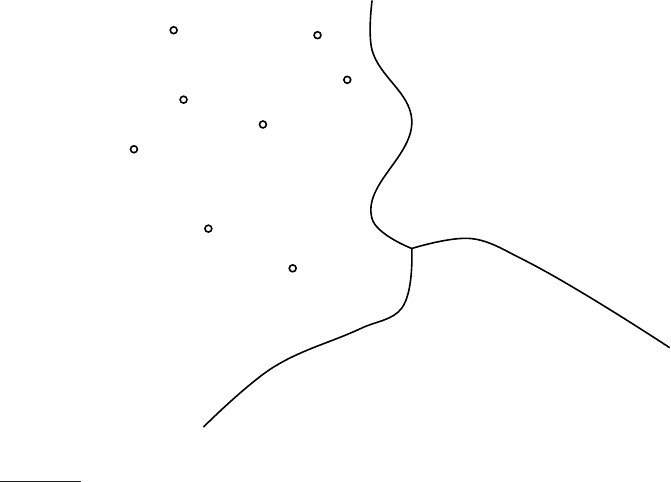
word patterns. For example, documents in the class China tend to have high
values on dimensions like Chinese, Beijing, and Mao whereas documents in the
class UK tend to have high values for London, British and Queen. Documents
of the two classes therefore form distinct contiguous regions as shown in
Figure
14.1 and we can draw boundaries that separate them and classify new
documents. How exactly this is done is the topic of this chapter.
Whether or not a set of documents is mapped into a contiguous region de-
pends on the particular choices we make for the document representation:
type of weighting, stop list etc. To see that the document representation is
crucial, consider the two classes written by a group vs. written by a single per-
son. Frequent occurrence of the first person pronoun I is evidence for the
single-person class. But that information is likely deleted from the document
representation if we use a stop list. If the document representation chosen
is unfavorable, the contiguity hypothesis will not hold and successful vector
space classification is not possible.
The same considerations that led us to prefer weighted representations, in
particular length-normalized tf-idf representations, in Chapters 6 and 7 also
Online edition (c)2009 Cambridge UP
290 14 Vector space classification
x
x
x
x
⋄
⋄
⋄
⋄
⋄
⋄
China
Kenya
UK
⋆
◮
Figure 14.1 Vector space classification into three classes.
apply here. For example, a term with 5 occurrences in a document should get
a higher weight than a term with one occurrence, but a weight 5 times larger
would give too much emphasis to the term. Unweighted and unnormalized
counts should not be used in vector space classification.
We introduce two vector space classification methods in this chapter, Roc-
chio and kNN. Rocchio classification (Section
14.2) divides the vector space
into regions centered on centroids or prototypes, one for each class, computedPROTOTYPE
as the center of mass of all documents in the class. Rocchio classification is
simple and efficient, but inaccurate if classes are not approximately spheres
with similar radii.
kNN or k nearest neighbor classification (Section
14.3) assigns the majority
class of the k nearest neighbors to a test document. kNN requires no explicit
training and can use the unprocessed training set directly in classification.
It is less efficient than other classification methods in classifying documents.
If the training set is large, then kNN can handle non-spherical and other
complex classes better than Rocchio.
A large number of text classifiers can be viewed as linear classifiers – clas-
sifiers that classify based on a simple linear combination of the features (Sec-
tion
14.4). Such classifiers partition the space of features into regions sepa-
rated by linear decision hyperplanes, in a manner to be detailed below. Because
of the bias-variance tradeoff (Section
14.6) more complex nonlinear models
Online edition (c)2009 Cambridge UP
14.1 Document representations and measures of rel atedness in vector spaces 291
d
true
d
projected
x
1
x
2
x
3
x
4
x
5
x
′
1
x
′
2
x
′
3
x
′
4
x
′
5
x
′
1
x
′
2
x
′
3
x
′
4
x
′
5
◮
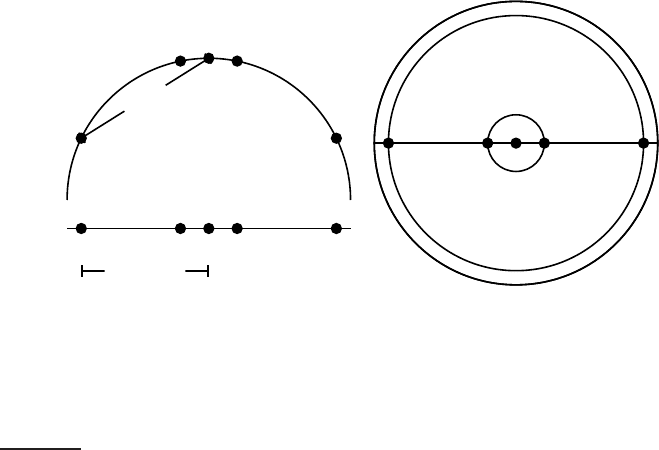
Figure 14.2 Projections of small areas of the unit sphere preserve distances. Left:
A projection of the 2D semicircle to 1D. For the points x
1
, x
2
, x
3
, x
4
, x
5
at x coordinates
−0.9, −0.2, 0, 0.2, 0.9 the distance |x
2
x
3
| ≈ 0.201 only differs by 0.5% from |x
′
2
x
′
3
| =
0.2; but |x
1
x
3
|/|x
′
1
x
′
3
| = d
true
/d
projected
≈ 1.06/0.9 ≈ 1.18 is an example of a large
distortion (18%) when projecting a large area. Right: The corresponding projection of
the 3D hemisphere to 2D.
are not systematically better than linear models. Nonlinear models have
more parameters to fit on a limited amount of training data and are more
likely to make mistakes for small and noisy data sets.
When applying two-class classifiers to problems with more than two classes,
there are one-of tasks – a document must be assigned to exactly one of several
mutually exclusive classes – and any-of tasks – a document can be assigned to
any number of classes as we will explain in Section
14.5. Two-class classifiers
solve any-of problems and can be combined to solve one-of problems.
14.1 Document representations and measures of relatedness in vec-
tor spaces
As in Chapter
6, we represent documents as vectors in R
|V|
in this chapter.
To illustrate properties of document vectors in vector classification, we will
render these vectors as points in a plane as in the example in Figure
14.1.
In reality, document vectors are length-normalized unit vectors that point
to the surface of a hypersphere. We can view the 2D planes in our figures
as projections onto a plane of the surface of a (hyper-)sphere as shown in
Figure
14.2. Distances on the surface of the sphere and on the projection
plane are approximately the same as long as we restrict ourselves to small
areas of the surface and choose an appropriate projection (Exercise
14.1).

Online edition (c)2009 Cambridge UP
292 14 Vector space classification
Decisions of many vector space classifiers are based on a notion of dis-
tance, e.g., when computing the nearest neighbors in kNN classification.
We will use Euclidean distance in this chapter as the underlying distance
measure. We observed earlier (Exercise
6.18, page 131) that there is a direct
correspondence between cosine similarity and Euclidean distance for length-
normalized vectors. In vector space classification, it rarely matters whether
the relatedness of two documents is expressed in terms of similarity or dis-
tance.
However, in addition to documents, centroids or averages of vectors also
play an important role in vector space classification. Centroids are not length-
normalized. For unnormalized vectors, dot product, cosine similarity and
Euclidean distance all have different behavior in general (Exercise
14.6). We
will be mostly concerned with small local regions when computing the sim-
ilarity between a document and a centroid, and the smaller the region the
more similar the behavior of the three measures is.
?
Exercise 14.1
For small areas, distances on the surface of the hypersphere are approximated well
by distances on its projection (Figure
14.2) because α ≈ sin α for small angles. For
what size angle is the distortion α/ sin(α) (i) 1.01, (ii) 1.05 and (iii) 1.1?
14.2 Rocchio classification
Figure 14.1 shows three classes, China, UK and Kenya, in a two-dimensional
(2D) space. Documents are shown as circles, diamonds and X’s. The bound-
aries in the figure, which we call decision boundaries, are chosen to separateDECISION BOUNDARY
the three classes, but are otherwise arbitrary. To classify a new document,
depicted as a star in the figure, we determine the region it occurs in and as-
sign it the class of that region – China in this case. Our task in vector space
classification is to devise algorithms that compute good boundaries where
“good” means high classification accuracy on data unseen during training.
Perhaps the best-known way of computing good class boundaries is Roc-ROCCHIO
CLASSIFICATION
chio classification, which uses centroids to define the boundaries. The centroid
CENTROID
of a class c is computed as the vector average or center of mass of its mem-
bers:
~µ(c) =
1
|D
c
|
∑
d∈D
c
~v(d)
(14.1)
where D
c
is the set of documents in D whose class is c: D
c
= {d : hd, ci ∈ D}.
We denote the normalized vector of d by ~v(d) (Equation (6.11), page 122).
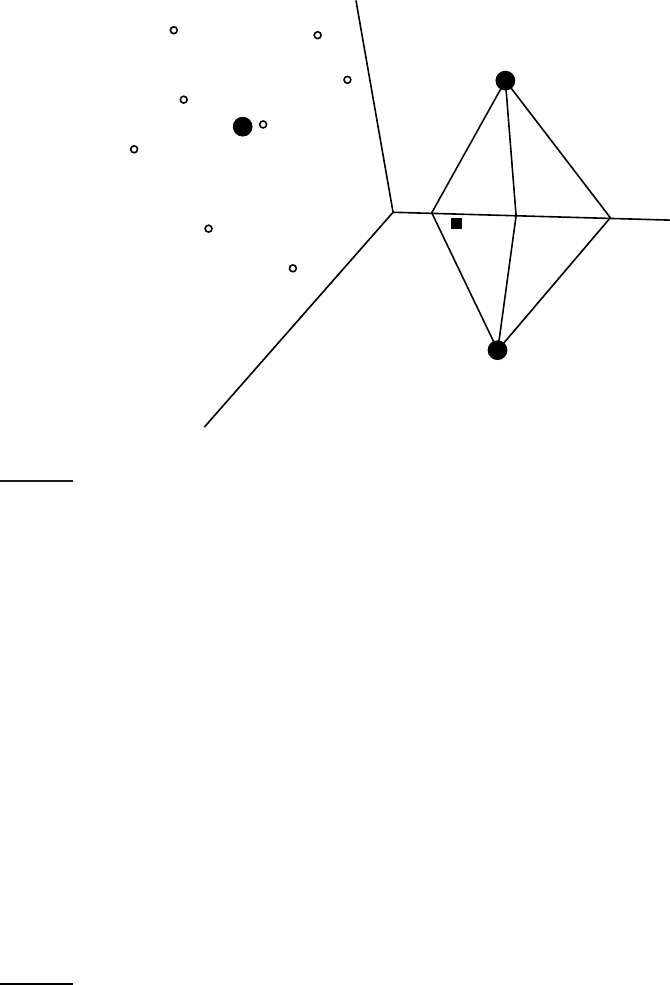
Three example centroids are shown as solid circles in Figure 14.3.
The boundary between two classes in Rocchio classification is the set of
points with equal distance from the two centroids. For example, |a
1
| = |a
2
|,
Online edition (c)2009 Cambridge UP
14.2 Rocchio classification 293
x
x
x
x
⋄
⋄
⋄
⋄
⋄
⋄
China
Kenya
UK
⋆
a
1
a
2
b
1
b
2
c
1
c
2
◮
Figure 14.3 Rocchio classification.
|b
1
| = |b
2
|, and |c
1
| = |c
2
| in the figure. This set of points is always a line.
The generalization of a line in M-dimensional space is a hyperplane, which
we define as the set of points ~x that satisfy:
~w
T
~x = b
(14.2)
where ~w is the M-dimensional normal vector
1
of the hyperplane and b is aNORMAL VECTOR
constant. This definition of hyperplanes includes lines (any line in 2D can
be defined by w
1
x
1
+ w
2
x
2
= b) and 2-dimensional planes (any plane in 3D
can be defined by w
1
x
1
+ w
2
x
2
+ w
3
x
3
= b). A line divides a plane in two,
a plane divides 3-dimensional space in two, and hyperplanes divide higher-
dimensional spaces in two.
Thus, the boundaries of class regions in Rocchio classification are hyper-
planes. The classification rule in Rocchio is to classify a point in accordance
with the region it falls into. Equivalently, we determine the centroid ~µ(c) that
the point is closest to and then assign it to c. As an example, consider the star
in Figure 14.3. It is located in the China region of the space and Rocchio
therefore assigns it to China. We show the Rocchio algorithm in pseudocode
in Figure
14.4.
1. Recall from basic linear algebra that ~v · ~w = ~v
T
~w, i.e., the dot product of ~v and ~w equals the
product by matrix multiplication of the transpose of ~v and ~w.
Online edition (c)2009 Cambridge UP
294 14 Vector space classification
term weights
vector Chinese Japan Tokyo Macao Beijing Shanghai
~
d
1
0 0 0 0 1.0 0
~
d
2
0 0 0 0 0 1.0
~
d
3
0 0 0 1.0 0 0
~
d
4
0 0.71 0.71 0 0 0
~
d
5
0 0.71 0.71 0 0 0
~µ
c
0 0 0 0.33 0.33 0.33
~µ
c
0 0.71 0.71 0 0 0
◮
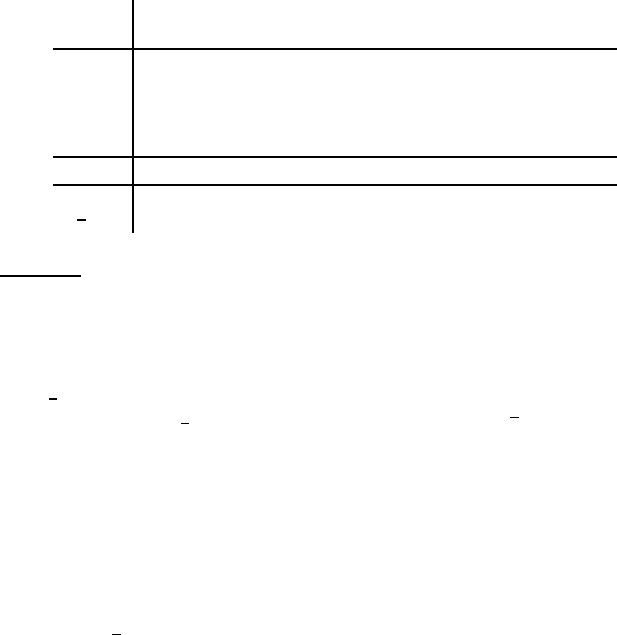
Table 14.1 Vectors and class centroids for the data in Table 13.1.
✎
Example 14.1: Table
14.1 shows the tf-idf vector representations of the five docu-
ments in Table
13.1 (page 261), using the formula (1 + log
10
tf
t,d
) log
10
(4/df
t
) if tf
t,d
>
0 (Equation (
6.14), page 127). The two class centroids are µ
c
= 1/3 · (
~
d
1
+
~
d
2
+
~
d
3
)
and µ
c
= 1/1 · (
~
d
4
). The distances of the test document from the centroids are
|µ
c
−
~
d
5
| ≈ 1.15 and |µ
c
−
~
d
5
| = 0.0. Thus, Rocchio assigns d
5
to
c.
The separating hyperplane in this case has the following parameters:
~w ≈ (0 − 0.71 − 0.71 1/3 1/3 1/3)
T
b = −1/3
See Exercise
14.15 for how to compute ~w and b. We can easily verify that this hy-
perplane separates the documents as desired: ~w
T
~
d
1
≈ 0 · 0 + −0.71 ·0 + −0.71 · 0 +
1/3 ·0 + 1/3 · 1.0 + 1/3 ·0 = 1/3 > b (and, similarly, ~w
T
~
d
i
> b for i = 2 and i = 3)
and ~w
T
~
d
4
= −1 < b. Thus, documents in c are above the hyperplane (~w
T
~
d > b) and
documents in
c are below the hyperplane (~w
T
~
d < b).
The assignment criterion in Figure
14.4 is Euclidean distance (APPLYROC-
CHIO, line 1). An alternative is cosine similarity:
Assign d to class c = arg max
c
′
cos(~µ(c
′
),~v(d))
As discussed in Section 14.1, the two assignment criteria will sometimes
make different classification decisions. We present the Euclidean distance
variant of Rocchio classification here because it emphasizes Rocchio’s close
correspondence to K-means clustering (Section
16.4, page 360).
Rocchio classification is a form of Rocchio relevance feedback (Section 9.1.1,
page
178). The average of the relevant documents, corresponding to the most
important component of the Rocchio vector in relevance feedback (Equa-
tion (9.3), page 182), is the centroid of the “class” of relevant documents.
We omit the query component of the Rocchio formula in Rocchio classifica-
tion since there is no query in text classification. Rocchio classification can be
Online edition (c)2009 Cambridge UP
14.2 Rocchio classification 295
TRAINROCCHIO(C, D)
1 for each c
j
∈ C
2 do D
j
← {d : hd, c
j
i ∈ D}
3 ~µ
j
←
1
|D
j
|
∑
d∈D
j
~v(d)
4 return {~µ
1
, . . . ,~µ
J
}
APPLYROCCHIO({~µ
1
, . . . ,~µ
J
}, d)
1 return arg min
j
|~µ
j
−~v(d)|
◮
Figure 14.4 Rocchio classification: Training and testing.
a
a
a
a
a
a
a
a
a
a
a
a
a
a
a a
aa
a
a
a
a
a
a
a
a
a
a
a
a
a
a
a
aa
a
a
a
a
a
b
b
b
b
b
b
b
b
b
b
b
b
b
b
b
b
b
b
b
X
X
A
B
o
◮
Figure 14.5 The multimodal class “a” consists of two different clusters (small
upper circles centered on X’s). Rocchio classification will misclassify “o” as “a”
because it is closer to the centroid A of the “a” class than to the centroid B of the “b”
class.
applied to J > 2 classes whereas Rocchio relevance feedback is designed to
distinguish only two classes, relevant and nonrelevant.
In addition to respecting contiguity, the classes in Rocchio classification
must be approximate spheres with similar radii. In Figure
14.3, the solid
square just below the boundary between UK and Kenya is a better fit for the
class UK since UK is more scattered than Kenya. But Rocchio assigns it to
Kenya because it ignores details of the distribution of points in a class and
only uses distance from the centroid for classification.
The assumption of sphericity also does not hold in Figure
14.5. We can-