
Manning Ch. D., Raghavan P., Sch?tze H. Introduction to Information Retrieval - Введение в информационный поиск
Подождите немного. Документ загружается.

Online edition (c)2009 Cambridge UP
296 14 Vector space classification
mode
time complexity
training Θ(|D|L
ave
+ |C||V|)
testing Θ(L
a
+ |C|M
a
) = Θ(|C|M
a
)
◮
Table 14.2 Training and test times for Rocchio classification. L
ave
is the average
number of tokens per document. L
a
and M
a
are the numbers of tokens and types,
respectively, in the test document. Computing Euclidean distance between the class
centroids and a document is Θ(|C|M
a
).
not represent the “a” class well with a single prototype because it has two
clusters. Rocchio often misclassifies this type of multimodal class. A text clas-MULTIMODAL CLASS
sification example for multimodality is a country like Burma, which changed
its name to Myanmar in 1989. The two clusters before and after the name
change need not be close to each other in space. We also encountered the
problem of multimodality in relevance feedback (Section
9.1.2, page 184).
Two-class classification is another case where classes are rarely distributed
like spheres with similar radii. Most two-class classifiers distinguish between
a class like China that occupies a small region of the space and its widely
scattered complement. Assuming equal radii will result in a large number
of false positives. Most two-class classification problems therefore require a
modified decision rule of the form:
Assign d to class c iff |~µ(c) −~v(d)| < |~µ(c) −~v(d)|− b
for a positive constant b. As in Rocchio relevance feedback, the centroid of
the negative documents is often not used at all, so that the decision criterion
simplifies to |~µ(c) −~v(d)| < b
′
for a positive constant b
′
.
Table
14.2 gives the time complexity of Rocchio classification.
2
Adding all
documents to their respective (unnormalized) centroid is Θ(|D|L
ave
) (as op-
posed to Θ(|D||V|)) since we need only consider non-zero entries. Dividing
each vector sum by the size of its class to compute the centroid is Θ(|V|).
Overall, training time is linear in the size of the collection (cf. Exercise
13.1).
Thus, Rocchio classification and Naive Bayes have the same linear training
time complexity.
In the next section, we will introduce another vector space classification
method, kNN, that deals better with classes that have non-spherical, discon-
nected or other irregular shapes.
?
Exercise 14.2
[⋆]
Show that Rocchio classification can assign a label to a document that is different from
its training set label.
2. We write Θ(|D|L
ave
) for Θ(T) and assume that the length of test documents is bounded as
we did on page 262.
Online edition (c)2009 Cambridge UP
14.3 k nearest neighbor 297
x
x
x
x
x
x
x
x
x
x
x
⋄
⋄
⋄
⋄
⋄
⋄
⋄
⋄
⋄
⋄
⋄
⋆
◮
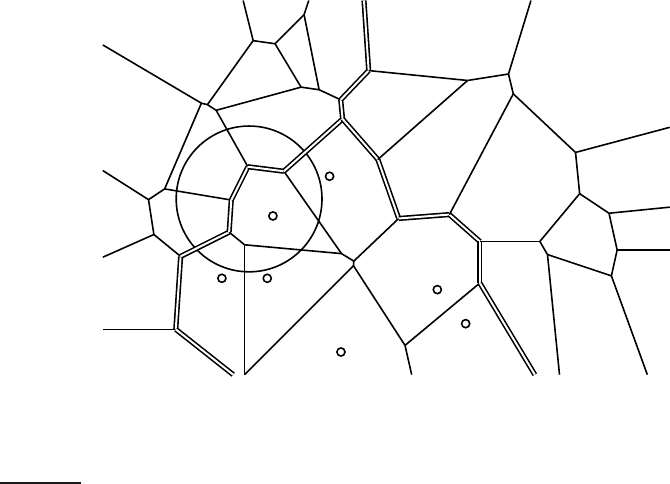
Figure 14.6 Voronoi tessellation and decision boundaries (double lines) in 1NN
classification. The three classes are: X, circle and diamond.
14.3 k nearest neighbor
Unlike Rocchio, k nearest neighbor or kNN classification determines the deci-k NEAREST NEIGHBOR
CLASSIFICATION
sion boundary locally. For 1NN we assign each document to the class of its
closest neighbor. For kNN we assign each document to the majority class of
its k closest neighbors where k is a parameter. The rationale of kNN classifi-
cation is that, based on the contiguity hypothesis, we expect a test document
d to have the same label as the training documents located in the local region
surrounding d.
Decision boundaries in 1NN are concatenated segments of the Voronoi tes-VORONOI
TESSELLATION
sellation as shown in Figure
14.6. The Voronoi tessellation of a set of objects
decomposes space into Voronoi cells, where each object’s cell consists of all
points that are closer to the object than to other objects. In our case, the ob-
jects are documents. The Voronoi tessellation then partitions the plane into
|D| convex polygons, each containing its corresponding document (and no
other) as shown in Figure
14.6, where a convex polygon is a convex region in
2-dimensional space bounded by lines.
For general k ∈ N in kNN, consider the region in the space for which the
set of k nearest neighbors is the same. This again is a convex polygon and the
space is partitioned into convex polygons, within each of which the set of k

Online edition (c)2009 Cambridge UP
298 14 Vector space classification
TRAIN-KNN(C, D)
1 D
′
← PREPROCESS(D)
2 k ← SELECT-K(C, D
′
)
3 return D
′
, k
APPLY-KNN(C, D
′
, k, d)
1 S
k
← COMPUTENEARESTNEIGHBORS(D
′
, k, d)
2 for each c
j
∈ C
3 do p
j
← |S
k
∩c
j
|/k
4 return arg max
j
p
j
◮
Figure 14.7 kNN training (with preprocessing) and testing. p
j
is an estimate for
P(c
j
|S
k
) = P(c
j
|d). c
j
denotes the set of all documents in the class c
j
.
nearest neighbors is invariant (Exercise 14.11).
3
1NN is not very robust. The classification decision of each test document
relies on the class of a single training document, which may be incorrectly
labeled or atypical. kNN for k > 1 is more robust. It assigns documents to
the majority class of their k closest neighbors, with ties broken randomly.
There is a probabilistic version of this kNN classification algorithm. We
can estimate the probability of membership in class c as the proportion of the
k nearest neighbors in c. Figure
14.6 gives an example for k = 3. Probabil-
ity estimates for class membership of the star are
ˆ
P(circle class|star) = 1/3,
ˆ
P(X class|star) = 2/3, and
ˆ
P(diamond class|star) = 0. The 3nn estimate
(
ˆ
P
1
(circle class|star) = 1/3) and the 1nn estimate (
ˆ
P
1
(circle class|star) = 1)
differ with 3nn preferring the X class and 1nn preferring the circle class .
The parameter k in kNN is often chosen based on experience or knowledge
about the classification problem at hand. It is desirable for k to be odd to
make ties less likely. k = 3 and k = 5 are common choices, but much larger
values between 50 and 100 are also used. An alternative way of setting the
parameter is to select the k that gives best results on a held-out portion of the
training set.
We can also weight the “votes” of the k nearest neighbors by their cosine
3. The generalization of a polygon to higher dimensions is a polytope. A polytope is a region
in M-dimensional space bounded by (M − 1)-dimensional hyperplanes. In M dimensions, the
decision boundaries for kNN consist of segments of (M −1)-dimensional hyperplanes that form
the Voronoi tessellation into convex polytopes for the training set of documents. The decision
criterion of assigning a document to the majority class of its k nearest neighbors applies equally
to M = 2 (tessellation into polygons) and M > 2 (tessellation into polytopes).

Online edition (c)2009 Cambridge UP
14.3 k nearest neighbor 299
kNN with preprocessing of training set
training Θ(|D|L
ave
)
testing Θ(L
a
+ |D|M
ave
M
a
) = Θ(|D|M
ave
M
a
)
kNN without preprocessing of training set
training Θ(1)
testing Θ(L
a
+ |D|L
ave
M
a
) = Θ(|D|L
ave
M
a
)
◮
Table 14.3 Training and test times for kNN classification. M
ave
is the average size
of the vocabulary of documents in the collection.
similarity. In this scheme, a class’s score is computed as:
score(c, d) =
∑
d
′
∈S
k
(d)
I
c
(d
′
) cos(~v(d
′
),~v(d))
where S
k
(d) is the set of d’s k nearest neighbors and I
c
(d
′
) = 1 iff d
′
is in class
c and 0 otherwise. We then assign the document to the class with the highest
score. Weighting by similarities is often more accurate than simple voting.
For example, if two classes have the same number of neighbors in the top k,
the class with the more similar neighbors wins.
Figure
14.7 summarizes the kNN algorithm.
✎
Example 14.2: The distances of the test document from the four training docu-
ments in Table 14.1 are |
~
d
1
−
~
d
5
| = |
~
d
2
−
~
d
5
| = |
~
d
3
−
~
d
5
| ≈ 1.41 and |
~
d
4
−
~
d
5
| = 0.0.
d
5
’s nearest neighbor is therefore d
4
and 1NN assigns d
5
to d
4
’s class,
c.
✄
14.3.1 Time complexity and optimality of kNN
Table
14.3 gives the time complexity of kNN. kNN has properties that are
quite different from most other classification algorithms. Training a kNN
classifier simply consists of determining k and preprocessing documents. In
fact, if we preselect a value for k and do not preprocess, then kNN requires
no training at all. In practice, we have to perform preprocessing steps like
tokenization. It makes more sense to preprocess training documents once
as part of the training phase rather than repeatedly every time we classify a
new test document.
Test time is Θ(|D|M
ave
M
a
) for kNN. It is linear in the size of the training
set as we need to compute the distance of each training document from the
test document. Test time is independent of the number of classes J. kNN
therefore has a potential advantage for problems with large J.
In kNN classification, we do not perform any estimation of parameters as
we do in Rocchio classification (centroids) or in Naive Bayes (priors and con-
ditional probabilities). kNN simply memorizes all examples in the training
Online edition (c)2009 Cambridge UP
300 14 Vector space classification
set and then compares the test document to them. For this reason, kNN is
also called memory-based learning or instance-based learning. It is usually desir-MEMORY-BASED
LEARNING
able to have as much training data as possible in machine learning. But in
kNN large training sets come with a severe efficiency penalty in classifica-
tion.
Can kNN testing be made more efficient than Θ(|D|M
ave
M
a
) or, ignoring
the length of documents, more efficient than Θ(|D|)? There are fast kNN
algorithms for small dimensionality M (Exercise
14.12). There are also ap-
proximations for large M that give error bounds for specific efficiency gains
(see Section
14.7). These approximations have not been extensively tested
for text classification applications, so it is not clear whether they can achieve
much better efficiency than Θ(|D|) without a significant loss of accuracy.
The reader may have noticed the similarity between the problem of finding
nearest neighbors of a test document and ad hoc retrieval, where we search
for the documents with the highest similarity to the query (Section
6.3.2,
page 123). In fact, the two problems are both k nearest neighbor problems
and only differ in the relative density of (the vector of) the test document
in kNN (10s or 100s of non-zero entries) versus the sparseness of (the vec-
tor of) the query in ad hoc retrieval (usually fewer than 10 non-zero entries).
We introduced the inverted index for efficient ad hoc retrieval in Section
1.1
(page 6). Is the inverted index also the solution for efficient kNN?
An inverted index restricts a search to those documents that have at least
one term in common with the query. Thus in the context of kNN, the in-
verted index will be efficient if the test document has no term overlap with a
large number of training documents. Whether this is the case depends on the
classification problem. If documents are long and no stop list is used, then
less time will be saved. But with short documents and a large stop list, an
inverted index may well cut the average test time by a factor of 10 or more.
The search time in an inverted index is a function of the length of the post-
ings lists of the terms in the query. Postings lists grow sublinearly with the
length of the collection since the vocabulary increases according to Heaps’
law – if the probability of occurrence of some terms increases, then the prob-
ability of occurrence of others must decrease. However, most new terms are
infrequent. We therefore take the complexity of inverted index search to be
Θ(T) (as discussed in Section
2.4.2, page 41) and, assuming average docu-
ment length does not change over time, Θ(T) = Θ(|D|).
As we will see in the next chapter, kNN’s effectiveness is close to that of the
most accurate learning methods in text classification (Table
15.2, page 334). A
measure of the quality of a learning method is its Bayes error rate, the averageBAYES ERROR RATE
error rate of classifiers learned by it for a particular problem. kNN is not
optimal for problems with a non-zero Bayes error rate – that is, for problems
where even the best possible classifier has a non-zero classification error. The
error of 1NN is asymptotically (as the training set increases) bounded by
Online edition (c)2009 Cambridge UP
14.4 Linear versus nonlinear classifiers 301
◮
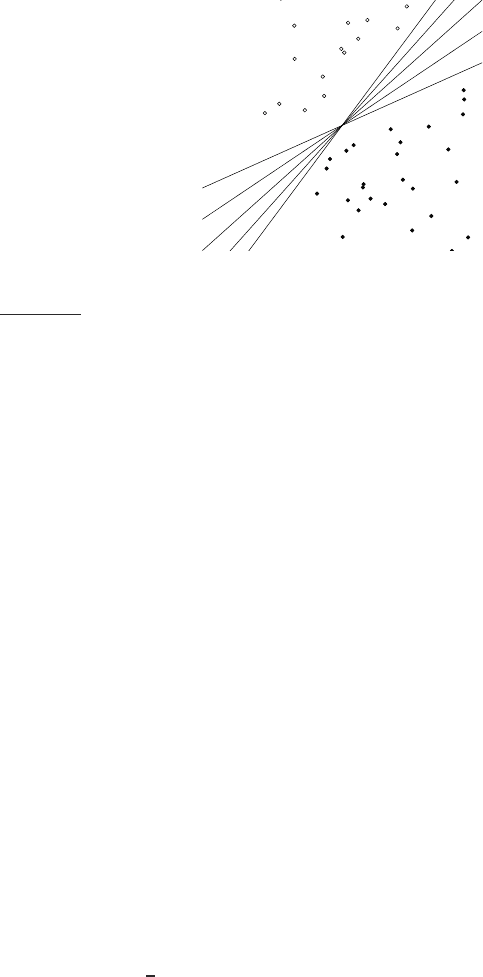
Figure 14.8 There are an infinite number of hyperplanes that separate two linearly
separable classes.
twice the Bayes error rate. That is, if the optimal classifier has an error rate
of x, then 1NN has an asymptotic error rate of less than 2x. This is due to the
effect of noise – we already saw one example of noise in the form of noisy
features in Section
13.5 (page 271), but noise can also take other forms as we
will discuss in the next section. Noise affects two components of kNN: the
test document and the closest training document. The two sources of noise
are additive, so the overall error of 1NN is twice the optimal error rate. For
problems with Bayes error rate 0, the error rate of 1NN will approach 0 as
the size of the training set increases.
?
Exercise 14.3
Explain why kNN handles multimodal classes better than Rocchio.
14.4 Linea r versus nonlinear classifiers
In this section, we show that the two learning methods Naive Bayes and
Rocchio are instances of linear classifiers, the perhaps most important group
of text classifiers, and contrast them with nonlinear classifiers. To simplify
the discussion, we will only consider two-class classifiers in this section and
define a linear classifier as a two-class classifier that decides class membershipLINEAR CLASSIFIER
by comparing a linear combination of the features to a threshold.
In two dimensions, a linear classifier is a line. Five examples are shown
in Figure
14.8. These lines have the functional form w
1
x
1
+ w
2
x
2
= b. The
classification rule of a linear classifier is to assign a document to c if w
1
x
1
+
w
2
x
2
> b and to
c if w
1
x
1
+ w
2
x
2
≤ b. Here, (x
1
, x
2
)
T
is the two-dimensional
vector representation of the document and (w
1
, w
2
)
T
is the parameter vector
Online edition (c)2009 Cambridge UP
302 14 Vector space classification
APPLYLINEARCLASSIFIER(~w, b,~x)
1 score ←
∑
M
i=1
w
i
x
i
2 if score > b
3 t hen return 1
4 else return 0
◮
Figure 14.9 Linear classification algorithm.
that defines (together with b) the decision boundary. An alternative geomet-
ric interpretation of a linear classifier is provided in Figure 15.7 (page 343).
We can generalize this 2D linear classifier to higher dimensions by defining
a hyperplane as we did in Equation (
14.2), repeated here as Equation (14.3):
~w
T
~x = b(14.3)
The assignment criterion then is: assign to c if ~w
T
~x > b and to c if ~w
T
~x ≤ b.
We call a hyperplane that we use as a linear classifier a decision hyperplane.DECISION HYPERPLANE
The corresponding algorithm for linear classification in M dimensions is
shown in Figure
14.9. Linear classification at first seems trivial given the
simplicity of this algorithm. However, the difficulty is in training the lin-
ear classifier, that is, in determining the parameters ~w and b based on the
training set. In general, some learning methods compute much better param-
eters than others where our criterion for evaluating the quality of a learning
method is the effectiveness of the learned linear classifier on new data.
We now show that Rocchio and Naive Bayes are linear classifiers. To see
this for Rocchio, observe that a vector ~x is on the decision boundary if it has
equal distance to the two class centroids:
|~µ(c
1
) −~x| = |~µ(c
2
) −~x|
(14.4)
Some basic arithmetic shows that this corresponds to a linear classifier with
normal vector ~w = ~µ(c
1
) −~µ(c
2
) and b = 0.5 ∗ (|~µ(c
1
)|
2
− |~µ(c
2
)|
2
) (Exer-
cise 14.15).
We can derive the linearity of Naive Bayes from its decision rule, which
chooses the category c with the largest
ˆ
P(c|d) (Figure
13.2, page 260) where:
ˆ
P(c|d) ∝
ˆ
P(c)
∏
1≤k≤n
d
ˆ
P(t
k
|c)
and n
d
is the number of tokens in the document that are part of the vocabu-
lary. Denoting the complement category as
¯
c, we obtain for the log odds:
log
ˆ
P(c|d)
ˆ
P(
¯
c|d)
= log
ˆ
P(c)
ˆ
P(
¯
c)
+
∑
1≤k≤n
d
log
ˆ
P(t
k
|c)
ˆ
P(t
k
|
¯
c)
(14.5)
Online edition (c)2009 Cambridge UP
14.4 Linear versus nonlinear classifiers 303
t
i
w
i
d
1i
d
2i
t
i
w
i
d
1i
d
2i
prime 0.70 0 1 dlrs -0.71 1 1
rate 0.67 1 0 world -0.35 1 0
interest 0.63 0 0
sees -0.33 0 0
rates 0.60 0 0 year -0.25 0 0
discount 0.46 1 0 group -0.24 0 0
bundesbank 0.43 0 0
dlr -0.24 0 0
◮
Table 14.4 A linear classifier. The dimensions t
i
and parameters w
i
of a linear
classifier for the class interest (as in interest rate) in Reuters-21578. The threshold is
b = 0. Terms like dlr and world have negative weights because they are indicators for
the competing class currency.
We choose class c if the odds are greater than 1 or, equivalently, if the log
odds are greater than 0. It is easy to see that Equation (
14.5) is an instance
of Equation (14.3) for w
i
= log[
ˆ
P(t
i
|c)/
ˆ
P(t
i
|
¯
c)], x
i
= number of occurrences
of t
i
in d, and b = −log[
ˆ
P(c)/
ˆ
P(
¯
c)]. Here, the index i , 1 ≤ i ≤ M, refers
to terms of the vocabulary (not to positions in d as k does; cf. Section
13.4.1,
page 270) and ~x and ~w are M-dimensional vectors. So in log space, Naive
Bayes is a linear classifier.
✎
Example 14.3: Table 14.4 defines a linear classifier for the category interest in
Reuters-21578 (see Section
13.6, page 279). We assign document
~
d
1
“rate discount
dlrs world” to interest since ~w
T
~
d
1
= 0.67 · 1 + 0.46 · 1 + (−0.71) · 1 + (−0.35) · 1 =
0.07 > 0 = b. We assign
~
d
2
“prime dlrs” to the complement class (not in interest) since
~w
T
~
d
2
= −0.01 ≤ b. For simplicity, we assume a simple binary vector representation
in this example: 1 for occurring terms, 0 for non-occurring terms.
Figure
14.10 is a graphical example of a linear problem, which we define to
mean that the underlying distributions P(d|c) and P(d|
c) of the two classes
are separated by a line. We call this separating line the class boundary. It isCLASS BOUNDARY
the “true” boundary of the two classes and we distinguish it from the deci-
sion boundary that the learning method computes to approximate the class
boundary.
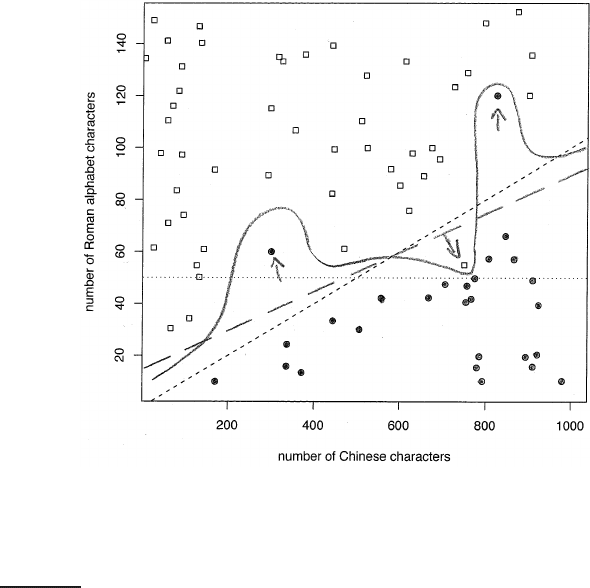
As is typical in text classification, there are some noise documents in Fig-NOISE DOCUMENT
ure
14.10 (marked with arrows) that do not fit well into the overall distri-
bution of the classes. In Section 13.5 (page 271), we defined a noise feature
as a misleading feature that, when included in the document representation,
on average increases the classification error. Analogously, a noise document
is a document that, when included in the training set, misleads the learn-
ing method and increases classification error. Intuitively, the underlying
distribution partitions the representation space into areas with mostly ho-
Online edition (c)2009 Cambridge UP
304 14 Vector space classification
◮
Figure 14.10 A linear problem with noise. In this hypothetical web page classifi-
cation scenario, Chinese-only web pages are solid circles and mixed Chinese-English
web pages are squares. The two classes are separated by a linear class boundary
(dashed line, short dashes), except for three noise documents (marked with arrows).
mogeneous class assignments. A document that does not conform with the
dominant class in its area is a noise document.
Noise documents are one reason why training a linear classifier is hard. If
we pay too much attention to noise documents when choosing the decision
hyperplane of the classifier, then it will be inaccurate on new data. More
fundamentally, it is usually difficult to determine which documents are noise
documents and therefore potentially misleading.
If there exists a hyperplane that perfectly separates the two classes, then
we call the two classes linearly separable. In fact, if linear separability holds,LINEAR SEPARABILITY
then there is an infinite number of linear separators (Exercise
14.4) as illus-
trated by Figure 14.8, where the number of possible separating hyperplanes
is infinite.
Figure
14.8 illustrates another challenge in training a linear classifier. If we
are dealing with a linearly separable problem, then we need a criterion for
selecting among all decision hyperplanes that perfectly separate the training
data. In general, some of these hyperplanes will do well on new data, some
Online edition (c)2009 Cambridge UP
14.4 Linear versus nonlinear classifiers 305
0.0 0.2 0.4 0.6 0.8 1.0
0.0 0.2 0.4 0.6 0.8 1.0
◮
Figure 14.11 A nonlinear problem.
will not.
An example of a nonlinear classifier is kNN. The nonlinearity of kNN isNONLINEAR
CLASSIFIER
intuitively clear when looking at examples like Figure
14.6. The decision
boundaries of kNN (the double lines in Figure 14.6) are locally linear seg-
ments, but in general have a complex shape that is not equivalent to a line in
2D or a hyperplane in higher dimensions.
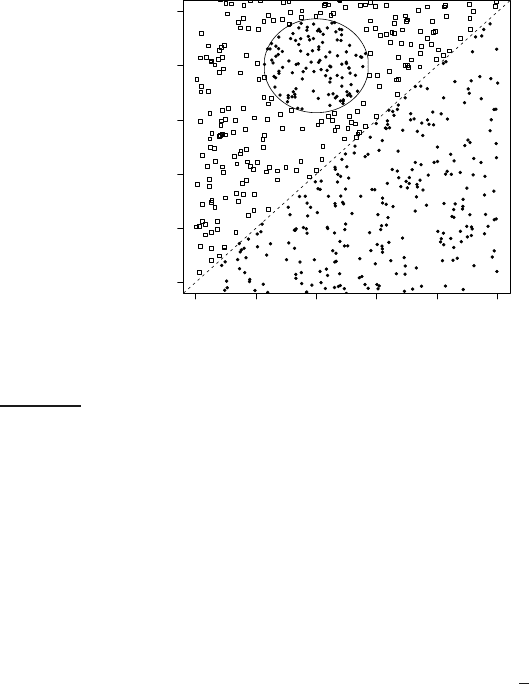
Figure
14.11 is another example of a nonlinear problem: there is no good
linear separator between the distributions P(d|c) and P(d|
c) because of the
circular “enclave” in the upper left part of the graph. Linear classifiers mis-
classify the enclave, whereas a nonlinear classifier like kNN will be highly
accurate for this type of problem if the training set is large enough.
If a problem is nonlinear and its class boundaries cannot be approximated
well with linear hyperplanes, then nonlinear classifiers are often more accu-
rate than linear classifiers. If a problem is linear, it is best to use a simpler
linear classifier.
?
Exercise 14.4
Prove that the number of linear separators of two classes is either infinite or zero.