
Manning Ch. D., Raghavan P., Sch?tze H. Introduction to Information Retrieval - Введение в информационный поиск
Подождите немного. Документ загружается.

Online edition (c)2009 Cambridge UP
316 14 Vector space classification
0 1 2 3 4 5 6 7 8
0
1
2
3
4
5
6
7
8
a
x
b
c
◮
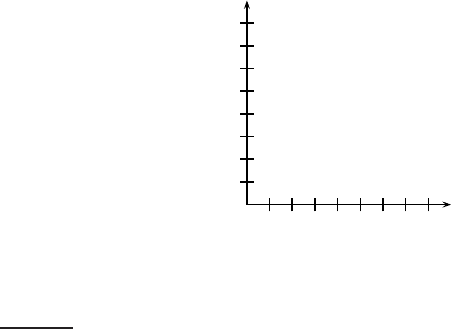
Figure 14.14 Example for differences between Euclidean distance, dot product
similarity and cosine similarity. The vectors are ~a = (0.5 1.5)
T
, ~x = (2 2)
T
,
~
b =
(4 4)
T
, and~c = (8 6)
T
.
plement Rocchio classification and kNN classification, for example, the Bow toolkit
(McCallum 1996).
Exercise 14.8
Download 20 Newgroups (page 154) and train and test Rocchio and kNN classifiers
for its 20 classes.
Exercise 14.9
Show that the decision boundaries in Rocchio classification are, as in kNN, given by
the Voronoi tessellation.
Exercise 14.10 [⋆]
Computing the distance between a dense centroid and a sparse vector is Θ(M) for
a naive implementation that iterates over all M dimensions. Based on the equality
∑
(x
i
− µ
i
)
2
= 1.0 +
∑
µ
2
i
−2
∑
x
i
µ
i
and assuming that
∑
µ
2
i
has been precomputed,
write down an algorithm that is Θ(M
a
) instead, where M
a
is the number of distinct
terms in the test document.
Exercise 14.11 [⋆ ⋆ ⋆]
Prove that the region of the plane consisting of all points with the same k nearest
neighbors is a convex polygon.
Exercise 14.12
Design an algorithm that performs an efficient 1NN search in 1 dimension (where
efficiency is with respect to the number of documents N). What is the time complexity
of the algorithm?
Exercise 14.13 [⋆ ⋆ ⋆]
Design an algorithm that performs an efficient 1NN search in 2 dimensions with at
most polynomial (in N) preprocessing time.
Online edition (c)2009 Cambridge UP
14.8 Exercises 317
◮
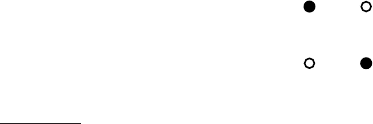
Figure 14.15 A simple non-separable set of points.
Exercise 14.14 [⋆ ⋆ ⋆]
Can one design an exact efficient algorithm for 1NN for very large M along the ideas
you used to solve the last exercise?
Exercise 14.15
Show that Equation (14.4) defines a hyperplane with ~w = ~µ(c
1
) −~µ(c
2
) and b =
0.5 ∗ (|~µ(c
1
)|
2
−|~µ(c
2
)|
2
).
Exercise 14.16
We can easily construct non-separable data sets in high dimensions by embedding
a non-separable set like the one shown in Figure
14.15. Consider embedding Fig-
ure
14.15 in 3D and then perturbing the 4 points slightly (i.e., moving them a small
distance in a random direction). Why would you expect the resulting configuration
to be linearly separable? How likely is then a non-separable set of m ≪ M points in
M-dimensional space?
Exercise 14.17
Assuming two classes, show that the percentage of non-separable assignments of the
vertices of a hypercube decreases with dimensionality M for M > 1. For example,
for M = 1 the proportion of non-separable assignments is 0, for M = 2, it is 2/16.
One of the two non-separable cases for M = 2 is shown in Figure
14.15, the other is
its mirror image. Solve the exercise either analytically or by simulation.
Exercise 14.18
Although we point out the similarities of Naive Bayes with linear vector space classi-
fiers, it does not make sense to represent count vectors (the document representations
in NB) in a continuous vector space. There is however a formalization of NB that is
analogous to Rocchio. Show that NB assigns a document to the class (represented as
a parameter vector) whose Kullback-Leibler (KL) divergence (Section
12.4, page 251)
to the document (represented as a count vector as in Section
13.4.1 (page 270), nor-
malized to sum to 1) is smallest.
Online edition (c)2009 Cambridge UP
Online edition (c)2009 Cambridge UP
DRAFT! © April 1, 2009 Cambridge University Press. Feedback welcome. 319
15
Support vector machines and
machine learni ng on d ocuments
Improving classifier effectiveness has been an area of intensive machine-
learning research over the last two decades, and this work has led to a new
generation of state-of-the-art classifiers, such as support vector machines,
boosted decision trees, regularized logistic regression, neural networks, and
random forests. Many of these methods, including support vector machines
(SVMs), the main topic of this chapter, have been applied with success to
information retrieval problems, particularly text classification. An SVM is a
kind of large-margin classifier: it is a vector space based machine learning
method where the goal is to find a decision boundary between two classes
that is maximally far from any point in the training data (possibly discount-
ing some points as outliers or noise).
We will initially motivate and develop SVMs for the case of two-class data
sets that are separable by a linear classifier (Section 15.1), and then extend the
model in Section
15.2 to non-separable data, multi-class problems, and non-
linear models, and also present some additional discussion of SVM perfor-
mance. The chapter then moves to consider the practical deployment of text
classifiers in Section
15.3: what sorts of classifiers are appropriate when, and
how can you exploit domain-specific text features in classification? Finally,
we will consider how the machine learning technology that we have been
building for text classification can be applied back to the problem of learning
how to rank documents in ad hoc retrieval (Section
15.4). While several ma-
chine learning methods have been applied to this task, use of SVMs has been
prominent. Support vector machines are not necessarily better than other
machine learning methods (except perhaps in situations with little training
data), but they perform at the state-of-the-art level and have much current
theoretical and empirical appeal.
Online edition (c)2009 Cambridge UP
320 15 Support vector machines and machine learning on documents
Support vectors
Maximum
margin
decision
hyperplane
Margin is
maximized
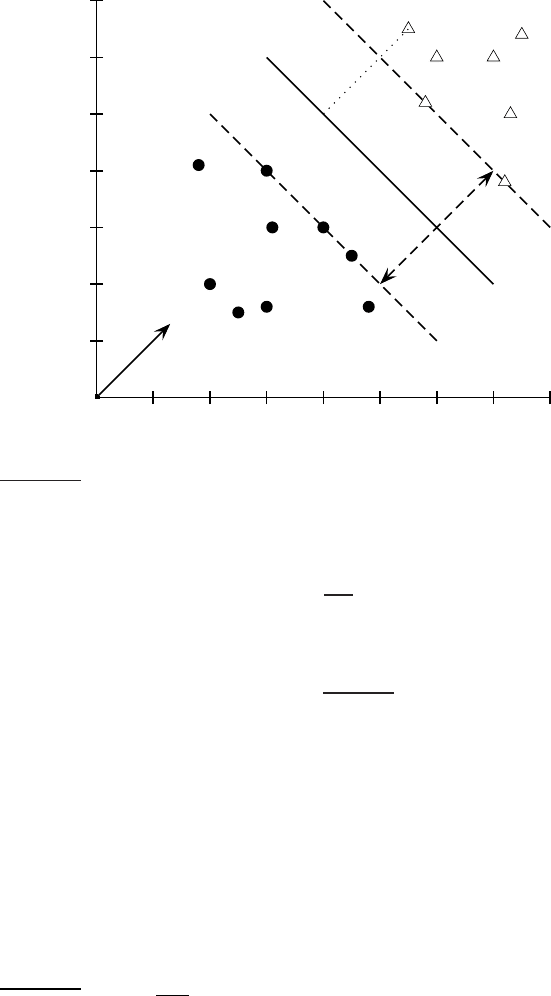
◮
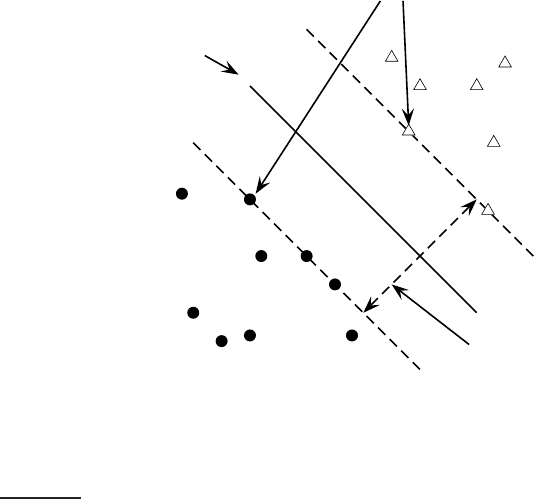
Figure 15.1 The support vectors are the 5 points right up against the margin of
the classifier.
15.1 Supp ort vector machines: The linearly separable case
For two-class, separable training data sets, such as the one in Figure
14.8
(page 301), there are lots of possible linear separators. Intuitively, a decision
boundary drawn in the middle of the void between data items of the two
classes seems better than one which approaches very close to examples of
one or both classes. While some learning methods such as the perceptron
algorithm (see references in Section
14.7, page 314) find just any linear sepa-
rator, others, like Naive Bayes, search for the best linear separator according
to some criterion. The SVM in particular defines the criterion to be looking
for a decision surface that is maximally far away from any data point. This
distance from the decision surface to the closest data point determines the
margin of the classifier. This method of construction necessarily means thatMARGIN
the decision function for an SVM is fully specified by a (usually small) sub-
set of the data which defines the position of the separator. These points are
referred to as the support vectors (in a vector space, a point can be thought ofSUPPORT VECTOR
as a vector between the origin and that point). Figure
15.1 shows the margin
and support vectors for a sample problem. Other data points play no part in
determining the decision surface that is chosen.
Online edition (c)2009 Cambridge UP
15.1 Support vector machines: The linearly separable case 321
◮
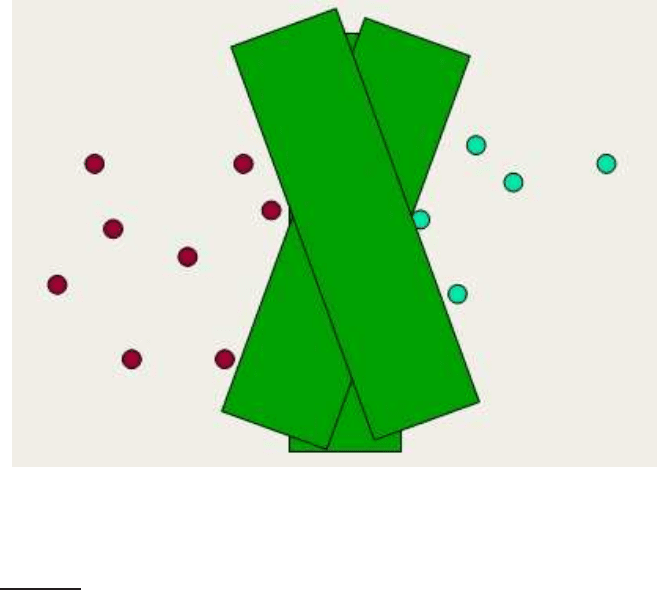
Figure 15.2 An intuition for large-margin classification. Insisting on a large mar-
gin reduces the capacity of the model: the range of angles at which the fat deci-
sion surface can be placed is smaller than for a decision hyperplane (cf. Figure 14.8,
page 301).
Maximizing the margin seems good because points near the decision sur-
face represent very uncertain classification decisions: there is almost a 50%
chance of the classifier deciding either way. A classifier with a large margin
makes no low certainty classification decisions. This gives you a classifica-
tion safety margin: a slight error in measurement or a slight document vari-
ation will not cause a misclassification. Another intuition motivating SVMs
is shown in Figure
15.2. By construction, an SVM classifier insists on a large
margin around the decision boundary. Compared to a decision hyperplane,
if you have to place a fat separator between classes, you have fewer choices
of where it can be put. As a result of this, the memory capacity of the model
has been decreased, and hence we expect that its ability to correctly general-
ize to test data is increased (cf. the discussion of the bias-variance tradeoff in
Chapter
14, page 312).
Let us formalize an SVM with algebra. A decision hyperplane (page 302)
can be defined by an intercept term b and a decision hyperplane normal vec-
tor ~w which is perpendicular to the hyperplane. This vector is commonly

Online edition (c)2009 Cambridge UP
322 15 Support vector machines and machine learning on documents
referred to in the machine learning literature as the weight vector. To chooseWEIGHT VECTOR
among all the hyperplanes that are perpendicular to the normal vector, we
specify the intercept term b. Because the hyperplane is perpendicular to the
normal vector, all points ~x on the hyperplane satisfy ~w
T
~x = −b. Now sup-
pose that we have a set of training data points D = {(~x
i
, y
i
)}, where each
member is a pair of a point ~x
i
and a class label y
i
corresponding to it.
1
For
SVMs, the two data classes are always named +1 and −1 (rather than 1 and
0), and the intercept term is always explicitly represented as b (rather than
being folded into the weight vector ~w by adding an extra always-on feature).
The math works out much more cleanly if you do things this way, as we will
see almost immediately in the definition of functional margin. The linear
classifier is then:
f (~x) = sign(~w
T
~x + b)
(15.1)
A value of −1 indicates one class, and a value of +1 the other class.
We are confident in the classification of a point if it is far away from the
decision boundary. For a given data set and decision hyperplane, we define
the functional margin of the i
th
example ~x
i
with respect to a hyperplane h~w, biFUNCTIONAL MARGIN
as the quantity y
i
(~w
T
~x
i
+ b ). The functional margin of a data set with re-
spect to a decision surface is then twice the functional margin of any of the
points in the data set with minimal functional margin (the factor of 2 comes
from measuring across the whole width of the margin, as in Figure
15.3).
However, there is a problem with using this definition as is: the value is un-
derconstrained, because we can always make the functional margin as big
as we wish by simply scaling up ~w and b. For example, if we replace ~w by
5~w and b by 5b then the functional margin y
i
(5~w
T
~x
i
+ 5b) is five times as
large. This suggests that we need to place some constraint on the size of the
~w vector. To get a sense of how to do that, let us look at the actual geometry.
What is the Euclidean distance from a point ~x to the decision boundary? In
Figure
15.3, we denote by r this distance. We know that the shortest distance
between a point and a hyperplane is perpendicular to the plane, and hence,
parallel to ~w. A unit vector in this direction is ~w/|~w|. The dotted line in the
diagram is then a translation of the vector r~w/|~w|. Let us label the point on
the hyperplane closest to ~x as ~x
′
. Then:
~x
′
= ~x − yr
~w
|~w|
(15.2)
where multiplying by y just changes the sign for the two cases of ~x being on
either side of the decision surface. Moreover,~x
′
lies on the decision boundary
1. As discussed in Section 14.1 (page 291), we present the general case of points in a vector
space, but if the points are length normalized document vectors, then all the action is taking
place on the surface of a unit sphere, and the decision surface intersects the sphere’s surface.
Online edition (c)2009 Cambridge UP
15.1 Support vector machines: The linearly separable case 323
0 1 2 3 4 5 6 7 8
0
1
2
3
4
5
6
7
~x
+
~x
′
r
ρ
~w
◮
Figure 15.3 The geometric margin of a point (r) and a decision boundary (ρ).
and so satisfies ~w
T
~x
′
+ b = 0. Hence:
~w
T
~x −yr
~w
|~w|
+ b = 0
(15.3)
Solving for r gives:
2
r = y
~w
T
~x + b
|~w|
(15.4)
Again, the points closest to the separating hyperplane are support vectors.
The geometric m argin of the classifier is the maximum width of the band thatGEOMETRIC MARGIN
can be drawn separating the support vectors of the two classes. That is, it is
twice the minimum value over data points for r given in Equation (
15.4), or,
equivalently, the maximal width of one of the fat separators shown in Fig-
ure
15.2. The geometric margin is clearly invariant to scaling of parameters:
if we replace ~w by 5~w and b by 5b, then the geometric margin is the same, be-
cause it is inherently normalized by the length of ~w. This means that we can
impose any scaling constraint we wish on ~w without affecting the geometric
margin. Among other choices, we could use unit vectors, as in Chapter
6, by
2. Recall that |~w| =
√
~w
T
~w.
Online edition (c)2009 Cambridge UP
324 15 Support vector machines and machine learning on documents
requiring that |~w| = 1. This would have the effect of making the geometric
margin the same as the functional margin.
Since we can scale the functional margin as we please, for convenience in
solving large SVMs, let us choose to require that the functional margin of all
data points is at least 1 and that it is equal to 1 for at least one data vector.
That is, for all items in the data:
y
i
(~w
T
~x
i
+ b) ≥ 1(15.5)
and there exist support vectors for which the inequality is an equality. Since
each example’s distance from the hyperplane is r
i
= y
i
(~w
T
~x
i
+ b)/|~w|, the
geometric margin is ρ = 2/|~w|. Our desire is still to maximize this geometric
margin. That is, we want to find ~w and b such that:
• ρ = 2/|~w| is maximized
• For all (~x
i
, y
i
) ∈ D, y
i
(~w
T
~x
i
+ b) ≥ 1
Maximizing 2/|~w| is the same as minimizing |~w|/2. This gives the final stan-
dard formulation of an SVM as a minimization problem:
(15.6) Find ~w and b such that:
•
1
2
~w
T
~w is minimized, and
• for all {(~x
i
, y
i
)}, y
i
(~w
T
~x
i
+ b) ≥ 1
We are now optimizing a quadratic function subject to linear constraints.
Quadratic optimiza tion problems are a standard, well-known class of mathe-QUADRATIC
PROGRAMMING
matical optimization problems, and many algorithms exist for solving them.
We could in principle build our SVM using standard quadratic programming
(QP) libraries, but there has been much recent research in this area aiming to
exploit the structure of the kind of QP that emerges from an SVM. As a result,
there are more intricate but much faster and more scalable libraries available
especially for building SVMs, which almost everyone uses to build models.
We will not present the details of such algorithms here.
However, it will be helpful to what follows to understand the shape of the
solution of such an optimization problem. The solution involves construct-
ing a dual problem where a Lagrange multiplier α
i
is associated with each
constraint y
i
(~w
T
~x
i
+ b) ≥ 1 in the primal problem:
(15.7) Find α
1
, . . . α
N
such that
∑
α
i
−
1
2
∑
i
∑
j
α
i
α
j
y
i
y
j
~x
i
T
~x
j
is maximized, and
•
∑
i
α
i
y
i
= 0
• α
i
≥ 0 for all 1 ≤ i ≤ N
The solution is then of the form:
Online edition (c)2009 Cambridge UP
15.1 Support vector machines: The linearly separable case 325
0 1 2 3
0
1
2
3
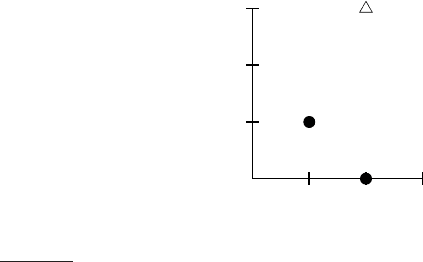
◮
Figure 15.4 A tiny 3 data point training set for an SVM.
(15.8) ~w =
∑
α
i
y
i
~x
i
b = y
k
− ~w
T
~x
k
for any ~x
k
such that α
k
6= 0
In the solution, most of the α
i
are zero. Each non-zero α
i
indicates that the
corresponding ~x
i
is a support vector. The classification function is then:
f (~x) = sign(
∑
i
α
i
y
i
~x
i
T
~x + b)
(15.9)
Both the term to be maximized in the dual problem and the classifying func-
tion involve a dot product between pairs of points (~x and ~x
i
or ~x
i
and ~x
j
), and
that is the only way the data are used – we will return to the significance of
this later.
To recap, we start with a training data set. The data set uniquely defines
the best separating hyperplane, and we feed the data through a quadratic
optimization procedure to find this plane. Given a new point ~x to classify,
the classification function f (~x) in either Equation (
15.1) or Equation (15.9) is
computing the projection of the point onto the hyperplane normal. The sign
of this function determines the class to assign to the point. If the point is
within the margin of the classifier (or another confidence threshold t that we
might have determined to minimize classification mistakes) then the classi-
fier can return “don’t know” rather than one of the two classes. The value
of f (~x) may also be transformed into a probability of classification; fitting
a sigmoid to transform the values is standard (Platt 2000). Also, since the
margin is constant, if the model includes dimensions from various sources,
careful rescaling of some dimensions may be required. However, this is not
a problem if our documents (points) are on the unit hypersphere.
✎
Example 15.1 : Consider building an SVM over the (very little) data set shown in
Figure
15.4. Working geometrically, for an example like this, the maximum margin
weight vector will be parallel to the shortest line connecting points of the two classes,
that is, the line between (1, 1) and (2, 3), giving a weight vector of (1, 2). The opti-
mal decision surface is orthogonal to that line and intersects it at the halfway point.