
Manning Ch. D., Raghavan P., Sch?tze H. Introduction to Information Retrieval - Введение в информационный поиск
Подождите немного. Документ загружается.

Online edition (c)2009 Cambridge UP
306 14 Vector space classification
14.5 Classification with more than two classes
We can extend two-class linear classifiers to J > 2 classes. The method to use
depends on whether the classes are mutually exclusive or not.
Classification for classes that are not mutually exclusive is called any-of ,ANY-OF
CLASSIFICATION
multilabel, or multivalue classification. In this case, a document can belong to
several classes simultaneously, or to a single class, or to none of the classes.
A decision on one class leaves all options open for the others. It is some-
times said that the classes are independent of each other, but this is misleading
since the classes are rarely statistically independent in the sense defined on
page 275. In terms of the formal definition of the classification problem in
Equation (
13.1) (page 256), we learn J different classifiers γ
j
in any-of classi-
fication, each returning either c
j
or c
j
: γ
j
(d) ∈ {c
j
, c
j
}.
Solving an any-of classification task with linear classifiers is straightfor-
ward:
1. Build a classifier for each class, where the training set consists of the set
of documents in the class (positive labels) and its complement (negative
labels).
2. Given the test document, apply each classifier separately. The decision of
one classifier has no influence on the decisions of the other classifiers.
The second type of classification with more than two classes is one-of clas-ONE-OF
CLASSIFICATION
sification. Here, the classes are mutually exclusive. Each document must
belong to exactly one of the classes. One-of classification is also called multi-
nomial, polytomous
4
, multiclass, or single-label classification. Formally, there is a
single classification function γ in one-of classification whose range is C, i.e.,
γ(d) ∈ {c
1
, . . . , c
J
}. kNN is a (nonlinear) one-of classifier.
True one-of problems are less common in text classification than any-of
problems. With classes like UK, China, poultry, or coffee, a document can be
relevant to many topics simultaneously – as when the prime minister of the
UK visits China to talk about the coffee and poultry trade.
Nevertheless, we will often make a one-of assumption, as we did in Fig-
ure
14.1, even if classes are not really mutually exclusive. For the classifica-
tion problem of identifying the language of a document, the one-of assump-
tion is a good approximation as most text is written in only one language.
In such cases, imposing a one-of constraint can increase the classifier’s ef-
fectiveness because errors that are due to the fact that the any-of classifiers
assigned a document to either no class or more than one class are eliminated.
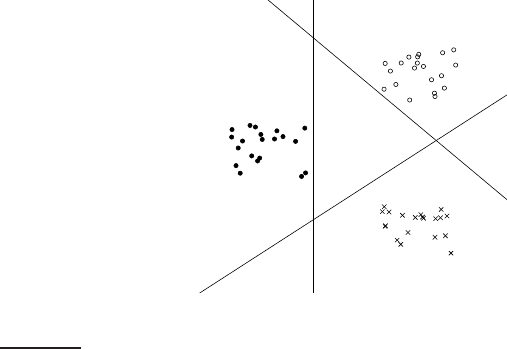
J hyperplanes do not divide R
|V|
into J distinct regions as illustrated in
Figure
14.12. Thus, we must use a combination method when using two-
class linear classifiers for one-of classification. The simplest method is to
4. A synonym of polytomous is polychotomous.
Online edition (c)2009 Cambridge UP
14.5 Classification with more than two classes 307
?
◮
Figure 14.12 J hyperplanes do not divide space into J disjoint regions.
rank classes and then select the top-ranked class. Geometrically, the ranking
can be with respect to the distances from the J linear separators. Documents
close to a class’s separator are more likely to be misclassified, so the greater
the distance from the separator, the more plausible it is that a positive clas-
sification decision is correct. Alternatively, we can use a direct measure of
confidence to rank classes, e.g., probability of class membership. We can
state this algorithm for one-of classification with linear classifiers as follows:
1. Build a classifier for each class, where the training set consists of the set
of documents in the class (positive labels) and its complement (negative
labels).
2. Given the test document, apply each classifier separately.
3. Assign the document to the class with
• the maximum score,
• the maximum confidence value,
• or the maximum probability.
An important tool for analyzing the performance of a classifier for J > 2
classes is the confusion m atrix. The confusion matrix shows for each pair ofCONFUSION MATRIX
classes hc
1
, c
2
i, how many documents from c
1
were incorrectly assigned to c
2
.
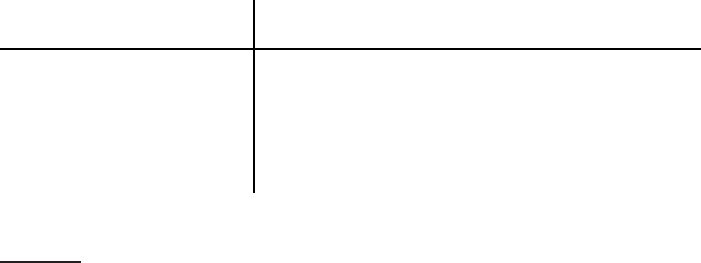
In Table
14.5, the classifier manages to distinguish the three financial classes
money-fx, trade, and interest from the three agricultural classes wheat, c orn,
and grain, but makes many errors within these two groups. The confusion
matrix can help pinpoint opportunities for improving the accuracy of the
Online edition (c)2009 Cambridge UP
308 14 Vector space classification
assigned class
money-fx trad e interest wheat corn grain
true class
money-fx 95 0 10 0 0 0
trade
1 1 90 0 1 0
interest 13 0 0 0 0 0
wheat 0 0 1 34 3 7
corn
1 0 2 13 26 5
grain 0 0 2 14 5 10
◮
Table 14.5 A confusion matrix for Reuters-21578. For example, 14 documents
from grain were incorrectly assigned to wheat. Adapted from Picca et al. (2006).
system. For example, to address the second largest error in Table 14.5 (14 in
the row grain), one could attempt to introduce features that distinguish wheat
documents from grain documents.
?
Exercise 14.5
Create a training set of 300 documents, 100 each from three different languages (e.g.,
English, French, Spanish). Create a test set by the same procedure, but also add 100
documents from a fourth language. Train (i) a one-of classifier (ii) an any-of classi-
fier on this training set and evaluate it on the test set. (iii) Are there any interesting
differences in how the two classifiers behave on this task?
✄
14.6 The bia s-variance tradeoff
Nonlinear classifiers are more powerful than linear classifiers. For some
problems, there exists a nonlinear classifier with zero classification error, but
no such linear classifier. Does that mean that we should always use nonlinear
classifiers for optimal effectiveness in statistical text classification?
To answer this question, we introduce the bias-variance tradeoff in this sec-
tion, one of the most important concepts in machine learning. The tradeoff
helps explain why there is no universally optimal learning method. Selecting
an appropriate learning method is therefore an unavoidable part of solving
a text classification problem.
Throughout this section, we use linear and nonlinear classifiers as proto-
typical examples of “less powerful” and “more powerful” learning, respec-
tively. This is a simplification for a number of reasons. First, many nonlinear
models subsume linear models as a special case. For instance, a nonlinear
learning method like kNN will in some cases produce a linear classifier. Sec-
ond, there are nonlinear models that are less complex than linear models.
For instance, a quadratic polynomial with two parameters is less powerful
than a 10,000-dimensional linear classifier. Third, the complexity of learn-
ing is not really a property of the classifier because there are many aspects
Online edition (c)2009 Cambridge UP
14.6 The bias-variance tradeoff 309
of learning (such as feature selection, cf. (Section 13.5, page 271), regulariza-
tion, and constraints such as margin maximization in Chapter
15) that make
a learning method either more powerful or less powerful without affecting
the type of classifier that is the final result of learning – regardless of whether
that classifier is linear or nonlinear. We refer the reader to the publications
listed in Section
14.7 for a treatment of the bias-variance tradeoff that takes
into account these complexities. In this section, linear and nonlinear classi-
fiers will simply serve as proxies for weaker and stronger learning methods
in text classification.
We first need to state our objective in text classification more precisely. In
Section
13.1 (page 256), we said that we want to minimize classification er-
ror on the test set. The implicit assumption was that training documents
and test documents are generated according to the same underlying distri-
bution. We will denote this distribution P(hd, c i) where d is the document
and c its label or class. Figures
13.4 and 13.5 were examples of generative
models that decompose P(hd, ci) into the product of P(c) and P(d|c). Fig-
ures 14.10 and 14.11 depict generative models for hd, ci with d ∈ R
2
and
c ∈ {square, solid circle}.
In this section, instead of using the number of correctly classified test doc-
uments (or, equivalently, the error rate on test documents) as evaluation
measure, we adopt an evaluation measure that addresses the inherent un-
certainty of labeling. In many text classification problems, a given document
representation can arise from documents belonging to different classes. This
is because documents from different classes can be mapped to the same doc-
ument representation. For example, the one-sentence documents China sues
France and France sues China are mapped to the same document representa-
tion d
′
= {China, France, sues} in a bag of words model. But only the latter
document is relevant to the class c
′
= legal actions brought by France (which
might be defined, for example, as a standing query by an international trade
lawyer).
To simplify the calculations in this section, we do not count the number
of errors on the test set when evaluating a classifier, but instead look at how
well the classifier estimates the conditional probability P(c|d) of a document
being in a class. In the above example, we might have P(c
′
|d
′
) = 0.5.
Our goal in text classification then is to find a classifier γ such that, aver-
aged over documents d, γ(d) is as close as possible to the true probability
P(c|d). We measure this using mean squared error:
MSE(γ) = E
d
[γ(d) − P(c|d)]
2
(14.6)
where E
d
is the expectation with respect to P(d). The mean squared error
term gives partial credit for decisions by γ that are close if not completely
right.

Online edition (c)2009 Cambridge UP
310 14 Vector space classification
E[x −α]
2
= Ex
2
−2Exα + α
2
(14.8)
= (Ex)
2
−2Exα + α
2
+Ex
2
−2(Ex)
2
+ (Ex)
2
= [Ex −α]
2
+Ex
2
− E2x(Ex) + E(Ex)
2
= [Ex −α]
2
+ E[x − Ex]
2
E
D
E
d
[Γ
D
(d) − P(c|d)]
2
= E
d
E
D
[Γ
D
(d) − P (c|d)]
2
(14.9)
= E
d
[ [E
D
Γ
D
(d) − P(c|d)]
2
+E
D
[Γ
D
(d) − E
D
Γ
D
(d)]
2
]
◮
Figure 14.13 Arithmetic transformations for the bias-variance decomposition.
For the derivation of Equation (14.9), we set α = P(c|d) and x = Γ
D
(d) in Equa-
tion (14.8).
We define a classifier γ to be optimal for a distribution P(hd, ci) if it mini-OPTIMAL CLASSIFIER
mizes MSE(γ).
Minimizing MSE is a desideratum for classifiers. We also need a criterion
for learning meth ods. Recall that we defined a learning method Γ as a function
that takes a labeled training set D as input and returns a classifier γ.
For learning methods, we adopt as our goal to find a Γ that, averaged over
training sets, learns classifiers γ with minimal MSE. We can formalize this as
minimizing learning error:LEARNING ERROR
learning-error(Γ) = E
D
[MSE(Γ(D))]
(14.7)
where E
D
is the expectation over labeled training sets. To keep things simple,
we can assume that training sets have a fixed size – the distribution P(hd, ci)
then defines a distribution P(D) over training sets.
We can use learning error as a criterion for selecting a learning method in
statistical text classification. A learning method Γ is optimal for a distributionOPTIMAL LEARNING
METHOD
P(D) if it minimizes the learning error.
Writing Γ
D
for Γ(D) for better readability, we can transform Equation (
14.7)
as follows:
learning-error(Γ) = E
D
[MSE(Γ
D
)]
= E
D
E
d
[Γ
D
(d) − P (c|d)]
2
(14.10)
= E
d
[bias(Γ, d) + variance(Γ, d)](14.11)
Online edition (c)2009 Cambridge UP
14.6 The bias-variance tradeoff 311
bias(Γ, d) = [P(c|d) − E
D
Γ
D
(d)]
2
(14.12)
variance(Γ, d) = E
D
[Γ
D
(d) − E
D
Γ
D
(d)]
2
(14.13)
where the equivalence between Equations (14.10) and (14.11) is shown in
Equation (14.9) in Figure 14.13. Note that d and D are independent of each
other. In general, for a random document d and a random training set D, D
does not contain a labeled instance of d.
Bias is the squared difference between P(c|d), the true conditional prob-BIAS
ability of d being in c, and Γ
D
(d), the prediction of the learned classifier,
averaged over training sets. Bias is large if the learning method produces
classifiers that are consistently wrong. Bias is small if (i) the classifiers are
consistently right or (ii) different training sets cause errors on different docu-
ments or (iii) different training sets cause positive and negative errors on the
same documents, but that average out to close to 0. If one of these three con-
ditions holds, then E
D
Γ
D
(d), the expectation over all training sets, is close to
P(c|d).
Linear methods like Rocchio and Naive Bayes have a high bias for non-
linear problems because they can only model one type of class boundary, a
linear hyperplane. If the generative model P(hd, ci) has a complex nonlinear
class boundary, the bias term in Equation (
14.11) will be high because a large
number of points will be consistently misclassified. For example, the circular
enclave in Figure 14.11 does not fit a linear model and will be misclassified
consistently by linear classifiers.
We can think of bias as resulting from our domain knowledge (or lack
thereof) that we build into the classifier. If we know that the true boundary
between the two classes is linear, then a learning method that produces linear
classifiers is more likely to succeed than a nonlinear method. But if the true
class boundary is not linear and we incorrectly bias the classifier to be linear,
then classification accuracy will be low on average.
Nonlinear methods like kNN have low bias. We can see in Figure
14.6 that
the decision boundaries of kNN are variable – depending on the distribu-
tion of documents in the training set, learned decision boundaries can vary
greatly. As a result, each document has a chance of being classified correctly
for some training sets. The average prediction E
D
Γ
D
(d) is therefore closer to
P(c|d) and bias is smaller than for a linear learning method.
Variance is the variation of the prediction of learned classifiers: the aver-VARIANCE
age squared difference between Γ
D
(d) and its average E
D
Γ
D
(d). Variance is
large if different training sets D give rise to very different classifiers Γ
D
. It is
small if the training set has a minor effect on the classification decisions Γ
D
makes, be they correct or incorrect. Variance measures how inconsistent the
decisions are, not whether they are correct or incorrect.
Linear learning methods have low variance because most randomly drawn
training sets produce similar decision hyperplanes. The decision lines pro-
Online edition (c)2009 Cambridge UP
312 14 Vector space classification
duced by linear learning methods in Figures 14.10 and 14.11 will deviate
slightly from the main class boundaries, depending on the training set, but
the class assignment for the vast majority of documents (with the exception
of those close to the main boundary) will not be affected. The circular enclave
in Figure
14.11 will be consistently misclassified.
Nonlinear methods like kNN have high variance. It is apparent from Fig-
ure
14.6 that kNN can model very complex boundaries between two classes.
It is therefore sensitive to noise documents of the sort depicted in Figure 14.10.
As a result the variance term in Equation (14.11) is large for kNN: Test doc-
uments are sometimes misclassified – if they happen to be close to a noise
document in the training set – and sometimes correctly classified – if there
are no noise documents in the training set near them. This results in high
variation from training set to training set.
High-variance learning methods are prone to overfitting the training data.OVERFITTING
The goal in classification is to fit the training data to the extent that we cap-
ture true properties of the underlying distribution P(hd, ci). In overfitting,
the learning method also learns from noise. Overfitting increases MSE and
frequently is a problem for high-variance learning methods.
We can also think of variance as the model complexity or, equivalently, mem-MEMORY CAPACITY
ory capacity of the learning method – how detailed a characterization of the
training set it can remember and then apply to new data. This capacity corre-
sponds to the number of independent parameters available to fit the training
set. Each kNN neighborhood S
k
makes an independent classification deci-
sion. The parameter in this case is the estimate
ˆ
P(c|S
k
) from Figure
14.7.
Thus, kNN’s capacity is only limited by the size of the training set. It can
memorize arbitrarily large training sets. In contrast, the number of parame-
ters of Rocchio is fixed – J parameters per dimension, one for each centroid
– and independent of the size of the training set. The Rocchio classifier (in
form of the centroids defining it) cannot “remember” fine-grained details of
the distribution of the documents in the training set.
According to Equation (
14.7), our goal in selecting a learning method is to
minimize learning error. The fundamental insight captured by Equation (14.11),
which we can succinctly state as: learning-error = bias + variance, is that the
learning error has two components, bias and variance, which in general can-
not be minimized simultaneously. When comparing two learning methods
Γ
1
and Γ
2
, in most cases the comparison comes down to one method having
higher bias and lower variance and the other lower bias and higher variance.
The decision for one learning method vs. another is then not simply a mat-
ter of selecting the one that reliably produces good classifiers across training
sets (small variance) or the one that can learn classification problems with
very difficult decision boundaries (small bias). Instead, we have to weigh
the respective merits of bias and variance in our application and choose ac-
cordingly. This tradeoff is called the bias-variance tradeoff.BIAS-VARIANCE
TRADEOFF
Online edition (c)2009 Cambridge UP
14.6 The bias-variance tradeoff 313
Figure 14.10 provides an illustration, which is somewhat contrived, but
will be useful as an example for the tradeoff. Some Chinese text contains
English words written in the Roman alphabet like CPU, ONLINE, and GPS.
Consider the task of distinguishing Chinese-only web pages from mixed
Chinese-English web pages. A search engine might offer Chinese users with-
out knowledge of English (but who understand loanwords like CPU) the op-
tion of filtering out mixed pages. We use two features for this classification
task: number of Roman alphabet characters and number of Chinese char-
acters on the web page. As stated earlier, the distribution P(hd, ci) of the
generative model generates most mixed (respectively, Chinese) documents
above (respectively, below) the short-dashed line, but there are a few noise
documents.
In Figure
14.10, we see three classifiers:
• One-feature clas sifier. Shown as a dotted horizontal line. This classifier
uses only one feature, the number of Roman alphabet characters. Assum-
ing a learning method that minimizes the number of misclassifications
in the training set, the position of the horizontal decision boundary is
not greatly affected by differences in the training set (e.g., noise docu-
ments). So a learning method producing this type of classifier has low
variance. But its bias is high since it will consistently misclassify squares
in the lower left corner and “solid circle” documents with more than 50
Roman characters.
• Linear classifier. Shown as a dashed line with long dashes. Learning lin-
ear classifiers has less bias since only noise documents and possibly a few
documents close to the boundary between the two classes are misclassi-
fied. The variance is higher than for the one-feature classifiers, but still
small: The dashed line with long dashes deviates only slightly from the
true boundary between the two classes, and so will almost all linear de-
cision boundaries learned from training sets. Thus, very few documents
(documents close to the class boundary) will be inconsistently classified.
• “Fit-training-set -perfectly” classifier. Shown as a solid line. Here, the
learning method constructs a decision boundary that perfectly separates
the classes in the training set. This method has the lowest bias because
there is no document that is consistently misclassified – the classifiers
sometimes even get noise documents in the test set right. But the variance
of this learning method is high. Because noise documents can move the
decision boundary arbitrarily, test documents close to noise documents
in the training set will be misclassified – something that a linear learning
method is unlikely to do.
It is perhaps surprising that so many of the best-known text classification
algorithms are linear. Some of these methods, in particular linear SVMs, reg-
Online edition (c)2009 Cambridge UP
314 14 Vector space classification
ularized logistic regression and regularized linear regression, are among the
most effective known methods. The bias-variance tradeoff provides insight
into their success. Typical classes in text classification are complex and seem
unlikely to be modeled well linearly. However, this intuition is misleading
for the high-dimensional spaces that we typically encounter in text appli-
cations. With increased dimensionality, the likelihood of linear separability
increases rapidly (Exercise
14.17). Thus, linear models in high-dimensional
spaces are quite powerful despite their linearity. Even more powerful nonlin-
ear learning methods can model decision boundaries that are more complex
than a hyperplane, but they are also more sensitive to noise in the training
data. Nonlinear learning methods sometimes perform better if the training
set is large, but by no means in all cases.
14.7 Ref erences and further reading
As discussed in Chapter 9, Rocchio relevance feedback is due to Rocchio
(1971). Joachims (1997) presents a probabilistic analysis of the method. Roc-
chio classification was widely used as a classification method in TREC in the
1990s (Buckley et al. 1994a;b, Voorhees and Harman 2005). Initially, it was
used as a form of routing. Routing merely ranks documents according to rel-ROUTING
evance to a class without assigning them. Early work on filtering, a true clas-FILTERING
sification approach that makes an assignment decision on each document,
was published by Ittner et al. (1995) and Schapire et al. (1998). The definition
of routing we use here should not be confused with another sense. Routing
can also refer to the electronic distribution of documents to subscribers, the
so-called push model of document distribution. In a pull model, each transferPUSH MODEL
PULL MODEL
of a document to the user is initiated by the user – for example, by means
of search or by selecting it from a list of documents on a news aggregation
website.
Some authors restrict the name Roccchio classificatio n to two-class problems
and use the terms cluster-based (Iwayama and Tokunaga 1995) and c entroid-CENTROID-BASED
CLASSIFICATION
based classification (Han and Karypis 2000, Tan and Cheng 2007) for Rocchio
classification with J > 2.
A more detailed treatment of kNN can be found in (Hastie et al. 2001), in-
cluding methods for tuning the parameter k. An example of an approximate
fast kNN algorithm is locality-based hashing (Andoni et al. 2006). Klein-
berg (1997) presents an approximate Θ((M log
2
M)(M + log N)) kNN algo-
rithm (where M is the dimensionality of the space and N the number of data
points), but at the cost of exponential storage requirements: Θ((N log M)
2M
).
Indyk (2004) surveys nearest neighbor methods in high-dimensional spaces.
Early work on kNN in text classification was motivated by the availability
of massively parallel hardware architectures (Creecy et al. 1992). Yang (1994)
Online edition (c)2009 Cambridge UP
14.8 Exercises 315
uses an inverted index to speed up kNN classification. The optimality result
for 1NN (twice the Bayes error rate asymptotically) is due to Cover and Hart
(1967).
The effectiveness of Rocchio classification and kNN is highly dependent
on careful parameter tuning (in particular, the parameters b
′
for Rocchio on
page
296 and k for kNN), feature engineering (Section 15.3, page 334) and
feature selection (Section
13.5, page 271). Buckley and Salton (1995), Schapire
et al. (1998), Yang and Kisiel (2003) and Moschitti (2003) address these issues
for Rocchio and Yang (2001) and Ault and Yang (2002) for kNN. Zavrel et al.
(2000) compare feature selection methods for kNN.
The bias-variance tradeoff was introduced by Geman et al. (1992). The
derivation in Section
14.6 is for MSE(γ), but the tradeoff applies to many
loss functions (cf. Friedman (1997), Domingos (2000)). Schütze et al. (1995)
and Lewis et al. (1996) discuss linear classifiers for text and Hastie et al. (2001)
linear classifiers in general. Readers interested in the algorithms mentioned,
but not described in this chapter may wish to consult Bishop (2006) for neu-
ral networks, Hastie et al. (2001) for linear and logistic regression, and Min-
sky and Papert (1988) for the perceptron algorithm. Anagnostopoulos et al.
(2006) show that an inverted index can be used for highly efficient document
classification with any linear classifier, provided that the classifier is still ef-
fective when trained on a modest number of features via feature selection.
We have only presented the simplest method for combining two-class clas-
sifiers into a one-of classifier. Another important method is the use of error-
correcting codes, where a vector of decisions of different two-class classifiers
is constructed for each document. A test document’s decision vector is then
“corrected” based on the distribution of decision vectors in the training set,
a procedure that incorporates information from all two-class classifiers and
their correlations into the final classification decision (Dietterich and Bakiri
1995). Ghamrawi and McCallum (2005) also exploit dependencies between
classes in any-of classification. Allwein et al. (2000) propose a general frame-
work for combining two-class classifiers.
14.8 Exe rcises
?
Exercise 14.6
In Figure 14.14, which of the three vectors~a,
~
b, and~c is (i) most similar to ~x according
to dot product similarity, (ii) most similar to ~x according to cosine similarity, (iii)
closest to ~x according to Euclidean distance?
Exercise 14.7
Download Reuters-21578 and train and test Rocchio and kNN classifiers for the classes
acquisitions, corn, crude, earn, grain, interest, money-fx, ship, trade, and wheat. Use the
ModApte split. You may want to use one of a number of software packages that im-