
Manning Ch. D., Raghavan P., Sch?tze H. Introduction to Information Retrieval - Введение в информационный поиск
Подождите немного. Документ загружается.


Online edition (c)2009 Cambridge UP
326 15 Support vector machines and machine learning on documents
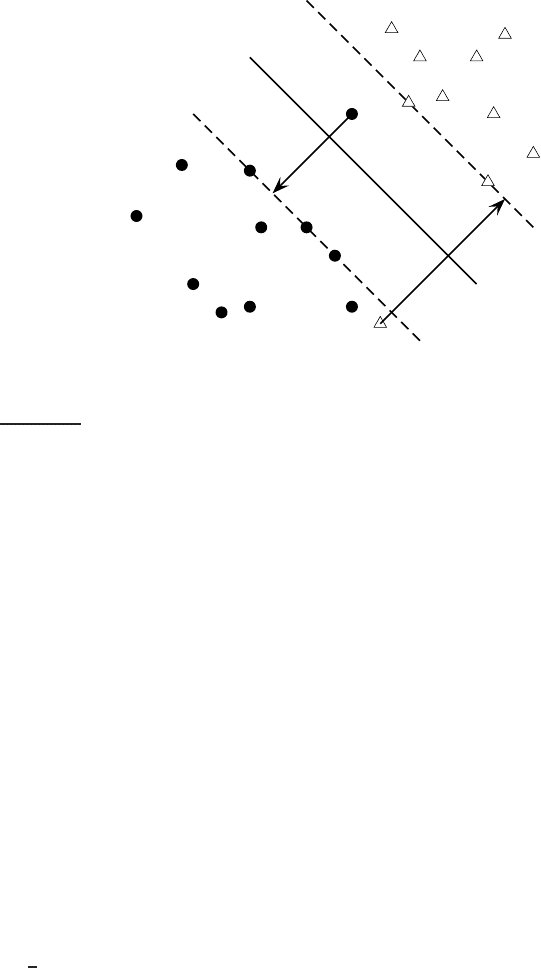
Therefore, it passes through (1.5, 2). So, the SVM decision boundary is:
y = x
1
+ 2x
2
−5.5
Working algebraically, with the standard constraint that sign(y
i
(~w
T
~x
i
+ b)) ≥ 1,
we seek to minimize |~w|. This happens when this constraint is satisfied with equality
by the two support vectors. Further we know that the solution is ~w = (a, 2a) for some
a. So we have that:
a + 2a + b = −1
2a + 6a + b = 1
Therefore, a = 2/5 and b = −11/5. So the optimal hyperplane is given by ~w =
(2/5, 4/5) and b = −11/5.
The margin ρ is 2/|~w| = 2/
√
4/25 + 16/25 = 2/(2
√
5/5) =
√
5. This answer can
be confirmed geometrically by examining Figure
15.4.
?
Exercise 15.1
[⋆]
What is the minimum number of support vectors that there can be for a data set
(which contains instances of each class)?
Exercise 15.2 [⋆⋆]
The basis of being able to use kernels in SVMs (see Section
15.2.3) is that the classifica-
tion function can be written in the form of Equation (
15.9) (where, for large problems,
most α
i
are 0). Show explicitly how the classification function could be written in this
form for the data set from Example
15.1. That is, write f as a function where the data
points appear and the only variable is ~x.
Exercise 15.3 [⋆⋆]
Install an SVM package such as SVMlight (http://svmlight.joachims.org/), and build an
SVM for the data set discussed in Example
15.1. Confirm that the program gives the
same solution as the text. For SVMlight, or another package that accepts the same
training data format, the training file would be:
+1 1:2 2:3
−1 1:2 2:0
−1 1:1 2:1
The training command for SVMlight is then:
svm_learn -c 1 -a alphas.dat train.dat model.dat
The -c 1 option is needed to turn off use of the slack variables that we discuss in
Section
15.2.1. Check that the norm of the weight vector agrees with what we found
in Example
15.1. Examine the file alphas.dat which contains the α
i
values, and check
that they agree with your answers in Exercise
15.2.
Online edition (c)2009 Cambridge UP
15.2 Extensions to the SVM model 327
~x
i
ξ
i
~x
j
ξ
j
◮
Figure 15.5 Large margin classification with slack variables.
15.2 Exten sions to the SVM model
15.2.1 Soft margin classification
For the very high dimensional problems common in text classification, some-
times the data are linearly separable. But in the general case they are not, and
even if they are, we might prefer a solution that better separates the bulk of
the data while ignoring a few weird noise documents.
If the training set D is not linearly separable, the standard approach is to
allow the fat decision margin to make a few mistakes (some points – outliers
or noisy examples – are inside or on the wrong side of the margin). We then
pay a cost for each misclassified example, which depends on how far it is
from meeting the margin requirement given in Equation (
15.5). To imple-
ment this, we introduce slack variables ξ
i
. A non-zero value for ξ
i
allows ~x
i
toSLACK VARIABLES
not meet the margin requirement at a cost proportional to the value of ξ
i
. See
Figure
15.5.
The formulation of the SVM optimization problem with slack variables is:
(15.10) Find ~w, b, and ξ
i
≥ 0 such that:
•
1
2
~w
T
~w + C
∑
i
ξ
i
is minimized
• and for all {(~x
i
, y
i
)}, y
i
(~w
T
~x
i
+ b) ≥ 1 −ξ
i

Online edition (c)2009 Cambridge UP
328 15 Support vector machines and machine learning on documents
The optimization problem is then trading off how fat it can make the margin
versus how many points have to be moved around to allow this margin.
The margin can be less than 1 for a point ~x
i
by setting ξ
i
> 0, but then one
pays a penalty of Cξ
i
in the minimization for having done that. The sum of
the ξ
i
gives an upper bound on the number of training errors. Soft-margin
SVMs minimize training error traded off against margin. The parameter C
is a regularization term, which provides a way to control overfitting: as CREGULARIZATION
becomes large, it is unattractive to not respect the data at the cost of reducing
the geometric margin; when it is small, it is easy to account for some data
points with the use of slack variables and to have a fat margin placed so it
models the bulk of the data.
The dual problem for soft margin classification becomes:
(15.11) Find α
1
, . . . α
N
such that
∑
α
i
−
1
2
∑
i
∑
j
α
i
α
j
y
i
y
j
~x
i
T
~x
j
is maximized, and
•
∑
i
α
i
y
i
= 0
• 0 ≤ α
i
≤ C for all 1 ≤ i ≤ N
Neither the slack variables ξ
i
nor Lagrange multipliers for them appear in the
dual problem. All we are left with is the constant C bounding the possible
size of the Lagrange multipliers for the support vector data points. As before,
the ~x
i
with non-zero α
i
will be the support vectors. The solution of the dual
problem is of the form:
(15.12) ~w =
∑
αy
i
~x
i
b = y
k
(1 − ξ
k
) − ~w
T
~x
k
for k = arg max
k
α
k
Again ~w is not needed explicitly for classification, which can be done in terms
of dot products with data points, as in Equation (
15.9).
Typically, the support vectors will be a small proportion of the training
data. However, if the problem is non-separable or with small margin, then
every data point which is misclassified or within the margin will have a non-
zero α
i
. If this set of points becomes large, then, for the nonlinear case which
we turn to in Section
15.2.3, this can be a major slowdown for using SVMs at
test time.
The complexity of training and testing with linear SVMs is shown in Ta-
ble
15.1.
3
The time for training an SVM is dominated by the time for solving
the underlying QP, and so the theoretical and empirical complexity varies de-
pending on the method used to solve it. The standard result for solving QPs
is that it takes time cubic in the size of the data set (Kozlov et al. 1979). All the
recent work on SVM training has worked to reduce that complexity, often by
3. We write Θ(|D|L
ave
) for Θ(T) (page 262) and assume that the length of test documents is
bounded as we did on page 262.
Online edition (c)2009 Cambridge UP
15.2 Extensions to the SVM model 329
Classifier Mode Method Time complexity
NB training Θ(|D|L
ave
+ |C||V|)
NB testing Θ(|C|M
a
)
Rocchio training Θ(|D|L
ave
+ |C||V|)
Rocchio testing Θ(|C|M
a
)
kNN training preprocessing Θ(|D|L
ave
)
kNN testing preprocessing Θ(|D|M
ave
M
a
)
kNN training no preprocessing Θ(1)
kNN testing no preprocessing Θ(|D|L
ave
M
a
)
SVM training conventional O(|C||D|
3
M
ave
);
≈ O(|C||D|
1.7
M
ave
), empirically
SVM training cutting planes O(|C||D|M
ave
)
SVM testing O(|C|M
a
)
◮
Table 15.1 Training and testing complexity of various classifiers including SVMs.
Training is the time the learning method takes to learn a classifier over D, while test-
ing is the time it takes a classifier to classify one document. For SVMs, multiclass
classification is assumed to be done by a set of |C| one-versus-rest classifiers. L
ave
is
the average number of tokens per document, while M
ave
is the average vocabulary
(number of non-zero features) of a document. L
a
and M
a
are the numbers of tokens
and types, respectively, in the test document.
being satisfied with approximate solutions. Standardly, empirical complex-
ity is about O(|D|
1.7
) (Joachims 2006a). Nevertheless, the super-linear train-
ing time of traditional SVM algorithms makes them difficult or impossible
to use on very large training data sets. Alternative traditional SVM solu-
tion algorithms which are linear in the number of training examples scale
badly with a large number of features, which is another standard attribute
of text problems. However, a new training algorithm based on cutting plane
techniques gives a promising answer to this issue by having running time
linear in the number of training examples and the number of non-zero fea-
tures in examples (Joachims 2006a). Nevertheless, the actual speed of doing
quadratic optimization remains much slower than simply counting terms as
is done in a Naive Bayes model. Extending SVM algorithms to nonlinear
SVMs, as in the next section, standardly increases training complexity by a
factor of |D| (since dot products between examples need to be calculated),
making them impractical. In practice it can often be cheaper to materialize

Online edition (c)2009 Cambridge UP
330 15 Support vector machines and machine learning on documents
the higher-order features and to train a linear SVM.
4
15.2.2 Multiclass SVMs
SVMs are inherently two-class classifiers. The traditional way to do mul-
ticlass classification with SVMs is to use one of the methods discussed in
Section
14.5 (page 306). In particular, the most common technique in prac-
tice has been to build |C| one-versus-rest classifiers (commonly referred to as
“one-versus-all” or OVA classification), and to choose the class which classi-
fies the test datum with greatest margin. Another strategy is to build a set
of one-versus-one classifiers, and to choose the class that is selected by the
most classifiers. While this involves building |C|(|C| − 1)/2 classifiers, the
time for training classifiers may actually decrease, since the training data set
for each classifier is much smaller.
However, these are not very elegant approaches to solving multiclass prob-
lems. A better alternative is provided by the construction of multiclass SVMs,
where we build a two-class classifier over a feature vector Φ(~x, y) derived
from the pair consisting of the input features and the class of the datum. At
test time, the classifier chooses the class y = arg max
y
′
~w
T
Φ(~x, y
′
). The mar-
gin during training is the gap between this value for the correct class and
for the nearest other class, and so the quadratic program formulation will
require that ∀i ∀y 6= y
i
~w
T
Φ(~x
i
, y
i
) − ~w
T
Φ(~x
i
, y) ≥ 1 − ξ
i
. This general
method can be extended to give a multiclass formulation of various kinds of
linear classifiers. It is also a simple instance of a generalization of classifica-
tion where the classes are not just a set of independent, categorical labels, but
may be arbitrary structured objects with relationships defined between them.
In the SVM world, such work comes under the label of structural SVMs. WeSTRUCTURAL SVMS
mention them again in Section
15.4.2.
15.2.3 Nonlinear SVMs
With what we have presented so far, data sets that are linearly separable (per-
haps with a few exceptions or some noise) are well-handled. But what are
we going to do if the data set just doesn’t allow classification by a linear clas-
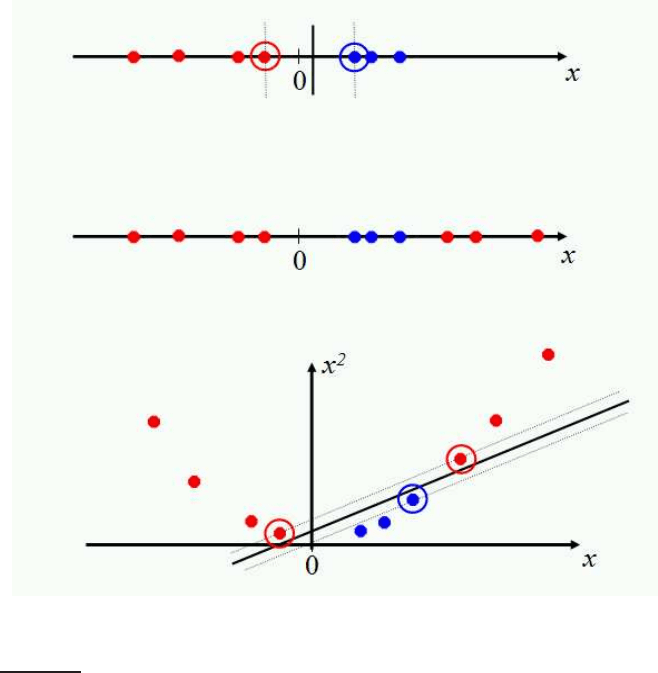
sifier? Let us look at a one-dimensional case. The top data set in Figure
15.6
is straightforwardly classified by a linear classifier but the middle data set is
not. We instead need to be able to pick out an interval. One way to solve this
problem is to map the data on to a higher dimensional space and then to use
a linear classifier in the higher dimensional space. For example, the bottom
part of the figure shows that a linear separator can easily classify the data
4. Materializing the features refers to directly calculating higher order and interaction terms
and then putting them into a linear model.
Online edition (c)2009 Cambridge UP
15.2 Extensions to the SVM model 331
◮
Figure 15.6 Projecting data that is not linearly separable into a higher dimensional
space can make it linearly separable.
if we use a quadratic function to map the data into two dimensions (a po-
lar coordinates projection would be another possibility). The general idea is
to map the original feature space to some higher-dimensional feature space
where the training set is separable. Of course, we would want to do so in
ways that preserve relevant dimensions of relatedness between data points,
so that the resultant classifier should still generalize well.
SVMs, and also a number of other linear classifiers, provide an easy and
efficient way of doing this mapping to a higher dimensional space, which is
referred to as “the kernel trick”. It’s not really a trick: it just exploits the mathKERNEL TRICK
that we have seen. The SVM linear classifier relies on a dot product between
data point vectors. Let K(~x
i
,~x
j
) = ~x
i
T
~x
j
. Then the classifier we have seen so

Online edition (c)2009 Cambridge UP
332 15 Support vector machines and machine learning on documents
far is:
f (~x) = sign(
∑
i
α
i
y
i
K(~x
i
,~x) + b )(15.13)
Now suppose we decide to map every data point into a higher dimensional
space via some transformation Φ:~x 7→ φ(~x). Then the dot product becomes
φ(~x
i
)
T
φ(~x
j
). If it turned out that this dot product (which is just a real num-
ber) could be computed simply and efficiently in terms of the original data
points, then we wouldn’t have to actually map from ~x 7→ φ(~x). Rather, we
could simply compute the quantity K(~x
i
,~x
j
) = φ(~x
i
)
T
φ(~x
j
), and then use the
function’s value in Equation (
15.13). A kernel function K is such a functionKERNEL FUNCTION
that corresponds to a dot product in some expanded feature space.
✎
Example 15.2: The quadratic kernel in two dimensions. For 2-dimensional
vectors ~u = (u
1
u
2
), ~v = (v
1
v
2
), consider K(~u,~v) = (1 + ~u
T
~v)
2
. We wish to
show that this is a kernel, i.e., that K(~u,~v) = φ(~u)
T
φ(~v) for some φ. Consider φ(~u) =
(1 u
2
1
√
2u
1
u
2
u
2
2
√
2u
1
√
2u
2
). Then:
K(~u,~v) = (1 + ~u
T
~v)
2
(15.14)
= 1 + u
2
1
v
2
1
+ 2u
1
v
1
u
2
v
2
+ u
2
2
v
2
2
+ 2u
1
v
1
+ 2u
2
v
2
= (1 u
2
1
√
2u
1
u
2
u
2
2
√
2u
1
√
2u
2
)
T
(1 v
2
1
√
2v
1
v
2
v
2
2
√
2v
1
√
2v
2
)
= φ(~u)
T
φ(~v )
In the language of functional analysis, what kinds of functions are valid
kernel functions? Kernel functions are sometimes more precisely referred toKERNEL
as Mercer kernels, because they must satisfy Mercer’s condition: for any g(~x)MERCER KERNEL
such that
R
g(~x)
2
d~x is finite, we must have that:
Z
K(~x,~z)g(~x)g(~z)d~xd~z ≥ 0 .
(15.15)
A kernel function K must be continuous, symmetric, and have a positive def-
inite gram matrix. Such a K means that there exists a mapping to a reproduc-
ing kernel Hilbert space (a Hilbert space is a vector space closed under dot
products) such that the dot product there gives the same value as the function
K. If a kernel does not satisfy Mercer’s condition, then the corresponding QP
may have no solution. If you would like to better understand these issues,
you should consult the books on SVMs mentioned in Section
15.5. Other-
wise, you can content yourself with knowing that 90% of work with kernels
uses one of two straightforward families of functions of two vectors, which
we define below, and which define valid kernels.
The two commonly used families of kernels are polynomial kernels and
radial basis functions. Polynomial kernels are of the form K(~x,~z) = (1 +
Online edition (c)2009 Cambridge UP
15.2 Extensions to the SVM model 333
~x
T
~z)
d
. The case of d = 1 is a linear kernel, which is what we had before the
start of this section (the constant 1 just changing the threshold). The case of
d = 2 gives a quadratic kernel, and is very commonly used. We illustrated
the quadratic kernel in Example
15.2.
The most common form of radial basis function is a Gaussian distribution,
calculated as:
K(~x,~z) = e
−(~x−~z)
2
/(2σ
2
)
(15.16)
A radial basis function (rbf) is equivalent to mapping the data into an infi-
nite dimensional Hilbert space, and so we cannot illustrate the radial basis
function concretely, as we did a quadratic kernel. Beyond these two families,
there has been interesting work developing other kernels, some of which is
promising for text applications. In particular, there has been investigation of
string kernels (see Section
15.5).
The world of SVMs comes with its own language, which is rather different
from the language otherwise used in machine learning. The terminology
does have deep roots in mathematics, but it’s important not to be too awed
by that terminology. Really, we are talking about some quite simple things. A
polynomial kernel allows us to model feature conjunctions (up to the order of
the polynomial). That is, if we want to be able to model occurrences of pairs
of words, which give distinctive information about topic classification, not
given by the individual words alone, like perhaps operating AND system or
ethnic AND cleansing, then we need to use a quadratic kernel. If occurrences
of triples of words give distinctive information, then we need to use a cubic
kernel. Simultaneously you also get the powers of the basic features – for
most text applications, that probably isn’t useful, but just comes along with
the math and hopefully doesn’t do harm. A radial basis function allows you
to have features that pick out circles (hyperspheres) – although the decision
boundaries become much more complex as multiple such features interact. A
string kernel lets you have features that are character subsequences of terms.
All of these are straightforward notions which have also been used in many
other places under different names.
15.2.4 Experimental results
We presented results in Section
13.6 showing that an SVM is a very effec-
tive text classifier. The results of Dumais et al. (1998) given in Table
13.9
show SVMs clearly performing the best. This was one of several pieces of
work from this time that established the strong reputation of SVMs for text
classification. Another pioneering work on scaling and evaluating SVMs
for text classification was (Joachims 1998). We present some of his results
Online edition (c)2009 Cambridge UP
334 15 Support vector machines and machine learning on documents
Roc- Dec. linear SVM rbf-SVM
NB chio Trees kNN C = 0.5 C = 1.0 σ ≈ 7
earn 96.0 96.1 96.1 97.8 98.0 98.2 98.1
acq 90.7 92.1 85.3 91.8 95.5 95.6 94.7
money-fx 59.6 67.6 69.4 75.4 78.8 78.5 74.3
grain 69.8 79.5 89.1 82.6 91.9 93.1 93.4
crude 81.2 81.5 75.5 85.8 89.4 89.4 88.7
trade 52.2 77.4 59.2 77.9 79.2 79.2 76.6
interest 57.6 72.5 49.1 76.7 75.6 74.8 69.1
ship 80.9 83.1 80.9 79.8 87.4 86.5 85.8
wheat 63.4 79.4 85.5 72.9 86.6 86.8 82.4
corn 45.2 62.2 87.7 71.4 87.5 87.8 84.6
microavg. 72.3 79.9 79.4 82.6 86.7 87.5 86.4
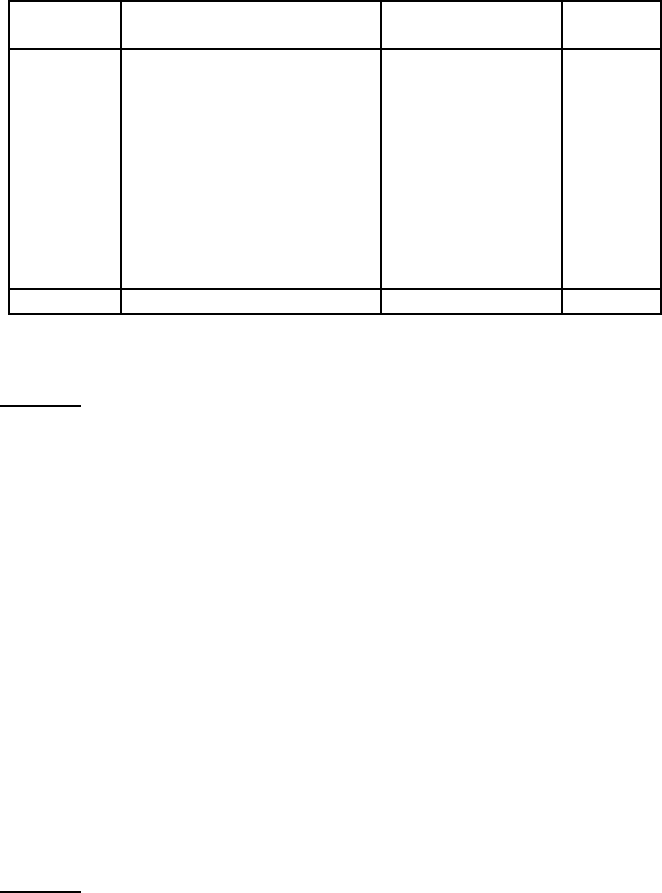
◮
Table 15.2 SVM classifier break-even F
1
from (Joachims 2002a, p. 114). Results
are shown for the 10 largest categories and for microaveraged performance over all
90 categories on the Reuters-21578 data set.
from (Joachims 2002a) in Table 15.2.
5
Joachims used a large number of term
features in contrast to Dumais et al. (1998), who used MI feature selection
(Section
13.5.1, page 272) to build classifiers with a much more limited num-
ber of features. The success of the linear SVM mirrors the results discussed
in Section
14.6 (page 308) on other linear approaches like Naive Bayes. It
seems that working with simple term features can get one a long way. It is
again noticeable the extent to which different papers’ results for the same ma-
chine learning methods differ. In particular, based on replications by other
researchers, the Naive Bayes results of (Joachims 1998) appear too weak, and
the results in Table
13.9 should be taken as representative.
15.3 Issues in the classification of text documents
There are lots of applications of text classification in the commercial world;
email spam filtering is perhaps now the most ubiquitous. Jackson and Mou-
linier (2002) write: “There is no question concerning the commercial value of
being able to classify documents automatically by content. There are myriad
5. These results are in terms of the break-even F
1
(see Section 8.4). Many researchers disprefer
this measure for text classification evaluation, since its calculation may involve interpolation
rather than an actual parameter setting of the system and it is not clear why this value should
be reported rather than maximal F
1
or another point on the precision/recall curve motivated by
the task at hand. While earlier results in (Joachims 1998) suggested notable gains on this task
from the use of higher order polynomial or rbf kernels, this was with hard-margin SVMs. With
soft-margin SVMs, a simple linear SVM with the default C = 1 performs best.
Online edition (c)2009 Cambridge UP
15.3 Issues in the classification of text documents 335
potential applications of such a capability for corporate Intranets, govern-
ment departments, and Internet publishers.”
Most of our discussion of classification has focused on introducing various
machine learning methods rather than discussing particular features of text
documents relevant to classification. This bias is appropriate for a textbook,
but is misplaced for an application developer. It is frequently the case that
greater performance gains can be achieved from exploiting domain-specific
text features than from changing from one machine learning method to an-
other. Jackson and Moulinier (2002) suggest that “Understanding the data
is one of the keys to successful categorization, yet this is an area in which
most categorization tool vendors are extremely weak. Many of the ‘one size
fits all’ tools on the market have not been tested on a wide range of content
types.” In this section we wish to step back a little and consider the applica-
tions of text classification, the space of possible solutions, and the utility of
application-specific heuristics.
15.3.1 C hoosing what kind of classifier to use
When confronted with a need to build a text classifier, the first question to
ask is how much training data is there currently available? None? Very little?
Quite a lot? Or a huge amount, growing every day? Often one of the biggest
practical challenges in fielding a machine learning classifier in real applica-
tions is creating or obtaining enough training data. For many problems and
algorithms, hundreds or thousands of examples from each class are required
to produce a high performance classifier and many real world contexts in-
volve large sets of categories. We will initially assume that the classifier is
needed as soon as possible; if a lot of time is available for implementation,
much of it might be spent on assembling data resources.
If you have no labeled training data, and especially if there are existing
staff knowledgeable about the domain of the data, then you should never
forget the solution of using hand-written rules. That is, you write standing
queries, as we touched on at the beginning of Chapter
13. For example:
IF (wheat OR grain) AND NOT (whole OR bread) THEN c = grain
In practice, rules get a lot bigger than this, and can be phrased using more
sophisticated query languages than just Boolean expressions, including the
use of numeric scores. With careful crafting (that is, by humans tuning the
rules on development data), the accuracy of such rules can become very high.
Jacobs and Rau (1990) report identifying articles about takeovers with 92%
precision and 88.5% recall, and Hayes and Weinstein (1990) report 94% re-
call and 84% precision over 675 categories on Reuters newswire documents.
Nevertheless the amount of work to create such well-tuned rules is very
large. A reasonable estimate is 2 days per class, and extra time has to go