
Manning Ch. D., Raghavan P., Sch?tze H. Introduction to Information Retrieval - Введение в информационный поиск
Подождите немного. Документ загружается.

Online edition (c)2009 Cambridge UP
336 15 Support vector machines and machine learning on documents
into maintenance of rules, as the content of documents in classes drifts over
time (cf. page
269).
If you have fairly little data and you are going to train a supervised clas-
sifier, then machine learning theory says you should stick to a classifier with
high bias, as we discussed in Section
14.6 (page 308). For example, there
are theoretical and empirical results that Naive Bayes does well in such cir-
cumstances (Ng and Jordan 2001, Forman and Cohen 2004), although this
effect is not necessarily observed in practice with regularized models over
textual data (Klein and Manning 2002). At any rate, a very low bias model
like a nearest neighbor model is probably counterindicated. Regardless, the
quality of the model will be adversely affected by the limited training data.
Here, the theoretically interesting answer is to try to apply semi-supervisedSEMI-SUPERVISED
LEARNING
training methods. This includes methods such as bootstrapping or the EM
algorithm, which we will introduce in Section
16.5 (page 368). In these meth-
ods, the system gets some labeled documents, and a further large supply
of unlabeled documents over which it can attempt to learn. One of the big
advantages of Naive Bayes is that it can be straightforwardly extended to
be a semi-supervised learning algorithm, but for SVMs, there is also semi-
supervised learning work which goes under the title of transductive SVMs.TRANSDUCTIVE SVMS
See the references for pointers.
Often, the practical answer is to work out how to get more labeled data as
quickly as you can. The best way to do this is to insert yourself into a process
where humans will be willing to label data for you as part of their natural
tasks. For example, in many cases humans will sort or route email for their
own purposes, and these actions give information about classes. The alter-
native of getting human labelers expressly for the task of training classifiers
is often difficult to organize, and the labeling is often of lower quality, be-
cause the labels are not embedded in a realistic task context. Rather than
getting people to label all or a random sample of documents, there has also
been considerable research on active learning, where a system is built whichACTIVE LEARNING
decides which documents a human should label. Usually these are the ones
on which a classifier is uncertain of the correct classification. This can be ef-
fective in reducing annotation costs by a factor of 2–4, but has the problem
that the good documents to label to train one type of classifier often are not
the good documents to label to train a different type of classifier.
If there is a reasonable amount of labeled data, then you are in the per-
fect position to use everything that we have presented about text classifi-
cation. For instance, you may wish to use an SVM. However, if you are
deploying a linear classifier such as an SVM, you should probably design
an application that overlays a Boolean rule-based classifier over the machine
learning classifier. Users frequently like to adjust things that do not come
out quite right, and if management gets on the phone and wants the classi-
fication of a particular document fixed right now, then this is much easier to

Online edition (c)2009 Cambridge UP
15.3 Issues in the classification of text documents 337
do by hand-writing a rule than by working out how to adjust the weights
of an SVM without destroying the overall classification accuracy. This is one
reason why machine learning models like decision trees which produce user-
interpretable Boolean-like models retain considerable popularity.
If a huge amount of data are available, then the choice of classifier probably
has little effect on your results and the best choice may be unclear (cf. Banko
and Brill 2001). It may be best to choose a classifier based on the scalability
of training or even runtime efficiency. To get to this point, you need to have
huge amounts of data. The general rule of thumb is that each doubling of
the training data size produces a linear increase in classifier performance,
but with very large amounts of data, the improvement becomes sub-linear.
15.3.2 Impro ving classifier performance
For any particular application, there is usually significant room for improv-
ing classifier effectiveness through exploiting features specific to the domain
or document collection. Often documents will contain zones which are espe-
cially useful for classification. Often there will be particular subvocabularies
which demand special treatment for optimal classification effectiveness.
Large and difficult category taxonomies
If a text classification problem consists of a small number of well-separated
categories, then many classification algorithms are likely to work well. But
many real classification problems consist of a very large number of often
very similar categories. The reader might think of examples like web direc-
tories (the Yahoo! Directory or the Open Directory Project), library classi-
fication schemes (Dewey Decimal or Library of Congress) or the classifica-
tion schemes used in legal or medical applications. For instance, the Yahoo!
Directory consists of over 200,000 categories in a deep hierarchy. Accurate
classification over large sets of closely related classes is inherently difficult.
Most large sets of categories have a hierarchical structure, and attempting
to exploit the hierarchy by doing hierarchical classification is a promising ap-HIERARCHICAL
CLASSIFICATION
proach. However, at present the effectiveness gains from doing this rather
than just working with the classes that are the leaves of the hierarchy re-
main modest.
6
But the technique can be very useful simply to improve the
scalability of building classifiers over large hierarchies. Another simple way
to improve the scalability of classifiers over large hierarchies is the use of
aggressive feature selection. We provide references to some work on hierar-
chical classification in Section 15.5.
6. Using the small hierarchy in Figure 13.1 (page 257) as an example, the leaf classes are ones
like poultry and coffee, as opposed to higher-up classes like industries.
Online edition (c)2009 Cambridge UP
338 15 Support vector machines and machine learning on documents
A general result in machine learning is that you can always get a small
boost in classification accuracy by combining multiple classifiers, provided
only that the mistakes that they make are at least somewhat independent.
There is now a large literature on techniques such as voting, bagging, and
boosting multiple classifiers. Again, there are some pointers in the refer-
ences. Nevertheless, ultimately a hybrid automatic/manual solution may be
needed to achieve sufficient classification accuracy. A common approach in
such situations is to run a classifier first, and to accept all its high confidence
decisions, but to put low confidence decisions in a queue for manual review.
Such a process also automatically leads to the production of new training
data which can be used in future versions of the machine learning classifier.
However, note that this is a case in point where the resulting training data is
clearly not randomly sampled from the space of documents.
Features for text
The default in both ad hoc retrieval and text classification is to use terms
as features. However, for text classification, a great deal of mileage can be
achieved by designing additional features which are suited to a specific prob-
lem. Unlike the case of IR query languages, since these features are internal
to the classifier, there is no problem of communicating these features to an
end user. This process is generally referred to as feature engineering. At pre-FEATURE ENGINEERING
sent, feature engineering remains a human craft, rather than something done
by machine learning. Good feature engineering can often markedly improve
the performance of a text classifier. It is especially beneficial in some of the
most important applications of text classification, like spam and porn filter-
ing.
Classification problems will often contain large numbers of terms which
can be conveniently grouped, and which have a similar vote in text classi-
fication problems. Typical examples might be year mentions or strings of
exclamation marks. Or they may be more specialized tokens like ISBNs or
chemical formulas. Often, using them directly in a classifier would greatly in-
crease the vocabulary without providing classificatory power beyond know-
ing that, say, a chemical formula is present. In such cases, the number of
features and feature sparseness can be reduced by matching such items with
regular expressions and converting them into distinguished tokens. Con-
sequently, effectiveness and classifier speed are normally enhanced. Some-
times all numbers are converted into a single feature, but often some value
can be had by distinguishing different kinds of numbers, such as four digit
numbers (which are usually years) versus other cardinal numbers versus real
numbers with a decimal point. Similar techniques can be applied to dates,
ISBN numbers, sports game scores, and so on.
Going in the other direction, it is often useful to increase the number of fea-
Online edition (c)2009 Cambridge UP
15.3 Issues in the classification of text documents 339
tures by matching parts of words, and by matching selected multiword pat-
terns that are particularly discriminative. Parts of words are often matched
by character k-gram features. Such features can be particularly good at pro-
viding classification clues for otherwise unknown words when the classifier
is deployed. For instance, an unknown word ending in -rase is likely to be an
enzyme, even if it wasn’t seen in the training data. Good multiword patterns
are often found by looking for distinctively common word pairs (perhaps
using a mutual information criterion between words, in a similar way to
its use in Section
13.5.1 (page 272) for feature selection) and then using fea-
ture selection methods evaluated against classes. They are useful when the
components of a compound would themselves be misleading as classifica-
tion cues. For instance, this would be the case if the keyword ethnic was
most indicative of the categories food and arts, the keyword cleansing was
most indicative of the category home, but the collocation ethnic cleansing in-
stead indicates the category world news. Some text classifiers also make use
of features from named entity recognizers (cf. page
195).
Do techniques like stemming and lowercasing (Section 2.2, page 22) help
for text classification? As always, the ultimate test is empirical evaluations
conducted on an appropriate test collection. But it is nevertheless useful to
note that such techniques have a more restricted chance of being useful for
classification. For IR, you often need to collapse forms of a word like oxy-
genate and oxyg enatio n, because the appearance of either in a document is a
good clue that the document will be relevant to a query about oxygenation.
Given copious training data, stemming necessarily delivers no value for text
classification. If several forms that stem together have a similar signal, the
parameters estimated for all of them will have similar weights. Techniques
like stemming help only in compensating for data sparseness. This can be
a useful role (as noted at the start of this section), but often different forms
of a word can convey significantly different cues about the correct document
classification. Overly aggressive stemming can easily degrade classification
performance.
Document zones in text classification
As already discussed in Section
6.1, documents usually have zones, such as
mail message headers like the subject and author, or the title and keywords
of a research article. Text classifiers can usually gain from making use of
these zones during training and classification.
Upweighting document zones. In text classification problems, you can fre-
quently get a nice boost to effectiveness by differentially weighting contri-
butions from different document zones. Often, upweighting title words is
particularly effective (Cohen and Singer 1999, p. 163). As a rule of thumb,
Online edition (c)2009 Cambridge UP
340 15 Support vector machines and machine learning on documents
it is often effective to double the weight of title words in text classification
problems. You can also get value from upweighting words from pieces of
text that are not so much clearly defined zones, but where nevertheless evi-
dence from document structure or content suggests that they are important.
Murata et al. (2000) suggest that you can also get value (in an ad hoc retrieval
context) from upweighting the first sentence of a (newswire) document.
Separate feature spaces for document zones. There are two strategies that
can be used for document zones. Above we upweighted words that appear
in certain zones. This means that we are using the same features (that is, pa-
rameters are “tied” across different zones), but we pay more attention to thePARAMETER TYING
occurrence of terms in particular zones. An alternative strategy is to have a
completely separate set of features and corresponding parameters for words
occurring in different zones. This is in principle more powerful: a word
could usually indicate the topic Middle East when in the title but Commodities
when in the body of a document. But, in practice, tying parameters is usu-
ally more successful. Having separate feature sets means having two or more
times as many parameters, many of which will be much more sparsely seen
in the training data, and hence with worse estimates, whereas upweighting
has no bad effects of this sort. Moreover, it is quite uncommon for words to
have different preferences when appearing in different zones; it is mainly the
strength of their vote that should be adjusted. Nevertheless, ultimately this
is a contingent result, depending on the nature and quantity of the training
data.
Connections t o text summariza tion. In Section
8.7, we mentioned the field
of text summarization, and how most work in that field has adopted the
limited goal of extracting and assembling pieces of the original text that are
judged to be central based on features of sentences that consider the sen-
tence’s position and content. Much of this work can be used to suggest zones
that may be distinctively useful for text classification. For example Kołcz
et al. (2000) consider a form of feature selection where you classify docu-
ments based only on words in certain zones. Based on text summarization
research, they consider using (i) only the title, (ii) only the first paragraph,
(iii) only the paragraph with the most title words or keywords, (iv) the first
two paragraphs or the first and last paragraph, or (v) all sentences with a
minimum number of title words or keywords. In general, these positional
feature selection methods produced as good results as mutual information
(Section
13.5.1), and resulted in quite competitive classifiers. Ko et al. (2004)
also took inspiration from text summarization research to upweight sen-
tences with either words from the title or words that are central to the doc-
ument’s content, leading to classification accuracy gains of almost 1%. This
Online edition (c)2009 Cambridge UP
15.4 Machine learning methods in ad hoc information retrieval 341
presumably works because most such sentences are somehow more central
to the concerns of the document.
?
Exercise 15.4
[⋆⋆]
Spam email often makes use of various cloaking techniques to try to get through. One
method is to pad or substitute characters so as to defeat word-based text classifiers.
For example, you see terms like the following in spam email:
Rep1icaRolex bonmus Viiiaaaagra pi11z
PHARlbdMACY [LEV]i[IT]l[RA] se∧xual ClAfLlS
Discuss how you could engineer features that would largely defeat this strategy.
Exercise 15.5 [⋆⋆]
Another strategy often used by purveyors of email spam is to follow the message
they wish to send (such as buying a cheap stock or whatever) with a paragraph of
text from another innocuous source (such as a news article). Why might this strategy
be effective? How might it be addressed by a text classifier?
Exercise 15.6 [⋆]
What other kinds of features appear as if they would be useful in an email spam
classifier?
15.4 Machine learning methods in ad hoc informa tion retrieval
Rather than coming up with term and document weighting functions by
hand, as we primarily did in Chapter
6, we can view different sources of rele-
vance signal (cosine score, title match, etc.) as features in a learning problem.
A classifier that has been fed examples of relevant and nonrelevant docu-
ments for each of a set of queries can then figure out the relative weights
of these signals. If we configure the problem so that there are pairs of a
document and a query which are assigned a relevance judgment of relevant
or nonrelevant, then we can think of this problem too as a text classification
problem. Taking such a classification approach is not necessarily best, and
we present an alternative in Section
15.4.2. Nevertheless, given the material
we have covered, the simplest place to start is to approach this problem as
a classification problem, by ordering the documents according to the confi-
dence of a two-class classifier in its relevance decision. And this move is not
purely pedagogical; exactly this approach is sometimes used in practice.
15.4.1 A simple example of machine-learned scoring
In this section we generalize the methodology of Section
6.1.2 (page 113) to
machine learning of the scoring function. In Section 6.1.2 we considered a
case where we had to combine Boolean indicators of relevance; here we con-
sider more general factors to further develop the notion of machine-learned

Online edition (c)2009 Cambridge UP
342 15 Support vector machines and machine learning on documents
Example DocID Query Cosine score ω Judgment
Φ
1
37 linux operating system 0.032 3 relevant
Φ
2
37 penguin logo 0.02 4 nonrelevant
Φ
3
238 operating system 0.043 2 relevant
Φ
4
238 runtime environment 0.004 2 nonrelevant
Φ
5
1741 kernel layer 0.022 3 relevant
Φ
6
2094 device driver 0.03 2 relevant
Φ
7
3191 device driver 0.027 5 nonrelevant
··· ··· ··· ··· ··· ···
◮
Table 15.3 Training examples for machine-learned scoring.
relevance. In particular, the factors we now consider go beyond Boolean
functions of query term presence in document zones, as in Section
6.1.2.
We develop the ideas in a setting where the scoring function is a linear
combination of two factors: (1) the vector space cosine similarity between
query and document and (2) the minimum window width ω within which
the query terms lie. As we noted in Section
7.2.2 (page 144), query term
proximity is often very indicative of a document being on topic, especially
with longer documents and on the web. Among other things, this quantity
gives us an implementation of implicit phrases. Thus we have one factor that
depends on the statistics of query terms in the document as a bag of words,
and another that depends on proximity weighting. We consider only two
features in the development of the ideas because a two-feature exposition
remains simple enough to visualize. The technique can be generalized to
many more features.
As in Section
6.1.2, we are provided with a set of training examples, each
of which is a pair consisting of a query and a document, together with a
relevance judgment for that document on that query that is either relevant or
nonrelevant. For each such example we can compute the vector space cosine
similarity, as well as the window width ω. The result is a training set as
shown in Table
15.3, which resembles Figure 6.5 (page 115) from Section 6.1.2.
Here, the two features (cosine score denoted α and window width ω) are
real-valued predictors. If we once again quantify the judgment relevant as 1
and nonrelevant as 0, we seek a scoring function that combines the values of
the features to generate a value that is (close to) 0 or 1. We wish this func-
tion to be in agreement with our set of training examples as far as possible.
Without loss of generality, a linear classifier will use a linear combination of
features of the form
Score(d, q) = Score(α, ω) = aα + bω + c,
(15.17)
with the coefficients a, b, c to be learned from the training data. While it is
Online edition (c)2009 Cambridge UP
15.4 Machine learning methods in ad hoc information retrieval 343
◮
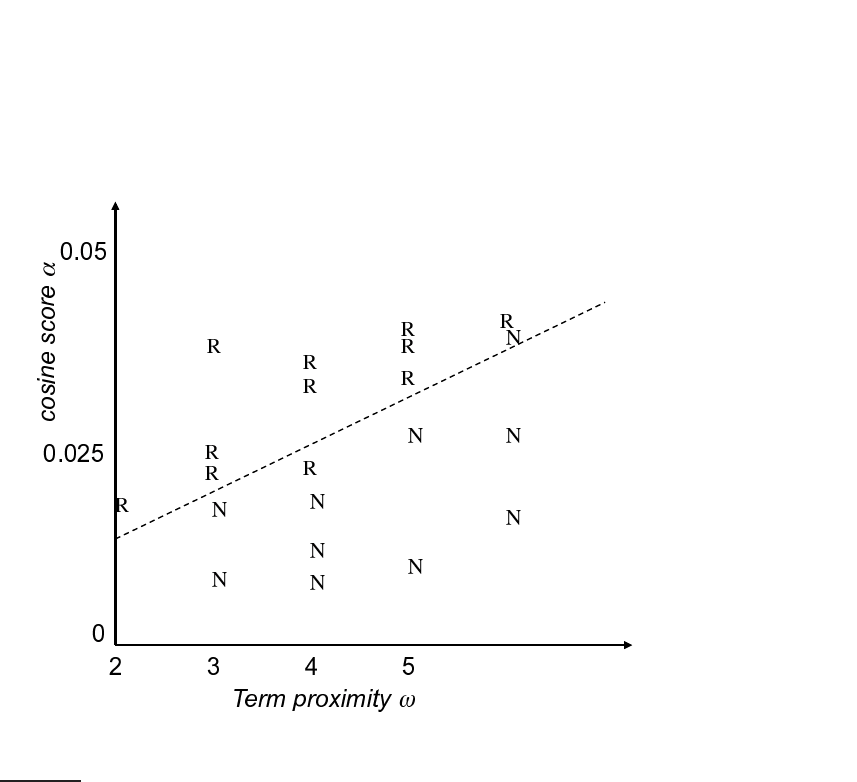
Figure 15.7 A collection of training examples. Each R denotes a training example
labeled relevant, while each N is a training example labeled nonrelevant.
possible to formulate this as an error minimization problem as we did in
Section 6.1.2, it is instructive to visualize the geometry of Equation (15.17).
The examples in Table 15.3 can be plotted on a two-dimensional plane with
axes corresponding to the cosine score α and the window width ω. This is
depicted in Figure
15.7.
In this setting, the function Scor e(α, ω) from Equation (15.17) represents
a plane “hanging above” Figure
15.7. Ideally this plane (in the direction
perpendicular to the page containing Figure 15.7) assumes values close to
1 above the points marked R, and values close to 0 above the points marked
N. Since a plane is unlikely to assume only values close to 0 or 1 above the
training sample points, we make use of thresholding: given any query and
document for which we wish to determine relevance, we pick a value θ and
if Score(α, ω) > θ we declare the document to be relevant, else we declare
the document to be nonrelevant. As we know from Figure
14.8 (page 301),
all points that satisfy Scor e(α, ω) = θ form a line (shown as a dashed line
in Figure
15.7) and we thus have a linear classifier that separates relevant
Online edition (c)2009 Cambridge UP
344 15 Support vector machines and machine learning on documents
from nonrelevant instances. Geometrically, we can find the separating line
as follows. Consider the line passing through the plane Score(α, ω) whose
height is θ above the page containing Figure
15.7. Project this line down onto
Figure
15.7; this will be the dashed line in Figure 15.7. Then, any subse-
quent query/document pair that falls below the dashed line in Figure 15.7 is
deemed nonrelevant; above the dashed line, relevant.
Thus, the problem of making a binary relevant/nonrelevant judgment given
training examples as above turns into one of learning the dashed line in Fig-
ure
15.7 separating relevant training examples from the nonrelevant ones. Be-
ing in the α-ω plane, this line can be written as a linear equation involving
α and ω, with two parameters (slope and intercept). The methods of lin-
ear classification that we have already looked at in Chapters
13–15 provide
methods for choosing this line. Provided we can build a sufficiently rich col-
lection of training samples, we can thus altogether avoid hand-tuning score
functions as in Section
7.2.3 (page 145). The bottleneck of course is the ability
to maintain a suitably representative set of training examples, whose rele-
vance assessments must be made by experts.
15.4.2 R esult ranking by machine learning
The above ideas can be readily generalized to functions of many more than
two variables. There are lots of other scores that are indicative of the rel-
evance of a document to a query, including static quality (PageRank-style
measures, discussed in Chapter
21), document age, zone contributions, doc-
ument length, and so on. Providing that these measures can be calculated
for a training document collection with relevance judgments, any number
of such measures can be used to train a machine learning classifier. For in-
stance, we could train an SVM over binary relevance judgments, and order
documents based on their probability of relevance, which is monotonic with
the documents’ signed distance from the decision boundary.
However, approaching IR result ranking like this is not necessarily the
right way to think about the problem. Statisticians normally first divide
problems into classification problems (where a categorical variable is pre-
dicted) versus regression problems (where a real number is predicted). InREGRESSION
between is the specialized field of ordinal regression where a ranking is pre-ORDINAL REGRESSION
dicted. Machine learning for ad hoc retrieval is most properly thought of as
an ordinal regression problem, where the goal is to rank a set of documents
for a query, given training data of the same sort. This formulation gives
some additional power, since documents can be evaluated relative to other
candidate documents for the same query, rather than having to be mapped
to a global scale of goodness, while also weakening the problem space, since
just a ranking is required rather than an absolute measure of relevance. Is-
sues of ranking are especially germane in web search, where the ranking at

Online edition (c)2009 Cambridge UP
15.4 Machine learning methods in ad hoc information retrieval 345
the very top of the results list is exceedingly important, whereas decisions
of relevance of a document to a query may be much less important. Such
work can and has been pursued using the structural SVM framework which
we mentioned in Section
15.2.2, where the class being predicted is a ranking
of results for a query, but here we will present the slightly simpler ranking
SVM.
The construction of a ranking SVM proceeds as follows. We begin with aRANKING SVM
set of judged queries. For each training query q, we have a set of documents
returned in response to the query, which have been totally ordered by a per-
son for relevance to the query. We construct a vector of features ψ
j
= ψ(d
j
, q)
for each document/query pair, using features such as those discussed in Sec-
tion
15.4.1, and many more. For two documents d
i
and d
j
, we then form the
vector of feature differences:
Φ(d
i
, d
j
, q) = ψ(d
i
, q) −ψ(d
j
, q)
(15.18)
By hypothesis, one of d
i
and d
j
has been judged more relevant. If d
i
is
judged more relevant than d
j
, denoted d
i
≺ d
j
(d
i
should precede d
j
in the
results ordering), then we will assign the vector Φ(d
i
, d
j
, q) the class y
ijq
=
+1; otherwise −1. The goal then is to build a classifier which will return
~w
T
Φ(d
i
, d
j
, q) > 0 iff d
i
≺ d
j
(15.19)
This SVM learning task is formalized in a manner much like the other exam-
ples that we saw before:
(15.20) Find ~w, and ξ
i,j
≥ 0 such that:
•
1
2
~w
T
~w + C
∑
i,j
ξ
i,j
is minimized
• and for all {Φ(d
i
, d
j
, q) : d
i
≺ d
j
}, ~w
T
Φ(d
i
, d
j
, q) ≥ 1 − ξ
i,j
We can leave out y
ijq
in the statement of the constraint, since we only need
to consider the constraint for document pairs ordered in one direction, since
≺ is antisymmetric. These constraints are then solved, as before, to give
a linear classifier which can rank pairs of documents. This approach has
been used to build ranking functions which outperform standard hand-built
ranking functions in IR evaluations on standard data sets; see the references
for papers that present such results.
Both of the methods that we have just looked at use a linear weighting
of document features that are indicators of relevance, as has most work in
this area. It is therefore perhaps interesting to note that much of traditional
IR weighting involves nonlinear scaling of basic measurements (such as log-
weighting of term frequency, or idf). At the present time, machine learning is
very good at producing optimal weights for features in a linear combination