
Manning Ch. D., Raghavan P., Sch?tze H. Introduction to Information Retrieval - Введение в информационный поиск
Подождите немного. Документ загружается.

Online edition (c)2009 Cambridge UP
366 16 Flat clustering
2 4 6 8 10
1750 1800 1850 1900 1950
number of clusters
residual sum of squares
◮
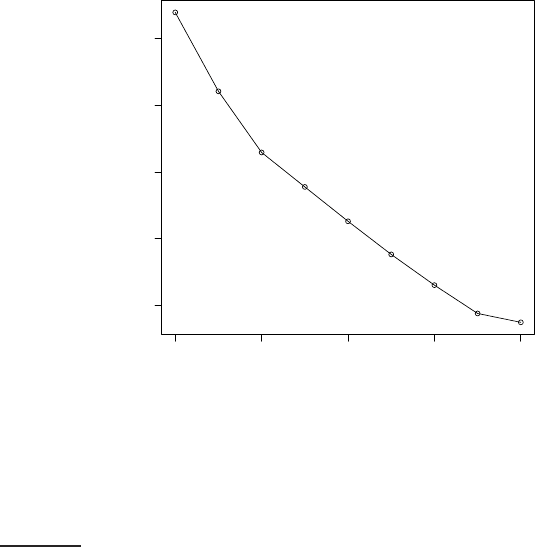
Figure 16.8 Estimated minimal residual sum of squares as a function of the num-
ber of clusters in K-means. In this clustering of 1203 Reuters-RCV1 documents, there
are two points where the
d
RSS
min
curve flattens: at 4 clusters and at 9 clusters. The
documents were selected from the categories Chin a, Germany, Russia and Sports, so
the K = 4 clustering is closest to the Reuters classification.
A second type of criterion for cluster cardinality imposes a penalty for each
new cluster – where conceptually we start with a single cluster containing all
documents and then search for the optimal number of clusters K by succes-
sively incrementing K by one. To determine the cluster cardinality in this
way, we create a generalized objective function that combines two elements:
distortion, a measure of how much documents deviate from the prototype ofDISTORTION
their clusters (e.g., RSS for K-means); and a measure of model complexity. WeMODEL COMPLEXITY
interpret a clustering here as a model of the data. Model complexity in clus-
tering is usually the number of clusters or a function thereof. For K-means,
we then get this selection criterion for K:
K = arg min
K
[RSS
min
(K) + λK]
(16.11)
where λ is a weighting factor. A large value of λ favors solutions with few
clusters. For λ = 0, there is no penalty for more clusters and K = N is the
best solution.
Online edition (c)2009 Cambridge UP
16.4 K-means 367
The obvious difficulty with Equation (16.11) is that we need to determine
λ. Unless this is easier than determining K directly, then we are back to
square one. In some cases, we can choose values of λ that have worked well
for similar data sets in the past. For example, if we periodically cluster news
stories from a newswire, there is likely to be a fixed value of λ that gives us
the right K in each successive clustering. In this application, we would not
be able to determine K based on past experience since K changes.
A theoretical justification for Equation (
16.11) is the Akaike Information Cri-AKAIKE INFORMATION
CRITERION
terion or AIC, an information-theoretic measure that trades off distortion
against model complexity. The general form of AIC is:
AIC: K = arg min
K
[−2L(K) + 2q(K)](16.12)
where −L(K), the negative maximum log-likelihood of the data for K clus-
ters, is a measure of distortion and q(K), the number of parameters of a
model with K clusters, is a measure of model complexity. We will not at-
tempt to derive the AIC here, but it is easy to understand intuitively. The
first property of a good model of the data is that each data point is modeled
well by the model. This is the goal of low distortion. But models should
also be small (i.e., have low model complexity) since a model that merely
describes the data (and therefore has zero distortion) is worthless. AIC pro-
vides a theoretical justification for one particular way of weighting these two
factors, distortion and model complexity, when selecting a model.
For K-means, the AIC can be stated as follows:
AIC: K = arg min
K
[RSS
min
(K) + 2MK]
(16.13)
Equation (16.13) is a special case of Equation (16.11) for λ = 2M.
To derive Equation (16.13) from Equation (16.12) observe that q(K) = KM
in K-means since each element of the K centroids is a parameter that can be
varied independently; and that L(K) = −(1/2)RSS
min
(K) (modulo a con-
stant) if we view the model underlying K-means as a Gaussian mixture with
hard assignment, uniform cluster priors and identical spherical covariance
matrices (see Exercise
16.19).
The derivation of AIC is based on a number of assumptions, e.g., that the
data are independent and identically distributed. These assumptions are
only approximately true for data sets in information retrieval. As a conse-
quence, the AIC can rarely be applied without modification in text clustering.
In Figure
16.8, the dimensionality of the vector space is M ≈ 50,000. Thus,
2MK > 50,000 dominates the smaller RSS-based term (
d
RSS
min
(1) < 5000,
not shown in the figure) and the minimum of the expression is reached for
K = 1. But as we know, K = 4 (corresponding to the four classes China,
Online edition (c)2009 Cambridge UP
368 16 Flat clustering
Germany, Russia and Sports) is a better choice than K = 1. In practice, Equa-
tion (
16.11) is often more useful than Equation (16.13) – with the caveat that
we need to come up with an estimate for λ.
?
Exercise 16.4
Why are documents that do not use the same term for the concept car likely to end
up in the same cluster in K-means clustering?
Exercise 16.5
Two of the possible termination conditions for K-means were (1) assignment does not
change, (2) centroids do not change (page
361). Do these two conditions imply each
other?
✄
16.5 Model-based clustering
In this section, we describe a generalization of K-means, the EM algorithm.
It can be applied to a larger variety of document representations and distri-
butions than K-means.
In K-means, we attempt to find centroids that are good representatives. We
can view the set of K centroids as a model that generates the data. Generating
a document in this model consists of first picking a centroid at random and
then adding some noise. If the noise is normally distributed, this procedure
will result in clusters of spherical shape. Model-based clustering assumes thatMODEL-BASED
CLUSTERING
the data were generated by a model and tries to recover the original model
from the data. The model that we recover from the data then defines clusters
and an assignment of documents to clusters.
A commonly used criterion for estimating the model parameters is maxi-
mum likelihood. In K-means, the quantity exp(−RSS) is proportional to the
likelihood that a particular model (i.e., a set of centroids) generated the data.
For K-means, maximum likelihood and minimal RSS are equivalent criteria.
We denote the model parameters by Θ. In K-means, Θ = {~µ
1
, . . . ,~µ
K
}.
More generally, the maximum likelihood criterion is to select the parame-
ters Θ that maximize the log-likelihood of generating the data D:
Θ = arg max
Θ
L(D|Θ) = arg max
Θ
log
N
∏
n=1
P(d
n
|Θ) = arg max
Θ
N
∑
n=1
log P(d
n
|Θ)
L(D|Θ) is the objective function that measures the goodness of the cluster-
ing. Given two clusterings with the same number of clusters, we prefer the
one with higher L(D|Θ).
This is the same approach we took in Chapter
12 (page 237) for language
modeling and in Section 13.1 (page 265) for text classification. In text clas-
sification, we chose the class that maximizes the likelihood of generating a
particular document. Here, we choose the clustering Θ that maximizes the

Online edition (c)2009 Cambridge UP
16.5 Model-based clusterin g 369
likelihood of generating a given set of documents. Once we have Θ, we can
compute an assignment probability P(d|ω
k
; Θ) for each document-cluster
pair. This set of assignment probabilities defines a soft clustering.
An example of a soft assignment is that a document about Chinese cars
may have a fractional membership of 0.5 in each of the two clusters Ch ina
and automo biles, reflecting the fact that both topics are pertinent. A hard clus-
tering like K-means cannot model this simultaneous relevance to two topics.
Model-based clustering provides a framework for incorporating our know-
ledge about a domain. K-means and the hierarchical algorithms in Chap-
ter 17 make fairly rigid assumptions about the data. For example, clusters
in K-means are assumed to be spheres. Model-based clustering offers more
flexibility. The clustering model can be adapted to what we know about
the underlying distribution of the data, be it Bernoulli (as in the example
in Table
16.3), Gaussian with non-spherical variance (another model that is
important in document clustering) or a member of a different family.
A commonly used algorithm for model-based clustering is the Expectation-EXPECTATION-
MAXIMIZATION
ALGORITHM
Maximization algorithm or EM algorithm. EM clustering is an iterative algo-
rithm that maximizes L(D|Θ). EM can be applied to many different types of
probabilistic modeling. We will work with a mixture of multivariate Bernoulli
distributions here, the distribution we know from Section
11.3 (page 222) and
Section 13.3 (page 263):
P(d|ω
k
; Θ) =
∏
t
m
∈d
q
mk
!
∏
t
m
/∈d
(1 − q
mk
)
!
(16.14)
where Θ = {Θ
1
, . . . , Θ
K
}, Θ
k
= (α
k
, q
1k
, . . . , q
Mk
), and q
mk
= P(U
m
= 1|ω
k
)
are the parameters of the model.
3
P(U
m
= 1|ω
k
) is the probability that a
document from cluster ω
k
contains term t
m
. The probability α
k
is the prior of
cluster ω
k
: the probability that a document d is in ω
k
if we have no informa-
tion about d.
The mixture model then is:
P(d|Θ) =
K
∑
k=1
α
k
∏
t
m
∈d
q
mk
!
∏
t
m
/∈d
(1 − q
mk
)
!
(16.15)
In this model, we generate a document by first picking a cluster k with prob-
ability α
k
and then generating the terms of the document according to the
parameters q
mk
. Recall that the document representation of the multivariate
Bernoulli is a vector of M Boolean values (and not a real-valued vector).
3. U
m
is the random variable we defined in Section 13.3 (page 266) for the Bernoulli Naive Bayes
model. It takes the values 1 (term t
m
is present in the document) and 0 (term t
m
is absent in the
document).

Online edition (c)2009 Cambridge UP
370 16 Flat clustering
How do we use EM to infer the parameters of the clustering from the data?
That is, how do we choose parameters Θ that maximize L(D|Θ)? EM is simi-
lar to K-means in that it alternates between an expectation step, correspondingEXPECTATION STEP
to reassignment, and a maximization step, corresponding to recomputation ofMAXIMIZATION STEP
the parameters of the model. The parameters of K-means are the centroids,
the parameters of the instance of EM in this section are the α
k
and q
mk
.
The maximization step recomputes the conditional parameters q
mk
and the
priors α
k
as follows:
Maximization step: q
mk
=
∑
N
n=1
r
nk
I(t
m
∈ d
n
)
∑
N
n=1
r
nk
α
k
=
∑
N
n=1
r
nk
N
(16.16)
where I(t
m
∈ d
n
) = 1 if t
m
∈ d
n
and 0 otherwise and r
nk
is the soft as-
signment of document d
n
to cluster k as computed in the preceding iteration.
(We’ll address the issue of initialization in a moment.) These are the max-
imum likelihood estimates for the parameters of the multivariate Bernoulli
from Table
13.3 (page 268) except that documents are assigned fractionally to
clusters here. These maximum likelihood estimates maximize the likelihood
of the data given the model.
The expectation step computes the soft assignment of documents to clus-
ters given the current parameters q
mk
and α
k
:
Expectation step : r
nk
=
α
k
(
∏
t
m
∈d
n
q
mk
)(
∏
t
m
/∈d
n
(1 −q
mk
))
∑
K
k=1
α
k
(
∏
t
m
∈d
n
q
mk
)(
∏
t
m
/∈d
n
(1 − q
mk
))
(16.17)
This expectation step applies Equations (16.14) and (16.15) to computing the
likelihood that ω
k
generated document d
n
. It is the classification procedure
for the multivariate Bernoulli in Table
13.3. Thus, the expectation step is
nothing else but Bernoulli Naive Bayes classification (including normaliza-
tion, i.e. dividing by the denominator, to get a probability distribution over
clusters).
We clustered a set of 11 documents into two clusters using EM in Ta-
ble
16.3. After convergence in iteration 25, the first 5 documents are assigned
to cluster 1 (r
i,1
= 1.00) and the last 6 to cluster 2 (r
i,1
= 0.00). Somewhat
atypically, the final assignment is a hard assignment here. EM usually con-
verges to a soft assignment. In iteration 25, the prior α
1
for cluster 1 is
5/11 ≈ 0.45 because 5 of the 11 documents are in cluster 1. Some terms
are quickly associated with one cluster because the initial assignment can
“spread” to them unambiguously. For example, membership in cluster 2
spreads from document 7 to document 8 in the first iteration because they
share sugar (r
8,1
= 0 in iteration 1). For parameters of terms occurring
in ambiguous contexts, convergence takes longer. Seed documents 6 and 7

Online edition (c)2009 Cambridge UP
16.5 Model-based clusterin g 371
(a) docID document text
docID document text
1 hot chocolate cocoa beans 7 sweet sugar
2 cocoa ghana africa
8 sugar cane brazil
3 beans harvest ghana 9 sweet sugar beet
4 cocoa butter 10 sweet cake icing
5 butter truffles
11 cake black forest
6 sweet chocolate
(b) Parameter Iteration of clustering
0 1 2 3 4 5 15 25
α
1
0.50 0.45 0.53 0.57 0.58 0.54 0.45
r
1,1
1.00 1.00 1.00 1.00 1.00 1.00 1.00
r
2,1
0.50 0.79 0.99 1.00 1.00 1.00 1.00
r
3,1
0.50 0.84 1.00 1.00 1.00 1.00 1.00
r
4,1
0.50 0.75 0.94 1.00 1.00 1.00 1.00
r
5,1
0.50 0.52 0.66 0.91 1.00 1.00 1.00
r
6,1
1.00 1.00 1.00 1.00 1.00 1.00 0.83 0.00
r
7,1
0.00 0.00 0.00 0.00 0.00 0.00 0.00 0.00
r
8,1
0.00 0.00 0.00 0.00 0.00 0.00 0.00
r
9,1
0.00 0.00 0.00 0.00 0.00 0.00 0.00
r
10,1
0.50 0.40 0.14 0.01 0.00 0.00 0.00
r
11,1
0.50 0.57 0.58 0.41 0.07 0.00 0.00
q
africa,1
0.000 0.100 0.134 0.158 0.158 0.169 0.200
q
africa,2
0.000 0.083 0.042 0.001 0.000 0.000 0.000
q
brazil,1
0.000 0.000 0.000 0.000 0.000 0.000 0.000
q
brazil,2
0.000 0.167 0.195 0.213 0.214 0.196 0.167
q
cocoa,1
0.000 0.400 0.432 0.465 0.474 0.508 0.600
q
cocoa,2
0.000 0.167 0.090 0.014 0.001 0.000 0.000
q
sugar,1
0.000 0.000 0.000 0.000 0.000 0.000 0.000
q
sugar,2
1.000 0.500 0.585 0.640 0.642 0.589 0.500
q
sweet,1
1.000 0.300 0.238 0.180 0.159 0.153 0.000
q
sweet,2
1.000 0.417 0.507 0.610 0.640 0.608 0.667
◮
Table 16.3 The EM clustering algorithm. The table shows a set of documents
(a) and parameter values for selected iterations during EM clustering (b). Parameters
shown are prior α
1
, soft assignment scores r
n,1
(both omitted for cluster 2), and lexical
parameters q
m,k
for a few terms. The authors initially assigned document 6 to clus-
ter 1 and document 7 to cluster 2 (iteration 0). EM converges after 25 iterations. For
smoothing, the r
nk
in Equation (16.16) were replaced with r
nk
+ ǫ where ǫ = 0.0001.

Online edition (c)2009 Cambridge UP
372 16 Flat clustering
both contain sweet. As a result, it takes 25 iterations for the term to be unam-
biguously associated with cluster 2. (q
sweet,1
= 0 in iteration 25.)
Finding good seeds is even more critical for EM than for K-means. EM is
prone to get stuck in local optima if the seeds are not chosen well. This is a
general problem that also occurs in other applications of EM.
4
Therefore, as
with K-means, the initial assignment of documents to clusters is often com-
puted by a different algorithm. For example, a hard K-means clustering may
provide the initial assignment, which EM can then “soften up.”
?
Exercise 16.6
We saw above that the time complexity of K-means is Θ(IKNM). What is the time
complexity of EM?
16.6 Ref erences and further reading
Berkhin (2006b) gives a general up-to-date survey of clustering methods with
special attention to scalability. The classic reference for clustering in pat-
tern recognition, covering both K-means and EM, is (Duda et al. 2000). Ras-
mussen (1992) introduces clustering from an information retrieval perspec-
tive. Anderberg (1973) provides a general introduction to clustering for ap-
plications. In addition to Euclidean distance and cosine similarity, Kullback-
Leibler divergence is often used in clustering as a measure of how (dis)similar
documents and clusters are (Xu and Croft 1999, Muresan and Harper 2004,
Kurland and Lee 2004).
The cluster hypothesis is due to Jardine and van Rijsbergen (1971) who
state it as follows: Associat io ns between documents convey informat io n about the
relevance of documents to requests. Salton (1971a; 1975), Croft (1978), Voorhees
(1985a), Can and Ozkarahan (1990), Cacheda et al. (2003), Can et al. (2004),
Singitham et al. (2004) and Altingövde et al. (2008) investigate the efficiency
and effectiveness of cluster-based retrieval. While some of these studies
show improvements in effectiveness, efficiency or both, there is no consensus
that cluster-based retrieval works well consistently across scenarios. Cluster-
based language modeling was pioneered by Liu and Croft (2004).
There is good evidence that clustering of search results improves user ex-
perience and search result quality (Hearst and Pedersen 1996, Zamir and Et-
zioni 1999, Tombros et al. 2002, Käki 2005, Toda and Kataoka 2005), although
not as much as search result structuring based on carefully edited category
hierarchies (Hearst 2006). The Scatter-Gather interface for browsing collec-
tions was presented by Cutting et al. (1992). A theoretical framework for an-
4. For example, this problem is common when EM is used to estimate parameters of hidden
Markov models, probabilistic grammars, and machine translation models in natural language
processing (Manning and Schütze 1999).
Online edition (c)2009 Cambridge UP
16.6 References and further reading 373
alyzing the properties of Scatter/Gather and other information seeking user
interfaces is presented by Pirolli (2007). Schütze and Silverstein (1997) eval-
uate LSI (Chapter
18) and truncated representations of centroids for efficient
K-means clustering.
The Columbia NewsBlaster system (McKeown et al. 2002), a forerunner to
the now much more famous and refined Google News (http://news.google.com),
used hierarchical clustering (Chapter
17) to give two levels of news topic
granularity. See Hatzivassiloglou et al. (2000) for details, and Chen and Lin
(2000) and Radev et al. (2001) for related systems. Other applications of
clustering in information retrieval are duplicate detection (Yang and Callan
(2006), Section
19.6, page 438), novelty detection (see references in Section 17.9,
page
399) and metadata discovery on the semantic web (Alonso et al. 2006).
The discussion of external evaluation measures is partially based on Strehl
(2002). Dom (2002) proposes a measure Q
0
that is better motivated theoret-
ically than NMI. Q
0
is the number of bits needed to transmit class member-
ships assuming cluster memberships are known. The Rand index is due to
Rand (1971). Hubert and Arabie (1985) propose an adjusted Rand index thatADJUSTED RAND INDEX
ranges between −1 and 1 and is 0 if there is only chance agreement between
clusters and classes (similar to κ in Chapter
8, page 165). Basu et al. (2004) ar-
gue that the three evaluation measures NMI, Rand index and F measure give
very similar results. Stein et al. (2003) propose expected edge density as an in-
ternal measure and give evidence that it is a good predictor of the quality of a
clustering. Kleinberg (2002) and Meil˘a (2005) present axiomatic frameworks
for comparing clusterings.
Authors that are often credited with the invention of the K-means algo-
rithm include Lloyd (1982) (first distributed in 1957), Ball (1965), MacQueen
(1967), and Hartigan and Wong (1979). Arthur and Vassilvitskii (2006) in-
vestigate the worst-case complexity of K-means. Bradley and Fayyad (1998),
Pelleg and Moore (1999) and Davidson and Satyanarayana (2003) investi-
gate the convergence properties of K-means empirically and how it depends
on initial seed selection. Dhillon and Modha (2001) compare K-means clus-
ters with SVD-based clusters (Chapter
18). The K-medoid algorithm was
presented by Kaufman and Rousseeuw (1990). The EM algorithm was orig-
inally introduced by Dempster et al. (1977). An in-depth treatment of EM is
(McLachlan and Krishnan 1996). See Section
18.5 (page 417) for publications
on latent analysis, which can also be viewed as soft clustering.
AIC is due to Akaike (1974) (see also Burnham and Anderson (2002)). An
alternative to AIC is BIC, which can be motivated as a Bayesian model se-
lection procedure (Schwarz 1978). Fraley and Raftery (1998) show how to
choose an optimal number of clusters based on BIC. An application of BIC to
K-means is (Pelleg and Moore 2000). Hamerly and Elkan (2003) propose an
alternative to BIC that performs better in their experiments. Another influ-
ential Bayesian approach for determining the number of clusters (simultane-
Online edition (c)2009 Cambridge UP
374 16 Flat clustering
ously with cluster assignment) is described by Cheeseman and Stutz (1996).
Two methods for determining cardinality without external criteria are pre-
sented by Tibshirani et al. (2001).
We only have space here for classical completely unsupervised clustering.
An important current topic of research is how to use prior knowledge to
guide clustering (e.g., Ji and Xu (2006)) and how to incorporate interactive
feedback during clustering (e.g., Huang and Mitchell (2006)). Fayyad et al.
(1998) propose an initialization for EM clustering. For algorithms that can
cluster very large data sets in one scan through the data see Bradley et al.
(1998).
The applications in Table 16.1 all cluster documents. Other information re-
trieval applications cluster words (e.g., Crouch 1988), contexts of words (e.g.,
Schütze and Pedersen 1995) or words and documents simultaneously (e.g.,
Tishby and Slonim 2000, Dhillon 2001, Zha et al. 2001). Simultaneous clus-
tering of words and documents is an example of co-clustering or biclustering.CO-CLUSTERING
16.7 Exe rcises
?
Exercise 16.7
Let Ω be a clustering that exactly reproduces a class structure C and Ω
′
a clustering
that further subdivides some clusters in Ω. Show that I(Ω; C) = I(Ω
′
; C).
Exercise 16.8
Show that I(Ω; C) ≤ [H(Ω) + H(C)]/2.
Exercise 16.9
Mutual information is symmetric in the sense that its value does not change if the
roles of clusters and classes are switched: I(Ω; C) = I(C; Ω). Which of the other
three evaluation measures are symmetric in this sense?
Exercise 16.10
Compute RSS for the two clusterings in Figure 16.7.
Exercise 16.11
(i) Give an example of a set of points and three initial centroids (which need not be
members of the set of points) for which 3-means converges to a clustering with an
empty cluster. (ii) Can a clustering with an empty cluster be the global optimum with
respect to RSS?
Exercise 16.12
Download Reuters-21578. Discard documents that do not occur in one of the 10
classes acquisitions, corn, crude, earn, grain, interest, money-fx, ship, trade, and wheat.
Discard documents that occur in two of these 10 classes. (i) Compute a K-means clus-
tering of this subset into 10 clusters. There are a number of software packages that
implement K-means, such as WEKA (Witten and Frank 2005) and R (R Development
Core Team 2005). (ii) Compute purity, normalized mutual information, F
1
and RI for

Online edition (c)2009 Cambridge UP
16.7 Exercises 375
the clustering with respect to the 10 classes. (iii) Compile a confusion matrix (Ta-
ble
14.5, page 308) for the 10 classes and 10 clusters. Identify classes that give rise to
false positives and false negatives.
Exercise 16.13
Prove that RSS
min
(K) is monotonically decreasing in K.
Exercise 16.14
There is a soft version of K -means that computes the fractional membership of a doc-
ument in a cluster as a monotonically decreasing function of the distance ∆ from its
centroid, e.g., as e
−∆
. Modify reassignment and recomputation steps of hard K-means
for this soft version.
Exercise 16.15
In the last iteration in Table 16.3, document 6 is in cluster 2 even though it was the
initial seed for cluster 1. Why does the document change membership?
Exercise 16.16
The values of the parameters q
mk
in iteration 25 in Table 16.3 are rounded. What are
the exact values that EM will converge to?
Exercise 16.17
Perform a K-means clustering for the documents in Table 16.3. After how many
iterations does K-means converge? Compare the result with the EM clustering in
Table
16.3 and discuss the differences.
Exercise 16.18 [⋆ ⋆ ⋆]
Modify the expectation and maximization steps of EM for a Gaussian mixture. The
maximization step computes the maximum likelihood parameter estimates α
k
, ~µ
k
,
and Σ
k
for each of the clusters. The expectation step computes for each vector a soft
assignment to clusters (Gaussians) based on their current parameters. Write down
the equations for Gaussian mixtures corresponding to Equations (
16.16) and (16.17).
Exercise 16.19 [⋆ ⋆ ⋆]
Show that K-means can be viewed as the limiting case of EM for Gaussian mixtures
if variance is very small and all covariances are 0.
Exercise 16.20 [⋆ ⋆ ⋆]
The within-point scatter of a clustering is defined as
∑
k
1
2
∑
~x
i
∈ω
k
∑
~x
j
∈ω
k
|~x
i
−~x
j
|
2
. ShowWITHIN-POINT
SCATTER
that minimizing RSS and minimizing within-point scatter are equivalent.
Exercise 16.21 [⋆ ⋆ ⋆]
Derive an AIC criterion for the multivariate Bernoulli mixture model from Equa-
tion (
16.12).