
Manning Ch. D., Raghavan P., Sch?tze H. Introduction to Information Retrieval - Введение в информационный поиск
Подождите немного. Документ загружается.

Online edition (c)2009 Cambridge UP

Online edition (c)2009 Cambridge UP
DRAFT! © April 1, 2009 Cambridge University Press. Feedback welcome. 377
17 Hierarchical clustering
Flat clustering is efficient and conceptually simple, but as we saw in Chap-
ter 16 it has a number of drawbacks. The algorithms introduced in Chap-
ter 16 return a flat unstructured set of clusters, require a prespecified num-
ber of clusters as input and are nondeterministic. H ierarchical clustering (orHIERARCHICAL
CLUSTERING
hierarchic clustering) outputs a hierarchy, a structure that is more informative
than the unstructured set of clusters returned by flat clustering.
1
Hierarchical
clustering does not require us to prespecify the number of clusters and most
hierarchical algorithms that have been used in IR are deterministic. These ad-
vantages of hierarchical clustering come at the cost of lower efficiency. The
most common hierarchical clustering algorithms have a complexity that is at
least quadratic in the number of documents compared to the linear complex-
ity of K-means and EM (cf. Section
16.4, page 364).
This chapter first introduces agglomerative hierarchical clustering (Section
17.1)
and presents four different agglomerative algorithms, in Sections 17.2–17.4,
which differ in the similarity measures they employ: single-link, complete-
link, group-average, and centroid similarity. We then discuss the optimality
conditions of hierarchical clustering in Section
17.5. Section 17.6 introduces
top-down (or divisive) hierarchical clustering. Section
17.7 looks at labeling
clusters automatically, a problem that must be solved whenever humans in-
teract with the output of clustering. We discuss implementation issues in
Section
17.8. Section 17.9 provides pointers to further reading, including ref-
erences to soft hierarchical clustering, which we do not cover in this book.
There are few differences between the applications of flat and hierarchi-
cal clustering in information retrieval. In particular, hierarchical clustering
is appropriate for any of the applications shown in Table
16.1 (page 351; see
also Section
16.6, page 372). In fact, the example we gave for collection clus-
tering is hierarchical. In general, we select flat clustering when efficiency
is important and hierarchical clustering when one of the potential problems
1. In this chapter, we only consider hierarchies that are binary trees like the one shown in Fig-
ure 17.1 – but hierarchical clustering can be easily extended to other types of trees.
Online edition (c)2009 Cambridge UP
378 17 Hierarchical clustering
of flat clustering (not enough structure, predetermined number of clusters,
non-determinism) is a concern. In addition, many researchers believe that hi-
erarchical clustering produces better clusters than flat clustering. However,
there is no consensus on this issue (see references in Section
17.9).
17.1 Hiera rchical agglomerative clustering
Hierarchical clustering algorithms are either top-down or bottom-up. Bottom-
up algorithms treat each document as a singleton cluster at the outset and
then successively merge (or a gglomerate) pairs of clusters until all clusters
have been merged into a single cluster that contains all documents. Bottom-
up hierarchical clustering is therefore called hierarchical agglomerative cluster-HIERARCHICAL
AGGLOMERATIVE
CLUSTERING
ing or HAC. Top-down clustering requires a method for splitting a cluster.
HAC
It proceeds by splitting clusters recursively until individual documents are
reached. See Section
17.6. HAC is more frequently used in IR than top-down
clustering and is the main subject of this chapter.
Before looking at specific similarity measures used in HAC in Sections
17.2–17.4, we first introduce a method for depicting hierarchical clusterings
graphically, discuss a few key properties of HACs and present a simple algo-
rithm for computing an HAC.
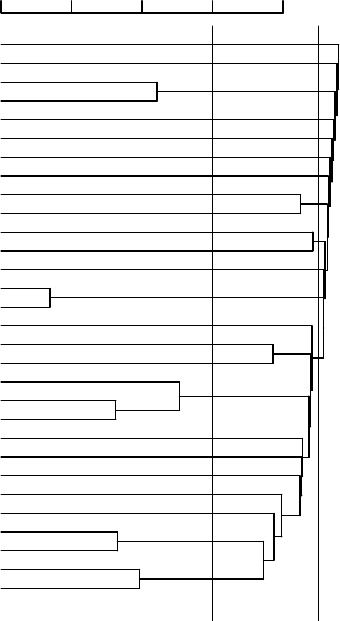
An HAC clustering is typically visualized as a dendrogram as shown inDENDROGRAM
Figure
17.1. Each merge is represented by a horizontal line. The y-coordinate
of the horizontal line is the similarity of the two clusters that were merged,
where documents are viewed as singleton clusters. We call this similarity the
combination similarity of the merged cluster. For example, the combinationCOMBINATION
SIMILARITY
similarity of the cluster consisting of Lloy d’s CEO questioned and Lloyd’s chief
/ U.S. grilling in Figure
17.1 is ≈ 0.56. We define the combination similarity
of a singleton cluster as its document’s self-similarity (which is 1.0 for cosine
similarity).
By moving up from the bottom layer to the top node, a dendrogram al-
lows us to reconstruct the history of merges that resulted in the depicted
clustering. For example, we see that the two documents entitled War hero
Colin Powell were merged first in Figure
17.1 and that the last merge added
Ag trade reform to a cluster consisting of the other 29 documents.
A fundamental assumption in HAC is that the merge operation is m ono-MONOTONICITY
tonic. Monotonic means that if s
1
, s
2
, . . . , s
K−1
are the combination similarities
of the successive merges of an HAC, then s
1
≥ s
2
≥ . . . ≥ s
K−1
holds. A non-
monotonic hierarchical clustering contains at least one inversion s
i
< s
i+1
INVERSION
and contradicts the fundamental assumption that we chose the best merge
available at each step. We will see an example of an inversion in Figure
17.12.
Hierarchical clustering does not require a prespecified number of clusters.
However, in some applications we want a partition of disjoint clusters just as
Online edition (c)2009 Cambridge UP
17.1 Hierarchical agglomerative clustering 379
1.0 0.8 0.6 0.4 0.2 0.0
Ag trade reform.
Back−to−school spending is up
Lloyd’s CEO questioned
Lloyd’s chief / U.S. grilling
Viag stays positive
Chrysler / Latin America
Ohio Blue Cross
Japanese prime minister / Mexico
CompuServe reports loss
Sprint / Internet access service
Planet Hollywood
Trocadero: tripling of revenues
German unions split
War hero Colin Powell
War hero Colin Powell
Oil prices slip
Chains may raise prices
Clinton signs law
Lawsuit against tobacco companies
suits against tobacco firms
Indiana tobacco lawsuit
Most active stocks
Mexican markets
Hog prices tumble
NYSE closing averages
British FTSE index
Fed holds interest rates steady
Fed to keep interest rates steady
Fed keeps interest rates steady
Fed keeps interest rates steady
◮
Figure 17.1 A dendrogram of a single-link clustering of 30 documents from
Reuters-RCV1. Two possible cuts of the dendrogram are shown: at 0.4 into 24 clusters
and at 0.1 into 12 clusters.

Online edition (c)2009 Cambridge UP
380 17 Hierarchical clustering
in flat clustering. In those cases, the hierarchy needs to be cut at some point.
A number of criteria can be used to determine the cutting point:
• Cut at a prespecified level of similarity. For example, we cut the dendro-
gram at 0.4 if we want clusters with a minimum combination similarity
of 0.4. In Figure 17.1, cutting the diagram at y = 0.4 yields 24 clusters
(grouping only documents with high similarity together) and cutting it at
y = 0.1 yields 12 clusters (one large financial news cluster and 11 smaller
clusters).
• Cut the dendrogram where the gap between two successive combination
similarities is largest. Such large gaps arguably indicate “natural” clus-
terings. Adding one more cluster decreases the quality of the clustering
significantly, so cutting before this steep decrease occurs is desirable. This
strategy is analogous to looking for the knee in the K-means graph in Fig-
ure
16.8 (page 366).
• Apply Equation (16.11) (page 366):
K = arg min
K
′
[RSS(K
′
) + λK
′
]
where K
′
refers to the cut of the hierarchy that results in K
′
clusters, RSS is
the residual sum of squares and λ is a penalty for each additional cluster.
Instead of RSS, another measure of distortion can be used.
• As in flat clustering, we can also prespecify the number of clusters K and
select the cutting point that produces K clusters.
A simple, naive HAC algorithm is shown in Figure 17.2. We first compute
the N × N similarity matrix C. The algorithm then executes N − 1 steps
of merging the currently most similar clusters. In each iteration, the two
most similar clusters are merged and the rows and columns of the merged
cluster i in C are updated.
2
The clustering is stored as a list of merges in
A. I indicates which clusters are still available to be merged. The function
SIM(i, m, j) computes the similarity of cluster j with the merge of clusters i
and m. For some HAC algorithms, SIM(i, m, j) is simply a function of C[j][i]
and C[j][m], for example, the maximum of these two values for single-link.
We will now refine this algorithm for the different similarity measures
of single-link and complete-link clustering (Section 17.2) and group-average
and centroid clustering (Sections 17.3 and 17.4). The merge criteria of these
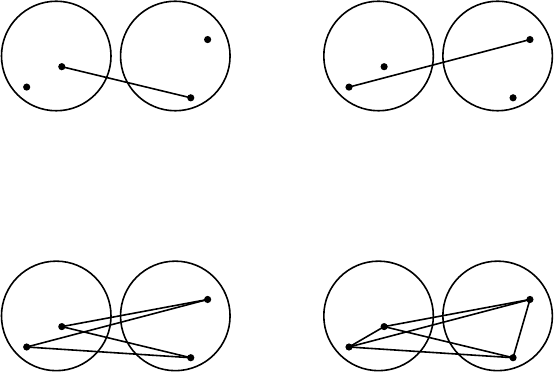
four variants of HAC are shown in Figure
17.3.
2. We assume that we use a deterministic method for breaking ties, such as always choose the
merge that is the first cluster with respect to a total ordering of the subsets of the document set
D.
Online edition (c)2009 Cambridge UP
17.1 Hierarchical agglomerative clustering 381
SIMPLEHAC(d
1
, . . . , d
N
)
1 for n ← 1 to N
2 do for i ← 1 to N
3 do C[n][i] ← SIM(d
n
, d
i
)
4 I[n] ← 1 (keeps track of active clusters)
5 A ← [] (assembles clustering as a sequence of merges)
6 for k ← 1 to N − 1
7 do hi, mi ← arg max
{hi,mi:i6=m∧I[i]=1∧I[m]=1}
C[i][m]
8 A.APPEND(hi, mi) (store merge)
9 for j ← 1 to N
10 do C[i][j] ← SIM(i, m, j)
11 C[j][i] ← SIM(i, m , j)
12 I[m] ← 0 (deactiva te cluster)
13 return A
◮
Figure 17.2 A simple, but inefficient HAC algorithm.
(a) single-link: maximum similarity (b) complete-link: minimum similarity
(c) centroid: average inter-similarity (d) group-average: average of all similarities
◮
Figure 17.3 The different notions of cluster similarity used by the four HAC al-
gorithms. An inter-similarity is a similarity between two documents from different
clusters.
Online edition (c)2009 Cambridge UP
382 17 Hierarchical clustering
0 1 2 3 4
0
1
2
3
×
d
5
×
d
6
×
d
7
×
d
8
×
d
1
×
d
2
×
d
3
×
d
4
0 1 2 3 4
0
1
2
3
×
d
5
×
d
6
×
d
7
×
d
8
×
d
1
×
d
2
×
d
3
×
d
4
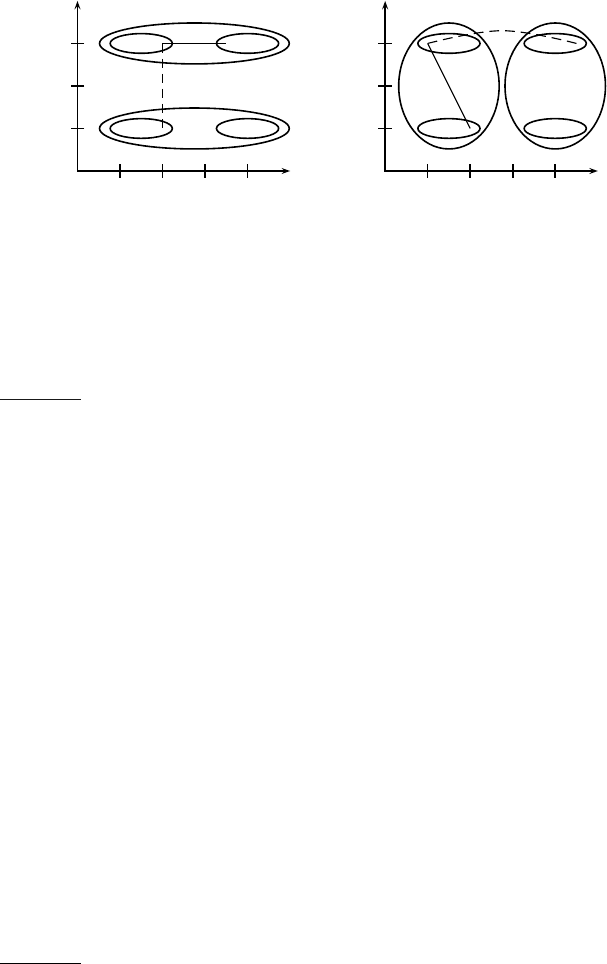
◮
Figure 17.4 A single-link (left) and complete-link (right) clustering of eight doc-
uments. The ellipses correspond to successive clustering stages. Left: The single-link
similarity of the two upper two-point clusters is the similarity of d
2
and d
3
(solid
line), which is greater than the single-link similarity of the two left two-point clusters
(dashed line). Right: The complete-link similarity of the two upper two-point clusters
is the similarity of d
1
and d
4
(dashed line), which is smaller than the complete-link
similarity of the two left two-point clusters (solid line).
17.2 Single-link and complete-link clustering
In single-link clustering or single-linkage clustering, the similarity of two clus-SINGLE-LINK
CLUSTERING
ters is the similarity of their most similar members (see Figure
17.3, (a))
3
. This
single-link merge criterion is local. We pay attention solely to the area where
the two clusters come closest to each other. Other, more distant parts of the
cluster and the clusters’ overall structure are not taken into account.
In complete-link clustering or complete-linkage clustering, the similarity of twoCOMPLETE-LINK
CLUSTERING
clusters is the similarity of their most dissimilar members (see Figure
17.3, (b)).
This is equivalent to choosing the cluster pair whose merge has the smallest
diameter. This complete-link merge criterion is non-local; the entire structure
of the clustering can influence merge decisions. This results in a preference
for compact clusters with small diameters over long, straggly clusters, but
also causes sensitivity to outliers. A single document far from the center can
increase diameters of candidate merge clusters dramatically and completely
change the final clustering.
Figure
17.4 depicts a single-link and a complete-link clustering of eight
documents. The first four steps, each producing a cluster consisting of a pair
of two documents, are identical. Then single-link clustering joins the up-
per two pairs (and after that the lower two pairs) because on the maximum-
similarity definition of cluster similarity, those two clusters are closest. Complete-
3. Throughout this chapter, we equate similarity with proximity in 2D depictions of clustering.
Online edition (c)2009 Cambridge UP
17.2 Single-link and complete-link clustering 383
1.0 0.8 0.6 0.4 0.2 0.0
NYSE closing averages
Hog prices tumble
Oil prices slip
Ag trade reform.
Chrysler / Latin America
Japanese prime minister / Mexico
Fed holds interest rates steady
Fed to keep interest rates steady
Fed keeps interest rates steady
Fed keeps interest rates steady
Mexican markets
British FTSE index
War hero Colin Powell
War hero Colin Powell
Lloyd’s CEO questioned
Lloyd’s chief / U.S. grilling
Ohio Blue Cross
Lawsuit against tobacco companies
suits against tobacco firms
Indiana tobacco lawsuit
Viag stays positive
Most active stocks
CompuServe reports loss
Sprint / Internet access service
Planet Hollywood
Trocadero: tripling of revenues
Back−to−school spending is up
German unions split
Chains may raise prices
Clinton signs law
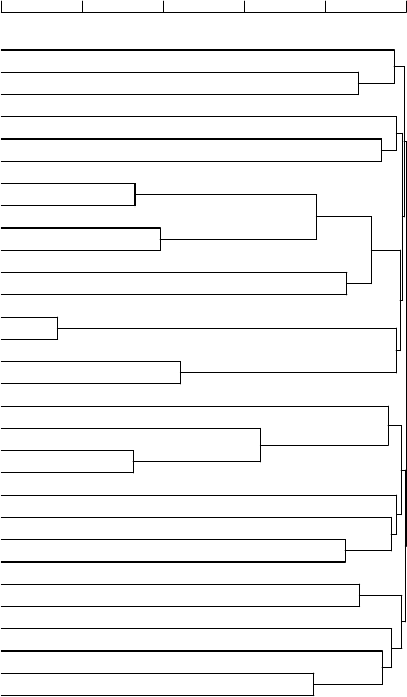
◮
Figure 17.5 A dendrogram of a complete-link clustering. The same 30 documents
were clustered with single-link clustering in Figure 17.1.
Online edition (c)2009 Cambridge UP
384 17 Hierarchical clustering
× × × × × ×
× × × × × ×
◮
Figure 17.6 Chaining in single-link clustering. The local criterion in single-link
clustering can cause undesirable elongated clusters.
link clustering joins the left two pairs (and then the right two pairs) because
those are the closest pairs according to the minimum-similarity definition of
cluster similarity.
4
Figure
17.1 is an example of a single-link clustering of a set of documents
and Figure
17.5 is the complete-link clustering of the same set. When cutting
the last merge in Figure 17.5, we obtain two clusters of similar size (doc-
uments 1–16, from NYSE closing averages to Lloyd’s chief / U.S. grilling, and
documents 17–30, from Ohio Blue Cross to Clinton signs law). There is no cut
of the dendrogram in Figure
17.1 that would give us an equally balanced
clustering.
Both single-link and complete-link clustering have graph-theoretic inter-
pretations. Define s
k
to be the combination similarity of the two clusters
merged in step k, and G(s
k
) the graph that links all data points with a similar-
ity of at least s
k
. Then the clusters after step k in single-link clustering are the
connected components of G(s
k
) and the clusters after step k in complete-link
clustering are maximal cliques of G(s
k
). A connected component is a maximalCONNECTED
COMPONENT
set of connected points such that there is a path connecting each pair. A clique
CLIQUE
is a set of points that are completely linked with each other.
These graph-theoretic interpretations motivate the terms single-link and
complete-link clustering. Single-link clusters at step k are maximal sets of
points that are linked via at least one link (a single link) of similarity s ≥ s
k
;
complete-link clusters at step k are maximal sets of points that are completely
linked with each other via links of similarity s ≥ s
k
.
Single-link and complete-link clustering reduce the assessment of cluster
quality to a single similarity between a pair of documents: the two most sim-
ilar documents in single-link clustering and the two most dissimilar docu-
ments in complete-link clustering. A measurement based on one pair cannot
fully reflect the distribution of documents in a cluster. It is therefore not sur-
prising that both algorithms often produce undesirable clusters. Single-link
clustering can produce straggling clusters as shown in Figure
17.6. Since the
merge criterion is strictly local, a chain of points can be extended for long
4. If you are bothered by the possibility of ties, assume that d
1
has coordinates (1 + ǫ, 3 − ǫ) and
that all other points have integer coordinates.
Online edition (c)2009 Cambridge UP
17.2 Single-link and complete-link clustering 385
0 1 2 3 4 5 6 7
0
1
×
d
1
×
d
2
×
d
3
×
d
4
×
d
5
◮
Figure 17.7 Outliers in complete-link clustering. The five documents have
the x-coordinates 1 + 2ǫ, 4, 5 + 2ǫ, 6 and 7 − ǫ. Complete-link clustering cre-
ates the two clusters shown as ellipses. The most intuitive two-cluster cluster-
ing is {{d
1
}, {d
2
, d
3
, d
4
, d
5
}}, but in complete-link clustering, the outlier d
1
splits
{d
2
, d
3
, d
4
, d
5
} as shown.
distances without regard to the overall shape of the emerging cluster. This
effect is called chaining.CHAINING
The chaining effect is also apparent in Figure
17.1. The last eleven merges
of the single-link clustering (those above the 0.1 line) add on single docu-
ments or pairs of documents, corresponding to a chain. The complete-link
clustering in Figure
17.5 avoids this problem. Documents are split into two
groups of roughly equal size when we cut the dendrogram at the last merge.
In general, this is a more useful organization of the data than a clustering
with chains.
However, complete-link clustering suffers from a different problem. It
pays too much attention to outliers, points that do not fit well into the global
structure of the cluster. In the example in Figure
17.7 the four documents
d
2
, d
3
, d
4
, d
5
are split because of the outlier d
1
at the left edge (Exercise
17.1).
Complete-link clustering does not find the most intuitive cluster structure in
this example.
17.2.1 Time complexity of HAC
The complexity of the naive HAC algorithm in Figure 17.2 is Θ(N
3
) because
we exhaustively scan the N × N matrix C for the largest similarity in each of
N −1 iterations.
For the four HAC methods discussed in this chapter a more efficient algo-
rithm is the priority-queue algorithm shown in Figure
17.8. Its time complex-
ity is Θ(N
2
log N). The rows C[k] of the N × N similarity matrix C are sorted
in decreasing order of similarity in the priority queues P. P[k].MAX() then
returns the cluster in P[k] that currently has the highest similarity with ω
k
,
where we use ω
k
to denote the k
th
cluster as in Chapter
16. After creating the
merged cluster of ω
k
1
and ω
k
2
, ω
k
1
is used as its representative. The function
SIM computes the similarity function for potential merge pairs: largest simi-
larity for single-link, smallest similarity for complete-link, average similarity
for GAAC (Section
17.3), and centroid similarity for centroid clustering (Sec-