
Manning Ch. D., Raghavan P., Sch?tze H. Introduction to Information Retrieval - Введение в информационный поиск
Подождите немного. Документ загружается.

Online edition (c)2009 Cambridge UP
386 17 Hierarchical clustering
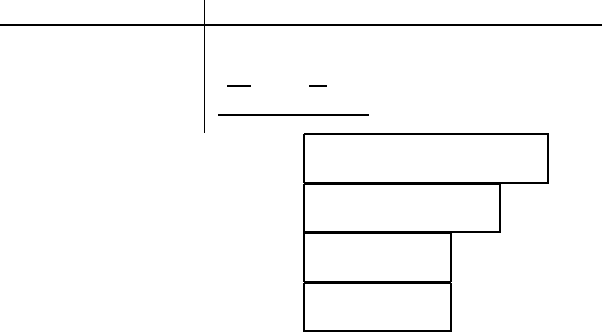
EFFICIENTHAC(
~
d
1
, . . . ,
~
d
N
)
1 for n ← 1 to N
2 do for i ← 1 to N
3 do C[n][i].sim ←
~
d
n
·
~
d
i
4 C[n][i].index ← i
5 I[n] ← 1
6 P[n] ← priority queue for C[n] sorted on sim
7 P[n].DELETE(C[n][n]) (don’t want self-similarities)
8 A ← []
9 for k ← 1 to N −1
10 do k
1
← arg max
{k:I[k]=1}
P[k].MAX().sim
11 k
2
← P [k
1
].MAX().index
12 A.APPEND(hk
1
, k
2
i)
13 I[k
2
] ← 0
14 P[k
1
] ← []
15 for each i with I[i] = 1 ∧i 6= k
1
16 do P[i].DELETE(C[i][k
1
])
17 P[i].DELETE(C[i][k
2
])
18 C[i][k
1
].sim ← SIM(i, k
1
, k
2
)
19 P[i].INSERT(C[i][k
1
])
20 C[k
1
][i].sim ← SIM(i, k
1
, k
2
)
21 P[k
1
].INSERT(C[k
1
][i])
22 return A
clustering algorithm
SIM(i, k
1
, k
2
)
single-link max(SIM(i, k
1
), SIM(i, k
2
))
complete-link min(SIM(i, k
1
), SIM(i, k
2
))
centroid
(
1
N
m
~v
m
) · (
1
N
i
~v
i
)
group-average
1
(N
m
+N
i
)(N
m
+N
i
−1)
[(~v
m
+ ~v
i
)
2
− (N
m
+ N
i
)]
compute C[5]
1 2 3 4 5
0.2 0.8 0.6 0.4 1.0
create P[5] (by sorting)
2 3 4 1
0.8 0.6 0.4 0.2
merge 2 and 3, update
similarity of 2, delete 3
2 4 1
0.3 0.4 0.2
delete and reinsert 2
4 2 1
0.4 0.3 0.2
◮
Figure 17.8 The priority-queue algorithm for HAC. Top: The algorithm. Center:
Four different similarity measures. Bottom: An example for processing steps 6 and
16–19. This is a made up example showing P[5] for a 5 × 5 matrix C.

Online edition (c)2009 Cambridge UP
17.2 Single-link and complete-link clustering 387
SINGLELINKCLUSTERING(d
1
, . . . , d
N
)
1 for n ← 1 to N
2 do for i ← 1 to N
3 do C[n][i].sim ← SIM(d
n
, d
i
)
4 C[n][i].index ← i
5 I[n] ← n
6 NBM[n] ← arg max
X∈{C[n][i]:n6=i}
X.sim
7 A ← []
8 for n ← 1 to N − 1
9 do i
1
← arg max
{i:I[i]=i}
NBM[i].sim
10 i
2
← I[NBM[i
1
].index]
11 A.APPEND(hi
1
, i
2
i)
12 for i ← 1 to N
13 do if I[i] = i ∧ i 6= i
1
∧i 6= i
2
14 then C[i
1
][i].sim ← C[i][i
1
].sim ← max(C[i
1
][i].sim, C[i
2
][i].sim)
15 if I[i] = i
2
16 then I[i] ← i
1
17 NBM[i
1
] ← arg max
X∈{C[i
1
][i]:I[i]=i∧i6=i
1
}
X.sim
18 return A
◮
Figure 17.9 Single-link clustering algorithm using an NBM array. After merging
two clusters i
1
and i
2
, the first one (i
1
) represents the merged cluster. If I[i] = i, then i
is the representative of its current cluster. If I[i] 6= i, then i has been merged into the
cluster represented by I[i] and will therefore be ignored when updating NBM[i
1
].
tion 17.4). We give an example of how a row of C is processed (Figure 17.8,
bottom panel). The loop in lines 1–7 is Θ(N
2
) and the loop in lines 9–21 is
Θ(N
2
log N) for an implementation of priority queues that supports deletion
and insertion in Θ(log N). The overall complexity of the algorithm is there-
fore Θ(N
2
log N). In the definition of the function SIM, ~v
m
and ~v
i
are the
vector sums of ω
k
1
∪ω
k
2
and ω
i
, respectively, and N
m
and N
i
are the number
of documents in ω
k
1
∪ω
k
2
and ω
i
, respectively.
The argument of EFFICIENTHAC in Figure
17.8 is a set of vectors (as op-
posed to a set of generic documents) because GAAC and centroid clustering
(Sections
17.3 and 17.4) require vectors as input. The complete-link version
of EFFICIENTHAC can also be applied to documents that are not represented
as vectors.
For single-link, we can introduce a next-best-merge array (NBM) as a fur-
ther optimization as shown in Figure
17.9. NBM keeps track of what the best
merge is for each cluster. Each of the two top level for-loops in Figure
17.9
are Θ(N
2
), thus the overall complexity of single-link clustering is Θ(N
2
).
Online edition (c)2009 Cambridge UP
388 17 Hierarchical clustering
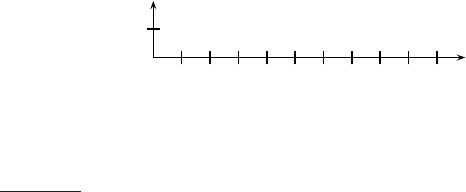
0 1 2 3 4 5 6 7 8 9 10
0
1
×
d
1
×
d
2
×
d
3
×
d
4
◮
Figure 17.10 Complete-link clustering is not best-merge persistent. At first, d
2
is
the best-merge cluster for d
3
. But after merging d
1
and d
2
, d
4
becomes d
3
’s best-merge
candidate. In a best-merge persistent algorithm like single-link, d
3
’s best-merge clus-
ter would be {d
1
, d
2
}.
Can we also speed up the other three HAC algorithms with an NBM ar-
ray? We cannot because only single-link clustering is best-merge persistent.BEST-MERGE
PERSISTENCE
Suppose that the best merge cluster for ω
k
is ω
j
in single-link clustering.
Then after merging ω
j
with a third cluster ω
i
6= ω
k
, the merge of ω
i
and ω
j
will be ω
k
’s best merge cluster (Exercise
17.6). In other words, the best-merge
candidate for the merged cluster is one of the two best-merge candidates of
its components in single-link clustering. This means that C can be updated
in Θ(N) in each iteration – by taking a simple max of two values on line 14
in Figure
17.9 for each of the remaining ≤ N clusters.
Figure 17.10 demonstrates that best-merge persistence does not hold for
complete-link clustering, which means that we cannot use an NBM array to
speed up clustering. After merging d
3
’s best merge candidate d
2
with cluster
d
1
, an unrelated cluster d
4
becomes the best merge candidate for d
3
. This is
because the complete-link merge criterion is non-local and can be affected by
points at a great distance from the area where two merge candidates meet.
In practice, the efficiency penalty of the Θ(N
2
log N) algorithm is small
compared with the Θ(N
2
) single-link algorithm since computing the similar-
ity between two documents (e.g., as a dot product) is an order of magnitude
slower than comparing two scalars in sorting. All four HAC algorithms in
this chapter are Θ(N
2
) with respect to similarity computations. So the differ-
ence in complexity is rarely a concern in practice when choosing one of the
algorithms.
?
Exercise 17.1
Show that complete-link clustering creates the two-cluster clustering depicted in Fig-
ure
17.7.
17.3 Group-average agglomerative clustering
Group-average agglomerative clustering or GAAC (see Figure
17.3, (d)) evaluatesGROUP-AVERAGE
AGGLOMERATIVE
CLUSTERING
cluster quality based on all similarities between documents, thus avoiding
the pitfalls of the single-link and complete-link criteria, which equate cluster

Online edition (c)2009 Cambridge UP
17.3 Group-average agglomerative clustering 389
similarity with the similarity of a single pair of documents. GAAC is also
called group-average clustering and average-link clustering. GAAC computes
the average similarity SIM-GA of all pairs of documents, including pairs from
the same cluster. But self-similarities are not included in the average:
SIM-GA(ω
i
, ω
j
) =
1
(N
i
+ N
j
)(N
i
+ N
j
−1)
∑
d
m
∈ω
i
∪ω
j
∑
d
n
∈ω
i
∪ω
j
,d
n
6=d
m
~
d
m
·
~
d
n
(17.1)
where
~
d is the length-normalized vector of document d, · denotes the dot
product, and N
i
and N
j
are the number of documents in ω
i
and ω
j
, respec-
tively.
The motivation for GAAC is that our goal in selecting two clusters ω
i
and ω
j
as the next merge in HAC is that the resulting merge cluster ω
k
=
ω
i
∪ ω
j
should be coherent. To judge the coherence of ω
k
, we need to look
at all document-document similarities within ω
k
, including those that occur
within ω
i
and those that occur within ω
j
.
We can compute the measure SIM-GA efficiently because the sum of indi-
vidual vector similarities is equal to the similarities of their sums:
∑
d
m
∈ω
i
∑
d
n
∈ω
j
(
~
d
m
·
~
d
n
) = (
∑
d
m
∈ω
i
~
d
m
) ·(
∑
d
n
∈ω
j
~
d
n
)
(17.2)
With (17.2), we have:
SIM-GA(ω
i
, ω
j
) =
1
(N
i
+ N
j
)(N
i
+ N
j
−1)
[(
∑
d
m
∈ω
i
∪ω
j
~
d
m
)
2
− (N
i
+ N
j
)]
(17.3)
The term (N
i
+ N
j
) on the right is the sum of N
i
+ N
j
self-similarities of value
1.0. With this trick we can compute cluster similarity in constant time (as-
suming we have available the two vector sums
∑
d
m
∈ω
i
~
d
m
and
∑
d
m
∈ω
j
~
d
m
)
instead of in Θ(N
i
N
j
). This is important because we need to be able to com-
pute the function SIM on lines 18 and 20 in EFFICIENTHAC (Figure
17.8)
in constant time for efficient implementations of GAAC. Note that for two
singleton clusters, Equation (
17.3) is equivalent to the dot product.
Equation (17.2) relies on the distributivity of the dot product with respect
to vector addition. Since this is crucial for the efficient computation of a
GAAC clustering, the method cannot be easily applied to representations of
documents that are not real-valued vectors. Also, Equation (
17.2) only holds
for the dot product. While many algorithms introduced in this book have
near-equivalent descriptions in terms of dot product, cosine similarity and
Euclidean distance (cf. Section
14.1, page 291), Equation (17.2) can only be
expressed using the dot product. This is a fundamental difference between
single-link/complete-link clustering and GAAC. The first two only require a

Online edition (c)2009 Cambridge UP
390 17 Hierarchical clustering
square matrix of similarities as input and do not care how these similarities
were computed.
To summarize, GAAC requires (i) documents represented as vectors, (ii)
length normalization of vectors, so that self-similarities are 1.0, and (iii) the
dot product as the measure of similarity between vectors and sums of vec-
tors.
The merge algorithms for GAAC and complete-link clustering are the same
except that we use Equation (
17.3) as similarity function in Figure 17.8. There-
fore, the overall time complexity of GAAC is the same as for complete-link
clustering: Θ(N
2
log N). Like complete-link clustering, GAAC is not best-
merge persistent (Exercise
17.6). This means that there is no Θ(N
2
) algorithm
for GAAC that would be analogous to the Θ(N
2
) algorithm for single-link in
Figure
17.9.
We can also define group-average similarity as including self-similarities:
SIM-GA
′
(ω
i
, ω
j
) =
1
(N
i
+N
j
)
2
(
∑
d
m
∈ω
i
∪ω
j
~
d
m
)
2
=
1
N
i
+N
j
∑
d
m
∈ω
i
∪ω
j
[
~
d
m
·~µ(ω
i
∪ω
j
)]
(17.4)
where the centroid ~µ(ω) is defined as in Equation (14.1) (page 292). This
definition is equivalent to the intuitive definition of cluster quality as average
similarity of documents
~
d
m
to the cluster’s centroid ~µ.
Self-similarities are always equal to 1.0, the maximum possible value for
length-normalized vectors. The proportion of self-similarities in Equation (
17.4)
is i/i
2
= 1/i for a cluster of size i. This gives an unfair advantage to small
clusters since they will have proportionally more self-similarities. For two
documents d
1
, d
2
with a similarity s, we have SIM-GA
′
(d
1
, d
2
) = (1 + s )/2.
In contrast, SIM-GA(d
1
, d
2
) = s ≤ (1 + s)/2. This similarity SIM-GA(d
1
, d
2
)
of two documents is the same as in single-link, complete-link and centroid
clustering. We prefer the definition in Equation (
17.3), which excludes self-
similarities from the average, because we do not want to penalize large clus-
ters for their smaller proportion of self-similarities and because we want a
consistent similarity value s for document pairs in all four HAC algorithms.
?
Exercise 17.2
Apply group-average clustering to the points in Figures 17.6 and 17.7. Map them onto
the surface of the unit sphere in a three-dimensional space to get length-normalized
vectors. Is the group-average clustering different from the single-link and complete-
link clusterings?
Online edition (c)2009 Cambridge UP
17.4 Centroid clustering 391
0 1 2 3 4 5 6 7
0
1
2
3
4
5
×
d
1
×
d
2
×
d
3
×
d
4
×
d
5
×
d
6
µ
1
µ
3
µ
2
◮
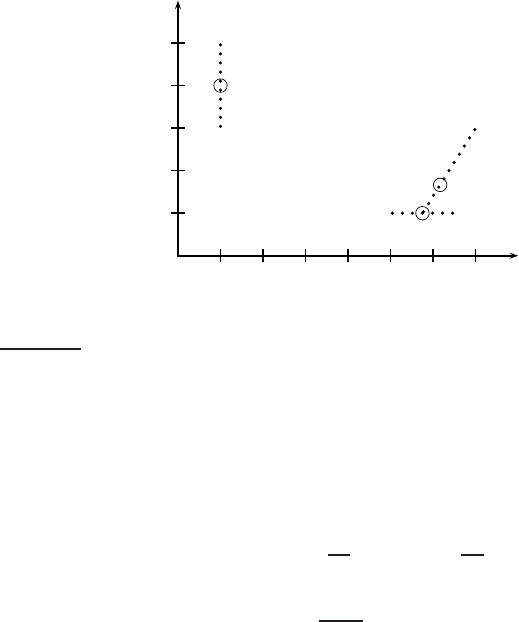
Figure 17.11 Three iterations of centroid clustering. Each iteration merges the
two clusters whose centroids are closest.
17.4 Centr oid clustering
In centroid clustering, the similarity of two clusters is defined as the similar-
ity of their centroids:
SIM-CENT(ω
i
, ω
j
) = ~µ(ω
i
) ·~µ(ω
j
)
(17.5)
= (
1
N
i
∑
d
m
∈ω
i
~
d
m
) · (
1
N
j
∑
d
n
∈ω
j
~
d
n
)
=
1
N
i
N
j
∑
d
m
∈ω
i
∑
d
n
∈ω
j
~
d
m
·
~
d
n
(17.6)
Equation (17.5) is centroid similarity. Equation (17.6) shows that centroid
similarity is equivalent to average similarity of all pairs of documents from
different clusters. Thus, the differencebetween GAAC and centroid clustering
is that GAAC considers all pairs of documents in computing average pair-
wise similarity (Figure
17.3, (d)) whereas centroid clustering excludes pairs
from the same cluster (Figure
17.3, (c)).
Figure 17.11 shows the first three steps of a centroid clustering. The first
two iterations form the clusters {d
5
, d
6
} with centroid µ
1
and {d
1
, d
2
} with
centroid µ
2
because the pairs hd
5
, d
6
i and hd
1
, d
2
i have the highest centroid
similarities. In the third iteration, the highest centroid similarity is between
µ
1
and d
4
producing the cluster {d
4
, d
5
, d
6
} with centroid µ
3
.
Like GAAC, centroid clustering is not best-merge persistent and therefore
Θ(N
2
log N) (Exercise
17.6).
In contrast to the other three HAC algorithms, centroid clustering is not
monotonic. So-called inversions can occur: Similarity can increase duringINVERSION
Online edition (c)2009 Cambridge UP
392 17 Hierarchical clustering
0 1 2 3 4 5
0
1
2
3
4
5
× ×
×
d
1
d
2
d
3
−4
−3
−2
−1
0
d
1
d
2
d
3
◮
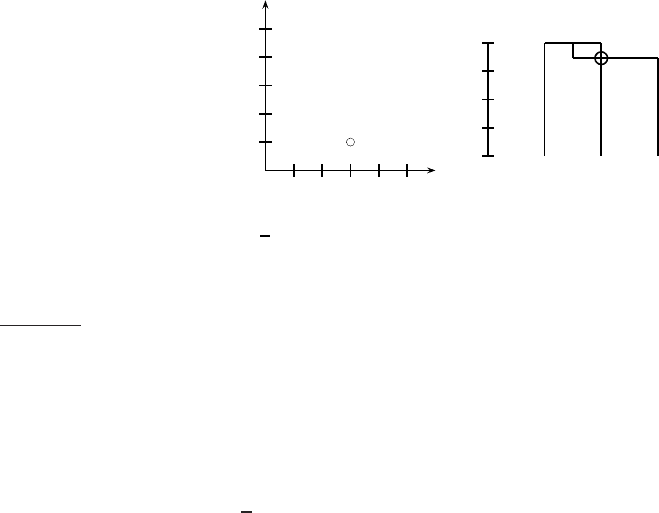
Figure 17.12 Centroid clustering is not monotonic. The documents d
1
at (1 + ǫ, 1),
d
2
at (5, 1), and d
3
at (3, 1 + 2
√
3) are almost equidistant, with d
1
and d
2
closer to
each other than to d
3
. The non-monotonic inversion in the hierarchical clustering
of the three points appears as an intersecting merge line in the dendrogram. The
intersection is circled.
clustering as in the example in Figure 17.12, where we define similarity as
negative distance. In the first merge, the similarity of d
1
and d
2
is −(4 −ǫ). In
the second merge, the similarity of the centroid of d
1
and d
2
(the circle) and d
3
is ≈ −cos(π/6) ×4 = −
√
3/2 ×4 ≈ −3.46 > −(4 −ǫ). This is an example
of an inversion: similarity increases in this sequence of two clustering steps.
In a monotonic HAC algorithm, similarity is monotonically decreasing from
iteration to iteration.
Increasing similarity in a series of HAC clustering steps contradicts the
fundamental assumption that small clusters are more coherent than large
clusters. An inversion in a dendrogram shows up as a horizontal merge line
that is lower than the previous merge line. All merge lines in Figures
17.1
and 17.5 are higher than their predecessors because single-link and complete-
link clustering are monotonic clustering algorithms.
Despite its non-monotonicity, centroid clustering is often used because its
similarity measure – the similarity of two centroids – is conceptually simpler
than the average of all pairwise similarities in GAAC. Figure
17.11 is all one
needs to understand centroid clustering. There is no equally simple graph
that would explain how GAAC works.
?
Exercise 17.3
For a fixed set of N documents there are up to N
2
distinct similarities between clusters
in single-link and complete-link clustering. How many distinct cluster similarities are
there in GAAC and centroid clustering?
Online edition (c)2009 Cambridge UP
17.5 Optimality of HAC 393
✄
17.5 Optimality of HAC
To state the optimality conditions of hierarchical clustering precisely, we first
define the combination similarity COMB-SIM of a clustering Ω = {ω
1
, . . . , ω
K
}
as the smallest combination similarity of any of its K clusters:
COMB-SIM({ω
1
, . . . , ω
K
}) = min
k
COMB-SIM(ω
k
)
Recall that the combination similarity of a cluster ω that was created as the
merge of ω
1
and ω
2
is the similarity of ω
1
and ω
2
(page
378).
We then define Ω = {ω
1
, . . . , ω
K
} to be optimal if all clusterings Ω
′
with kOPTIMAL CLUSTERING
clusters, k ≤ K, have lower combination similarities:
|Ω
′
| ≤ |Ω| ⇒ COMB-SIM(Ω
′
) ≤ COMB-SIM(Ω)
Figure 17.12 shows that centroid clustering is not optimal. The cluster-
ing {{d
1
, d
2
}, {d
3
}} (for K = 2) has combination similarity −(4 − ǫ) and
{{d
1
, d
2
, d
3
}} (for K = 1) has combination similarity -3.46. So the cluster-
ing {{d
1
, d
2
}, {d
3
}} produced in the first merge is not optimal since there is
a clustering with fewer clusters ({{d
1
, d
2
, d
3
}}) that has higher combination
similarity. Centroid clustering is not optimal because inversions can occur.
The above definition of optimality would be of limited use if it was only
applicable to a clustering together with its merge history. However, we can
show (Exercise
17.4) that combination similarity for the three non-inversionCOMBINATION
SIMILARITY
algorithms can be read off from the cluster without knowing its history. These
direct definitions of combination similarity are as follows.
single-l ink The combination similarity of a cluster ω is the smallest similar-
ity of any bipartition of the cluster, where the similarity of a bipartition is
the largest similarity between any two documents from the two parts:
COMB-SIM(ω) = min
{ω
′
:ω
′
⊂ω}
max
d
i
∈ω
′
max
d
j
∈ω−ω
′
SIM(d
i
, d
j
)
where each hω
′
, ω −ω
′
i is a bipartition of ω.
complete -link The combination similarity of a cluster ω is the smallest sim-
ilarity of any two points in ω: min
d
i
∈ω
min
d
j
∈ω
SIM(d
i
, d
j
).
GAAC The combination similarity of a cluster ω is the average of all pair-
wise similarities in ω (where self-similarities are not included in the aver-
age): Equation (
17.3).
If we use these definitions of combination similarity, then optimality is a
property of a set of clusters and not of a process that produces a set of clus-
ters.

Online edition (c)2009 Cambridge UP
394 17 Hierarchical clustering
We can now prove the optimality of single-link clustering by induction
over the number of clusters K. We will give a proof for the case where no two
pairs of documents have the same similarity, but it can easily be extended to
the case with ties.
The inductive basis of the proof is that a clustering with K = N clusters has
combination similarity 1.0, which is the largest value possible. The induc-
tion hypothesis is that a single-link clustering Ω
K
with K clusters is optimal:
COMB-SIM(Ω
K
) ≥ COMB-SIM(Ω
′
K
) for all Ω
′
K
. Assume for contradiction that
the clustering Ω
K−1
we obtain by merging the two most similar clusters in
Ω
K
is not optimal and that instead a different sequence of merges Ω
′
K
, Ω
′
K−1
leads to the optimal clustering with K − 1 clusters. We can write the as-
sumption that Ω
′
K−1
is optimal and that Ω
K−1
is not as COMB-SIM(Ω
′
K−1
) >
COMB-SIM(Ω
K−1
).
Case 1: The two documents linked by s = COMB-SIM(Ω
′
K−1
) are in the
same cluster in Ω
K
. They can only be in the same cluster if a merge with sim-
ilarity smaller than s has occurred in the merge sequence producing Ω
K
. This
implies s > COMB-SIM(Ω
K
). Thus, COMB-SIM(Ω
′
K−1
) = s > COMB-SIM(Ω
K
) >
COMB-SIM(Ω
′
K
) > COMB-SIM(Ω
′
K−1
). Contradiction.
Case 2: The two documents linked by s = COMB-SIM(Ω
′
K−1
) are not in
the same cluster in Ω
K
. But s = COMB-SIM(Ω
′
K−1
) > COMB-SIM(Ω
K−1
), so
the single-link merging rule should have merged these two clusters when
processing Ω
K
. Contradiction.
Thus, Ω
K−1
is optimal.
In contrast to single-link clustering, complete-link clustering and GAAC
are not optimal as this example shows:
× × × ×
1
3 3
d
1
d
2
d
3
d
4
Both algorithms merge the two points with distance 1 (d
2
and d
3
) first and
thus cannot find the two-cluster clustering {{d
1
, d
2
}, {d
3
, d
4
}}. But {{d
1
, d
2
}, {d
3
, d
4
}}
is optimal on the optimality criteria of complete-link clustering and GAAC.
However, the merge criteria of complete-link clustering and GAAC ap-
proximate the desideratum of approximate sphericity better than the merge
criterion of single-link clustering. In many applications, we want spheri-
cal clusters. Thus, even though single-link clustering may seem preferable at
first because of its optimality, it is optimal with respect to the wrong criterion
in many document clustering applications.
Table
17.1 summarizes the properties of the four HAC algorithms intro-
duced in this chapter. We recommend GAAC for document clustering be-
cause it is generally the method that produces the clustering with the best
Online edition (c)2009 Cambridge UP
17.6 Divisive clustering 395
method
combination similarity time compl. optimal? comment
single-link max inter-similarity of any 2 docs Θ(N
2
) yes chaining effect
complete-link
min inter-similarity of any 2 docs Θ(N
2
log N) no sensitive to outliers
group-average
average of all sims Θ(N
2
log N) no
best choice for
most applications
centroid
average inter-similarity Θ(N
2
log N) no
inversions can occur
◮
Table 17.1 Comparison of HAC algorithms.
properties for applications. It does not suffer from chaining, from sensitivity
to outliers and from inversions.
There are two exceptions to this recommendation. First, for non-vector
representations, GAAC is not applicable and clustering should typically be
performed with the complete-link method.
Second, in some applications the purpose of clustering is not to create a
complete hierarchy or exhaustive partition of the entire document set. For
instance, first story detection or novelty d et ection is the task of detecting the firstFIRST STORY
DETECTION
occurrence of an event in a stream of news stories. One approach to this task
is to find a tight cluster within the documents that were sent across the wire
in a short period of time and are dissimilar from all previous documents. For
example, the documents sent over the wire in the minutes after the World
Trade Center attack on September 11, 2001 form such a cluster. Variations of
single-link clustering can do well on this task since it is the structure of small
parts of the vector space – and not global structure – that is important in this
case.
Similarly, we will describe an approach to duplicate detection on the web
in Section
19.6 (page 440) where single-link clustering is used in the guise of
the union-find algorithm. Again, the decision whether a group of documents
are duplicates of each other is not influenced by documents that are located
far away and single-link clustering is a good choice for duplicate detection.
?
Exercise 17.4
Show the equivalence of the two definitions of combination similarity: the process
definition on page
378 and the static definition on page 393.
17.6 Divisive clustering
So far we have only looked at agglomerative clustering, but a cluster hierar-
chy can also be generated top-down. This variant of hierarchical clustering
is called top -down clustering or divisive clustering. We start at the top with allTOP-DOWN
CLUSTERING
documents in one cluster. The cluster is split using a flat clustering algo-