
Manning Ch. D., Raghavan P., Sch?tze H. Introduction to Information Retrieval - Введение в информационный поиск
Подождите немного. Документ загружается.


Online edition (c)2009 Cambridge UP
356 16 Flat clustering
a search problem. The brute force solution would be to enumerate all pos-
sible clusterings and pick the best. However, there are exponentially many
partitions, so this approach is not feasible.
1
For this reason, most flat clus-
tering algorithms refine an initial partitioning iteratively. If the search starts
at an unfavorable initial point, we may miss the global optimum. Finding a
good starting point is therefore another important problem we have to solve
in flat clustering.
16.3 Evaluation of clustering
Typical objective functions in clustering formalize the goal of attaining high
intra-cluster similarity (documents within a cluster are similar) and low inter-
cluster similarity (documents from different clusters are dissimilar). This is
an internal criterion for the quality of a clustering. But good scores on anINTERNAL CRITERION
OF QUALITY
internal criterion do not necessarily translate into good effectiveness in an
application. An alternative to internal criteria is direct evaluation in the ap-
plication of interest. For search result clustering, we may want to measure
the time it takes users to find an answer with different clustering algorithms.
This is the most direct evaluation, but it is expensive, especially if large user
studies are necessary.
As a surrogate for user judgments, we can use a set of classes in an evalua-
tion benchmark or gold standard (see Section
8.5, page 164, and Section 13.6,
page
279). The gold standard is ideally produced by human judges with a
good level of inter-judge agreement (see Chapter 8, page 152). We can then
compute an external criterion that evaluates how well the clustering matchesEXTERNAL CRITERION
OF QUALITY
the gold standard classes. For example, we may want to say that the opti-
mal clustering of the search results for jaguar in Figure
16.2 consists of three
classes corresponding to the three senses car, anim a l, and operating system.
In this type of evaluation, we only use the partition provided by the gold
standard, not the class labels.
This section introduces four external criteria of clustering quality. Purity is
a simple and transparent evaluation measure. Normalized mutual information
can be information-theoretically interpreted. The Rand index penalizes both
false positive and false negative decisions during clustering. The F measure
in addition supports differential weighting of these two types of errors.
To compute purity, each cluster is assigned to the class which is most fre-PURITY
quent in the cluster, and then the accuracy of this assignment is measured
by counting the number of correctly assigned documents and dividing by N.
1. An upper bound on the number of clusterings is K
N
/K!. The exact number of different
partitions of N documents into K clusters is the Stirling number of the second kind. See
http://mathworld.wolfram.com/StirlingNumberoftheSecondKind.html or Comtet (1974).
Online edition (c)2009 Cambridge UP
16.3 Evaluation of clustering 357
x
o
x x
x
x
o
x
o
o ⋄
o x
⋄
⋄
⋄
x
cluster 1 cluster 2 cluster 3
◮
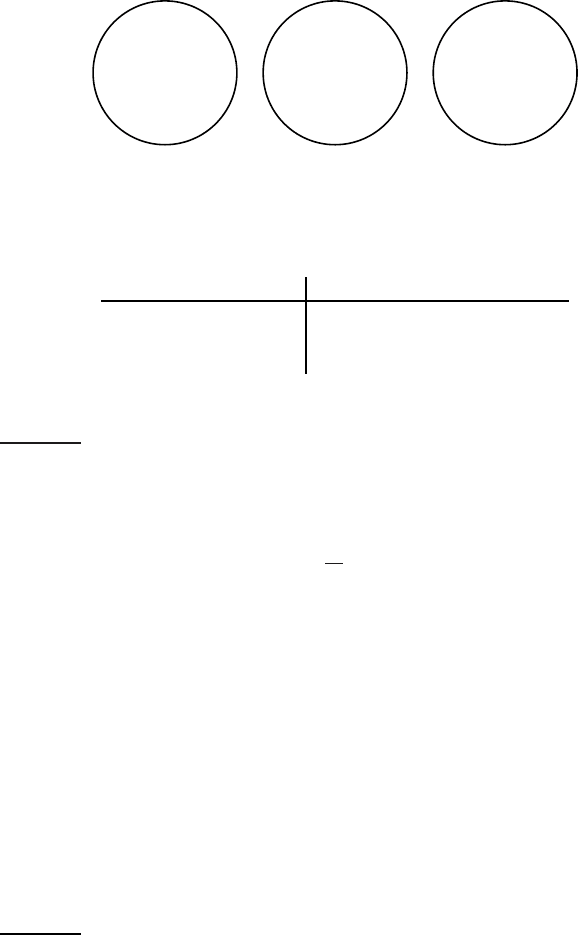
Figure 16.4 Purity as an external evaluation criterion for cluster quality. Majority
class and number of members of the majority class for the three clusters are: x, 5
(cluster 1); o, 4 (cluster 2); and ⋄, 3 (cluster 3). Purity is (1/17) × (5 + 4 + 3) ≈ 0.71.
purity NMI RI F
5
lower bound 0.0 0.0 0.0 0.0
maximum
1 1 1 1
value for Figure 16.4 0.71 0.36 0.68 0.46
◮
Table 16.2 The four external evaluation measures applied to the clustering in
Figure 16.4.
Formally:
purity(Ω, C) =
1
N
∑
k
max
j
|ω
k
∩c
j
|
(16.1)
where Ω = {ω
1
, ω
2
, . . . , ω
K
} is the set of clusters and C = {c
1
, c
2
, . . . , c
J
} is
the set of classes. We interpret ω
k
as the set of documents in ω
k
and c
j
as the
set of documents in c
j
in Equation (16.1).
We present an example of how to compute purity in Figure
16.4.
2
Bad
clusterings have purity values close to 0, a perfect clustering has a purity of
1. Purity is compared with the other three measures discussed in this chapter
in Table
16.2.
High purity is easy to achieve when the number of clusters is large – in
particular, purity is 1 if each document gets its own cluster. Thus, we cannot
use purity to trade off the quality of the clustering against the number of
clusters.
A measure that allows us to make this tradeoff is normalized mutual infor-NORMALIZED MUTUAL
INFORMATION
2. Recall our note of caution from Figure 14.2 (page 291) when looking at this and other 2D
figures in this and the following chapter: these illustrations can be misleading because 2D pro-
jections of length-normalized vectors distort similarities and distances between points.

Online edition (c)2009 Cambridge UP
358 16 Flat clustering
mation or NMI:
NMI(Ω, C) =
I(Ω; C)
[H(Ω) + H(C)]/2
(16.2)
I is mutual information (cf. Chapter 13, page 272):
I(Ω; C) =
∑
k
∑
j
P(ω
k
∩c
j
) log
P(ω
k
∩c
j
)
P(ω
k
)P(c
j
)
(16.3)
=
∑
k
∑
j
|ω
k
∩c
j
|
N
log
N|ω
k
∩c
j
|
|ω
k
||c
j
|
(16.4)
where P(ω
k
), P(c
j
), and P(ω
k
∩c
j
) are the probabilities of a document being
in cluster ω
k
, class c
j
, and in the intersection of ω
k
and c
j
, respectively. Equa-
tion (16.4) is equivalent to Equation (16.3) for maximum likelihood estimates
of the probabilities (i.e., the estimate of each probability is the corresponding
relative frequency).
H is entropy as defined in Chapter
5 (page 99):
H(Ω) = −
∑
k
P(ω
k
) log P(ω
k
)
(16.5)
= −
∑
k
|ω
k
|
N
log
|ω
k
|
N
(16.6)
where, again, the second equation is based on maximum likelihood estimates
of the probabilities.
I(Ω; C) in Equation (16.3) measures the amount of information by which
our knowledge about the classes increases when we are told what the clusters
are. The minimum of I(Ω; C) is 0 if the clustering is random with respect to
class membership. In that case, knowing that a document is in a particular
cluster does not give us any new information about what its class might be.
Maximum mutual information is reached for a clustering Ω
exact
that perfectly
recreates the classes – but also if clusters in Ω
exact
are further subdivided into
smaller clusters (Exercise
16.7). In particular, a clustering with K = N one-
document clusters has maximum MI. So MI has the same problem as purity:
it does not penalize large cardinalities and thus does not formalize our bias
that, other things being equal, fewer clusters are better.
The normalization by the denominator [H(Ω) + H(C)]/2 in Equation (
16.2)
fixes this problem since entropy tends to increase with the number of clus-
ters. For example, H(Ω) reaches its maximum log N for K = N, which en-
sures that NMI is low for K = N. Because NMI is normalized, we can use
it to compare clusterings with different numbers of clusters. The particular
form of the denominator is chosen because [H(Ω) + H(C)]/2 is a tight upper
bound on I(Ω; C) (Exercise
16.8). Thus, NMI is always a number between 0
and 1.

Online edition (c)2009 Cambridge UP
16.3 Evaluation of clustering 359
An alternative to this information-theoretic interpretation of clustering is
to view it as a series of decisions, one for each of the N(N −1)/2 pairs of
documents in the collection. We want to assign two documents to the same
cluster if and only if they are similar. A true positive (TP) decision assigns
two similar documents to the same cluster, a true negative (TN) decision as-
signs two dissimilar documents to different clusters. There are two types
of errors we can commit. A false positive (FP) decision assigns two dissim-
ilar documents to the same cluster. A false negative (FN) decision assigns
two similar documents to different clusters. The Rand index (RI) measuresRAND INDEX
RI
the percentage of decisions that are correct. That is, it is simply accuracy
(Section 8.3, page 155).
RI =
TP + TN
TP + FP + FN + TN
As an example, we compute RI for Figure
16.4. We first compute TP + FP.
The three clusters contain 6, 6, and 5 points, respectively, so the total number
of “positives” or pairs of documents that are in the same cluster is:
TP + FP =
6
2
+
6
2
+
5
2
= 40
Of these, the x pairs in cluster 1, the o pairs in cluster 2, the ⋄pairs in cluster 3,
and the x pair in cluster 3 are true positives:
TP =
5
2
+
4
2
+
3
2
+
2
2
= 20
Thus, FP = 40 −20 = 20.
FN and TN are computed similarly, resulting in the following contingency
table:
Same cluster Different clusters
Same class TP = 20 FN = 24
Different classes FP = 20 TN = 72
RI is then (20 + 72)/(20 + 20 + 24 + 72) ≈ 0.68.
The Rand index gives equal weight to false positives and false negatives.
Separating similar documents is sometimes worse than putting pairs of dis-
similar documents in the same cluster. We can use the F measure (Section
8.3,F MEASURE
page 154) to penalize false negatives more strongly than false positives by
selecting a value β > 1, thus giving more weight to recall.
P =
TP
TP + FP
R =
TP
TP + FN
F
β
=
(β
2
+ 1)PR
β
2
P + R

Online edition (c)2009 Cambridge UP
360 16 Flat clustering
Based on the numbers in the contingency table, P = 20/40 = 0.5 and R =
20/44 ≈ 0.455. This gives us F
1
≈ 0.48 for β = 1 and F
5
≈ 0.456 for β = 5.
In information retrieval, evaluating clustering with F has the advantage that
the measure is already familiar to the research community.
?
Exercise 16.3
Replace every point d in Figure 16.4 with two identical copies of d in the same class.
(i) Is it less difficult, equally difficult or more difficult to cluster this set of 34 points
as opposed to the 17 points in Figure
16.4? (ii) Compute purity, NMI, RI, and F
5
for
the clustering with 34 points. Which measures increase and which stay the same after
doubling the number of points? (iii) Given your assessment in (i) and the results in
(ii), which measures are best suited to compare the quality of the two clusterings?
16.4 K-m eans
K-means is the most important flat clustering algorithm. Its objective is to
minimize the average squared Euclidean distance (Chapter
6, page 131) of
documents from their cluster centers where a cluster center is defined as the
mean or centroid ~µ of the documents in a cluster ω:CENTROID
~µ(ω) =
1
|ω|
∑
~x∈ω
~x
The definition assumes that documents are represented as length-normalized
vectors in a real-valued space in the familiar way. We used centroids for Roc-
chio classification in Chapter 14 (page 292). They play a similar role here.
The ideal cluster in K-means is a sphere with the centroid as its center of
gravity. Ideally, the clusters should not overlap. Our desiderata for classes
in Rocchio classification were the same. The difference is that we have no la-
beled training set in clustering for which we know which documents should
be in the same cluster.
A measure of how well the centroids represent the members of their clus-
ters is the residual sum of squares or RSS, the squared distance of each vectorRESIDUAL SUM OF
SQUARES
from its centroid summed over all vectors:
RSS
k
=
∑
~x∈ω
k
|~x −~µ(ω
k
)|
2
RSS =
K
∑
k=1
RSS
k
(16.7)
RSS is the objective function in K-means and our goal is to minimize it. Since
N is fixed, minimizing RSS is equivalent to minimizing the average squared
distance, a measure of how well centroids represent their documents.

Online edition (c)2009 Cambridge UP
16.4 K-means 361
K-MEANS({~x
1
, . . . ,~x
N
}, K)
1 (~s
1
,~s
2
, . . . ,~s
K
) ← SELECTRANDOMSEEDS({~x
1
, . . . ,~x
N
}, K)
2 for k ← 1 to K
3 do ~µ
k
←~s
k
4 while stopping criterion has not been met
5 do for k ← 1 to K
6 do ω
k
← {}
7 for n ← 1 to N
8 do j ← arg min
j
′
|~µ
j
′
−~x
n
|
9 ω
j
← ω
j
∪{~x
n
} ( reassignment of vectors)
10 for k ← 1 to K
11 do ~µ
k
←
1
|ω
k
|
∑
~x∈ω
k
~x (recomputation of centroids)
12 return {~µ
1
, . . . ,~µ
K
}
◮
Figure 16.5 The K-means algorithm. For most IR applications, the vectors
~x
n
∈ R
M
should be length-normalized. Alternative methods of seed selection and
initialization are discussed on page 364.
The first step of K-means is to select as initial cluster centers K randomly
selected documents, the seeds. The algorithm then moves the cluster centersSEED
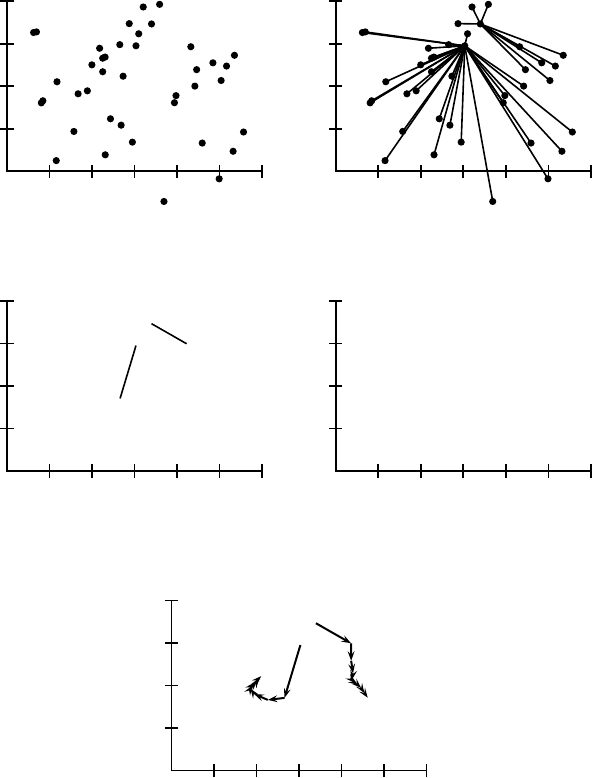
around in space in order to minimize RSS. As shown in Figure 16.5, this is
done iteratively by repeating two steps until a stopping criterion is met: reas-
signing documents to the cluster with the closest centroid; and recomputing
each centroid based on the current members of its cluster. Figure
16.6 shows
snapshots from nine iterations of the K-means algorithm for a set of points.
The “centroid” column of Table
17.2 (page 397) shows examples of centroids.
We can apply one of the following termination conditions.
• A fixed number of iterations I has been completed. This condition limits
the runtime of the clustering algorithm, but in some cases the quality of
the clustering will be poor because of an insufficient number of iterations.
• Assignment of documents to clusters (the partitioning function γ) does
not change between iterations. Except for cases with a bad local mini-
mum, this produces a good clustering, but runtimes may be unacceptably
long.
• Centroids~µ
k
do not change between iterations. This is equivalent to γ not
changing (Exercise
16.5).
• Terminate when RSS falls below a threshold. This criterion ensures that
the clustering is of a desired quality after termination. In practice, we
Online edition (c)2009 Cambridge UP
362 16 Flat clustering
0 1 2 3 4 5 6
0
1
2
3
4
×
×
selection of seeds
0 1 2 3 4 5 6
0
1
2
3
4
×
×
assignment of documents (iter. 1)
0 1 2 3 4 5 6
0
1
2
3
4
+
+
+
+
+
+
+
+
+
+
+
o
o
+
o
+
+
+
+
+
+
+
+
o
+
+
o
+
+
+
+
o
o
+
o
+
+
o
+
o
×
×
×
×
recomputation/movement of ~µ’s (iter. 1)
0 1 2 3 4 5 6
0
1
2
3
4
+
+
+
+
+
+
+
+
+
+
+
+
+
+
o
+
+
+
+
+
o
+
o
o
o
o
+
o
+
o
+
o
+
o
o
o
+
o
+
o
×
×
~µ’s after convergence (iter. 9)
0 1 2 3 4 5 6
0
1
2
3
4
.
.
.
.
.
.
.
.
.
.
.
.
.
.
.
.
.
.
.
.
.
.
.
.
.
.
.
.
.
.
.
.
.
.
.
.
.
.
.
.
movement of ~µ’s in 9 iterations
◮
Figure 16.6 A K-means example for K = 2 in R
2
. The position of the two cen-
troids (~µ’s shown as X’s in the top four panels) converges after nine iterations.

Online edition (c)2009 Cambridge UP
16.4 K-means 363
need to combine it with a bound on the number of iterations to guarantee
termination.
• Terminate when the decrease in RSS falls below a threshold θ. For small θ,
this indicates that we are close to convergence. Again, we need to combine
it with a bound on the number of iterations to prevent very long runtimes.
We now show that K-means converges by proving that RSS monotonically
decreases in each iteration. We will use decrease in the meaning decrease or does
not change in this section. First, RSS decreases in the reassignment step since
each vector is assigned to the closest centroid, so the distance it contributes
to RSS decreases. Second, it decreases in the recomputation step because the
new centroid is the vector ~v for which RSS
k
reaches its minimum.
RSS
k
(~v) =
∑
~x∈ω
k
|~v −~x|
2
=
∑
~x∈ω
k
M
∑
m=1
(v
m
− x
m
)
2
(16.8)
∂RSS
k
(~v)
∂v
m
=
∑
~x∈ω
k
2(v
m
− x
m
)
(16.9)
where x
m
and v
m
are the m
th
components of their respective vectors. Setting
the partial derivative to zero, we get:
v
m
=
1
|ω
k
|
∑
~x∈ω
k
x
m
(16.10)
which is the componentwise definition of the centroid. Thus, we minimize
RSS
k
when the old centroid is replaced with the new centroid. RSS, the sum
of the RSS
k
, must then also decrease during recomputation.
Since there is only a finite set of possible clusterings, a monotonically de-
creasing algorithm will eventually arrive at a (local) minimum. Take care,
however, to break ties consistently, e.g., by assigning a document to the clus-
ter with the lowest index if there are several equidistant centroids. Other-
wise, the algorithm can cycle forever in a loop of clusterings that have the
same cost.
While this proves the convergence of K-means, there is unfortunately no
guarantee that a global minimum in the objective function will be reached.
This is a particular problem if a document set contains many outliers, doc-OUTLIER
uments that are far from any other documents and therefore do not fit well
into any cluster. Frequently, if an outlier is chosen as an initial seed, then no
other vector is assigned to it during subsequent iterations. Thus, we end up
with a singleton cluster (a cluster with only one document) even though thereSINGLETON CLUSTER
is probably a clustering with lower RSS. Figure
16.7 shows an example of a
suboptimal clustering resulting from a bad choice of initial seeds.
Online edition (c)2009 Cambridge UP
364 16 Flat clustering
0 1 2 3 4
0
1
2
3
×
×
×
×
×
×
d
1
d
2
d
3
d
4
d
5
d
6
◮
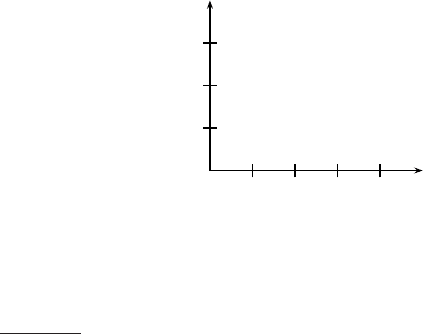
Figure 16.7 The outcome of clustering in K-means depends on the initial seeds.
For seeds d
2
and d
5
, K-means converges to {{d
1
, d
2
, d
3
}, {d
4
, d
5
, d
6
}}, a suboptimal
clustering. For seeds d
2
and d
3
, it converges to {{d
1
, d
2
, d
4
, d
5
}, {d
3
, d
6
}}, the global
optimum for K = 2.
Another type of suboptimal clustering that frequently occurs is one with
empty clusters (Exercise
16.11).
Effective heuristics for seed selection include (i) excluding outliers from
the seed set; (ii) trying out multiple starting points and choosing the cluster-
ing with lowest cost; and (iii) obtaining seeds from another method such as
hierarchical clustering. Since deterministic hierarchical clustering methods
are more predictable than K-means, a hierarchical clustering of a small ran-
dom sample of size iK (e.g., for i = 5 or i = 10) often provides good seeds
(see the description of the Buckshot algorithm, Chapter
17, page 399).
Other initialization methods compute seeds that are not selected from the
vectors to be clustered. A robust method that works well for a large variety
of document distributions is to select i (e.g., i = 10) random vectors for each
cluster and use their centroid as the seed for this cluster. See Section
16.6 for
more sophisticated initializations.
What is the time complexity of K-means? Most of the time is spent on com-
puting vector distances. One such operation costs Θ(M). The reassignment
step computes KN distances, so its overall complexity is Θ(KN M). In the
recomputation step, each vector gets added to a centroid once, so the com-
plexity of this step is Θ(N M). For a fixed number of iterations I, the overall
complexity is therefore Θ(IKNM). Thus, K-means is linear in all relevant
factors: iterations, number of clusters, number of vectors and dimensionality
of the space. This means that K-means is more efficient than the hierarchical
algorithms in Chapter
17. We had to fix the number of iterations I, which can
be tricky in practice. But in most cases, K-means quickly reaches either com-
plete convergence or a clustering that is close to convergence. In the latter
case, a few documents would switch membership if further iterations were
computed, but this has a small effect on the overall quality of the clustering.
Online edition (c)2009 Cambridge UP
16.4 K-means 365
There is one subtlety in the preceding argument. Even a linear algorithm
can be quite slow if one of the arguments of Θ(. . .) is large, and M usually is
large. High dimensionality is not a problem for computing the distance be-
tween two documents. Their vectors are sparse, so that only a small fraction
of the theoretically possible M componentwise differences need to be com-
puted. Centroids, however, are dense since they pool all terms that occur in
any of the documents of their clusters. As a result, distance computations are
time consuming in a naive implementation of K-means. However, there are
simple and effective heuristics for making centroid-document similarities as
fast to compute as document-document similarities. Truncating centroids to
the most significant k terms (e.g., k = 1000) hardly decreases cluster quality
while achieving a significant speedup of the reassignment step (see refer-
ences in Section
16.6).
The same efficiency problem is addressed by K-medoids, a variant of K-K-MEDOIDS
means that computes medoids instead of centroids as cluster centers. We
define the medoid of a cluster as the document vector that is closest to theMEDOID
centroid. Since medoids are sparse document vectors, distance computations
are fast.
✄
16.4.1 C luster cardinality in K-means
We stated in Section
16.2 that the number of clusters K is an input to most flat
clustering algorithms. What do we do if we cannot come up with a plausible
guess for K?
A naive approach would be to select the optimal value of K according to
the objective function, namely the value of K that minimizes RSS. Defining
RSS
min
(K) as the minimal RSS of all clusterings with K clusters, we observe
that RSS
min
(K) is a monotonically decreasing function in K (Exercise
16.13),
which reaches its minimum 0 for K = N where N is the number of doc-
uments. We would end up with each document being in its own cluster.
Clearly, this is not an optimal clustering.
A heuristic method that gets around this problem is to estimate RSS
min
(K)
as follows. We first perform i (e.g., i = 10) clusterings with K clusters (each
with a different initialization) and compute the RSS of each. Then we take the
minimum of the i RSS values. We denote this minimum by
d
RSS
min
(K). Now
we can inspect the values
d
RSS
min
(K) as K increases and find the “knee” in the
curve – the point where successive decreases in
d
RSS
min
become noticeably
smaller. There are two such points in Figure
16.8, one at K = 4, where the
gradient flattens slightly, and a clearer flattening at K = 9. This is typical:
there is seldom a single best number of clusters. We still need to employ an
external constraint to choose from a number of possible values of K (4 and 9
in this case).