
Manning Ch. D., Raghavan P., Sch?tze H. Introduction to Information Retrieval - Введение в информационный поиск
Подождите немного. Документ загружается.

Online edition (c)2009 Cambridge UP
346 15 Support vector machines and machine learning on documents
(or other similar restricted model classes), but it is not good at coming up
with good nonlinear scalings of basic measurements. This area remains the
domain of human feature engineering.
The idea of learning ranking functions has been around for a number of
years, but it is only very recently that sufficient machine learning knowledge,
training document collections, and computational power have come together
to make this method practical and exciting. It is thus too early to write some-
thing definitive on machine learning approaches to ranking in information
retrieval, but there is every reason to expect the use and importance of ma-
chine learned ranking approaches to grow over time. While skilled humans
can do a very good job at defining ranking functions by hand, hand tuning
is difficult, and it has to be done again for each new document collection and
class of users.
?
Exercise 15.7
Plot the first 7 rows of Table 15.3 in the α-ω plane to produce a figure like that in
Figure
15.7.
Exercise 15.8
Write down the equation of a line in the α-ω plane separating the Rs from the Ns.
Exercise 15.9
Give a training example (consisting of values for α, ω and the relevance judgment)
that when added to the training set makes it impossible to separate the R’s from the
N’s using a line in the α-ω plane.
15.5 Ref erences and further reading
The somewhat quirky name support vector machine originates in the neu-
ral networks literature, where learning algorithms were thought of as ar-
chitectures, and often referred to as “machines”. The distinctive element of
this model is that the decision boundary to use is completely decided (“sup-
ported”) by a few training data points, the support vectors.
For a more detailed presentation of SVMs, a good, well-known article-
length introduction is (Burges 1998). Chen et al. (2005) introduce the more
recent ν-SVM, which provides an alternative parameterization for dealing
with inseparable problems, whereby rather than specifying a penalty C, you
specify a parameter ν which bounds the number of examples which can ap-
pear on the wrong side of the decision surface. There are now also several
books dedicated to SVMs, large margin learning, and kernels: (Cristianini
and Shawe-Taylor 2000) and (Schölkopf and Smola 2001) are more math-
ematically oriented, while (Shawe-Taylor and Cristianini 2004) aims to be
more practical. For the foundations by their originator, see (Vapnik 1998).
Online edition (c)2009 Cambridge UP
15.5 References and further reading 347
Some recent, more general books on statistical learning, such as (Hastie et al.
2001) also give thorough coverage of SVMs.
The construction of multiclass SVMs is discussed in (Weston and Watkins
1999), (Crammer and Singer 2001), and (Tsochantaridis et al. 2005). The last
reference provides an introduction to the general framework of structural
SVMs.
The kernel trick was first presented in (Aizerman et al. 1964). For more
about string kernels and other kernels for structured data, see (Lodhi et al.
2002) and (Gaertner et al. 2002). The Advances in Neural Information Pro-
cessing (NIPS) conferences have become the premier venue for theoretical
machine learning work, such as on SVMs. Other venues such as SIGIR are
much stronger on experimental methodology and using text-specific features
to improve classifier effectiveness.
A recent comparison of most current machine learning classifiers (though
on problems rather different from typical text problems) can be found in
(Caruana and Niculescu-Mizil 2006). (Li and Yang 2003), discussed in Sec-
tion
13.6, is the most recent comparative evaluation of machine learning clas-
sifiers on text classification. Older examinations of classifiers on text prob-
lems can be found in (Yang 1999, Yang and Liu 1999, Dumais et al. 1998).
Joachims (2002a) presents his work on SVMs applied to text problems in de-
tail. Zhang and Oles (2001) present an insightful comparison of Naive Bayes,
regularized logistic regression and SVM classifiers.
Joachims (1999) discusses methods of making SVM learning practical over
large text data sets. Joachims (2006a) improves on this work.
A number of approaches to hierarchical classification have been developed
in order to deal with the common situation where the classes to be assigned
have a natural hierarchical organization (Koller and Sahami 1997, McCal-
lum et al. 1998, Weigend et al. 1999, Dumais and Chen 2000). In a recent
large study on scaling SVMs to the entire Yahoo! directory, Liu et al. (2005)
conclude that hierarchical classification noticeably if still modestly outper-
forms flat classification. Classifier effectiveness remains limited by the very
small number of training documents for many classes. For a more general
approach that can be applied to modeling relations between classes, which
may be arbitrary rather than simply the case of a hierarchy, see Tsochan-
taridis et al. (2005).
Moschitti and Basili (2004) investigate the use of complex nominals, proper
nouns and word senses as features in text classification.
Dietterich (2002) overviews ensemble methods for classifier combination,
while Schapire (2003) focuses particularly on boosting, which is applied to
text classification in (Schapire and Singer 2000).
Chapelle et al. (2006) present an introduction to work in semi-supervised
methods, including in particular chapters on using EM for semi-supervised
text classification (Nigam et al. 2006) and on transductive SVMs (Joachims
Online edition (c)2009 Cambridge UP
348 15 Support vector machines and machine learning on documents
2006b). Sindhwani and Keerthi (2006) present a more efficient implementa-
tion of a transductive SVM for large data sets.
Tong and Koller (2001) explore active learning with SVMs for text classi-
fication; Baldridge and Osborne (2004) point out that examples selected for
annotation with one classifier in an active learning context may be no better
than random examples when used with another classifier.
Machine learning approaches to ranking for ad hoc retrieval were pio-
neered in (Wong et al. 1988), (Fuhr 1992), and (Gey 1994). But limited training
data and poor machine learning techniques meant that these pieces of work
achieved only middling results, and hence they only had limited impact at
the time.
Taylor et al. (2006) study using machine learning to tune the parameters
of the BM25 family of ranking functions (Section
11.4.3, page 232) so as to
maximize NDCG (Section 8.4, page 163). Machine learning approaches to
ordinal regression appear in (Herbrich et al. 2000) and (Burges et al. 2005),
and are applied to clickstream data in (Joachims 2002b). Cao et al. (2006)
study how to make this approach effective in IR, and Qin et al. (2007) suggest
an extension involving using multiple hyperplanes. Yue et al. (2007) study
how to do ranking with a structural SVM approach, and in particular show
how this construction can be effectively used to directly optimize for MAP
(Section
8.4, page 158), rather than using surrogate measures like accuracy or
area under the ROC curve. Geng et al. (2007) study feature selection for the
ranking problem.
Other approaches to learning to rank have also been shown to be effective
for web search, such as (Burges et al. 2005, Richardson et al. 2006).
Online edition (c)2009 Cambridge UP
DRAFT! © April 1, 2009 Cambridge University Press. Feedback welcome. 349
16 Flat cluster i ng
Clustering algorithms group a set of documents into subsets or clusters. TheCLUSTER
algorithms’ goal is to create clusters that are coherent internally, but clearly
different from each other. In other words, documents within a cluster should
be as similar as possible; and documents in one cluster should be as dissimi-
lar as possible from documents in other clusters.
0.0 0.5 1.0 1.5 2.0
0.0 0.5 1.0 1.5 2.0 2.5
◮
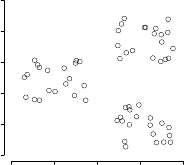
Figure 16.1 An example of a data set with a clear cluster structure.
Clustering is the most common form of unsupervised learning. No super-UNSUPERVISED
LEARNING
vision means that there is no human expert who has assigned documents
to classes. In clustering, it is the distribution and makeup of the data that
will determine cluster membership. A simple example is Figure
16.1. It is
visually clear that there are three distinct clusters of points. This chapter and
Chapter
17 introduce algorithms that find such clusters in an unsupervised
fashion.
The difference between clustering and classification may not seem great
at first. After all, in both cases we have a partition of a set of documents
into groups. But as we will see the two problems are fundamentally differ-
ent. Classification is a form of supervised learning (Chapter
13, page 256):
our goal is to replicate a categorical distinction that a human supervisor im-
Online edition (c)2009 Cambridge UP
350 16 Flat clustering
poses on the data. In unsupervised learning, of which clustering is the most
important example, we have no such teacher to guide us.
The key input to a clustering algorithm is the distance measure. In Fig-
ure
16.1, the distance measure is distance in the 2D plane. This measure sug-
gests three different clusters in the figure. In document clustering, the dis-
tance measure is often also Euclidean distance. Different distance measures
give rise to different clusterings. Thus, the distance measure is an important
means by which we can influence the outcome of clustering.
Flat clustering creates a flat set of clusters without any explicit structure thatFLAT CLUSTERING
would relate clusters to each other. Hierarchical clustering creates a hierarchy
of clusters and will be covered in Chapter
17. Chapter 17 also addresses the
difficult problem of labeling clusters automatically.
A second important distinction can be made between hard and soft cluster-
ing algorithms. Hard clustering computes a hard assignment – each documentHARD CLUSTERING
is a member of exactly one cluster. The assignment of soft clustering algo -SOFT CLUSTERING
rithms is soft – a document’s assignment is a distribution over all clusters.
In a soft assignment, a document has fractional membership in several clus-
ters. Latent semantic indexing, a form of dimensionality reduction, is a soft
clustering algorithm (Chapter
18, page 417).
This chapter motivates the use of clustering in information retrieval by
introducing a number of applications (Section
16.1), defines the problem
we are trying to solve in clustering (Section 16.2) and discusses measures
for evaluating cluster quality (Section
16.3). It then describes two flat clus-
tering algorithms, K-means (Section 16.4), a hard clustering algorithm, and
the Expectation-Maximization (or EM) algorithm (Section 16.5), a soft clus-
tering algorithm. K-means is perhaps the most widely used flat clustering
algorithm due to its simplicity and efficiency. The EM algorithm is a gen-
eralization of K-means and can be applied to a large variety of document
representations and distributions.
16.1 Clustering in information retrieval
The cluster hypothesis states the fundamental assumption we make when us-CLUSTER HYPOTHESIS
ing clustering in information retrieval.
Cluster hypothesis. Documents in the same cluster behave similarly
with respect to relevance to information needs.
The hypothesis states that if there is a document from a cluster that is rele-
vant to a search request, then it is likely that other documents from the same
cluster are also relevant. This is because clustering puts together documents
that share many terms. The cluster hypothesis essentially is the contiguity
Online edition (c)2009 Cambridge UP
16.1 Clustering in information retrieval 351
Application What is Benefit Example
clustered?
Search result clustering search
results
more effective information
presentation to user
Figure 16.2
Scatter-Gather (subsets of)
collection
alternative user interface:
“search without typing”
Figure 16.3
Collection clustering collection effective information pre-
sentation for exploratory
browsing
McKeown et al. (2002),
http://news.google.com
Language modeling collection increased precision and/or
recall
Liu and Croft (2004)
Cluster-based retrieval collection higher efficiency: faster
search
Salton (1971a)
◮
Table 16.1 Some applications of clustering in information retrieval.
hypothesis in Chapter 14 (page 289). In both cases, we posit that similar
documents behave similarly with respect to relevance.
Table
16.1 shows some of the main applications of clustering in informa-
tion retrieval. They differ in the set of documents that they cluster – search
results, collection or subsets of the collection – and the aspect of an informa-
tion retrieval system they try to improve – user experience, user interface,
effectiveness or efficiency of the search system. But they are all based on the
basic assumption stated by the cluster hypothesis.
The first application mentioned in Table
16.1 is search result clustering whereSEARCH RESULT
CLUSTERING
by search results we mean the documents that were returned in response to
a query. The default presentation of search results in information retrieval is
a simple list. Users scan the list from top to bottom until they have found
the information they are looking for. Instead, search result clustering clus-
ters the search results, so that similar documents appear together. It is often
easier to scan a few coherent groups than many individual documents. This
is particularly useful if a search term has different word senses. The example
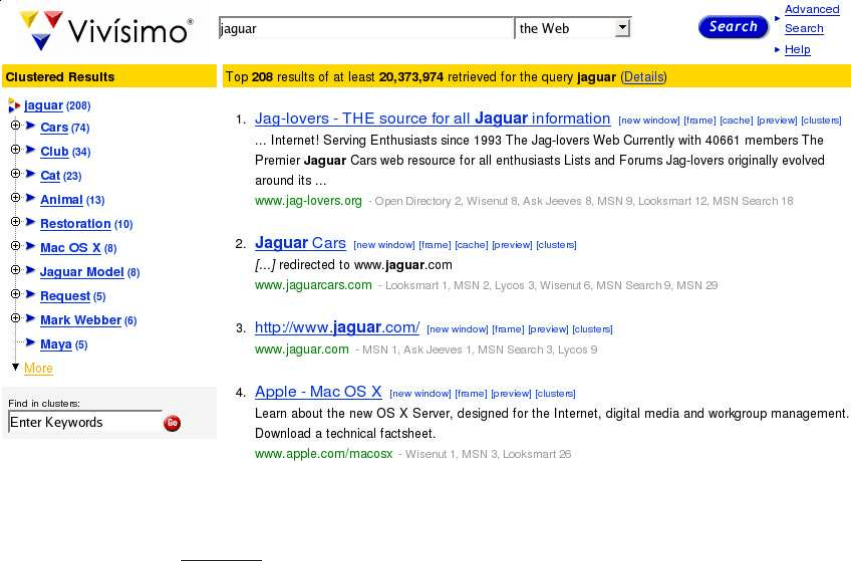
in Figure
16.2 is jaguar. Three frequent senses on the web refer to the car, the
animal and an Apple operating system. The Clustered Results panel returned
by the Vivísimo search engine (http://vivisimo.com) can be a more effective user
interface for understanding what is in the search results than a simple list of
documents.
A better user interface is also the goal of Scatter-Gather, the second ap-SCATTER-GATHER
plication in Table
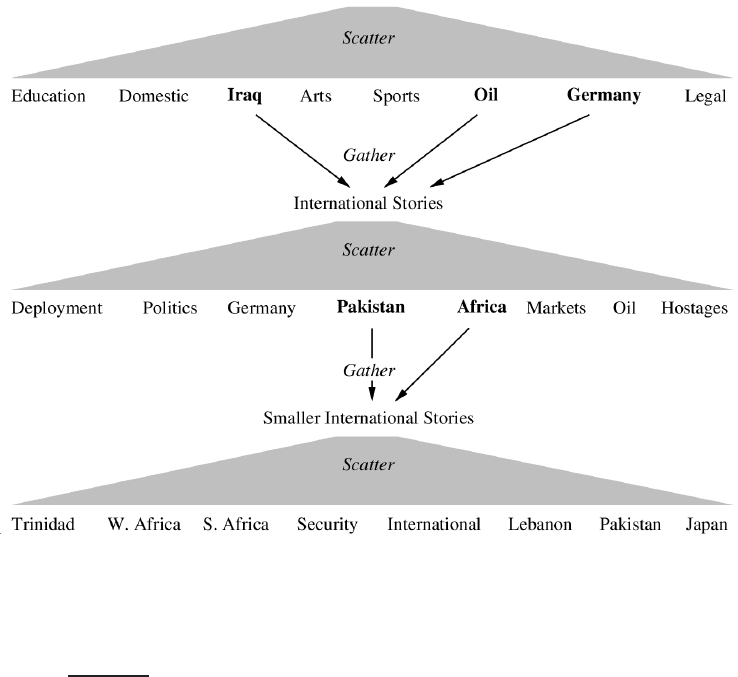
16.1. Scatter-Gather clusters the whole collection to get
groups of documents that the user can select or gather. The selected groups
are merged and the resulting set is again clustered. This process is repeated
until a cluster of interest is found. An example is shown in Figure
16.3.
Online edition (c)2009 Cambridge UP
352 16 Flat clustering
◮
Figure 16.2 Clustering of search results to improve recall. None of the top hits
cover the animal sense of jaguar, but users can easily access it by clicking on the cat
cluster in the Clustered Results panel on the left (third arrow from the top).
Automatically generated clusters like those in Figure 16.3 are not as neatly
organized as a manually constructed hierarchical tree like the Open Direc-
tory at http://dmoz.org. Also, finding descriptive labels for clusters automati-
cally is a difficult problem (Section
17.7, page 396). But cluster-based navi-
gation is an interesting alternative to keyword searching, the standard infor-
mation retrieval paradigm. This is especially true in scenarios where users
prefer browsing over searching because they are unsure about which search
terms to use.
As an alternative to the user-mediated iterative clustering in Scatter-Gather,
we can also compute a static hierarchical clustering of a collection that is
not influenced by user interactions (“Collection clustering” in Table
16.1).
Google News and its precursor, the Columbia NewsBlaster system, are ex-
amples of this approach. In the case of news, we need to frequently recom-
pute the clustering to make sure that users can access the latest breaking
stories. Clustering is well suited for access to a collection of news stories
since news reading is not really search, but rather a process of selecting a
subset of stories about recent events.
Online edition (c)2009 Cambridge UP
16.1 Clustering in information retrieval 353
◮
Figure 16.3 An example of a user session in Scatter-Gather. A collection of New
York Times news stories is clustered (“scattered”) into eight clusters (top row). The
user manually gathers three of these into a smaller collection International Stories and
performs another scattering operation. This process repeats until a small cluster with
relevant documents is found (e.g., Trinidad).
The fourth application of clustering exploits the cluster hypothesis directly
for improving search results, based on a clustering of the entire collection.
We use a standard inverted index to identify an initial set of documents that
match the query, but we then add other documents from the same clusters
even if they have low similarity to the query. For example, if the query is car
and several car documents are taken from a cluster of automobile documents,
then we can add documents from this cluster that use terms other than car
(automobile, vehicle etc). This can increase recall since a group of documents
with high mutual similarity is often relevant as a whole.
More recently this idea has been used for language modeling. Equation (
12.10),
page
245, showed that to avoid sparse data problems in the language mod-
eling approach to IR, the model of document d can be interpolated with a
Online edition (c)2009 Cambridge UP
354 16 Flat clustering
collection model. But the collection contains many documents with terms
untypical of d. By replacing the collection model with a model derived from
d’s cluster, we get more accurate estimates of the occurrence probabilities of
terms in d.
Clustering can also speed up search. As we saw in Section
6.3.2 (page 123)
search in the vector space model amounts to finding the nearest neighbors
to the query. The inverted index supports fast nearest-neighbor search for
the standard IR setting. However, sometimes we may not be able to use an
inverted index efficiently, e.g., in latent semantic indexing (Chapter
18). In
such cases, we could compute the similarity of the query to every document,
but this is slow. The cluster hypothesis offers an alternative: Find the clus-
ters that are closest to the query and only consider documents from these
clusters. Within this much smaller set, we can compute similarities exhaus-
tively and rank documents in the usual way. Since there are many fewer
clusters than documents, finding the closest cluster is fast; and since the doc-
uments matching a query are all similar to each other, they tend to be in
the same clusters. While this algorithm is inexact, the expected decrease in
search quality is small. This is essentially the application of clustering that
was covered in Section 7.1.6 (page 141).
?
Exercise 16.1
Define two documents as similar if they have at least two proper names like Clinton
or Sarkozy in common. Give an example of an information need and two documents,
for which the cluster hypothesis does not hold for this notion of similarity.
Exercise 16.2
Make up a simple one-dimensional example (i.e. points on a line) with two clusters
where the inexactness of cluster-based retrieval shows up. In your example, retriev-
ing clusters close to the query should do worse than direct nearest neighbor search.
16.2 Problem statemen t
We can define the goal in hard flat clustering as follows. Given (i) a set of
documents D = {d
1
, . . . , d
N
}, (ii) a desired number of clusters K, and (iii)
an objective function that evaluates the quality of a clustering, we want toOBJECTIVE FUNCTION
compute an assignment γ : D → {1, . . . , K} that minimizes (or, in other
cases, maximizes) the objective function. In most cases, we also demand that
γ is surjective, i.e., that none of the K clusters is empty.
The objective function is often defined in terms of similarity or distance
between documents. Below, we will see that the objective in K-means clus-
tering is to minimize the average distance between documents and their cen-
troids or, equivalently, to maximize the similarity between documents and
their centroids. The discussion of similarity measures and distance metrics
Online edition (c)2009 Cambridge UP
16.2 Problem statement 355
in Chapter 14 (page 291) also applies to this chapter. As in Chapter 14, we use
both similarity and distance to talk about relatedness between documents.
For documents, the type of similarity we want is usually topic similarity
or high values on the same dimensions in the vector space model. For exam-
ple, documents about China have high values on dimensions like Chinese,
Beijing, and Mao whereas documents about the UK tend to have high values
for London, Britain and Queen. We approximate topic similarity with cosine
similarity or Euclidean distance in vector space (Chapter
6). If we intend to
capture similarity of a type other than topic, for example, similarity of lan-
guage, then a different representation may be appropriate. When computing
topic similarity, stop words can be safely ignored, but they are important
cues for separating clusters of English (in which the occurs frequently and la
infrequently) and French documents (in which the occurs infrequently and la
frequently).
A note on terminology. An alternative definition of hard clustering is that
a document can be a full member of more than one cluster. Partitional clus-PARTITIONAL
CLUSTERING
tering always refers to a clustering where each document belongs to exactly
one cluster. (But in a partitional hierarchical clustering (Chapter
17) all mem-
bers of a cluster are of course also members of its parent.) On the definition
of hard clustering that permits multiple membership, the difference between
soft clustering and hard clustering is that membership values in hard clus-
tering are either 0 or 1, whereas they can take on any non-negative value in
soft clustering.
Some researchers distinguish between exh a ustive clusterings that assignEXHAUSTIVE
each document to a cluster and non-exhaustive clusterings, in which some
documents will be assigned to no cluster. Non-exhaustive clusterings in
which each document is a member of either no cluster or one cluster are
called exclusive. We define clustering to be exhaustive in this book.EXCLUSIVE
16.2.1 C ardinality – the number of clusters
A difficult issue in clustering is determining the number of clusters or cardi-CARDINALITY
nality of a clustering, which we denote by K. Often K is nothing more than
a good guess based on experience or domain knowledge. But for K-means,
we will also introduce a heuristic method for choosing K and an attempt to
incorporate the selection of K into the objective function. Sometimes the ap-
plication puts constraints on the range of K. For example, the Scatter-Gather
interface in Figure
16.3 could not display more than about K = 10 clusters
per layer because of the size and resolution of computer monitors in the early
1990s.
Since our goal is to optimize an objective function, clustering is essentially