
Marder M.P. Condensed Matter Physics
Подождите немного. Документ загружается.

Further
Features
of Scattering Experiments 63
3.4.3 Neutrons
Neutrons scatter only off nuclei, and apart from interesting corrections due to rela-
tive spins of incoming neutron and nucleus that make it possible to probe magnetic
structures, the interaction is completely isotropie. The scattering form factor f(r)
for neutrons is a constant a for any given element called the
scattering
length. This
simplifying fact is the great advantage of
neutrons.
Their main disadvantage is sim-
ply the great expense required to generate beams of useful intensities. A neutron
wavelength of 2 Â corresponds to an energy of 0.02 eV, which corresponds ap-
proximately to room temperature, giving neutrons of this energy the name thermal
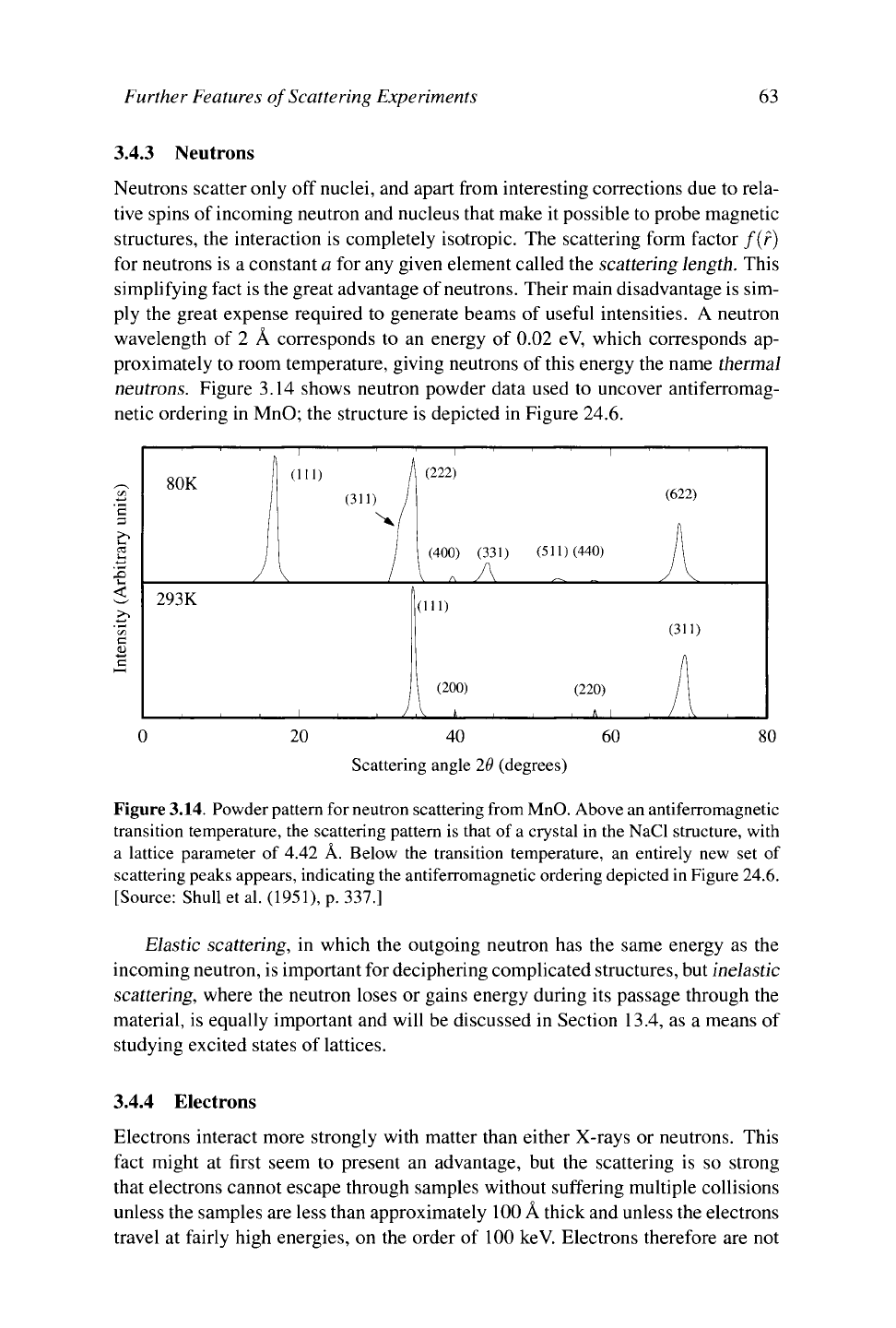
neutrons. Figure 3.14 shows neutron powder data used to uncover antiferromag-
netic ordering in MnO; the structure is depicted in Figure 24.6.
80K
)
293K
- i -
(111)
V
1
(311) /
■ 1
(222)
(400) (331)
l
Λ
A
(111)
(200)
V
i
1
1
(511) (440)
(220)
(622)
A
A
(311)
.
A
0 20 40 60 80
Scattering angle
2Θ
(degrees)
Figure 3.14. Powder pattern for neutron scattering from MnO. Above an antiferromagnetic
transition temperature, the scattering pattern is that of a crystal in the NaCl structure, with
a lattice parameter of 4.42 Â. Below the transition temperature, an entirely new set of
scattering peaks appears, indicating the antiferromagnetic ordering depicted in Figure 24.6.
[Source: Shull et al. (1951), p. 337.]
Elastic scattering, in which the outgoing neutron has the same energy as the
incoming neutron, is important for deciphering complicated structures, but inelastic
scattering, where the neutron loses or gains energy during its passage through the
material, is equally important and will be discussed in Section 13.4, as a means of
studying excited states of lattices.
3.4.4 Electrons
Electrons interact more strongly with matter than either X-rays or neutrons. This
fact might at first seem to present an advantage, but the scattering is so strong
that electrons cannot escape through samples without suffering multiple collisions
unless the samples are less than approximately 100 Â thick and unless the electrons
travel at fairly high energies, on the order of 100 keV. Electrons therefore are not
64 Chapter 3. Scattering and Structures
employed to deduce the structures of bulk crystals, but they do find use in the study
of solid surfaces (Section 4.3), and microscopically thin samples.
Incoming electrons interact with the complete electrostatic potential of
the
mat-
ter into which they travel, including both electrons and nuclei, and in the Born
approximation this leads to a scattering amplitude f
e
\
f
e
,(q)
= — / dr V(7)e""
q
See Landau and Lifshitz (1977) p. 513, or (3.46)
h
2
J Schiff (1968), p. 324.
v
'
which is related to the scattering function for X-rays by
2
ine
f
<
(q) = —~ \Z — n(q)] Z is the atomic number; n is the electron den- (3.47)
2/j Jt? sin Θ
s
'
t
y
an
d '
s re
'
ate<
J
t0
the X-ray scattering form
0
factor by Eq. (3.44).
as shown in Problem 6.
3.4.5 Deciphering Complex Structures
Teasing crystalline structures out of arrays of spots on film is relatively easy when
the structure in question is composed of only a few elements and the unit cell is
small. Faced, however, with a protein crystal, with a unit cell containing tens or
hundreds of thousands of atoms, the problem of reconstructing atomic positions
becomes a daunting one. Ideally, there would be some purely automatic procedure
that operates upon the scattering data and reconstructs the scattering potential. In
the fields of light and electron microscopy this procedure exists; it is known as a
lens,
which should be understood as a device for recombining scattered waves in a
fashion so as to reveal the structure from which they came. An important feature
of recombining waves by focusing them is that all information about the relative
phase of waves scattered from different parts of the structure is preserved. Math-
ematically, this information is needed for structure to be deduced from scattering
data, and in X-ray and neutron experiments it is almost always lost (see Hauptman
(1989)).
Automated procedures for analyzing X-ray data are nevertheless possible, to
a point. Suppose one carries out a rotating crystal experiment and measures I(q),
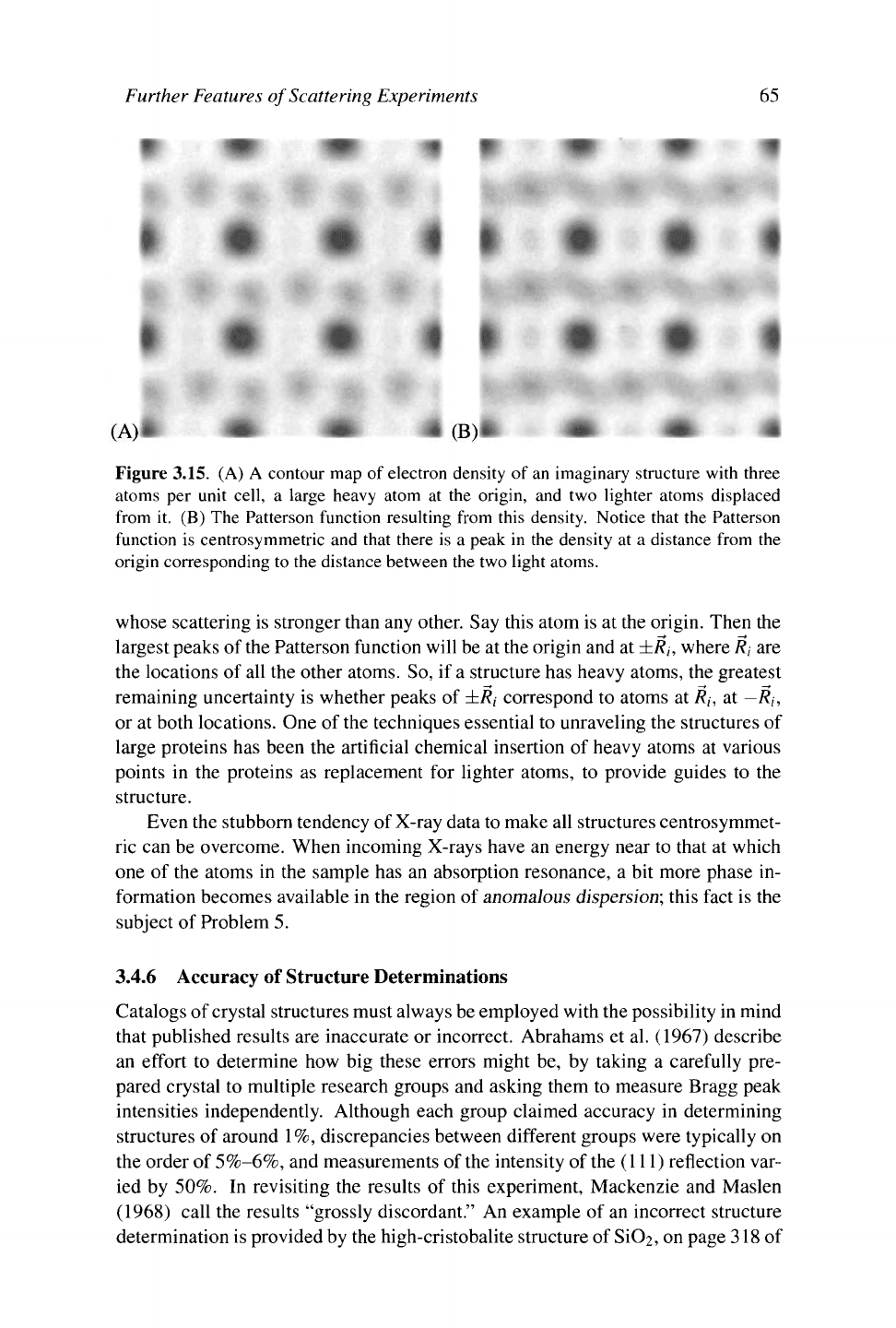
as in Eq. (3.45). Performing an inverse Fourier transform in 3 on these data gives
immediately the
Patterson
function, after Patterson (1934), depicted in Figure 3.15,
which is proportional to
/
n is the number density per volume of electrons. Con-
dr'n(~r*\n(~r — 7
1
)
stant
mum
P
ners
sucn as
factors of 2π are irrelevant for /τ ΛΟΛ
\ / V -'the ensuing arguments, and are being dropped. ^ ' '
How much of the information originally present in phases has irredeemably been
lost? As Figure 3.15 makes clear, not so much. There is a peak in the Patterson
function at all locations R\
—
R2,
where R\ and R2 are peaks of the true density,
and the height of each peak is given by the product of the amplitudes of the two
original density peaks that produce it. So, while one does not know where all the
atoms are from Figure 3.15(B), one can read off a net of vector distances between
them. Matters are simplified further if
the
structure contains a heavy
atom:
an atom
Further
Features
of Scattering Experiments
65
Figure 3.15. (A) A contour map of electron density of an imaginary structure with three
atoms per unit cell, a large heavy atom at the origin, and two lighter atoms displaced
from it. (B) The Patterson function resulting from this density. Notice that the Patterson
function is centrosymmetric and that there is a peak in the density at a distance from the
origin corresponding to the distance between the two light atoms.
whose scattering is stronger than any other. Say this atom is at the origin. Then the
largest peaks of
the
Patterson function will be at the origin and at ±/?,, where
Rj
are
the locations of all the other atoms. So, if a structure has heavy atoms, the greatest
remaining uncertainty is whether peaks of ±/?, correspond to atoms at
/?,·,
at
—/?,·,
or at both locations. One of the techniques essential to unraveling the structures of
large proteins has been the artificial chemical insertion of heavy atoms at various
points in the proteins as replacement for lighter atoms, to provide guides to the
structure.
Even the stubborn tendency of X-ray data to make all structures centrosymmet-
ric can be overcome. When incoming X-rays have an energy near to that at which
one of the atoms in the sample has an absorption resonance, a bit more phase in-
formation becomes available in the region of anomalous
dispersion;
this fact is the
subject of Problem 5.
3.4.6 Accuracy of Structure Determinations
Catalogs of crystal structures must always be employed with the possibility in mind
that published results are inaccurate or incorrect. Abrahams et al. (1967) describe
an effort to determine how big these errors might be, by taking a carefully pre-
pared crystal to multiple research groups and asking them to measure Bragg peak
intensities independently. Although each group claimed accuracy in determining
structures of around 1%, discrepancies between different groups were typically on
the order of 5%-6%, and measurements of
the
intensity of the (111) reflection var-
ied by 50%. In revisiting the results of this experiment, Mackenzie and Maslen
(1968) call the results "grossly discordant." An example of an incorrect structure
determination is provided by the high-cristobalite structure of
S1O2,
on page 318 of
66
Chapter 3. Scattering and Structures
Wyckoff (1963); the correct structure is discussed in Liu et al. (1993). How many
other examples like this latter one may exist is difficult to say.
3.5 Correlation Functions
3.5.1 Why Bragg Peaks Survive Atomic Motions
Sommerfeld objected in 1912 to the search for X-ray scattering on the grounds
that atoms constantly move large distances from their ideal positions, and the ex-
periment could not work. The theory presented so far assumes atoms sit perfectly
still at ideal locations, yet it compares well with experiments performed at room
temperature. How can this be?
This is a special case of an even more primitive question, which concerns the
nature of crystals. What really defines them? It is not enough to say that all their
atoms sit in a perfect lattice, since thermal motions and occasional impurities do
not destroy the crystal's essential nature.
The essential nature of a crystal is that positions of atoms are correlated at long
distances. This idea can be made precise in any monatomic system by defining the
two-particle or Van Hove (1954) correlation function
n
2
(7\,
r
2
; t). This function
gives the probability that if some particle is at position r\ at time t\, a particle is to
be found at position r
2
at time t\+t. Formally,
«2(n,
~h\
0 = (Σ
δ
(
7]
-Ri{h)W
2
-Ri'{t\ +t)) ) . SSe °
ngmal
(3.49)
\ / // I condition / ji /' is
' imposed on the sum.
The brackets denote either a thermal average or a time average over t\, as according
to principles of statistical mechanics the two averages should be the same. Vari-
ables R[(t) track the locations of the particles.
From the correlation function, define the dynamic structure factor, a dimen-
sionless measure of scattering, by
S(q, ή Ξ = — y^ /
e
'HRi('i)-Ri>(.ti+t))\ This is proportional to the time (3.50)
yV/iitnm N ^^ \ ' average or thermal average of
1,1'
Eq. (3.11).
= l Σ / ^1^2 ^'-
?2)
(<5(n -Rifa))S(r2-Ri>(ti +0)) (3-51)
= — I df\ dr
2
n
2
{r\,
r
2
\ ήε^'^"
7
"
1
"
1
Just insert the definition (3.49). (3.52)
V
= —η
2
{3, t) V is the system volume. If the condition / φ /' had been added to (3.53)
N Eq. (3.49), there would be an additive factor of 1.
where
n
2
(q, t) = ^ J
drdr>
η
2
{7
+
Ψ,
r; t)e^'. (3.54)
Return to Eq. (3.11). A traditional scattering experiment requires collecting
radiation on a photographic plate over times on the order of seconds. Atomic
Correlation Functions 67
oscillations occur on a time scale of picoseconds. Scattering experiments thus
measure the long-time average of radiation intensity exiting the sample. That is,
these experiments do not really measure the quantity in Eq. (3.11), they measure
its time average, which is the static
structure
factor,
S{q)=S(q,0). (3.55)
The necessary condition for scattering peaks can now be expressed in a more
general way. As Ψ in Eq. (3.54) becomes larger and larger, the static correlation
function must continue to exhibit periodic maxima centered on lattice sites, and the
amplitudes of these maxima should not diminish when the r' becomes large com-
pared to atomic spacings. A specific example comparing solids and liquids appears
in Figure 5.9. This is the type of correlation called long-range positional order.
Putting matters another way, it does not matter if atoms are in thermal motion, just
so long as every atom vibrates around a set of mean locations that constitute a per-
fect crystal. The effect of vibrations is to decrease the amplitude of Bragg peaks,
not their existence or location in frequency space. Explicit expressions for the way
that quantum mechanical and thermal fluctuations reduce Bragg peak amplitude
appear in Eqs. (13.124) and (13.129).
Placing atoms in lattices is a special case of the more general idea of long-
range order or long-range correlations. Long-range order concerns the average
behavior of pairs of particles over time, not their location at any one instant. Long-
range order is the fundamental property that separates solids from liquids. More
generally, the ideas of correlation and ordering explain qualitative phases of matter
including superconducting and superfluid states.
3.5.2 Extended X-Ray Absorption Fine Structure (EXAFS)
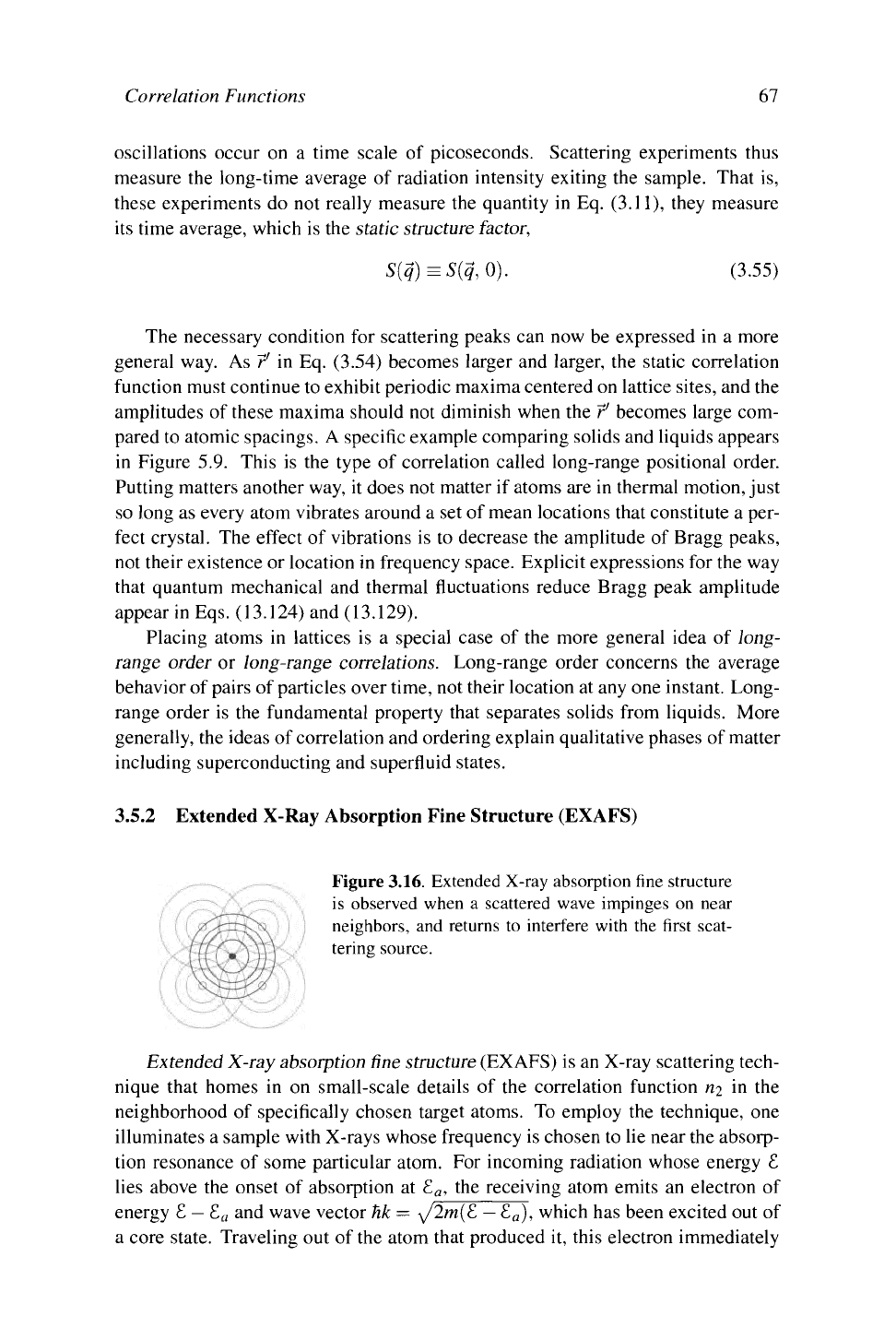
Figure 3.16. Extended X-ray absorption fine structure
is observed when a scattered wave impinges on near
neighbors, and returns to interfere with the first scat-
tering source.
Extended X-ray
absorption
une
structure
(EXAFS) is an X-ray scattering tech-
nique that homes in on small-scale details of the correlation function «2 in the
neighborhood of specifically chosen target atoms. To employ the technique, one
illuminates a sample with X-rays whose frequency is chosen to lie near the absorp-
tion resonance of some particular atom. For incoming radiation whose energy £
lies above the onset of absorption at E
a
, the receiving atom emits an electron of
energy £
—
£
u
and wave vector hk
—
\j2m{Z
—
£
a
), which has been excited out of
a core state. Traveling out of the atom that produced it, this electron immediately
68 Chapter 3. Scattering and Structures
begins to scatter off neighboring atoms; the scattered wave returns to the original
atom and interferes with the electron emission process, as in Figure 3.16. If
this
re-
turning wave reduces the electron amplitude at the original atom, X-rays will have
increased difficulty ejecting electrons to begin with, and there should be a dip in
the X-ray absorption coefficient a(E). Without developing a detailed theory of this
rather complicated interference process, it is possible to guess the form the result
must have. If X-rays eject electrons from atoms at the origin, and a neighboring
atom at location Rj scatters them back, then because the total path length from
atom to scatterer and back is 2Rj, interference between the original and scattered
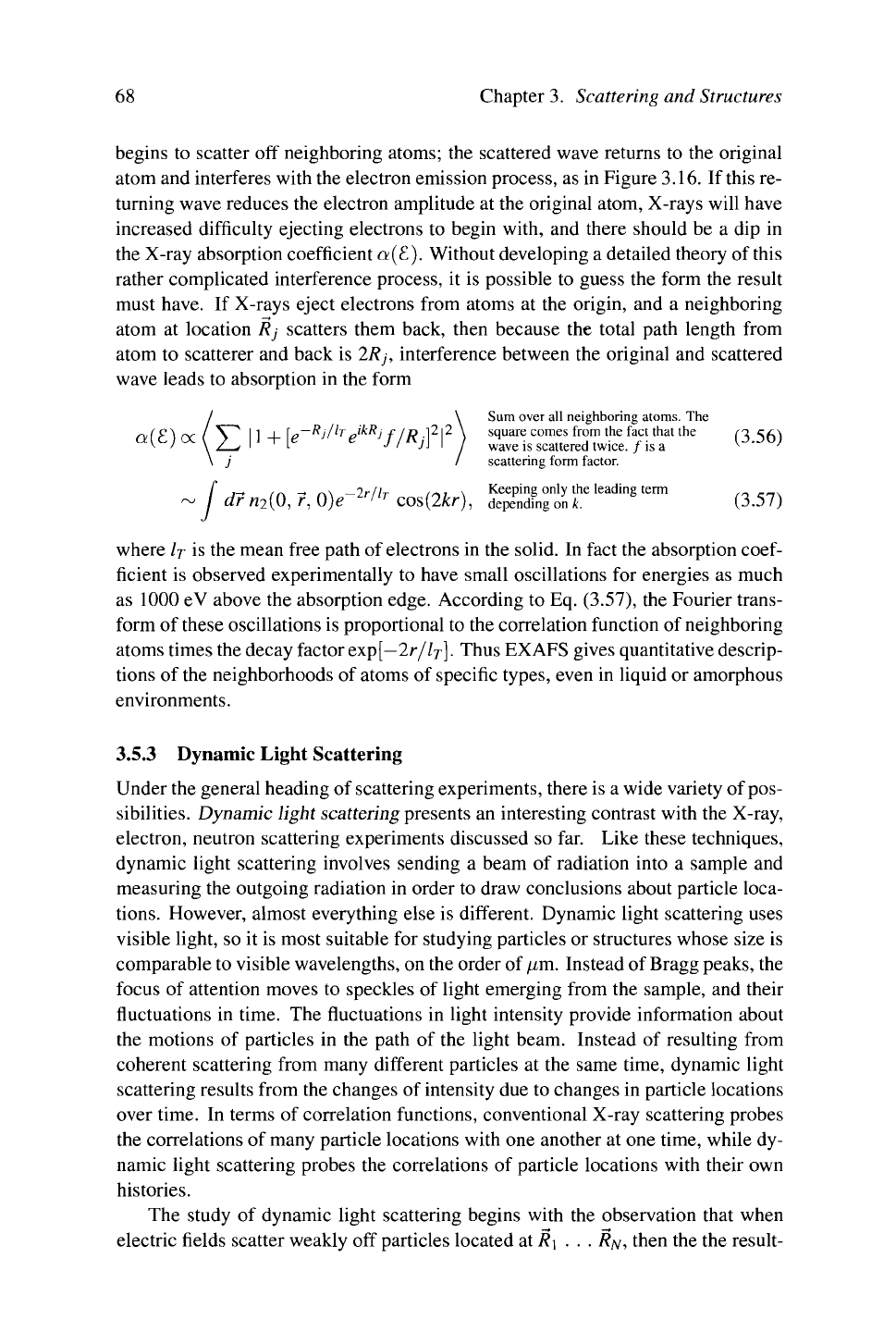
wave leads to absorption in the form
(
\ Sum over all neighboring atoms. The
Y"
11
+ \e~
R
>
th
e
m
'
f/Rj]
2
]
2
)
squarecomesfr
°
mthefaathatthe
(3.56)
' ' i ' L J i ji i / wave is scattered twice. / is a
v
'
j I scattering form factor.
/
.-. irs -, n\ —Jr/Ιτ /„. \ Keeping only the leading term ,_ ^_
N
drn
2
(0,r, 0)e
2r/
'
T
COs{2kr), depending on k. (3.57)
where
IT
is the mean free path of electrons in the solid. In fact the absorption
coef-
ficient is observed experimentally to have small oscillations for energies as much
as 1000 eV above the absorption edge. According to Eq. (3.57), the Fourier trans-
form of these oscillations is proportional to the correlation function of neighboring
atoms times the decay factor
exp[—2r//r].
Thus EXAFS gives quantitative descrip-
tions of the neighborhoods of atoms of specific types, even in liquid or amorphous
environments.
3.5.3 Dynamic Light Scattering
Under the general heading of scattering experiments, there is a wide variety of
pos-
sibilities. Dynamic light
scattering
presents an interesting contrast with the X-ray,
electron, neutron scattering experiments discussed so far. Like these techniques,
dynamic light scattering involves sending a beam of radiation into a sample and
measuring the outgoing radiation in order to draw conclusions about particle loca-
tions.
However, almost everything else is different. Dynamic light scattering uses
visible light, so it is most suitable for studying particles or structures whose size is
comparable to visible wavelengths, on the order of
/im.
Instead of Bragg peaks, the
focus of attention moves to speckles of light emerging from the sample, and their
fluctuations in time. The fluctuations in light intensity provide information about
the motions of particles in the path of the light beam. Instead of resulting from
coherent scattering from many different particles at the same time, dynamic light
scattering results from the changes of intensity due to changes in particle locations
over time. In terms of correlation functions, conventional X-ray scattering probes
the correlations of many particle locations with one another at one time, while dy-
namic light scattering probes the correlations of particle locations with their own
histories.
The study of dynamic light scattering begins with the observation that when
electric fields scatter weakly off particles located atR\... R^, then the the result-
Correlation Functions
69
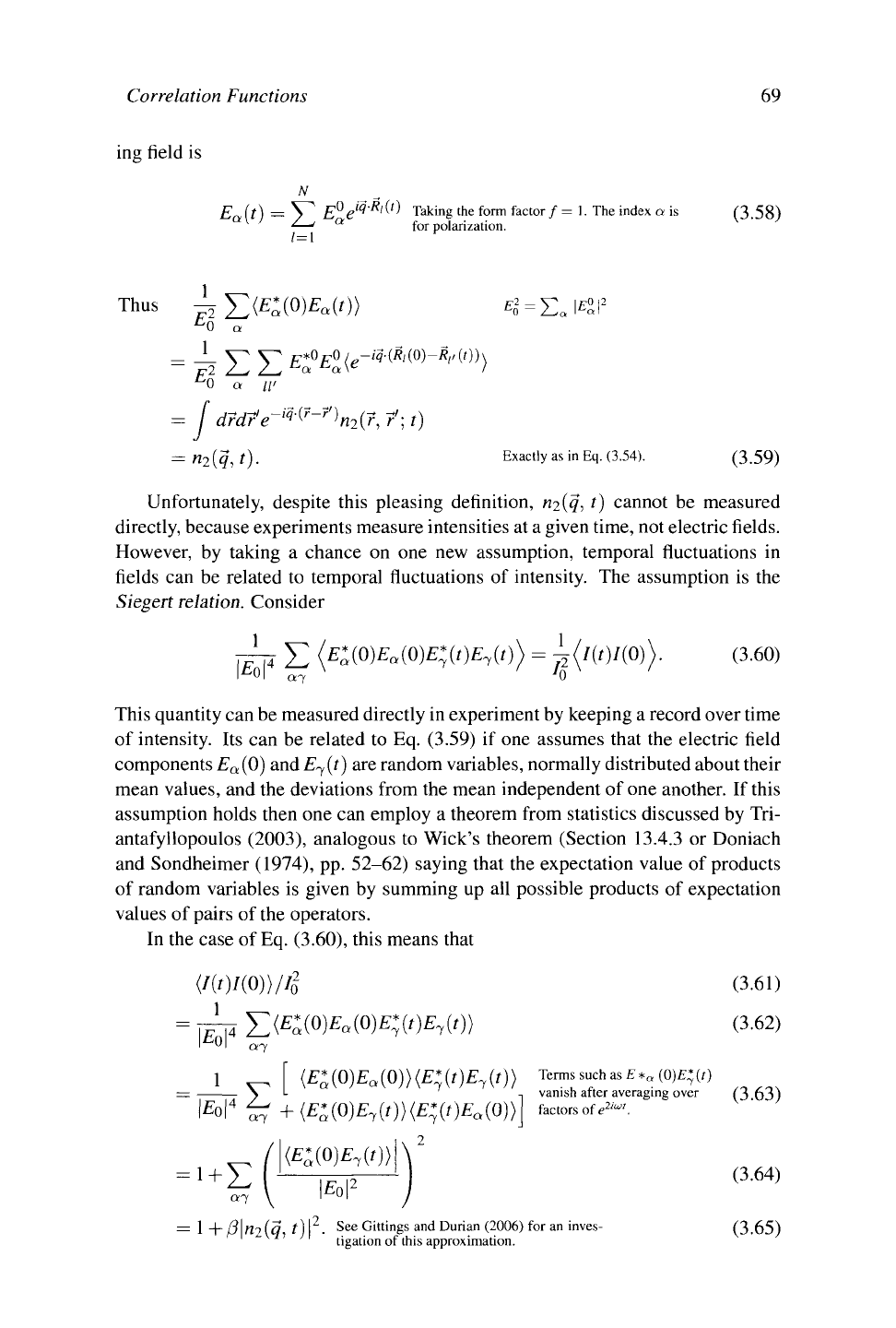
ing field
is
EM
=
Σ
E°
e
i
<i-
R
i(')
1=1
Taking the form factor
/
=
for polarization.
1.
The index
a is
(3.58)
Thus
-2
Σ(£*(0)Ε
Ω
(ί)>
=
— y y
^^(e-^-^'W-^'iO))
=
f
drdr
,
e~
i
^
7
-^n
2
(r,
?'; i)
= n
2
{q,t).
Ε
2
0
=
Σ
α
Κ\
Exactly
as in
Eq. (3.54).
(3.59)
Unfortunately, despite this pleasing definition,
ri2(q,
t)
cannot
be
measured
directly, because experiments measure intensities at a given time, not electric fields.
However,
by
taking
a
chance
on one new
assumption, temporal fluctuations
in
fields can
be
related
to
temporal fluctuations
of
intensity.
The
assumption
is the
Siegert
relation.
Consider
1
\Eo\
A
y (Ε*
α
(0)Ε
α
(0)Ε*
Ί
(ήΕ
Ί
(ή
i\I(t)I(0)
(3.60)
αη
This quantity can be measured directly in experiment by keeping a record over time
of intensity.
Its can be
related
to
Eq. (3.59)
if
one assumes that
the
electric field
components
E
a
(0)
and
Ε
Ί
(ί)
are random variables, normally distributed about their
mean values, and the deviations from the mean independent
of
one another.
If
this
assumption holds then one can employ
a
theorem from statistics discussed by Tri-
antafyllopoulos (2003), analogous
to
Wick's theorem (Section 13.4.3
or
Doniach
and Sondheimer (1974), pp. 52-62) saying that the expectation value
of
products
of random variables
is
given
by
summing
up all
possible products
of
expectation
values
of
pairs
of
the operators.
In the case
of
Eq. (3.60), this means that
</(0/(o))//£
i-^ £(Ε*
α
(0)Ε
α
(0)Ε;(ήΕ
Ί
(ή)
\Eof
1
a~f
Σ
{Ε*(0)Ε
α
{0)){Ε*(ήΕ
Ί
(ή) Terms such as £*
α
(0)£;(0
|£θ|
4
t? +(Ε*
α
(0)Ε
Ί
(ή)(Ε*
Ί
(ήΕ
α
(0))\ factorsof
/|(£*(0)£
7
(ί))
Κ
2
vanish after averaging over
Q7
]
_|-
ß\fi2{q
t) | .
See Gittings
and
Durian (2006)
for an
inves-
tigation
of
this approximation.
(3.61)
(3.62)
(3.63)
(3.64)
(3.65)
70 Chapter 3. Scattering and Structures
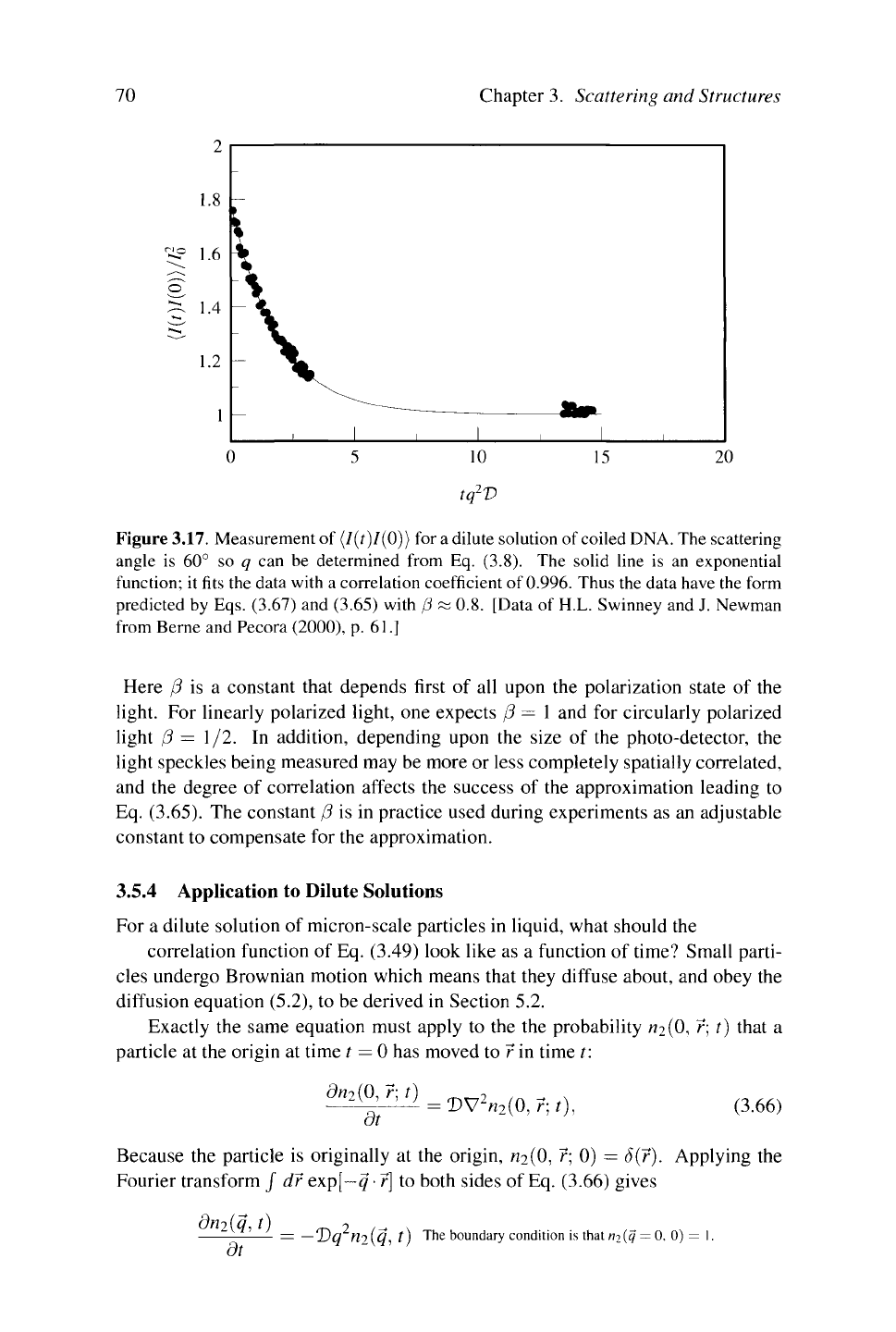
Figure 3.17. Measurement of (I(t)I(O)) for a dilute solution of coiled DNA. The scattering
angle is 60° so q can be determined from Eq. (3.8). The solid line is an exponential
function; it fits the data with a correlation coefficient of
0.996.
Thus the data have the form
predicted by Eqs. (3.67) and (3.65) with β κ. 0.8. [Data of H.L. Swinney and J. Newman
from Berne and Pecora (2000), p. 61.]
Here β is a constant that depends first of all upon the polarization state of the
light. For linearly polarized light, one expects β = 1 and for circularly polarized
light β = 1/2. In addition, depending upon the size of the photo-detector, the
light speckles being measured may be more or less completely spatially correlated,
and the degree of correlation affects the success of the approximation leading to
Eq. (3.65). The constant β is in practice used during experiments as an adjustable
constant to compensate for the approximation.
3.5.4 Application to Dilute Solutions
For a dilute solution of micron-scale particles in liquid, what should the
correlation function of Eq. (3.49) look like as a function of time? Small parti-
cles undergo Brownian motion which means that they diffuse about, and obey the
diffusion equation (5.2), to be derived in Section 5.2.
Exactly the same equation must apply to the the probability «2(0, r; t) that a
particle at the origin at time t = 0 has moved to r in time
V.
— = DV n
2
(0, r; t)
(3.66)
Because the particle is originally at the origin, «2(0, r; 0) = δ(τ). Applying the
Fourier transform J dr exp[—q
■ r]
to both sides of Eq. (3.66) gives
dnijq, ή
dt
- 1)q H2 (a, t) The boundary condition is that «2(<? = 0. 0) =
I.
Problems 11
=>n
2
(q,t)=e-'i
i
'
Dt
(3.67)
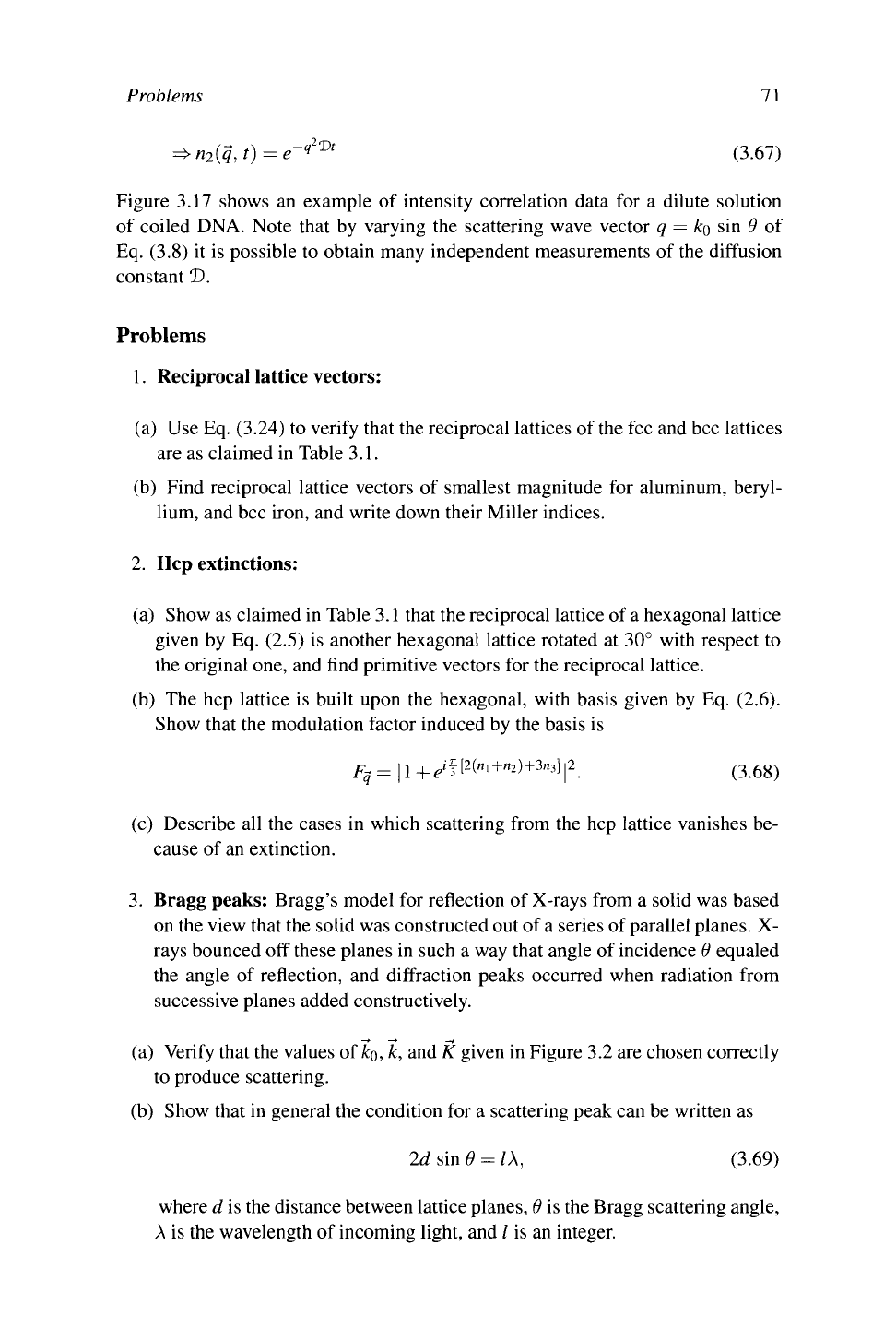
Figure 3.17 shows an example of intensity correlation data for a dilute solution
of coiled DNA. Note that by varying the scattering wave vector q = ko sin
Θ
of
Eq. (3.8) it is possible to obtain many independent measurements of the diffusion
constant D.
Problems
1.
Reciprocal lattice vectors:
(a) Use Eq. (3.24) to verify that the reciprocal lattices of the fee and bec lattices
are as claimed in Table 3.1.
(b) Find reciprocal lattice vectors of smallest magnitude for aluminum, beryl-
lium, and bec iron, and write down their Miller indices.
2.
Hep extinctions:
(a) Show as claimed in Table 3.1 that the reciprocal lattice of a hexagonal lattice
given by Eq. (2.5) is another hexagonal lattice rotated at 30° with respect to
the original one, and find primitive vectors for the reciprocal lattice.
(b) The hep lattice is built upon the hexagonal, with basis given by Eq. (2.6).
Show that the modulation factor induced by the basis is
F
n
=
|ΐ+^|[
2
("ι+"2)+
3
"3]|
2
. (3.68)
(c) Describe all the cases in which scattering from the hep lattice vanishes be-
cause of an extinction.
3.
Bragg peaks: Bragg's model for reflection of X-rays from a solid was based
on the view that the solid was constructed out of a series of parallel planes. X-
rays bounced off these planes in such a way that angle of incidence
Θ
equaled
the angle of reflection, and diffraction peaks occurred when radiation from
successive planes added constructively.
(a) Verify that the values of
ko,
k, and K given in Figure 3.2 are chosen correctly
to produce scattering.
(b) Show that in general the condition for a scattering peak can be written as
2d sin
Θ
= IX, (3.69)
where d is the distance between lattice planes,
Θ
is the Bragg scattering angle,
λ is the wavelength of incoming light, and / is an integer.
72
Chapter 3. Scattering and Structures
4.
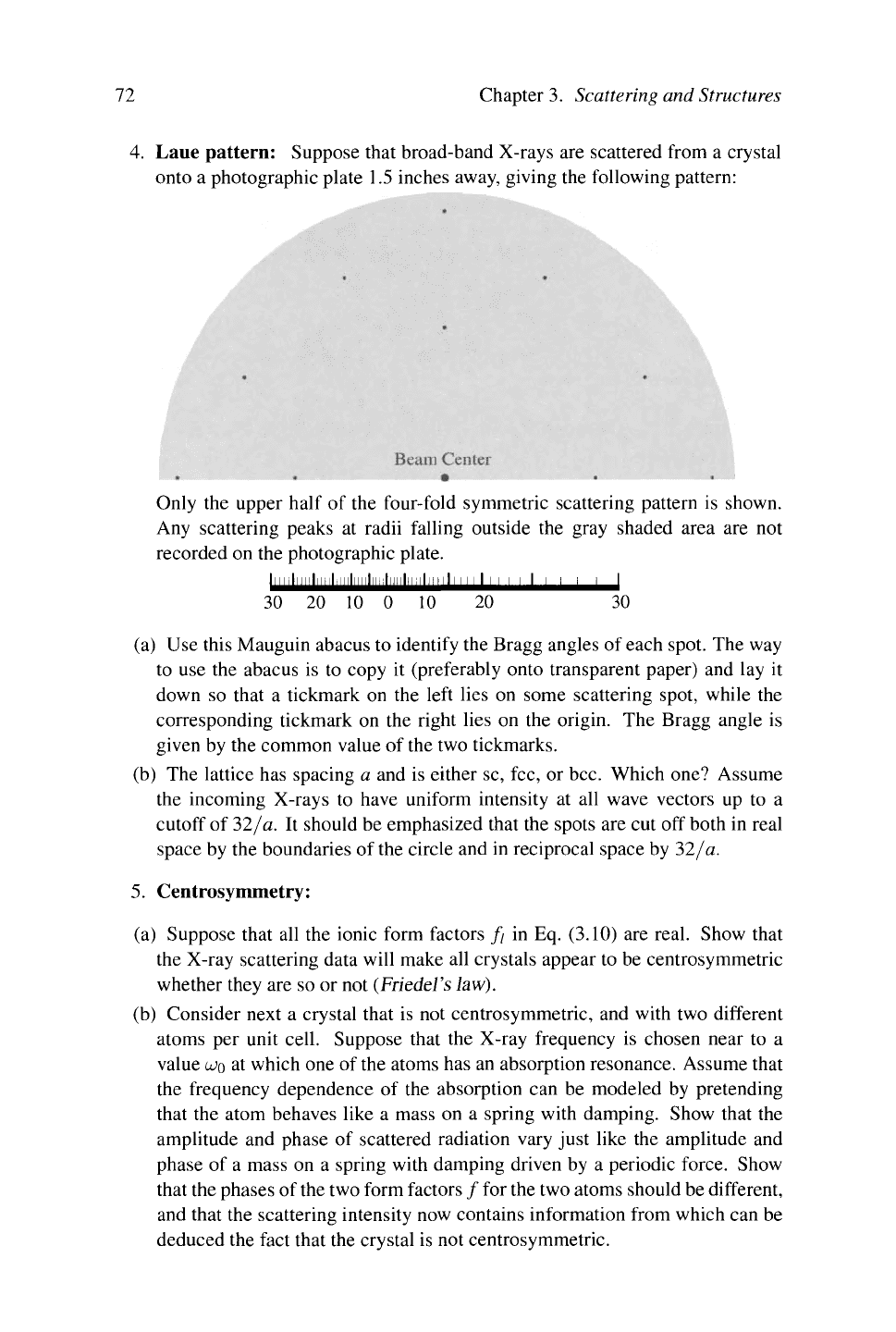
Laue pattern: Suppose that broad-band X-rays are scattered from a crystal
onto a photographic plate 1.5 inches away, giving the following pattern:
Only the upper half of the four-fold symmetric scattering pattern is shown.
Any scattering peaks at radii falling outside the gray shaded area are not
recorded on the photographic plate.
'""' '
Ilj
"'
1
30 20 10 0 10 20 30
(a) Use this Mauguin abacus to identify the Bragg angles of each spot. The way
to use the abacus is to copy it (preferably onto transparent paper) and lay it
down so that a tickmark on the left lies on some scattering spot, while the
corresponding tickmark on the right lies on the origin. The Bragg angle is
given by the common value of the two tickmarks.
(b) The lattice has spacing a and is either sc, fee, or bcc. Which one? Assume
the incoming X-rays to have uniform intensity at all wave vectors up to a
cutoff of 32/a. It should be emphasized that the spots are cut off both in real
space by the boundaries of the circle and in reciprocal space by 32/a.
5.
Centrosymmetry:
(a) Suppose that all the ionic form factors // in Eq. (3.10) are real. Show that
the X-ray scattering data will make all crystals appear to be centrosymmetric
whether they are so or not
(FriedeVs
law).
(b) Consider next a crystal that is not centrosymmetric, and with two different
atoms per unit cell. Suppose that the X-ray frequency is chosen near to a
value
ωο
at which one of the atoms has an absorption resonance. Assume that
the frequency dependence of the absorption can be modeled by pretending
that the atom behaves like a mass on a spring with damping. Show that the
amplitude and phase of scattered radiation vary just like the amplitude and
phase of a mass on a spring with damping driven by a periodic force. Show
that the phases of
the
two form factors / for the two atoms should be different,
and that the scattering intensity now contains information from which can be
deduced the fact that the crystal is not centrosymmetric.