
Marder M.P. Condensed Matter Physics
Подождите немного. Документ загружается.

Experimental Observation and Creation of Surfaces 83
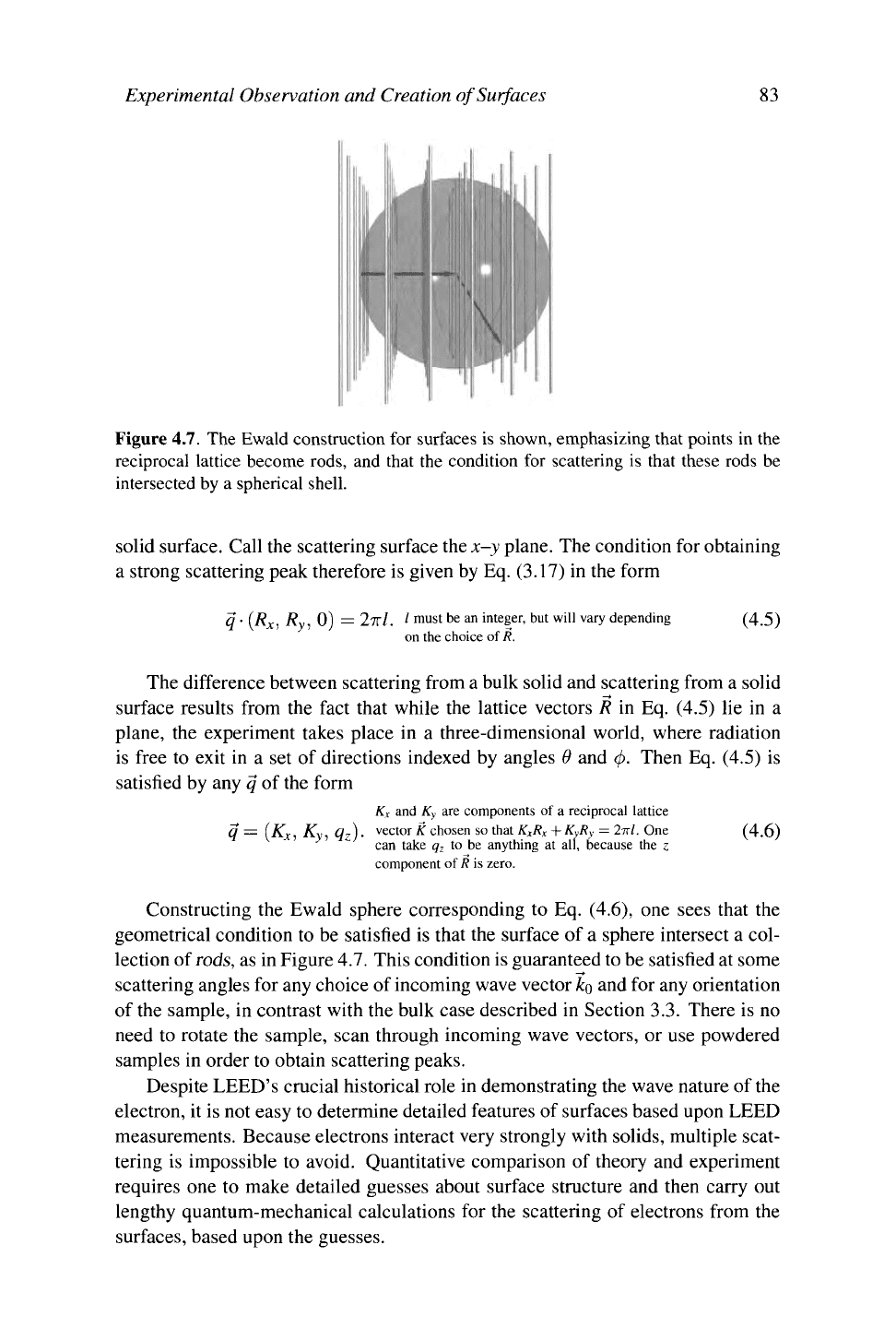
Figure
4.7.
The Ewald construction for surfaces is shown, emphasizing that points in the
reciprocal lattice become rods, and that the condition for scattering is that these rods be
intersected by a spherical shell.
solid surface. Call the scattering surface the x-y plane. The condition for obtaining
a strong scattering peak therefore is given by Eq. (3.17) in the form
q
■
(R
x
, R
y
, 0) = 2πΙ.
ι must be an
integer, but will vary depending (4.5)
on the choice of R.
The difference between scattering from a bulk solid and scattering from a solid
surface results from the fact that while the lattice vectors R in Eq. (4.5) lie in a
plane, the experiment takes place in a three-dimensional world, where radiation
is free to exit in a set of directions indexed by angles
Θ
and φ. Then Eq. (4.5) is
satisfied by any a of the form
K
x
and K
y
are components of a reciprocal lattice
q — [K
x
, Ky, q
z
). vector Kchosen so that
K
X
R
X
+ KyR
y
=
2-πΙ.
One (4.6)
can take q
z
to be anything at all, because the z
component of R is zero.
Constructing the Ewald sphere corresponding to Eq. (4.6), one sees that the
geometrical condition to be satisfied is that the surface of a sphere intersect a col-
lection of
rods,
as in Figure
4.7.
This condition is guaranteed to be satisfied at some
scattering angles for any choice of incoming wave vector
ko
and for any orientation
of the sample, in contrast with the bulk case described in Section 3.3. There is no
need to rotate the sample, scan through incoming wave vectors, or use powdered
samples in order to obtain scattering peaks.
Despite LEED's crucial historical role in demonstrating the wave nature of the
electron, it is not easy to determine detailed features of surfaces based upon LEED
measurements. Because electrons interact very strongly with solids, multiple scat-
tering is impossible to avoid. Quantitative comparison of theory and experiment
requires one to make detailed guesses about surface structure and then carry out
lengthy quantum-mechanical calculations for the scattering of electrons from the
surfaces, based upon the guesses.
84
Chapter 4. Surfaces and Interfaces
4.3.2 Reflection High-Energy Electron Diffraction (RHEED)
In this technique, electrons of energy on the order of 100 keV are reflected off a
surface at a grazing angle. The wave vectors associated with such energies are
on the order of 200 Â
-1
and are much larger than the spacing between reciprocal
lattice vectors, leading to streaky scattering patterns where the Ewald sphere in-
tersects reciprocal lattice rods. Slight rotations of the sample are needed to obtain
strong signals in desired directions.
4.3.3 Molecular Beam Epitaxy (MBE)
With the ability to measure the properties of surfaces with precision has come the
ability to control their composition with comparable precision. The technique of
molecular beam epitaxy (MBE) allows building up a solid one atomic layer at a
time with precise control over the composition of each layer and the ability to alter
composition at will.
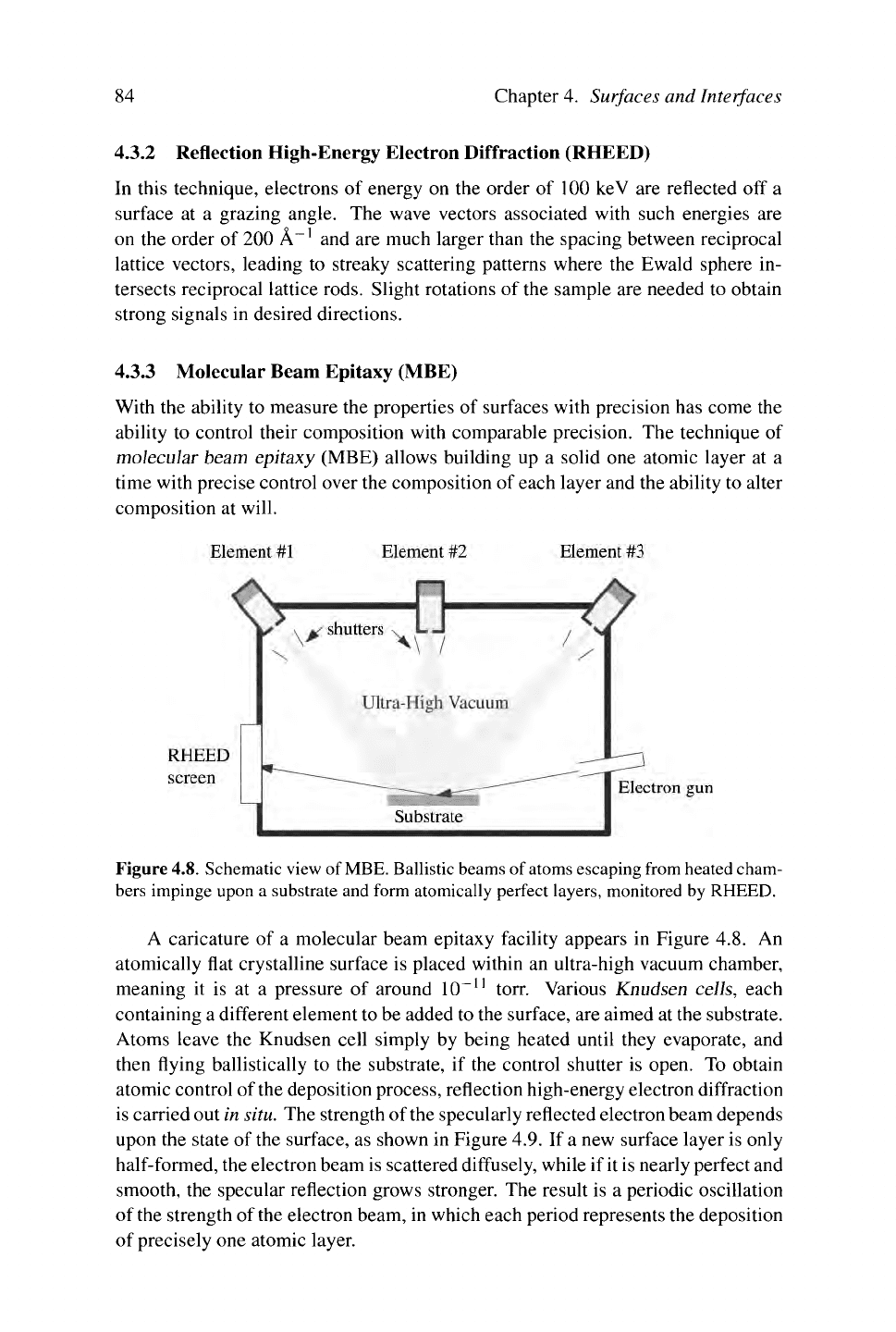
Figure
4.8.
Schematic view of
MBE.
Ballistic beams of
atoms
escaping from heated cham-
bers impinge upon a substrate and form atomically perfect layers, monitored by RHEED.
A caricature of a molecular beam epitaxy facility appears in Figure 4.8. An
atomically flat crystalline surface is placed within an ultra-high vacuum chamber,
meaning it is at a pressure of around 10~
n
torr. Various Knudsen cells, each
containing a different element to be added to the surface, are aimed at the substrate.
Atoms leave the Knudsen cell simply by being heated until they evaporate, and
then flying ballistically to the substrate, if the control shutter is open. To obtain
atomic control of
the
deposition process, reflection high-energy electron diffraction
is carried out in
situ.
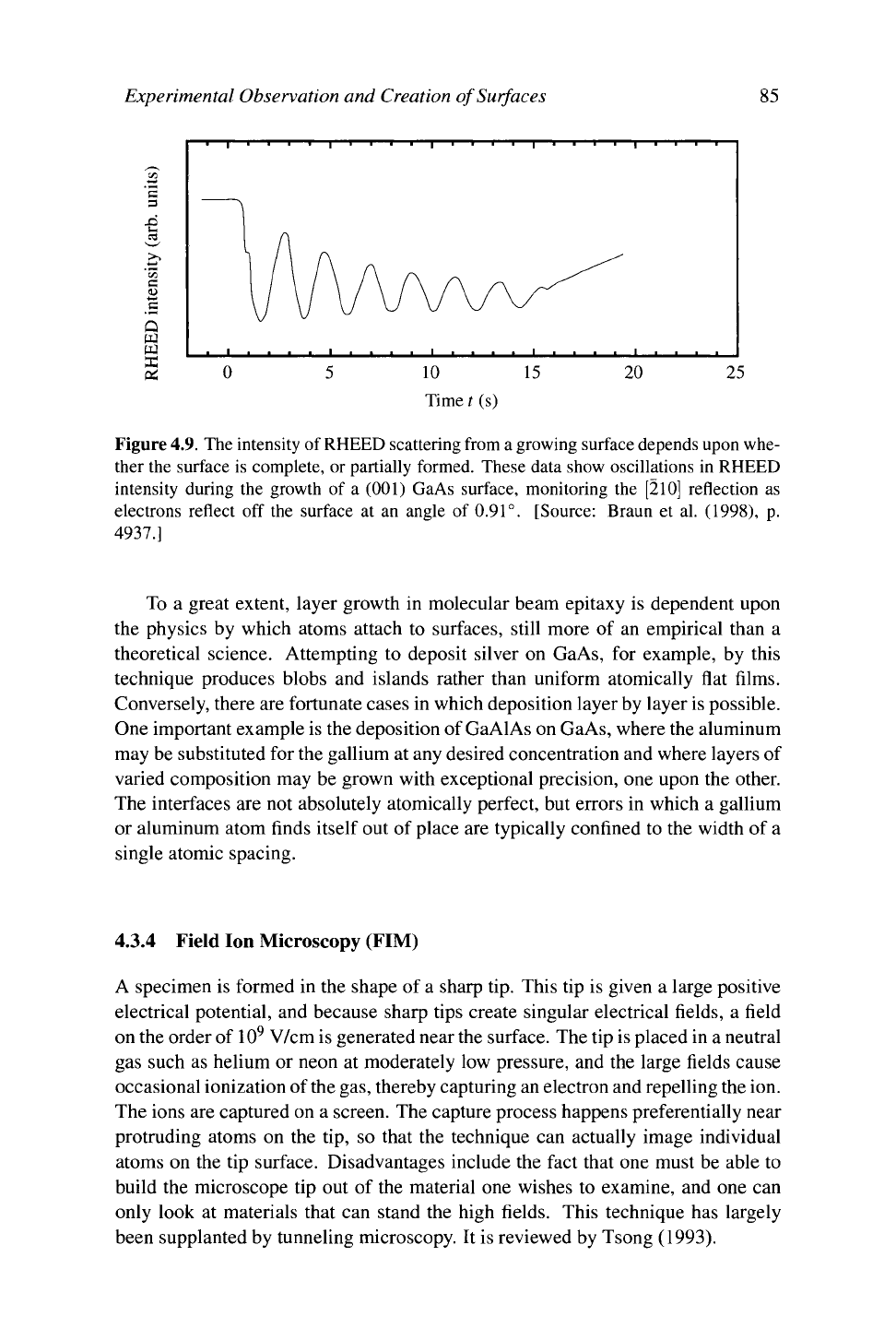
The strength of the specularly reflected electron beam depends
upon the state of the surface, as shown in Figure 4.9. If a new surface layer is only
half-formed, the electron beam is scattered diffusely, while if
it
is nearly perfect and
smooth, the specular reflection grows stronger. The result is a periodic oscillation
of the strength of the electron beam, in which each period represents the deposition
of precisely one atomic layer.
Experimental Observation and Creation of Surfaces
85
3
JO
a
Q
ω
m
x
ce
10 15
Time t (s)
25
Figure 4.9. The intensity of RHEED scattering from a growing surface depends upon whe-
ther the surface is complete, or partially formed. These data show oscillations in RHEED
intensity during the growth of a (001) GaAs surface, monitoring the [210] reflection as
electrons reflect off the surface at an angle of 0.91°. [Source: Braun et al. (1998), p.
4937.]
To a great extent, layer growth in molecular beam epitaxy is dependent upon
the physics by which atoms attach to surfaces, still more of an empirical than a
theoretical science. Attempting to deposit silver on GaAs, for example, by this
technique produces blobs and islands rather than uniform atomically flat films.
Conversely, there are fortunate cases in which deposition layer by layer is possible.
One important example is the deposition of GaAlAs on GaAs, where the aluminum
may be substituted for the gallium at any desired concentration and where layers of
varied composition may be grown with exceptional precision, one upon the other.
The interfaces are not absolutely atomically perfect, but errors in which a gallium
or aluminum atom finds itself out of place are typically confined to the width of a
single atomic spacing.
4.3.4 Field Ion Microscopy (FIM)
A specimen is formed in the shape of a sharp tip. This tip is given a large positive
electrical potential, and because sharp tips create singular electrical fields, a field
on the order of 10
9
V/cm is generated near the surface. The tip is placed in a neutral
gas such as helium or neon at moderately low pressure, and the large fields cause
occasional ionization of the gas, thereby capturing an electron and repelling the ion.
The ions are captured on a screen. The capture process happens preferentially near
protruding atoms on the tip, so that the technique can actually image individual
atoms on the tip surface. Disadvantages include the fact that one must be able to
build the microscope tip out of the material one wishes to examine, and one can
only look at materials that can stand the high fields. This technique has largely
been supplanted by tunneling microscopy. It is reviewed by Tsong (1993).
86
Chapter 4. Surfaces and Interfaces
4.3.5 Scanning Tunneling Microscopy (STM)
The idea that quantum mechanics should permit particles to pass through barriers
occurred to J. R. Oppenheimer during a drive from the eastern United States to a
position as research fellow at Cal. Tech. in 1927. The symbols
-C
i r^ exp See Davis (1968), p. 23. The tunneling (4.7)
E formula in more familiar notation might
read φ ~ exp[—x
had just been scrawled on the windshield of his car when he ran off the road into
a county courthouse, a rather unsuccessful first attempt to put the formula into
practice.
Tunneling spectroscopy became a powerful tool for investigation of metals
and superconductors over the next four decades. As discussed by Wolf (1975), it
was typically performed between flat millimeter-scale samples with separations be-
tween the plates much larger than an angstrom. The macroscopic size of
the
sample
offset the exponentially small current that could flow between the two plates, and
the large size also produced an average over the thermal vibrations of the plates.
Gradual improvement of numerous branches of technology made it possible
by the 1980s to employ Eq. (4.7) for imaging of surfaces on the atomic scale, in
a device invented by Binnig and Rohrer (1987) and called the scanning tunneling
microscope or STM. The essential idea is to bring an atomically sharp metallic tip
near to a conducting surface. Because the current flowing from surface to tip varies
exponentially with the distance between them, it can be used as an exceptionally
sensitive indicator of surface height, and because the tip is very sharp, it is sensitive
to small-scale variations in the horizontal direction as well.
Detailed calculations of
the
precise rate at which tunneling takes place between
surface and tip are not needed to appreciate the device, but it is worth asking how
all the quantities appearing in Eq. (4.7) are to be defined in order to apply to the
case of the tunneling microscope. A schematic picture of the device appears in
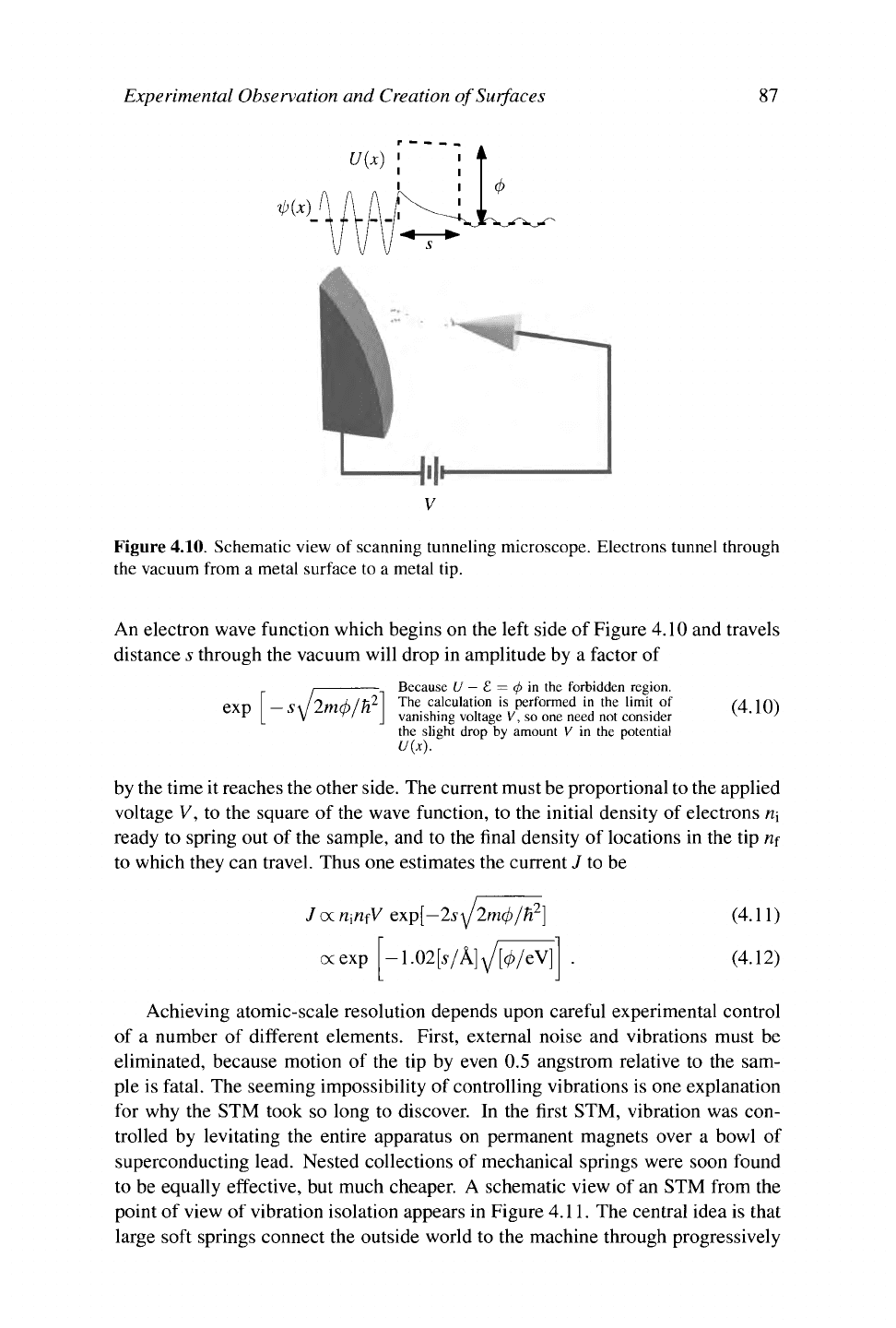
Figure 4.10. First, consider the case in which the voltage difference V between tip
and sample is zero. The equilibrium chemical potentials of different conductors
are not in general the same, which means that in order for tip and sample to be at
the same voltage, a small transient current has had to flow between them soon after
they were connected together, resulting in a situation where the minimum energy
needed to raise an electron from tip or surface to the energy of the vacuum is
φ =
—
(n\ -\- /Ì2). Thus φ is the average of the work functions (4.8)
2 of the tip and surface; work functions are dis-
cussed further in Sections 19.2.1 and
23.6.1.
The tunneling current Eq. (4.7) follows from the Wentzel-Kramers-Brillouin
(WKB) approximation, which gives as an approximate solution of Schrödinger's
equation
^(x)~exp [(i/h) I dx'^2m(E-U(x'))
See Landau and Lifshitz (4 9)
(1977),
p. 164, or Schiff
(1968),
p. 268.
Experimental Observation and Creation of Surfaces
V
Figure 4.10. Schematic view of scanning tunneling microscope. Electrons tunnel through
the vacuum from a metal surface to a metal tip.
An electron wave function which begins on the left side of Figure 4.10 and travels
distance s through the vacuum will drop in amplitude by a factor of
exp
2ηιφ/Η
Because U
—
£ = φ in the forbidden region.
The calculation is performed in the limit of
vanishing voltage V, so one need not consider
the slight drop by amount V in the potential
U(x).
(4.10)
by the time it reaches the other
side.
The current must be proportional to the applied
voltage V, to the square of the wave function, to the initial density of electrons n\
ready to spring out of the sample, and to the final density of locations in the tip «f
to which they can travel. Thus one estimates the current J to be
JocninfV exp[—2sy 2m0/ft
2
]
oc
exp
■\M[s/k]J[<f>/éV]
(4.11)
(4.12)
Achieving atomic-scale resolution depends upon careful experimental control
of a number of different elements. First, external noise and vibrations must be
eliminated, because motion of the tip by even 0.5 angstrom relative to the sam-
ple is fatal. The seeming impossibility of controlling vibrations is one explanation
for why the STM took so long to discover. In the first STM, vibration was con-
trolled by levitating the entire apparatus on permanent magnets over a bowl of
superconducting lead. Nested collections of mechanical springs were soon found
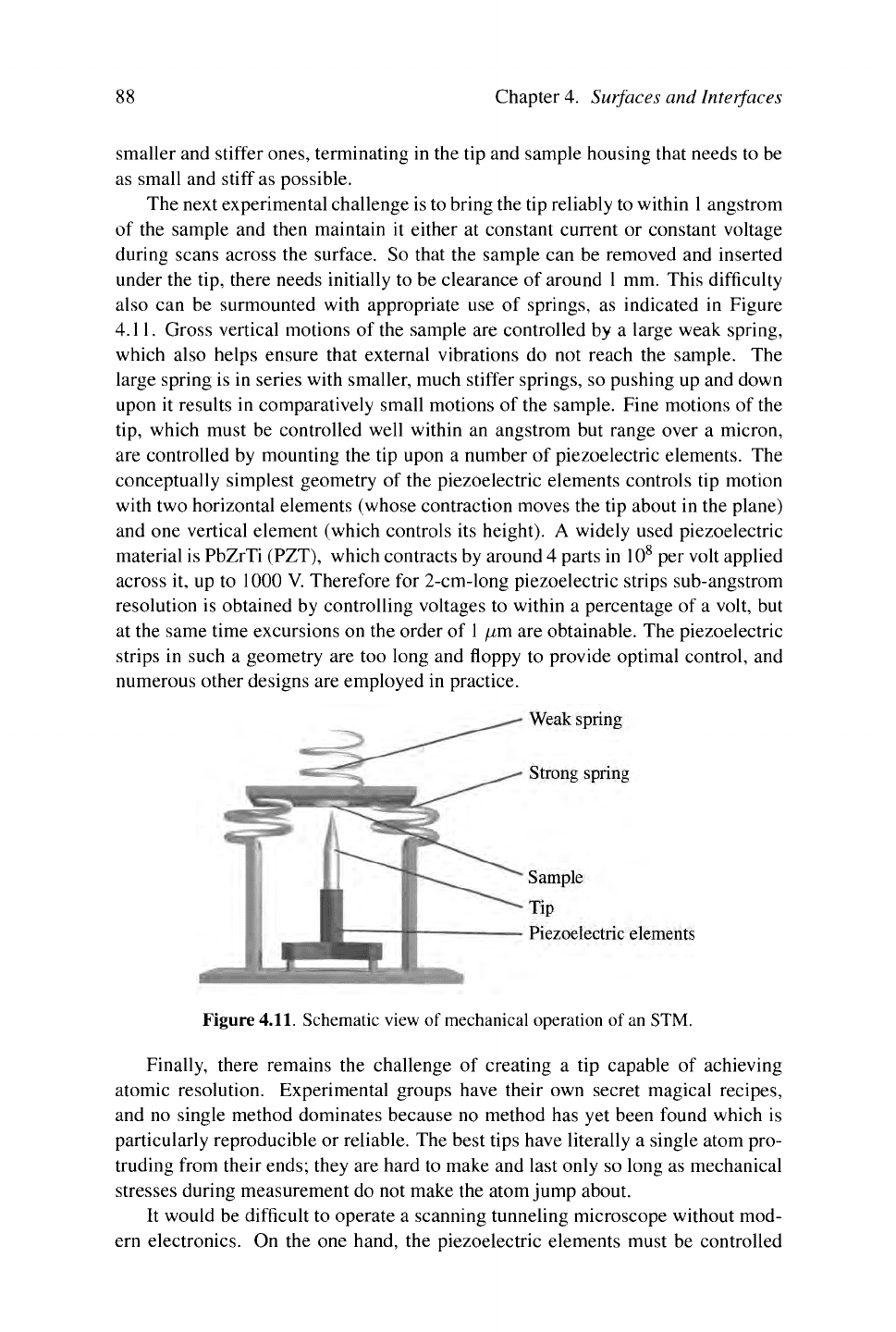
to be equally effective, but much cheaper. A schematic view of an STM from the
point of view of vibration isolation appears in Figure
4.11.
The central idea is that
large soft springs connect the outside world to the machine through progressively
88 Chapter 4. Surfaces and Interfaces
smaller and stiffer ones, terminating in the tip and sample housing that needs to be
as small and stiff as possible.
The next experimental challenge is to bring the tip reliably to within
1
angstrom
of the sample and then maintain it either at constant current or constant voltage
during scans across the surface. So that the sample can be removed and inserted
under the tip, there needs initially to be clearance of around
1
mm. This difficulty
also can be surmounted with appropriate use of springs, as indicated in Figure
4.11.
Gross vertical motions of the sample are controlled by a large weak spring,
which also helps ensure that external vibrations do not reach the sample. The
large spring is in series with smaller, much stiffer springs, so pushing up and down
upon it results in comparatively small motions of the sample. Fine motions of the
tip,
which must be controlled well within an angstrom but range over a micron,
are controlled by mounting the tip upon a number of piezoelectric elements. The
conceptually simplest geometry of the piezoelectric elements controls tip motion
with two horizontal elements (whose contraction moves the tip about in the plane)
and one vertical element (which controls its height). A widely used piezoelectric
material is PbZrTi (PZT), which contracts by around 4 parts in IO
8
per volt applied
across it, up to 1000 V. Therefore for 2-cm-long piezoelectric strips sub-angstrom
resolution is obtained by controlling voltages to within a percentage of a volt, but
at the same time excursions on the order of
1
μπ\ are obtainable. The piezoelectric
strips in such a geometry are too long and floppy to provide optimal control, and
numerous other designs are employed in practice.
Figure
4.11.
Schematic view of mechanical operation of
an
STM.
Finally, there remains the challenge of creating a tip capable of achieving
atomic resolution. Experimental groups have their own secret magical recipes,
and no single method dominates because no method has yet been found which is
particularly reproducible or reliable. The best tips have literally a single atom pro-
truding from their ends; they are hard to make and last only so long as mechanical
stresses during measurement do not make the atom jump about.
It would be difficult to operate a scanning tunneling microscope without mod-
ern electronics. On the one hand, the piezoelectric elements must be controlled
Experimental Observation and Creation of Surfaces 89
continuously and in precise sequence in order to scan the tip across the surface. In
addition, all the data for tip height as a function of
x,
y location have to be recorded
and assembled later for interpretation. Computer control and data acquisition are
therefore almost indispensable.
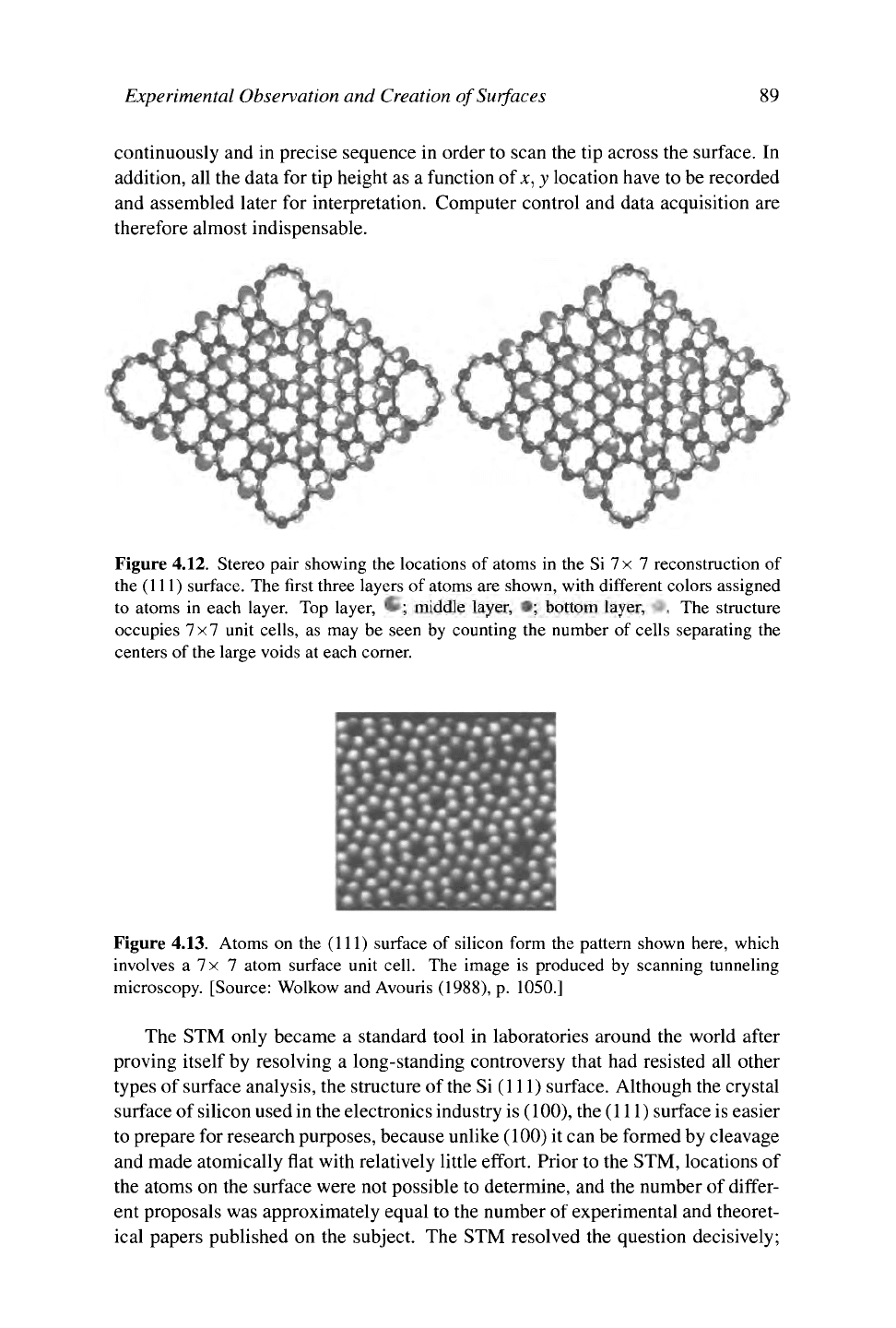
Figure 4.12. Stereo pair showing the locations of atoms in the Si 7x 7 reconstruction of
the (111) surface. The first three layers of atoms are shown, with different colors assigned
to atoms in each layer. Top layer, ; middle layer, ; bottom layer, . The structure
occupies 7x7 unit cells, as may be seen by counting the number of cells separating the
centers of the large voids at each corner.
Figure 4.13. Atoms on the (111) surface of silicon form the pattern shown here, which
involves a 7x 7 atom surface unit cell. The image is produced by scanning tunneling
microscopy. [Source: Wolkow and Avouris (1988), p. 1050.]
The STM only became a standard tool in laboratories around the world after
proving itself by resolving a long-standing controversy that had resisted all other
types of surface analysis, the structure of the Si
( 111 )
surface. Although the crystal
surface of silicon used in the electronics industry is (100), the (111) surface is easier
to prepare for research purposes, because unlike (100) it can be formed by cleavage
and made atomically flat with relatively little effort. Prior to the STM, locations of
the atoms on the surface were not possible to determine, and the number of differ-
ent proposals was approximately equal to the number of experimental and theoret-
ical papers published on the subject. The STM resolved the question decisively;
90 Chapter 4. Surfaces and Interfaces
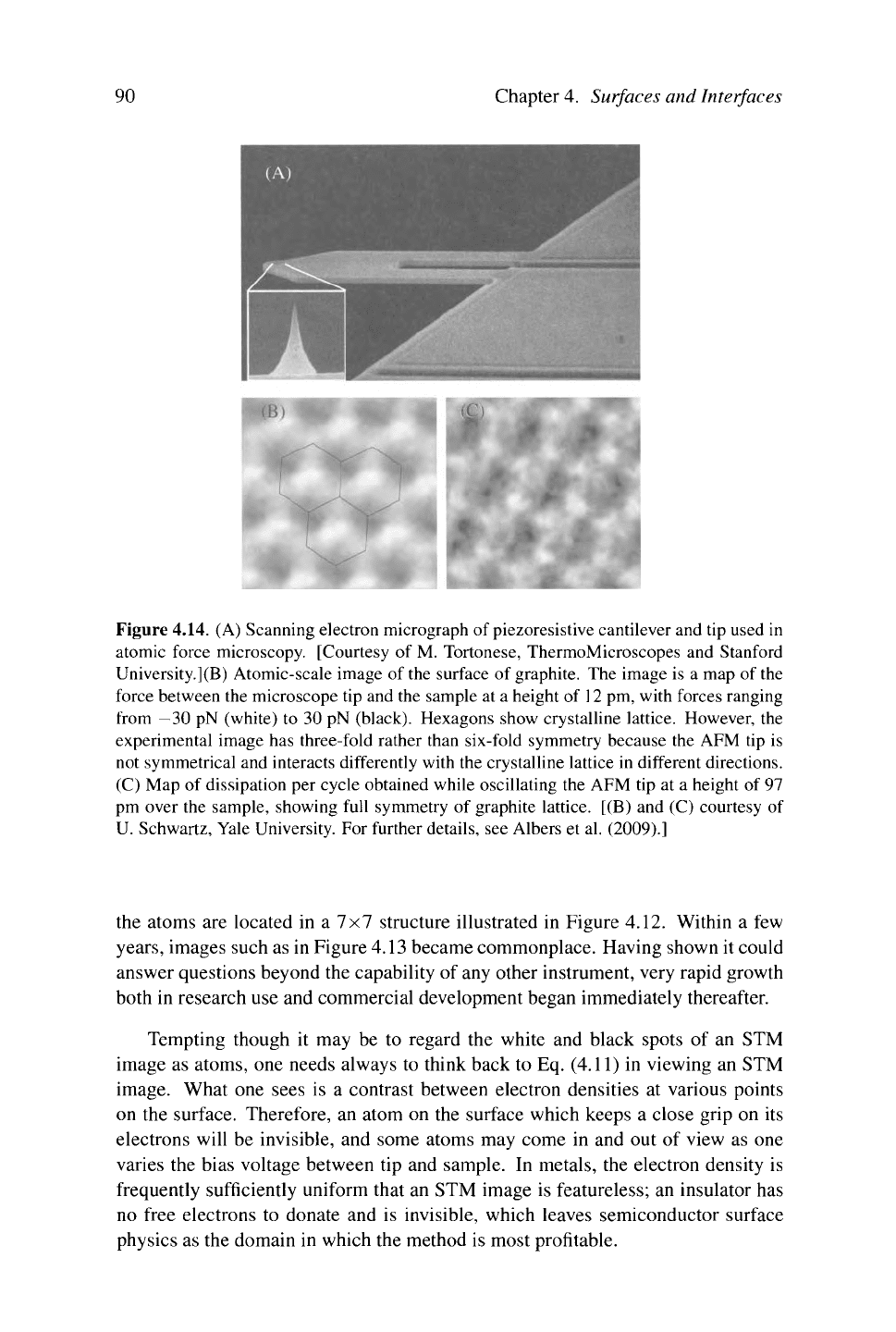
Figure 4.14. (A) Scanning electron micrograph of piezoresistive cantilever and tip used in
atomic force microscopy. [Courtesy of M. Tortonese, ThermoMicroscopes and Stanford
University.](B) Atomic-scale image of the surface of graphite. The image is a map of the
force between the microscope tip and the sample at a height of 12 pm, with forces ranging
from —30 pN (white) to 30 pN (black). Hexagons show crystalline lattice. However, the
experimental image has three-fold rather than six-fold symmetry because the AFM tip is
not symmetrical and interacts differently with the crystalline lattice in different directions.
(C) Map of dissipation per cycle obtained while oscillating the AFM tip at a height of 97
pm over the sample, showing full symmetry of graphite lattice. [(B) and (C) courtesy of
U. Schwartz, Yale University. For further details, see Albers et al. (2009).]
the atoms are located in a 7x7 structure illustrated in Figure 4.12. Within a few
years,
images such as in Figure 4.13 became commonplace. Having shown it could
answer questions beyond the capability of any other instrument, very rapid growth
both in research use and commercial development began immediately thereafter.
Tempting though it may be to regard the white and black spots of an STM
image as atoms, one needs always to think back to Eq. (4.11) in viewing an STM
image. What one sees is a contrast between electron densities at various points
on the surface. Therefore, an atom on the surface which keeps a close grip on its
electrons will be invisible, and some atoms may come in and out of view as one
varies the bias voltage between tip and sample. In metals, the electron density is
frequently sufficiently uniform that an STM image is featureless; an insulator has
no free electrons to donate and is invisible, which leaves semiconductor surface
physics as the domain in which the method is most profitable.
Problems
91
4.3.6 Atomic Force Microscopy (AFM)
The atomic force microscope (AFM) was developed by Binnig et al. (1986) as a
modification of the STM, to permit investigation of insulators. A tip is lowered
toward a sample on a lever until it virtually touches, and either the force on the
lever is maintained constant as it scans over the sample, or else deflection of the
lever is measured by mounting a mirror on it and bouncing a laser beam off the
top.
The difficulties of controlling motion at the angstrom scale find the same
solutions as with STM. An image of the surface of graphite is shown in Figure
4.14. Interpretation of the image requires some caution. It accurately reflects the
force between the surface of graphite and the AFM tip, but because the tip is not
completely symmetrical, the image has three-fold rather than six-fold symmetry.
Bustamante and Keller (1995) show that the AFM technique can be modified to
function even in liquids at room temperature, although in such noisy environments
atomic-scale resolution is no longer possible.
4.3.7 High Resolution Electron Microscopy (HREM)
High resolution electron microscopy (HREM), described by Spence (1988), allows
the study of solids with atomic resolution, and it can only be used on extremely thin
sections of
samples.
An example of
the
technique has been displayed in Figure 4.5.
The image looks like a photograph of atoms, but it must be approached with cau-
tion. It actually reflects a complicated smearing out of the actual electron density,
and any attempt to extract quantitative density information requires an attempt to
deal with the smearing quantitatively.
Problems
1.
Superlattice: Show that when two crystal surfaces meet in a commensurate
fashion, so that there is a superlattice along the interface, the areas of the
primitive cells for the two surface lattices must be rational multiples of one
another.
2.
Interplanar spacing: Consider a bcc lattice, and find how e in Eq. (4.3)
depends upon /,
j,
and k for the planes (110), (111), (114), and (137).
3.
Bond breaking:
(a) Consider an fee lattice in which the energy of a surface is given by the num-
ber of broken nearest-neighbor bonds. With reference to Figure 4.4, find the
energy needed per area to cut along the (001) plane.
(b) Consider the diamond structure, shown in Figure 2.6. How many bonds per
area need to be cut to expose the (001) plane?
(c) Consider again the diamond structure, but now also consulting Figure 2.2(D).
How many bonds per area need to be cut to expose a (111) plane? Which of
(001) and (111) should be expected to cleave most easily?
92
Chapter 4. Surfaces and Interfaces
4.
Faceting:
(a) Consider a two-dimensional square crystal. Suppose the energy needed to
form a surface of Miller index (ij) is simply the number of nearest-neighbor
bonds broken in forming the surface. Show that the surface energy
a
per unit
length is
where
J
is the energy per bond and a is the lattice spacing.
(b) Draw a polar plot of Eq. (4.13); that is, draw a curve in polar coordinates
where r(9) is given by the free energy
a
appropriate for a surface cut at angle
Θ.
(c) Suppose one has
a
two-dimensional crystal whose surface free energy per
unit length is α(θ) for a surface at orientation
Θ,
or equivalently
a(y'),
where
y(x) is a function describing the height of the crystal in Cartesian coordinates,
and
j'
=
dy/dx. Argue that the equilibrium shape of such a crystal is given by
minimizing the functional
f dxy/l+y^a^-X f
'
dxy(x),
(4.14)
where λ is a Lagrange multiplier.
(d) Dehne
f{y
,
) = \J^+y'My')·
(4.15)
Using the calculus of variations, show that
dx dy'
and that after obtaining a first integral and then multiplying by y", Eq. (4.16)
can be integrated to give
y/l+y
z
a(y)
=
\(y'x-y)
(4.17)
The arbitrary constants obtained during the integrations can be ignored. Why?
(e) Rewrite Eq. (4.17) in terms of the unit normal h to the surface described by
y{x).
Equation (4.17) describes a geometrical construction in which for every
normal direction n one draws a line perpendicular to « at a distance r(n) from
the origin such that the line hits the polar plot of a(/) from part
(b).
Then y(x)
is the envelope of all these lines. Use this construction to draw a sketch of the
equilibrium crystal resulting from the surface energy of Eq. (4.13). For more
information on this topic, see Rottman and Wortis (1984) and Tosi (1964)
p.
92.