
Marder M.P. Condensed Matter Physics
Подождите немного. Документ загружается.

Theory of Scattering from Crystals
53
but not lying within it. Placing the origin at this lattice site, find the three points u,
v, and w where the plane intersects the coordinate axes, measured in units of the
lattice spacing a. The inverses / = 1/w, j = l/v and k = \/w of these intercepts
are integers equal to Miller indices. This point of view is closely allied with the
second law of crystal habit, and therefore rooted in the origins of crystallography
(Problem 9 in Chapter
2).
If the plane is parallel to one of the coordinate axes, one
might for example get u = oo, leading to i = 0.
Miller Indices for Hexagonal
Lattices.
In hexagonal lattices, Miller indices make
use of four numbers (ijkl). The last integer, /, points along the z axis (the axis of
three- or sixfold symmetry), while /, j, and k refer to three axes at 120° to one
another, and conventionally
k=-(i + j). (3.26)
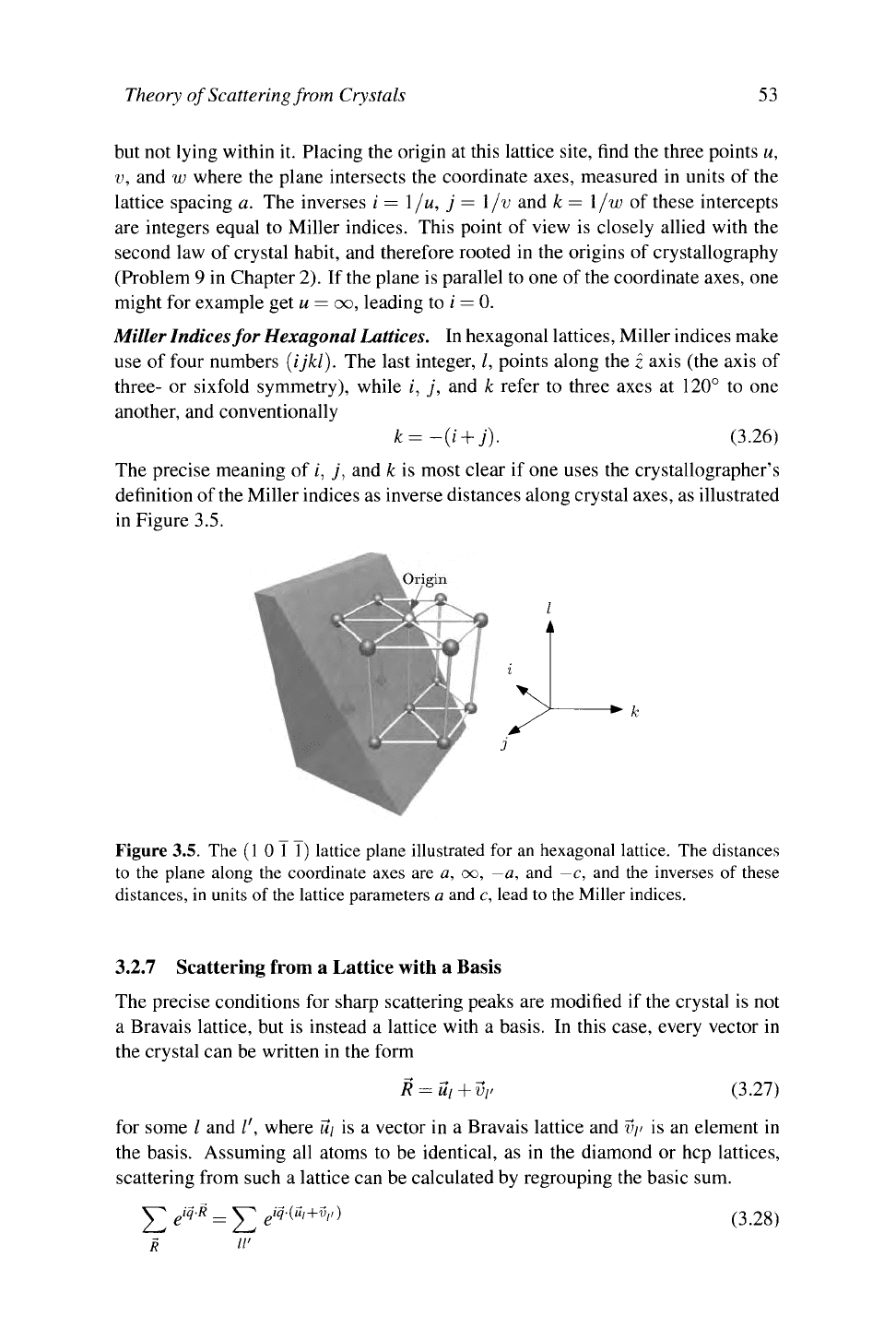
The precise meaning of i, j, and k is most clear if one uses the crystallographer's
definition of
the
Miller indices as inverse distances along crystal axes, as illustrated
in Figure 3.5.
Figure 3.5. The (10
1 1 )
lattice plane illustrated for an hexagonal lattice. The distances
to the plane along the coordinate axes are a, oo, —a, and —c, and the inverses of these
distances, in units of
the
lattice parameters a and c, lead to the Miller indices.
3.2.7 Scattering from a Lattice with a Basis
The precise conditions for sharp scattering peaks are modified if the crystal is not
a Bravais lattice, but is instead a lattice with a basis. In this case, every vector in
the crystal can be written in the form
R =
U[+vi>
(3.27)
for some / and /', where w/ is a vector in a Bravais lattice and v\i is an element in
the basis. Assuming all atoms to be identical, as in the diamond or hep lattices,
scattering from such a lattice can be calculated by regrouping the basic sum.
Σ S* = Σ
<?
i
*
(s
'
+ii
''
)
(3.28)
R "'
54
Chapter 3. Scattering and Structures
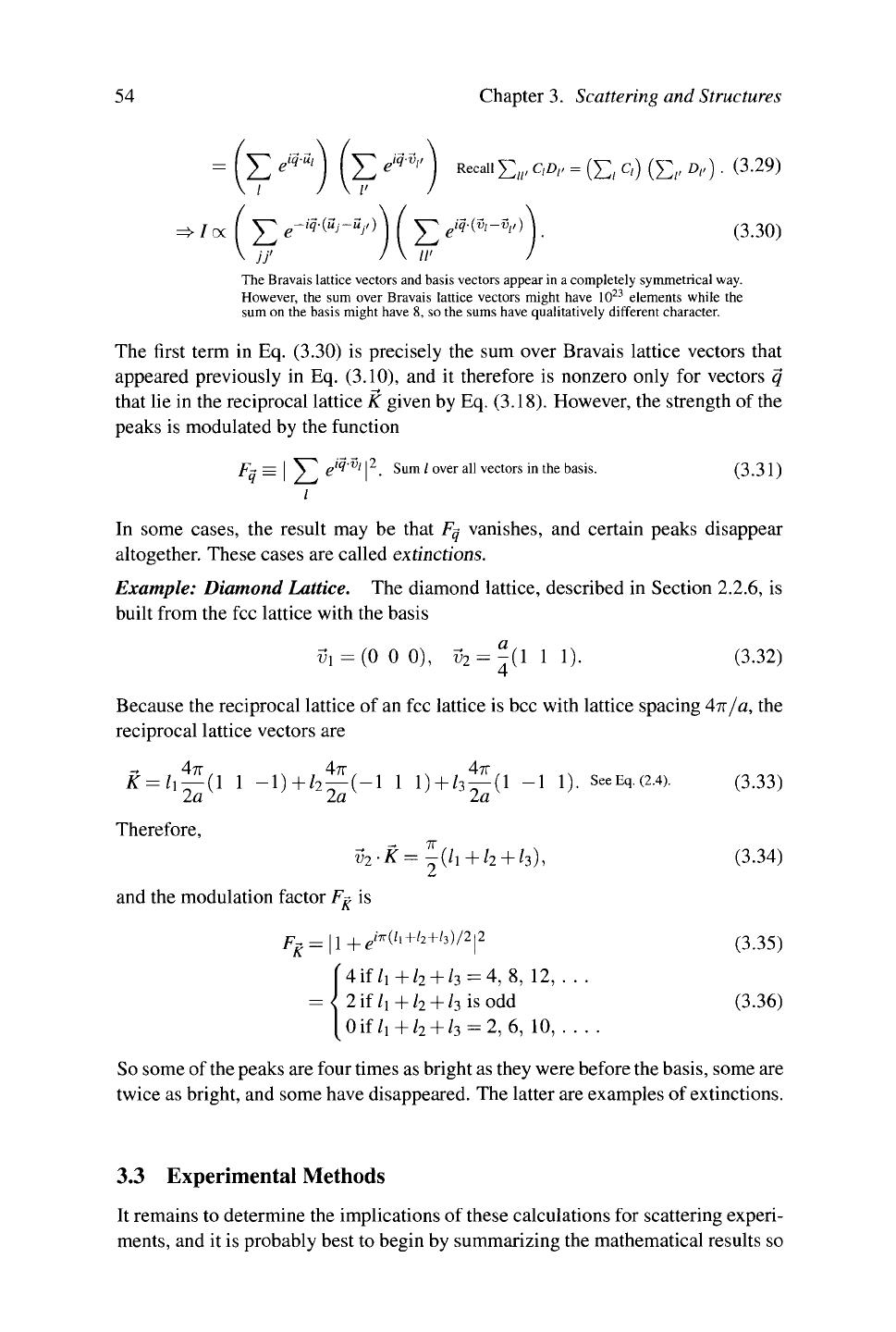
= (E «**) (E e*'") R-al, £„,
QD,,
= (
Σ/
Q) (Σ, Ο,)
■
(3-29)
=^
/oc
( Σ e-^-W
)
( Σ
e
,?
·^'"^
5
) ·
(3.30)
The Bravais lattice vectors and basis vectors appear in a completely symmetrical way.
However, the sum over Bravais lattice vectors might have 10
23
elements while the
sum on the basis might have 8, so the sums have qualitatively different character.
The first term in Eq. (3.30) is precisely the sum over Bravais lattice vectors that
appeared previously in Eq. (3.10), and it therefore is nonzero only for vectors a
that lie in the reciprocal lattice K given by Eq. (3.18). However, the strength of the
peaks is modulated by the function
p-. = I \
Λ
e I . Sum / over all vectors in the basis. (3.31)
/
In some cases, the result may be that F$ vanishes, and certain peaks disappear
altogether. These cases are called extinctions.
Example: Diamond Lattice. The diamond lattice, described in Section 2.2.6, is
built from the fee lattice with the basis
£, = (0 0 0),
V2
= ^(l 1 1)· (3-32)
Because the reciprocal lattice of an fee lattice is bec with lattice spacing 4π/α, the
reciprocal lattice vectors are
—
4-TT
47Γ
4"7T
K = h—
(1
1 -\)+h — (-1 1 \) + h — {\ -1 1). SeeEq.(2.4). (3.33)
2a 2a 2a
Therefore,
v
2
-K=^{h+h + h), (3.34)
and the modulation factor F^ is
F£ = |l+£>('»
+/2+/3
)/
2
1
2
(3.35)
'4if/
1
+Z
2
+
*3
= 4, 8, 12, ...
2if/,+/2 + /
3
isodd (3.36)
0if/i+/
2
+
/3
= 2, 6, 10,
So some of
the
peaks are four times as bright as they were before the basis, some are
twice as bright, and some have disappeared. The latter are examples of extinctions.
3.3 Experimental Methods
It remains to determine the implications of these calculations for scattering experi-
ments, and it is probably best to begin by summarizing the mathematical results so
Experimental Methods
55
far. Radiation with wave vector ko impacting a crystal produces a scattered wave
along direction k, where the magnitudes of k and ko are the same, but only if the
wave vector q = ko
—
k equals one of the reciprocal lattice vectors K of the crystal.
The reciprocal lattice vectors are completely determined by the underlying Bravais
lattice of the crystal, and any decoration of the Bravais lattice with a basis serves
only to modify the strengths of the scattering peaks, not their positions.
The prescription for a successful experiment at first seems clear. Shine a
monochromatic X-ray source at a crystalline sample, put a camera behind it, and
start clicking the shutter. But a moment's reflection shows that this brilliant idea
will not work. Each point on the photographic paper catching a scattered X-ray
corresponds to a single scattering direction k, so the experiment scans through a
two-dimensional space of scattering vectors. However, the reciprocal lattice is a
discrete set of points in three dimensions, and it is therefore exceptionally unlikely
that any given two-dimensional surface will cut through any of them. In order to
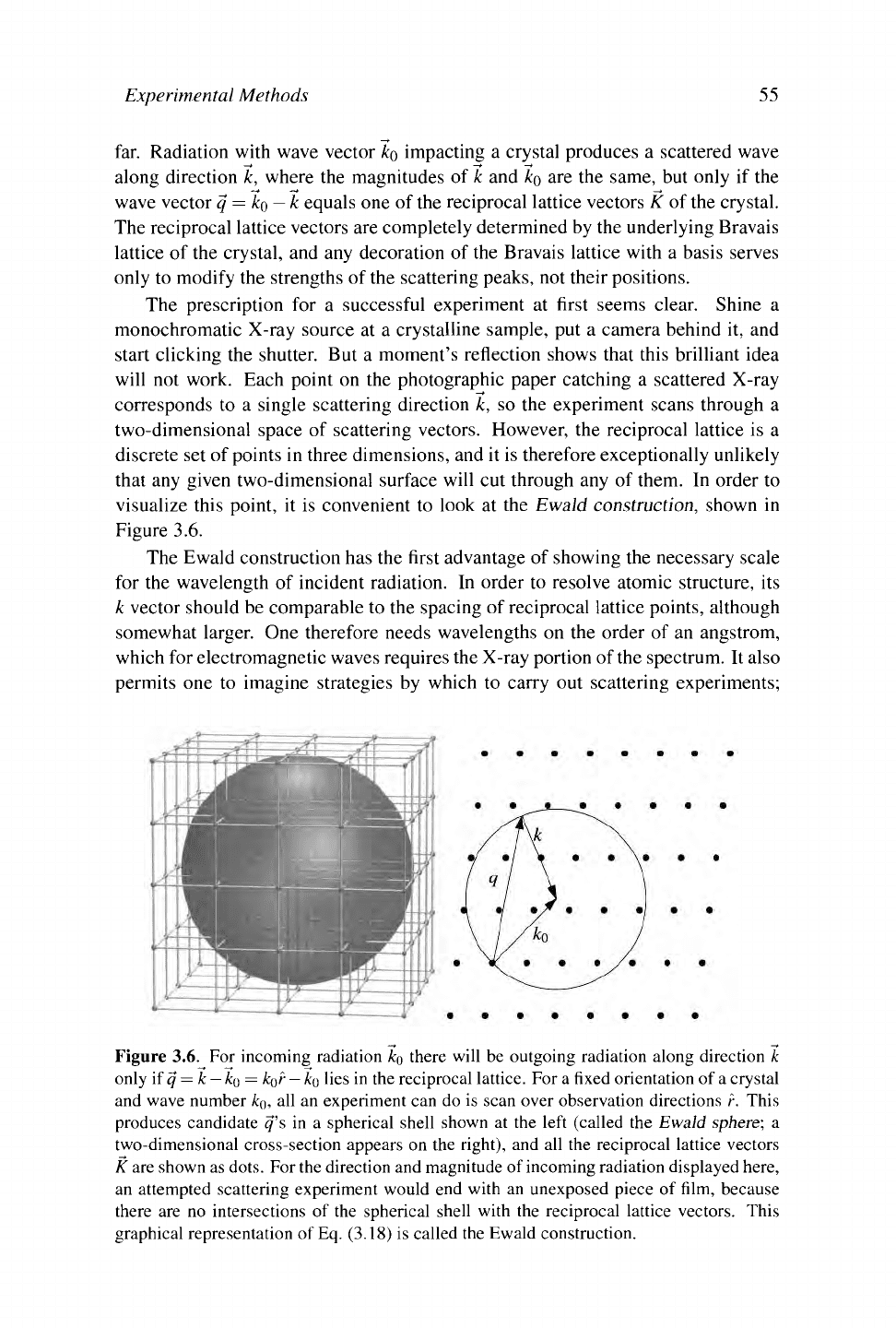
visualize this point, it is convenient to look at the Ewald construction, shown in
Figure 3.6.
The Ewald construction has the first advantage of showing the necessary scale
for the wavelength of incident radiation. In order to resolve atomic structure, its
k vector should be comparable to the spacing of reciprocal lattice points, although
somewhat larger. One therefore needs wavelengths on the order of an angstrom,
which for electromagnetic waves requires the X-ray portion of the spectrum. It also
permits one to imagine strategies by which to carry out scattering experiments;
Figure 3.6. For incoming radiation ko there will be outgoing radiation along direction k
only if q = k
— ko
=
kor — ko
lies in the reciprocal lattice. For a fixed orientation of
a
crystal
and wave number
ko,
all an experiment can do is scan over observation directions r. This
produces candidate <f s in a spherical shell shown at the left (called the Ewald sphere; a
two-dimensional cross-section appears on the right), and all the reciprocal lattice vectors
K are shown as dots. For the direction and magnitude of incoming radiation displayed here,
an attempted scattering experiment would end with an unexposed piece of film, because
there are no intersections of the spherical shell with the reciprocal lattice vectors. This
graphical representation of Eq. (3.18) is called the Ewald construction.
56
Chapter 3. Scattering and Structures
there are three traditional solutions to the problem that monochromatic radiation
generally does not produce sharp scattering peaks after contact with a fixed crystal:
the Laue method, the rotating crystal method, and the powder method.
3.3.1 Laue Method
The first solution is the Laue
method,
found as an accidental offshoot of the manner
in which the first X-rays were generated. X-rays were produced by bombarding
a tungsten anode with electrons accelerated through about 510
4
eV. A slightly
higher voltage would excite sharp lines in the tungsten spectrum, corresponding to
ionization energies of inner core electrons, but at this voltage the X-ray spectrum
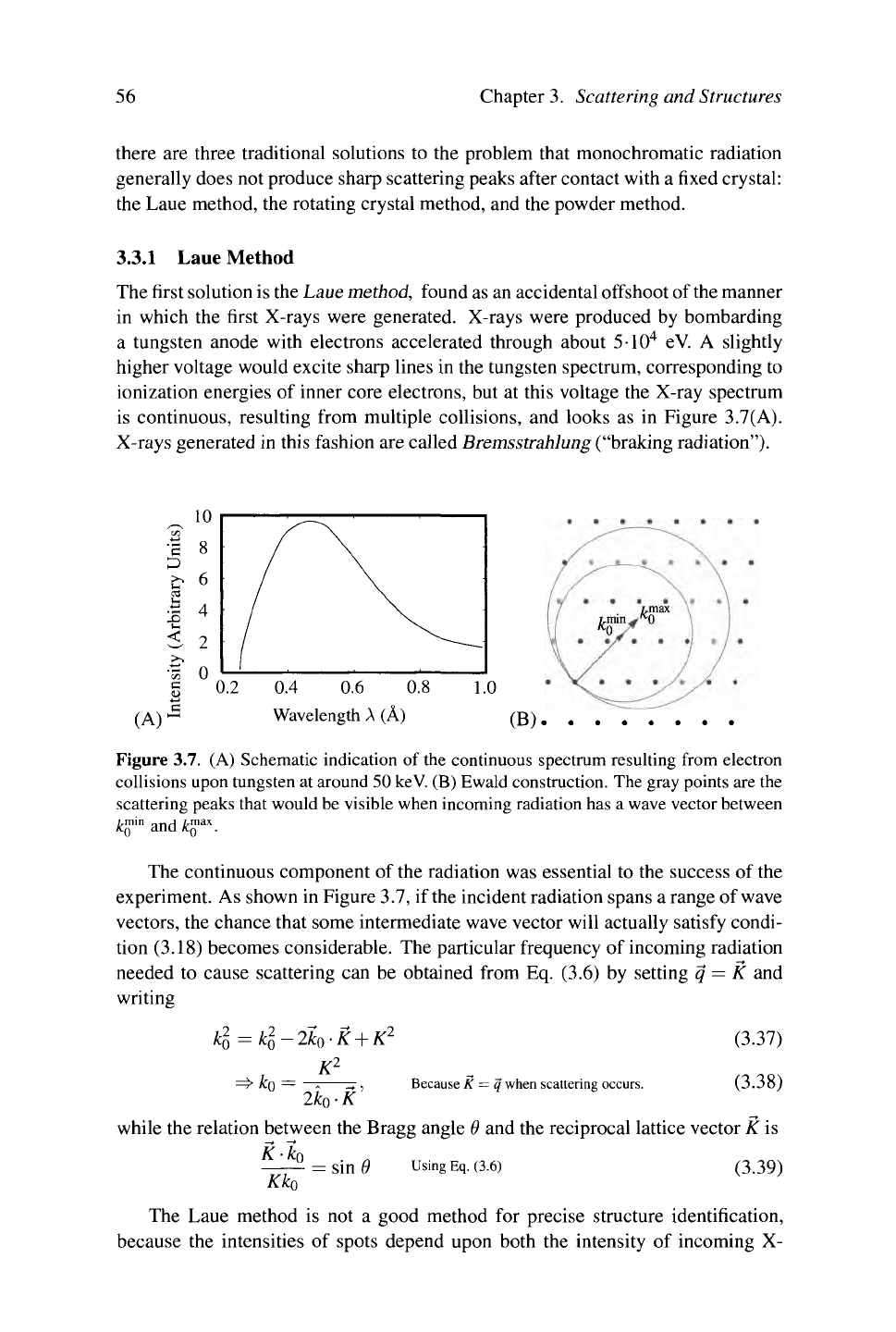
is continuous, resulting from multiple collisions, and looks as in Figure 3.7(A).
X-rays generated in this fashion are called Bremsstrahlung ("braking radiation").
1.0
(B)
Figure 3.7. (A) Schematic indication of the continuous spectrum resulting from electron
collisions upon tungsten at around 50 keV. (B) Ewald construction. The gray points are the
scattering peaks that would be visible when incoming radiation has a wave vector between
The continuous component of the radiation was essential to the success of the
experiment. As shown in Figure 3.7, if the incident radiation spans a range of wave
vectors, the chance that some intermediate wave vector will actually satisfy condi-
tion (3.18) becomes considerable. The particular frequency of incoming radiation
needed to cause scattering can be obtained from Eq. (3.6) by setting q = K and
writing
kl = kl-2k
0
-K + K
2
(3.37)
K
2
=/■
KQ
= —^ z7, Because K = q when scattering occurs. (3.38)
2k
0
-K
while the relation between the Bragg angle
Θ
and the reciprocal lattice vector K is
K lc
—-^ = Sin Θ Using
Eq.
(3.6) (3.39)
Kko
The Laue method is not a good method for precise structure identification,
because the intensities of spots depend upon both the intensity of incoming X-
10
c
D
■R
4
■33
0
c
(A)·
9
0.2 0.4 0.6 0.!
Wavelength λ (Â)
Experimental Methods 57
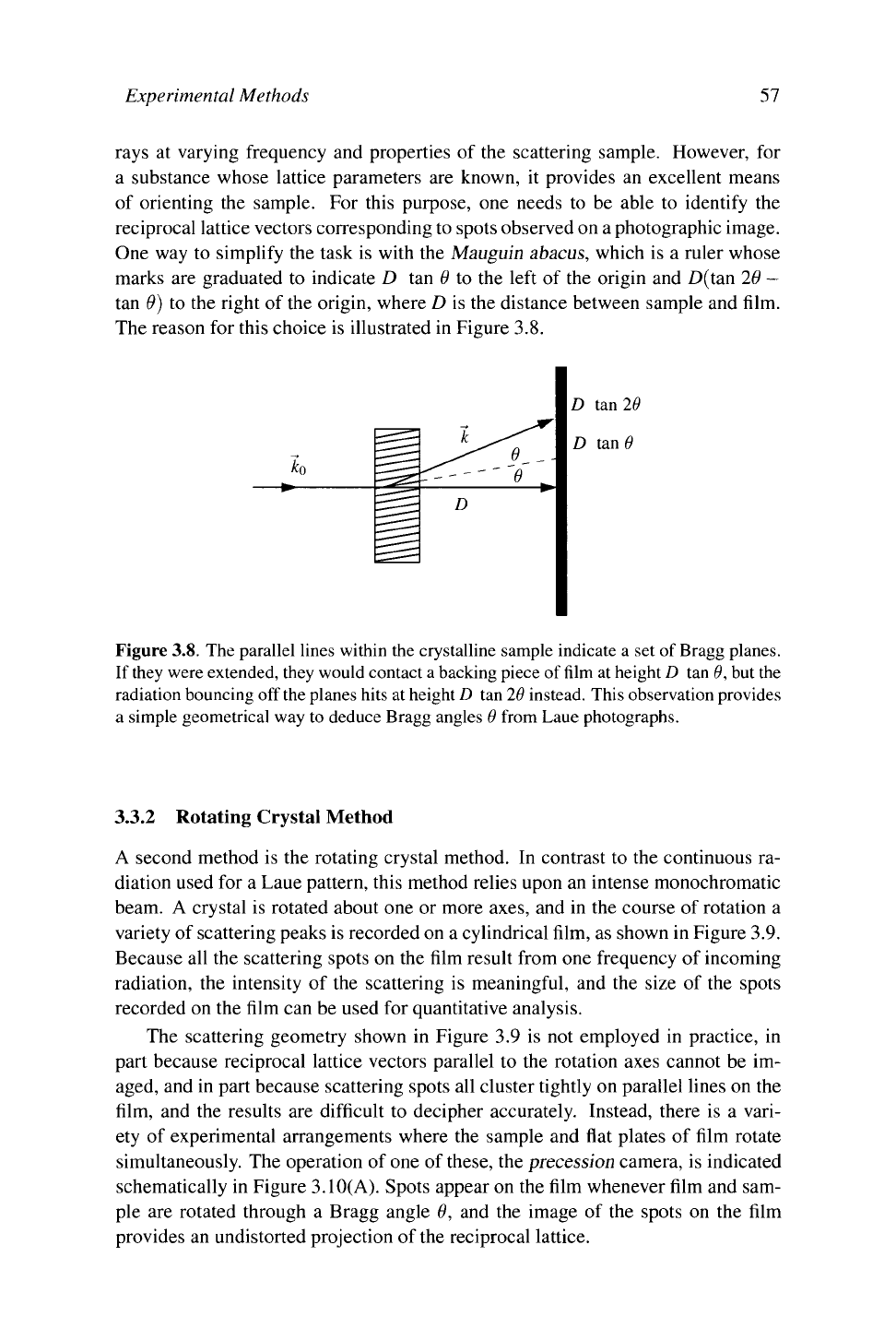
rays at varying frequency and properties of the scattering sample. However, for
a substance whose lattice parameters are known, it provides an excellent means
of orienting the sample. For this purpose, one needs to be able to identify the
reciprocal lattice vectors corresponding to spots observed on a photographic image.
One way to simplify the task is with the Mauguin abacus, which is a ruler whose
marks are graduated to indicate D tan
Θ
to the left of the origin and D(tan 20
—
tan
Θ)
to the right of the origin, where D is the distance between sample and film.
The reason for this choice is illustrated in Figure 3.8.
D tan
2Θ
D tan0
Figure 3.8. The parallel lines within the crystalline sample indicate a set of Bragg planes.
If
they
were extended, they would contact
a
backing piece of
film
at height
D
tan
Θ,
but the
radiation bouncing off
the
planes hits at height
D
tan
2Θ
instead. This observation provides
a simple geometrical way to deduce Bragg angles
Θ
from Laue photographs.
3.3.2 Rotating Crystal Method
A second method is the rotating crystal method. In contrast to the continuous ra-
diation used for a Laue pattern, this method relies upon an intense monochromatic
beam. A crystal is rotated about one or more axes, and in the course of rotation a
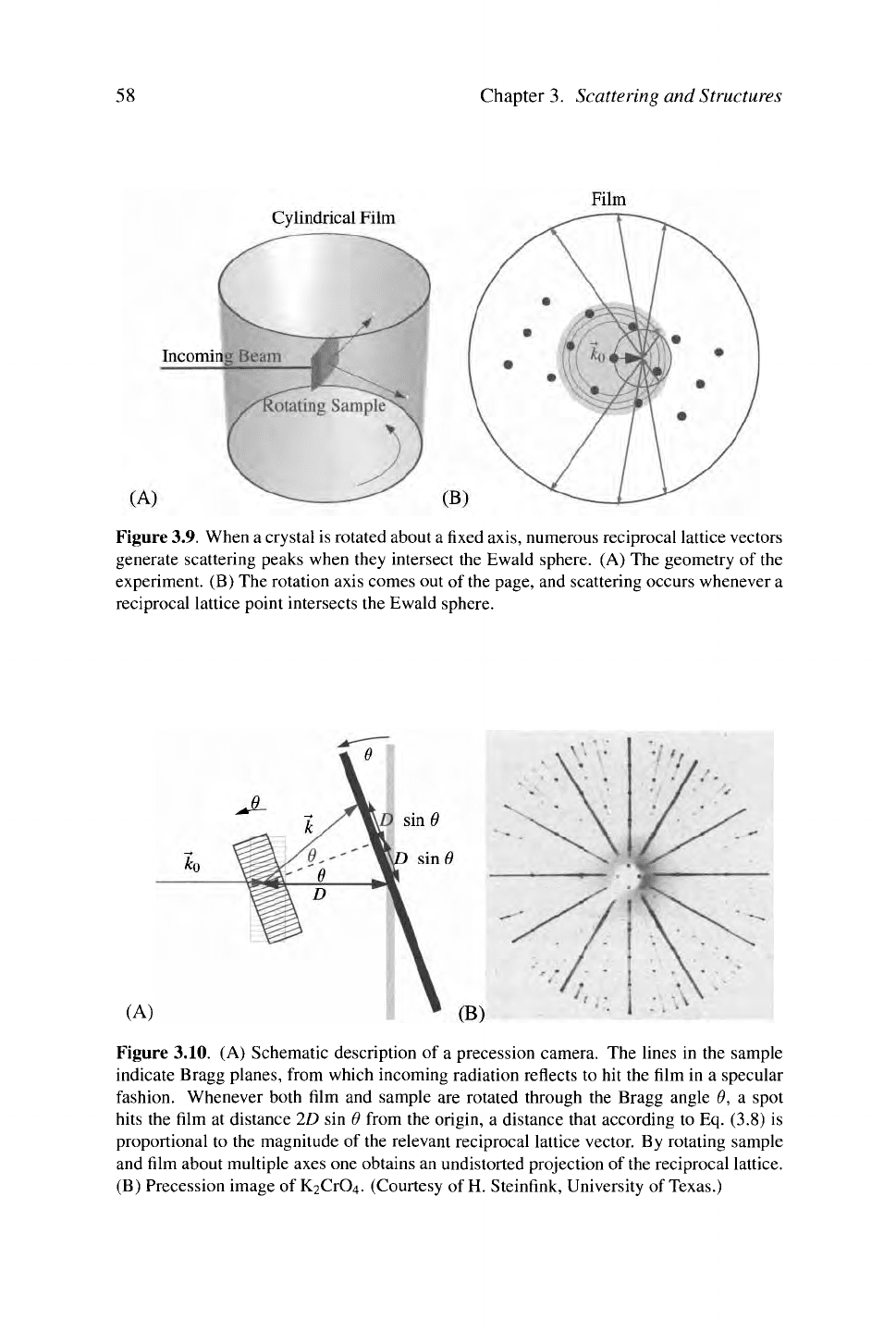
variety of scattering peaks is recorded on a cylindrical film, as shown in Figure 3.9.
Because all the scattering spots on the film result from one frequency of incoming
radiation, the intensity of the scattering is meaningful, and the size of the spots
recorded on the film can be used for quantitative analysis.
The scattering geometry shown in Figure 3.9 is not employed in practice, in
part because reciprocal lattice vectors parallel to the rotation axes cannot be im-
aged, and in part because scattering spots all cluster tightly on parallel lines on the
film, and the results are difficult to decipher accurately. Instead, there is a vari-
ety of experimental arrangements where the sample and flat plates of film rotate
simultaneously. The operation of one of these, the precession camera, is indicated
schematically in Figure 3.10(A). Spots appear on the film whenever film and sam-
ple are rotated through a Bragg angle
Θ,
and the image of the spots on the film
provides an undistorted projection of the reciprocal lattice.
^0
k ^^
D
58 Chapter 3. Scattering and Structures
Figure 3.9. When a crystal is rotated about a fixed axis, numerous reciprocal lattice vectors
generate scattering peaks when they intersect the Ewald sphere. (A) The geometry of the
experiment. (B) The rotation axis comes out of the page, and scattering occurs whenever a
reciprocal lattice point intersects the Ewald sphere.
(A)
Figure 3.10. (A) Schematic description of a precession camera. The lines in the sample
indicate Bragg planes, from which incoming radiation reflects to hit the film in a specular
fashion. Whenever both film and sample are rotated through the Bragg angle
Θ,
a spot
hits the film at distance 2D sin
Θ
from the origin, a distance that according to Eq. (3.8) is
proportional to the magnitude of the relevant reciprocal lattice vector. By rotating sample
and film about multiple axes one obtains an undistorted projection of the reciprocal lattice.
(B) Precession image of K
2
Cr0
4
. (Courtesy of
H.
Steinfink, University of Texas.)
Experimental Methods 59
3.3.3 Powder Method
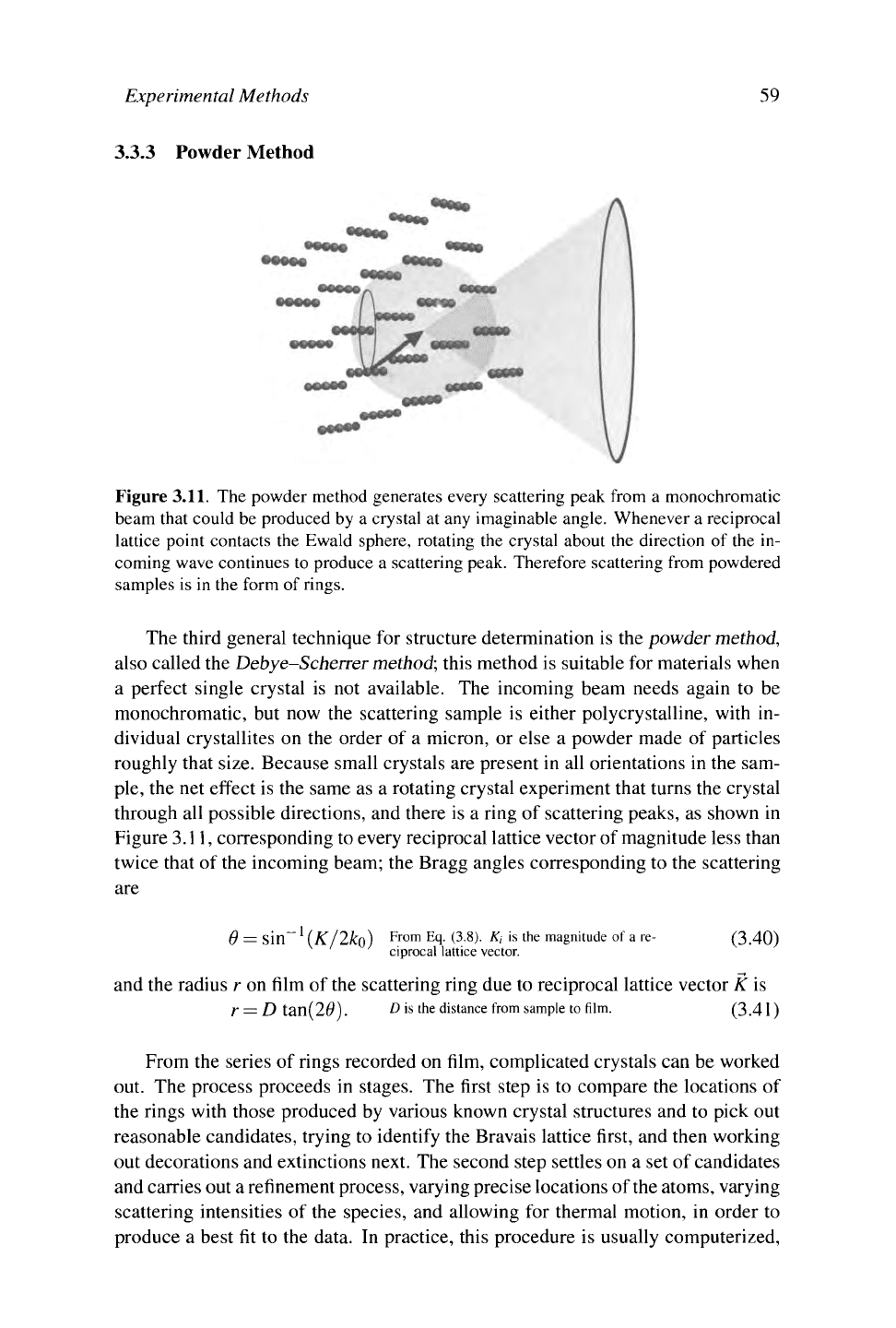
Figure 3.11. The powder method generates every scattering peak from a monochromatic
beam that could be produced by a crystal at any imaginable angle. Whenever a reciprocal
lattice point contacts the Ewald sphere, rotating the crystal about the direction of the in-
coming wave continues to produce a scattering peak. Therefore scattering from powdered
samples is in the form of rings.
The third general technique for structure determination is the powder
method,
also called the Debye-Scherrer
method;
this method is suitable for materials when
a perfect single crystal is not available. The incoming beam needs again to be
monochromatic, but now the scattering sample is either polycrystalline, with in-
dividual crystallites on the order of a micron, or else a powder made of particles
roughly that size. Because small crystals are present in all orientations in the sam-
ple,
the net effect is the same as a rotating crystal experiment that turns the crystal
through all possible directions, and there is a ring of scattering peaks, as shown in
Figure 3.11, corresponding to every reciprocal lattice vector of magnitude less than
twice that of the incoming beam; the Bragg angles corresponding to the scattering
are
Θ = Sin" ' (K/2k
0
)
Fr
°
m
Eq- (3-8)· K, is the magnitude of a re- (3.40)
ciprocal lattice vector.
and the radius r on film of the scattering ring due to reciprocal lattice vector K is
f = D
tan(2$).
D is the distance from sample to film. (3.41)
From the series of rings recorded on film, complicated crystals can be worked
out. The process proceeds in stages. The first step is to compare the locations of
the rings with those produced by various known crystal structures and to pick out
reasonable candidates, trying to identify the Bravais lattice first, and then working
out decorations and extinctions next. The second step settles on a set of candidates
and carries out a refinement process, varying precise locations of the atoms, varying
scattering intensities of the species, and allowing for thermal motion, in order to
produce a best fit to the data. In practice, this procedure is usually computerized,
60
Chapter 3. Scattering and Structures
e
3
t
J L
Simple cubic
_l_
Basis at (.25 .25 .25)
0.0
Body-centered cubic
-U
0.5 1.0
Bragg angle
Θ
(radians)
1.5
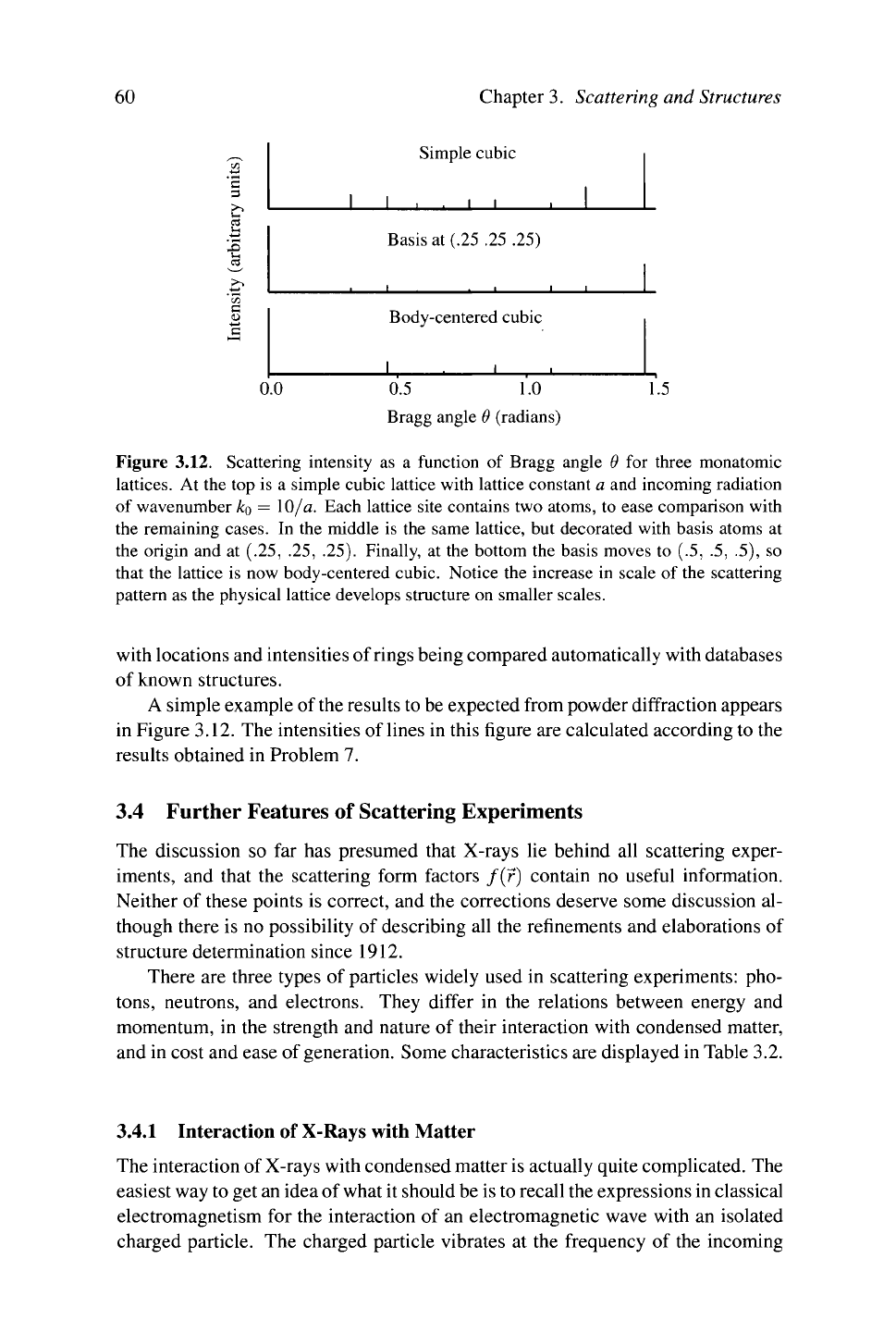
Figure 3.12. Scattering intensity as a function of Bragg angle
Θ
for three monatomic
lattices. At the top is a simple cubic lattice with lattice constant a and incoming radiation
of wavenumber
ko
= 10/α. Each lattice site contains two atoms, to ease comparison with
the remaining cases. In the middle is the same lattice, but decorated with basis atoms at
the origin and at (.25, .25, .25). Finally, at the bottom the basis moves to (.5, .5, .5), so
that the lattice is now body-centered cubic. Notice the increase in scale of the scattering
pattern as the physical lattice develops structure on smaller scales.
with locations and intensities of rings being compared automatically with databases
of known structures.
A simple example of
the
results to be expected from powder diffraction appears
in Figure 3.12. The intensities of lines in this figure are calculated according to the
results obtained in Problem 7.
3.4 Further Features of Scattering Experiments
The discussion so far has presumed that X-rays lie behind all scattering exper-
iments, and that the scattering form factors f(r) contain no useful information.
Neither of these points is correct, and the corrections deserve some discussion al-
though there is no possibility of describing all the refinements and elaborations of
structure determination since 1912.
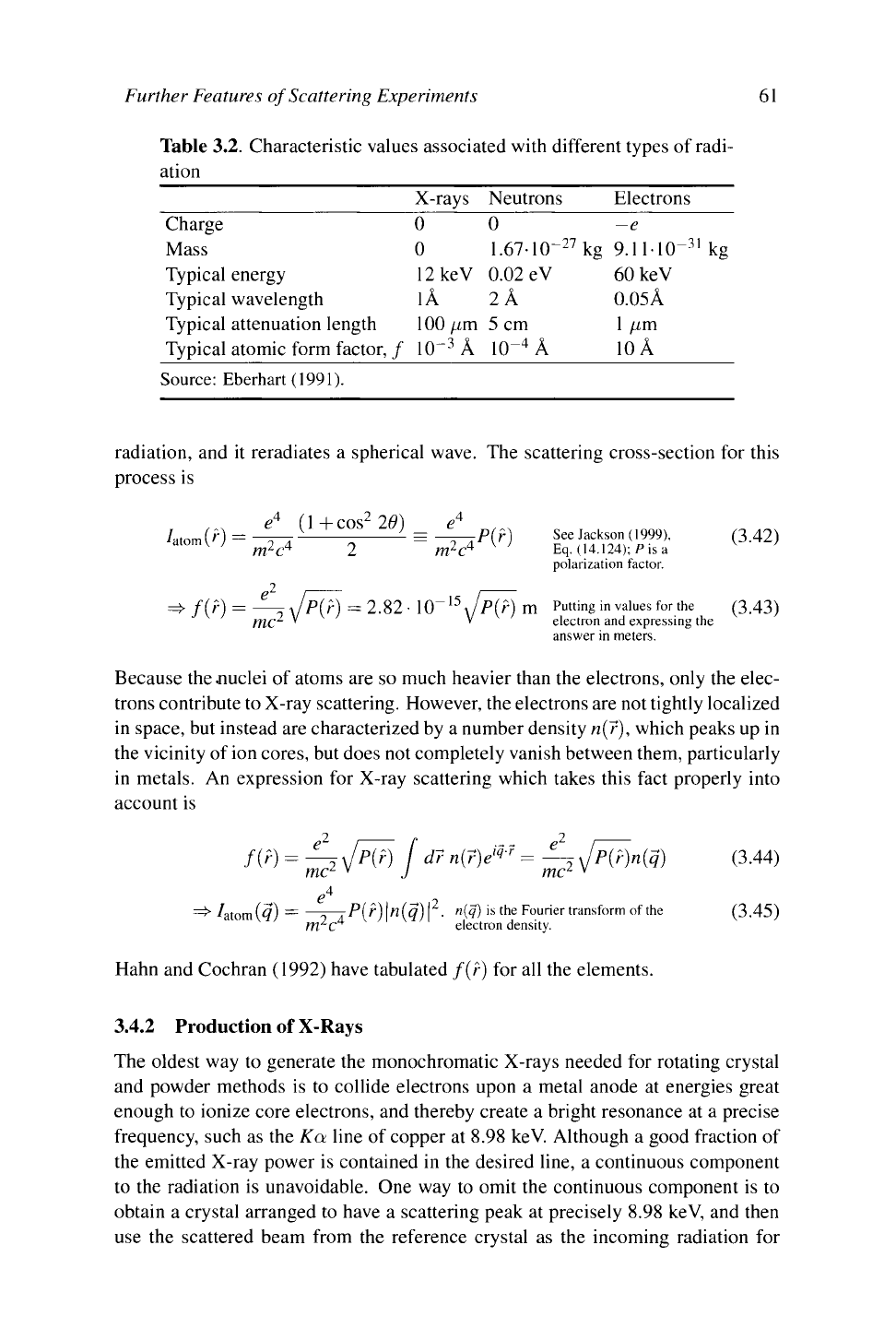
There are three types of particles widely used in scattering experiments: pho-
tons,
neutrons, and electrons. They differ in the relations between energy and
momentum, in the strength and nature of their interaction with condensed matter,
and in cost and ease of generation. Some characteristics are displayed in Table 3.2.
3.4.1 Interaction of X-Rays with Matter
The interaction of X-rays with condensed matter is actually quite complicated. The
easiest way to get an idea of what it should be is to recall the expressions in classical
electromagnetism for the interaction of an electromagnetic wave with an isolated
charged particle. The charged particle vibrates at the frequency of the incoming
Further
Features
of Scattering Experiments 61
Table 3.2. Characteristic values associated with different types of radi-
ation
X-rays Neutrons Electrons
Ö ~e
1.67· 10^
27
kg 9.11·
10
31
kg
60keV
Charge
Mass
Typical energy
Typical wavelength
Typical attenuation length
0 0
0 1.67·
12keV 0.02
i
1Â 2À
100 μηι 5 cm
0.05Â
1 μπι
Typical atomic form factor, / 10~
3
 10~
4
 10 Â
Source: Eberhart (1991).
radiation, and it reradiates a spherical wave. The scattering cross-section for this
process is
e
4
( 1
+ cos
2
260 e
4
/atom(r) = —
A
y
~ '- = -T-
A
P{r) See Jackson (,999). (3.42)
m
z
C
4
2 m
z
C
4
Eq. (14.124); Pis a
polarization factor.
e
2
f(f) =
=
JP(r) = 2X2- \QT
l5
JP{r)
TO.
Putting in values for the (3.43)
ItlC * * electron and expressing the
answer m meters.
Because the .nuclei of atoms are so much heavier than the electrons, only the elec-
trons contribute to X-ray scattering. However, the electrons are not tightly localized
in space, but instead are characterized by a number density n(7), which peaks up in
the vicinity of ion cores, but does not completely vanish between them, particularly
in metals. An expression for X-ray scattering which takes this fact properly into
account is
f(r) = —
2
φψ) ( dr
n{f)S-
?
= ~
>Jp{f)n{q)
(3.44)
mc
L
v
J mc
L v
=> /atom(g) = n . P(r) |w(^) | . n(q) is the Fourier transform of the (3.45)
m C electron density.
Hahn and Cochran (1992) have tabulated f(f) for all the elements.
3.4.2 Production of X-Rays
The oldest way to generate the monochromatic X-rays needed for rotating crystal
and powder methods is to collide electrons upon a metal anode at energies great
enough to ionize core electrons, and thereby create a bright resonance at a precise
frequency, such as the Ka line of copper at 8.98 keV. Although a good fraction of
the emitted X-ray power is contained in the desired line, a continuous component
to the radiation is unavoidable. One way to omit the continuous component is to
obtain a crystal arranged to have a scattering peak at precisely 8.98 keV, and then
use the scattered beam from the reference crystal as the incoming radiation for
62
Chapter 3. Scattering and Structures
further experiments. The highly monochromatic beam produced in this way has
unfortunately low amplitude, and a brighter but less narrow beam can be chosen
by filtering the X-rays through an element that absorbs most of the continuous
radiation while leaving the sharp line alone; a good candidate for such a filter is
the element one atomic number down in the periodic table, which in the case of
copper is nickel. Electron collisions with a metal do not provide an efficient way
to generate X-rays; 99% of incoming energy is converted to heat. Even employing
tricks such as rapidly rotating the target anode to keep it cool, the maximum X-ray
power that can practically be extracted from conventional tubes is around 100 W,
and by the time the X-ray has been filtered, fewer than 10 W may be left. The
situation is very different at a synchrotron, where radiation is generated by rapidly
accelerating electrons in huge rings. The total power emitted as X-rays in a broad
band up to 200 keV is on the order of 10
6
W, so even after filtering to
0.1%
of the
200 keV bandwidth to get a monochromatic beam, 1000 W of power is left. The
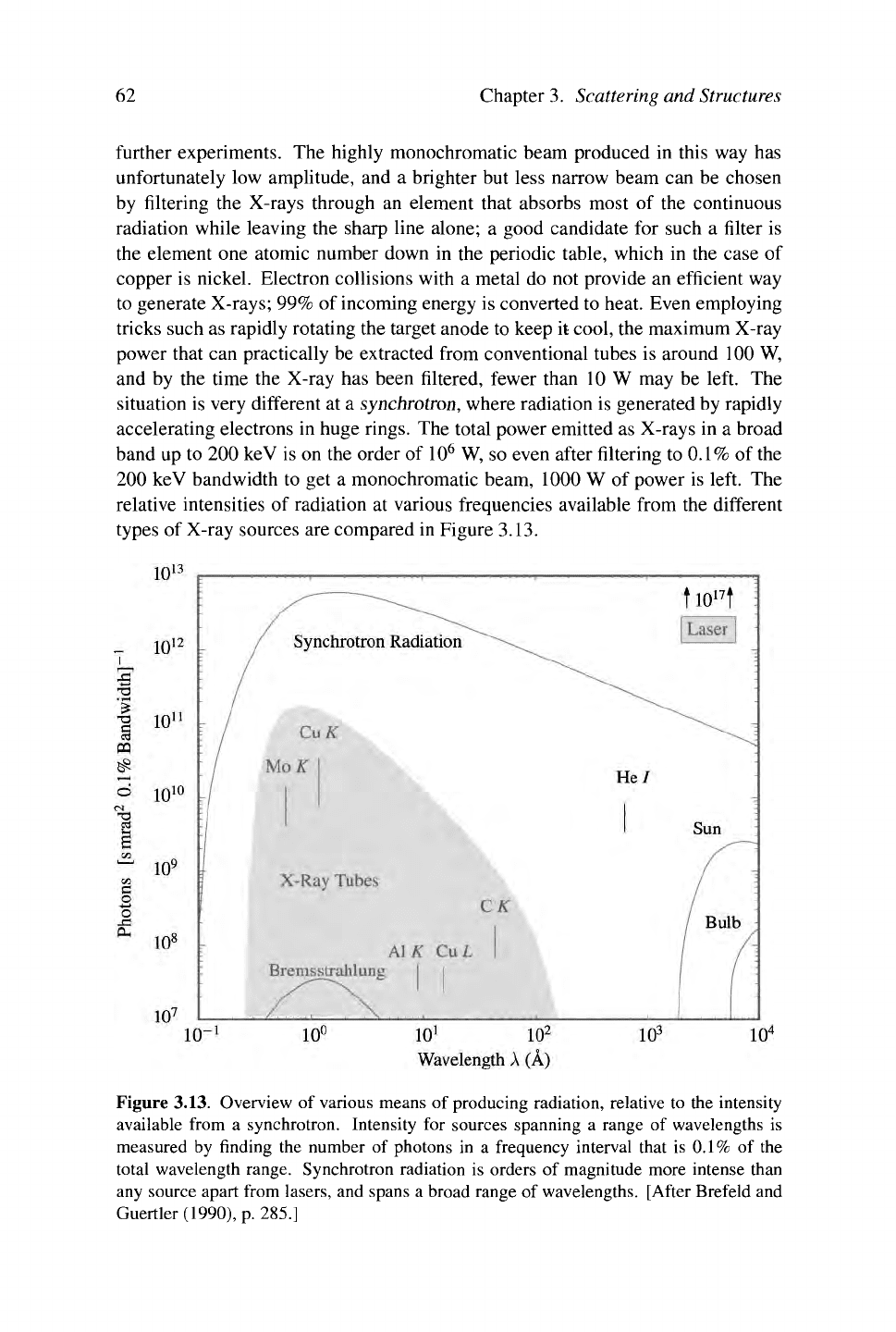
relative intensities of radiation at various frequencies available from the different
types of X-ray sources are compared in Figure 3.13.
Figure 3.13. Overview of various means of producing radiation, relative to the intensity
available from a synchrotron. Intensity for sources spanning a range of wavelengths is
measured by finding the number of photons in a frequency interval that is 0.1% of the
total wavelength range. Synchrotron radiation is orders of magnitude more intense than
any source apart from lasers, and spans a broad range of wavelengths. [After Brefeld and
Guertler(1990), p. 285.]