
Marder M.P. Condensed Matter Physics
Подождите немного. Документ загружается.

Problems
93
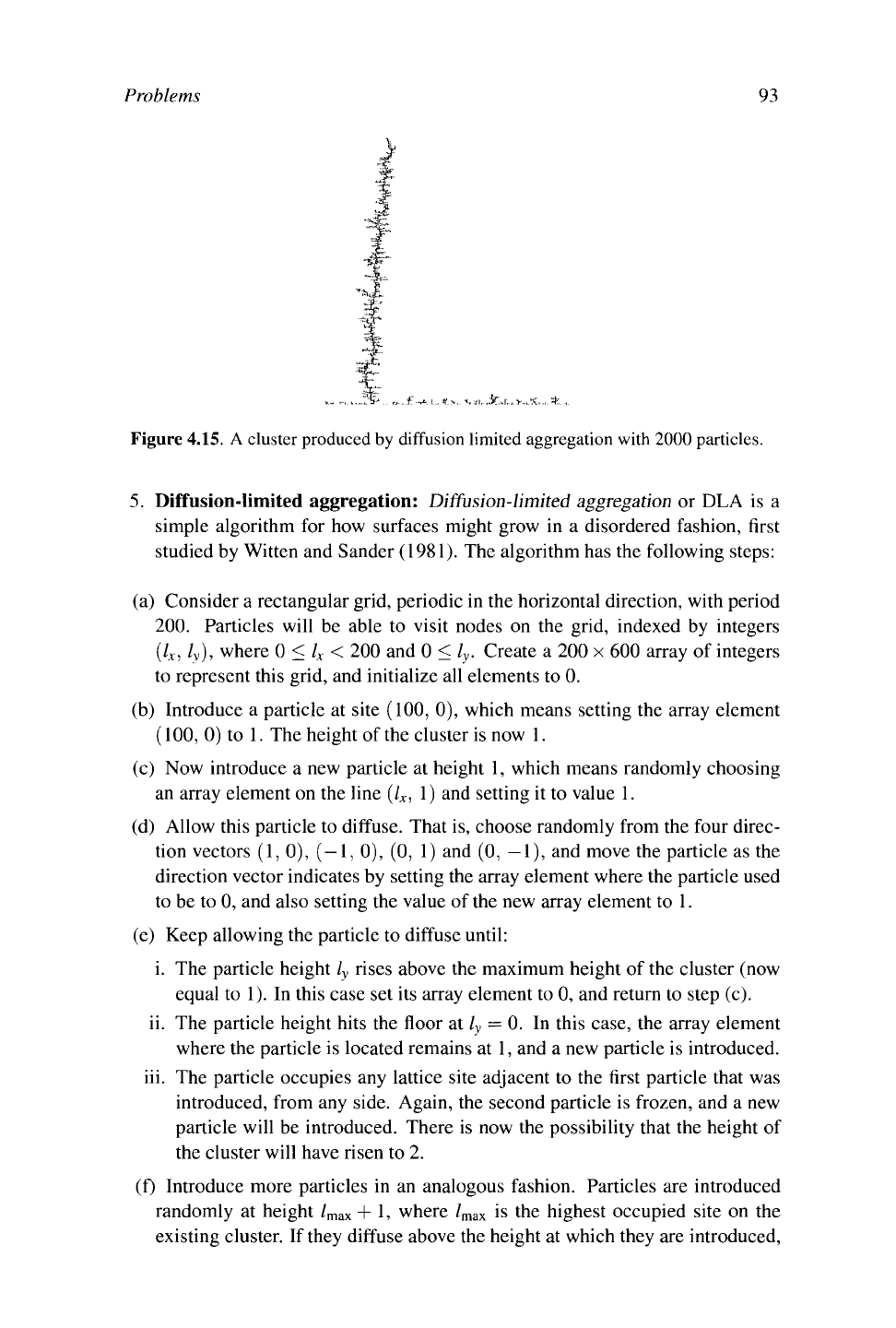
Figure 4.15.
A
cluster produced by diffusion limited aggregation with 2000 particles.
5.
Diffusion-limited aggregation: Diffusion-limited
aggregation
or DLA is a
simple algorithm for how surfaces might grow in a disordered fashion, first
studied by Witten and Sander (1981). The algorithm has the following steps:
(a) Consider a rectangular grid, periodic in the horizontal direction, with period
200.
Particles will be able to visit nodes on the grid, indexed by integers
(l
x
, ly), where 0 < l
x
< 200 and 0 < l
y
. Create a 200 x 600 array of integers
to represent this grid, and initialize all elements to 0.
(b) Introduce a particle at site (100, 0), which means setting the array element
(100,
0) to 1. The height of the cluster is now 1.
(c) Now introduce a new particle at height 1, which means randomly choosing
an array element on the line (l
x
, 1) and setting it to value 1.
(d) Allow this particle to diffuse. That is, choose randomly from the four direc-
tion vectors (1, 0),
(—1,
0), (0, 1) and (0, —1), and move the particle as the
direction vector indicates by setting the array element where the particle used
to be to 0, and also setting the value of the new array element to 1.
(e) Keep allowing the particle to diffuse until:
i. The particle height l
y
rises above the maximum height of the cluster (now
equal to 1). In this case set its array element to 0, and return to step (c).
ii.
The particle height hits the floor at l
y
—
0. In this case, the array element
where the particle is located remains at 1, and a new particle is introduced.
iii.
The particle occupies any lattice site adjacent to the first particle that was
introduced, from any side. Again, the second particle is frozen, and a new
particle will be introduced. There is now the possibility that the height of
the cluster will have risen to 2.
(f) Introduce more particles in an analogous fashion. Particles are introduced
randomly at height /
max
+ 1, where /
max
is the highest occupied site on the
existing cluster. If they diffuse above the height at which they are introduced,
94 Chapter 4. Surfaces and Interfaces
throw them out, and introduce a new particle. If a particle touches the floor,
or any particle already frozen in the cluster, it too freezes, /
max
is increased by
1 if necessary, and a new particle is introduced.
(g) Using this algorithm, produce a cluster with 2000 particles and draw a pic-
ture of it (see Figure 4.15).
References
B.
J. Albers, T. C. Schwendemann, M. Z. Baykara, N. Pilet, E. I. A. Marcus Liebmann and, and
U. D. Schwarz (2009), Three-dimensional imaging of short-range chemical forces with picometre
resolution, Nature Nanotechnology, 4, 307-310.
G. Binnig, C. F. Quate, and C. Gerber (1986), Atomic force microscope, Physical Review Letters,
56,
930-933.
G. Binnig and H. Rohrer (1987), Scanning tunneling microscopy-from birth to adolescence, Reviews
of Modern Physics, 59, 615-625.
S. Boseck (1995), Scanning acoustic microscopy and its applications to material characterization,
Reviews of Modern Physics, 67,
863-891.
W. Braun, L. Däweritz, and K. H. Ploog (1998), Origin of electron diffraction oscillations during
crystal growth, Physical Review Letters, 80, 4935-4938.
C. Bustamante and D. Keller (1995), Scanning force microscopy in biology, Physics Today, 48(12),
32-38.
C.-L. Cheng, H.-C. Chang, J.-C. Lin, K.-J. Song, and J.-K. Want (1997), Direct observation of hy-
drogen etching anisotropy on diamond single crystal surfaces, Physical Review Letters, 78,
3713—
3716.
N.
P. Davis (1968), Lawrence and Oppenheimer, Simon and Schuster, New York.
J. Davisson and L. H. Germer (1927), Diffraction of electrons by a crystal of
nickel,
Physical Review,
30,
705-740.
P.
G. de Gennes (1985), Wetting: Statistics and dynamics, Reviews of Modern Physics, 57, 827-863.
A. L. de Lozanne (1993), Scanning tunneling microscopy, in Investigations of Surfaces and
Interfaces-Part A, B. W. Rossiter and R. C. Baetzold, eds., vol. IXA of Physical Methods of
Chemistry, pp. 142-207, John Wiley and Sons, New York.
A. Erzan, L. Pietronero, and A. Vespignani (1995), The fixed-scale transformation approach to fractal
growth, Reviews of Modern Physics, 67, 545-604.
R. Gomer (1975), Chemisorption on metals, Solid State Physics: Advances in Research and Appli-
cations, 30, 93-225.
L. D. Landau and E. M. Lifshitz (1977), Quantum Mechanics (Non-relativistic Theory), 3rd ed.,
Pergamon Press, Oxford.
K. Nadarzinski and F. Ernst (1996), The atomistic structure of a Σ = 3, (111) grain boundary in
NiAl, studied by quantitative high-resolution transmission electron microscopy, Philosophical
Magazine A, 74, 641-664.
C. F. Quate (1986), Vacuum tunneling: A new technique for microscopy, Physics Today, 39(8),
26-33.
C. Rottman and M. Wortis (1984), Statistical mechanics of equilibrium crystal shapes: Interfacial
phase diagrams and phase transitions, Physics Reports, 103, 59-79.
L. Schiff (1968), Quantum Mechanics, 3rd ed., McGraw-Hill, New York.
J. C. H. Spence (1988), Experimental High-Resolution Electron Microscopy, 2nd ed., Oxford Uni-
versity Press, New York.
References
95
M. P. Tosi (1964), Cohesion of ionic solids in the Born model, Solid State Physics: Advances in
Research and Applications, 16,
1-120.
T. T. Tsong (1993), Atom-probe field ion microscopy, Physics
Today,
46(5),
24-31.
M. B. Webb and M. G. Lagally (1973), Elastic scattering of low-energy electrons from surfaces,
Solid State Physics: Advances in Research and Applications, 28, 301^105.
T. A. Witten and L. M. Sander (1981), Diffusion-limited aggregation, a kinetic critical phenomenon,
Physical Review Letters, 47, 1400-1403.
D.
Wolf (1992), Atomic-level geometry of crystalline interfaces, in Materials Interfaces: Atomic-
level Structure and Properties, D. Wolf and S. Yip, eds., pp. 1-57, Chapman and Hall, London.
E. L. Wolf (1975), Nonsuperconducting electron tunneling spectroscopy, Solid State Physics: Ad-
vances in Research and Applications, 30, 1-91.
R. Wolkow and P. Avouris (1988), Atom-resolved surface chemistry using scanning tunneling mi-
croscopy, Physical Review Letters, 60, 1049-1052.
A. Zangwill (1988), Physics at Surfaces, Cambridge University Press, Cambridge.
5.
Beyond Crystals
5.1 Introduction
The number of possible equilibrium crystal structures is enormous, but these struc-
tures represent ideal cases, rarely realized in the natural world. Macroscopic sam-
ples of solid matter are rarely close at all to thermal equilibrium, and equilibrium
structures are not always crystals. The goal of this chapter is to discuss some of the
relations between naturally occurring materials and crystals. The first topic is
dif-
fusion, since random displacement of atoms provides one of the primary ways that
perfect crystalline order is modified. Metal alloys provide the next topic. Simple
statistical arguments show that their crystalline order can be destroyed at a critical
temperature well below melting, and that even when one disregards this transition,
these alloys are unlikely ever to be in equilibrium. There follows a brief discussion
of several other forms condensed matter can take—liquids, glasses, liquid crystals,
and polymers—for which the language of crystals is inappropriate. The discussion
closes with an introduction to quasicrystals, which provide an example where a
structure without true crystalline order can be described with the same precision
and completeness that has been found for crystals.
5.2 Diffusion and Random Variables
5.2.1 Brownian Motion and the Diffusion Equation
In 1827, Robert Brown published an account of observations through a microscope,
beginning with pollen, and proceeding to a large variety of
powders.
He concluded
[t]hat extremely minute particles of solid matter, whether obtained from
organic or inorganic substances, when suspended in pure water or in
some other aqueous fluids, exhibit motions for which I am unable to
account and which from their irregularity and seeming independence re-
semble in a remarkable degree the less rapid motions of some of the
simplest animalcules of infusions. —Brown (1827), p. 481
The motions were eventually explained by Einstein (1905) and Perrin (1909)
as the result of thermal fluctuations causing fluid molecules to collide with the par-
ticles,
and exciting them into motion. The microscopic motions became identified
with the tendency of small particles to spread apart, as when some ink drops onto
a piece of paper or a gel.
97
Condensed Matter
Physics,
Second Edition
by Michael P. Marder
Copyright © 2010 John Wiley & Sons, Inc.
98 Chapter 5. Beyond Crystals
5.2.2 Diffusion
Diffusive motion concerns a large population of noninteracting particles kicked
about by random forces. Equivalently, it describes the probability distribution of a
single particle undergoing random motion.
The mathematical description of diffusion begins with the observation that if
n(r, t) describes some density distribution of particles then there is a particle cur-
rent j that flows from regions of high density to low. The simplest possible rule
for how this happens is that the rate of flow is proportional to the gradient Vn(r, t)
(Fick's law) so that
j = -VWn. (5.1)
The constant Ί) is called the diffusion constant. Eq. (5.1) can also be rewritten as
Vn
j = —vn where v =—T>— (5.2)
n
is the mean velocity of particles.
Continuity Equation. To obtain a closed expression for the particle density n,
make use of the fact that particles are conserved. The continuity equation, illus-
trated in Figure 5.1 describes any collection of conserved particles whose coordi-
nates r change continuously with velocity v. If n(x, t) is the number of particles
at position x and they are moving with mean velocity v(x, t), then the number of
particles moving into a little region of width dx minus the number moving out is
Av(x)n(x) dt—Av{x + dx)n{x + dx) dt (5.3)
in time dt. Therefore for variable x one has that
dn d , . . .
= V(x)n(X t). Divide change in number of particles per time (5.4)
dt dx ' by volume Adx of the box.
If there are many variables, the argument holds for each coordinate in turn and
dn ^ d
~dt
=
~^dr,
&n
= - Σ ^-Mr)n(7, t). (5.5)
Figure 5.1. The continuity equation ap-
plies to any situation in which a conserved
collection of particles can
be
characterized
by a mean velocity wasa function of co-
ordinate
7.
Diffusion and Random Variables 99
Diffusion Equation. Using the velocity v for diffusing particles from Eq. (5.2) in
the continuity equation (5.5) gives finally the diffusion equation
— DV n. Taking Eq. (5.5) to apply to three dimensions. (5.6)
dt
5.2.3 Derivation from Master Equation
The simplest derivations of the diffusion equation do not make it apparent how
random motion of particles leads to diffusion. To build this connection, a more
sophisticated derivation is required. Again, let n(7, t) be the density of particles
at location 7 at time t. Assume that at small time dt later the number of particles
originally in small volume 5V at
7
that end up at 7 + ?
is
n(r, t) R(7
—>
7 + i, dt) ÔV.
R
g
ives tne
probability that particles start at 7 (5.7)
and end at r + ? after time t.
Then the change in the number of particles in the volume 5V near 7 is the number
of particles starting at
7
+
87
and coming to 7 minus the number starting at 7 and
leaving, which can be written as
n(7, t + dt)— n(7, t) = / ds -
R(7
+
s-^ 7, dt) n(7+s, t)
■
R(7
—>
r-s, 8t) n(7, t)
(5.8)
Factors of 8V have been divided out everywhere. Equation 5.8 is called the master
equation. It appears very general, but it is based on some strong assumptions that
can easily be violated. The most important is that knowing a particle is at 7 is all
one needs in order to know the probability it will be at
7
+ s some time dt later.
This need not be true. For example, if the momentum of particles is important,
then a collection of particles with momentum p\ will have a different probability
distribution for future locations from particles with momentum ριφ p\- On the
other hand, nothing in the derivation requires ? just to be three position coordinates.
The derivation goes through without change when 7 contains many components,
including for example momenta as well as positions.
To derive the diffusion equation, observe that /?(?+?—>
7,
t should be expected
to be a rapidly varying function of
s;
the chance of going distance s varies quickly
with the distance. However, one should not expect R(7 +
s*
—>■
7, t to vary very
quickly as a function of r: the rate at which particles jump about should not depend
very much on where they are. Adopting this assumption, one can insert a Taylor
expansion in Eq. (5.8) sending
7
to
7 —
s,
R(7+67^7, 6t)n(7+s, t) « R(7->7-s, öt)n(7, t)
9
+
07-
—R(7—+ 7 —
Ï, ôt)n(7, t)
or
d
2
+ \ Σ
s
a
s
ßx R{7^7-s, dt)n(7,t) +
.
. .
αβ
ΟΓαΊΓ
Ρ
(5.9)
100
Chapter 5. Beyond Crystals
Substituting Eq. (5.9) into Eq. (5.8) gives
-^ =
- Σ
ΈΓ
υ
<*
«('> 0 +
Σ
äryVoß
n
^')>
(5
·
10)
vi
a
<Jr
a
α
β
<Jr
a
rp
where, sending ?
—►
— sin the integrals,
v
a
V) =
fdss
a
R
^
f
+
ldt)
(5.11a)
V
aß
(r)
=
J ds\
w/
(?
^^
+?
'
dt)
.
(5.11b)
The diffusion equation has now been generalized to include the possibility of a
nonzero net flow «ina particular direction, and the possibility that the diffusion
rate is different in different directions so that Ί) becomes a tensor.
5.2.4 Connection Between Diffusion and Random Walks
Using Eqs. (5.11), one can connect physical models for how particles move to the
diffusion equation. For example, suppose that at time intervals io, particles jump a
distance a in a random direction in three dimensions. The mean flow w vanishes,
because the probabilities of going forward or backward in direction a are equal.
Off-diagonal components of Ί) vanish as well. Since jumping distance a in time
to
is certain,
R(r^r + s,to) =
0
-^^-. (5.12)
The normalization ensures that
/
dsR= 1. Thus
Σ©
Ωα
(7)=/
ds
[
2^(
s
~
a
)
a
2
s-
-
=
—
(5.13)
Ans
2
2
to 2/o
a
2
=>·
D =
Έαα
=
Since the three components are equal by symmetry (5.14)
6io
Thus a random walk with step length a and time constant to is equivalent to a
solution of the diffusion equation with diffusion constant D = α
2
/6ίο· This cor-
respondence can be used to find the mean square distance travelled by particles
undergoing a random walk. Multiply the diffusion equation (5.6) by r
2
and inte-
grate:
drr ~—-=T)
/ dr r ^rn =
6T> Use spherical coordinates for
d
2
/r
2
and (5.15)
Ot
J
V Qr assume n(r, t) is spherically symmetric.
Then integrate twice by parts and use the
/
2\ ^m> 2^
fact that
f
drnCr, t)
=
1. ...
. -.
=>
{r
z
) =6T>t =
a
l
-
■>
y
'
(5.16)
Alloys
101
5.3 Alloys
The importance of metallic alloys is compactly expressed in the fact that eras of
human history are named for them. The Bronze Age began around 3000 B.C. in
Greece with the discovery that addition of between 10% and 30% of tin to copper
produced
a
metal of greater hardness and lower melting point than either of its
components. Bronze was in most respects superior to the alloys of the Iron Age
which followed, except that iron was cheaper and easier to mold. The progress of
industry in recent centuries has closely been tied to the creation of improved forms
of
steel,
which meant developing ingenious ways to add carbon and other materials
in a controlled fashion to iron.
5.3.1 Equilibrium Structures
Consider
a
pure crystal of some element—say iron—and imagine addition of a
very small amount of
a
second element—say carbon. The second element is always
soluble in the first in sufficiently small quantities.
The reason that thermodynamics favors a mixture is a consequence of entropy.
Suppose that addition of each atom of the second element to the first incurs an
energy penalty e > 0. The number of ways to add M atoms to a lattice of N 3> M
sites is
/N\
N\ N
M
=
Ft
Using the approximation that
(5 17)
\MJ M\{N-M)\ M\ ' N(N-l)... (N-M+\)^N
M
.
so the entropy associated with the addition of M atoms, in terms of the concentra-
tion
c = M/N, (5.18)
is
kß in(N
M
/Ml) « —ksN(c inc
—
c).
The
entropy is Boltzmann's constant kg (5.19)
times the log of the number of ways to
achieve some macroscopic state; also use
M\?sM
M
e-
M
.
Therefore, the free energy
3~
of the mixture is
2f
= £
-
TS =
N[ce
+ k
B
Tc In c
-
k
B
Tc], (5.20)
which has a minimal value for concentration
C~e
_e
/*
e7
\ Just differentiate Eq. (5.20) by c, set to zero, (5.21)
and solve for c.
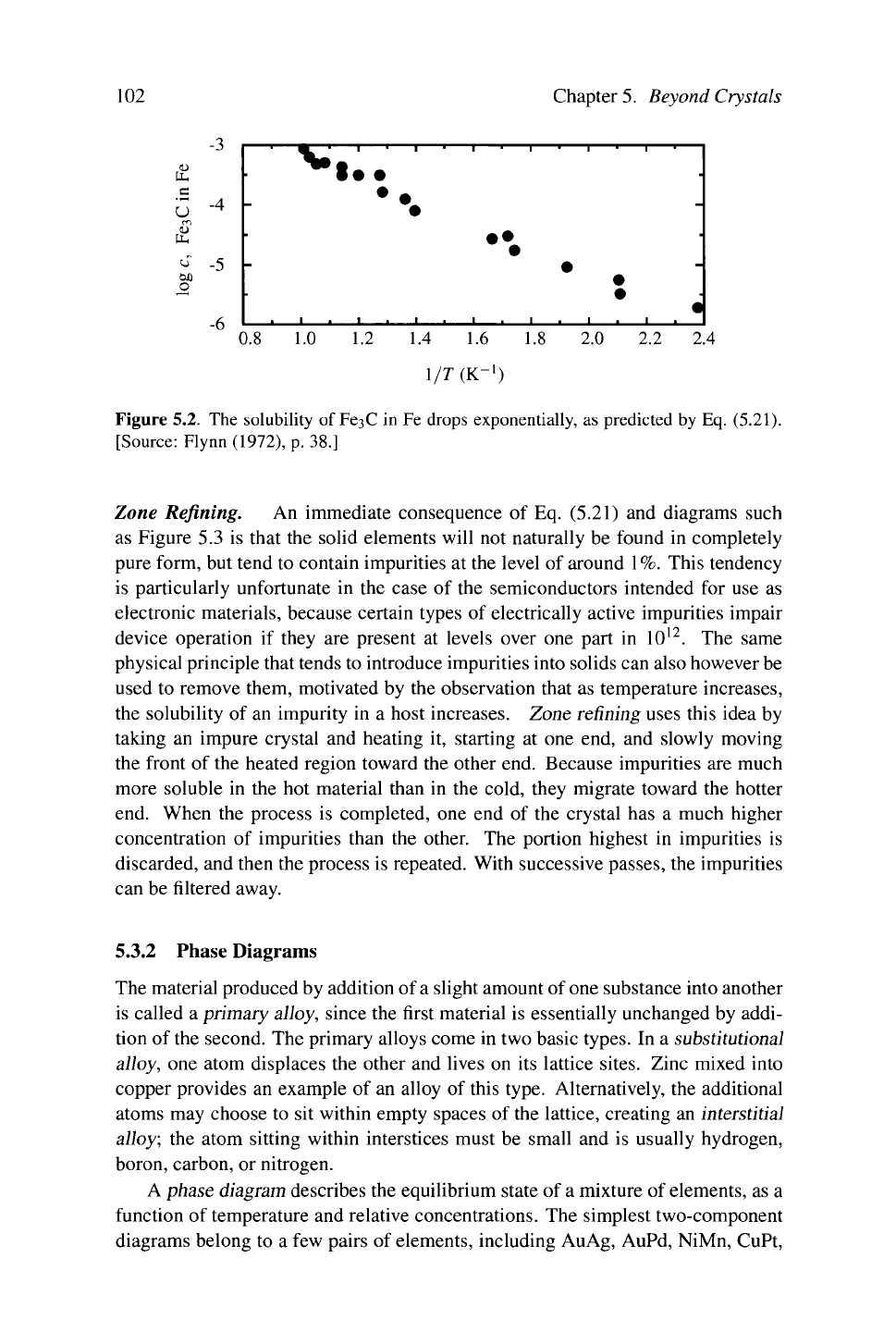
This tendency toward solubility of one element in another that declines exponen-
tially with decreasing temperature is illustrated in Figures 5.2 and 5.3(B).
102 Chapter 5. Beyond Crystals
IL,
u
-4 -
^ -5 -
00
o
Figure 5.2. The solubility of
Fe3C
in Fe drops exponentially, as predicted by Eq. (5.21).
[Source: Flynn (1972), p. 38.]
Zone Refining. An immediate consequence of Eq. (5.21) and diagrams such
as Figure 5.3 is that the solid elements will not naturally be found in completely
pure form, but tend to contain impurities at the level of around 1%. This tendency
is particularly unfortunate in the case of the semiconductors intended for use as
electronic materials, because certain types of electrically active impurities impair
device operation if they are present at levels over one part in 10
12
. The same
physical principle that tends to introduce impurities into solids can also however be
used to remove them, motivated by the observation that as temperature increases,
the solubility of an impurity in a host increases. Zone refìning uses this idea by
taking an impure crystal and heating it, starting at one end, and slowly moving
the front of the heated region toward the other end. Because impurities are much
more soluble in the hot material than in the cold, they migrate toward the hotter
end. When the process is completed, one end of the crystal has a much higher
concentration of impurities than the other. The portion highest in impurities is
discarded, and then the process is repeated. With successive passes, the impurities
can be filtered away.
5.3.2 Phase Diagrams
The material produced by addition of a slight amount of one substance into another
is called a primary alloy, since the first material is essentially unchanged by addi-
tion of the second. The primary alloys come in two basic types. In a substitutional
alloy, one atom displaces the other and lives on its lattice sites. Zinc mixed into
copper provides an example of an alloy of this type. Alternatively, the additional
atoms may choose to sit within empty spaces of the lattice, creating an interstitial
alloy; the atom sitting within interstices must be small and is usually hydrogen,
boron, carbon, or nitrogen.
A phase
diagram
describes the equilibrium state of a mixture of elements, as a
function of temperature and relative concentrations. The simplest two-component
diagrams belong to a few pairs of elements, including AuAg, AuPd, NiMn, CuPt,