
Marder M.P. Condensed Matter Physics
Подождите немного. Документ загружается.

9. Electron-Electron Interactions
9.1 Introduction
Bloch's theory for periodic solids brilliantly solves the problem of a single electron
in a periodic potential. While engaged in the process of solving this problem, it is
easy to forget the severity of the approximations needed to reduce a real periodic
solid to a single-electron problem. The problem has two different sides. First, how
conceptually can interacting electrons be treated within a one-electron framework
at all? An answer to this question will be provided in Section 17.5 by Fermi liquid
theory. Yet Fermi liquid theory provides little practical guidance in constructing
the effective one-electron potential it shows may exist. The construction is instead
provided by a sequence of approximations, whose validity is in principle not quite
clear but in practice lies behind all attempts at realistic calculations. There is no
internally consistent test for the validity of these calculations, and sometimes they
fail rather badly. Even more often, however, they achieve detailed comparison
with experiment that is much better than might have been expected. The goal of
this chapter is to describe only those treatments of electron-electron interactions
leading to practical band structure calculations.
The Hamiltonian that one really should solve is Eq. (6.1), in which electrons
and nuclei all appear on an equal quantum-mechanical footing. A first simplifica-
tion is to remove the nuclei from the quantum mechanics problem. Because nuclei
are thousands of times more massive than electrons, they move that much more
slowly. Born and Oppenheimer (1927) suggested an approximation scheme that
is employed quite universally throughout condensed matter physics. So far as the
electrons are concerned, take the nuclei to be static, classical potentials, and solve
the electronic problem without worrying about the nuclei further. So far as the nu-
clei are concerned, the electrons are a rapidly moving shroud of charge that follows
them wherever they go. Because the motion of nuclei is accompanied by charge
redistribution, the energies involved in moving nuclei about depend upon the so-
lution of the electron problem, and the nuclei interact with complicated effective
potentials. All the ideas of different types of interatomic bonding arise from this
viewpoint and will be discussed further in Chapter 11.
The Born-Oppenheimer approximation may have to be abandoned whenever
the electrons and nuclei cannot be disentangled so neatly. The world is full of
phenomena where the approximation fails. For example, in striking a flint to create
a spark, mechanical motion excites electrons into a plasma that then emits light.
233
Condensed Matter
Physics,
Second Edition
by Michael P. Marder
Copyright © 2010 John Wiley & Sons, Inc.
234
Chapter 9. Electron-Electron Interactions
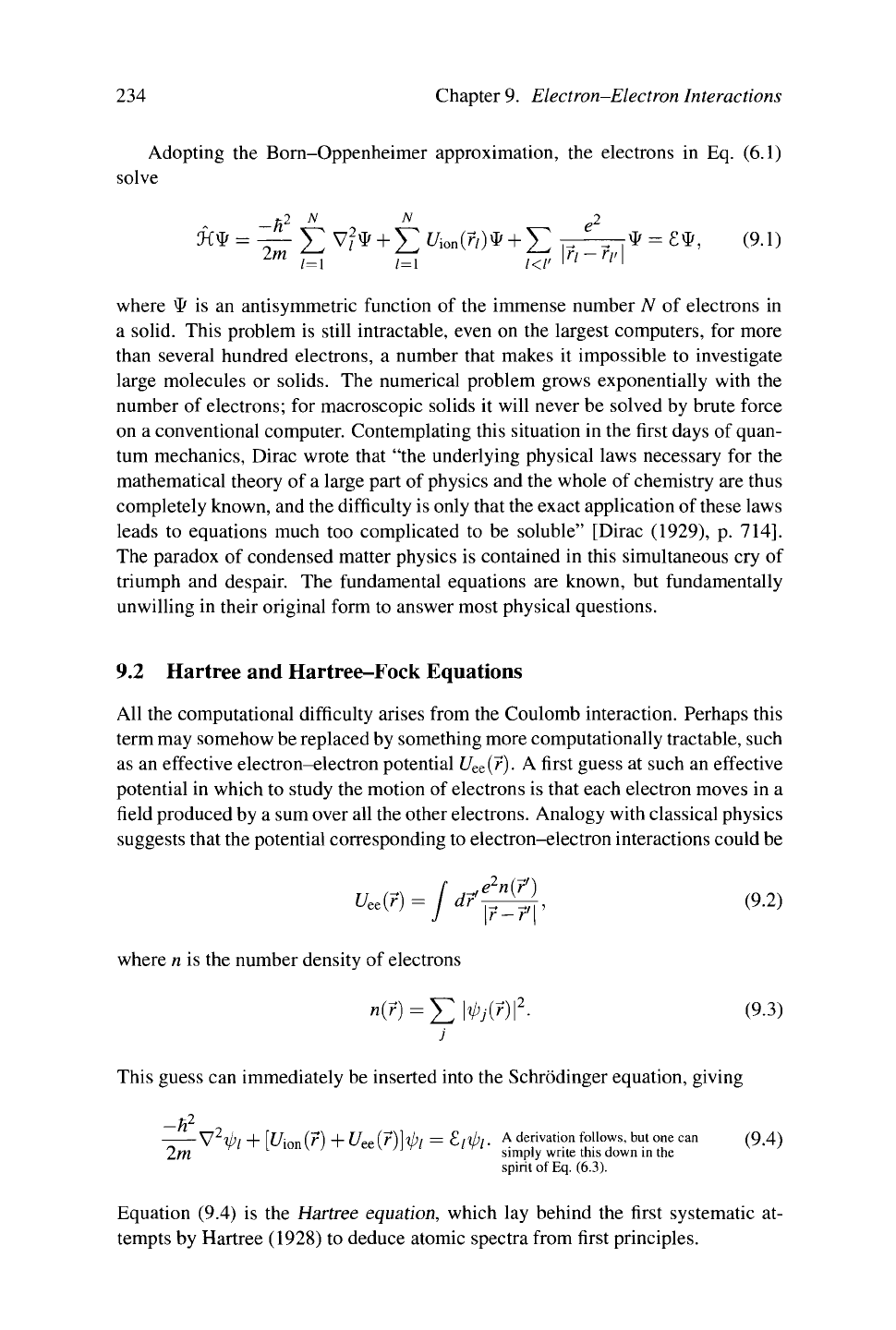
Adopting the Born-Oppenheimer approximation, the electrons
in
Eq. (6.1)
solve
-h
2
N N
e
2
where Φ
is
an antisymmetric function of the immense number
N
of electrons
in
a solid. This problem is still intractable, even on the largest computers, for more
than several hundred electrons,
a
number that makes
it
impossible to investigate
large molecules
or
solids. The numerical problem grows exponentially with the
number of electrons; for macroscopic solids it will never be solved by brute force
on a conventional computer. Contemplating this situation in the first days of quan-
tum mechanics, Dirac wrote that "the underlying physical laws necessary for the
mathematical theory of a large part of physics and the whole of chemistry are thus
completely known, and the difficulty is only that the exact application of these laws
leads
to
equations much too complicated to be soluble" [Dirac (1929), p. 714].
The paradox of condensed matter physics is contained in this simultaneous cry of
triumph and despair. The fundamental equations are known, but fundamentally
unwilling in their original form to answer most physical questions.
9.2 Hartree and Hartree-Fock Equations
All the computational difficulty arises from the Coulomb interaction. Perhaps this
term may somehow be replaced by something more computationally tractable, such
as an effective electron-electron potential U
ee
(r). A first guess at such an effective
potential in which to study the motion of electrons is that each electron moves in a
field produced by a sum over all the other electrons. Analogy with classical physics
suggests that the potential corresponding to electron-electron interactions could be
U
ee
(r)= [dr>
e
-^Q,
(9.2)
J \r-r'\
where n is the number density of electrons
η(?)
=
Σ
/
\φ
]
(?)\
2
.
(9.3)
i
This guess can immediately be inserted into the Schrödinger equation, giving
-h
2
—
V
2
Vv + \U
io
Jr) + U
te
(r)]lp[ = £/?/>/.
Α
derivation follows, but one can
(9.4)
2m simply write this down in the
spirit of
Eq.
(6.3).
Equation (9.4)
is
the Hartree equation, which lay behind the first systematic at-
tempts by Hartree (1928) to deduce atomic spectra from first principles.
Hartree and Hartree-Fock Equations 235
9.2.1 Variational Principle
In order to improve upon the Hartree equations, it is desirable to find a formal way
to derive them from Eq. (9.1). The best method is the variational principle derived
in Appendix B which states that wave functions solving Schrödinger's equation are
extrema of the functional
F
M
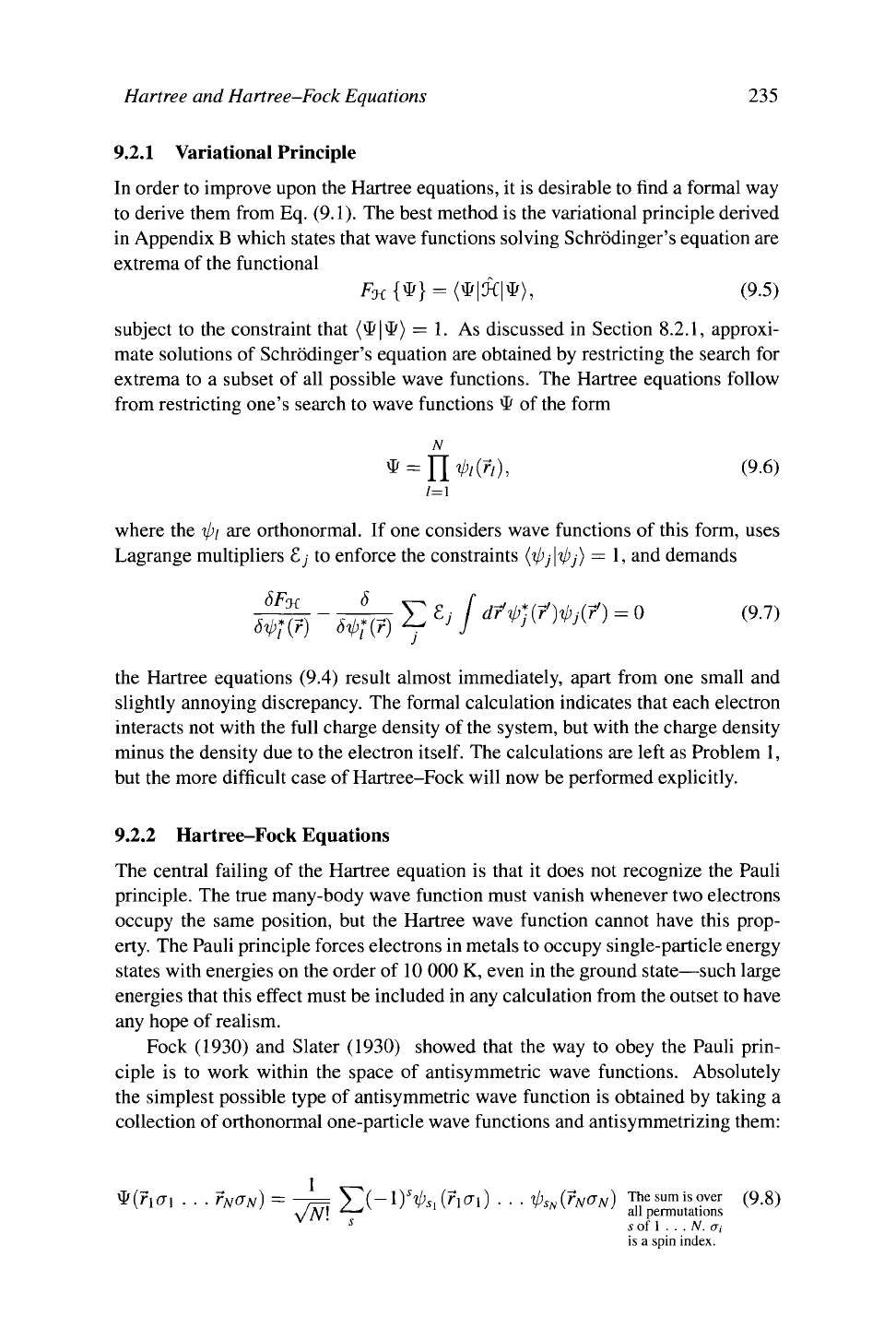
{Φ} = <Φ|Α|Φ>, (9.5)
subject to the constraint that (Φ|Φ) = 1. As discussed in Section
8.2.1,
approxi-
mate solutions of Schrödinger's equation are obtained by restricting the search for
extrema to a subset of all possible wave functions. The Hartree equations follow
from restricting one's search to wave functions Φ of the form
N
* = 1[Ψι(7ι), (9-6)
1=1
where the ψι are orthonormal. If one considers wave functions of this form, uses
Lagrange multipliers S
;
- to enforce the constraints (ißj\ipj) = 1, and demands
SFK δ
^E^7^W^(^) = 0
(9.7)
the Hartree equations (9.4) result almost immediately, apart from one small and
slightly annoying discrepancy. The formal calculation indicates that each electron
interacts not with the full charge density of the system, but with the charge density
minus the density due to the electron
itself.
The calculations are left as Problem 1,
but the more difficult case of Hartree-Fock will now be performed explicitly.
9.2.2 Hartree-Fock Equations
The central failing of the Hartree equation is that it does not recognize the Pauli
principle. The true many-body wave function must vanish whenever two electrons
occupy the same position, but the Hartree wave function cannot have this prop-
erty. The Pauli principle forces electrons in metals to occupy single-particle energy
states with energies on the order of 10 000 K, even in the ground state—such large
energies that this effect must be included in any calculation from the outset to have
any hope of realism.
Fock (1930) and Slater (1930) showed that the way to obey the Pauli prin-
ciple is to work within the space of antisymmetric wave functions. Absolutely
the simplest possible type of antisymmetric wave function is obtained by taking a
collection of orthonormal one-particle wave functions and antisymmetrizing them:
Φ(πσ, . . .
ΐ
Ν
σ
Ν
)
= -= νν-Ι)^,(ησι) · · · il>
SN
(r
N
a
N
)
The sum is over
(9.8)
w/\J\
Δ
—' all permutations
v
"
s
s of
1
. . . N. σ,
is a spin index.
236
Chapter 9. Electron-Electron Interactions
N\
ψι(7\σ\)
Ψι
{ησ
2
)
Ψ\(τ
Ν
σ
Ν
)
ψΝ{7\σ\) ipNihvi)
ΨΝ(7ΝΟ-Ν)
This type
of
wave function
is
called
a
Slater
determinant.
(9.9)
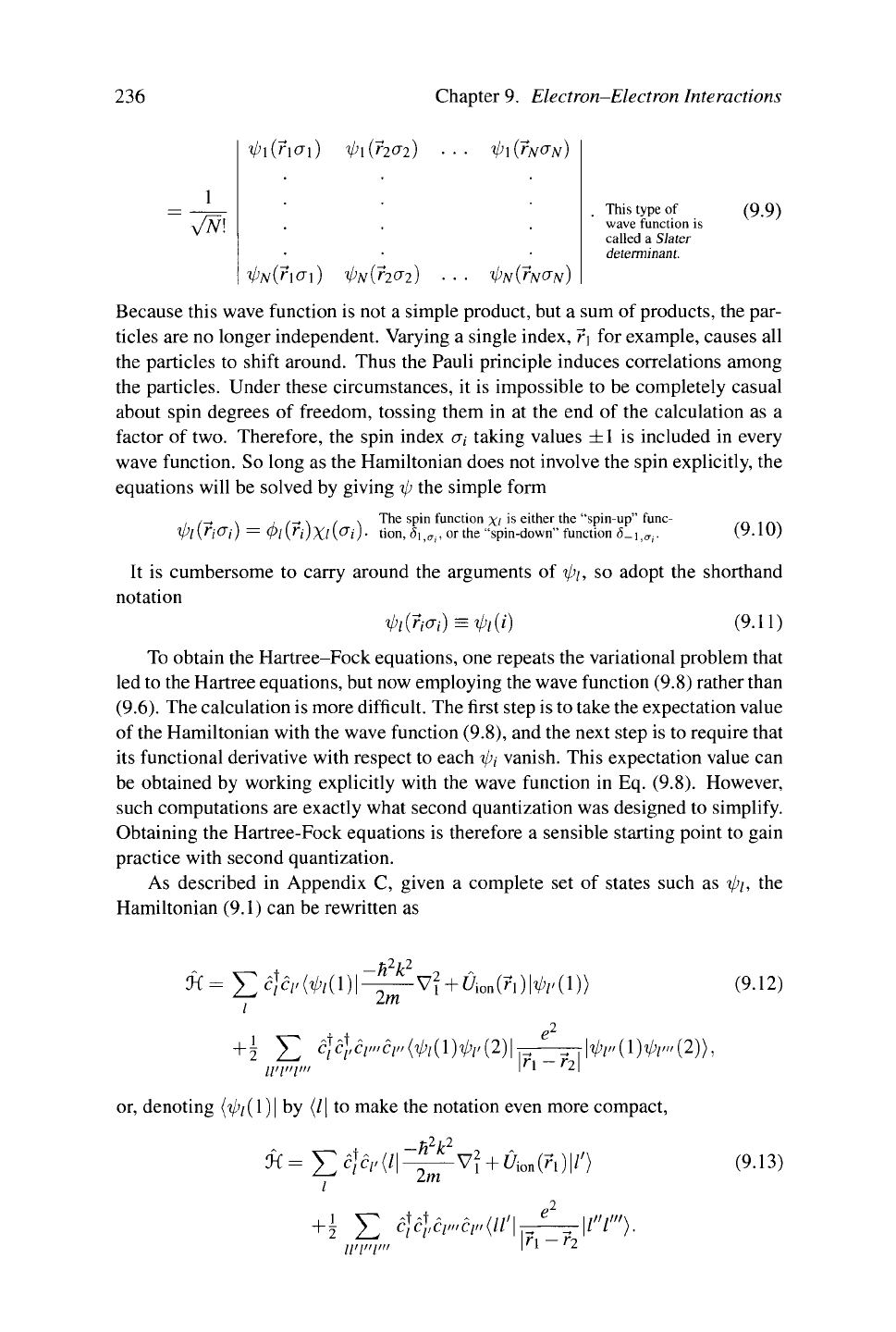
Because this wave function
is
not
a
simple product,
but
a
sum
of
products,
the
par-
ticles
are no
longer independent. Varying
a
single index,
7\
for
example, causes
all
the particles
to
shift around. Thus
the
Pauli principle induces correlations among
the particles. Under these circumstances,
it is
impossible
to be
completely casual
about spin degrees
of
freedom, tossing them
in at the end of
the
calculation
as a
factor
of
two. Therefore,
the
spin index
σ,
taking values
±1 is
included
in
every
wave function.
So
long
as the
Hamiltonian does
not
involve
the
spin explicitly,
the
equations will
be
solved
by
giving
ψ
the
simple form
,_,
. ;
/-»
\ / \
The
spin function
χι is
either
the
"spin-up" fune-
WlVi^i)
=
Φΐνί)Χΐ\
σ
ί)· tion,5i,
ffl
.,
or
the
"spin-down" function <5_ι,
σ/
. (9.1Ü)
It
is
cumbersome
to
carry around
the
arguments
of
ψι,
so
adopt
the
shorthand
notation
To obtain
the
Hartree-Fock equations,
one
repeats
the
variational problem that
led
to the
Hartree equations,
but
now employing
the
wave function (9.8) rather than
(9.6).
The calculation
is
more difficult.
The
first
step
is
to take the expectation value
of the Hamiltonian with
the
wave function (9.8),
and the
next step
is to
require that
its functional derivative with respect
to
each
φι
vanish. This expectation value
can
be obtained
by
working explicitly with
the
wave function
in
Eq.
(9.8). However,
such computations
are
exactly what second quantization
was
designed
to
simplify.
Obtaining
the
Hartree-Fock equations
is
therefore
a
sensible starting point
to
gain
practice with second quantization.
As described
in
Appendix
C,
given
a
complete
set of
states such
as ψι, the
Hamiltonian
(9.1) can be
rewritten
as
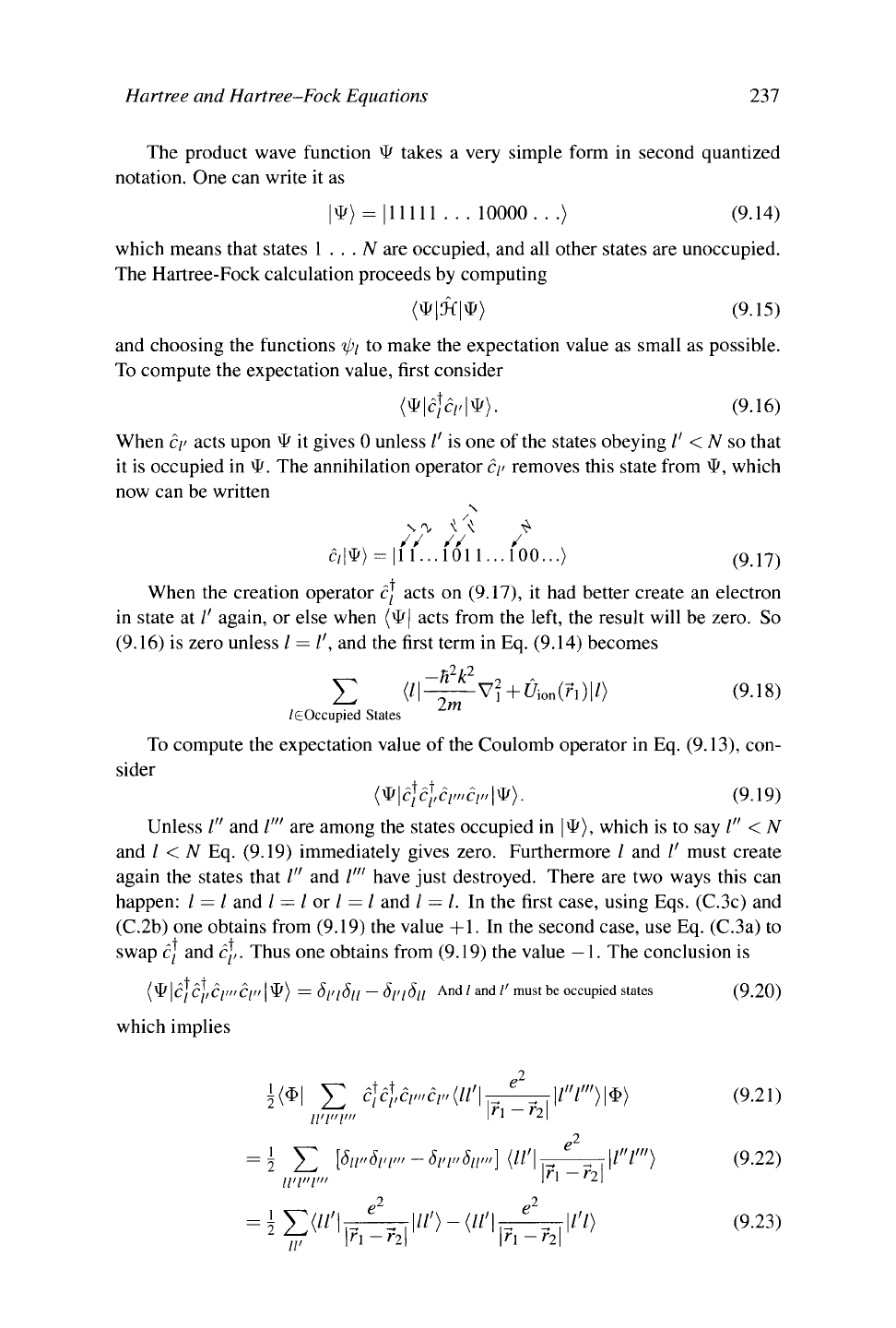
A=5]cÌc
ZÌ
(^(l)|^^V? + i/ion(ri)|#(l))
(9.12)
+ \
Σ
c
/
t
4Q-Q»(V/(l)#(2)|
//'/"/"
r\-r
2
\
#,»(1)#»(2)>,
or, denoting
{φι
( 1 ) |
by
(/1
to
make
the
notation even more compact,
2 a
W-k
Ä
= χ;
cjc
r
<z
|
——v?
+
i/ion
(n
)
|/'
2m
(9.13)
+ 2
Σ
ήέι>έΐ'"έΐ"{1ΐ
ΙΙΊ'Ί'"
n-r
2
\l"l'").
Hartree and Hartree-Fock Equations 237
The product wave function Φ takes a very simple form in second quantized
notation. One can write it as
|Φ) = 111111 ... 10000. . .) (9.14)
which means that states I . . . N are occupied, and all other states are unoccupied.
The Hartree-Fock calculation proceeds by computing
(Φ|Λ|Φ) (9.15)
and choosing the functions ψι to make the expectation value as small as possible.
To compute the expectation value, first consider
(Φ|φ//|Φ).
(9.16)
When
C[>
acts upon Φ it gives 0 unless /' is one of the states obeying /' < N so that
it is occupied in Φ. The annihilation operator c/' removes this state from Φ, which
now can be written
s^ l'i *
// // /
c/ΙΦ) =
|11...
1011...
100...) (9_
17
)
When the creation operator c\ acts on (9.17), it had better create an electron
in state at /' again, or else when (Φ| acts from the left, the result will be zero. So
(9.16) is zero unless / = /', and the first term in Eq. (9.14) becomes
Σ
{if^-^ì
+
ÙUmi)
(9-18)
/^Occupied States
To compute the expectation value of the Coulomb operator in Eq. (9.13), con-
sider
<*|cjcj,c//«c///|*>. (9.19)
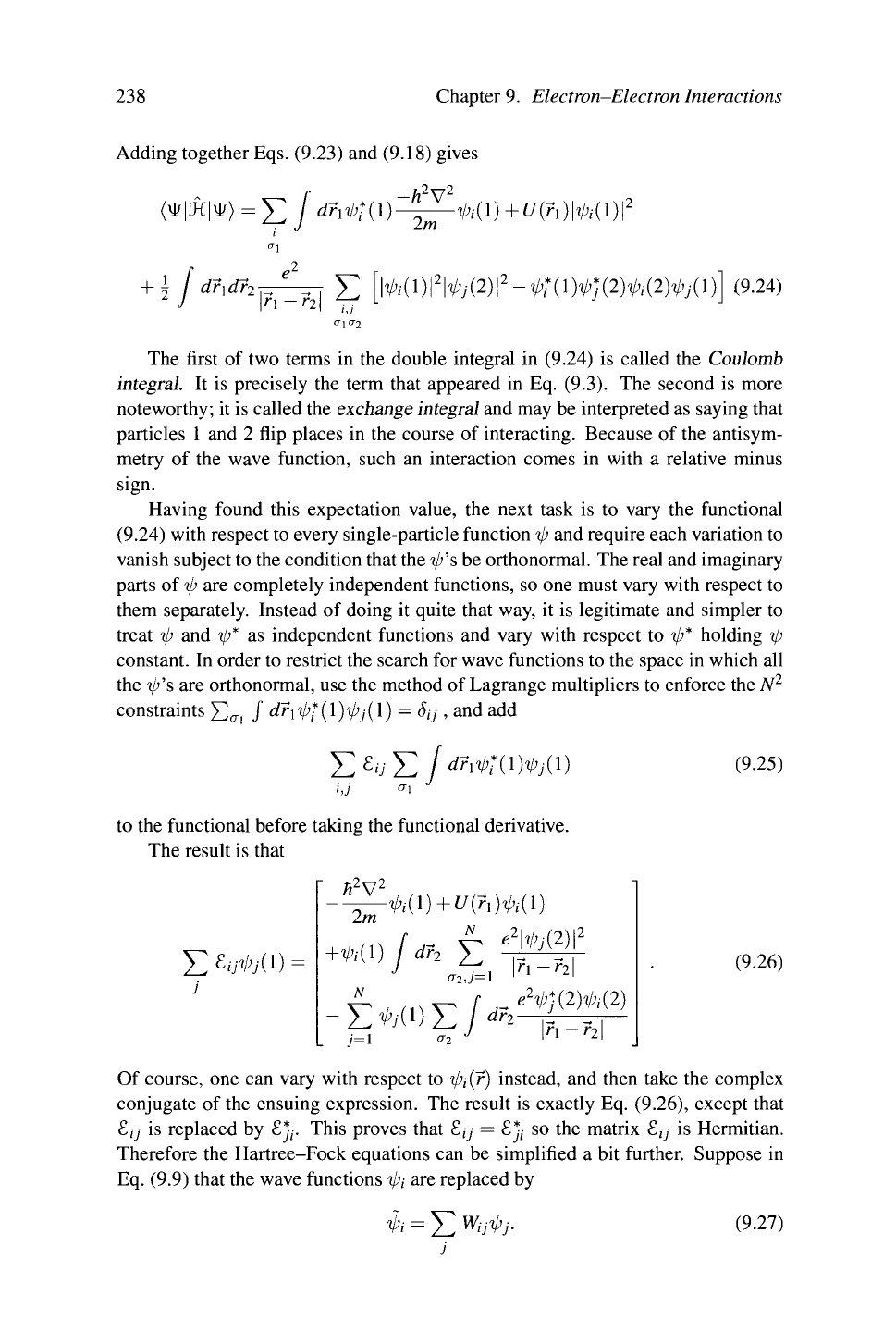
Unless /" and /'" are among the states occupied in |Φ), which is to say /" < N
and I < N Eq. (9.19) immediately gives zero. Furthermore / and /' must create
again the states that /" and /'" have just destroyed. There are two ways this can
happen:
1
=
1
and I = I or I = I and / = /. In the first case, using Eqs. (C.3c) and
(C.2b) one obtains from (9.19) the value +1. In the second case, use Eq. (C.3a) to
swap cj and
e],.
Thus one obtains from (9.19) the value
—
1.
The conclusion is
(Φ |cJcJ/C;'//C/" jΦ) = δΐ'ΐδιι — δ['ΐδιι And / and/'must be occupied states (9.20)
which implies
1(Φ|
J]] c)clc
v
„c
v
,(lï\-^—
\1"1'")\Φ)
(9.21)
—ri
—
r?
^ e
2
=
\ Σ
[<SH"<W"-<W'<$H<"'IF——ι\ι"ΐ")
(9·
22
)
— ri
—
ro\
\
J2{ll'\^
e
_^,\W)
-
(ll'\
r
e
_^.\l'l) (9.23)
,// i
r
i-^2| \r\-r
2
\
238 Chapter 9. Electron-Electron Interactions
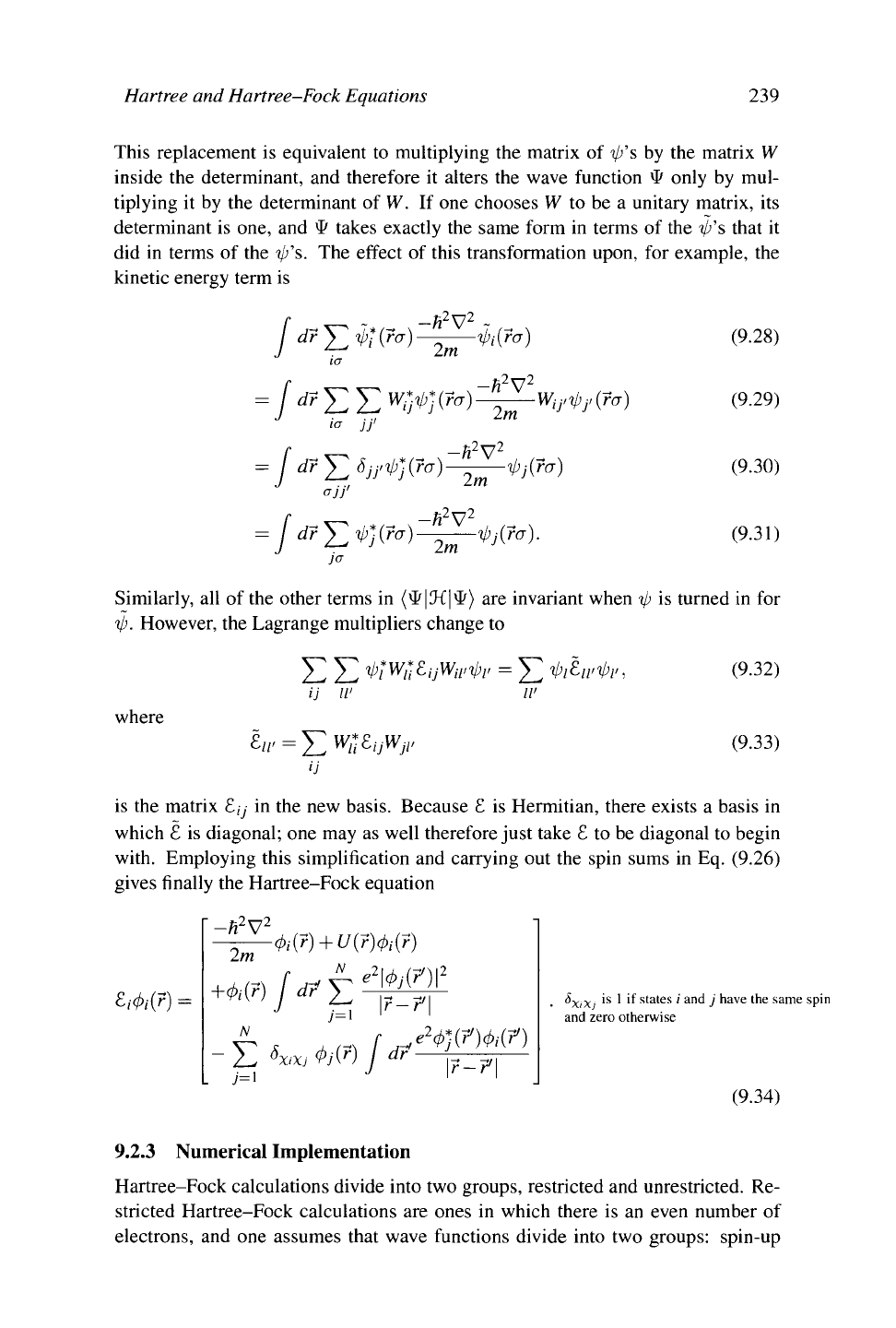
Adding together Eqs. (9.23) and (9.18) gives
(Φ|:Κ|Ψ)
Σ/
αηΦΐ(ΐ)
-ft
2
V
2
2m
φ
ί
(ί)
+
υ(7
ι
)\Φ
ί
(\)\
2
/■
+ 2 / dr\dr
2
-^
r\ -r
2
\
Σ [iVi(i)i
2
i^(2)i
2
-v?(i)^(2M-(2)^(i;
σ
\
σ
2
(9.24)
The first of two terms in the double integral in (9.24) is called the Coulomb
integral. It is precisely the term that appeared in Eq. (9.3). The second is more
noteworthy; it is called the exchange
integral
and may be interpreted as saying that
particles 1 and 2 flip places in the course of interacting. Because of the antisym-
metry of the wave function, such an interaction comes in with a relative minus
sign.
Having found this expectation value, the next task is to vary the functional
(9.24) with respect to every single-particle function φ and require each variation to
vanish subject to the condition that the t/>'s be orthonormal. The real and imaginary
parts of φ are completely independent functions, so one must vary with respect to
them separately. Instead of doing it quite that way, it is legitimate and simpler to
treat φ and φ* as independent functions and vary with respect to φ* holding φ
constant. In order to restrict the search for wave functions to the space in which all
the ^'s are orthonormal, use the method of Lagrange multipliers to enforce the N
2
constraints Σ
σι
I άτ\φ*{\)φj{\) =
<5
iy
·,
and add
Σ^Σ [
αηΦΐΜΦ^ι)
ij
σ,
(9.25)
to the functional before taking the functional derivative.
The result is that
Σ
£
#)
φ
ί
(1)
+
υ(?
ί
)φ
ί
(1)
h
2
v
Im
N
+φι(1)
j dr
2
Σ
- Σ
vv(i)
Σ /
e
2
\M2)\
2
\r\-r
2
„2
dr
2
β
2
φ){2)φ
ί
{2)
\f\ -hi
(9.26)
Of course, one can vary with respect to φί(τ) instead, and then take the complex
conjugate of the ensuing expression. The result is exactly Eq. (9.26), except that
E,j
is replaced by £^·. This proves that £,; = £^
(
so the matrix £
i;
is Hermitian.
Therefore the Hartree-Fock equations can be simplified a bit further. Suppose in
Eq. (9.9) that the wave functions φι are replaced by
<Α·
=
Σ^·
(9.27)
Hartree and Hartree-Fock Equations 239
This replacement
is
equivalent
to
multiplying
the
matrix
of
-0's
by the
matrix
W
inside
the
determinant,
and
therefore
it
alters
the
wave function
Φ
only
by
mul-
tiplying
it by the
determinant
of W. If
one chooses
W to be a
unitary matrix,
its
determinant
is
one,
and Φ
takes exactly
the
same form
in
terms
of
the V'S
that
it
did
in
terms
of
the ^'s.
The
effect
of
this transformation upon,
for
example,
the
kinetic energy term
is
Jdrj2iï(™y
-h
2
V
2
~ _
2m
φί(τσ)
^ΣΣ %rj(^)-^W
u
^
r
(ra)
ισ
)ϊ
2m
^Σ^7^*(
?σ
)-
2ντ2
°Jf
2m
■Ψ](?σ)
-h
2
V
2
dr
Σ
ψ*
(ra)
^
ipj
(?σ).
J<7
2m
(9.28)
(9.29)
(9.30)
(9.31)
Similarly,
all of
the other terms
in
(Φ|ΙΚ|Φ)
are
invariant when
ψ is
turned
in for
ψ.
However,
the
Lagrange multipliers change
to
Σ
]T
tfWZEijWwtpr
= E
ΨιϊινΨν,
ij
IV IV
where
έ,,-Σ^Ϊ^
ÌV
(9.32)
(9.33)
is
the
matrix
£
!y
in the
new
basis. Because
£ is
Hermitian, there exists
a
basis
in
which
£ is
diagonal;
one
may
as
well therefore just take
δ to be
diagonal
to
begin
with. Employing this simplification
and
carrying
out the
spin sums
in Eq.
(9.26)
gives finally
the
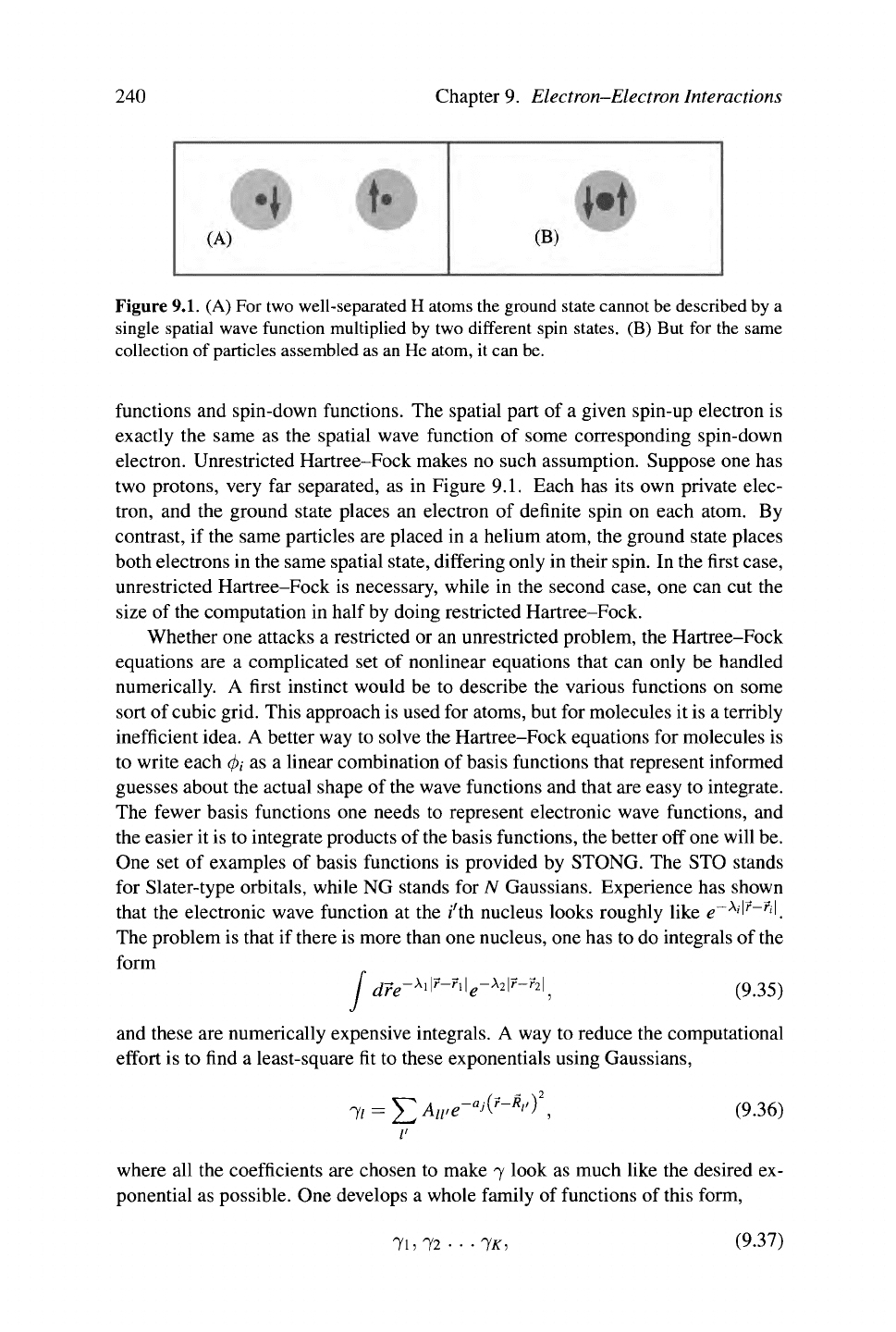
Hartree-Fock equation
£,·&(?)
=
2v72
2m
■φί{Ψ)
+U(r)4>i(r)
N
ni2
*%(OI
N
Σ
S
XXJ
<
AK'
S
)
/
dr
1
β
2
φ){7')φ^)
S
XiX
,
is
1
if
states
i
and
j
have
the
same spin
and zero otherwise
(9.34)
9.2.3 Numerical Implementation
Hartree-Fock calculations divide into
two
groups, restricted
and
unrestricted.
Re-
stricted Hartree-Fock calculations
are
ones
in
which there
is an
even number
of
electrons,
and one
assumes that wave functions divide into
two
groups: spin-up
240
Chapter 9. Electron-Electron Interactions
Figure
9.1.
(A) For two well-separated
H
atoms the ground state cannot be described by a
single spatial wave function multiplied by two different spin states. (B) But for the same
collection of particles assembled as an He atom, it can be.
functions and spin-down functions. The spatial part of a given spin-up electron is
exactly the same as the spatial wave function of some corresponding spin-down
electron. Unrestricted Hartree-Fock makes no such assumption. Suppose one has
two protons, very far separated, as in Figure 9.1. Each has its own private elec-
tron, and the ground state places an electron of definite spin on each atom.
By
contrast, if the same particles are placed in a helium atom, the ground state places
both electrons in the same spatial state, differing only in their spin. In the first case,
unrestricted Hartree-Fock is necessary, while in the second case, one can cut the
size of the computation in half by doing restricted Hartree-Fock.
Whether one attacks a restricted or an unrestricted problem, the Hartree-Fock
equations are
a
complicated set of nonlinear equations that can only be handled
numerically. A first instinct would be to describe the various functions on some
sort of cubic grid. This approach is used for atoms, but for molecules it is a terribly
inefficient idea. A better way to solve the Hartree-Fock equations for molecules is
to write each φι as a linear combination of basis functions that represent informed
guesses about the actual shape of the wave functions and that are easy to integrate.
The fewer basis functions one needs to represent electronic wave functions, and
the easier it is to integrate products of
the
basis functions, the better off one will be.
One set of examples of basis functions is provided by STONG. The STO stands
for Slater-type orbitals, while NG stands for N Gaussians. Experience has shown
that the electronic wave function at the /'th nucleus looks roughly like
e~
x
>\
r
~
ri
\.
The problem is that if there is more than one nucleus, one has to do integrals of the
form
[
dre-W-^e-W-^,
(9.35)
and these are numerically expensive integrals. A way to reduce the computational
effort is to find a least-square
fit
to these exponentials using Gaussians,
Ίι
=
ΣΑ
ιν
β-
α
^-«>')\
(9.36)
where all the coefficients are chosen to make
7
look as much like the desired ex-
ponential as possible. One develops a whole family of functions of this form,
71)72
··
·
IK,
(9.37)
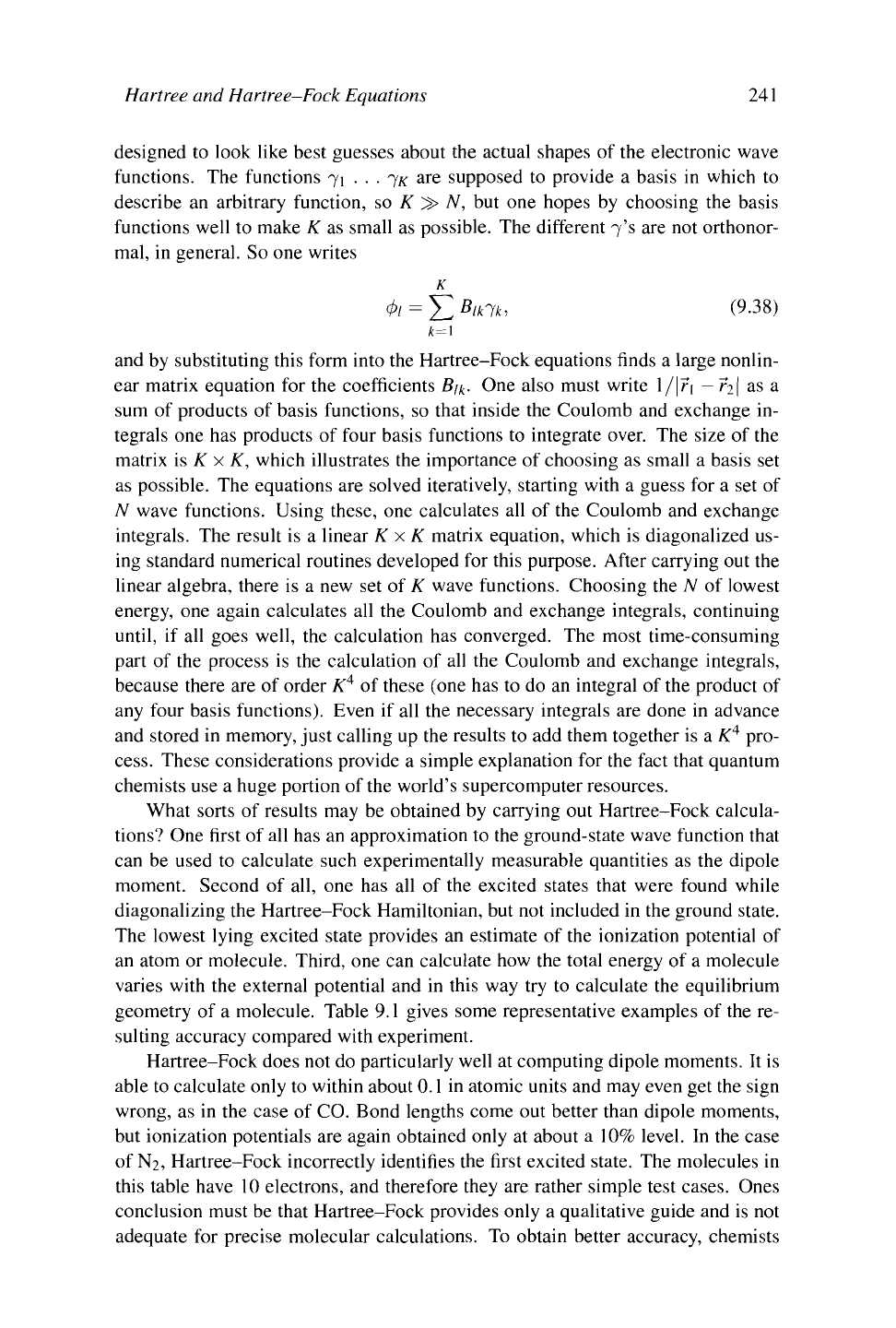
Hartree and Hartree-Fock Equations 241
designed to look like best guesses about the actual shapes of the electronic wave
functions. The functions 71 ...
7A-
are supposed to provide a basis in which to
describe an arbitrary function, so K 3> N, but one hopes by choosing the basis
functions well to make
Λ^
as small as possible. The different 7's are not orthonor-
mal, in general. So one writes
K
Ψι
= Σ
B
i^k,
(9.38)
k=\
and by substituting this form into the Hartree-Fock equations finds a large nonlin-
ear matrix equation for the coefficients B^. One also must write \/\r\
—
?2|
as a
sum of products of basis functions, so that inside the Coulomb and exchange in-
tegrals one has products of four basis functions to integrate over. The size of the
matrix is K x K, which illustrates the importance of choosing as small a basis set
as possible. The equations are solved iteratively, starting with a guess for a set of
N wave functions. Using these, one calculates all of the Coulomb and exchange
integrals. The result is a linear K x K matrix equation, which is diagonalized us-
ing standard numerical routines developed for this purpose. After carrying out the
linear algebra, there is a new set of K wave functions. Choosing the N of lowest
energy, one again calculates all the Coulomb and exchange integrals, continuing
until, if all goes well, the calculation has converged. The most time-consuming
part of the process is the calculation of all the Coulomb and exchange integrals,
because there are of order K
4
of these (one has to do an integral of the product of
any four basis functions). Even if all the necessary integrals are done in advance
and stored in memory, just calling up the results to add them together is a K
4
pro-
cess.
These considerations provide a simple explanation for the fact that quantum
chemists use a huge portion of the world's supercomputer resources.
What sorts of results may be obtained by carrying out Hartree-Fock calcula-
tions? One first of all has an approximation to the ground-state wave function that
can be used to calculate such experimentally measurable quantities as the dipole
moment. Second of all, one has all of the excited states that were found while
diagonalizing the Hartree-Fock Hamiltonian, but not included in the ground state.
The lowest lying excited state provides an estimate of the ionization potential of
an atom or molecule. Third, one can calculate how the total energy of a molecule
varies with the external potential and in this way try to calculate the equilibrium
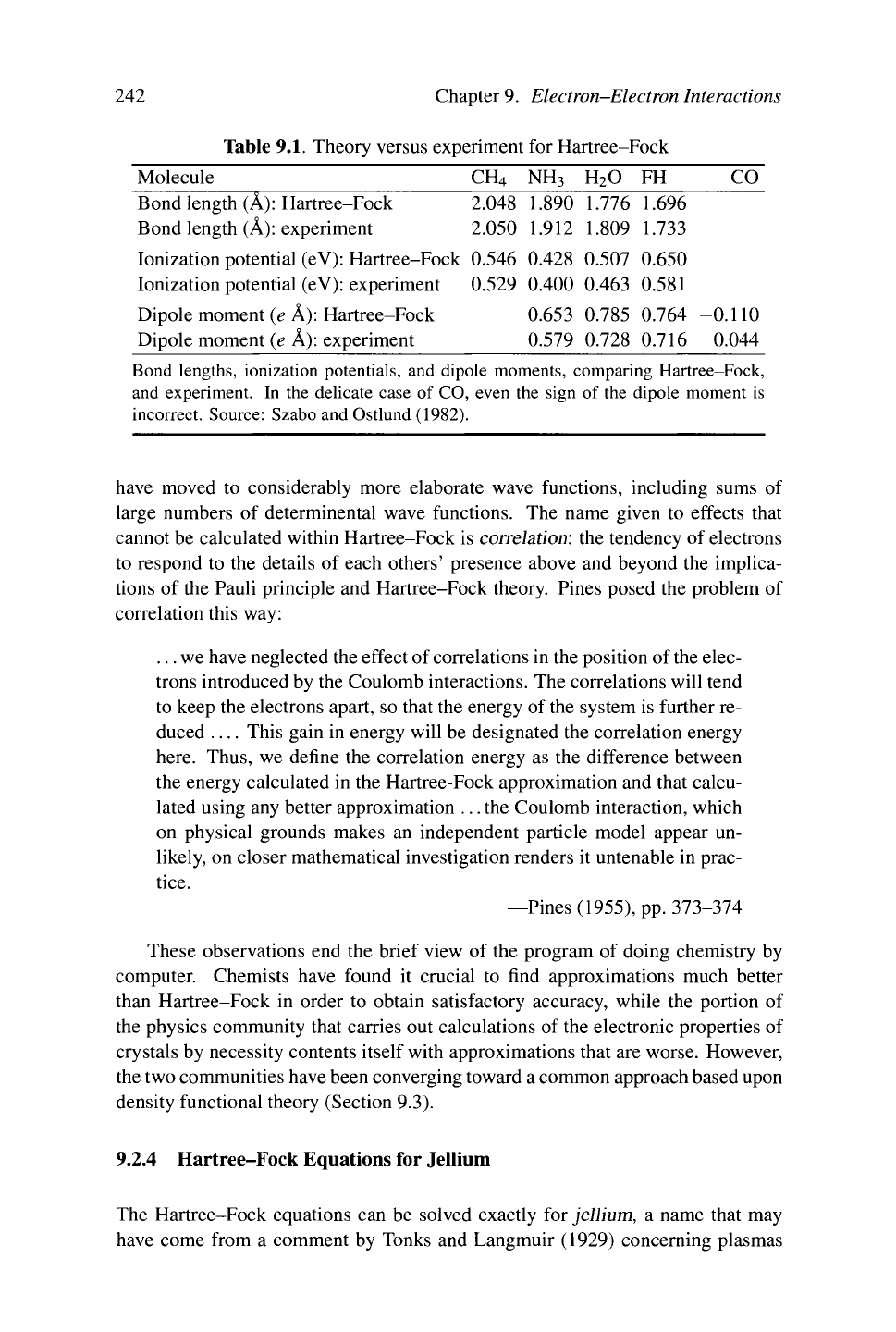
geometry of a molecule. Table 9.1 gives some representative examples of the re-
sulting accuracy compared with experiment.
Hartree-Fock does not do particularly well at computing dipole moments. It is
able to calculate only to within about 0.1 in atomic units and may even get the sign
wrong, as in the case of CO. Bond lengths come out better than dipole moments,
but ionization potentials are again obtained only at about a 10% level. In the case
of
N2,
Hartree-Fock incorrectly identifies the first excited state. The molecules in
this table have 10 electrons, and therefore they are rather simple test cases. Ones
conclusion must be that Hartree-Fock provides only a qualitative guide and is not
adequate for precise molecular calculations. To obtain better accuracy, chemists
242 Chapter 9. Electron-Electron Interactions
Table 9.1. Theory versus experiment for Hartree-Fock
Molecule CH
4
NH
3
H
2
Q FH CO
Bond length (À): Hartree-Fock 2.048 1.890 1.776 1.696
Bond length (Â): experiment 2.050 1.912 1.809 1.733
Ionization potential (eV): Hartree-Fock 0.546 0.428 0.507 0.650
Ionization potential (eV): experiment 0.529 0.400 0.463 0.581
Dipole moment (e À): Hartree-Fock 0.653 0.785 0.764 -0.110
Dipole moment (e Â): experiment 0.579 0.728 0.716 0.044
Bond lengths, ionization potentials, and dipole moments, comparing Hartree-Fock,
and experiment. In the delicate case of CO, even the sign of the dipole moment is
incorrect. Source: Szabo and Ostlund (1982).
have moved to considerably more elaborate wave functions, including sums of
large numbers of determinental wave functions. The name given to effects that
cannot be calculated within Hartree-Fock is
correlation:
the tendency of electrons
to respond to the details of each others' presence above and beyond the implica-
tions of the Pauli principle and Hartree-Fock theory. Pines posed the problem of
correlation this way:
... we have neglected the effect of correlations in the position of the elec-
trons introduced by the Coulomb interactions. The correlations will tend
to keep the electrons apart, so that the energy of the system is further re-
duced This gain in energy will be designated the correlation energy
here.
Thus, we define the correlation energy as the difference between
the energy calculated in the Hartree-Fock approximation and that calcu-
lated using any better approximation ... the Coulomb interaction, which
on physical grounds makes an independent particle model appear un-
likely, on closer mathematical investigation renders it untenable in prac-
tice.
—Pines (1955), pp. 373-374
These observations end the brief view of the program of doing chemistry by
computer. Chemists have found it crucial to find approximations much better
than Hartree-Fock in order to obtain satisfactory accuracy, while the portion of
the physics community that carries out calculations of the electronic properties of
crystals by necessity contents itself with approximations that are worse. However,
the two communities have been converging toward a common approach based upon
density functional theory (Section 9.3).
9.2.4 Hartree-Fock Equations for Jellium
The Hartree-Fock equations can be solved exactly for jellium, a name that may
have come from a comment by Tonks and Langmuir
( 1929)
concerning plasmas