
Marder M.P. Condensed Matter Physics
Подождите немного. Документ загружается.

Problems 203
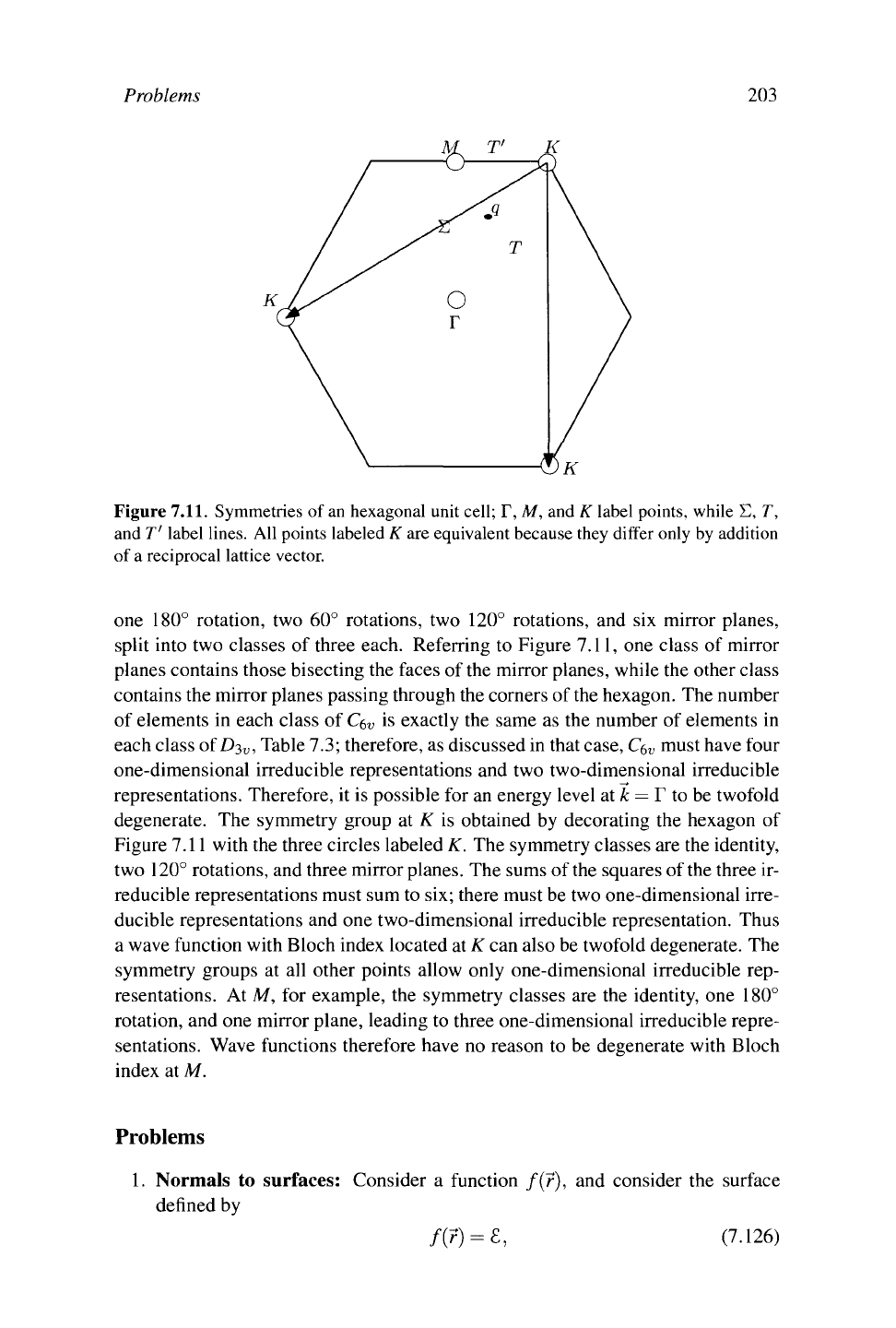
Figure 7.11. Symmetries of
an
hexagonal unit cell; Γ, M, and K label points, while Σ, T,
and T' label lines. All points labeled K are equivalent because they differ only by addition
of
a
reciprocal lattice vector.
one 180° rotation, two 60° rotations, two 120° rotations, and six mirror planes,
split into two classes of three each. Referring to Figure 7.11, one class of mirror
planes contains those bisecting the faces of the mirror planes, while the other class
contains the mirror planes passing through the corners of the hexagon. The number
of elements in each class of C^
v
is exactly the same as the number of elements in
each class of
D^
v
,
Table
7.3;
therefore, as discussed in that case,
C(,
v
must have four
one-dimensional irreducible representations and two two-dimensional irreducible
representations. Therefore, it is possible for an energy level at k = Γ to be twofold
degenerate. The symmetry group at K is obtained by decorating the hexagon of
Figure 7.11 with the three circles labeled K. The symmetry classes are the identity,
two 120° rotations, and three mirror planes. The sums of
the
squares of the three ir-
reducible representations must sum to six; there must be two one-dimensional irre-
ducible representations and one two-dimensional irreducible representation. Thus
a wave function with Bloch index located at K can also be twofold degenerate. The
symmetry groups at all other points allow only one-dimensional irreducible rep-
resentations. At M, for example, the symmetry classes are the identity, one 180°
rotation, and one mirror plane, leading to three one-dimensional irreducible repre-
sentations. Wave functions therefore have no reason to be degenerate with Bloch
index at M.
Problems
1.
Normals to surfaces: Consider a function f(r), and consider the surface
defined by
/(?) = £, (7.126)
204
Chapter 7. Non-Interacting Electrons in a Periodic Potential
where £ is a constant. Let ?(i) be a curve that lies within the surface defined
by Eq. (7.126), parametrized by t. Observing that
d_
dt
mt))=o,
(7.127)
show that V/ is normal to the surface.
2.
Commutation: Show that the translation operators 7^ defined in Eq. (7.38)
commute with each other, and with the Hamiltonian (7.2), using the symmetry
Eq.(7.1).
3.
Van Hove Singularities:
(a) Consider an energy surface defined by £ = F^. Show that V^ is perpen-
dicular to all vectors lying parallel to the energy surface, and therefore points
in the normal direction.
(b) Suppose that one has a two-dimensional crystal and finds a value of k near
which
(7.128)
F -
K,
F —
k
2
Find the singularity that will be produced in D(F).
(c) Repeat this problem for a three-dimensional crystal.
4.
Kronig-Penney numerics: Use a computer to reproduce Figure 7.6 by the
methods described in the caption of the figure.
5.
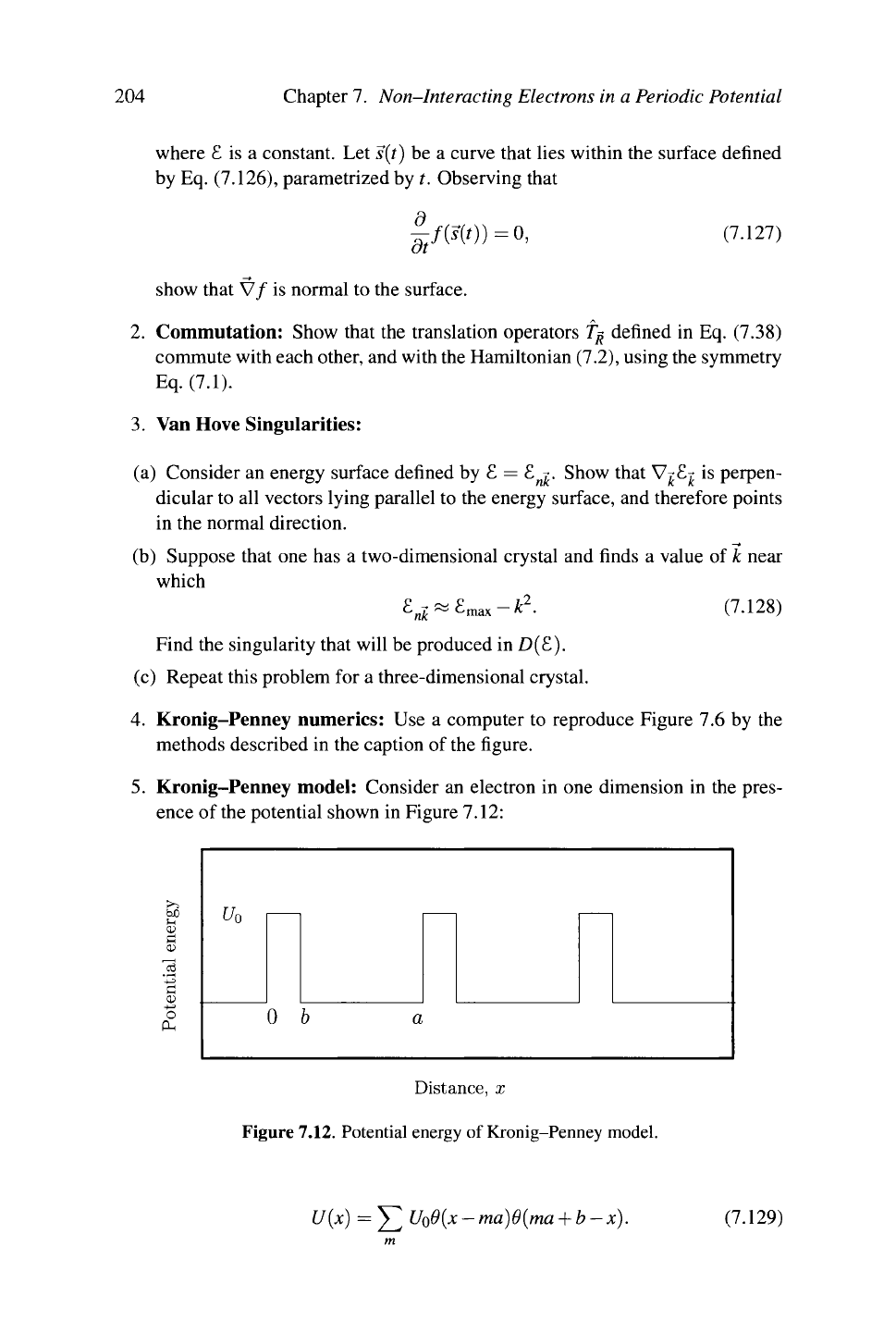
Kronig-Penney model: Consider an electron in one dimension in the pres-
ence of the potential shown in Figure 7.12:
e
o
P-,
u
0
0
b
a
Distance, x
Figure 7.12. Potential energy of Kronig-Penney model.
U(x) = ^2
Uo9(x —
ma)9(ma + b
—
x).
(7.129)
Problems 205
(a) Restrict attention to a single unit cell, and write down the boundary condi-
tions on Schrödinger's equation that lead to Bloch states in this unit cell.
(b) Solve Schrödinger's equation in this cell by taking sums of plane waves and
imposing suitable boundary conditions at 0, b, and a. The result is a condition
on the Bloch index k.
(c) Take the limit
h
2
a-
2
b~>0, i/o-x»,
U
Q
b->Woa
. (7.130)
m
The condition on the Bloch index should become
W
0
cos ka = — sin
ΑΏ
+ cos Ka, (7.131)
Ka
where
K=y2mi/H
z
. (7.132)
(d) Produce plots of the two lowest energy bands following from Eq. (7.131) for
a = Ì, m = 1,
H
= 1, and Wo = 0.5. Display the bands in the reduced zone
scheme and the extended zone scheme.
6. Group Representations:
Consider a group representation {A} in which all the matrices are unitary.
(a) Show that the matrix A(E) representing the identity element of the group
{G} is always the unit matrix.
(b) Show that
A(G)A(G')=A(GG'). (7.133)
(c) Show that Eq. (7.101) follows from Eq. (7.99), by taking the conjugate of
Eq. (7.99).
7.
Regular representation: The regular representation provides an automatic
procedure that tracks down the irreducible representations of a symmetry
group. The procedure can be implemented quite generally in symbolic al-
gebra.
Suppose one has a collection of rotation matrices G\ . . . G/,, that form a
group, so GjGj = Gi for some /. The regular representation is a set of h
hx h matricesA
(l)
. . . A
(J
'\
{i
(,„
)
=
j 1 if
G
m
Gi-Gj,
(7134)
0 otherwise.
That is, A
(m)
is a matrix whose entries encode the rules for multiplying all the
matrices in the group by G
m
. Each /-dimensional irreducible representation
appears within the regular representation I times.
206 Chapter 7. Non-Interacting Electrons in a Periodic Potential
(a) In a symbolic algebra program, create the six rotation matrices that constitute
the group D3.
(b) Form the six matrices
A
{>)
. . . A
{6)
that constitute the regular representation.
(c) Form the matrix M defined in Eq. (7.94), and P = M + M*.
(d) Find the eigenvalues and eigenvectors of P.
(e) Rewrite each of the matrices A
(m)
in the basis of these eigenvectors, and
verify that it assumes block diagonal form.
8. Optical transitions: Optical transitions have an amplitude proportional to
matrix elements such as (1|P
X
|2), where P
x
is the x component of the mo-
mentum operator, and (11 and |2) are two wave functions. Consulting Table
7.4, determine whether symmetry allows or forbids the following transitions,
where state (1| has the first symmetry and state |2) has the second. When a
representation contains more than one basis function, one has to determine
whether any of the functions could make the transition possible.
(a) Γ,
-^Γ
25
,
(b)
r
2y
-,r
15
(c) r
2y
-+
r
2
,
(d) Γ
15
-+Γ
2
References
F.
Bloch (1928), The quantum mechanics of electrons in crystal lattices, Zeitschrift für
Physik,
52,
555-600. In German.
F.
Bloch (1976), Reminiscences of Heisenberg, Physics Today, 29(12), 23-25.
L. P. Bouckaert, R. Smoluchowski, and E. Wigner (1936), Theory of Brillouin zones and symmetry
properties of wave functions in crystals, Physical Review, 50, 58-67.
C. J. Bradley and A. P. Cracknell (1972), The Mathematical Theory of Symmetry in Solids; Repre-
sentation Theory for Point Groups and Space Groups, Clarendon Press, Oxford.
G. F. Koster (1957), Space groups and their representations, Solid State Physics: Advances in Re-
search and Applications, 5, 174-256.
R. Kronig and W. G. Penney (1931), Quantum mechanics of electrons in crystals lattices,
Proceed-
ings of the Royal Society of London, A130, 499-513.
L. D. Landau and E. M. Lifshitz (1977), Quantum Mechanics (Non-relativistic Theory), 3rd ed.,
Pergamon Press, Oxford.
G. Y. Lyubarskii (1960), The Applications of Group Theory in Physics, Pergamon Press, New York.
F.
D. Murnaghan (1938), The Theory of
Group
Representations, The Johns Hopkins Press, Baltimore.
L. Schiff (1968), Quantum Mechanics, 3rd ed., McGraw-Hill, New York.
M. Tinkham (1964), Group Theory and Quantum Mechanics, McGraw-Hill, New York.
G. P. Tolstov (1978), Fourier Series, Dover, New York.
E. Wigner (1959), Group Theory and its Application to the Quantum Mechanics of Atomic Spectra,
Academic Press, New York.
8. Nearly Free and Tightly Bound
Electrons
8.1 Introduction
A rich set of problems becomes available for study when one puts electrons into the
periodic potentials proposed by Bloch. However, two cases stand out as conceptu-
ally and historically important. These two cases are the nearly free electron model
and the tight binding model. They sit at opposite ends of a conceptual continuum.
Nearly free electrons are those that sit in a very weak potential. Their behavior is
almost the same as that of electrons in a free Fermi gas. In the opposite limit, ions
are treated as very strong attractive forces that bind electrons tightly and keep them
nearly immobile.
The nearly free electron model was introduced by Peierls (1930). Placing a
single electron in a weak periodic potential results in a solvable problem with a
surprise. The potential is never so weak that it can completely be ignored. For
those electrons whose Bloch wave vector k meets conditions that would lead any
wave to scatter strongly from a periodic crystal, the change in electron velocity is
large. Only a small subset of electrons have wave vectors meeting these conditions,
but they are important for transport properties, and there are easily measurable
experimental effects. The response of metals to electric and magnetic fields is
almost entirely due to the electrons of maximum energy, those that sit on the Fermi
surface. The Fermi surface is a two-dimensional shell sitting in three-dimensional
k space that can be measured and plotted. When Gold (1958) carried out some of
the early experimental measurements, he noticed that to excellent approximation
the Fermi surfaces of noble metals consisted in sections of spherical shells, sliced
up,
slid about, and reassembled in fantastic shapes. The nearly free electron model
predicts precisely this behavior; it is a triumph of Perirls' approximation.
Bloch (1928) began in the opposite limit. He modeled electrons as tightly
bound to particular atoms, overlapping only weakly with neighbors. The tight-
binding model was put on firm formal ground by Wannier (1937), who showed
how Bloch eigenfunctions could always be summed together to obtain a complete
set of wave functions, centered at single atoms. This approximation turns out to
be much richer than the nearly free electron model. It provides the possibility of
studying both metals and insulators. It is the beginning of a systematic approach
to investigating arbitrary potentials. Tight binding models have long provided the
starting point to investigate many of the subtle conceptual questions surrounding
207
Condensed Matter
Physics,
Second Edition
by Michael P. Marder
Copyright © 2010 John Wiley & Sons, Inc.
208
Chapter 8. Nearly
Free
and Tightly Bound Electrons
electrons in metals, including the origins of magnetism, superconductivity, and the
effects of random disordering of atoms.
8.2 Nearly Free Electrons
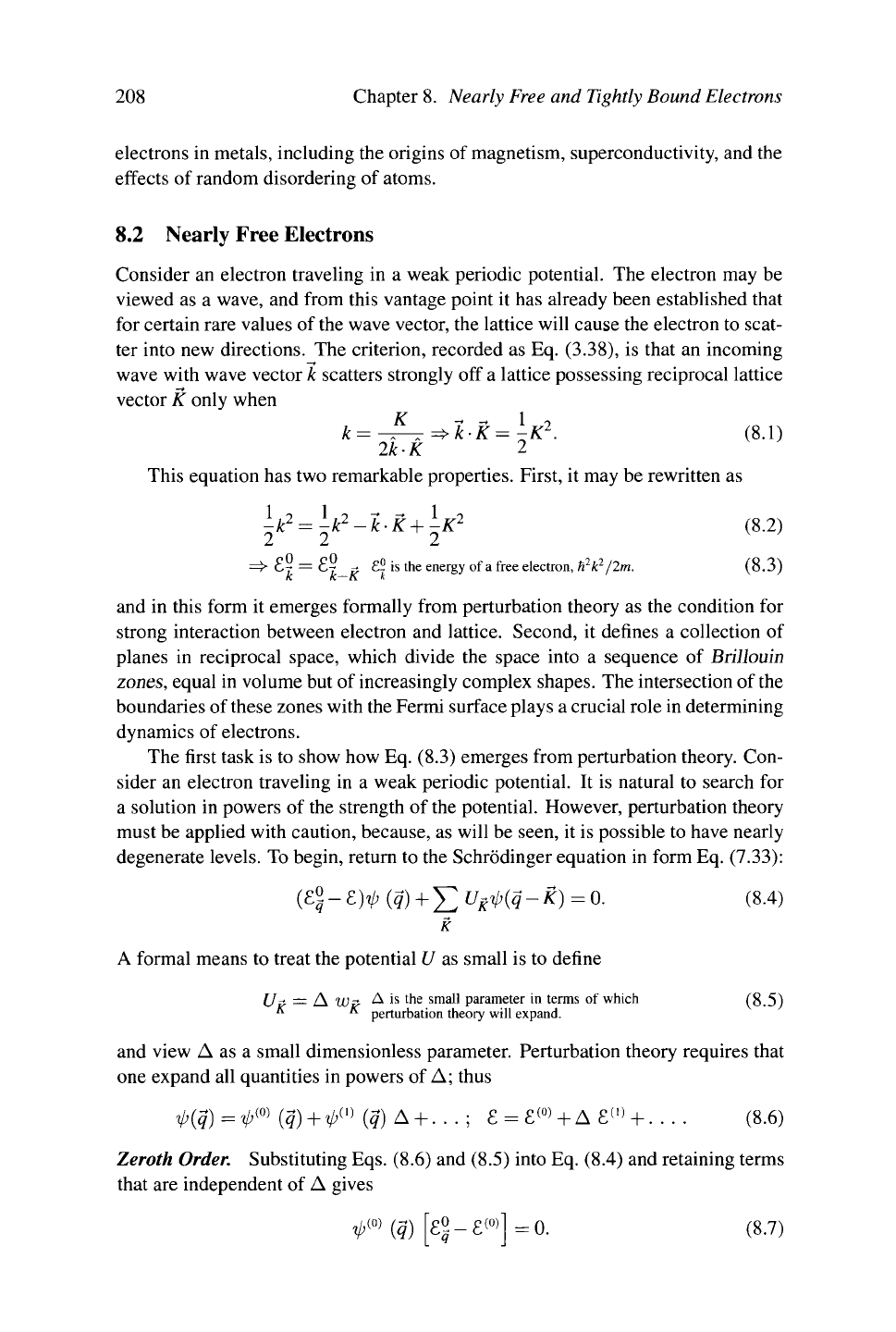
Consider an electron traveling in a weak periodic potential. The electron may be
viewed as a wave, and from this vantage point it has already been established that
for certain rare values of the wave vector, the lattice will cause the electron to scat-
ter into new directions. The criterion, recorded as Eq. (3.38), is that an incoming
wave with wave vector k scatters strongly off a lattice possessing reciprocal lattice
vector K only when
K
k-K=
]
-K
2
.
(8.1)
2k-K
2
This equation has two remarkable properties. First, it may be rewritten as
-k
2
= -k
2
-k-K+-K
2
(8.2)
2 2 2
=>-
c- = C- - 8S is the energy of a free electron, H
2
k
2
/2m. (8.3)
and in this form it emerges formally from perturbation theory as the condition for
strong interaction between electron and lattice. Second, it defines a collection of
planes in reciprocal space, which divide the space into a sequence of Brillouin
zones, equal in volume but of increasingly complex shapes. The intersection of the
boundaries of these zones with the Fermi surface plays a crucial role in determining
dynamics of electrons.
The first task is to show how Eq. (8.3) emerges from perturbation theory. Con-
sider an electron traveling in a weak periodic potential. It is natural to search for
a solution in powers of the strength of the potential. However, perturbation theory
must be applied with caution, because, as will be seen, it is possible to have nearly
degenerate levels. To begin, return to the Schrödinger equation in form Eq. (7.33):
(ε2-ε)ν (?)+Σ u^(q-k)
=
o.
(8.4)
K
A formal means to treat the potential U as small is to define
Up =r Δ
ιχ)ϊ>
Δ is the small parameter in terms of which (8.5)
"- * perturbation theory will expand.
and view Δ as a small dimensionless parameter. Perturbation theory requires that
one expand all quantities in powers of Δ; thus
φ{ξ)=φ
{0)
{ξ)+ψ
0)
{q)A + ...; £ = £
(0)
+A£
(,)
+ .... (8.6)
Zeroth Order. Substituting Eqs. (8.6) and (8.5) into Eq. (8.4) and retaining terms
that are independent of Δ gives
r
]
(q)
c0_
c(0)
= 0. (8.7)
Nearly Free Electrons
209
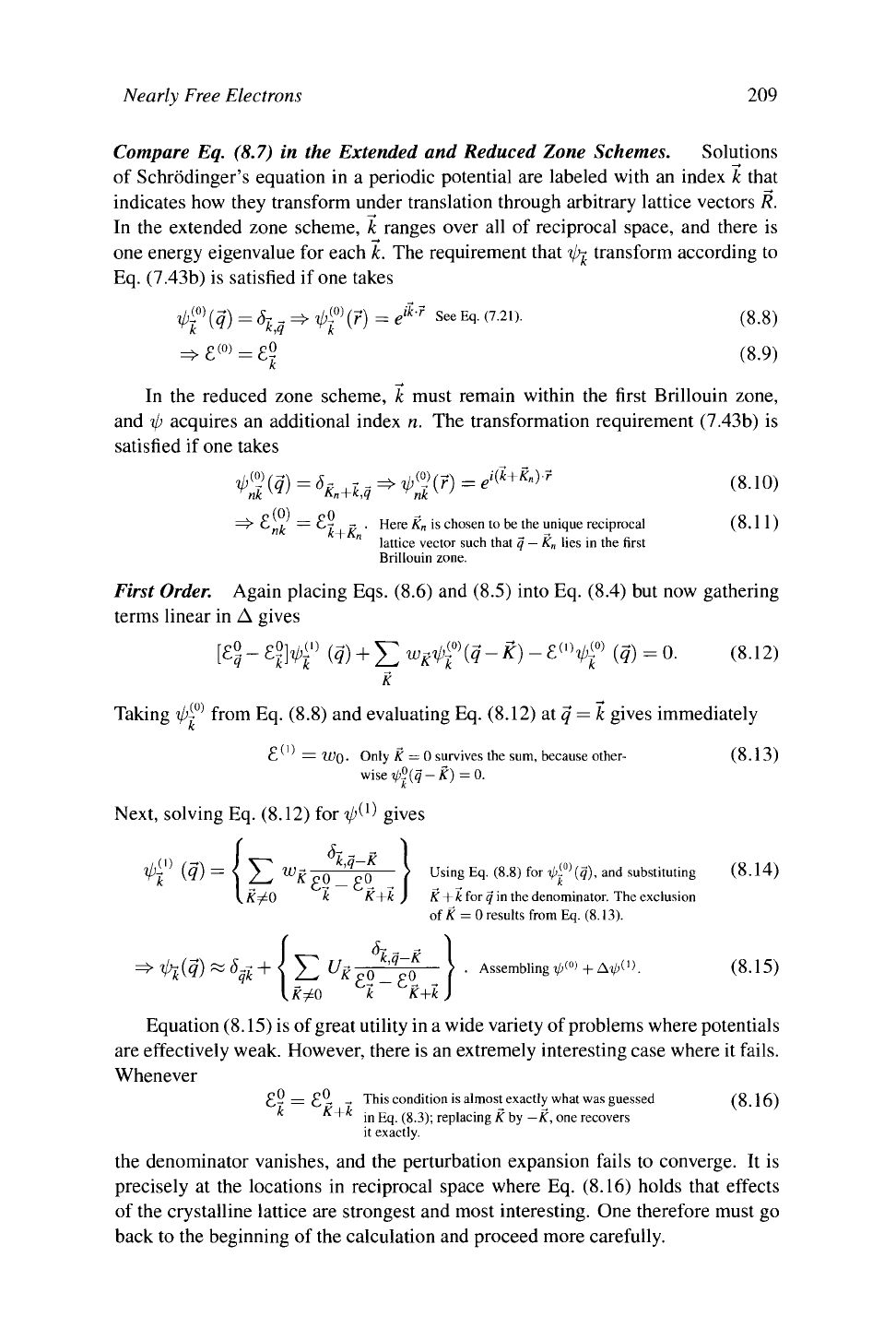
Compare Eq. (8.7) in the Extended and Reduced Zone Schemes. Solutions
of Schrödinger's equation in a periodic potential are labeled with an index k that
indicates how they transform under translation through arbitrary lattice vectors R.
In the extended zone scheme, k ranges over all of reciprocal space, and there is
one energy eigenvalue for each k. The requirement that φ^ transform according to
Eq. (7.43b) is satisfied if one takes
V'f (q) =<%-=> ^
0)
(?) =
e
ilT
See Eq. (7.21). (8.8)
=>
ε
(0)
= ε9 (8.9)
In the reduced zone scheme, k must remain within the first Brillouin zone,
and φ acquires an additional index n. The transformation requirement (7.43b) is
satisfied if one takes
Ψ™
(?) = h 4.Ï - =*
-Φ™(?)
=
e^
k+
^
rr
(8.10)
=r- G u = Cj p. . Here
K„
is chosen to be the unique reciprocal (8.11)
lattice vector such that q
—
K
n
lies in the first
Brillouin zone.
First
Order.
Again placing Eqs. (8.6) and (8.5) into Eq. (8.4) but now gathering
terms linear in Δ gives
Ι^-Φ^
(#
+
E
w
*Vf (*-$-£
(,)
Vf (#
= 0.
(8.12)
K
Taking φ^ from Eq. (8.8) and evaluating Eq. (8.12)
dXq
= k gives immediately
G = WQ. Only K = 0 survives the sum, because other- (8.13)
v/\seip°(q-K) = 0.
Next, solving Eq. (8.12) for φ^ gives
^T ®
=
1
Σ
W
K
cO^pO
(
Usin
§
Ε<
ϊ'
(8
·
8)
for
Ό
?)
'
and
substitutin
g
(
8
·
14
)
Ι,Λ^Ο k K+k ) K + kforqin the denominator. The exclusion
of K = 0 results from Eq. (8.13).
=> ^(?) ~%+ | Σ
U
koJ
M
of-
I · Assembling ^<°)+ΔψΟ). (8.15)
Equation (8.15) is of great utility in a wide variety of problems where potentials
are effectively weak. However, there is an extremely interesting case where it fails.
Whenever
£" = £x, _ This condition is almost exactly what was guessed (8.16)
K+k
j
n
gq.(8.3); replacing K by
—AT,
one recovers
it exactly.
the denominator vanishes, and the perturbation expansion fails to converge. It is
precisely at the locations in reciprocal space where Eq. (8.16) holds that effects
of the crystalline lattice are strongest and most interesting. One therefore must go
back to the beginning of the calculation and proceed more carefully.
210 Chapter 8. Nearly Free and Tightly Bound Electrons
8.2.1 Degenerate Perturbation Theory
This difficulty posed by degenerate or nearly degenerate energy levels is resolved
by degenerate perturbation theory. Two states whose energies are close mix very
strongly when perturbed, and one has to include both of them in the initial state at
the beginning of perturbation theory, because even in the limit as U vanishes, the
eigenfunctions will involve a sum of the two states.
One way to obtain a resolution of this problem is to recast Schrödinger's equa-
tion in variational form, as discussed in Appendix B. According to Eq. (B.10)
solving Schrödinger's equation is equivalent to finding extrema of the functional
<V|(Ä —£)|V>- (8-17)
This variational principle is exact, but it also suggests good approximations, be-
cause one can find approximate eigenfunctions and eigenvalues by performing the
variation with a restricted set of
wave
functions \ip). In this approximation scheme,
one restricts attention to / wave functions of the form
|V) = ]TCM>· (8.18)
i=l
Carrying out the variation of Eq. (8.17) with respect to the / coefficients
C*
leads
to the equation
ÇM(ÎC-£)|^)C; = 0, (8-19)
j
which has solutions only when the / x / matrix
Äf7=(V;|(Ä-£)|^·) (8.20)
has vanishing determinant. Degenerate perturbation theory is an approximation of
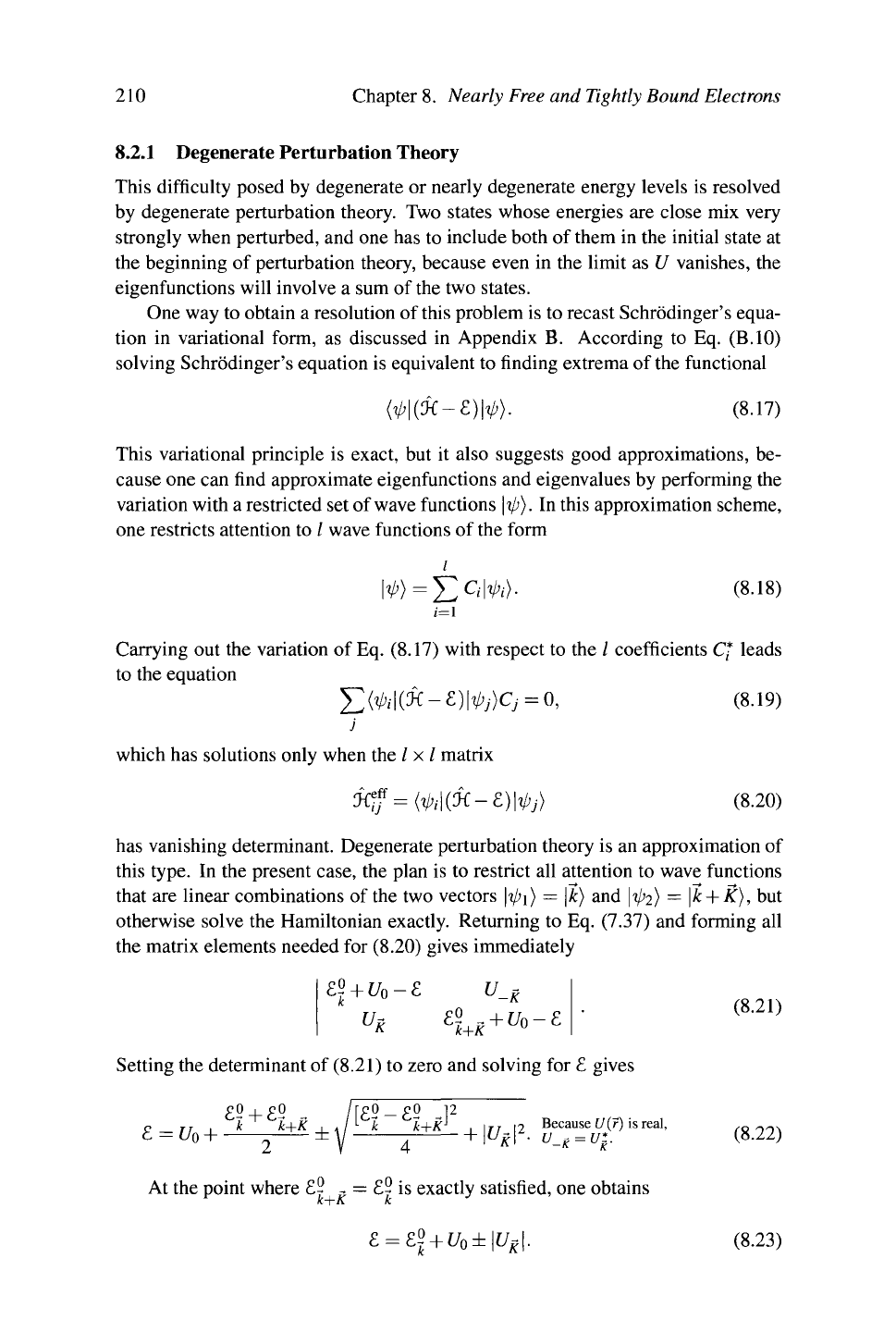
this type. In the present case, the plan is to restrict all attention to wave functions
that are linear combinations of the two vectors \ip\) = \k) and \ψ2) =
\k
+ K), but
otherwise solve the Hamiltonian exactly. Returning to Eq. (7.37) and forming all
the matrix elements needed for (8.20) gives immediately
Setting the determinant of (8.21) to zero and solving for δ gives
(8.21)
ε° + ε°
_ /[ε9-ε9 J
2
*·
k+K
i ,/
L
k
k^l
2 V 4
c ,, i I
k+Kj-\
* *+£ _i_lJ7 12 Because t/(r) is real,
ig w
t =
Uo-\
±\l
N^AH
·
U_
R
=
U*.
(8.22)
At the point where ε9 _ = ε9 is exactly satisfied, one obtains
t = e.\ +
UQ±\U
k
\.
(8.23)
Brillouin Zones 211
Thus the energy gap E
g
between bands is
£g =
2\U
R
\.
(8.24)
When k and K are far from obeying Eq. (8.16), the alteration of the free-electron
energy is of order
U
2
—much
smaller than near the zone boundaries.
Example: Application of
Eq.
(8.22) to a One-Dimensional Case. Consider an
electron in a weak one-dimensional potential, for which the lattice constant is a.
Then Eq. (8.16) obtains when k is in the neighborhood of π/α. In the neighbor-
hood of —π/α, it also obtains, with K
—
2π/α, and generally at ηπ/α, substituting
—2ηπ/α for K. These points are exactly those where discontinuities in £^ are
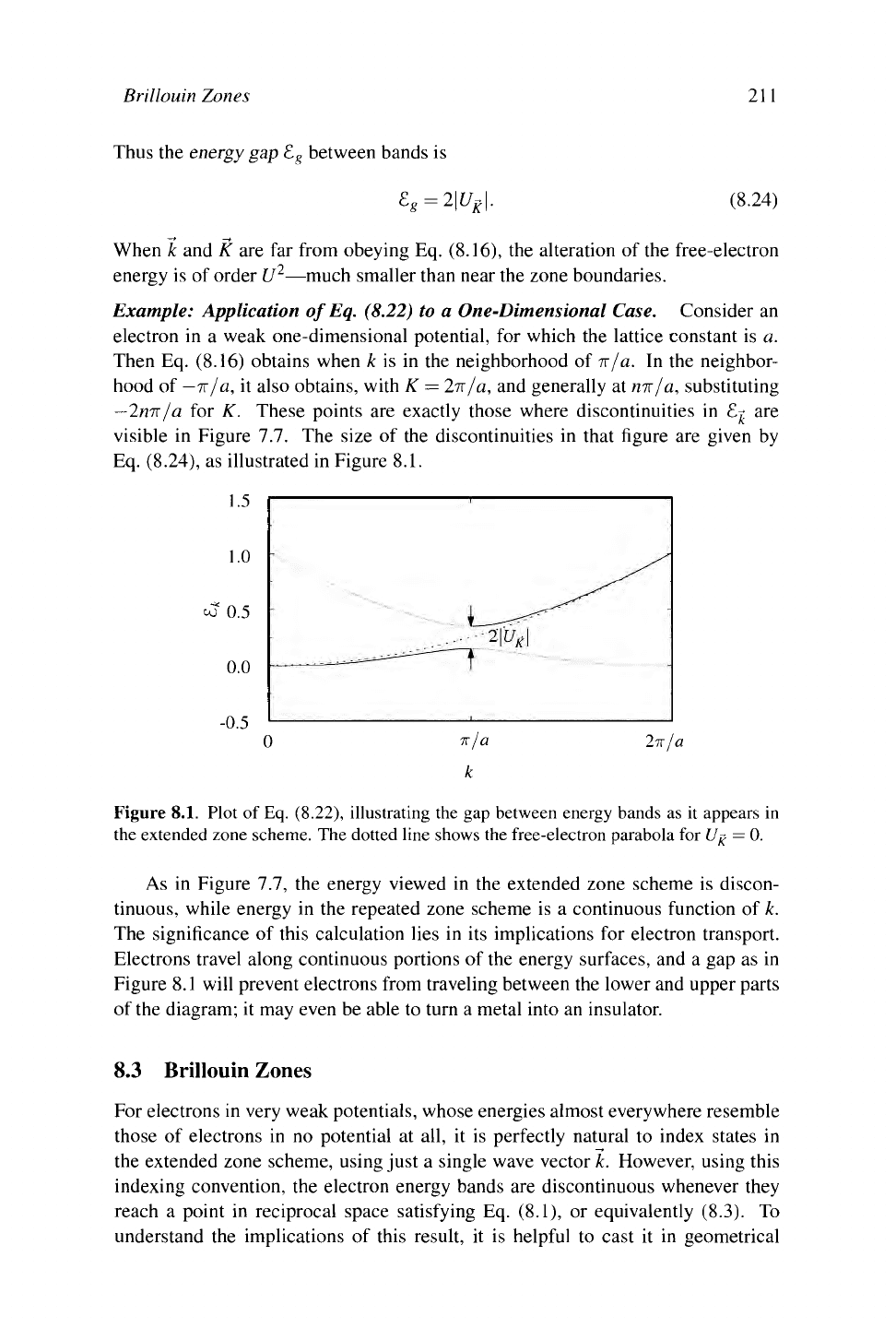
visible in Figure 7.7. The size of the discontinuities in that figure are given by
Eq. (8.24), as illustrated in Figure 8.1.
1.5
1.0
oj 0.5
0.0
-0.5
0 π/α 2π/α
k
Figure 8.1. Plot of
Eq.
(8.22), illustrating the gap between energy bands as it appears in
the extended zone scheme. The dotted line shows the free-electron parabola for
Ug
= 0.
As in Figure 7.7, the energy viewed in the extended zone scheme is discon-
tinuous, while energy in the repeated zone scheme is a continuous function of k.
The significance of this calculation lies in its implications for electron transport.
Electrons travel along continuous portions of the energy surfaces, and a gap as in
Figure 8.1 will prevent electrons from traveling between the lower and upper parts
of the diagram; it may even be able to turn a metal into an insulator.
8.3 Brillouin Zones
For electrons in very weak potentials, whose energies almost everywhere resemble
those of electrons in no potential at all, it is perfectly natural to index states in
the extended zone scheme, using just a single wave vector k. However, using this
indexing convention, the electron energy bands are discontinuous whenever they
reach a point in reciprocal space satisfying Eq. (8.1), or equivalently (8.3). To
understand the implications of this result, it is helpful to cast it in geometrical
212
Chapter 8. Nearly Free and Tightly Bound Electrons
form. Rewrite Eq. (8.1) as
k-^=
X
-K.
(8.25)
The set of points satisfying Eq. (8.25) is a plane that is perpendicular to the vector
connecting the origin to K and lying precisely midway between 0 and K. Crossing
this plane brings one closer to K than to the origin. Constructing many such planes
by scanning over all possible K encloses the origin within a solid region. This
region is nothing but the Wigner-Seitz cell of the origin in reciprocal space, or the
first Brillouin zone, as all points inside it are closer to the origin than to any other
reciprocal lattice vector.
This construction is illustrated in Figure 8.2, for a two-dimensional centered
rectangular lattice. If one travels on any straight line outward from the origin, one
will pass one by one lines on which Eq. (8.25) holds. When one passes the nth
line,
one is closer to precisely n reciprocal lattice points than one is to the origin.
Thus the nth Brillouin zone is defined to be the set of points in reciprocal space that
is closer to n
— 1
reciprocal lattice points than it is to the origin. The boundaries
of these zones are the points in reciprocal space where nearly free electrons are
strongly scattered by weak potentials.
The shape of the nth Brillouin zone becomes rather elaborate as n becomes
large; however, the total area of each zone equals the area of
the
first Brillouin zone.
The reason is that the interior of the nth Brillouin zone is the collection of points
closer to exactly n
— 1
reciprocal lattice points than to the origin. If one translates
the reciprocal lattice through any reciprocal lattice vector K, the interior of the new
nth Brillouin zone cannot overlap the old one, because all points inside the old
nth Brillouin zone are now nth nearest neighbors of K, and not the origin. On the
other hand if one continues to translate the lattice through successive reciprocal
lattice vectors, all of reciprocal space must eventually be filled with copies of the
nth Brillouin zone, because any point one chooses has some nth nearest neighbor in
the lattice. Therefore each Brillouin zone has the same volume as the first Brillouin
zone and is a primitive cell.
The importance of understanding the structure of energy bands near zone bound-
aries lies in the way that electrons in a crystal lattice behave under the influence
of external fields. A free electron subjected to a small electric field gains energy
indefinitely. An electron in a weak periodic potential subjected to a small electric
field behaves similarly until its k vector approaches a zone boundary plane. At that
point, the electron follows the branch of the energy surface which makes energy a
continuous function of k. The analysis leading to Eq. (8.24) shows that the contin-
uous branch of the energy surface has energy
E
0
.
p
, not £?. An electron traveling
from the left to it/a along the lower branch in Figure 8.1 continues along the lower
dashed line rather than jumping to the upper solid one. The central rule of elec-
tron dynamics is that an electron once in the nth Brillouin zone remains in the nth
Brillouin zone. This claim will be demonstrated in Chapter 16.
For most purposes, the first Brillouin zone is the most important. Almost all
computations involving electrons in crystals are carried out using the reduced zone