
Marder M.P. Condensed Matter Physics
Подождите немного. Документ загружается.

Quantum Monte Carlo
253
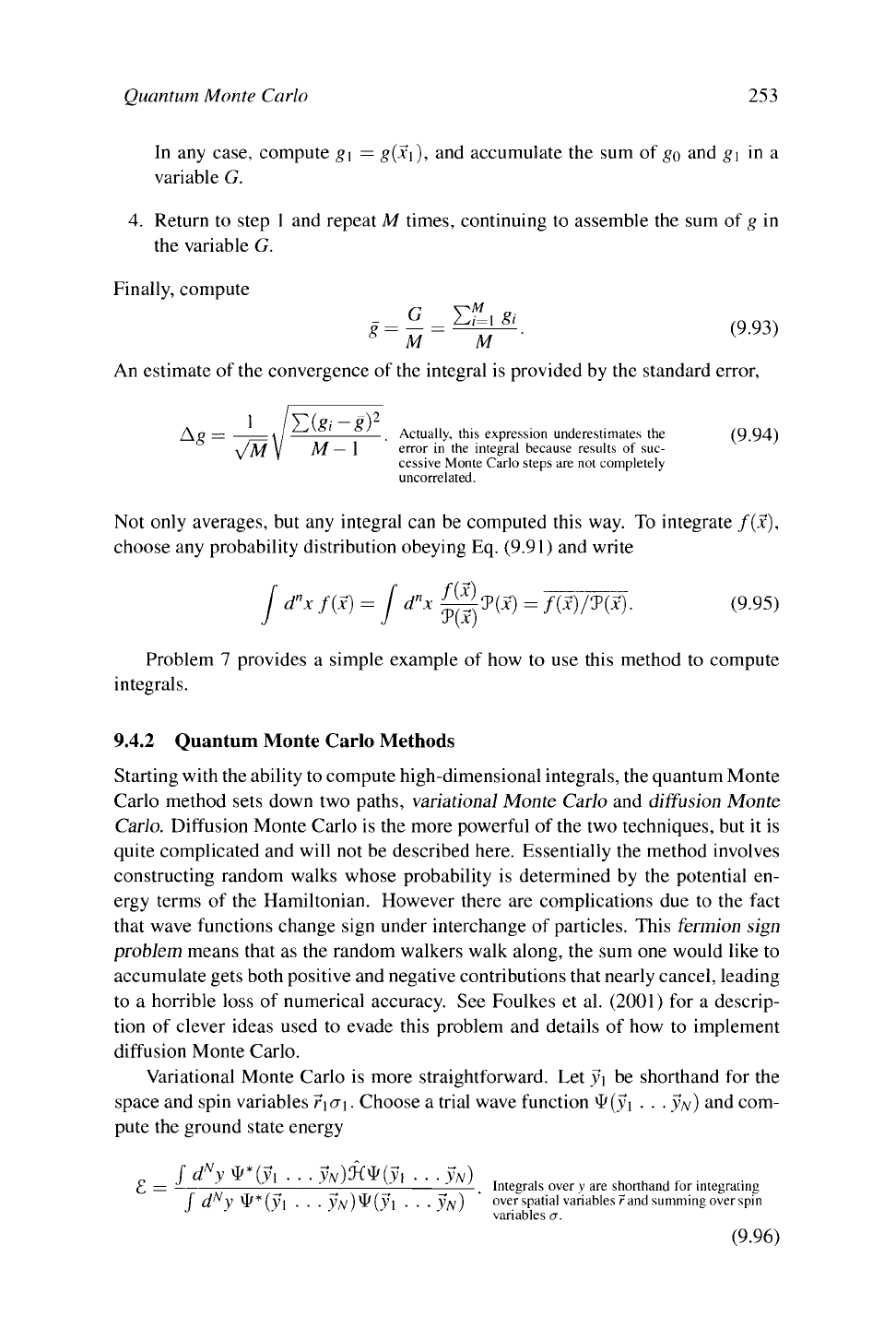
In any case, compute g\ =
g(x\),
and accumulate the sum of go and g\ in a
variable G.
4.
Return to step
1
and repeat M times, continuing to assemble the sum of g in
the variable G.
Finally, compute
G V
M
, 9:
(9.93)
G _ Σ£ι Si
° M M
An estimate of the convergence of the integral is provided by the standard error,
1 γ(α.-ο)2
ΔΡ = \ =—. Actually, this expression underestimates the (9.94)
\/~M V M — I error in the integral because results of suc-
cessive Monte Carlo steps are not completely
uncorrelated.
Not only averages, but any integral can be computed this way. To integrate f(x),
choose any probability distribution obeying Eq. (9.91) and write
J d"x f(x) = J d"x 7^n% =
JW/W)-
(9-95)
Problem 7 provides a simple example of how to use this method to compute
integrals.
9.4.2 Quantum Monte Carlo Methods
Starting with the ability to compute high-dimensional integrals, the quantum Monte
Carlo method sets down two paths,
variational
Monte Carlo and diffusion Monte
Carlo.
Diffusion Monte Carlo is the more powerful of the two techniques, but it is
quite complicated and will not be described here. Essentially the method involves
constructing random walks whose probability is determined by the potential en-
ergy terms of the Hamiltonian. However there are complications due to the fact
that wave functions change sign under interchange of particles. This fermion sign
problem means that as the random walkers walk along, the sum one would like to
accumulate gets both positive and negative contributions that nearly cancel, leading
to a horrible loss of numerical accuracy. See Foulkes et al. (2001) for a descrip-
tion of clever ideas used to evade this problem and details of how to implement
diffusion Monte Carlo.
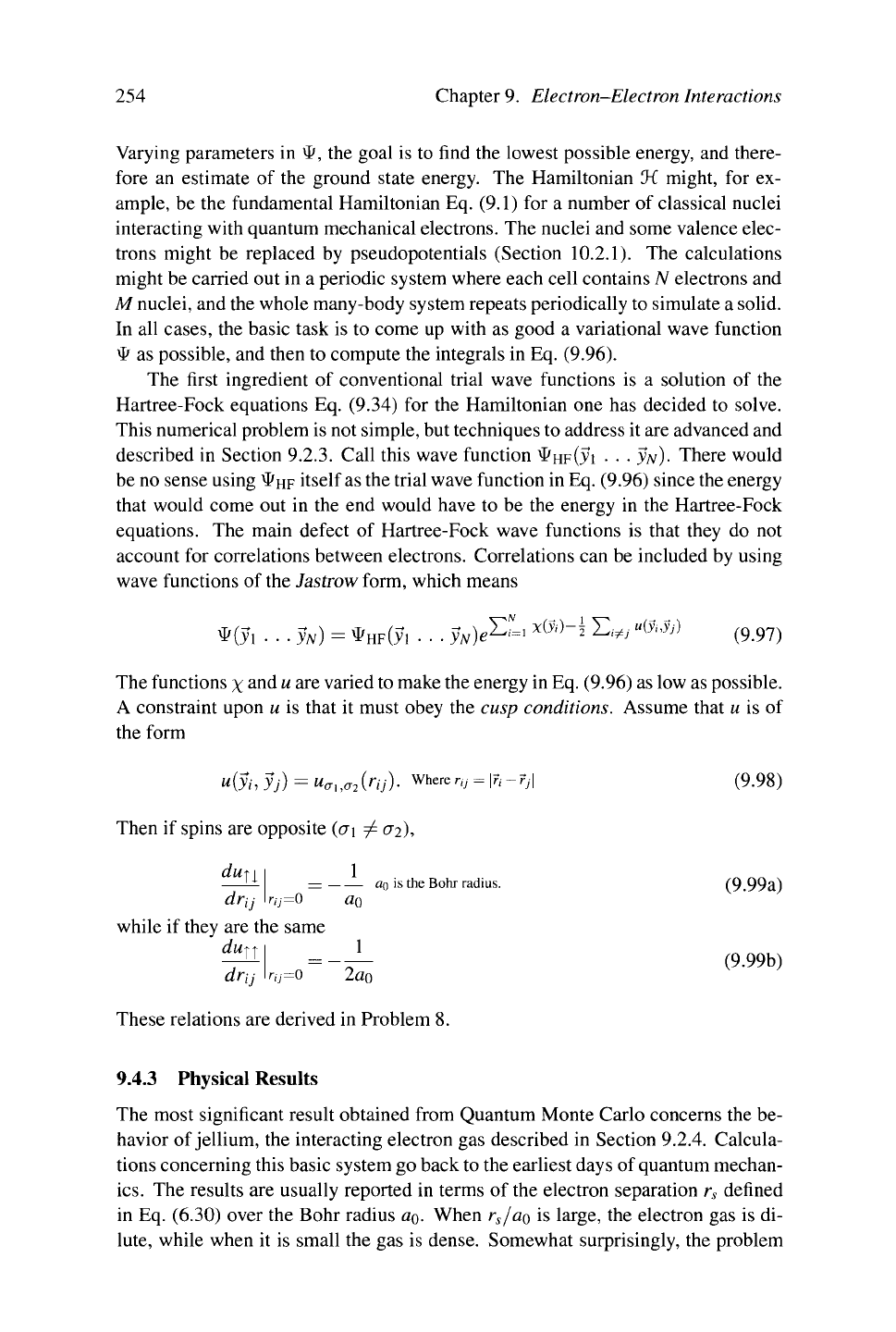
Variational Monte Carlo is more straightforward. Let y\ be shorthand for the
space and spin variables Τ\σ\. Choose a trial wave function ty(y\ . . .y^) and com-
pute the ground state energy
„ ( d
N
y^*(y
{
. . .yM^iyx . . .y
N
)
t, = -—
:
—-. Integrals over y are shorthand for integrating
I d^y Φ*(7ι . · . .y/vì^CVl ■ · · J/v) over spatial variables rand summing over spin
variables σ.
(9.96)
254
Chapter 9. Electron-Electron Interactions
Varying parameters
in Φ, the
goal
is to
find
the
lowest possible energy,
and
there-
fore
an
estimate
of the
ground state energy.
The
Hamiltonian
"K
might,
for ex-
ample,
be the
fundamental Hamiltonian
Eq. (9.1) for a
number
of
classical nuclei
interacting with quantum mechanical electrons.
The
nuclei
and
some valence elec-
trons might
be
replaced
by
pseudopotentials (Section 10.2.1).
The
calculations
might
be
carried
out in a
periodic system where each cell contains
N
electrons
and
M nuclei, and the whole many-body system repeats periodically to simulate a solid.
In
all
cases,
the
basic task
is to
come
up
with
as
good
a
variational wave function
Φ
as
possible,
and
then
to
compute
the
integrals
in
Eq. (9.96).
The first ingredient
of
conventional trial wave functions
is a
solution
of the
Hartree-Fock equations
Eq.
(9.34)
for the
Hamiltonian
one has
decided
to
solve.
This numerical problem is
not
simple, but techniques to address
it
are advanced and
described
in
Section 9.2.3. Call this wave function
^HF(JI · · · 9N)-
There would
be no sense using
<]/HF
itself
as
the trial wave function
in
Eq. (9.96) since the energy
that would come
out in the end
would have
to be the
energy
in the
Hartree-Fock
equations.
The
main defect
of
Hartree-Fock wave functions
is
that they
do not
account
for
correlations between electrons. Correlations
can be
included
by
using
wave functions
of
the
Jastrow
form, which means
Φ(?ι ...y
N
)
= ΦΗΡ(?Ι · ·
■
y
N
)e^>=>
x(?
'
H Σ
<^
Β(ΑΛ)
(9.97)
The functions
χ
and u are varied to make the energy
in
Eq. (9.96) as low as possible.
A constraint upon
u is
that
it
must obey
the
cusp conditions. Assume that
u is of
the form
u(y
h
yj) =
Η
σ
,
,
σ2
{ni).
Where
r
y
=
\r,
- rj\
(9.98)
Then
if
spins
are
opposite
(σ\ φ ai),
du
n
drtj
—
ÜQ
is
the Bohr
radius.
(9.99a)
while
if
they
are the
same
du
TT
dnj
~ (9.99b)
2ao
These relations
are
derived
in
Problem
8.
9.4.3 Physical Results
The most significant result obtained from Quantum Monte Carlo concerns
the be-
havior of jellium,
the
interacting electron
gas
described
in
Section 9.2.4. Calcula-
tions concerning this basic system go back to the earliest days
of
quantum mechan-
ics.
The
results
are
usually reported
in
terms
of
the electron separation
r
s
defined
in
Eq.
(6.30) over
the
Bohr radius ao. When r
s
/ao
is
large,
the
electron
gas is di-
lute,
while when
it is
small
the gas is
dense. Somewhat surprisingly,
the
problem
Kohn-Sham Equations
255
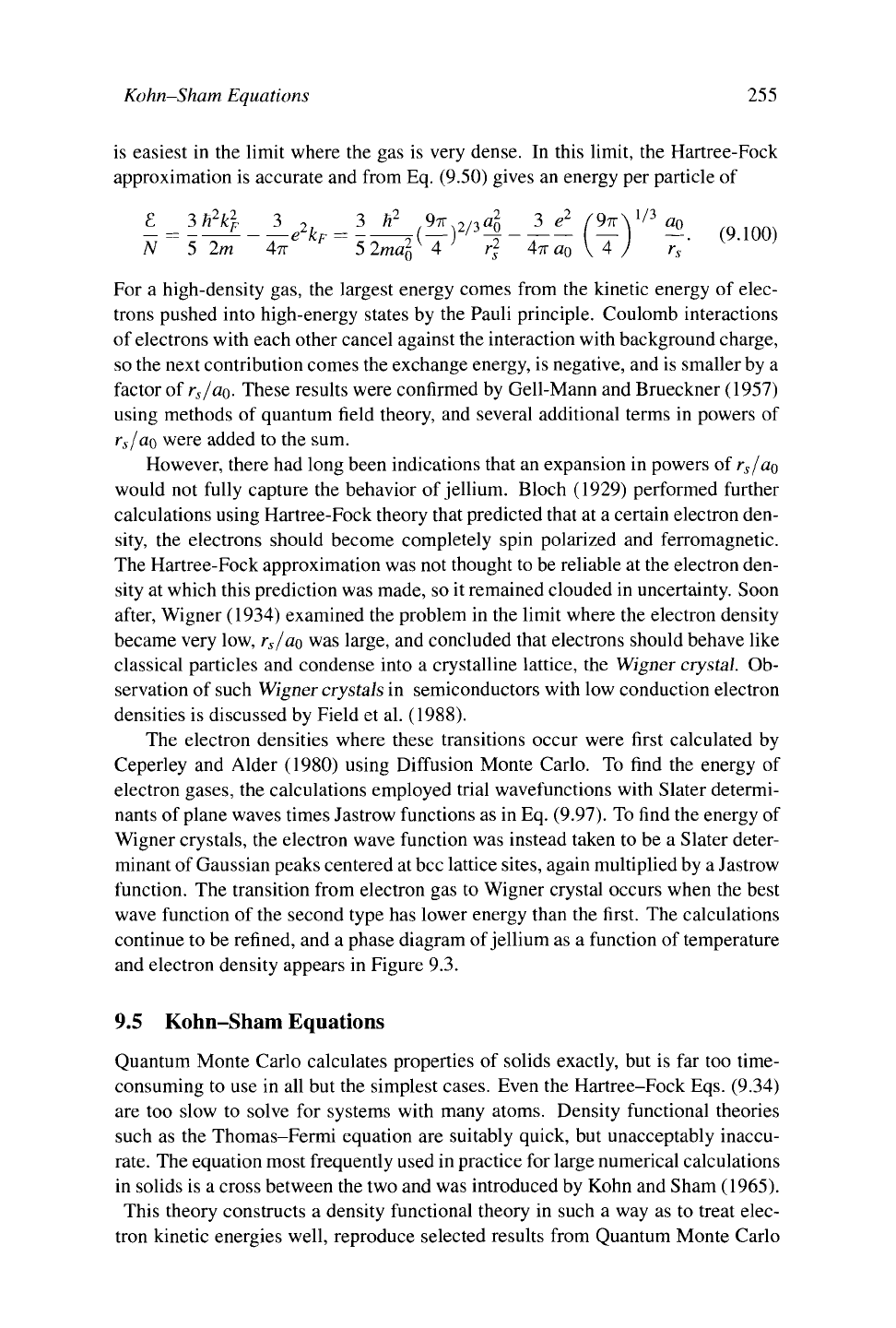
is easiest in the limit where the gas is very dense. In this limit, the Hartree-Fock
approximation is accurate and from Eq. (9.50) gives an energy per particle of
«
=
?^_A
AF
=
5JL
(
^/4__Lì!(^y
/3
2s.
mm)
N 5 2m 4π 5 2mal
v
4 ' r} 4π a
0
\ 4 ) r
s
For a high-density gas, the largest energy comes from the kinetic energy of elec-
trons pushed into high-energy states by the Pauli principle. Coulomb interactions
of electrons with each other cancel against the interaction with background charge,
so the next contribution comes the exchange energy, is negative, and is smaller by a
factor of
r
s
/üQ.
These results were confirmed by Gell-Mann and Brueckner (1957)
using methods of quantum field theory, and several additional terms in powers of
r
s
/ao were added to the sum.
However, there had long been indications that an expansion in powers of r
s
/ao
would not fully capture the behavior of jellium. Bloch (1929) performed further
calculations using Hartree-Fock theory that predicted that at a certain electron den-
sity, the electrons should become completely spin polarized and ferromagnetic.
The Hartree-Fock approximation was not thought to be reliable at the electron den-
sity at which this prediction was made, so it remained clouded in uncertainty. Soon
after, Wigner
( 1934)
examined the problem in the limit where the electron density
became very low, r
s
/ao was large, and concluded that electrons should behave like
classical particles and condense into a crystalline lattice, the Wigner
crystal.
Ob-
servation of such Wigner
crystals
in semiconductors with low conduction electron
densities is discussed by Field et al. (1988).
The electron densities where these transitions occur were first calculated by
Ceperley and Alder (1980) using Diffusion Monte Carlo. To find the energy of
electron gases, the calculations employed trial wavefunctions with Slater determi-
nants of plane waves times Jastrow functions as in Eq. (9.97). To find the energy of
Wigner crystals, the electron wave function was instead taken to be a Slater deter-
minant of Gaussian peaks centered at bcc lattice sites, again multiplied by a Jastrow
function. The transition from electron gas to Wigner crystal occurs when the best
wave function of the second type has lower energy than the first. The calculations
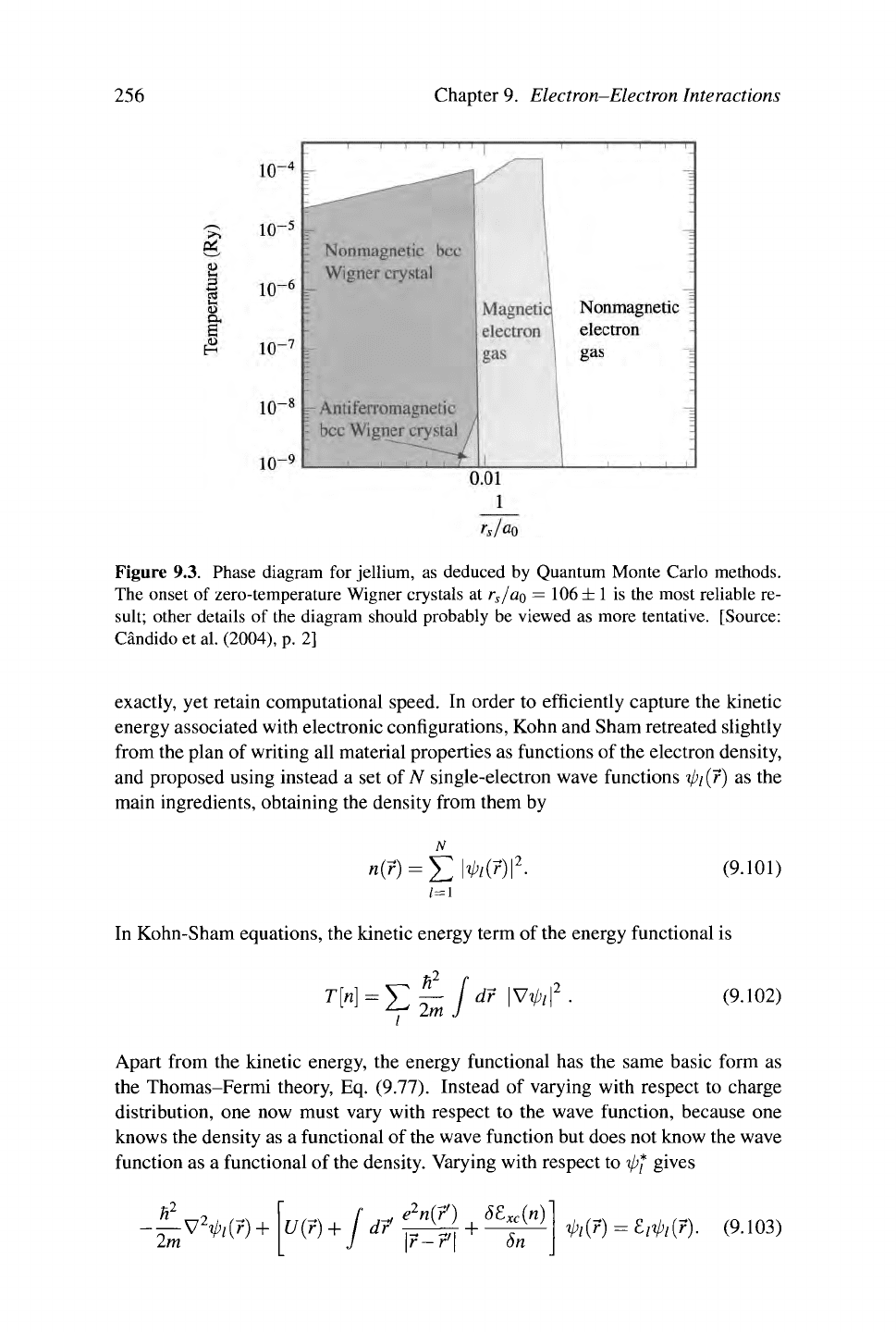
continue to be refined, and a phase diagram of jellium as a function of temperature
and electron density appears in Figure 9.3.
9.5 Kohn-Sham Equations
Quantum Monte Carlo calculates properties of solids exactly, but is far too time-
consuming to use in all but the simplest cases. Even the Hartree-Fock Eqs. (9.34)
are too slow to solve for systems with many atoms. Density functional theories
such as the Thomas-Fermi equation are suitably quick, but unacceptably inaccu-
rate.
The equation most frequently used in practice for large numerical calculations
in solids is a cross between the two and was introduced by Kohn and Sham (1965).
This theory constructs a density functional theory in such a way as to treat elec-
tron kinetic energies well, reproduce selected results from Quantum Monte Carlo
256
Chapter 9.
Electron—Electron
Interactions
Figure 9.3. Phase diagram for jellium, as deduced by Quantum Monte Carlo methods.
The onset of zero-temperature Wigner crystals at r
s
/ao =
106
±
1
is the most reliable re-
sult; other details of the diagram should probably be viewed as more tentative. [Source:
Càndido et al. (2004),
p.
2]
exactly, yet retain computational speed. In order to efficiently capture the kinetic
energy associated with electronic configurations, Kohn and Sham retreated slightly
from the plan of writing all material properties as functions of the electron density,
and proposed using instead a set of N single-electron wave functions
ψι (r)
as the
main ingredients, obtaining the density from them by
N
η(?) =
Σ\Ψι{7)\
2
.
(9.101)
ι=ι
In Kohn-Sham equations, the kinetic energy term of the energy functional is
vi
1
f
2>] = Σ^ J
d7
l
V
^/|
2
·
(9-102)
Apart from the kinetic energy, the energy functional has the same basic form as
the Thomas-Fermi theory, Eq. (9.77). Instead of varying with respect to charge
distribution, one now must vary with respect to the wave function, because one
knows the density as a functional of the wave function but does not know the wave
function as a functional of the density. Varying with respect to ψ* gives
~vViW
+
U(r) +
J
„, e
2
n{f) ô£
xc
{n)
dr
———■
+ —
\r —
r\ on
i>i(r)
= £iM'
!
)· (9-103)
Kohn-Sham Equations 257
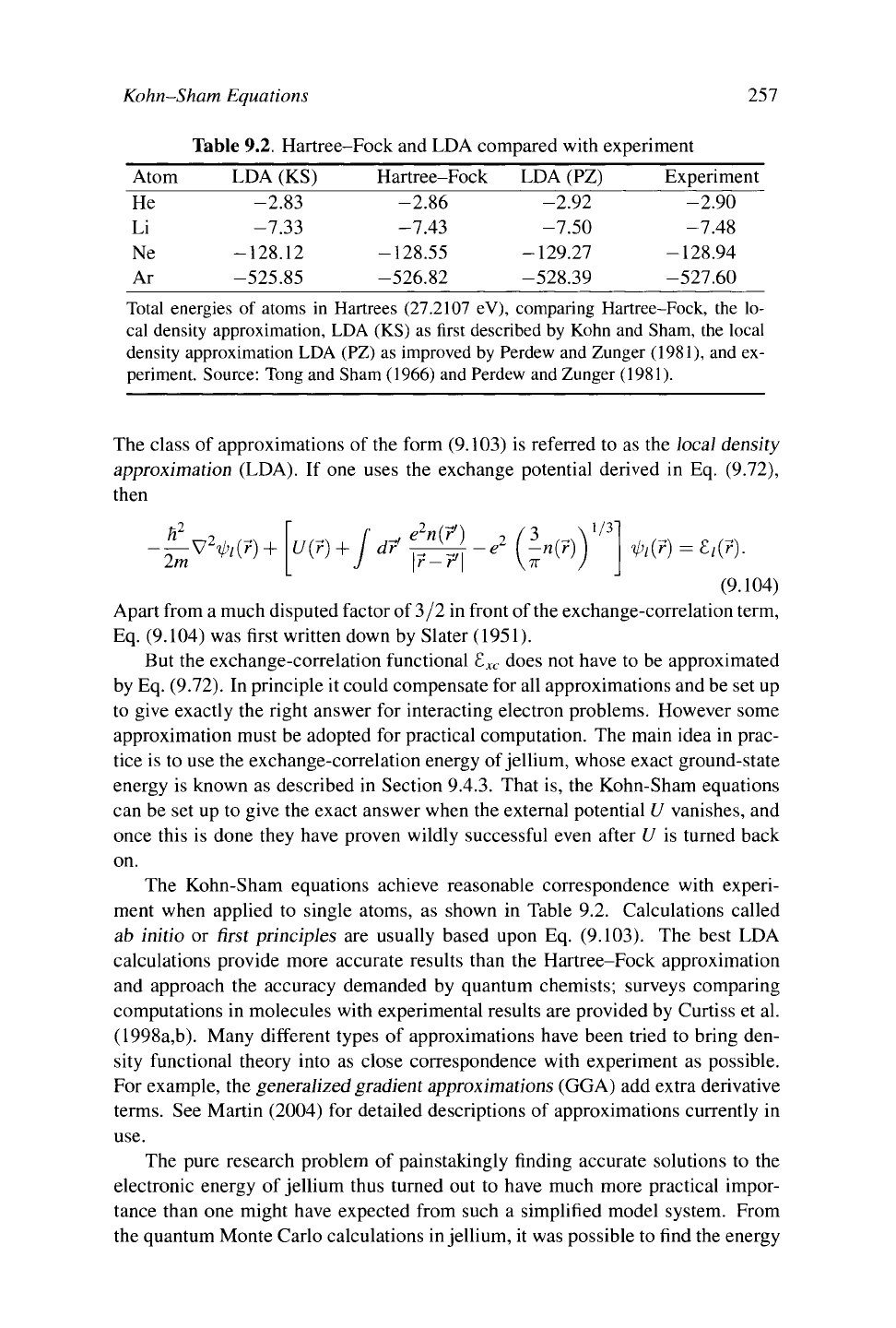
Table 9.2. Hartree-Fock and LDA compared with experiment
Atom
He
Li
Ne
Ar
LDA (KS)
-2.83
-7.33
-128.12
-525.85
Hartree-Fock
-2.86
-7.43
-128.55
-526.82
LDA (PZ)
-2.92
-7.50
-129.27
-528.39
Experiment
-2.90
-7.48
-128.94
-527.60
Total energies of atoms in Hartrees (27.2107 eV), comparing Hartree-Fock, the lo-
cal density approximation, LDA (KS) as first described by Kohn and Sham, the local
density approximation LDA (PZ) as improved by Perdew and Zunger (1981), and ex-
periment. Source: Tong and Sham (1966) and Perdew and Zunger (1981).
The class of approximations of the form (9.103) is referred to as the local density
approximation (LDA). If one uses the exchange potential derived in Eq. (9.72),
then
-|Vw(r)
+
„ , -<e
2
n(r") 2 ( * ,-Λ
1/3
'
U{r) + I df —A=7 -e
2
-nÇ"
\r—r\ \π
Φ
ι
{7) =
ε
ι
{7).
(9.104)
Apart from a much disputed factor of 3/2 in front of
the
exchange-correlation term,
Eq. (9.104) was first written down by Slater (1951).
But the exchange-correlation functional Z
xc
does not have to be approximated
by Eq. (9.72). In principle it could compensate for all approximations and be set up
to give exactly the right answer for interacting electron problems. However some
approximation must be adopted for practical computation. The main idea in prac-
tice is to use the exchange-correlation energy of jellium, whose exact ground-state
energy is known as described in Section 9.4.3. That is, the Kohn-Sham equations
can be set up to give the exact answer when the external potential U vanishes, and
once this is done they have proven wildly successful even after U is turned back
on.
The Kohn-Sham equations achieve reasonable correspondence with experi-
ment when applied to single atoms, as shown in Table 9.2. Calculations called
ab initio or first principles are usually based upon Eq. (9.103). The best LDA
calculations provide more accurate results than the Hartree-Fock approximation
and approach the accuracy demanded by quantum chemists; surveys comparing
computations in molecules with experimental results are provided by Curtiss et al.
(1998a,b). Many different types of approximations have been tried to bring den-
sity functional theory into as close correspondence with experiment as possible.
For example, the generalized gradient approximations (GGA) add extra derivative
terms.
See Martin (2004) for detailed descriptions of approximations currently in
use.
The pure research problem of painstakingly finding accurate solutions to the
electronic energy of jellium thus turned out to have much more practical impor-
tance than one might have expected from such a simplified model system. From
the quantum Monte Carlo calculations
in
jellium, it was possible to find the energy
258
Chapter 9. Electron-Electron Interactions
of the electron gas as a function of density. Simple functional fits to these results,
for example by Perdew and Zunger (1981), Lee et al. (1988), or Becke (1993),
produce the exchange-correlation functionals on which current density functional
codes are based. Papers containing these parameterizations win out over all recent
Nobel Prize-winning results, and are the most highly-cited papers in all of physics.
Problems
1.
Hartree equations:
(a) Find the expectation value Fu of
Eq.
(9.1) in a state of form Eq. (9.6).
(b) Take the variation of
Fu,
subject to the constraint that each φ be normalized:
SF
H
δ
δψι(7) δφι(7)
Σ Ej j α7'φ*(7')φ
]
(7') = 0. (9.105)
(c) Add one extra term (without much justification apart from simplicity) so
that the Coulomb interaction term of the Hamiltonian becomes the same for
all wave functions. In this way, recover the Hartree equations. Notice that
demanding that each φ be normalized is sufficient to result in an orthonormal
set of functions.
2.
Koopman's theorem:
(a) Evaluate the total energy of a collection of
TV
electrons in jellium, obtaining
Eq. (9.49). You must add also the energy of the positive ionic background.
(b) Compare the result with the sum over / of the single particle energies £/.
(c) The ionization potential of an atom is the energy needed to remove the most
energetic electron. Consider an atom with N electrons, and suppose it has
been solved in the Hartree-Fock approximation, producing wave functions φι
and energies £/. Suppose that when the electron of highest energy is removed,
the remaining N
— 1
wave functions continue to solve the Hartree-Fock equa-
tions,
and that the energies £/ do not change appreciably. Show that in this
approximation the ionization potential of the atom is £yy.
3.
Screening: The idea of screening comes originally from electrolytic solu-
tions.
Imagine placing a charged ion into such a solution. At first the po-
tential due to the added ion extends its influence to the far reaches of the
system, dying off slowly as \/r. However, mobile ions nearby rapidly react
to the intruder, and the motions they make in response have the effect of al-
most completely canceling out its electric field, except within a characteristic
distance called the screening length. Because this phenomenon occurs gen-
erally for any assembly of charged particles, it can be studied in the context
of Thomas-Fermi theory, given by Eq. (9.77).
Problems
259
(a) Consider Eq. (9.77), omitting for simplicity the last term on the left-hand
side resulting from exchange. Suppose that
no
is the solution of this equation
when the potential U(r) vanishes. If now a small potential U(r) is added, find
the equation governing deviations Sn(r) of
the
density from perfect uniformity
to first order in U.
(b) Consider adding one extra electron to the uniform electron gas, and therefore
specialize to the case
e
2
U\r) =—. Yes, it is dubious to regard such a potential as (9.106)
T small, but the basic lesson is still correct.
Solve the linearized equation for δη by use of Fourier transforms. The answer
should be of the form
e
-r/i
δη . (9.107)
r
Identify the screening length ξ, and express it in terms of the Bohr radius and
the average volume per particle of the original uniform electron gas.
(c) Estimate the screening length for aluminum.
4.
Thomas-Fermi theory: Use Thomas-Fermi theory to study an atom with
nuclear charge Z and Z electrons, so that the potential is
U{r) = -Ze
2
/r. (9.108)
(a) Rewrite Eq. (9.77), omitting the final term and substituting the function V(r)
for n(7) through
[~2mV]
3
/
2
3π
2
Η
3
(b) Show that in the vicinity of the origin, V(r)
—>
—Ze
2
/r.
(c) Define
(9.109)
V(r) = X, r = DS, and b = — [-7-] Z ' . a
0
is the Bohr radius.
(5
Show that for spherically symmetric solutions and s > 0 one obtains
*
1/2
§
=
*
3/2
·
(9
·
1Η)
(d) Show that the boundary conditions on χ require χ(0) =
1
and
χ(οο) = 0.
260
Chapter 9. Electron-Electron Interactions
5.
Thomas-Fermi numerics:
(a) Solve the two-point boundary problem in Eq. (9.111) numerically, and find
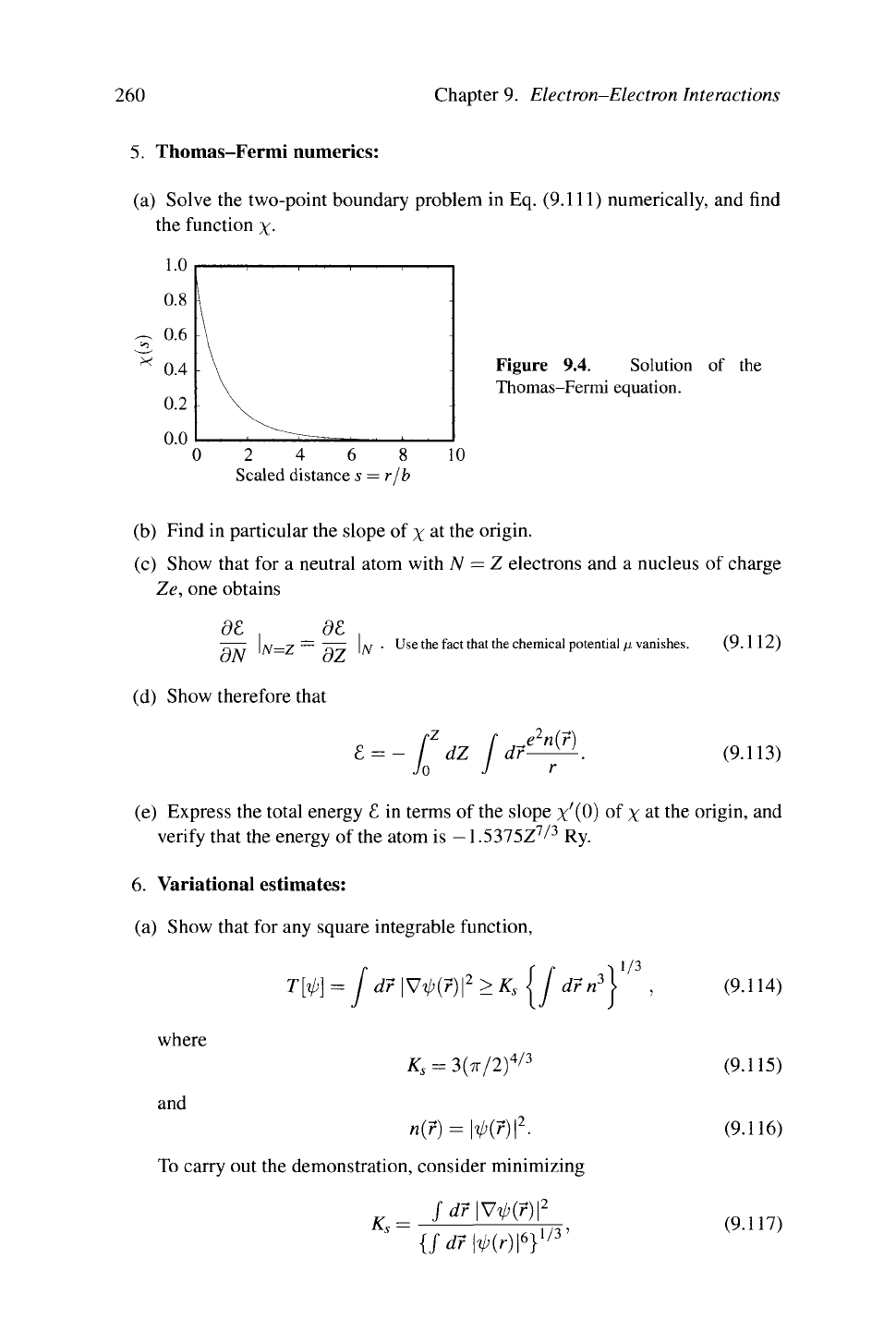
the function χ.
x
Figure 9.4. Solution of the
Thomas-Fermi equation.
2 4 6
Scaled distance s = r/b
10
(b) Find in particular the slope of χ at the origin.
(c) Show that for a neutral atom with N
—
Z electrons and a nucleus of charge
Ze, one obtains
"7;—
\M—7 — τ;— \M
■
Use the fact that the chemical potential u vanishes. (9.112)
oN oZ
(d) Show therefore that
t
dZ
I
dr
e
2
n(r)
(9.113)
(e) Express the total energy £ in terms of the slope χ'(0) of χ at the origin, and
verify that the energy of the atom is
—
1.5375Z
7
/
3
Ry.
6. Variational estimates:
(a) Show that for any square integrable function,
Τ[ψ]= ( dr \Vip(r)\
2
>K
s
j ί dr n
3
\ , (9.114)
where
and
^ = 3(π/2)
4
/
3
η(7) =
\φ(7)\
2
.
To carry out the demonstration, consider minimizing
/ Jr|V^(r)|
2
K
x
=
{fdrmr)\*}
6\l/3'
(9.115)
(9.116)
(9.117)
Problems
261
-ν
2
ψ-αψ
5
=0.
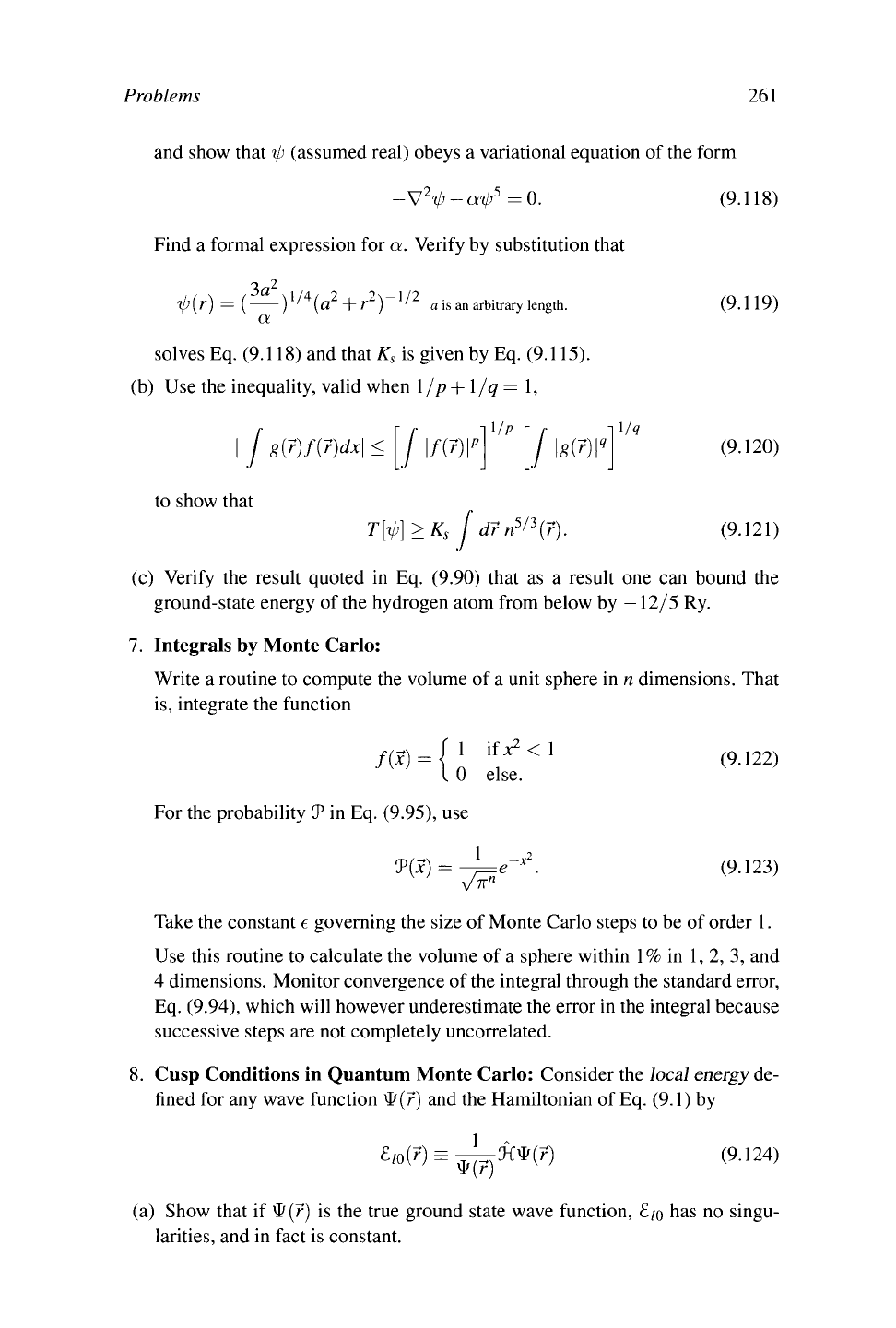
and show that ψ (assumed real) obeys a variational equation of the form
(9.118)
Find a formal expression for a. Verify by substitution that
,3a
2
a
a
is an arbitrary length.
(9.119)
solves Eq. (9.118) and that K
s
is given by Eq. (9.115).
(b) Use the inequality, valid when l/p+l/q = 1,
g{r)f(r)dx\ <
\m\
p
UP
i(f)\
q
!/</
to show that
Τ[ψ] >K
S
ί drn
5/3
(7).
(9.120)
(9.121)
(c) Verify the result quoted in Eq. (9.90) that as a result one can bound the
ground-state energy of the hydrogen atom from below by
—
12/5 Ry.
7.
Integrals by Monte Carlo:
Write a routine to compute the volume of a unit sphere in n dimensions. That
is,
integrate the function
/<*)
=
{
J
For the probability
CP
in Eq. (9.95), use
0>(*) =
if
x
2
< 1
else.
e
x
.
(9.122)
(9.123)
Take the constant e governing the size of Monte Carlo steps to be of order 1.
Use this routine to calculate the volume of a sphere within 1% in 1, 2, 3, and
4 dimensions. Monitor convergence of the integral through the standard error,
Eq. (9.94), which will however underestimate the error in the integral because
successive steps are not completely uncorrelated.
8. Cusp Conditions in Quantum Monte Carlo: Consider the local energy de-
fined for any wave function Ψ(?) and the Hamiltonian of
Eq.
(9.1) by
£/o(?)
1
φ(
-:ΚΦ(Γ)
(9.124)
(a) Show that if Φ(?) is the true ground state wave function, £/o has no singu-
larities, and in fact is constant.
262
Chapter 9. Electron-Electron Interactions
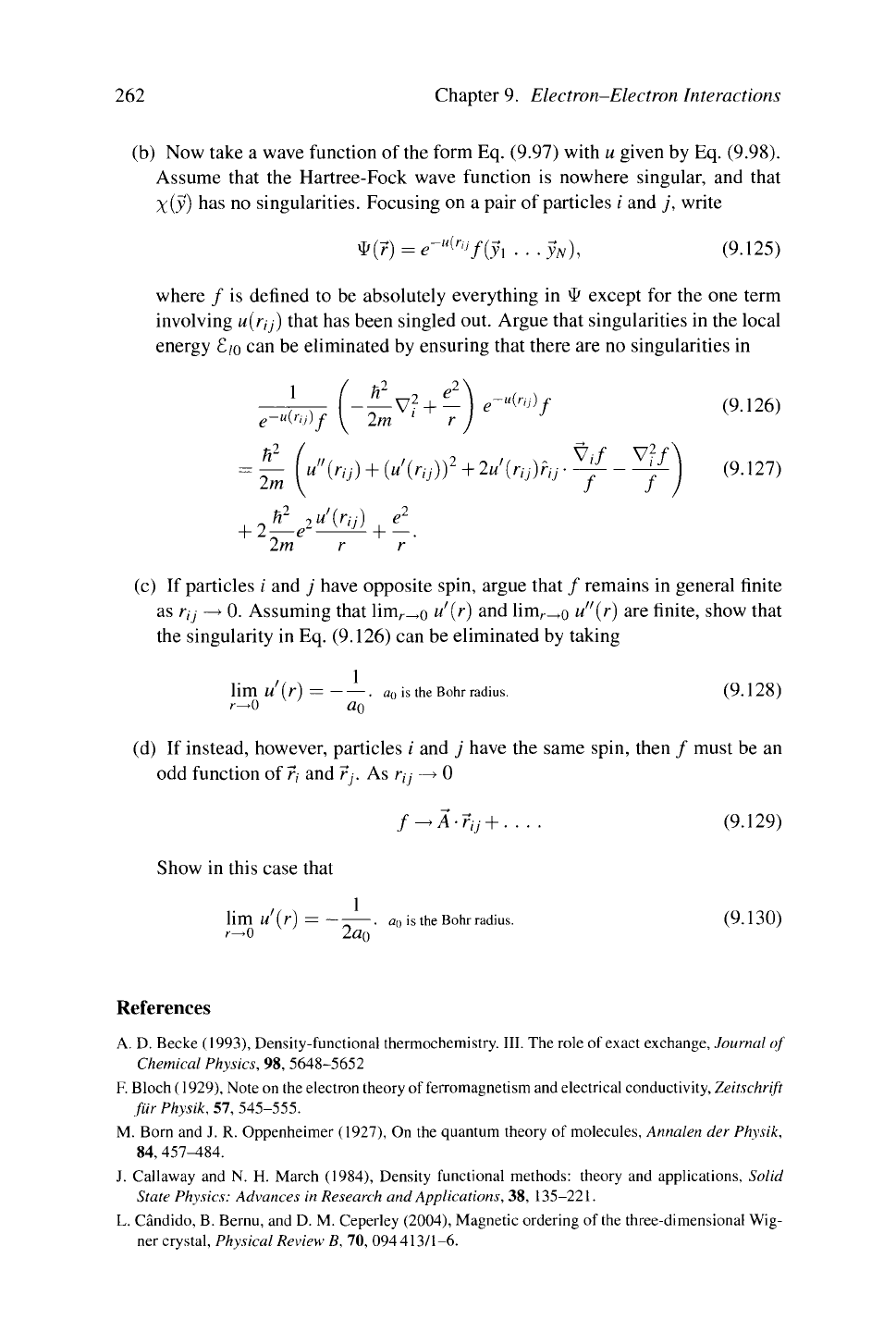
(b) Now take a wave function of the form Eq. (9.97) with u given by Eq. (9.98).
Assume that the Hartree-Fock wave function is nowhere singular, and that
X(y) has no singularities. Focusing on a pair of particles / and
j,
write
Φ(?) =
β
-»(^/(3?
1
...^),
(9.125)
where / is defined to be absolutely everything in Φ except for the one term
involving w(r,-y) that has been singled out. Argue that singularities in the local
energy £/o can be eliminated by ensuring that there are no singularities in
1 ( H2
-
V
2
+
e
l\
e
-«(ru)f
(9.126)
e
-"('■//)/
1 2m ' r
= 2^
(
u
"(
r
'j)
+ ("'M)
2
+
2«'(^-)r
l7
·
ψ - ^ j (9.127)
ft
2
2
u
'(
r
a)
el
+ 2—e
2
^-^ + —.
2m r r
(c) If particles i and y have opposite spin, argue that / remains in general finite
as r,j
—>
0. Assuming that lim
r
^o u'(r) and lim
r
^o u"(r) are finite, show that
the singularity in Eq. (9.126) can be eliminated by taking
lim u(r) = . iio is the Bohr
radius.
(9.128)
(d) If instead, however, particles / and j have the same spin, then / must be an
odd function of
r,-
and 7j. As r,-y
—>■
0
f^A-r
u
+ .... (9.129)
Show in this case that
lim u'(r) = — . a
0
is the Bohr
radius.
(9.130)
References
A. D. Becke (1993), Density-functional thermochemistry. III. The role of exact exchange, Journal of
Chemical Physics, 98, 5648-5652
F.
Bloch
(
1929),
Note on the electron theory of ferromagnetism and electrical conductivity, Zeitschrift
für
Physik,
57, 545-555.
M. Born and J. R. Oppenheimer (1927), On the quantum theory of molecules, Annalen der
Physik,
84,
457^84.
J. Callaway and N. H. March (1984), Density functional methods: theory and applications, Solid
State Physics: Advances in Research and Applications, 38,
135-221.
L. Càndido, B. Bernu, and D. M. Ceperley (2004), Magnetic ordering of the three-dimensional Wig-
ner crystal, Physical Review B, 70, 094413/1-6.