
Marder M.P. Condensed Matter Physics
Подождите немного. Документ загружается.

Numerical Methods 273
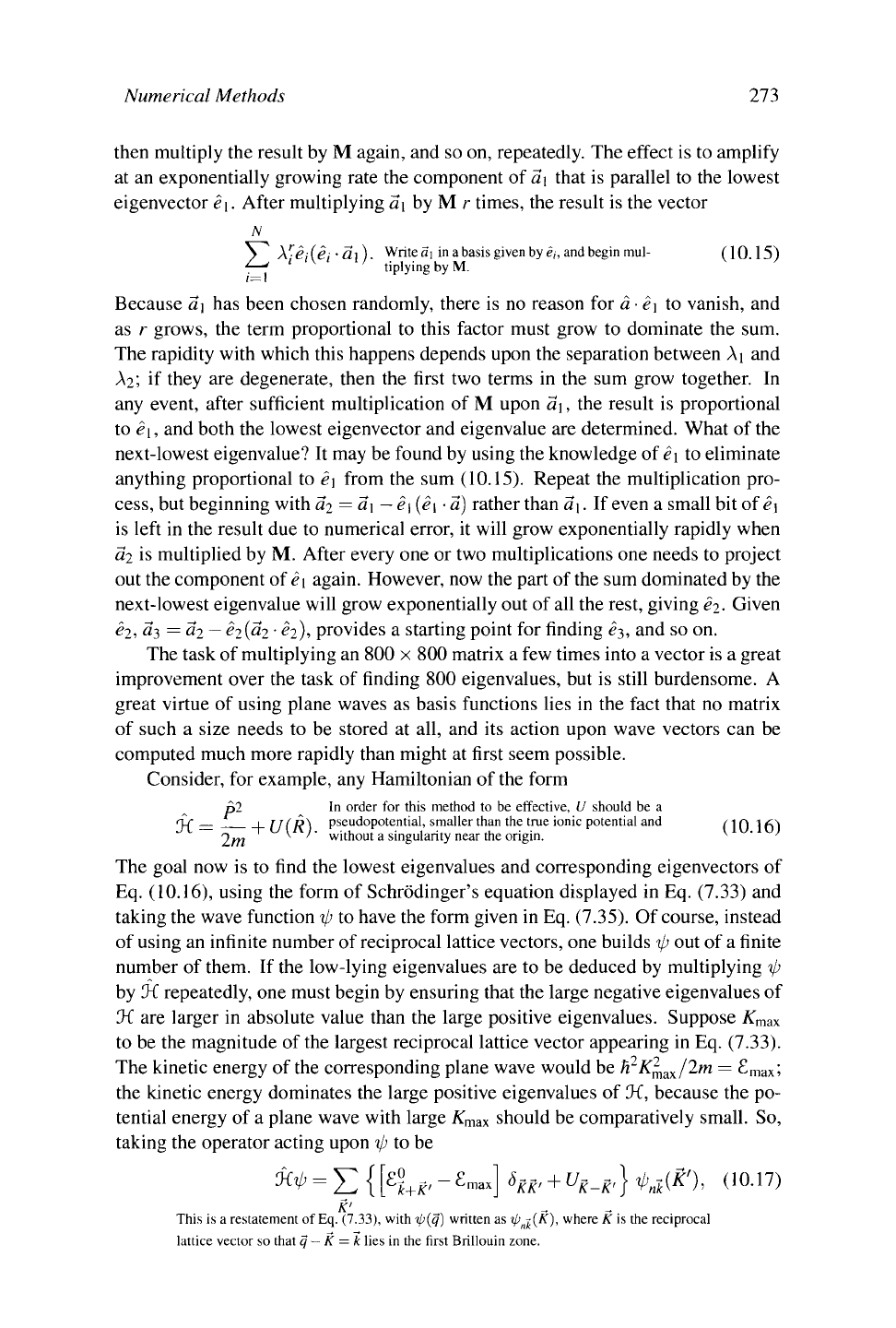
then multiply the result by M again, and so on, repeatedly. The effect is to amplify
at an exponentially growing rate the component of a\ that is parallel to the lowest
eigenvector ê\. After multiplying a\ by M r times, the result is the vector
N
E
\
V
:êi{êi ·α\). Write a\ in a basis given by ê„ and begin mul- (10.15)
' «plying by M.
i=l
Because a\ has been chosen randomly, there is no reason for â-ê\ to vanish, and
as r grows, the term proportional to this factor must grow to dominate the sum.
The rapidity with which this happens depends upon the separation between λι and
\2',
if they are degenerate, then the first two terms in the sum grow together. In
any event, after sufficient multiplication of M upon a\, the result is proportional
to êi, and both the lowest eigenvector and eigenvalue are determined. What of the
next-lowest eigenvalue? It may be found by using the knowledge of ê\ to eliminate
anything proportional to ê\ from the sum (10.15). Repeat the multiplication pro-
cess,
but beginning with
cÎ2
= a\—ê\{ê\-a) rather than a\. If even a small bit of ë\
is left in the result due to numerical error, it will grow exponentially rapidly when
02 is multiplied by M. After every one or two multiplications one needs to project
out the component of
ë\
again. However, now the part of the sum dominated by the
next-lowest eigenvalue will grow exponentially out of all the rest, giving ëi. Given
êi, «3 =
0.2
—
êïiai
-ë-i),
provides a starting point for finding êj, and so on.
The task of multiplying an 800 x 800 matrix a few times into a vector is a great
improvement over the task of finding 800 eigenvalues, but is still burdensome. A
great virtue of using plane waves as basis functions lies in the fact that no matrix
of such a size needs to be stored at all, and its action upon wave vectors can be
computed much more rapidly than might at first seem possible.
Consider, for example, any Hamiltonian of the form
pi In order for this method to be effective, U should be a
ryr \-U (R\ P
seu
d°P
ote
ntial, smaller than the true ionic potential and ( i n I f.\
1™ \ )■ without a singularity near the origin. ^ ' '
The goal now is to find the lowest eigenvalues and corresponding eigenvectors of
Eq. (10.16), using the form of Schrödinger's equation displayed in Eq. (7.33) and
taking the wave function φ to have the form given in Eq. (7.35). Of course, instead
of using an infinite number of reciprocal lattice vectors, one builds ψ out of a finite
number of them. If the low-lying eigenvalues are to be deduced by multiplying ψ
by
"K
repeatedly, one must begin by ensuring that the large negative eigenvalues of
Ji are larger in absolute value than the large positive eigenvalues. Suppose
K
max
to be the magnitude of the largest reciprocal lattice vector appearing in Eq. (7.33).
The kinetic energy of the corresponding plane wave would be /i
2
A'
max
/2m = £
max
;
the kinetic energy dominates the large positive eigenvalues of "K, because the po-
tential energy of a plane wave with large
K
max
should be comparatively small. So,
taking the operator acting upon ψ to be
K' -,
This is a restatement of Eq. (7.33), with rp(q) written as V„j (K), where K is the reciprocal
lattice vector so that a
—
K = k lies in the first Brillouin zone.
274
Chapter 10. Realistic Calculations in Solids
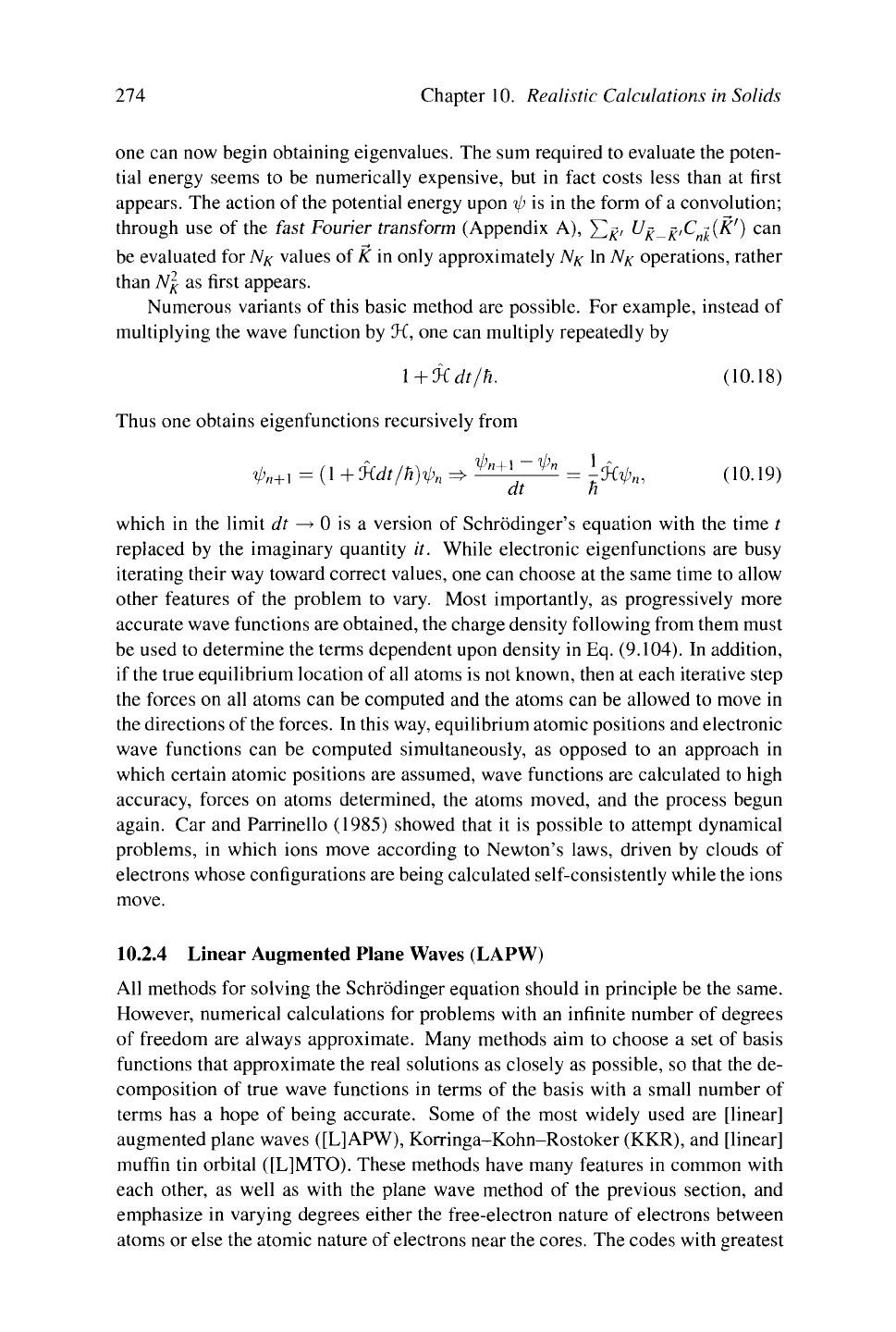
one can now begin obtaining eigenvalues. The sum required to evaluate the poten-
tial energy seems to be numerically expensive, but in fact costs less than at first
appears. The action of the potential energy upon ψ is in the form of a convolution;
through use of the fast Fourier transform (Appendix A), J^,
U^^C^K')
can
be evaluated for Νχ values of K in only approximately Νκ In
N%
operations, rather
than
N%
as first appears.
Numerous variants of this basic method are possible. For example, instead of
multiplying the wave function by
"K,
one can multiply repeatedly by
l +
Mdt/h.
(10.18)
Thus one obtains eigenfunctions recursively from
■ψ
η+λ
= (l+ÎCdt/h)il>
n
=>
ΨΧ+'-Ψ"
=
\<κ>ψ
η
,
(10.19)
dt h
which in the limit dt
—>
0 is a version of Schrödinger's equation with the time t
replaced by the imaginary quantity it. While electronic eigenfunctions are busy
iterating their way toward correct values, one can choose at the same time to allow
other features of the problem to vary. Most importantly, as progressively more
accurate wave functions are obtained, the charge density following from them must
be used to determine the terms dependent upon density in Eq. (9.104). In addition,
if the true equilibrium location of all atoms is not known, then at each iterative step
the forces on all atoms can be computed and the atoms can be allowed to move in
the directions of
the
forces. In this way, equilibrium atomic positions and electronic
wave functions can be computed simultaneously, as opposed to an approach in
which certain atomic positions are assumed, wave functions are calculated to high
accuracy, forces on atoms determined, the atoms moved, and the process begun
again. Car and Parrinello (1985) showed that it is possible to attempt dynamical
problems, in which ions move according to Newton's laws, driven by clouds of
electrons whose configurations are being calculated self-consistently while the ions
move.
10.2.4 Linear Augmented Plane Waves (LAPW)
All methods for solving the Schrödinger equation should in principle be the same.
However, numerical calculations for problems with an infinite number of degrees
of freedom are always approximate. Many methods aim to choose a set of basis
functions that approximate the real solutions as closely as possible, so that the de-
composition of true wave functions in terms of the basis with a small number of
terms has a hope of being accurate. Some of the most widely used are [linear]
augmented plane waves ([L]APW), Korringa-Kohn-Rostoker (KKR), and [linear]
muffin tin orbital ([L]MTO). These methods have many features in common with
each other, as well as with the plane wave method of the previous section, and
emphasize in varying degrees either the free-electron nature of electrons between
atoms or else the atomic nature of electrons near the cores. The codes with greatest
Numerical Methods 275
claim to accuracy tend to be expensive in terms of computational power and mem-
ory usage, while others making more severe approximations run faster on smaller
machines.
This section will briefly discuss augmented plane waves, which are due to
Slater (1937). The starting point is the observation after Eq. (7.47) that Bloch's
theorem provides the possibility of finding wave functions for the entire crystal by
solving Schrödinger's equation within a single unit cell, subject to the boundary
conditions recorded in Eq. (7.49).
In order to make the computation of boundary conditions simple, it is conven-
tional to mangle the periodic potential even beyond the point to which it has been
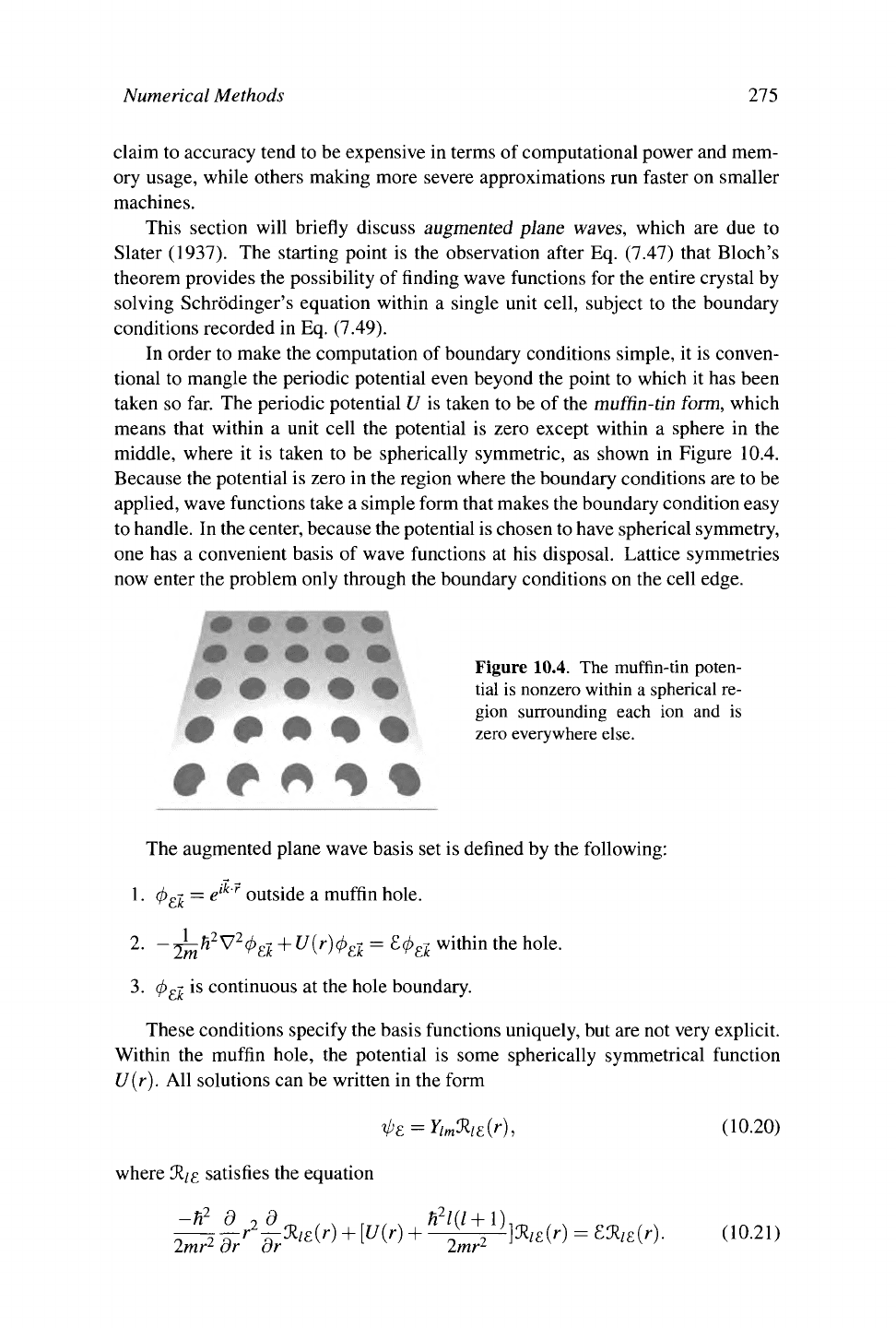
taken so far. The periodic potential U is taken to be of the muffin-tin form, which
means that within a unit cell the potential is zero except within a sphere in the
middle, where it is taken to be spherically symmetric, as shown in Figure 10.4.
Because the potential is zero in the region where the boundary conditions are to be
applied, wave functions take a simple form that makes the boundary condition easy
to handle. In the center, because the potential is chosen to have spherical symmetry,
one has a convenient basis of wave functions at his disposal. Lattice symmetries
now enter the problem only through the boundary conditions on the cell edge.
Figure 10.4. The muffin-tin poten-
tial is nonzero within a spherical re-
gion surrounding each ion and is
zero everywhere else.
The augmented plane wave basis set is defined by the following:
1.
φ^ =
e
lkr
outside a muffin hole.
2.
-^-Η
2
ν
2
φ
ε
ι + υ(Γ)φ
ε
ι = Εφ^ within the hole.
3.
φ
ε
^ is continuous at the hole boundary.
These conditions specify the basis functions uniquely, but are not very explicit.
Within the muffin hole, the potential is some spherically symmetrical function
U(r).
All solutions can be written in the form
#=^AW, (10.20)
where 3?/g satisfies the equation
~
h2 9
:
r
2
~Ji
lE
(r) + [U(r) + ^+H]
K/e
(r) = £K
/£
(r). (10.21)
2mr
2
dr dr 2mr
2
276 Chapter 10. Realistic Calculations in Solids
For an arbitrary £ there are two independent solutions to this equation, one of
which diverges at the origin, while the other diverges at infinity. One must discard
the solution that diverges at the origin, but divergences at infinity are of
no
concern,
because the solution need remain finite no further than the edge of the unit cell.
This second solution is therefore perfectly acceptable, and one can write
oo /
Φεί
= Σ Σ
A
lm
Y
lm
(r)%
e
(r),
(10.22)
/=0 m=-/
where for the moment all of
the
coefficients
A.\
m
are arbitrary. They may be fixed by
application of the condition that the wave function be continuous across the muffin
hole boundary. Recall that
oo /
É^ = 47T^ J2
il
Jl(
kr
)
Y
lmC
k
)
Y
lm(r)- See Landau and Lifshitz (1977), (10.23)
1=0 m=-l
P
'
Then, taking
R/,
to be the radius of the muffin hole, one has
♦"
=
^i«»UW).
00.24)
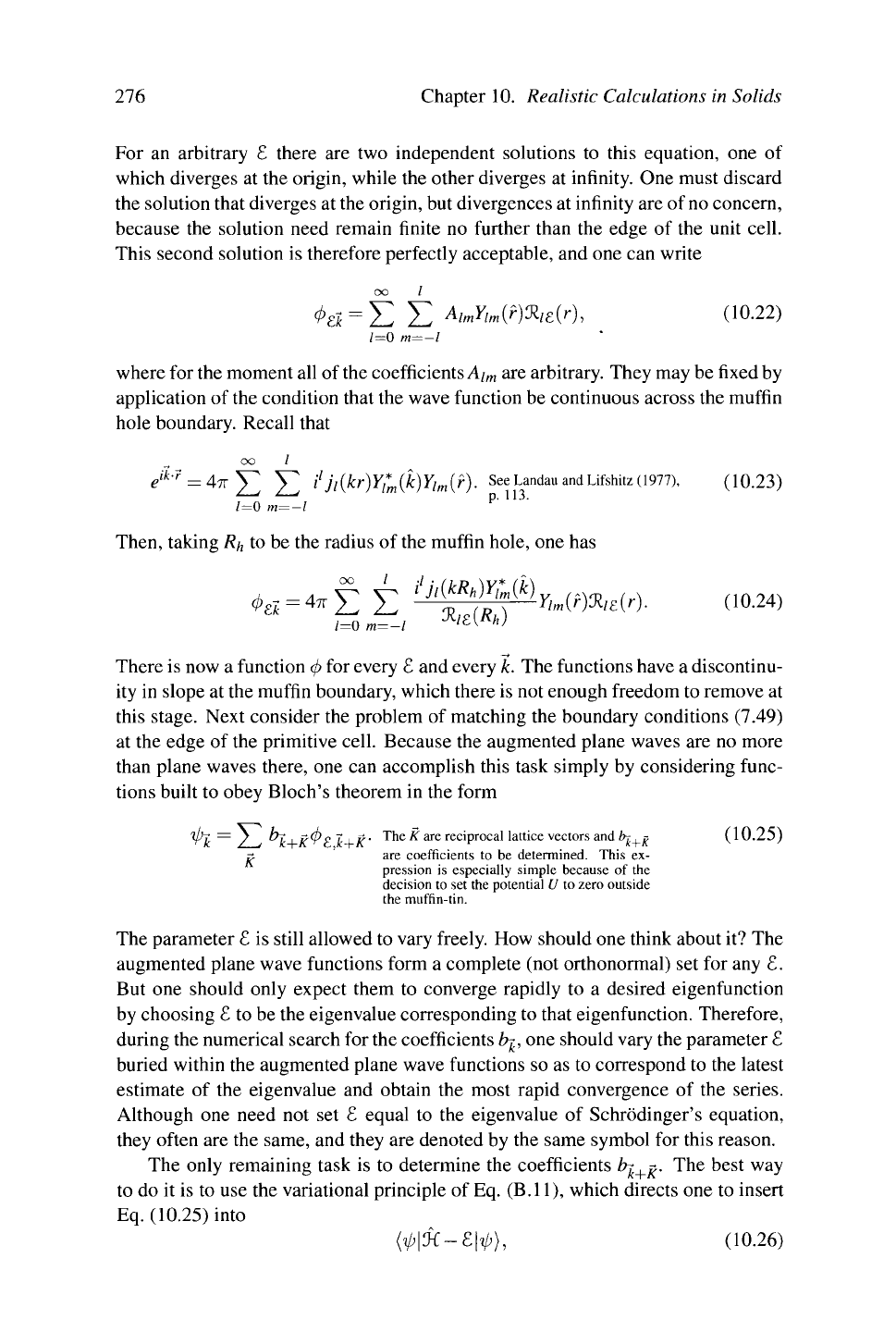
There is now a function φ for every £ and every k. The functions have a discontinu-
ity in slope at the muffin boundary, which there is not enough freedom to remove at
this stage. Next consider the problem of matching the boundary conditions (7.49)
at the edge of the primitive cell. Because the augmented plane waves are no more
than plane waves there, one can accomplish this task simply by considering func-
tions built to obey Bloch's theorem in the form
The K are reciprocal lattice vectors and
b-
k
, g ( 10.25)
are coefficients to be determined. This ex-
pression is especially simple because of the
decision to set the potential U to zero outside
the muffin-tin.
The parameter £ is still allowed to vary freely. How should one think about it? The
augmented plane wave functions form a complete (not orthonormal) set for any £.
But one should only expect them to converge rapidly to a desired eigenfunction
by choosing £ to be the eigenvalue corresponding to that eigenfunction. Therefore,
during the numerical search for the coefficients
b^,
one should vary the parameter £
buried within the augmented plane wave functions so as to correspond to the latest
estimate of the eigenvalue and obtain the most rapid convergence of the series.
Although one need not set £ equal to the eigenvalue of Schrödinger's equation,
they often are the same, and they are denoted by the same symbol for this reason.
The only remaining task is to determine the coefficients b^,^. The best way
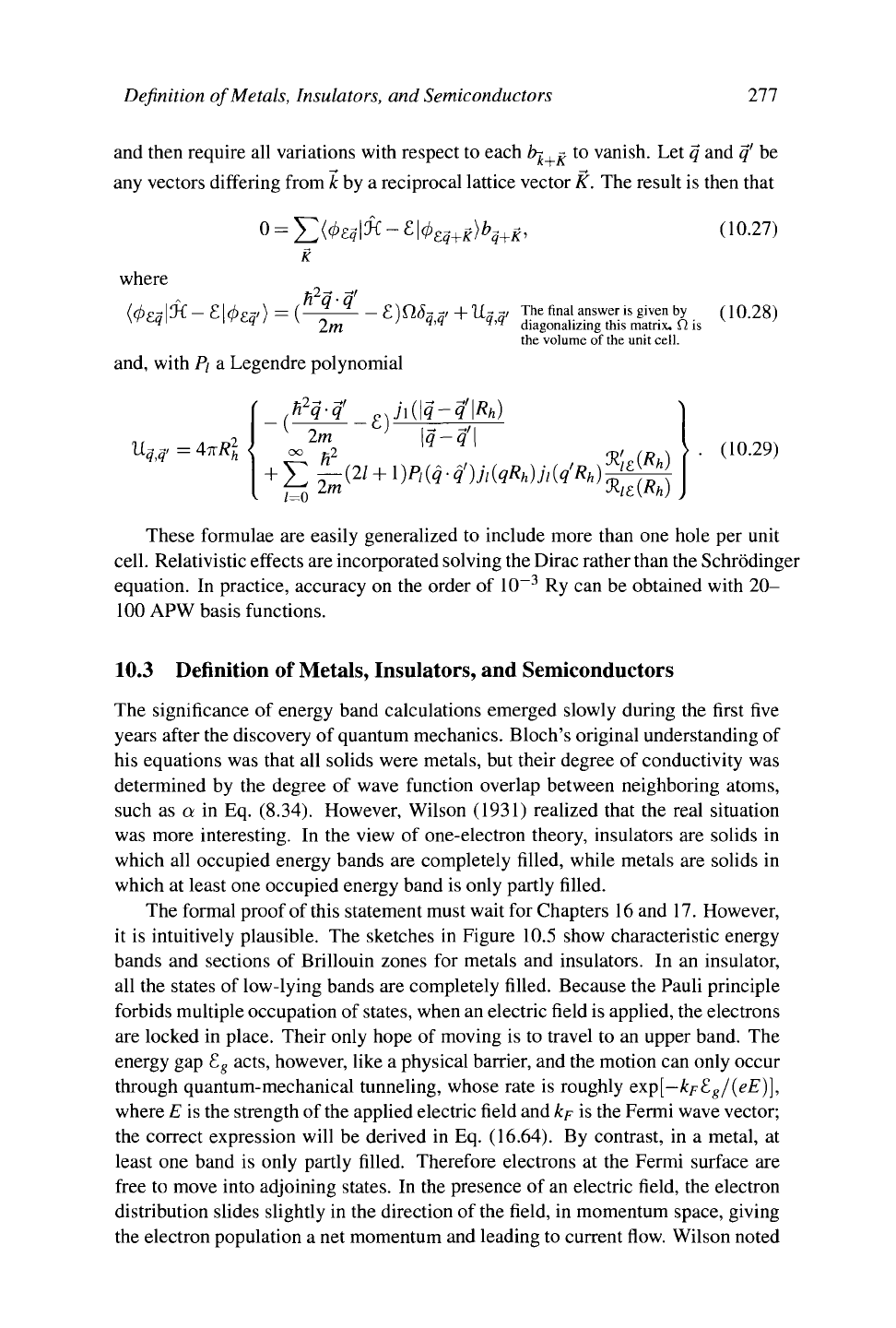
to do it is to use the variational principle of Eq. (B.l
1),
which directs one to insert
Eq. (10.25) into
(</>|A-£|V>), (10.26)
Ψϊ = Σ,
Η+κΦεΜκ-
κ
Definition of Metals, Insulators, and Semiconductors
277
and then require all variations with respect to each
b-
k
,
g to vanish. Let q and a' be
any vectors differing from k by a reciprocal lattice vector K. The result is then that
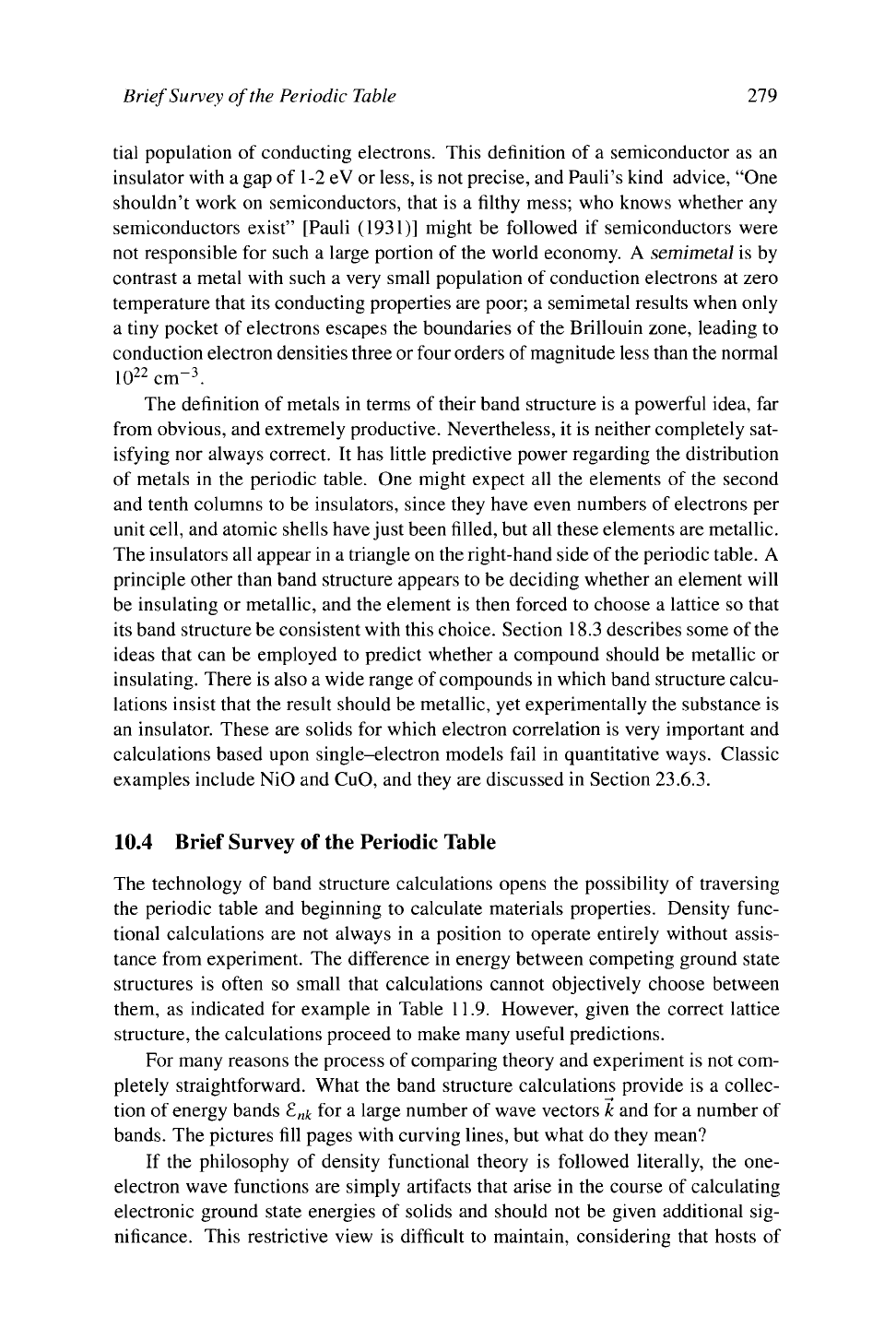
ο =
Σ<^|Α-εμ^^,
(10.27)
where
(φ^
|
Ä - ε
|
ΦΕ? ) = (
n
~P
L
- ε ) Ω%
?
+ Uff The final answer is given by
^ ' i ' 2/jj ^'
v
^" diagonahzing this matrix.
ί
1
is
the
volume of the unit
cell.
and, with P; a Legendre polynomial
U
M
= 4TTRI {
,h
2
q-q'
gJ\{\q-q'\
R
h)
2m
00
n
2
\q-q
(10.28)
>
. (10.29)
These formulae are easily generalized to include more than one hole per unit
cell. Relativistic effects are incorporated solving the Dirac rather than the Schrödinger
equation. In practice, accuracy on the order of 10
-3
Ry can be obtained with 20-
100 APW basis functions.
10.3 Definition of Metals, Insulators, and Semiconductors
The significance of energy band calculations emerged slowly during the first five
years after the discovery of quantum mechanics. Bloch's original understanding of
his equations was that all solids were metals, but their degree of conductivity was
determined by the degree of wave function overlap between neighboring atoms,
such as Q in Eq. (8.34). However, Wilson (1931) realized that the real situation
was more interesting. In the view of one-electron theory, insulators are solids in
which all occupied energy bands are completely filled, while metals are solids in
which at least one occupied energy band is only partly filled.
The formal proof of this statement must wait for Chapters 16 and 17. However,
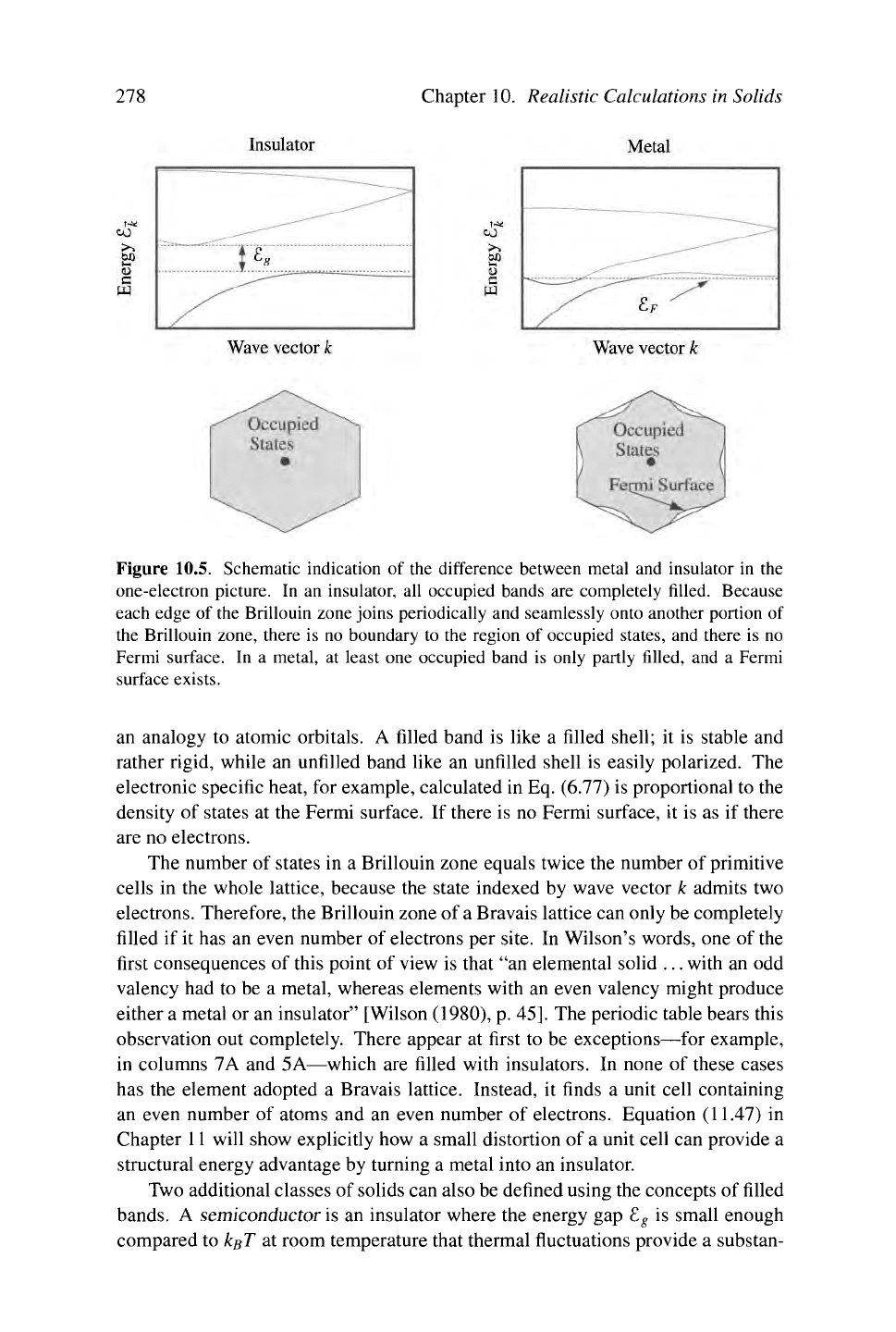
it is intuitively plausible. The sketches in Figure 10.5 show characteristic energy
bands and sections of Brillouin zones for metals and insulators. In an insulator,
all the states of low-lying bands are completely filled. Because the Pauli principle
forbids multiple occupation of
states,
when an electric field is applied, the electrons
are locked in place. Their only hope of moving is to travel to an upper band. The
energy gap E
g
acts, however, like a physical barrier, and the motion can only occur
through quantum-mechanical tunneling, whose rate is roughly exp[—kpE
g
/(eE)},
where E is the strength of
the
applied electric field and kp is the Fermi wave vector;
the correct expression will be derived in Eq. (16.64). By contrast, in a metal, at
least one band is only partly filled. Therefore electrons at the Fermi surface are
free to move into adjoining states. In the presence of an electric field, the electron
distribution slides slightly in the direction of the field, in momentum space, giving
the electron population a net momentum and leading to current flow. Wilson noted
278 Chapter 10. Realistic Calculations in Solids
Figure 10.5. Schematic indication of the difference between metal and insulator in the
one-electron picture. In an insulator, all occupied bands are completely filled. Because
each edge of the Bnllouin zone joins periodically and seamlessly onto another portion of
the Brillouin zone, there is no boundary to the region of occupied states, and there is no
Fermi surface. In a metal, at least one occupied band is only partly filled, and a Fermi
surface exists.
an analogy to atomic orbitals. A filled band is like a filled shell; it is stable and
rather rigid, while an unfilled band like an unfilled shell is easily polarized. The
electronic specific heat, for example, calculated in Eq. (6.77) is proportional to the
density of states at the Fermi surface. If there is no Fermi surface, it is as if there
are no electrons.
The number of states in a Brillouin zone equals twice the number of primitive
cells in the whole lattice, because the state indexed by wave vector k admits two
electrons. Therefore, the Brillouin zone of a Bravais lattice can only be completely
filled if it has an even number of electrons per site. In Wilson's words, one of the
first consequences of this point of view is that "an elemental solid ... with an odd
valency had to be a metal, whereas elements with an even valency might produce
either a metal or an insulator" [Wilson (1980), p. 45]. The periodic table bears this
observation out completely. There appear at first to be exceptions—for example,
in columns 7A and 5A—which are filled with insulators. In none of these cases
has the element adopted a Bravais lattice. Instead, it finds a unit cell containing
an even number of atoms and an even number of electrons. Equation (11.47) in
Chapter 11 will show explicitly how a small distortion of a unit cell can provide a
structural energy advantage by turning a metal into an insulator.
Two additional classes of solids can also be defined using the concepts of filled
bands.
A semiconductor is an insulator where the energy gap
E.
g
is small enough
compared to kßT at room temperature that thermal fluctuations provide a substan-
Brief Survey of the Periodic Table 279
tial population of conducting electrons. This definition of a semiconductor as an
insulator with a gap of 1-2 eV or less, is not precise, and Pauli's kind advice, "One
shouldn't work on semiconductors, that is a filthy mess; who knows whether any
semiconductors exist" [Pauli (1931)] might be followed if semiconductors were
not responsible for such a large portion of the world economy. A semimetal is by
contrast a metal with such a very small population of conduction electrons at zero
temperature that its conducting properties are poor; a semimetal results when only
a tiny pocket of electrons escapes the boundaries of the Brillouin zone, leading to
conduction electron densities three or four orders of magnitude less than the normal
10
22
cm"
3
.
The definition of metals in terms of their band structure is a powerful idea, far
from obvious, and extremely productive. Nevertheless, it is neither completely sat-
isfying nor always correct. It has little predictive power regarding the distribution
of metals in the periodic table. One might expect all the elements of the second
and tenth columns to be insulators, since they have even numbers of electrons per
unit cell, and atomic shells
have
just been filled, but all these elements are metallic.
The insulators all appear in a triangle on the right-hand side of the periodic table. A
principle other than band structure appears to be deciding whether an element will
be insulating or metallic, and the element is then forced to choose a lattice so that
its band structure be consistent with this choice. Section 18.3 describes some of the
ideas that can be employed to predict whether a compound should be metallic or
insulating. There is also a wide range of compounds in which band structure calcu-
lations insist that the result should be metallic, yet experimentally the substance is
an insulator. These are solids for which electron correlation is very important and
calculations based upon single-electron models fail in quantitative ways. Classic
examples include NiO and CuO, and they are discussed in Section
23.6.3.
10.4 Brief Survey of the Periodic Table
The technology of band structure calculations opens the possibility of traversing
the periodic table and beginning to calculate materials properties. Density func-
tional calculations are not always in a position to operate entirely without assis-
tance from experiment. The difference in energy between competing ground state
structures is often so small that calculations cannot objectively choose between
them, as indicated for example in Table 11.9. However, given the correct lattice
structure, the calculations proceed to make many useful predictions.
For many reasons the process of comparing theory and experiment is not com-
pletely straightforward. What the band structure calculations provide is a collec-
tion of energy bands E
n
k for a large number of wave vectors k and for a number of
bands.
The pictures fill pages with curving lines, but what do they mean?
If the philosophy of density functional theory is followed literally, the one-
electron wave functions are simply artifacts that arise in the course of calculating
electronic ground state energies of solids and should not be given additional sig-
nificance. This restrictive view is difficult to maintain, considering that hosts of
280
Chapter 10. Realistic Calculations in Solids
physical properties, ranging from electrical conduction to spontaneous magnetiza-
tion and optical absorption, can be calculated in terms of a single-electron picture.
So it is always interesting to examine the bands the arise during density functional
calculations and ask if transitions between them correspond to experimental obser-
vations. But one cannot be very upset or surprised if predictions obtained in this
way lack quantitative accuracy.
For example, optical experiments described in Section 23.6 measure energy
bands directly, so it is natural to hope that calculated energy bands correspond di-
rectly to these measurable quantities. Seeking predictions about excited electronic
states based on a naïve view of band structures is not completely meaningless, but
characteristically involves errors on the order of 20-50%. For example, the ex-
perimental band gaps of insulators and semiconductors typically differ from band
gaps calculated in density functional theory by this amount. Closer correspon-
dence with experiment is only achieved either through the deliberate incorporation
of small amounts of experimental information into the density functional formal-
ism, or else through lengthy additional calculations that differ from one element to
another and have not yet been formulated as generally applicable procedures.
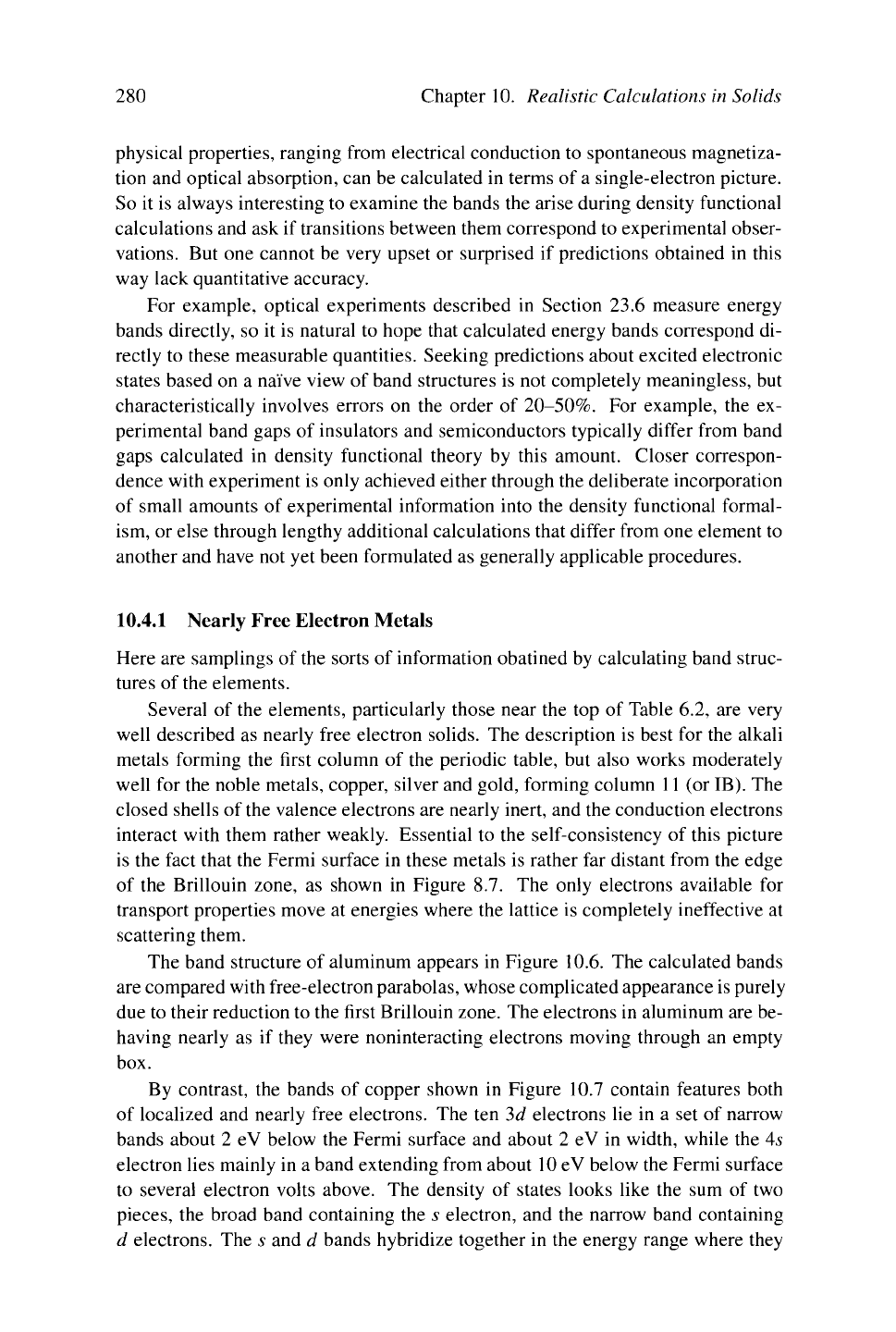
10.4.1 Nearly Free Electron Metals
Here are samplings of the sorts of information obatined by calculating band struc-
tures of the elements.
Several of the elements, particularly those near the top of Table 6.2, are very
well described as nearly free electron solids. The description is best for the alkali
metals forming the first column of the periodic table, but also works moderately
well for the noble metals, copper, silver and gold, forming column 11 (or IB). The
closed shells of the valence electrons are nearly inert, and the conduction electrons
interact with them rather weakly. Essential to the self-consistency of this picture
is the fact that the Fermi surface in these metals is rather far distant from the edge
of the Brillouin zone, as shown in Figure 8.7. The only electrons available for
transport properties move at energies where the lattice is completely ineffective at
scattering them.
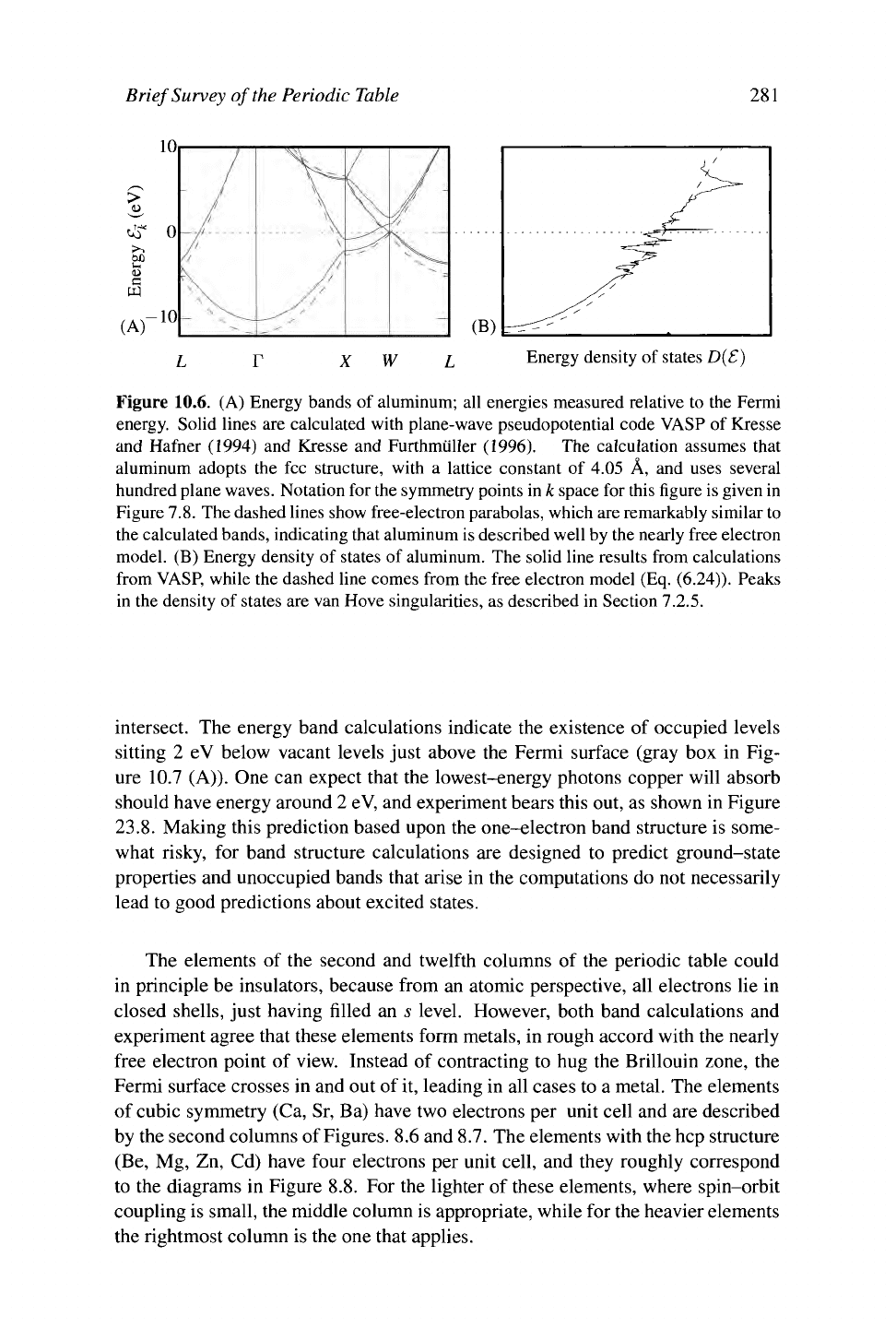
The band structure of aluminum appears in Figure 10.6. The calculated bands
are compared with free-electron parabolas, whose complicated appearance is purely
due to their reduction to the first Brillouin zone. The electrons in aluminum are be-
having nearly as if they were noninteracting electrons moving through an empty
box.
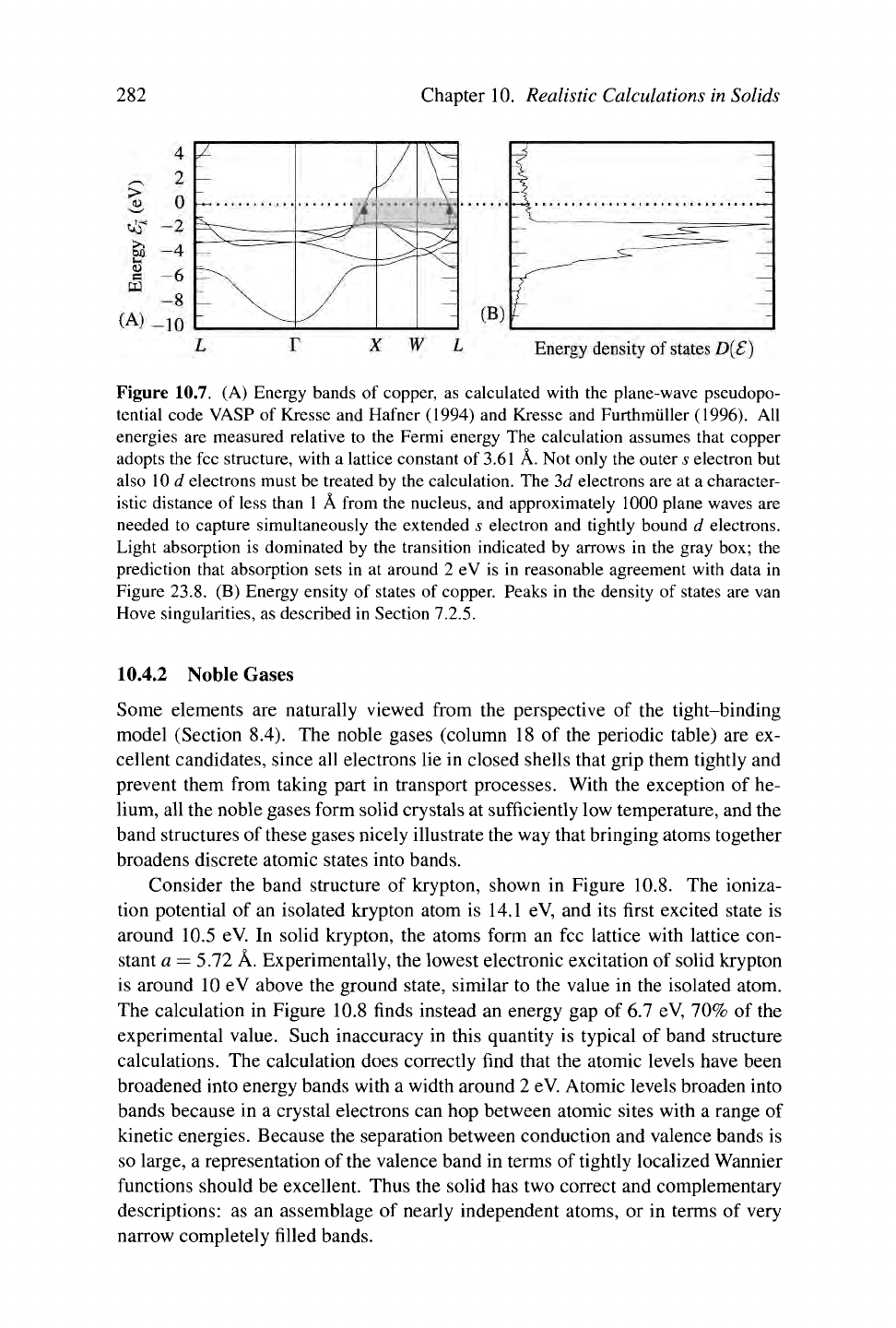
By contrast, the bands of copper shown in Figure 10.7 contain features both
of localized and nearly free electrons. The ten 3d electrons lie in a set of narrow
bands about 2 eV below the Fermi surface and about 2 eV in width, while the 4s
electron lies mainly in a band extending from about 10 eV below the Fermi surface
to several electron volts above. The density of states looks like the sum of two
pieces, the broad band containing the s electron, and the narrow band containing
d electrons. The s and d bands hybridize together in the energy range where they
Brief Survey of the Periodic Table
10
>
<ύ~
0
ËP
G
w
£ p X W L Energy density of states £)(£)
Figure 10.6. (A) Energy bands of aluminum; all energies measured relative to the Fermi
energy. Solid lines are calculated with plane-wave pseudopotential code VASP of Kresse
and Hafner (1994) and Kresse and Furthmuller (1996). The calculation assumes that
aluminum adopts the fee structure, with a lattice constant of 4.05 Â, and uses several
hundred plane waves. Notation for the symmetry points in k space for this figure is given in
Figure 7.8. The dashed lines show free-electron parabolas, which are remarkably similar to
the calculated bands, indicating that aluminum is described well by the nearly free electron
model. (B) Energy density of states of aluminum. The solid line results from calculations
from VASP, while the dashed line comes from the free electron model (Eq. (6.24)). Peaks
in the density of states are van Hove singularities, as described in Section 7.2.5.
intersect. The energy band calculations indicate the existence of occupied levels
sitting 2 eV below vacant levels just above the Fermi surface (gray box in Fig-
ure 10.7 (A)). One can expect that the lowest-energy photons copper will absorb
should have energy around 2 eV, and experiment bears this out, as shown in Figure
23.8.
Making this prediction based upon the one-electron band structure is some-
what risky, for band structure calculations are designed to predict ground-state
properties and unoccupied bands that arise in the computations do not necessarily
lead to good predictions about excited states.
The elements of the second and twelfth columns of the periodic table could
in principle be insulators, because from an atomic perspective, all electrons lie in
closed shells, just having filled an s level. However, both band calculations and
experiment agree that these elements form metals, in rough accord with the nearly
free electron point of view. Instead of contracting to hug the Brillouin zone, the
Fermi surface crosses in and out of it, leading in all cases to a metal. The elements
of cubic symmetry (Ca, Sr, Ba) have two electrons per unit cell and are described
by the second columns of Figures. 8.6 and 8.7. The elements with the hep structure
(Be,
Mg, Zn, Cd) have four electrons per unit cell, and they roughly correspond
to the diagrams in Figure 8.8. For the lighter of these elements, where spin-orbit
coupling is small, the middle column is appropriate, while for the heavier elements
the rightmost column is the one that applies.
281
282
Chapter 10. Realistic Calculations in Solids
Figure 10.7. (A) Energy bands of copper, as calculated with the plane-wave pseudopo-
tential code VASP of Kresse and Hafner (1994) and Kresse and Furthmiiller (1996). All
energies are measured relative to the Fermi energy The calculation assumes that copper
adopts the fee structure, with a lattice constant of 3.61 Â. Not only the outer s electron but
also 10
c?
electrons must be treated by the calculation. The 3d electrons are at a character-
istic distance of less than 1 Â from the nucleus, and approximately 1000 plane waves are
needed to capture simultaneously the extended s electron and tightly bound d electrons.
Light absorption is dominated by the transition indicated by arrows in the gray box; the
prediction that absorption sets in at around 2 eV is in reasonable agreement with data in
Figure 23.8. (B) Energy ensity of states of copper. Peaks in the density of states are van
Hove singularities, as described in Section 7.2.5.
10.4.2 Noble Gases
Some elements are naturally viewed from the perspective of the tight-binding
model (Section 8.4). The noble gases (column 18 of the periodic table) are ex-
cellent candidates, since all electrons lie in closed shells that grip them tightly and
prevent them from taking part in transport processes. With the exception of he-
lium, all the noble gases form solid crystals at sufficiently low temperature, and the
band structures of these gases nicely illustrate the way that bringing atoms together
broadens discrete atomic states into bands.
Consider the band structure of krypton, shown in Figure 10.8. The ioniza-
tion potential of an isolated krypton atom is 14.1 eV, and its first excited state is
around 10.5 eV. In solid krypton, the atoms form an fee lattice with lattice con-
stant a = 5.72 Â. Experimentally, the lowest electronic excitation of solid krypton
is around 10 eV above the ground state, similar to the value in the isolated atom.
The calculation in Figure 10.8 finds instead an energy gap of 6.7 eV, 70% of the
experimental value. Such inaccuracy in this quantity is typical of band structure
calculations. The calculation does correctly find that the atomic levels have been
broadened into energy bands with a width around 2 eV. Atomic levels broaden into
bands because in a crystal electrons can hop between atomic sites with a range of
kinetic energies. Because the separation between conduction and valence bands is
so large, a representation of the valence band in terms of tightly localized Wannier
functions should be excellent. Thus the solid has two correct and complementary
descriptions: as an assemblage of nearly independent atoms, or in terms of very
narrow completely filled bands.