
Marder M.P. Condensed Matter Physics
Подождите немного. Документ загружается.

Brief Survey of the Periodic Table 283
>
OJ
ε?
(U
c
m
10
(A)
il O.
T.t. T.
(B)
X W
Energy density of states D(£)
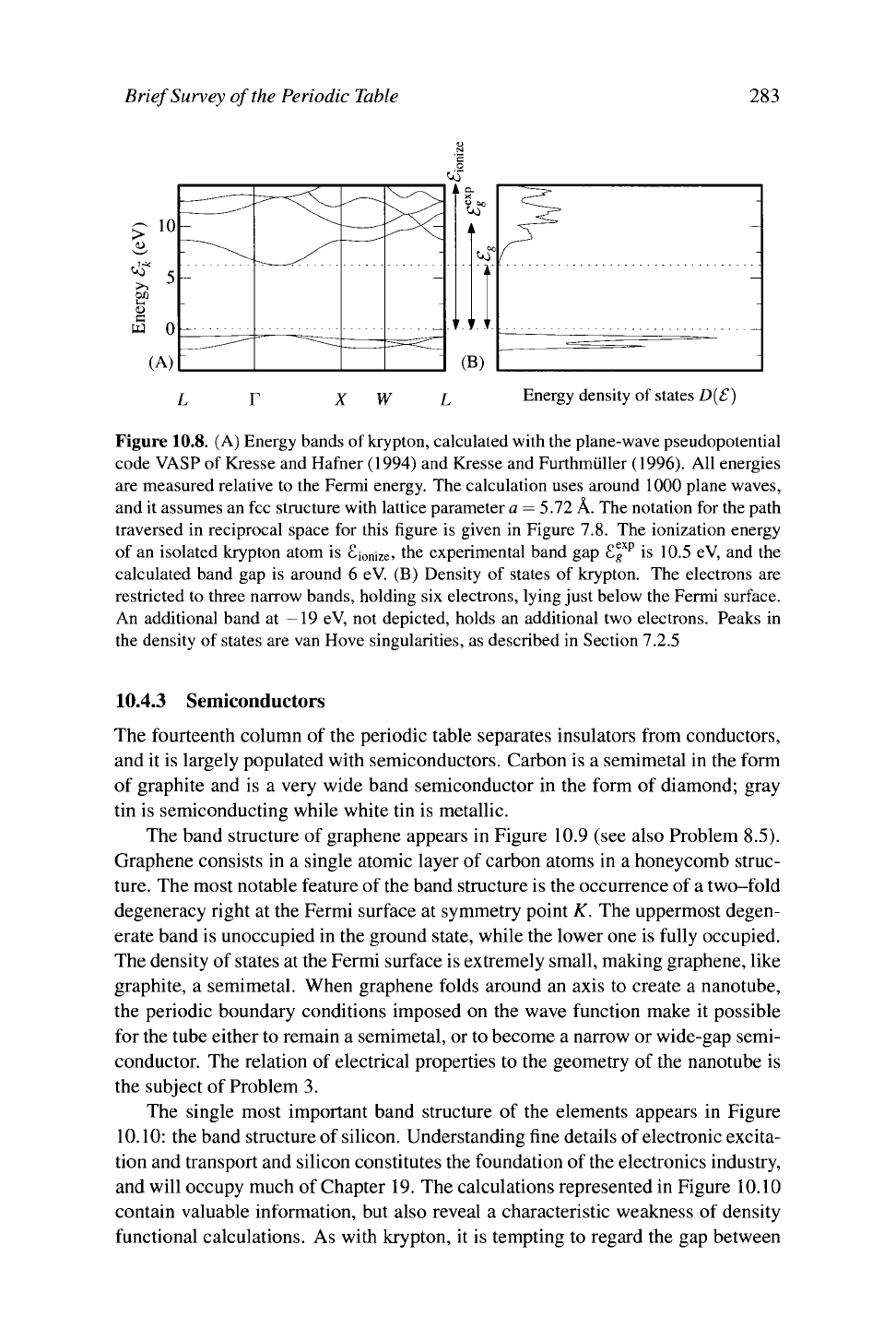
Figure 10.8. (A) Energy bands of
krypton,
calculated with the plane-wave pseudopotential
code VASP of Kresse and Hafner (1994) and Kresse and Furthmiiller (1996). All energies
are measured relative to the Fermi energy. The calculation uses around 1000 plane waves,
and it assumes an fee structure with lattice parameter a = 5.72 Â. The notation for the path
traversed in reciprocal space for this figure is given in Figure 7.8. The ionization energy
of an isolated krypton atom is
£j
on
j
ze
,
the experimental band gap £™
p
is 10.5 eV, and the
calculated band gap is around 6 eV. (B) Density of states of krypton. The electrons are
restricted to three narrow bands, holding six electrons, lying just below the Fermi surface.
An additional band at —19 eV, not depicted, holds an additional two electrons. Peaks in
the density of states are van Hove singularities, as described in Section 7.2.5
10.4.3 Semiconductors
The fourteenth column of the periodic table separates insulators from conductors,
and it is largely populated with semiconductors. Carbon is a semimetal in the form
of graphite and is a very wide band semiconductor in the form of diamond; gray
tin is semiconducting while white tin is metallic.
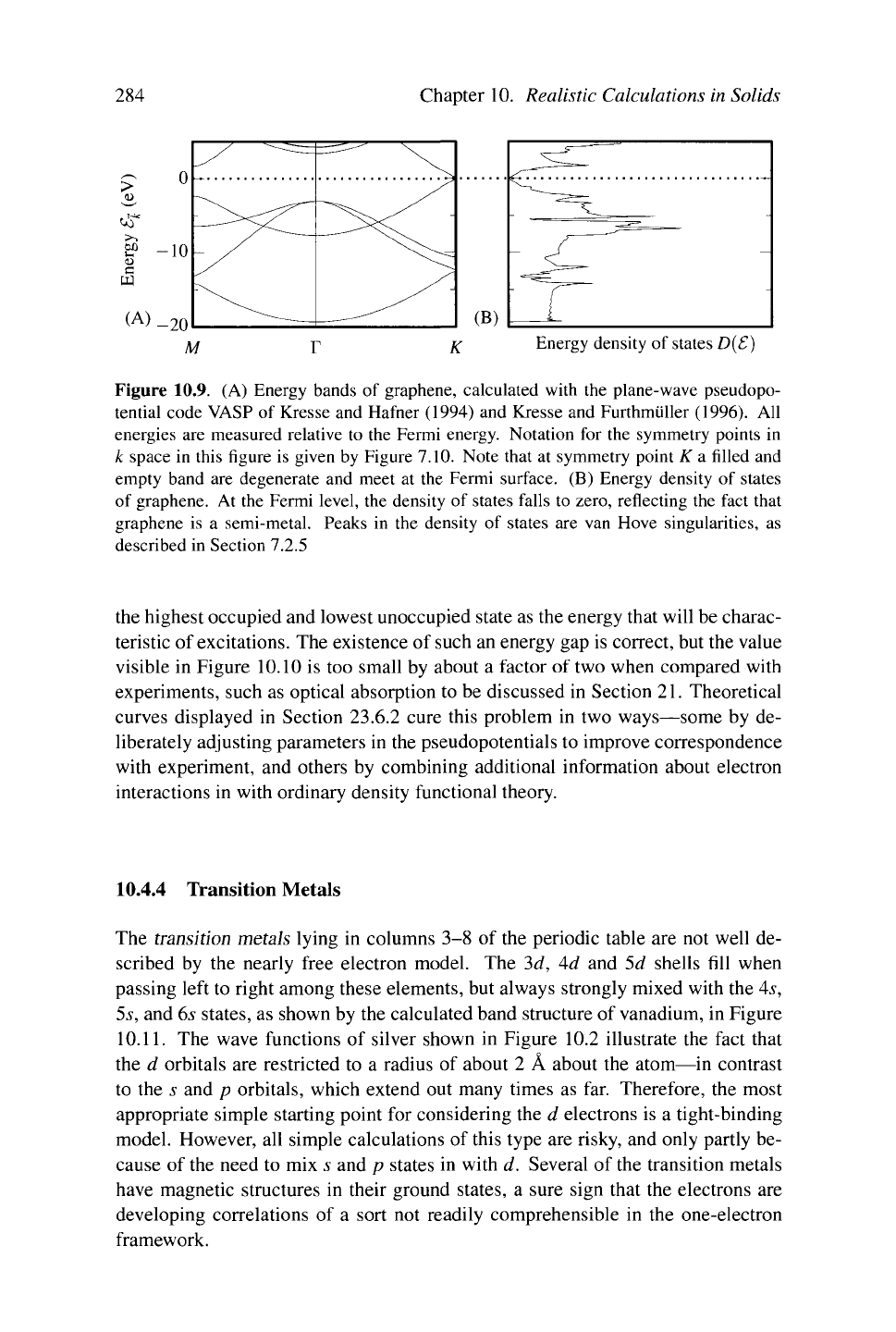
The band structure of graphene appears in Figure 10.9 (see also Problem 8.5).
Graphene consists in a single atomic layer of carbon atoms in a honeycomb struc-
ture.
The most notable feature of the band structure is the occurrence of a two-fold
degeneracy right at the Fermi surface at symmetry point K. The uppermost degen-
erate band is unoccupied in the ground state, while the lower one is fully occupied.
The density of states at the Fermi surface is extremely small, making graphene, like
graphite, a semimetal. When graphene folds around an axis to create a nanotube,
the periodic boundary conditions imposed on the wave function make it possible
for the tube either to remain a semimetal, or to become a narrow or wide-gap semi-
conductor. The relation of electrical properties to the geometry of the nanotube is
the subject of Problem 3.
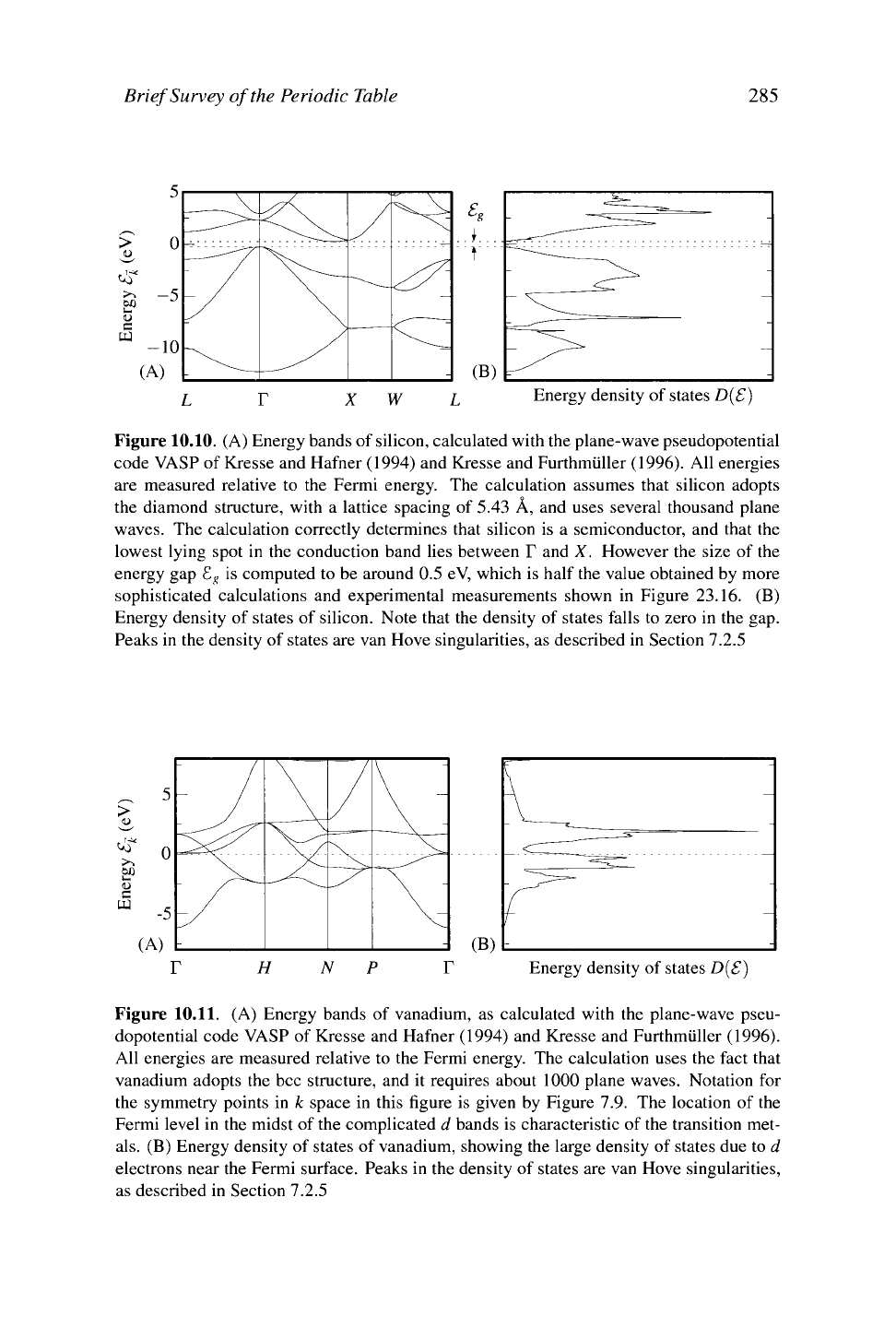
The single most important band structure of the elements appears in Figure
10.10:
the band structure of
silicon.
Understanding fine details of electronic excita-
tion and transport and silicon constitutes the foundation of the electronics industry,
and will occupy much of Chapter 19. The calculations represented in Figure 10.10
contain valuable information, but also reveal a characteristic weakness of density
functional calculations. As with krypton, it is tempting to regard the gap between
284 Chapter 10. Realistic Calculations in Solids
M T K Energy density of states D{E)
Figure 10.9. (A) Energy bands of graphene, calculated with the plane-wave pseudopo-
tential code VASP of Kresse and Hafner (1994) and Kresse and Furthmiiller (1996). All
energies are measured relative to the Fermi energy. Notation for the symmetry points in
k space in this figure is given by Figure 7.10. Note that at symmetry point K a filled and
empty band are degenerate and meet at the Fermi surface. (B) Energy density of states
of graphene. At the Fermi level, the density of states falls to zero, reflecting the fact that
graphene is a semi-metal. Peaks in the density of states are van Hove singularities, as
described in Section 7.2.5
the highest occupied and lowest unoccupied state as the energy that will be charac-
teristic of excitations. The existence of such an energy gap is correct, but the value
visible in Figure 10.10 is too small by about a factor of two when compared with
experiments, such as optical absorption to be discussed in Section 21. Theoretical
curves displayed in Section 23.6.2 cure this problem in two ways—some by de-
liberately adjusting parameters in the pseudopotentials to improve correspondence
with experiment, and others by combining additional information about electron
interactions in with ordinary density functional theory.
10.4.4 Transition Metals
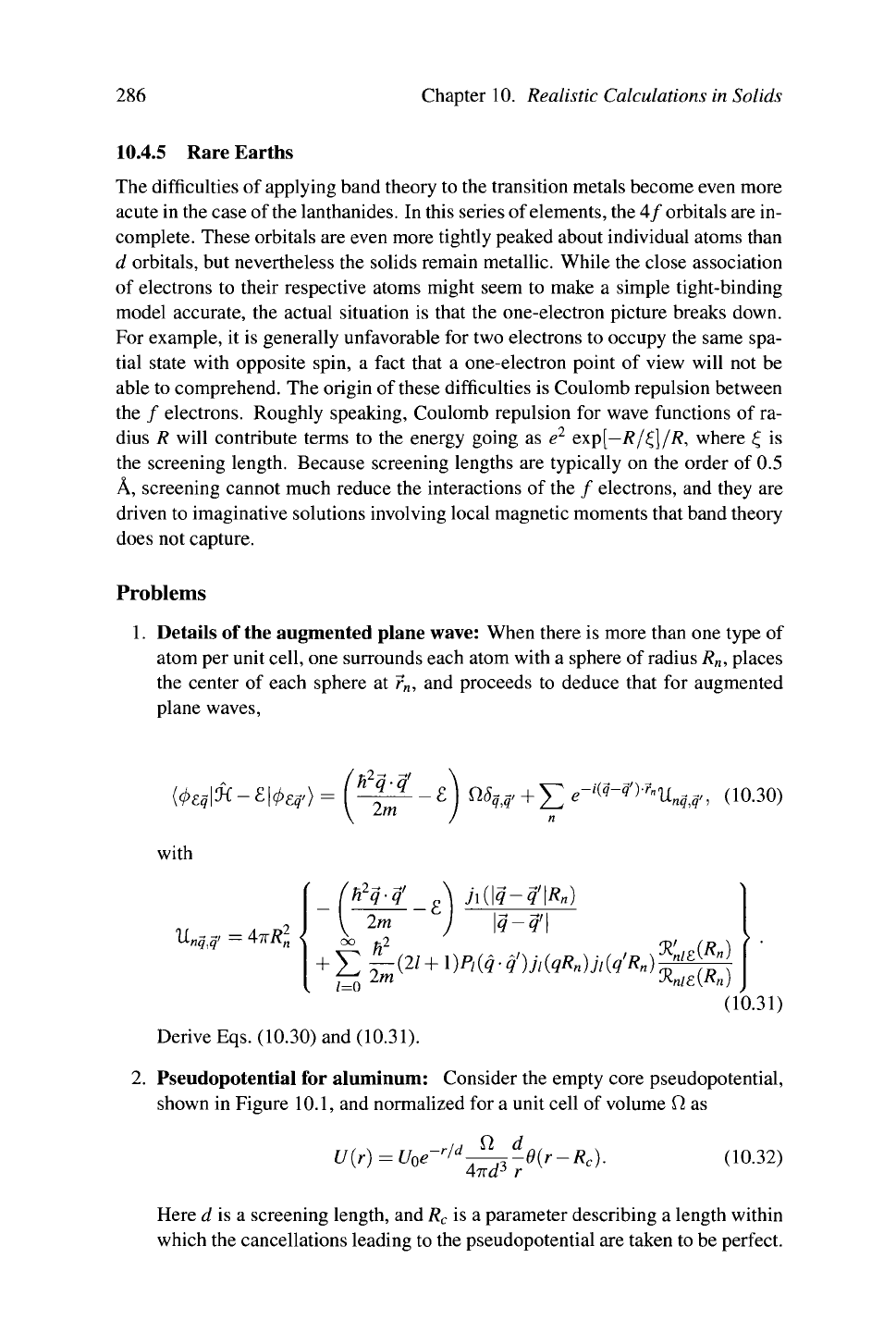
The transition metals lying in columns 3-8 of the periodic table are not well de-
scribed by the nearly free electron model. The 3d, Ad and 5d shells fill when
passing left to right among these elements, but always strongly mixed with the As,
5s,
and 6s states, as shown by the calculated band structure of vanadium, in Figure
10.11.
The wave functions of silver shown in Figure 10.2 illustrate the fact that
the d orbitals are restricted to a radius of about 2 Â about the atom—in contrast
to the s and p orbitals, which extend out many times as far. Therefore, the most
appropriate simple starting point for considering the d electrons is a tight-binding
model. However, all simple calculations of this type are risky, and only partly be-
cause of the need to mix s and p states in with d. Several of the transition metals
have magnetic structures in their ground states, a sure sign that the electrons are
developing correlations of a sort not readily comprehensible in the one-electron
framework.
Brief Survey of the Periodic Table
285
X W L
Energy density of states D(£)
Figure 10.10. (A) Energy bands of silicon, calculated with the plane-wave pseudopotential
code VASP of Kresse and Hafner (1994) and Kresse and Furthmiiller (1996). All energies
are measured relative to the Fermi energy. The calculation assumes that silicon adopts
the diamond structure, with a lattice spacing of 5.43 Â, and uses several thousand plane
waves. The calculation correctly determines that silicon is a semiconductor, and that the
lowest lying spot in the conduction band lies between Γ and X. However the size of the
energy gap £
Ä
is computed to be around 0.5 eV, which is half the value obtained by more
sophisticated calculations and experimental measurements shown in Figure 23.16. (B)
Energy density of states of silicon. Note that the density of states falls to zero in the gap.
Peaks in the density of states are van Hove singularities, as described in Section 7.2.5
Energy density of states D(£)
Figure
10.11.
(A) Energy bands of vanadium, as calculated with the plane-wave pseu-
dopotential code VASP of Kresse and Hafner (1994) and Kresse and Furthmiiller (1996).
All energies are measured relative to the Fermi energy. The calculation uses the fact that
vanadium adopts the bcc structure, and it requires about 1000 plane waves. Notation for
the symmetry points in k space in this figure is given by Figure 7.9. The location of the
Fermi level in the midst of the complicated d bands is characteristic of the transition met-
als.
(B) Energy density of states of vanadium, showing the large density of states due to d
electrons near the Fermi surface. Peaks in the density of states are van Hove singularities,
as described in Section 7.2.5
286 Chapter 10. Realistic Calculations in Solids
10.4.5 Rare Earths
The difficulties of applying band theory to the transition metals become even more
acute in the case of the lanthanides. In this series of elements, the 4/ orbitals are in-
complete. These orbitals are even more tightly peaked about individual atoms than
d orbitals, but nevertheless the solids remain metallic. While the close association
of electrons to their respective atoms might seem to make a simple tight-binding
model accurate, the actual situation is that the one-electron picture breaks down.
For example, it is generally unfavorable for two electrons to occupy the same spa-
tial state with opposite spin, a fact that a one-electron point of view will not be
able to comprehend. The origin of these difficulties is Coulomb repulsion between
the / electrons. Roughly speaking, Coulomb repulsion for wave functions of ra-
dius R will contribute terms to the energy going as e
2
exp [—/?/£]//?, where ξ is
the screening length. Because screening lengths are typically on the order of 0.5
Â, screening cannot much reduce the interactions of the / electrons, and they are
driven to imaginative solutions involving local magnetic moments that band theory
does not capture.
Problems
1
Details of the augmented plane wave: When there is more than one type of
atom per unit cell, one surrounds each atom with a sphere of radius R
n
, places
the center of each sphere at r
n
, and proceeds to deduce that for augmented
plane waves,
(Φεΐ\ΰ-ε\Φεψ)
1m
£ )
n-W
+ E^'^îW'
(
10
-
3
°)
with
iW =
4irR
l
<
'tfq·? _Λ M\q-?\Rn)
00
h
2
1=0
2m
2m'
\q-q
+ £ f-(2/ +
l)P,(q■
q'mqRMiq'Rn)^'^
>
.
&ηΐε(Κη)
(10.31)
Derive Eqs. (10.30) and (10.31).
2.
Pseudopotential for aluminum: Consider the empty core pseudopotential,
shown in Figure
10.1,
and normalized for a unit cell of volume Ω as
V(r) = U
0
e-^^9(r-R
c
). (10.32)
Here d is a screening length, and R
c
is a parameter describing a length within
which the cancellations leading to the pseudopotential are taken to be perfect.
Problems 287
The goal is to determine i/o, R
c
, and d. The experimental data that make
it possible come from the de Haas-van Alphen effect (Section 16.5.2) and
optical data, as in Problem 2 of Chapter
23.
However, all one needs to know
is that it has been possible to measure the Fourier transform U
q
defined in
Eq. (7.26), at two reciprocal lattice vectors, and the results for aluminum are
t/
(in)
=0.245 eV (10.33)
^(200) =
°·
762
eV
· (10.34)
The reciprocal lattice vectors are being described by their Miller indices and
are measured in units of 2-π/α.
In addition, the Fermi energy, measured relative to the lowest-energy k state,
is
£jr = 11.7eV, (10.35)
which can be used in Eq. (10.13).
(a) Take the Fourier transform of
Eq.
(10.32).
(b) Determine i/o, d, and R
c
by finding a reasonable fit of Eq. (10.32) to the
measured values Eq. (10.33), (10.34), and (10.13). The agreement cannot be
perfect, because one is trying to fit three parameters with two variables. Use
any nonlinear fitting routine, or use a process of trial and error as convenient.
The final values should be close to those listed after Eq. (10.38).
3.
Nanotube conductivity: An (m, n) nanotube was defined in Problem 1.3 to
be a graphene sheet rolled up so that the atom
&Xc
= ma\ +««2 finds itself back
at the origin, where a\ and
Ü2
are primitive vectors of the graphene sheet.
(a) Argue that for an (m, n) nanotube, allowed Bloch vectors k must satisfy
k-C = 2nl. Where / is an integer. (10.36)
(b) Consulting Figures 10.9 and 7.10, note that the nanotube should be expected
to be metallic if symmetry point K is an allowed value of k, and a semicon-
ductor or insulator otherwise. Show for positive m, n, that the condition for K
to be an allowed value of k is
m = n Or m — n = 3j. Where j is an integer. (10.37)
The nanotubes with n = m are in fact all metallic, while those with m
— n
= 3j
are very narrow-band semi-conductors at very low temperatures, and effec-
tively metallic at room temperature. The remaining nanotubes are semicon-
ductors. See Louie (2001) or Charlier et al. (2007).
4.
Plane wave band structure, part I: The following five problems outline the
construction of a primitive plane wave band structure code. The programming
task can be carried out in any language, but the computing environment should
be one that
288 Chapter 10. Realistic Calculations in Solids
• can carry out complex arithmetic, including multiplication and exponentia-
tion of complex numbers, and
• can take the (discrete) Fourier transform of a three-dimensional array of
complex numbers.
The first task is to write a subroutine that takes two arguments. The first is
c(i, j), an N x M-dimensional array of complex numbers. The second is an
integer, i\. The columns of c are orthonormal up to i\
—
\. The task of the
subroutine is to replace the i'ith column of c with a column that is orthogonal
to the preceding i\
—
l columns and normalized to unity. Test the program on
the following numbers:
c(i,l) c(i,2) c(i,3) c(i,4)
(0.258198887,0.516397774) (-0.392356962,-0.249681681) (0.303851753,0.138416067) 0
(0.774596632,0.258198887) (0.321019441,-0.071337625) (-0.221133977,0.082717843) 2
(0..0.) (0.107006453,0.749045134) (0.097649745,-0.087221026) 1
(0.,0.) (0.321019351,0.) (0.889513135,0.156192154) 0
The first three columns are orthonormal. Find c(i, 4).
5.
Band structure, part II: Consider the Fourier transform of the pseudopo-
tential in Figure 10.1
u
*-
Uoe
dK[*&
+ i] ·
(ia38)
Take d = 0.350, R
c
= 0.943, and i/o = —31.30 (the units are angstroms and
electron volts). These numbers are appropriate for aluminum and are the sub-
ject of Problem 2. The task is to compute
U(r) = Σ S^Ug, (10.39)
taking K to be the reciprocal lattice vectors of
an
fee lattice of spacing a = 4.05
(Â).
(a) Find Ug
=0
-
(b) Use Eq. (2.4) to construct the primitive vectors of the reciprocal lattice.
(c) Consult Appendix A.6 for guidance on the use of the fast Fourier transform.
Obtain a routine capable of performing the transform forN xN xN arrays of
numbers; the problems will use
TV
= 4, 5, 8, and 12. If such a routine cannot
be located, the problems can be performed for
TV
= 4, 8 only.
(d) For a given value of N, for what values of r will a fast Fourier transform
routine compute U(r), and how will they be indexed?
(e) Use the routine to evaluate Eq. (10.39), taking N
—
5, and printing the 125
values of U(r) and r in the Wigner-Seitz cell. Here are some of the values.
The first three numbers are x, y, and z coordinates of r in angstroms, and the
final number is the value of the potential U(r) in Rydbergs.
Problems 289
405
405
405
405
0.
0.405
0.810
1.215
1.620
0.
0.405
0.810
1.215
0.
0.405
0.810
1 .215
1
.
620
0.405
0.810
1.215
1.
620
0.201763183,0
-0.201839209,0
-0.757843018,0
-0.757843018,0
-0.201839209,0
-0.201839194,0
-0.658886611,0
-0.718343496,0
-0.734894872,0
If only
TV
= 4 is possible, then U does not come out to be real; the first values,
in Rydbergs, are
50625
50625
50625
0.
0.50625
1.01250
1.51875
0.
0.50625
1.01250
0.
0.50625
1.01250
1.51875
0.50625
1.01250
1.51875
0.166458577, 0
-0.265354961,
0
-0.911596537,
0
-0.265354961,-0
-0.265354931,
0
-0.591810703,-0
-0.781587422,
0
)
240282357)
)
240282357)
240282387)
186816186)
103971817)
6. Plane wave band structure, part
III:
Consider Schrödinger's equation in the
form of Eq. (7.33).
The task is to find the lowest-lying eigenvalue δ and eigenfunction ψ solving
this equation with the potential given by Eq. (10.38). Look for a solution with
Bloch index k = 0; essentially, this means that one sets q = 0 in Eq. (7.33).
Restrict all calculations to the 5 x 5 x 5 set of K considered in the previous
portion of the problem.
(a) Define a
5
x 5 x 5 complex array ψ(Κ). Let £
max
be £^ , where
K
max
is the
largest value of K under consideration. Write a routine to compute
^(£) = (£|-£
max
)^)
+
Ç^(^-^)·
Κ'
(10.40)
The hard part of the computation is the convolution ]Γ^, Ug,ip(K
—
K'). To
perform the convolution, use the fact that
Σ
U^(K-K')
= ^[Γ'^χϊ-'^ί)]]; (10.41)
that is, take the inverse Fourier transforms of U and i/>, form a new array by
multiplying together each element of U and ψ, take the Fourier transform of
the result, and divide by
TV
3
.
This procedure is vastly faster than performing
the sums described by the convolution directly.
(b) To find the ground state of
Eq.
(7.33),
i. Choose some random initial normalized ψ(Κ), such as ψ(0) = 1, with all
other components zero.
ii.
Find
-φ'
according to Eq. (10.40).
iii.
Normalize ψ'.
iv. Put
-ψ'
back into the right-hand side of
Eq.
(10.40), and find ψ".
v. Normalize ψ".
290
Chapter 10. Realistic Calculations in Solids
vi.
Continue in this fashion until the process converges. One should be left
with the lowest-energy eigenstate of Schrödinger's equation.
vii.
What is the eigenvalue £ of this state from Eq. (7.33)?
7.
Plane wave band structure, part IV: Consider again the potential given in
Eq. (10.38). The new task is to compute the lowest-lying six eigenvalues £ ^
of
(ε
0
ξ
-ε)ψ(ξ)+Σ
U^iq-'K')
(10.42)
K<
for
k =
[2π/α](Λ .4 .4), and a
=
4.05Â. Combine the routine for comput-
ing action of the Hamiltonian on wave functions with the orthogonalization
routine Problem 4. Use an 8 x 8 x 8 grid for K.
For the first four eigenvalues, on 8 x 8 x 8 and 12 x 12 x 12 grids one has the
following in Rydbergs:
8x8x8
-0.27
0.13
1.17
1.17
12x 12x 12
-0.27
0.13
1.17
1.17
8. Plane wave band structure, part V:
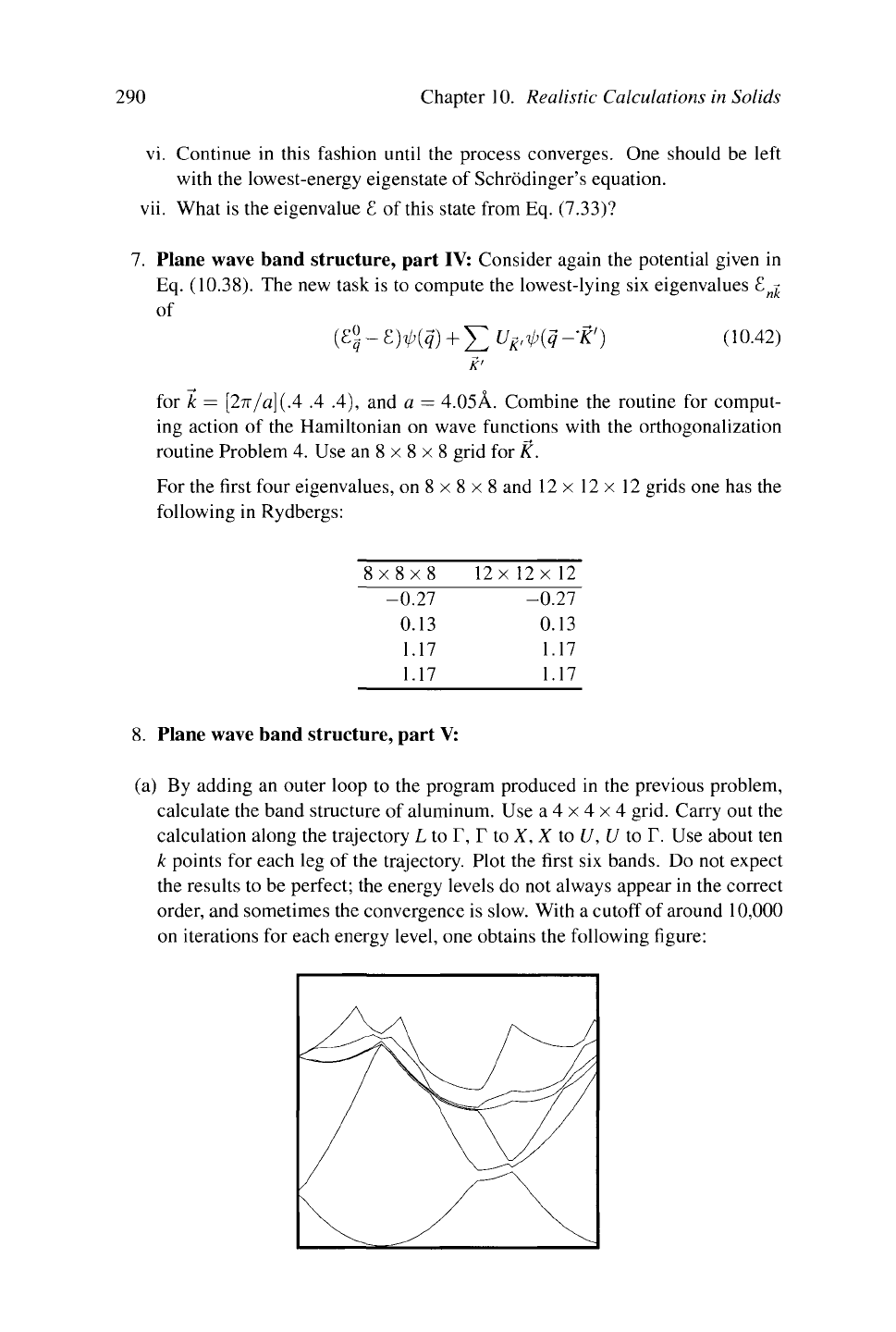
(a) By adding an outer loop to the program produced in the previous problem,
calculate the band structure of aluminum. Use a 4 x 4 x 4 grid. Carry out the
calculation along the trajectory L to Γ, Γ to X, X to U, U to Γ. Use about ten
k points for each leg of the trajectory. Plot the first six bands. Do not expect
the results to be perfect; the energy levels do not always appear in the correct
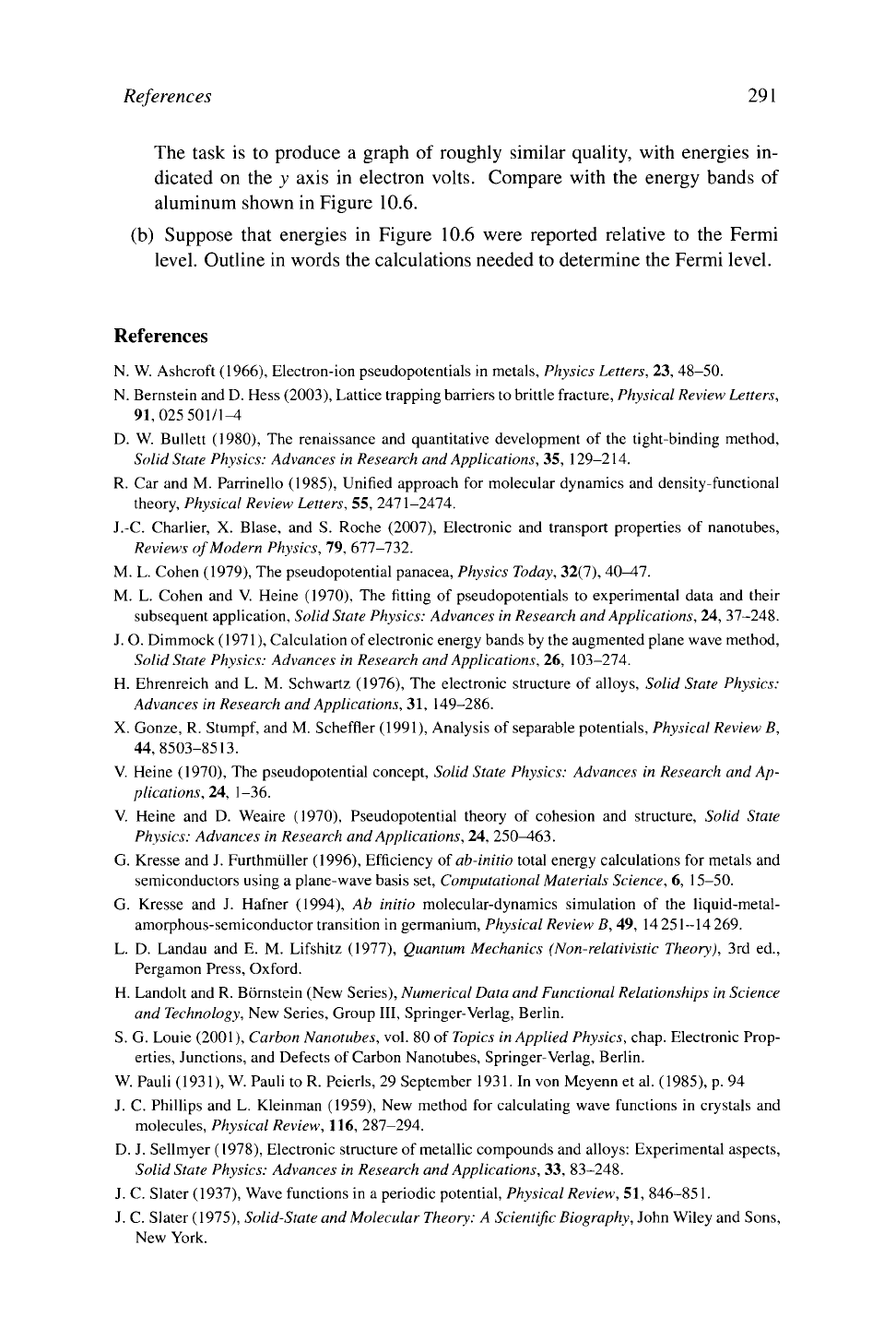
order, and sometimes the convergence is slow. With a cutoff of around 10,000
on iterations for each energy level, one obtains the following figure:
References
291
The task is to produce a graph of roughly similar quality, with energies in-
dicated on the y axis in electron volts. Compare with the energy bands of
aluminum shown in Figure 10.6.
(b) Suppose that energies in Figure 10.6 were reported relative to the Fermi
level. Outline in words the calculations needed to determine the Fermi level.
References
N.
W. Ashcroft (1966), Electron-ion pseudopotentials in metals, Physics Letters, 23, 48-50.
N.
Bernstein and D. Hess (2003), Lattice trapping barriers to brittle fracture, Physical Review Letters,
91,025 501/1^1
D.
W. Bullett (1980), The renaissance and quantitative development of the tight-binding method,
Solid State Physics: Advances in Research and Applications, 35, 129-214.
R. Car and M. Parrinello (1985), Unified approach for molecular dynamics and density-functional
theory, Physical Review Letters, 55, 2471-2474.
J.-C. Charlier, X. Blase, and S. Roche (2007), Electronic and transport properties of nanotubes,
Reviews of Modern Physics, 79, 677-732.
M. L. Cohen (1979), The pseudopotential panacea, Physics
Today,
32(7), 40—47.
M. L. Cohen and V. Heine (1970), The fitting of pseudopotentials to experimental data and their
subsequent application, Solid State Physics: Advances in Research and Applications, 24, 37-248.
J. O. Dimmock (1971), Calculation of electronic energy bands by the augmented plane wave method,
Solid State Physics: Advances in Research and Applications, 26, 103-274.
H. Ehrenreich and L. M. Schwartz (1976), The electronic structure of alloys, Solid State Physics:
Advances in Research and Applications,
31,
149-286.
X. Gonze, R.
Stumpf,
and M. Scheffler (1991), Analysis of separable potentials, Physical Review B,
44,8503-8513.
V. Heine (1970), The pseudopotential concept, Solid State Physics: Advances in Research and Ap-
plications, 24, 1-36.
V. Heine and D. Weaire (1970), Pseudopotential theory of cohesion and structure, Solid State
Physics: Advances in Research and Applications, 24, 250^163.
G. Kresse and J. Furthmiiller (1996), Efficiency of ab-initio total energy calculations for metals and
semiconductors using a plane-wave basis set, Computational Materials Science, 6, 15-50.
G. Kresse and J. Hafner (1994), Ab initio molecular-dynamics simulation of the liquid-metal-
amorphous-semiconductor transition in germanium, Physical Review B, 49, 14251-14269.
L. D. Landau and E. M. Lifshitz (1977), Quantum Mechanics (Non-relativistic Theory), 3rd ed.,
Pergamon Press, Oxford.
H. Landolt and R. Bernstein (New Series), Numerical Data and Functional Relationships in Science
and
Technology,
New Series, Group III, Springer-Verlag, Berlin.
S. G. Louie
(2001
),
Carbon Nanotubes, vol. 80 of
Topics
in Applied Physics, chap. Electronic Prop-
erties,
Junctions, and Defects of Carbon Nanotubes, Springer-Verlag, Berlin.
W. Pauli (1931), W. Pauli to R. Peierls, 29 September 1931. In von Meyenn et al. (1985), p. 94
J. C. Phillips and L. Kleinman (1959), New method for calculating wave functions in crystals and
molecules, Physical Review, 116, 287-294.
D.
J. Sellmyer (1978), Electronic structure of metallic compounds and alloys: Experimental aspects,
Solid State Physics: Advances in Research and Applications, 33, 83-248.
J. C. Slater (1937), Wave functions in aperiodic potential, Physical Review, 51,
846-851.
J. C. Slater
(
1975),
Solid-State and Molecular Theory: A Scientific Biography, John Wiley and Sons,
New York.
292
Chapter 10. Realistic Calculations in Solids
J. C. Slater and G. F. Koster (1956), Simplified LCAO method for the periodic potential problem,
Physical Review, 94, 1498-1524.
K. von Meyenn, A. Mermann, and V. F.
Weisskopf,
eds. (1985), Wolfgang Pauli. Scientific Corre-
spondence with Bohr Einstein, Heisenberg, a. o., II: 1930-1939, Springer-Verlag, Berlin.
E. WignerandF. Seitz(1933), On the constitution of metallic sodium, Physical
Review,
43, 804—810.
The first attempt at a realistic band structure calculation.
E. Wigner and F. Seitz (1955), Qualitative analysis in the cohesion of metals, Solid State Physics:
Advances in Research and Applications, 1, 97-126.
A. H. Wilson (1931), The theory of electronic semiconductors, Proceedings of the Royal Society of
London, A133, 458-491.
A. H. Wilson (1980), Opportunities lost and opportunities seized, in The Beginnings of Solid State
Physics, pp. 39-48, Royal Society, London.
J. M. Ziman (1971), Calculation of Bloch functions, Solid State Physics: Advances in Research and
Applications, 26, 1-101.