
Marder M.P. Condensed Matter Physics
Подождите немного. Документ загружается.

Vibrations of a Classical Lattice
343
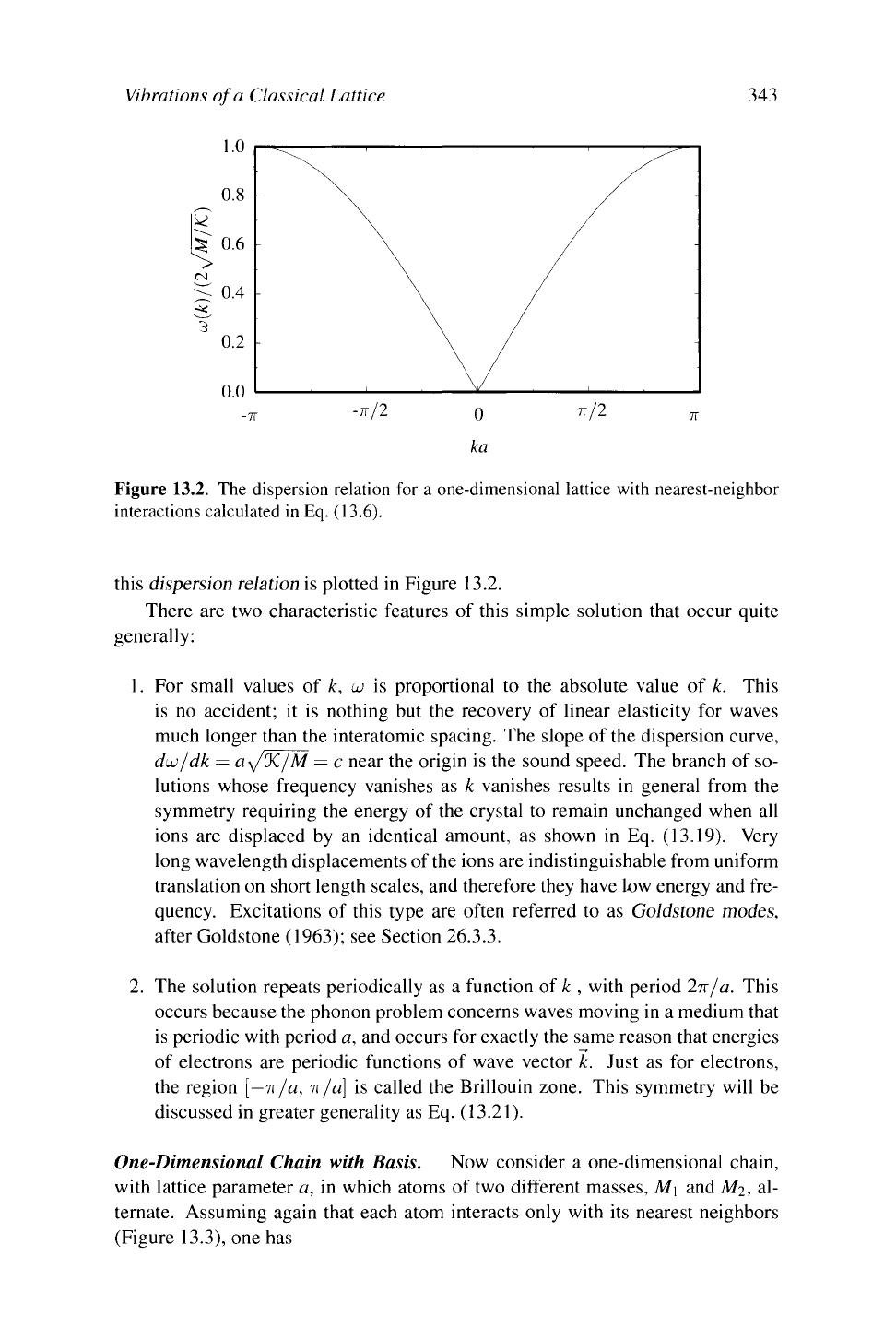
Figure 13.2. The dispersion relation for a one-dimensional lattice with nearest-neighbor
interactions calculated in Eq. (13.6).
this dispersion relation is plotted in Figure 13.2.
There are two characteristic features of this simple solution that occur quite
generally:
1.
For small values of k, ω is proportional to the absolute value of k. This
is no accident; it is nothing but the recovery of linear elasticity for waves
much longer than the interatomic spacing. The slope of the dispersion curve,
duj/dk = αχ/Χ/Μ = c near the origin is the sound speed. The branch of so-
lutions whose frequency vanishes as k vanishes results in general from the
symmetry requiring the energy of the crystal to remain unchanged when all
ions are displaced by an identical amount, as shown in Eq. (13.19). Very
long wavelength displacements of the ions are indistinguishable from uniform
translation on short length scales, and therefore they have low energy and fre-
quency. Excitations of this type are often referred to as Goldstone modes,
after Goldstone (1963); see Section
26.3.3.
2.
The solution repeats periodically as a function of k , with period 2π/α. This
occurs because the phonon problem concerns waves moving in a medium that
is periodic with period a, and occurs for exactly the same reason that energies
of electrons are periodic functions of wave vector k. Just as for electrons,
the region
[—π/α,
π/α] is called the Brillouin zone. This symmetry will be
discussed in greater generality as Eq. (13.21).
One-Dimensional Chain with Basis. Now consider a one-dimensional chain,
with lattice parameter a, in which atoms of two different masses, M\ and Mi, al-
ternate. Assuming again that each atom interacts only with its nearest neighbors
(Figure 13.3), one has
344
Chapter 13. Phonons
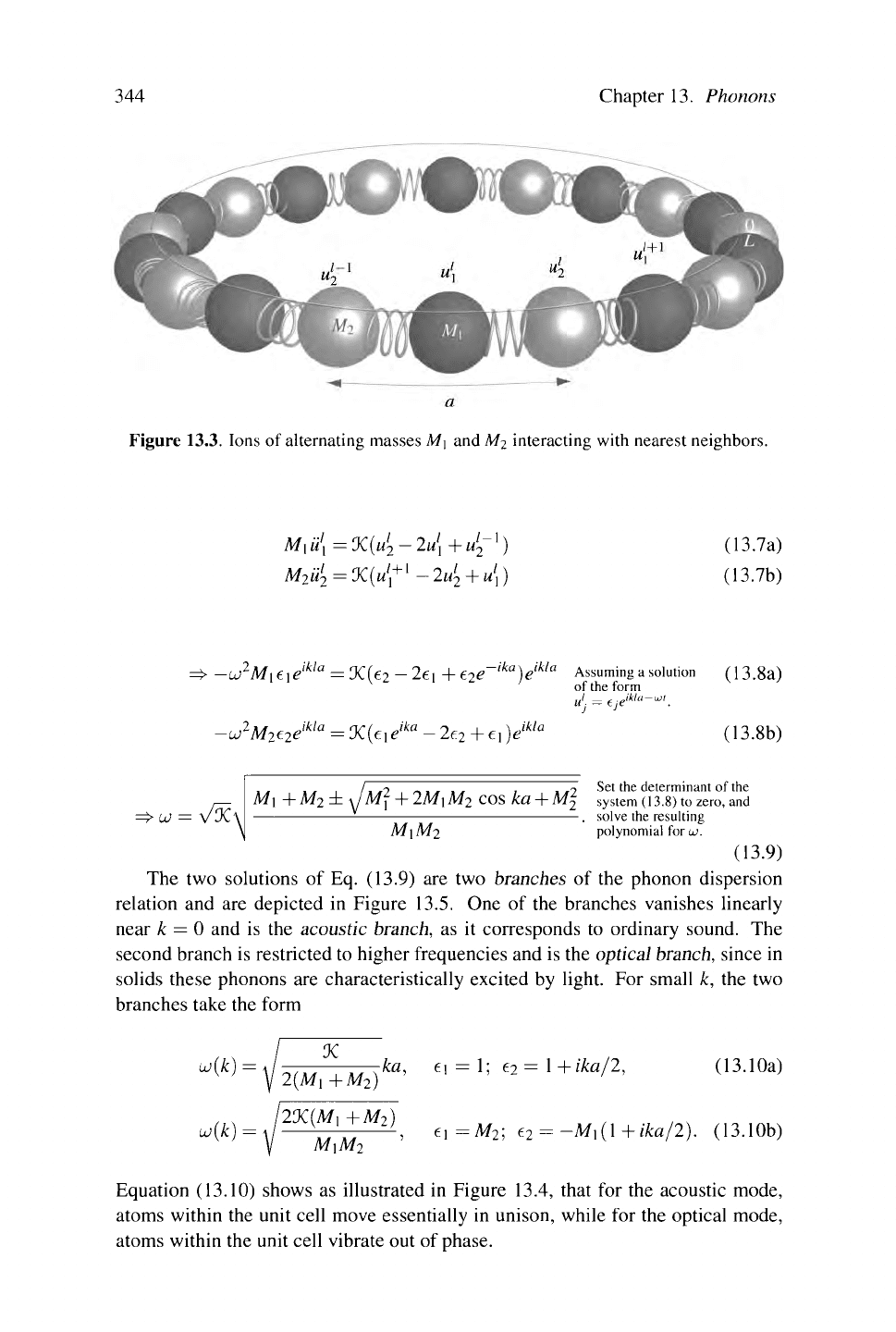
Figure 13.3. Ions of alternating masses M\ and M
2
interacting with nearest neighbors.
M\Ü\ :
M
2
ül
2
■
X(u
2
-2u[ +U
l-\<
2 .
3C(,
.'+·
■
2u
l
2
+ u\
(13.7a)
(13.7b)
-u
l
M
x
e\é
kÎa
= %{e
2
-2e
x
+e
2
e~
lka
)e
Ma
Assuming
a
solution (13.8a)
of the form
ika
uJ
z
M
2
e
2
e
,kla
= %{e
x
e
lka
- 2e
2
+ e,)e
Jkla
(13.8b)
LÜ
\
M\+M
2
±\/M} +
2M\M
2
COS
ka + M\
M\M
2
Set the determinant of the
system (13.8) to zero, and
solve the resulting
polynomial for ω.
(13.9)
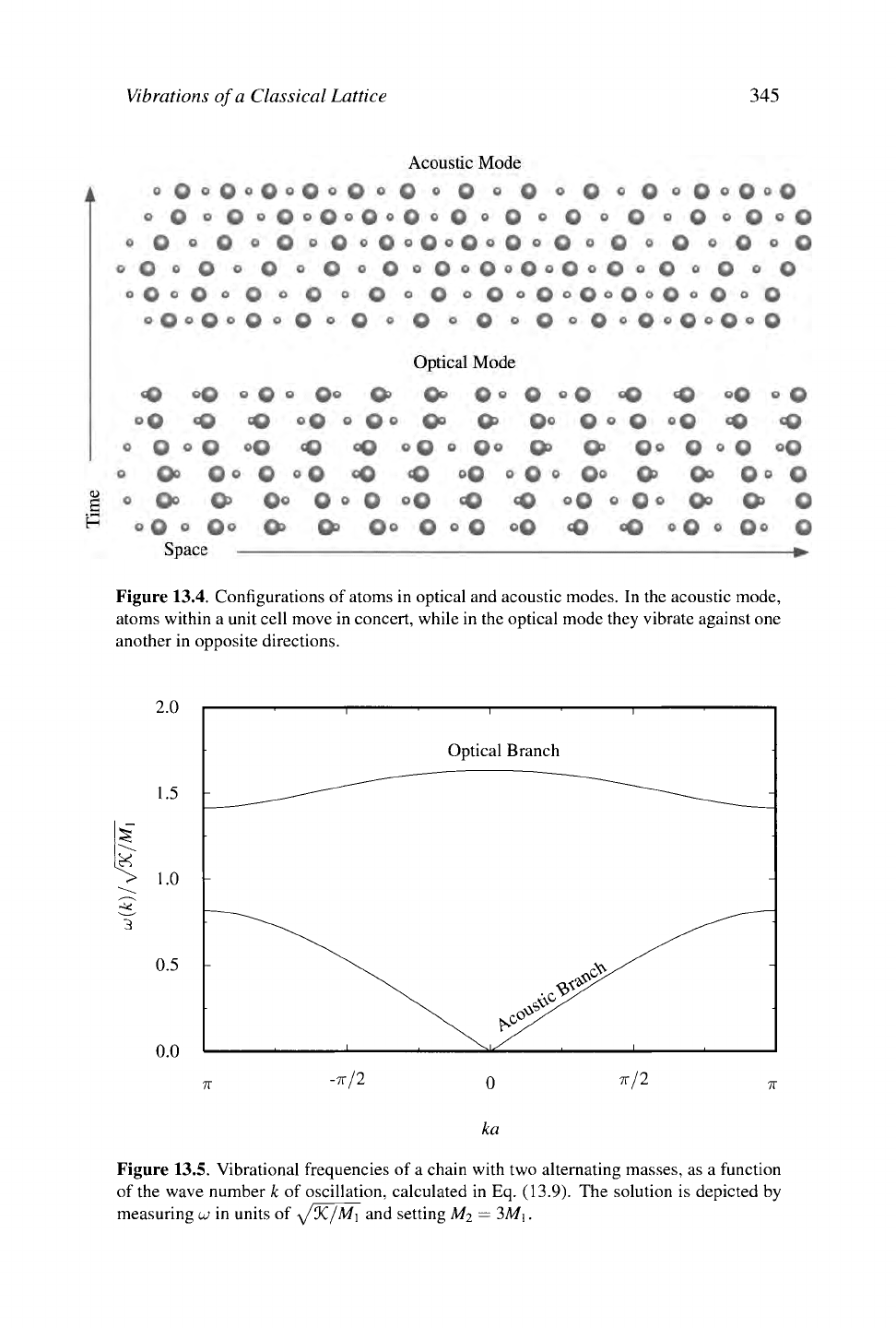
The two solutions of Eq. (13.9) are two branches of the phonon dispersion
relation and are depicted in Figure 13.5. One of the branches vanishes linearly
near k = 0 and is the acoustic branch, as it corresponds to ordinary sound. The
second branch is restricted to higher frequencies and is the optical branch, since in
solids these phonons are characteristically excited by light. For small k, the two
branches take the form
%
2(Mi+M
2
)
2X(Mi+M
2
)
M\M
2
ka, e\ = 1; £2=1 +ika/2,
(13.10a)
ei =M
2
; e
2
= -M\(\ + ika/2). (13.10b)
Equation (13.10) shows as illustrated in Figure 13.4, that for the acoustic mode,
atoms within the unit cell move essentially in unison, while for the optical mode,
atoms within the unit cell vibrate out of phase.
Vibrations of a Classical Lattice
345
Figure 13.4. Configurations of atoms in optical and acoustic modes. In the acoustic mode,
atoms within a unit cell move in concert, while in the optical mode they vibrate against one
another in opposite directions.
2.0
1.5
^ ,.0
■Ai
0.5
0.0
-7I-/2 7Γ/2
ka
Figure 13.5. Vibrational frequencies of a chain with two alternating masses, as a function
of the wave number k of oscillation, calculated in Eq. (13.9). The solution is depicted by
measuring ω in units of
y/%/M\
and setting Mi = 3Aii.
346 Chapter 13. Phonons
13.2.2 Classical Vibrations in Three Dimensions
Crystalline lattices are not one-dimensional chains of ions connected to nearest
neighbors by springs, nor even three-dimensional lattices of masses connected by
springs. Nevertheless, viewing them this way is essentially correct when one re-
stricts attention to small deviations of ions from their equilibrium locations. When
ions move only a small amount from equilibrium, the restoring forces on them are
linear, and the techniques developed for the one-dimensional chain continue to
apply-
Here is why linear restoring forces arise so generally. Suppose one knows the
location in the ground state of a collection of ions, 1 . . . N, and let u
l
. . . u
N
describe the vector displacement of these ions from their equilibrium locations
R
x
. . . R
N
. When ions move, the energy of the crystal goes up; take the energy
functional to be
E{u\u
2
.
..u
N
)..
(13.11)
Instead of making guesses about the form of the energy functional, as in Section
11.8,
assume all the variables
Ü
are small, and develop Eq. (13.11) in a Taylor
expansion in powers of the variables u.
The energy becomes
ßC 1
£ = E
c
+ ^
TrT
u
'n
+
_
Τ^
Μ
ί>Φ«/?
Μ
Α + · · · · a and /3 are Cartesian indices running over
^—' ßu 2 ^"~' basis vectors of three-dimensional space.
α
Ot aß
1
11'
(13.12)
The first term in Eq. (13.12) is the cohesive energy, calculated with such effort in
Chapter 11, but which for present purposes is a dull constant and will callously
be neglected. Because the lowest energy state is a minimum as a function of ion
locations, the linear term in the expansion in u
l
must vanish, and the first nonzero
contribution must be quadratic. That is,
aß
W
The 3x3 matrix Φ" comes immediately from Taylor expansion of the energy and
is
Φ'
d
2
e
Φ
α
/3 — . ,/ Φ" is always a symmetric matrix. (13.14)
öu'
a
du'ß
Periodic Boundary Conditions. The formal study of electron motion employed
the simplification of periodic boundary conditions. The same assumption also sim-
plifies calculations concerning lattice vibrations. Proceeding along the direction of
any of the three primitive vectors for the Bravais lattice, every physical quantity,
including the displacements u of the ions, is assumed to repeat after some number
of cells is cells is passed. All points in the equilibrium crystal are equivalent; the
Vibrations
of a Classical Lattice
347
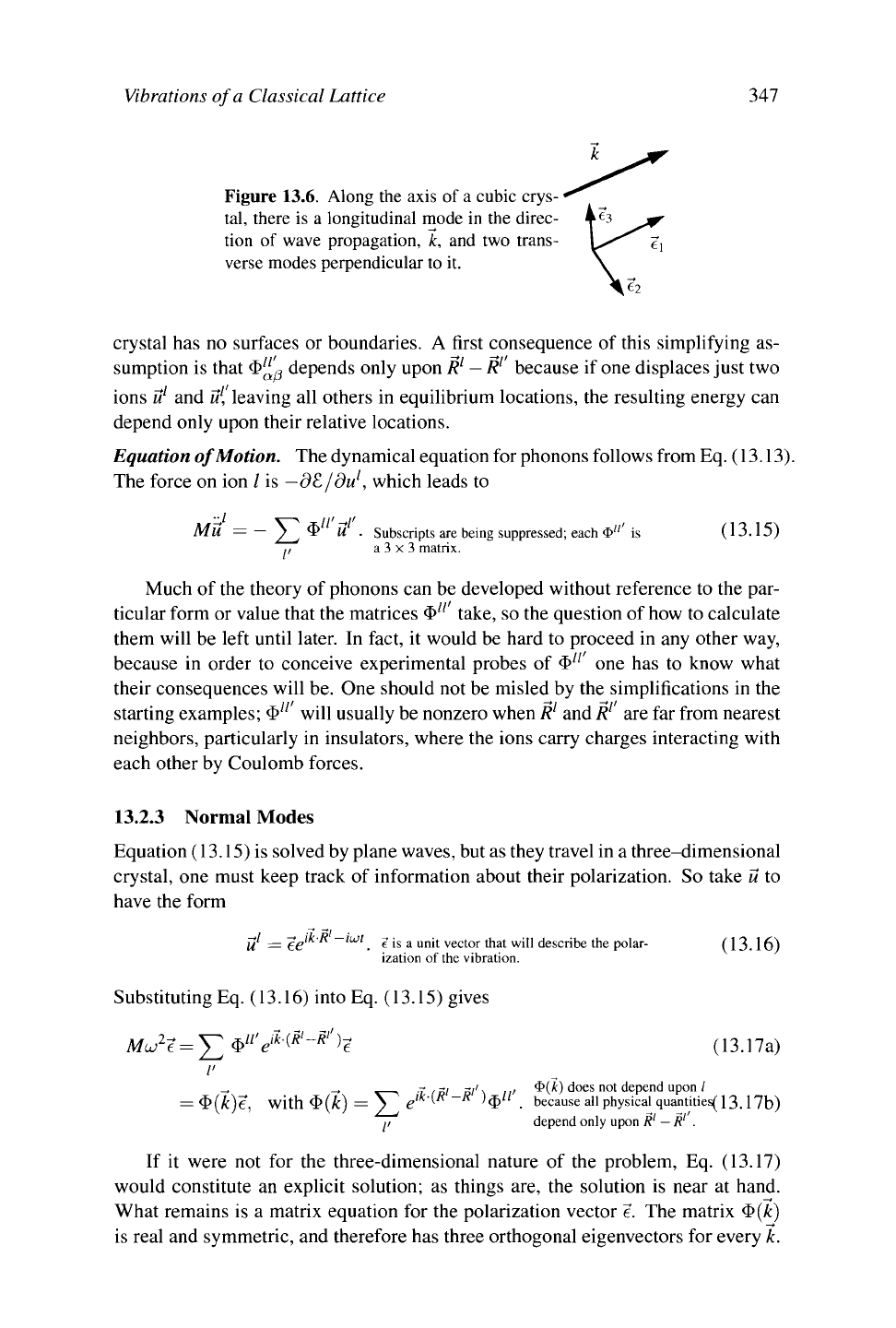
Figure 13.6. Along the axis of a cubic crys-
tal,
there is a longitudinal mode in the direc-
tion of wave propagation, k, and two trans-
verse modes perpendicular to it.
crystal has no surfaces or boundaries. A first consequence of this simplifying as-
sumption is that
φ[[β
depends only upon R
l
—
R
l
because if one displaces just two
ions u
l
and
u{
leaving all others in equilibrium locations, the resulting energy can
depend only upon their relative locations.
Equation of Motion. The dynamical equation for phonons follows from Eq. (13.13).
The force on ion / is —d£/du
l
, which leads to
MU = — y Φ U . Subscripts are being suppressed; each Φ" is (13.15)
,, a 3 x 3 matrix.
Much of the theory of phonons can be developed without reference to the par-
ticular form or value that the matrices Φ" take, so the question of how to calculate
them will be left until later. In fact, it would be hard to proceed in any other way,
because in order to conceive experimental probes of
Φ
11
one has to know what
their consequences will be. One should not be misled by the simplifications in the
starting examples;
Φ
11
will usually be nonzero when R
l
and R
l
are far from nearest
neighbors, particularly in insulators, where the ions carry charges interacting with
each other by Coulomb forces.
13.2.3 Normal Modes
Equation
( 13.15)
is solved by plane waves, but as they travel in a three-dimensional
crystal, one must keep track of information about their polarization. So take
Ü
to
have the form
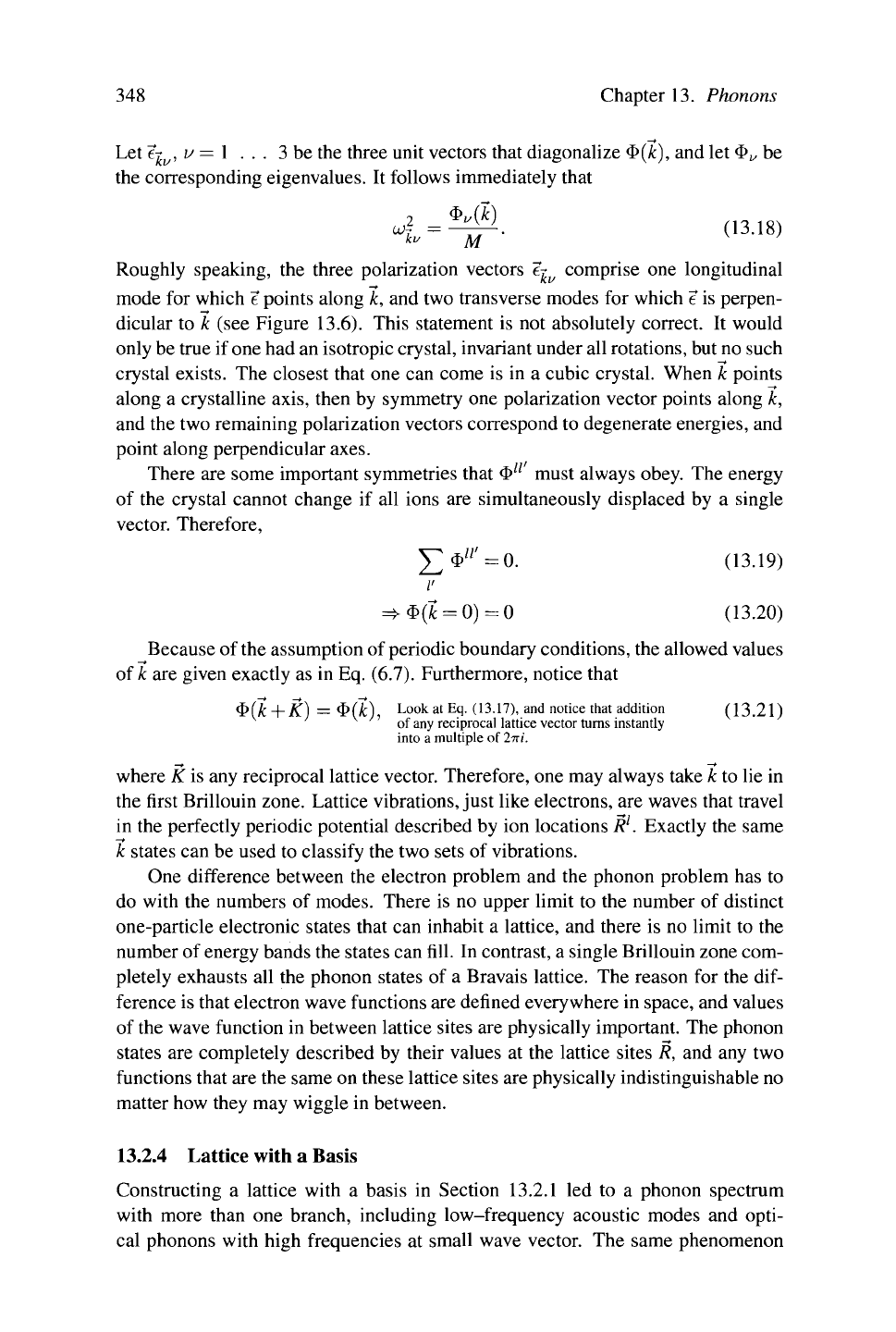
Sr = ?g
—
"*". e is a unit vector that will describe the polar- (13.16)
ization of the vibration.
Substituting Eq. (13.16) into Eq. (13.15) gives
Μ^
2
? = ]ΓΦ
,/
ν*-("')ε (13.17a)
/'
_ _,
N
T./Si Si'\ ni Φ(ϊ) does not depend upon /
= Φ(£)β, With Φ(&) = 22
e Φ
·
because a11
Physical quantities 13.17b)
,/ depend only upon W
—
R
1
.
If it were not for the three-dimensional nature of the problem, Eq. (13.17)
would constitute an explicit solution; as things are, the solution is near at hand.
What remains is a matrix equation for the polarization vector e. The matrix Φ(&)
is real and symmetric, and therefore has three orthogonal eigenvectors for every k.
348
Chapter 13. Phonons
Let e^, v =
1
... 3 be the three unit vectors that diagonalize Φ(ϋ), and let Φ„ be
the corresponding eigenvalues. It follows immediately that
kv M
Roughly speaking, the three polarization vectors e^ comprise one longitudinal
mode for which e points along k, and two transverse modes for which e is perpen-
dicular to k (see Figure 13.6). This statement is not absolutely correct. It would
only be true if
one
had an isotropie crystal, invariant under all rotations, but no such
crystal exists. The closest that one can come is in a cubic crystal. When k points
along a crystalline axis, then by symmetry one polarization vector points along k,
and the two remaining polarization vectors correspond to degenerate energies, and
point along perpendicular axes.
There are some important symmetries that Φ" must always obey. The energy
of the crystal cannot change if all ions are simultaneously displaced by a single
vector. Therefore,
J2$
ll
'=0.
(13.19)
/'
^Φ(Ι = 0)=Ο (13.20)
Because of
the
assumption of periodic boundary conditions, the allowed values
of k are given exactly as in Eq. (6.7). Furthermore, notice that
Φ(% + Κ) = Φ(&), Look at Eq. (13.17), and notice that addition (13.21)
of any reciprocal lattice vector turns instantly
into a multiple of 2πί.
where K is any reciprocal lattice vector. Therefore, one may always take k to lie in
the first Brillouin zone. Lattice vibrations, just like electrons, are waves that travel
in the perfectly periodic potential described by ion locations R
l
. Exactly the same
k states can be used to classify the two sets of vibrations.
One difference between the electron problem and the phonon problem has to
do with the numbers of modes. There is no upper limit to the number of distinct
one-particle electronic states that can inhabit a lattice, and there is no limit to the
number of energy bands the states can fill. In contrast, a single Brillouin zone com-
pletely exhausts all the phonon states of a Bravais lattice. The reason for the
dif-
ference is that electron wave functions are defined everywhere in space, and values
of the wave function in between lattice sites are physically important. The phonon
states are completely described by their values at the lattice sites R, and any two
functions that are the same on these lattice sites are physically indistinguishable no
matter how they may wiggle in between.
13.2.4 Lattice with a Basis
Constructing a lattice with a basis in Section 13.2.1 led to a phonon spectrum
with more than one branch, including low-frequency acoustic modes and opti-
cal phonons with high frequencies at small wave vector. The same phenomenon
Vibrations
of a Classical Lattice 349
persists in three dimensions. Adding new atoms to a unit cell adds new degrees of
freedom to the lattice, and one must consider a correspondingly greater number of
normal modes to describe them. For example, in three dimensions with four atoms
per unit cell, one has 3x4 normal modes for every value of k.
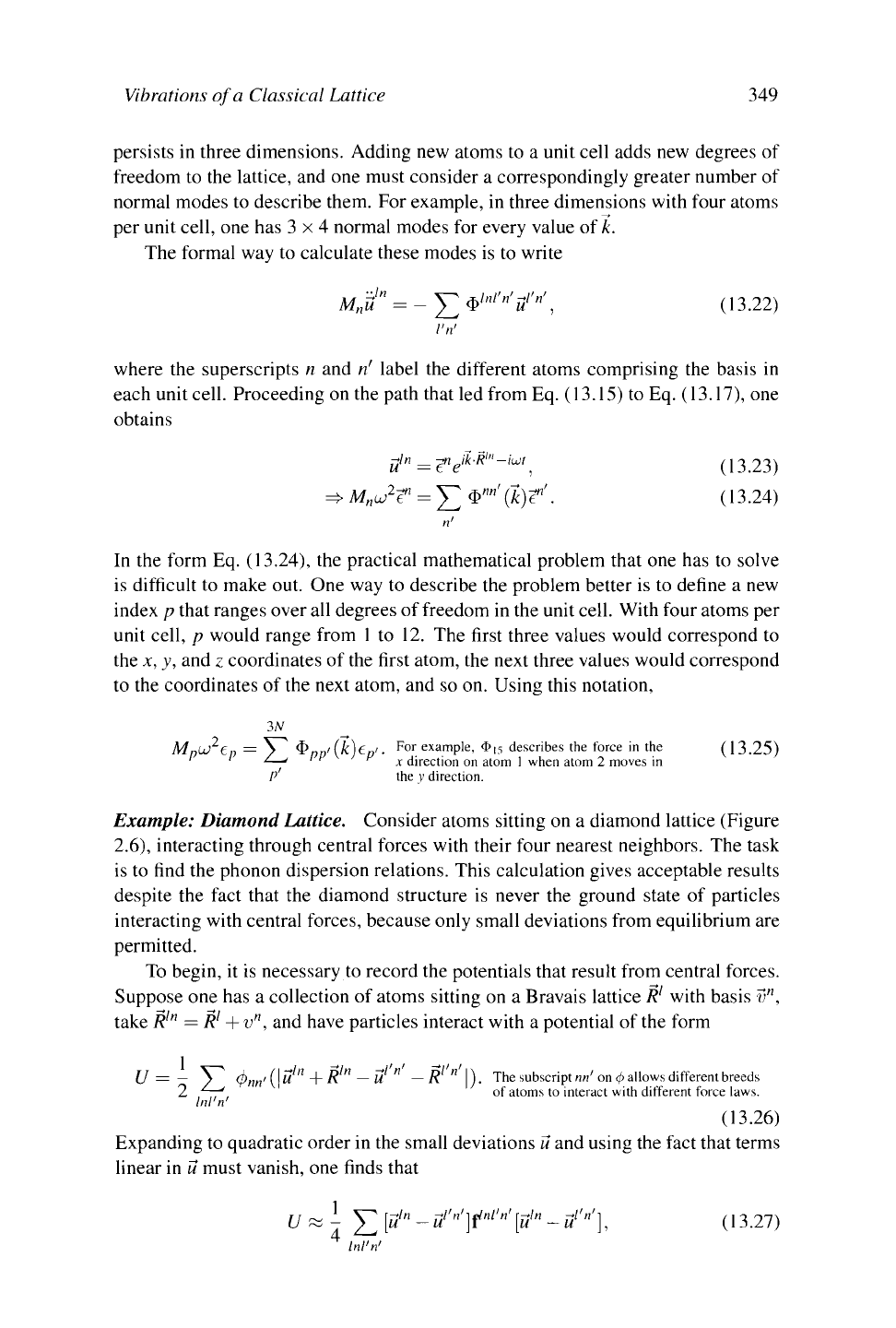
The formal way to calculate these modes is to write
Μ
^
/
"
= -Σ
φων
"
/ν
>
(
13
·
22
>
l'n'
where the superscripts n and n' label the different atoms comprising the basis in
each unit cell. Proceeding on the path that led from Eq. (13.15) to Eq. (13.17), one
obtains
u
l
" = e"e
iW
"-
iu;
', (13.23)
=>
Μ„ω
2
? = Σ Φ
ηη
'(k)?'. (13.24)
n'
In the form Eq. (13.24), the practical mathematical problem that one has to solve
is difficult to make out. One way to describe the problem better is to define a new
index p that ranges over all degrees of freedom in the unit cell. With four atoms per
unit cell, p would range from
1
to 12. The first three values would correspond to
the x, y, and z coordinates of the first atom, the next three values would correspond
to the coordinates of the next atom, and so on. Using this notation,
3N
M
p
U
2
t
p
= y^ Φρ
ρ
ι(%)<Ε
ρ
'.
For
example, Φ
|5
describes the force in the (13.25)
z
—' x direction on atom 1 when atom 2 moves in
P the y direction.
Example: Diamond Lattice. Consider atoms sitting on a diamond lattice (Figure
2.6),
interacting through central forces with their four nearest neighbors. The task
is to find the phonon dispersion relations. This calculation gives acceptable results
despite the fact that the diamond structure is never the ground state of particles
interacting with central forces, because only small deviations from equilibrium are
permitted.
To begin, it is necessary to record the potentials that result from central forces.
Suppose one has a collection of atoms sitting on a Bravais lattice R
1
with basis v",
take
R
1
"
= R
l
+v
n
, and have particles interact with a potential of the form
U = - V^
4>nn'{\Ü
ln
+R
1
" — U
1
'"'
-R
1
'"']).
The subscript™'on fallows different breeds
2 ~^, of atoms to interact with different force laws.
lui n
(13.26)
Expanding to quadratic order in the small deviations u and using the fact that terms
linear in u must vanish, one finds that
U
~\ Σ
["''"-"''"
']*"''
'"'[«'"-3
/V
],
(13.27)
Inl'n'
350
Chapter 13. Phonons
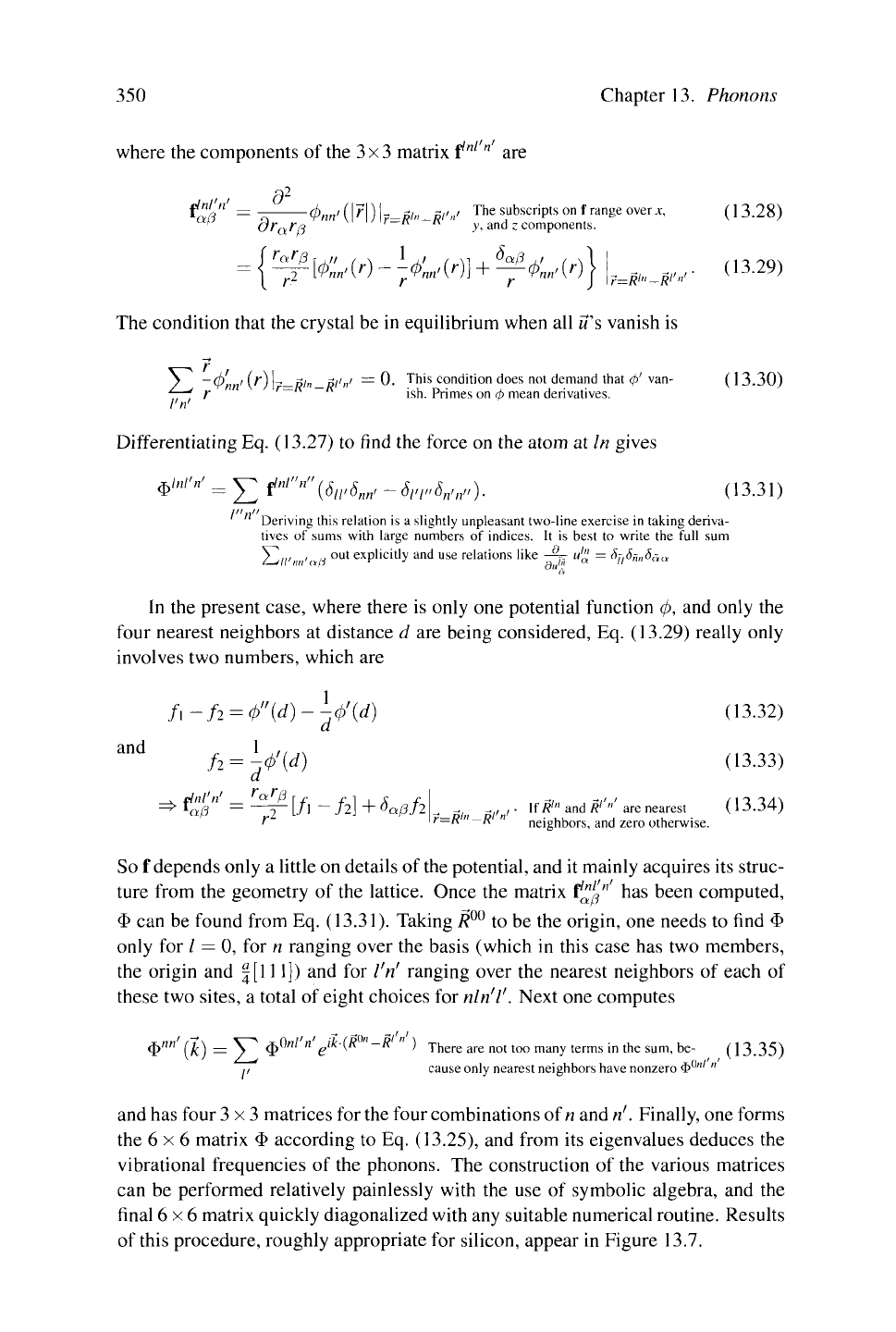
where the components of the 3x3 matrix
f
1
"
1
n
are
S" = T. Φηη·§ϊ\%-ΐ>ΐη-ϊ>ι>
η
' The subscripts on frange over
x,
(13.28)
ur
a
ra ">r—t\ n ;y, and z components.
^?[^W-^^(r)]
+
%^(r)}L
a
.
3
„„,. (13.29)
The condition that the crystal be in equilibrium when all if s vanish is
/ ~^nn'{
r
)V=Rl"-R
l
'
n
'
=
^' ™
S condition does not
demand that φ' van- (13.30)
~—f r
r
ish. Primes on φ mean derivatives.
Differentiating Eq. (13.27) to find the force on the atom at In gives
φ
/„/ν
=
£ f"""«"^^, -«W<W)· ('3-31)
Deriving this relation is a slightly unpleasant two-line exercise in taking deriva-
tives of sums with large numbers of indices. It is best to write the full sum
Σ
,„ , ,. out explicitly and use relations like -2*- «'" = δτ,δα„δά
α
il im a fi
v J
Q
u
ln
a
II
In the present case, where there is only one potential function φ, and only the
four nearest neighbors at distance d are being considered, Eq. (13.29) really only
involves two numbers, which are
/1-/2 = (/>"(</)-V(d) (13.32)
a
and
Η = \φ\ά) (13.33)
a
^f'aß" = "^2~[/l —h]+S
a
ßf2 ^_ a„_
5/
/„/
■
If «'" and «''"'are nearest (13.34)
l~ r—R"—R " neighbors, and zero otherwise.
So f depends only a little on details of the potential, and it mainly acquires its struc-
ture from the geometry of the lattice. Once the matrix f^L" has been computed,
Φ can be found from Eq. (13.31). Taking R
00
to be the origin, one needs to find Φ
only for / = 0, for n ranging over the basis (which in this case has two members,
the origin and | [111]) and for Ι'η' ranging over the nearest neighbors of each of
these two sites, a total of eight choices for nln'l''. Next one computes
Φ""'(k)
= ^
φ
0
"
1
'"'
e
ik
i
R
"~
R
") There are not too many terms in the sum, be- (13.35)
,/ cause only nearest neighbors have nonzero Φ
0
"' "
and has four 3x3 matrices for the four combinations of
n
and n'. Finally, one forms
the 6 x 6 matrix Φ according to Eq. (13.25), and from its eigenvalues deduces the
vibrational frequencies of the phonons. The construction of the various matrices
can be performed relatively painlessly with the use of symbolic algebra, and the
final 6x6 matrix quickly diagonalized with any suitable numerical routine. Results
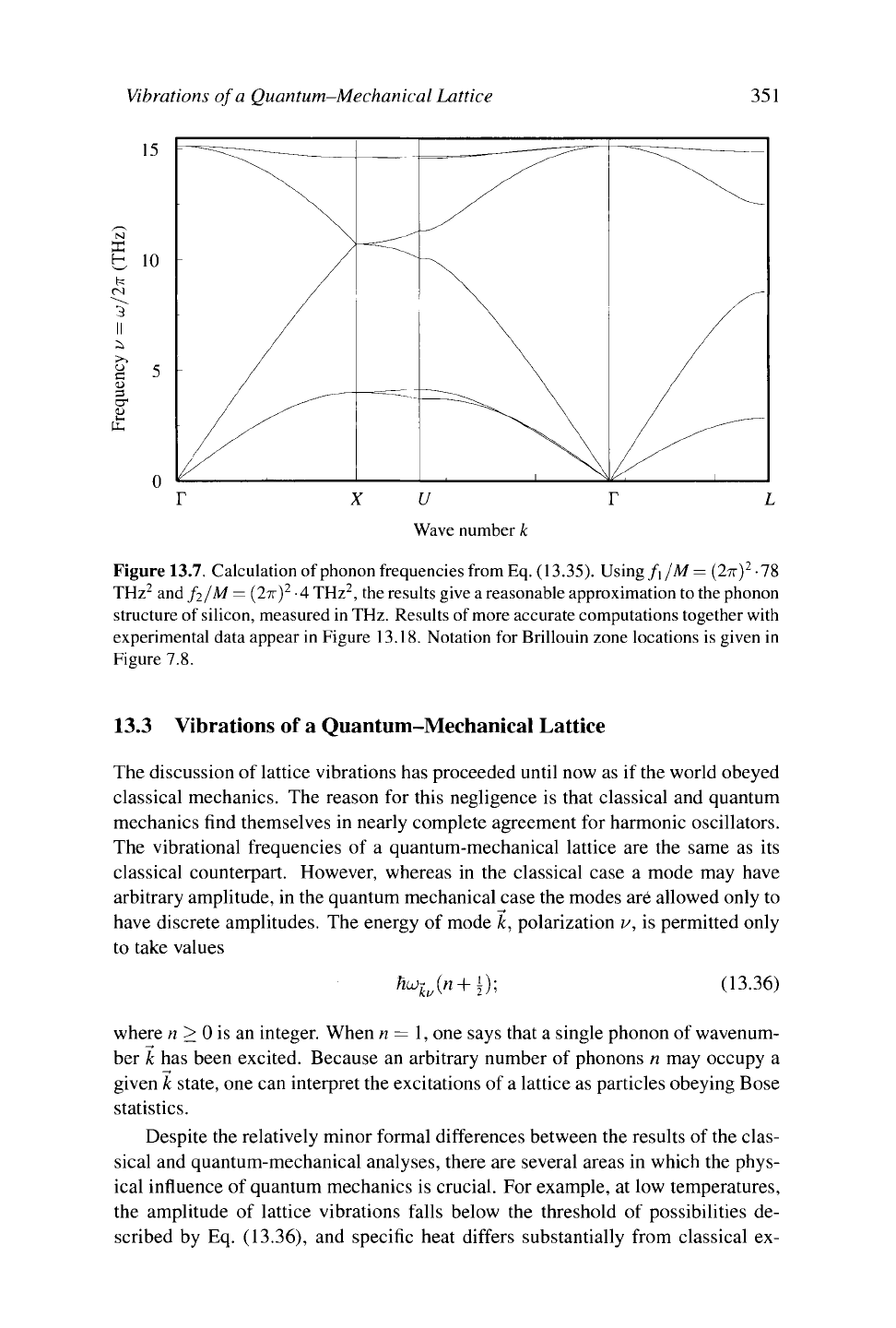
of this procedure, roughly appropriate for silicon, appear in Figure 13.7.
Vibrations
of a Quantum-Mechanical Lattice 351
Wave number
k
Figure 13.7. Calculation ofphonon frequencies from
Eq.
(13.35). Using/i/M= (2π)
2
·78
THz
2
and fijM = (2π)
2
·4
THz
2
,
the
results
give a
reasonable approximation
to the
phonon
structure of
silicon,
measured in
THz.
Results of more accurate computations together with
experimental data appear in Figure 13.18. Notation for Brillouin zone locations is given in
Figure 7.8.
13.3 Vibrations of a Quantum-Mechanical Lattice
The discussion of lattice vibrations has proceeded until now as if the world obeyed
classical mechanics. The reason for this negligence is that classical and quantum
mechanics find themselves in nearly complete agreement for harmonic oscillators.
The vibrational frequencies of a quantum-mechanical lattice are the same as its
classical counterpart. However, whereas in the classical case a mode may have
arbitrary amplitude, in the quantum mechanical case the modes are allowed only to
have discrete amplitudes. The energy of mode k, polarization v, is permitted only
to take values
/^> + i); (13.36)
where n > 0 is an integer. When n = 1, one says that a single phonon of wavenum-
ber k has been excited. Because an arbitrary number of phonons n may occupy a
given k state, one can interpret the excitations of a lattice as particles obeying Bose
statistics.
Despite the relatively minor formal differences between the results of the clas-
sical and quantum-mechanical analyses, there are several areas in which the phys-
ical influence of quantum mechanics is crucial. For example, at low temperatures,
the amplitude of lattice vibrations falls below the threshold of possibilities de-
scribed by Eq. (13.36), and specific heat differs substantially from classical ex-
352
Chapter 13. Phonons
pectations. For this and other reasons, a brief review of the quantum mechanical
theory now becomes necessary.
For a single harmonic oscillator described by the Hamiltonian
p2 i
•K= + -MUJ
2
R
2
(13.37)
2M 2
one defines raising and lowering operators
+
Μω
~
/ 1
Q\
=
*
/ R — i\l P This is the "raising" or "creation" operator, (13.38a)
V 2/z y 2hMüJ which when it acts upon the ground state of
the oscillator populates it with one excited state.
Μω - / 1
â= \ R-\-i\ P. And this is the "lowering" or "destruction" (13.38b)
V 2h y 2%Muj operator that drags the oscillator down the lad-
der of excited states each time it acts.
The Hamiltonian expressed in terms of these operators simplifies to
"K = Ηω ( ff a + |
1
= hxo ( fi + £
1
The number operator n = a'â measures the (13.39)
\ / V / degree of excitation of the oscillator, or equiv-
alently the number of phonons occupying it.
and the original particle position operator is
^v^
(
"
+
"
f)
·
(13
·
40)
Second Quantization of Phonons. To treat motion of the atoms of a solid to
quadratic order, write the Hamiltonian
p'
2
. ,.,
<
K=\] h | \_] " ^ Û
■
. . . The operators û
l
describe the deviation of an (13.41)
I *■*" ff/ ion from its equilibrium location R
1
, assumed
for the moment to belong to a monatomic Bra-
vais lattice.
In order to find all eigenvalues of Eq. (13.41), define the analog of
Eq.
(13.38),
N
1 v^ _;ï.s/^ r IMLÛI,, „, . / 1
ß7
kv
Σ *-**%
■
W^û'
+
i
J—i—P
l
]
(13.42a)
/-^/ kv \\ Oft \\ OtiMi,^
VÜf^~ ~
kv L
V 2» "" ''^2tiMu^
u
N
1 "
4 =4=Σ
kv . Γ\1 ί-~ι
„ _ _ , e
ikä
'er
kv
Λ
/Λ/ ^ kv
VNÎ
2h V
2hMusr
j
y ^-" y
"""^fci/
(13.42b)
A brief calculation (Problem 5) inverts these relations and expresses û
l
in terms
of the creation and annihilation operators as
u
l
= ^=Y far
e
iU
'+ul
e-
iMl
)
with Û
t
= J ^— er âr (13.43a)
kv ' *"
and