
Marder M.P. Condensed Matter Physics
Подождите немного. Документ загружается.

Classical Potentials 313
>
ω
a.
>>
£?
ω
c
u
-C
O
U
(A)
ε
o
1)
S>
1)
c
ω
1.2 1.4 1.6 1.
Wigner-Seitz radius, r^ (Â)
2.0°
(B)
Lattice constant a (Â)
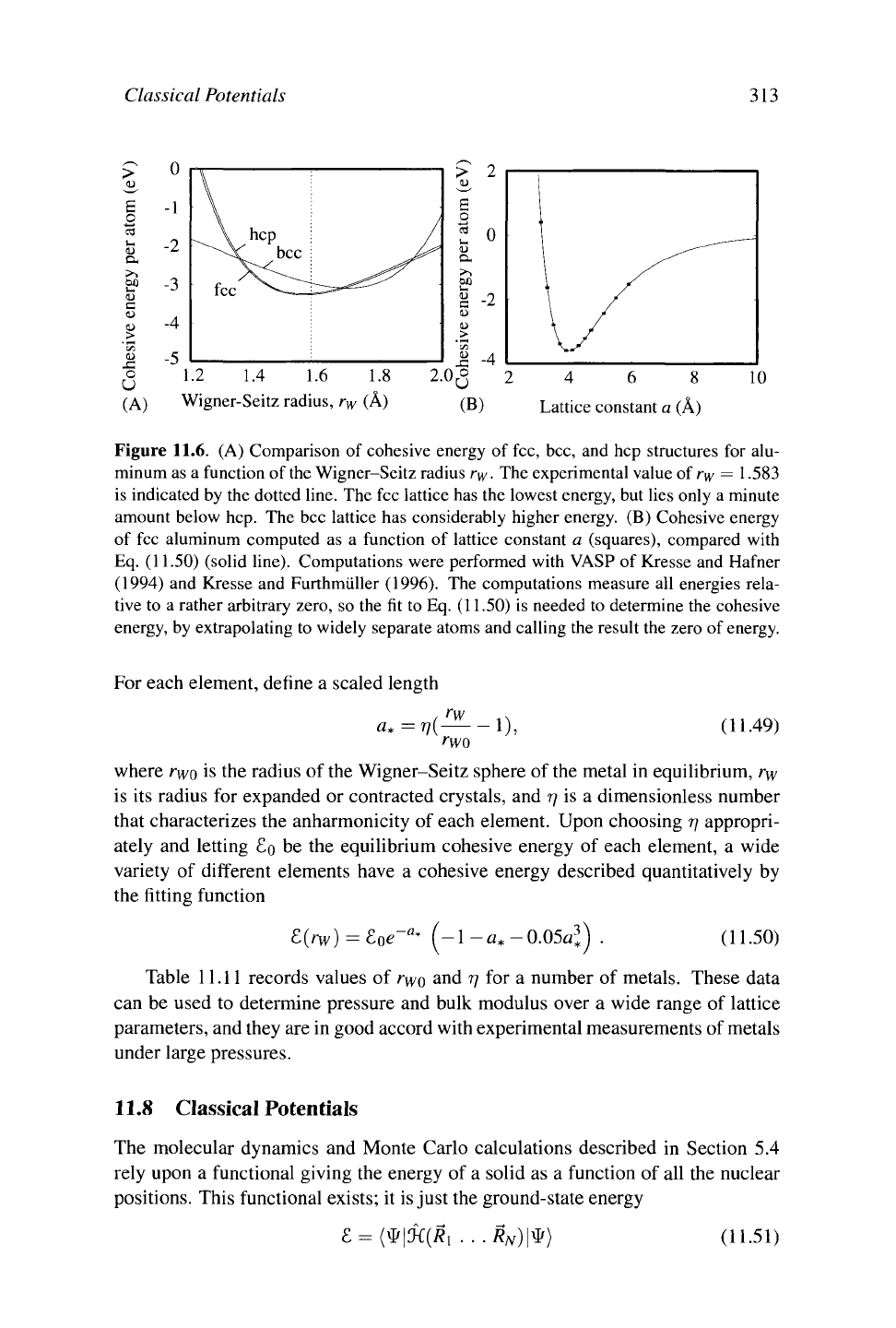
Figure 11.6. (A) Comparison of cohesive energy of fee, bee, and hep structures for alu-
minum as a function of the Wigner-Seitz radius
rw-
The experimental value of
rw
= 1.583
is indicated by the dotted line. The fee lattice has the lowest energy, but lies only a minute
amount below hep. The bec lattice has considerably higher energy. (B) Cohesive energy
of fee aluminum computed as a function of lattice constant a (squares), compared with
Eq.
( 11.50)
(solid line). Computations were performed with VASP of Kresse and Hafner
(1994) and Kresse and Furthmiiller (1996). The computations measure all energies rela-
tive to a rather arbitrary zero, so the fit to Eq. (11.50) is needed to determine the cohesive
energy, by extrapolating to widely separate atoms and calling the result the zero of energy.
For each element, define a scaled length
V(
'
Πνο
(11.49)
where rwo is the radius of the Wigner-Seitz sphere of the metal in equilibrium, rw
is its radius for expanded or contracted crystals, and
77
is a dimensionless number
that characterizes the anharmonicity of each element. Upon choosing η appropri-
ately and letting So be the equilibrium cohesive energy of each element, a wide
variety of different elements have a cohesive energy described quantitatively by
the fitting function
E{r
w
) = E
0
e-
a
* (-1 -a* -0.05^) . (11.50)
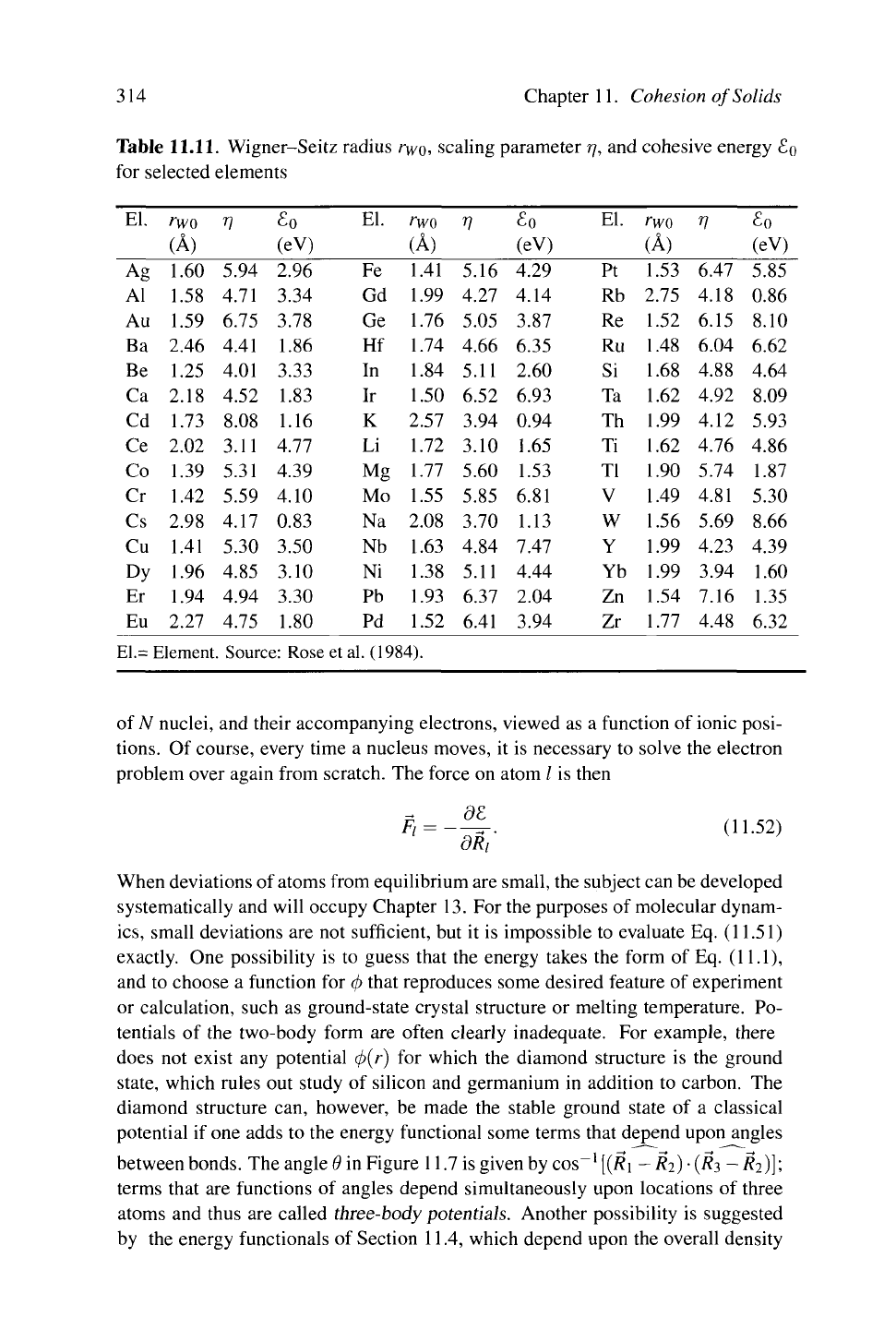
Table 11.11 records values of rwo and
77
for a number of metals. These data
can be used to determine pressure and bulk modulus over a wide range of lattice
parameters, and they are in good accord with experimental measurements of metals
under large pressures.
11.8 Classical Potentials
The molecular dynamics and Monte Carlo calculations described in Section 5.4
rely upon a functional giving the energy of a solid as a function of all the nuclear
positions. This functional exists; it is just the ground-state energy
ε = (Φ|5ί(Α! .../?*)
|Φ>
(11.51)
314 Chapter 11. Cohesion of Solids
Table
11.11.
Wigner-Seitz radius
rwo,
scaling parameter η, and cohesive energy £o
for selected elements
El.
Ag
Al
Au
Ba
Be
Ca
Cd
Ce
Co
Cr
Cs
Cu
Dy
Er
Eu
rwo
(Â)
1.60
1.58
1.59
2.46
1.25
2.18
1.73
2.02
1.39
1.42
2.98
1.41
1.96
1.94
2.27
El.= Element
V
5.94
4.71
6.75
4.41
4.01
4.52
8.08
3.11
5.31
5.59
4.17
5.30
4.85
4.94
4.75
£o
(eV)
2.96
3.34
3.78
1.86
3.33
1.83
1.16
4.77
4.39
4.10
0.83
3.50
3.10
3.30
1.80
El.
Fe
Gd
Ge
Hf
In
Ir
K
Li
Mg
Mo
Na
Nb
Ni
Pb
Pd
rwo
(Â)
1.41
1.99
1.76
1.74
1.84
1.50
2.57
1.72
1.77
1.55
2.08
1.63
1.38
1.93
1.52
. Source: Rose et
al.
(1984).
■n
5.16
4.27
5.05
4.66
5.11
6.52
3.94
3.10
5.60
5.85
3.70
4.84
5.11
6.37
6.41
So
(eV)
4.29
4.14
3.87
6.35
2.60
6.93
0.94
1.65
1.53
6.81
1.13
7.47
4.44
2.04
3.94
El.
Pt
Rb
Re
Ru
Si
Ta
Th
Ti
TI
V
W
Y
Yb
Zn
Zr
rwo
(Â)
1.53
2.75
1.52
1.48
1.68
1.62
1.99
1.62
1.90
1.49
1.56
1.99
1.99
1.54
1.77
V
6.47
4.18
6.15
6.04
4.88
4.92
4.12
4.76
5.74
4.81
5.69
4.23
3.94
7.16
4.48
£o
(eV)
5.85
0.86
8.10
6.62
4.64
8.09
5.93
4.86
1.87
5.30
8.66
4.39
1.60
1.35
6.32
of N nuclei, and their accompanying electrons, viewed as a function of ionic posi-
tions.
Of course, every time a nucleus moves, it is necessary to solve the electron
problem over again from scratch. The force on atom / is then
F
t
= -^i. (11.52)
dRi
When deviations of atoms from equilibrium are small, the subject can be developed
systematically and will occupy Chapter 13. For the purposes of molecular dynam-
ics,
small deviations are not sufficient, but it is impossible to evaluate Eq. (11.51)
exactly. One possibility is to guess that the energy takes the form of Eq. (11.1),
and to choose a function for φ that reproduces some desired feature of experiment
or calculation, such as ground-state crystal structure or melting temperature. Po-
tentials of the two-body form are often clearly inadequate. For example, there
does not exist any potential </>(r) for which the diamond structure is the ground
state,
which rules out study of silicon and germanium in addition to carbon. The
diamond structure can, however, be made the stable ground state of a classical
potential if one adds to the energy functional some terms that depend upon angles
between bonds. The angle
Θ
in Figure 11.7 is given by cos
-1
[(R\
— R2) ■ (R3
-
R2)]',
terms that are functions of angles depend simultaneously upon locations of three
atoms and thus are called three-body potentials. Another possibility is suggested
by the energy functionals of Section 11.4, which depend upon the overall density
Problems 315
of electrons; if terms of this sort are added to an energy functional, they depend
upon the total volume occupied by the atoms, which cannot be expressed in terms
either of pair potentials or three-body potentials.
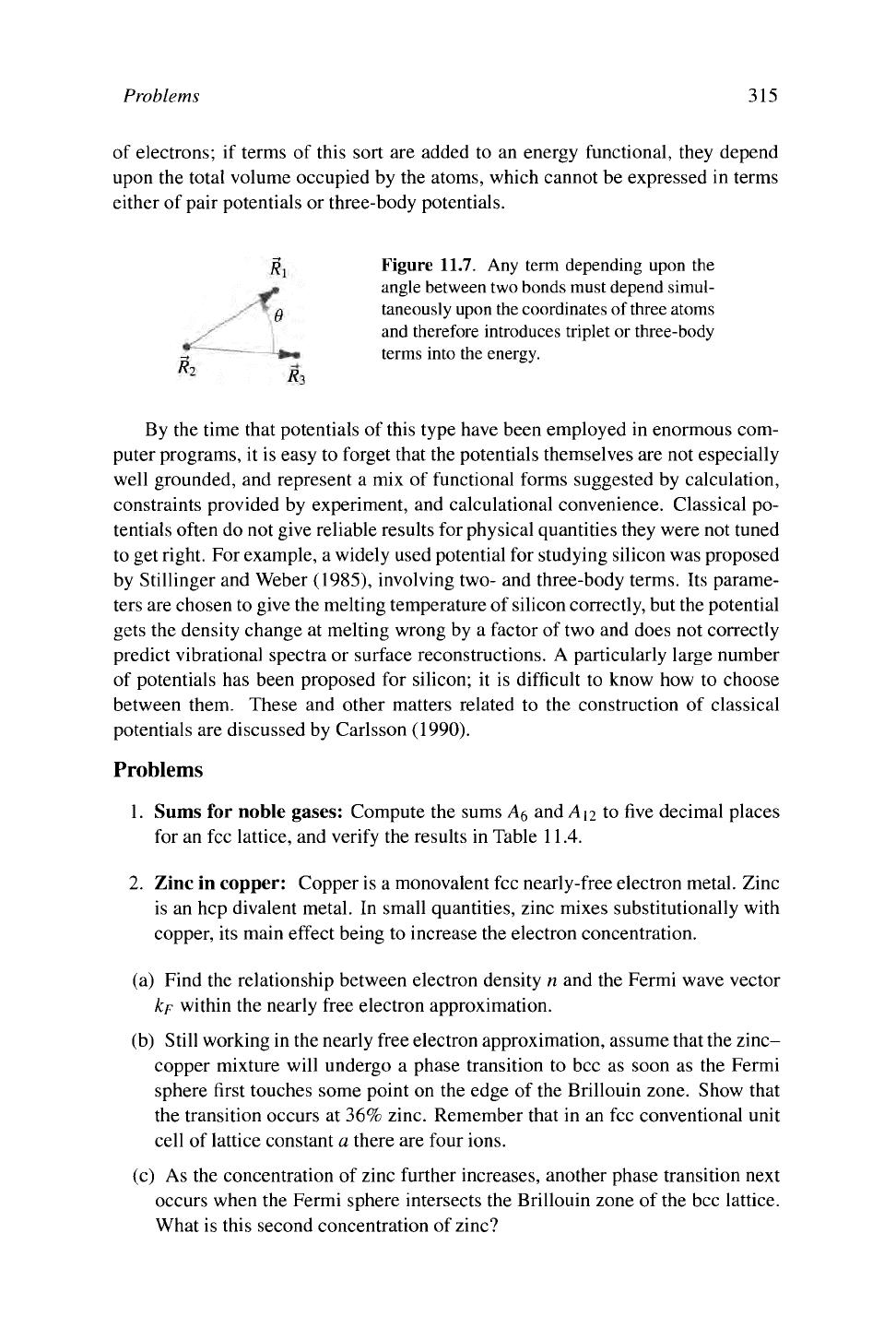
Figure 11.7. Any term depending upon the
angle between two bonds must depend simul-
taneously upon
the
coordinates of three atoms
and therefore introduces triplet or three-body
terms into the energy.
By the time that potentials of this type have been employed in enormous com-
puter programs, it is easy to forget that the potentials themselves are not especially
well grounded, and represent a mix of functional forms suggested by calculation,
constraints provided by experiment, and calculational convenience. Classical po-
tentials often do not give reliable results for physical quantities they were not tuned
to get right. For example, a widely used potential for studying silicon was proposed
by Stillinger and Weber (1985), involving two- and three-body terms. Its parame-
ters are chosen to give the melting temperature of silicon correctly, but the potential
gets the density change at melting wrong by a factor of two and does not correctly
predict vibrational spectra or surface reconstructions. A particularly large number
of potentials has been proposed for silicon; it is difficult to know how to choose
between them. These and other matters related to the construction of classical
potentials are discussed by Carlsson (1990).
Problems
1.
Sums for noble gases: Compute the sums Ag and
A12
to five decimal places
for an fee lattice, and verify the results in Table 11.4.
2.
Zinc in copper: Copper is a monovalent fee nearly-free electron metal. Zinc
is an hep divalent metal. In small quantities, zinc mixes substitutionally with
copper, its main effect being to increase the electron concentration.
(a) Find the relationship between electron density n and the Fermi wave vector
kp within the nearly free electron approximation.
(b) Still working in the nearly free electron approximation, assume that the zinc-
copper mixture will undergo a phase transition to bec as soon as the Fermi
sphere first touches some point on the edge of the Brillouin zone. Show that
the transition occurs at 36% zinc. Remember that in an fee conventional unit
cell of lattice constant a there are four ions.
(c) As the concentration of zinc further increases, another phase transition next
occurs when the Fermi sphere intersects the Brillouin zone of the bec lattice.
What is this second concentration of zinc?
316
Chapter 11. Cohesion of Solids
3.
Quantum view of van der Waals force:
(a) Consider two widely separated hydrogen atoms. Let "K\ and
OÏ2
be the
Hamiltonians for the separate, unperturbed atoms, and let R be the distance
vector between them. Consider now the perturbation
3~C;
1
1
R \R\-R\
1
W\
1
\R\
—R2Ì
(11.53)
where R\ and R
2
are the operators for the positions of the electrons at atoms
1 and 2 (there is no harm done in regarding the electrons as distinguishable,
because they are widely separated).
Show that at first order in perturbation theory, the effect of the perturbation is
exponentially small, because the ground state of the hydrogen atom is spheri-
cally symmetric, and the charge distributions of the two atoms hardly overlap.
(b) Argue that at second order in perturbation theory, all contributions to the
relevant integrals are negligible unless the electrons are very close to their
respective atoms:
|/?i|
<Λ and \R
2
-R\ «A. (11.54)
In this case, it is valid to expand Eq. (11.53) to leading (second) order in
the two small quantities appearing in Eq. (11.54). Show that as a result the
perturbation takes the form
3(R
i
-R)([R
2
-R]-R) Ri-[R
2
-R)
R
5
R*
(11.55)
(c) Show that the leading term in the interaction of the two hydrogen atoms is
negative and varies as R
6
.
4.
Ewald summation for metals:
(a) Show that when the electron density n is constant,Eq. (11.29) can be rewrit-
ten as
N-
5(0)
1
dr
S(r)
+
(11.56)
where 5 is defined by Eq. (11.14).
(b) Show finally that if 5(0) is given by Eq. (11.21) then Eq. (11.56) can be
rewritten as
N-
5(0)
n
g
2
(11.57)
5.
Ewald summation in one dimension: Suppose that one has a collection of
yV
charged spheres containing charge of magnitude q\ . . . q^. Overall the
spheres are electrically neutral; YJi-\ qi = 0. Make many copies of these
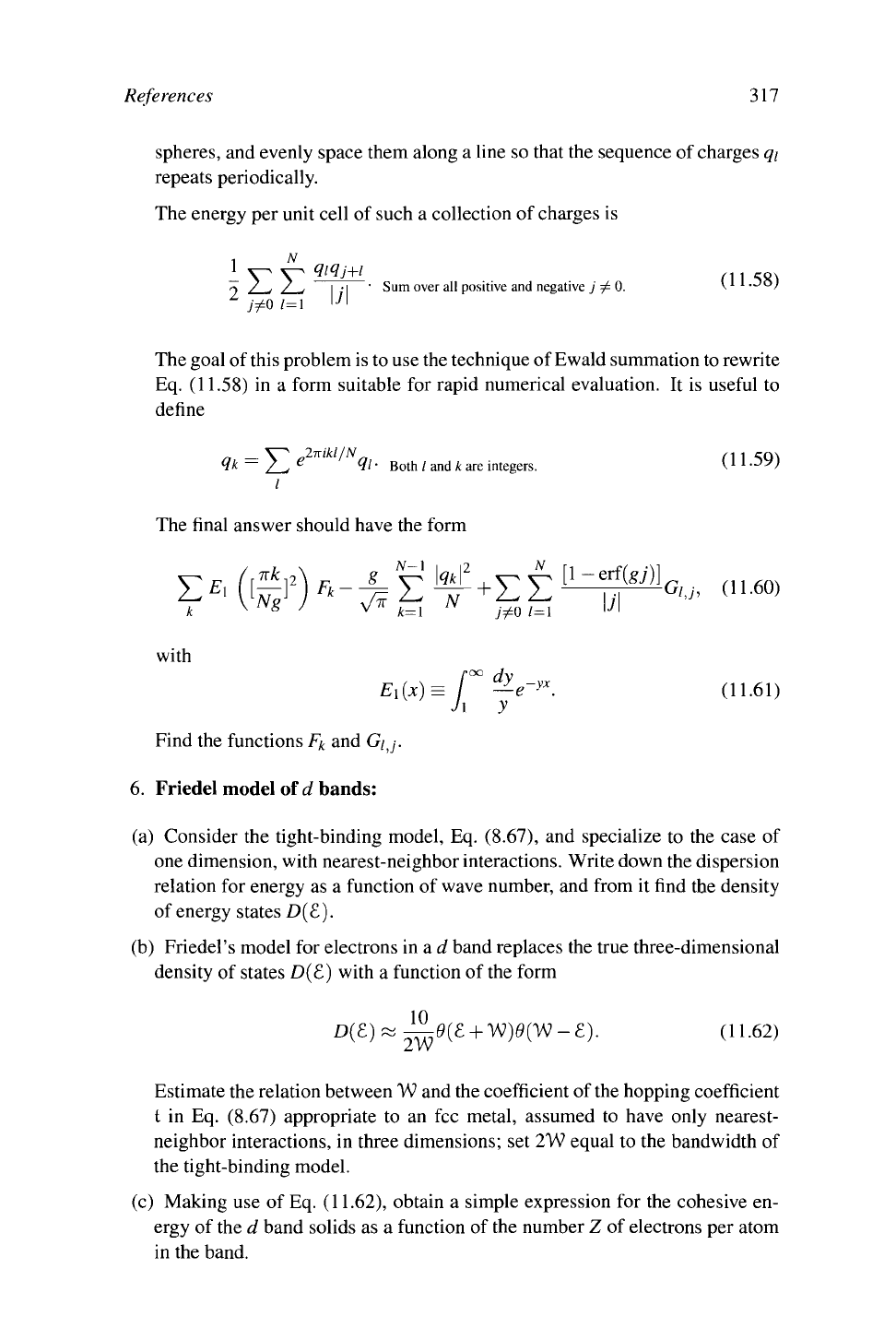
References 317
spheres, and evenly space them along a line so that the sequence of charges qi
repeats periodically.
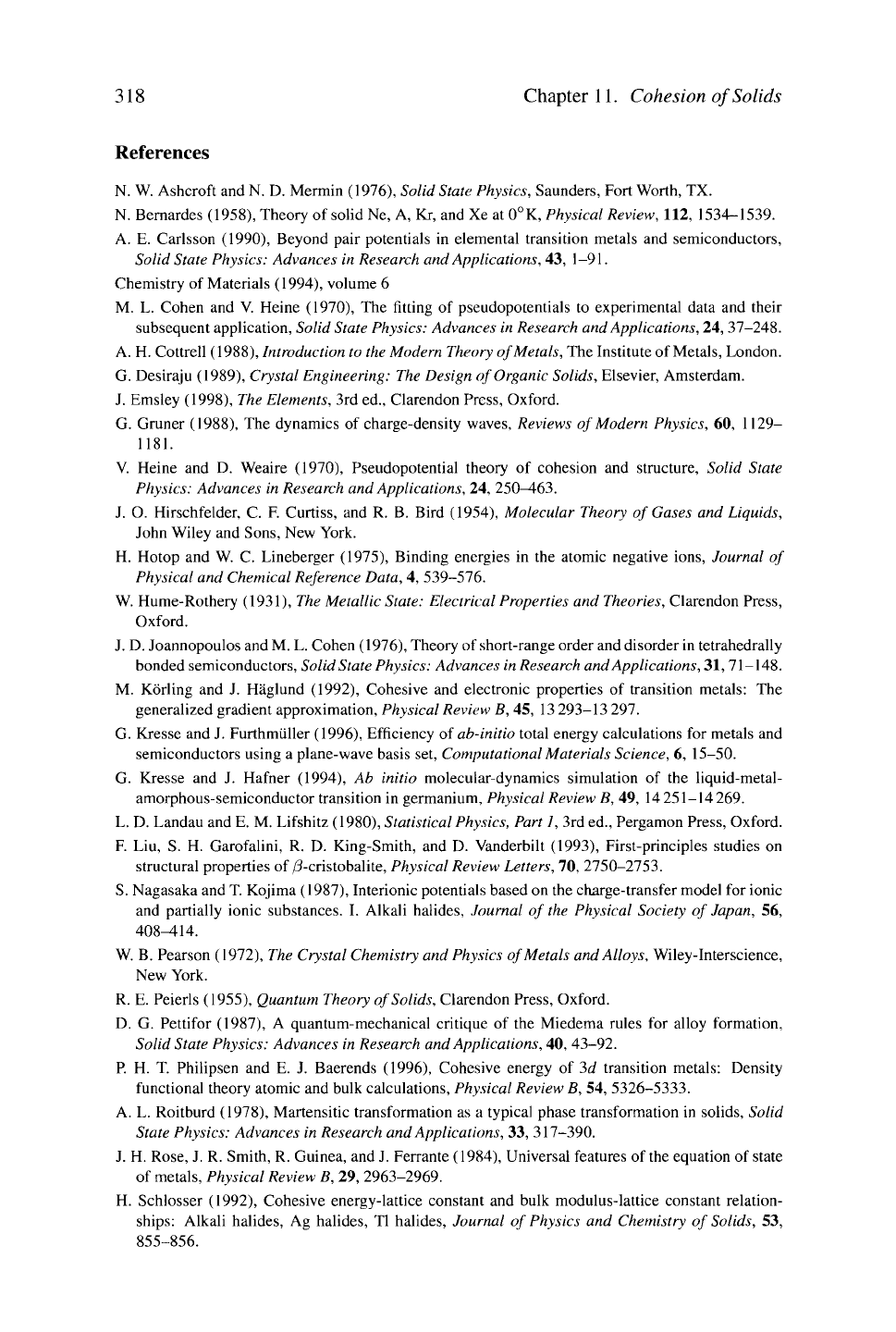
The energy per unit cell of such a collection of charges is
1
y^ y-v qiQj+l Π1 5XÌ
.->
/ j / j I -i · Sum over all positive and negative j φ 0. \ιι.~>ο)
L
]φ0 1=1 \
J
\
The goal of
this
problem is to use the technique of Ewald summation to rewrite
Eq. (11.58) in a form suitable for rapid numerical evaluation. It is useful to
define
Qk
= 2^
e m
11- Both / and k are
integers.
(11.59)
The final answer should have the form
N-Ì
I |2 N
k
\ "ô / v "
k=i
j^o ;
=
i
Σ
Ε
'
©)ί-^Σ^ΣΣ^. <>',o,
with
£I(JC)=
/°° — e~
yx
. (11.61)
Find the functions
Fk
and G/^·.
6. Friedet model of J bands:
(a) Consider the tight-binding model, Eq. (8.67), and specialize to the case of
one dimension, with nearest-neighbor interactions. Write down the dispersion
relation for energy as a function of wave number, and from it find the density
of energy states £>(£).
(b) Friedel's model for electrons in a J band replaces the true three-dimensional
density of states D(E) with a function of the form
D(£)
~2^
Ö(£
+ W)Ö(W
"
£)
'
(1L62)
Estimate the relation between W and the coefficient of
the
hopping coefficient
t in Eq. (8.67) appropriate to an fee metal, assumed to have only nearest-
neighbor interactions, in three dimensions; set 2W equal to the bandwidth of
the tight-binding model.
(c) Making use of Eq. (11.62), obtain a simple expression for the cohesive en-
ergy of the d band solids as a function of the number Z of electrons per atom
in the band.
318
Chapter 11. Cohesion of Solids
References
N.
W. Ashcroft and N. D. Mermin (1976), Solid State Physics, Saunders, Fort Worth, TX.
N.
Bernardes (1958), Theory of solid Ne, A, Kr, and Xe at 0°K, Physical Review, 112, 1534-1539.
A. E. Carlsson (1990), Beyond pair potentials in elemental transition metals and semiconductors,
Solid State Physics: Advances in Research and Applications, 43, 1-91.
Chemistry of Materials (1994), volume 6
M. L. Cohen and V. Heine (1970), The fitting of pseudopotentials to experimental data and their
subsequent application, Solid State Physics: Advances in Research and Applications, 24, 37-248.
A. H. Cottrell (1988), Introduction to the Modern Theory of Metals, The Institute of
Metals,
London.
G. Desiraju (1989), Crystal Engineering: The Design of Organic Solids, Elsevier, Amsterdam.
J. Emsley (1998), The Elements, 3rd ed., Clarendon Press, Oxford.
G. Grüner (1988), The dynamics of charge-density waves, Reviews of Modern Physics, 60, 1129-
1181.
V. Heine and D. Weaire (1970), Pseudopotential theory of cohesion and structure, Solid State
Physics: Advances in Research and Applications, 24, 250^4-63.
J. O. Hirschfelder, C. F. Curtiss, and R. B. Bird (1954), Molecular Theory of Gases and Liquids,
John Wiley and Sons, New York.
H. Hotop and W. C. Lineberger (1975), Binding energies in the atomic negative ions, Journal of
Physical and Chemical Reference Data, 4, 539-576.
W. Hume-Rothery (1931), The Metallic State: Electrical Properties and Theories, Clarendon Press,
Oxford.
J. D. Joannopoulos and M. L. Cohen (1976), Theory of short-range order and disorder in tetrahedrally
bonded semiconductors, Solid State Physics: Advances in Research and Applications, 31,71-148.
M. Körling and J. Häglund (1992), Cohesive and electronic properties of transition metals: The
generalized gradient approximation, Physical Review B, 45,
13
293-13 297.
G. Kresse and J. Furthmiiller (1996), Efficiency of ab-initio total energy calculations for metals and
semiconductors using a plane-wave basis set, Computational Materials Science, 6, 15-50.
G. Kresse and J. Hafner (1994), Ab initia molecular-dynamics simulation of the liquid-metal-
amorphous-semiconductor transition in germanium, Physical Review B, 49, 14251-14269.
L. D. Landau and E. M. Lifshitz (1980), Statistical
Physics,
Part 1, 3rd ed., Pergamon Press, Oxford.
F.
Liu, S. H. Garofalini, R. D. King-Smith, and D. Vanderbilt (1993), First-principles studies on
structural properties of /3-cristobalite, Physical Review Letters, 70, 2750-2753.
S. Nagasaka and
T.
Kojima (1987), Interionic potentials based on the charge-transfer model for ionic
and partially ionic substances. I. Alkali halides, Journal of the Physical Society of Japan, 56,
408^114.
W. B. Pearson (1972), The Crystal Chemistry and Physics of Metals and Alloys, Wiley-Interscience,
New York.
R. E. Peierls (1955), Quantum Theory of Solids, Clarendon Press, Oxford.
D.
G. Pettifor (1987), A quantum-mechanical critique of the Miedema rules for alloy formation,
Solid State Physics: Advances in Research and Applications, 40, 43-92.
P.
H. T. Philipsen and E. J. Baerends (1996), Cohesive energy of 3d transition metals: Density
functional theory atomic and bulk calculations, Physical Review B, 54, 5326-5333.
A. L. Roitburd (1978), Martensitic transformation as a typical phase transformation in solids, Solid
State Physics: Advances in Research and Applications, 33, 317-390.
J. H. Rose, J. R. Smith, R. Guinea, and J. Ferrante (1984), Universal features of the equation of state
of metals, Physical Review B, 29, 2963-2969.
H. Schlosser (1992), Cohesive energy-lattice constant and bulk modulus-lattice constant relation-
ships:
Alkali halides, Ag halides, Tl halides, Journal of Physics and Chemistry of Solids, 53,
855-856.

References
319
F.
H. Stillinger and T. A. Weber (1985), Computer simulation of local order in condensed phases of
silicon, Physical Review B, 31, 5262-5271.
R. Stumpf and M. Scheffler
(
1994),
Simultaneous calculation of the equilibrium electronic structure
and its ground state using density functional theory, Computer Physics Communications, 79, 447-
465.
The code is available in source from the CPC program library.
A. P. Sutton (1993), Electronic Structure of Materials, Clarendon Press, Oxford.
R. E. Thorne (1996), Charge-density-wave conductors, Physics
Today,
49(5), 42-47.
M. P. Tosi (1964), Cohesion of ionic solids in the Born model, Solid State Physics: Advances in
Research and Applications, 16,
1-120.
R. W. G. Wyckoff (1963-1971
),
Crystal Structures, 2nd ed., John Wiley and Sons, New York.
J. M. Zuo, M. Kim, M. O'Keeffe, and J. C. H. Spence (1999), Direct observation of (/-orbital holes
and Cu-Cu bonding in CU2O, Nature, 401,
49-51.
12.
Elasticity
12.1 Introduction
The theory of elasticity describes the energy needed to deform a solid body, pro-
vided that the wavelength of the deformations is large in comparison with any
microstructure. The equations are largely derived through considerations of sym-
metry, depending in the end upon a small number of parameters that can be deter-
mined either from experiment or from atomic-level calculation.
12.2 Nonlinear Elasticity
Nonlinear elasticity describes reversible deformation of solid objects without as-
suming that the deformation is small. In order to describe deformation, one has to
decide that in a certain state a piece of material is not deformed. This corresponds
to the material sitting quietly without any external forces acting upon it, and in this
situation it is in the reference state. Describe locations of material points in this
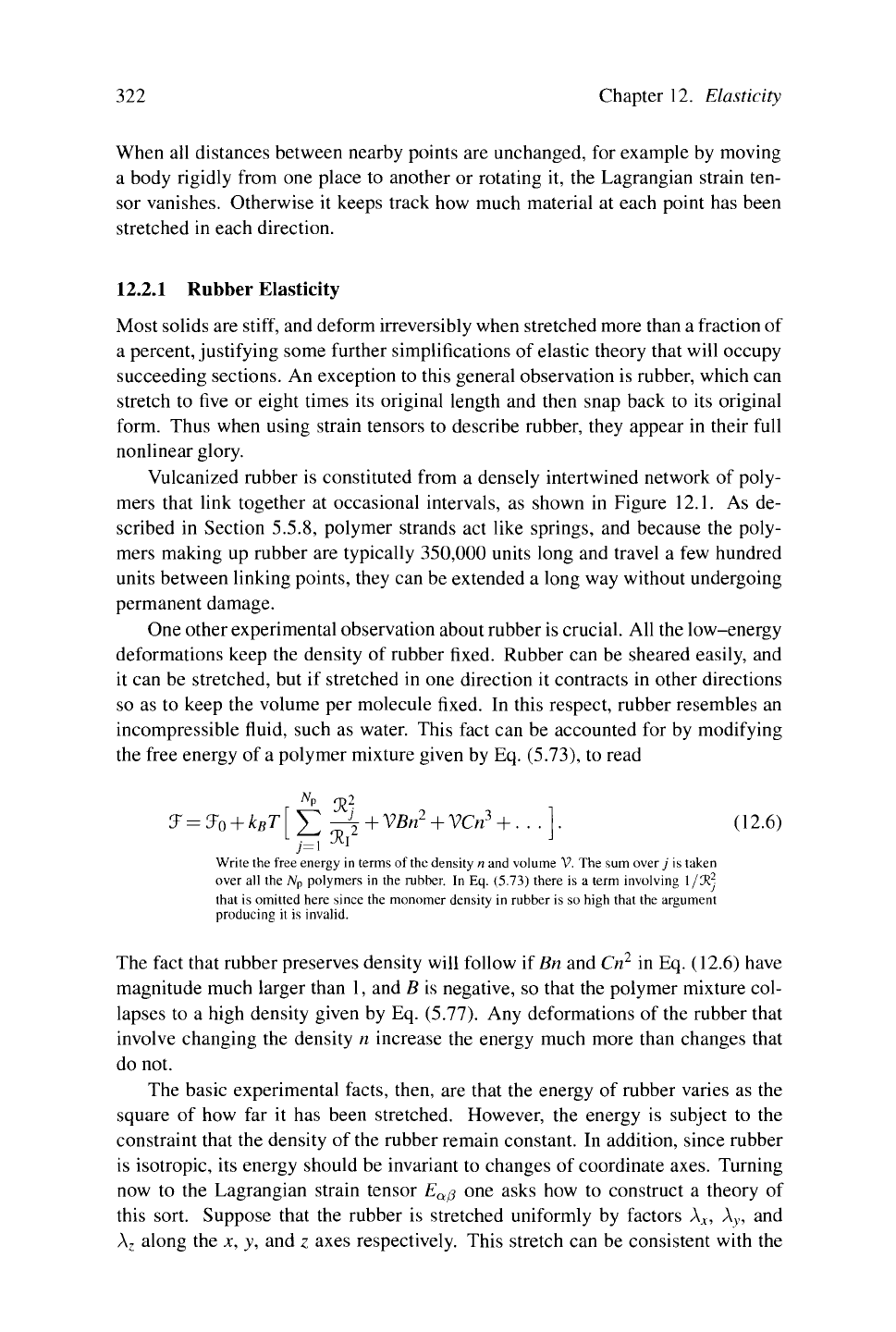
reference state with the variable r. Now grab the solid, twist it, pull it, bend it.
Each material point originally located at ? is now at a new location s(r).
Before deformation After deformation
γ ?(?) = r + ü(r).
The theory of elasticity assumes that the new energy of the object depends
only on the change in distance of material points that were originally close to one
another. For example, one can think about point r and its nearby neighbor r + dr.
The original squared distance between these two points is dr
■
dr =
dr
2
.
+ dr
2
+dr
2
.
After deformation, the new distance is
\s(r + dr)-s(r)\
2
^\—dr
x
+—dr
y
+ —dr
z
\
2
(12.2)
or
x
or
y
or
z
Σ
9? ds
g
aß
dr
a
dr
ß
where g
aß
= -— · —. «and grange
over
x,
(12.3)
0
Or
a
Ora y, andz.
aß
μ
The tensor g
a
ß is the metric tensor. The change in square distance caused by
deformation can be found from the
Lagrangian
strain
tensor
Ε
α
β ,
A |?(?+i/r)
—
?(r)|
—
\dr\ \ The factor of 1/2 is conventional. (12.4)
:
Σ \ ^
a
ß ~
δα
?\
dr
»
dr
ß
Ξ
Σ
Ε
αβ dr
a
dr
ß
(12.5)
αβ αβ
321
Condensed Matter
Physics,
Second Edition
by Michael P. Marder
Copyright © 2010 John Wiley & Sons, Inc.
322
Chapter 12. Elasticity
When all distances between nearby points are unchanged, for example by moving
a body rigidly from one place to another or rotating it, the Lagrangian strain ten-
sor vanishes. Otherwise it keeps track how much material at each point has been
stretched in each direction.
12.2.1 Rubber Elasticity
Most solids are
stiff,
and deform irreversibly when stretched more than a fraction of
a percent, justifying some further simplifications of elastic theory that will occupy
succeeding sections. An exception to this general observation is rubber, which can
stretch to five or eight times its original length and then snap back to its original
form. Thus when using strain tensors to describe rubber, they appear in their full
nonlinear glory.
Vulcanized rubber is constituted from a densely intertwined network of poly-
mers that link together at occasional intervals, as shown in Figure 12.1. As de-
scribed in Section 5.5.8, polymer strands act like springs, and because the poly-
mers making up rubber are typically 350,000 units long and travel a few hundred
units between linking points, they can be extended a long way without undergoing
permanent damage.
One other experimental observation about rubber is crucial. All the low-energy
deformations keep the density of rubber fixed. Rubber can be sheared easily, and
it can be stretched, but if stretched in one direction it contracts in other directions
so as to keep the volume per molecule fixed. In this respect, rubber resembles an
incompressible fluid, such as water. This fact can be accounted for by modifying
the free energy of a polymer mixture given by Eq. (5.73), to read
p
Ji
2
?
=
3-
0
+
k
B
T\j2 "4+Vßn
2
+
VC«
3
+
.
. . 1. (12.6)
Write the free energy in terms of the density n and volume V. The sum over j is taken
over all the N
p
polymers in the rubber. In Eq. (5.73) there is a term involving 1/DÎ
that is omitted here since the monomer density in rubber is so high that the argument
producing it is invalid.
The fact that rubber preserves density will follow if Bn and Cn
2
in Eq. (12.6) have
magnitude much larger than 1, and B is negative, so that the polymer mixture col-
lapses to a high density given by Eq. (5.77). Any deformations of the rubber that
involve changing the density n increase the energy much more than changes that
do not.
The basic experimental facts, then, are that the energy of rubber varies as the
square of how far it has been stretched. However, the energy is subject to the
constraint that the density of the rubber remain constant. In addition, since rubber
is isotropie, its energy should be invariant to changes of coordinate axes. Turning
now to the Lagrangian strain tensor Ε
α
β one asks how to construct a theory of
this sort. Suppose that the rubber is stretched uniformly by factors X
x
, X
Y
, and
λ
ζ
along the x, y, and z axes respectively. This stretch can be consistent with the