
Marder M.P. Condensed Matter Physics
Подождите немного. Документ загружается.

Inelastic Scattering from Phonons
363
For an isotropie solid, the coefficient of
linear
expansion ατ is just one-third
of the coefficient of volume expansion ßj. For a crystal, there will generally be
different degrees of contraction along different crystalline axes.
Definition of the Grüneisen parameter does not dramatically simplify the task
of presenting data on thermal expansion data, but does correctly emphasize the fact
that trends in the specific heat, particularly at low temperatures, are likely to be re-
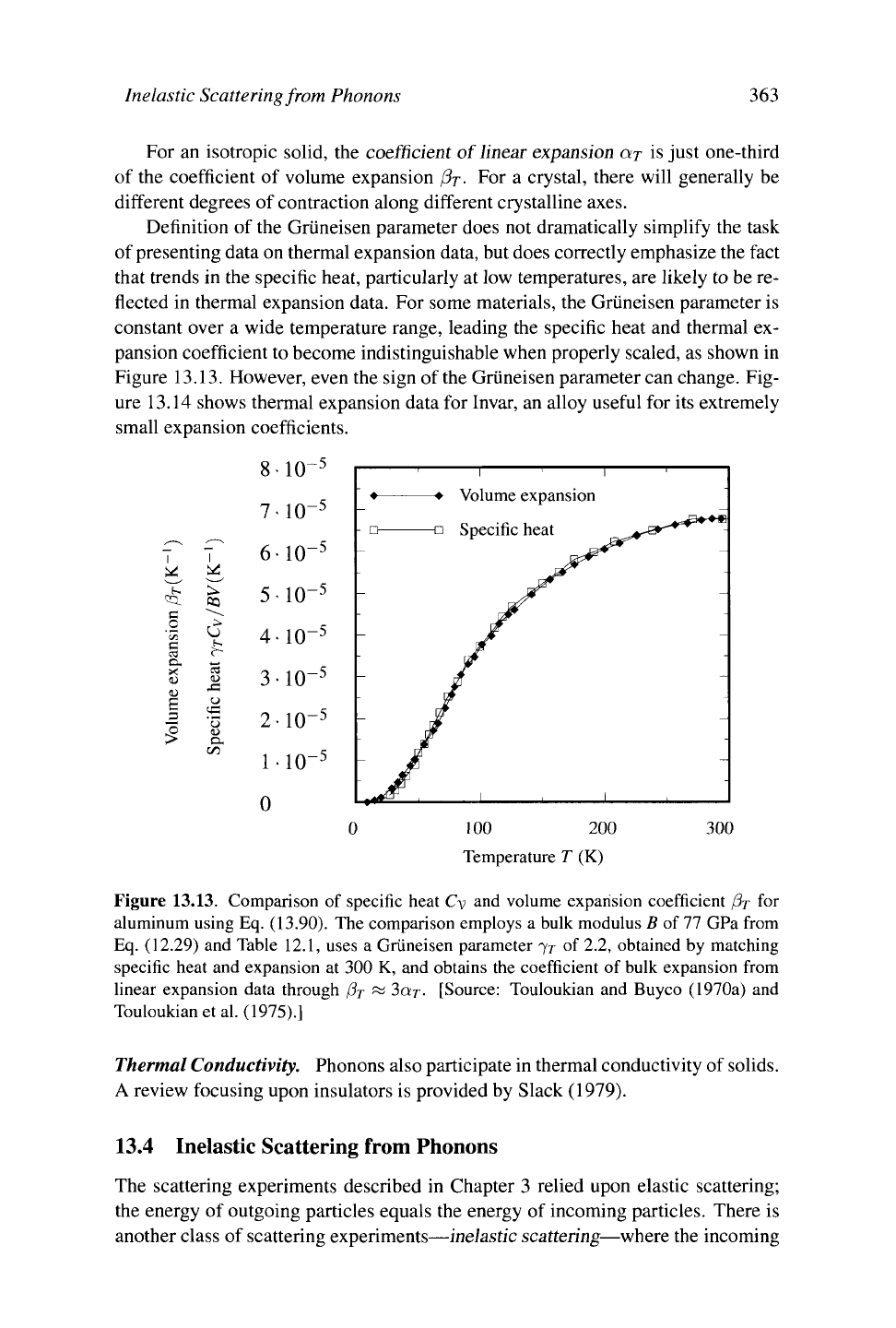
flected in thermal expansion data. For some materials, the Grüneisen parameter is
constant over a wide temperature range, leading the specific heat and thermal ex-
pansion coefficient to become indistinguishable when properly scaled, as shown in
Figure
13.13.
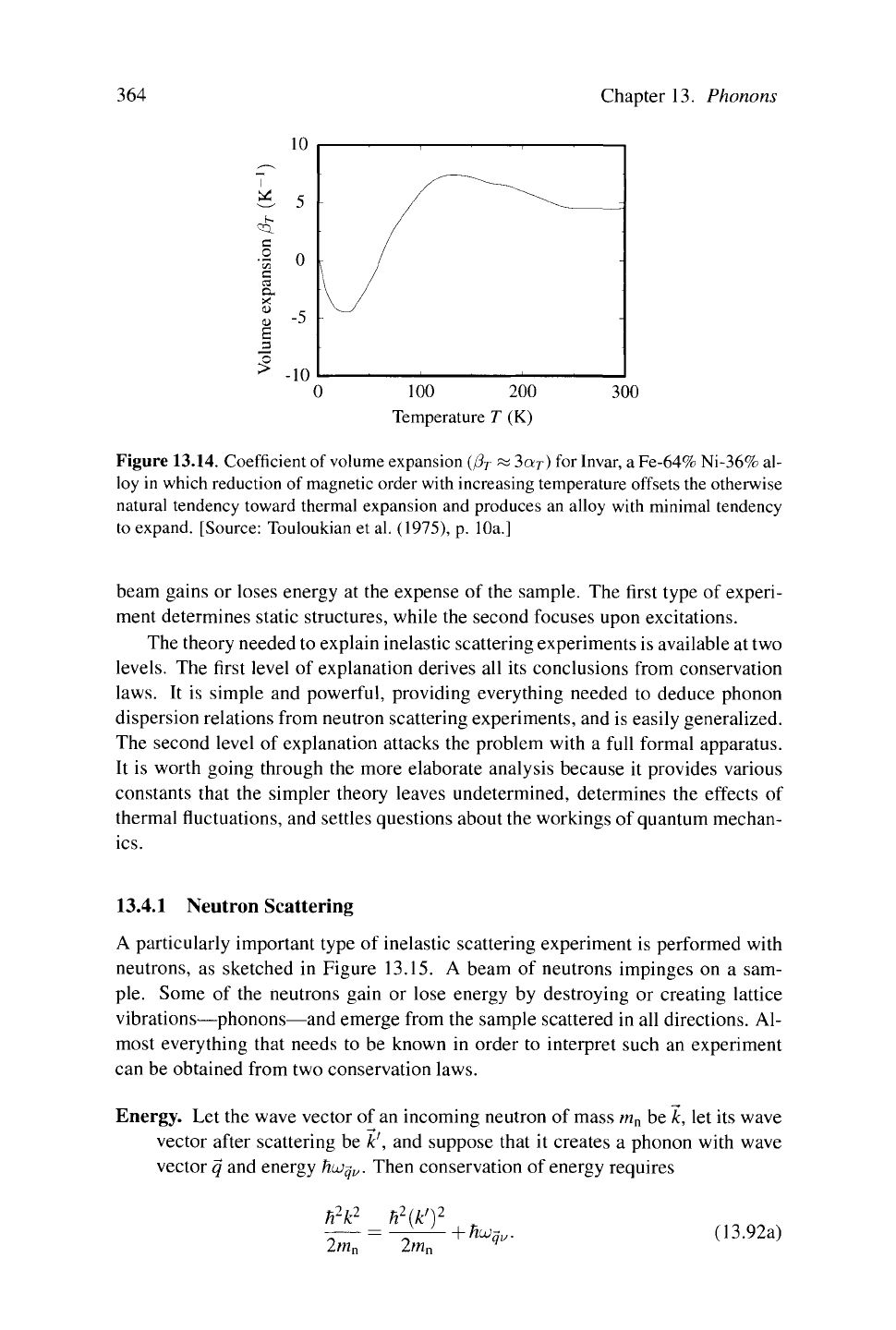
However, even the sign of
the
Grüneisen parameter can change. Fig-
ure 13.14 shows thermal expansion data for Invar, an alloy useful for its extremely
small expansion coefficients.
X, X
f~
^
c
o
rt
OH
X
<u
E
3
£
r^
EQ
^^
,
>
u
K
r-
^j
CO
1)
JS
o
<43
<Ji
8
7
6
5
4
3
2
1
0
1CT
5
10"
5
10"
5
10"
5
10"
5
10"
5
10"
5
10"
5
-♦ Volume expansion
-o Specific heat
100 200
Temperature T (K)
300
Figure 13.13. Comparison of specific heat Cv and volume expansion coefficient ßj for
aluminum using Eq. (13.90). The comparison employs a bulk modulus B of
77
GPa from
Eq. (12.29) and Table
12.1,
uses a Grüneisen parameter 77 of 2.2, obtained by matching
specific heat and expansion at 300 K, and obtains the coefficient of bulk expansion from
linear expansion data through ßj « 3αγ- [Source: Touloukian and Buyco (1970a) and
Touloukian et
al.
(1975).]
Thermal
Conductivity.
Phonons also participate in thermal conductivity of solids.
A review focusing upon insulators is provided by Slack (1979).
13.4 Inelastic Scattering from Phonons
The scattering experiments described in Chapter 3 relied upon elastic scattering;
the energy of outgoing particles equals the energy of incoming particles. There is
another class of scattering experiments—inelastic scattering—where the incoming
364
Chapter 13. Phonons
c
c
a
CL.
X
u
1)
>
100 200
Temperature T (K)
300
Figure 13.14. Coefficient of
volume
expansion (β
τ
« 3a
T
) for
Invar,
a
Fe-64%
Ni-36% al-
loy in which reduction of
magnetic
order with increasing temperature offsets the otherwise
natural tendency toward thermal expansion and produces an alloy with minimal tendency
to expand. [Source: Touloukian et
al.
(1975), p. 10a.]
beam gains or loses energy at the expense of the sample. The first type of experi-
ment determines static structures, while the second focuses upon excitations.
The theory needed to explain inelastic scattering experiments is available at two
levels.
The first level of explanation derives all its conclusions from conservation
laws.
It is simple and powerful, providing everything needed to deduce phonon
dispersion relations from neutron scattering experiments, and is easily generalized.
The second level of explanation attacks the problem with a full formal apparatus.
It is worth going through the more elaborate analysis because it provides various
constants that the simpler theory leaves undetermined, determines the effects of
thermal fluctuations, and settles questions about the workings of quantum mechan-
ics.
13.4.1 Neutron Scattering
A particularly important type of inelastic scattering experiment is performed with
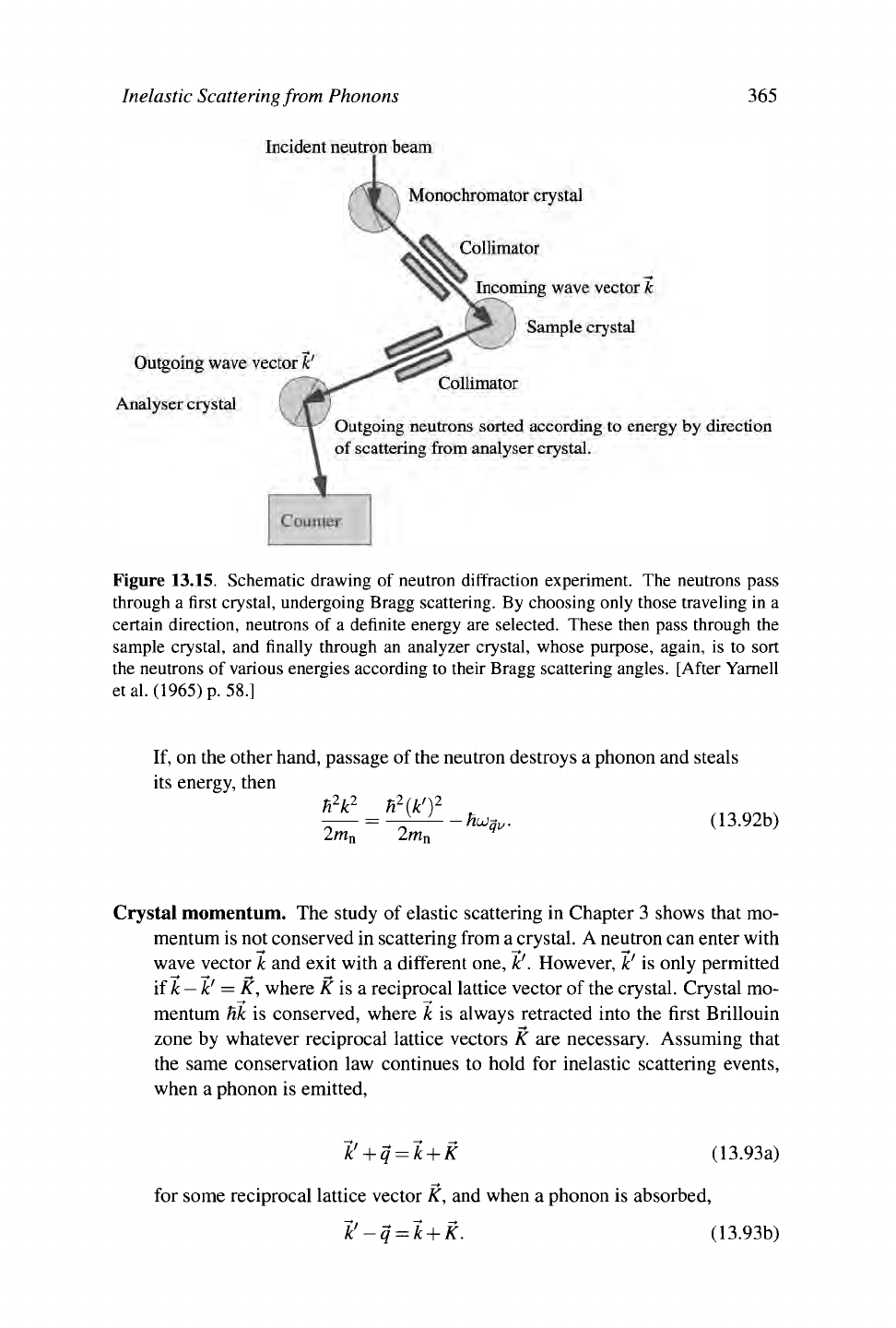
neutrons, as sketched in Figure 13.15. A beam of neutrons impinges on a sam-
ple.
Some of the neutrons gain or lose energy by destroying or creating lattice
vibrations—phonons—and emerge from the sample scattered in all directions. Al-
most everything that needs to be known in order to interpret such an experiment
can be obtained from two conservation laws.
Energy. Let the wave vector of an incoming neutron of mass m
n
be k, let its wave
vector after scattering be id, and suppose that it creates a phonon with wave
vector q and energy Ηω^. Then conservation of energy requires
Λ2
h
l
k
z
_ tr{k
2m
n
2m„
+
hiüs„.
(13.92a)
Inelastic Scattering from Phonons 365
Figure 13.15. Schematic drawing of neutron diffraction experiment. The neutrons pass
through a
first
crystal, undergoing Bragg scattering. By choosing only those traveling in a
certain direction, neutrons of a definite energy are selected. These then pass through the
sample crystal, and finally through an analyzer crystal, whose purpose, again, is to sort
the neutrons of various energies according to their Bragg scattering angles. [After Yarnell
et
al.
(1965)
p.
58.]
If, on the other hand, passage of
the
neutron destroys a phonon and steals
its energy, then
™<ψ1-^.
„3.92b,
2m
n
2m
n
Crystal momentum. The study of elastic scattering in Chapter 3 shows that mo-
mentum is not conserved in scattering from a crystal. A neutron can enter with
wave vector k and exit with a different one, κ. However, κ is only permitted
if k
—
k!
= K, where K is a reciprocal lattice vector of the crystal. Crystal mo-
mentum
Hk
is conserved, where k is always retracted into the first Brillouin
zone by whatever reciprocal lattice vectors K are necessary. Assuming that
the same conservation law continues to hold for inelastic scattering events,
when a phonon is emitted,
k' + q = k + K (13.93a)
for some reciprocal lattice vector K, and when a phonon is absorbed,
k'-q = k + K. (13.93b)
366
Chapter 13. Phonons
Combining Eqs. (13.92) and (13.93) gives
n
2
k
2
^
r
n
2
{k')
2
_ _
n/n
— 3zHüJ,7_7,\ — — , The reciprocal lattice vectors K disappear from (13.94)
2/iî
n
*■ '
'
^ΙΐΙη ωτ because ωτ, s =ΙΛ . Also note
L*J
7
=ΙΛ .
—κ,ν ku
where the + sign holds for phonon absorption, and the
—
sign holds for emission.
What Eq. (13.94) implies is that for any observation direction, k', there should
be some neutron scattering. The reason is that although the experiment will gaze
at the sample in a fixed direction, the magnitude of k' is arbitrary, and therefore by
scanning through k!, there is every reason to hope that one will obtain a discrete
number of different solutions to Eq. (13.94). If a solution is obtained, the known
difference between k and κ gives the wave vector of the phonon, while the differ-
ence in energies between incoming and outgoing neutrons gives the energy of the
phonon.
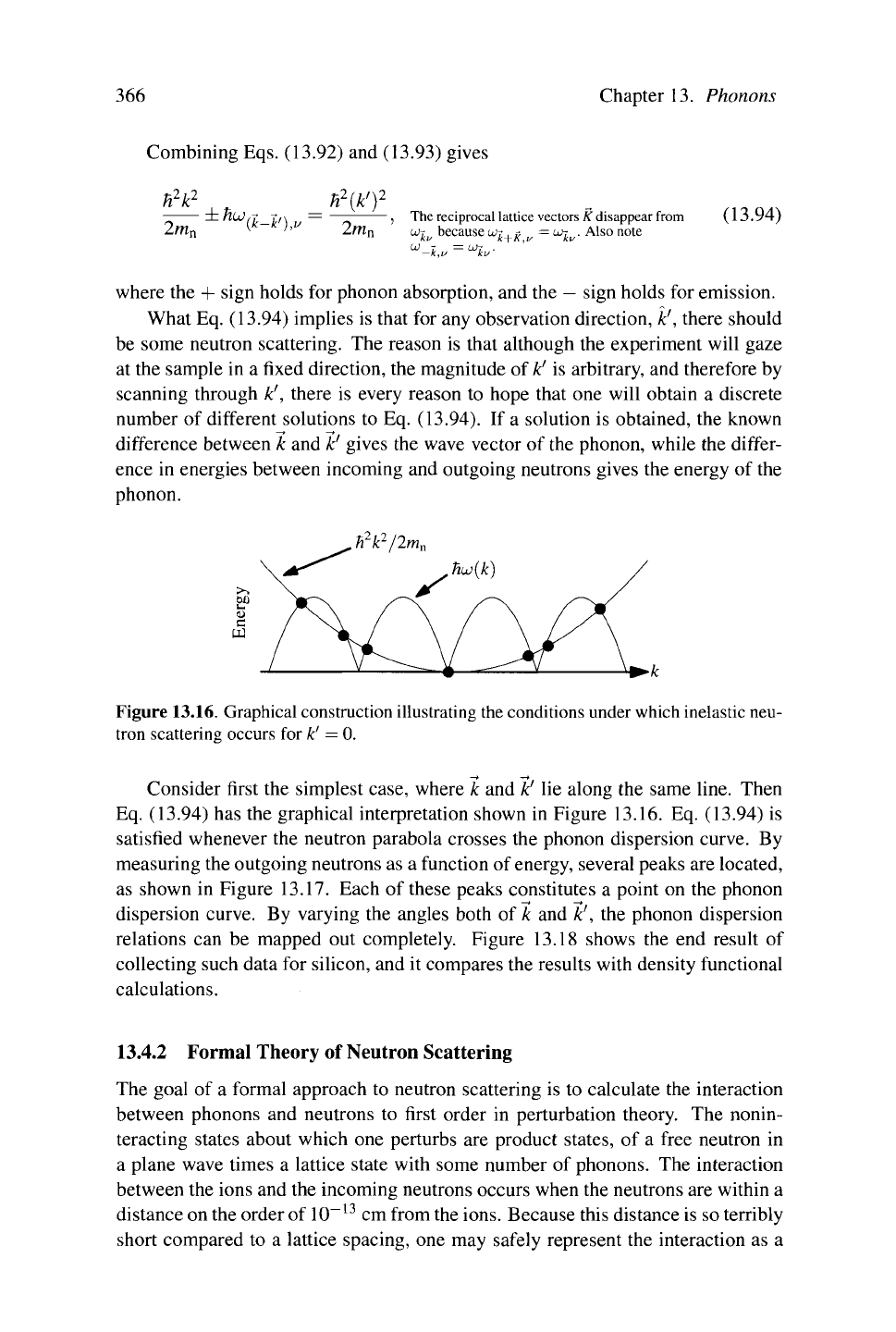
Figure 13.16. Graphical construction illustrating the conditions under which inelastic neu-
tron scattering occurs for k' = 0.
Consider first the simplest case, where k and k' lie along the same line. Then
Eq. (13.94) has the graphical interpretation shown in Figure 13.16. Eq. (13.94) is
satisfied whenever the neutron parabola crosses the phonon dispersion curve. By
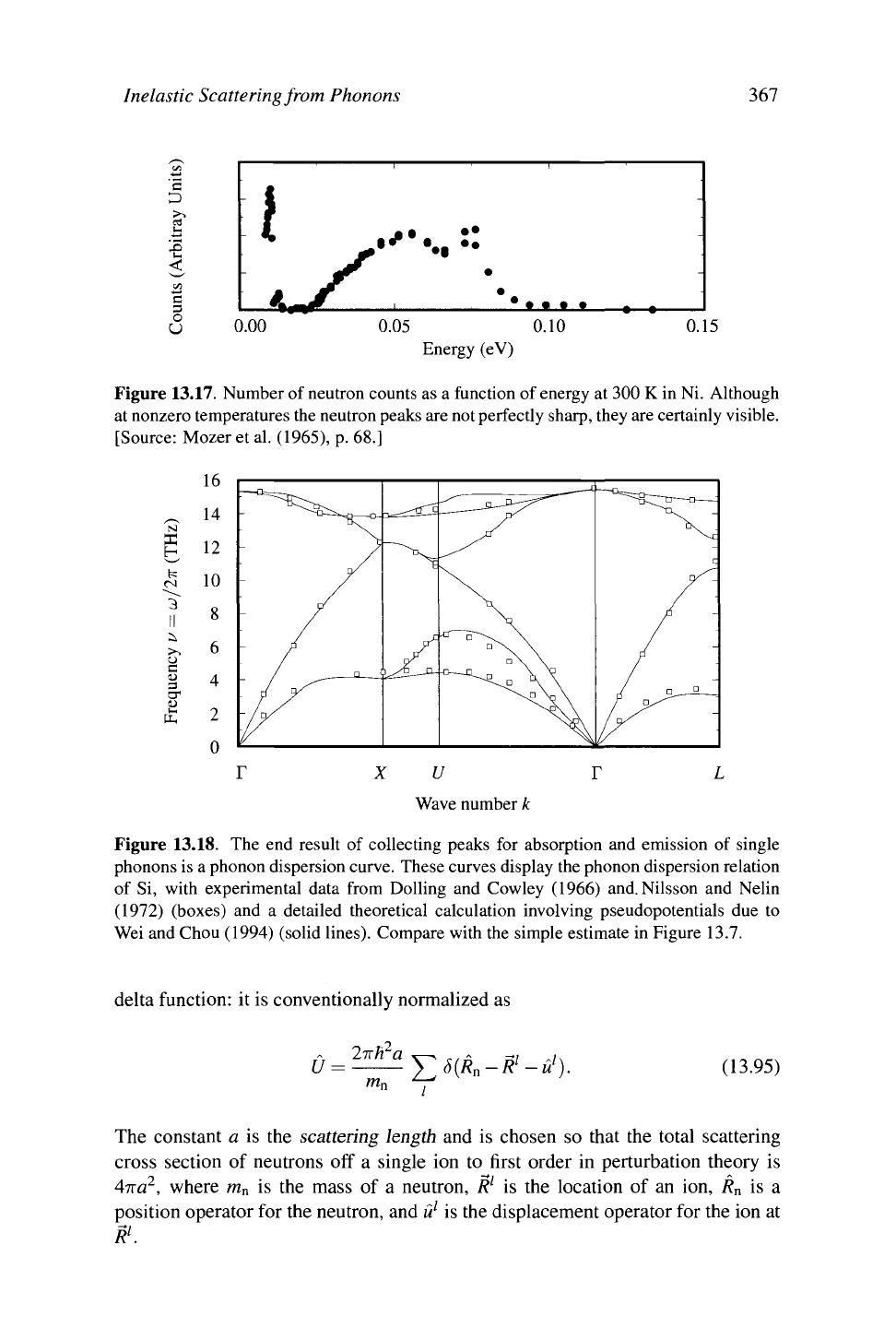
measuring the outgoing neutrons as a function of energy, several peaks are located,
as shown in Figure 13.17. Each of these peaks constitutes a point on the phonon
dispersion curve. By varying the angles both of k and k!, the phonon dispersion
relations can be mapped out completely. Figure 13.18 shows the end result of
collecting such data for silicon, and it compares the results with density functional
calculations.
13.4.2 Formal Theory of Neutron Scattering
The goal of a formal approach to neutron scattering is to calculate the interaction
between phonons and neutrons to first order in perturbation theory. The nonin-
teracting states about which one perturbs are product states, of a free neutron in
a plane wave times a lattice state with some number of phonons. The interaction
between the ions and the incoming neutrons occurs when the neutrons are within a
distance on the order of 10~
13
cm from the
ions.
Because this distance is so terribly
short compared to a lattice spacing, one may safely represent the interaction as a
Inelastic Scattering from Phonons 367
c
D
o
U
·· ··
• · · ·
0.00
0.05 0.10
Energy (eV)
0.15
Figure 13.17. Number of neutron counts as a function of energy at 300 K in Ni. Although
at nonzero temperatures the neutron peaks are not perfectly sharp, they are certainly visible.
[Source: Mozer et al. (1965), p. 68.]
X
O
B
U
3
UH
Γ XU Γ L
Wave number k
Figure 13.18. The end result of collecting peaks for absorption and emission of single
phonons is a phonon dispersion curve. These curves display the phonon dispersion relation
of Si, with experimental data from Dolling and Cowley (1966) and. Nilsson and Nelin
(1972) (boxes) and a detailed theoretical calculation involving pseudopotentials due to
Wei and Chou (1994) (solid lines). Compare with the simple estimate in Figure 13.7.
delta function: it is conventionally normalized as
2πΗ a
U
l d\
m
n
Y^5{R
n
-R
l
-û
(13.95)
The constant a is the scattering length and is chosen so that the total scattering
cross section of neutrons off a single ion to first order in perturbation theory is
4πα
2
,
where m
n
is the mass of a neutron, R
l
is the location of an ion, R
n
is a
position operator for the neutron, and û
l
is the displacement operator for the ion at
R
l
.
368 Chapter 13. Phonoris
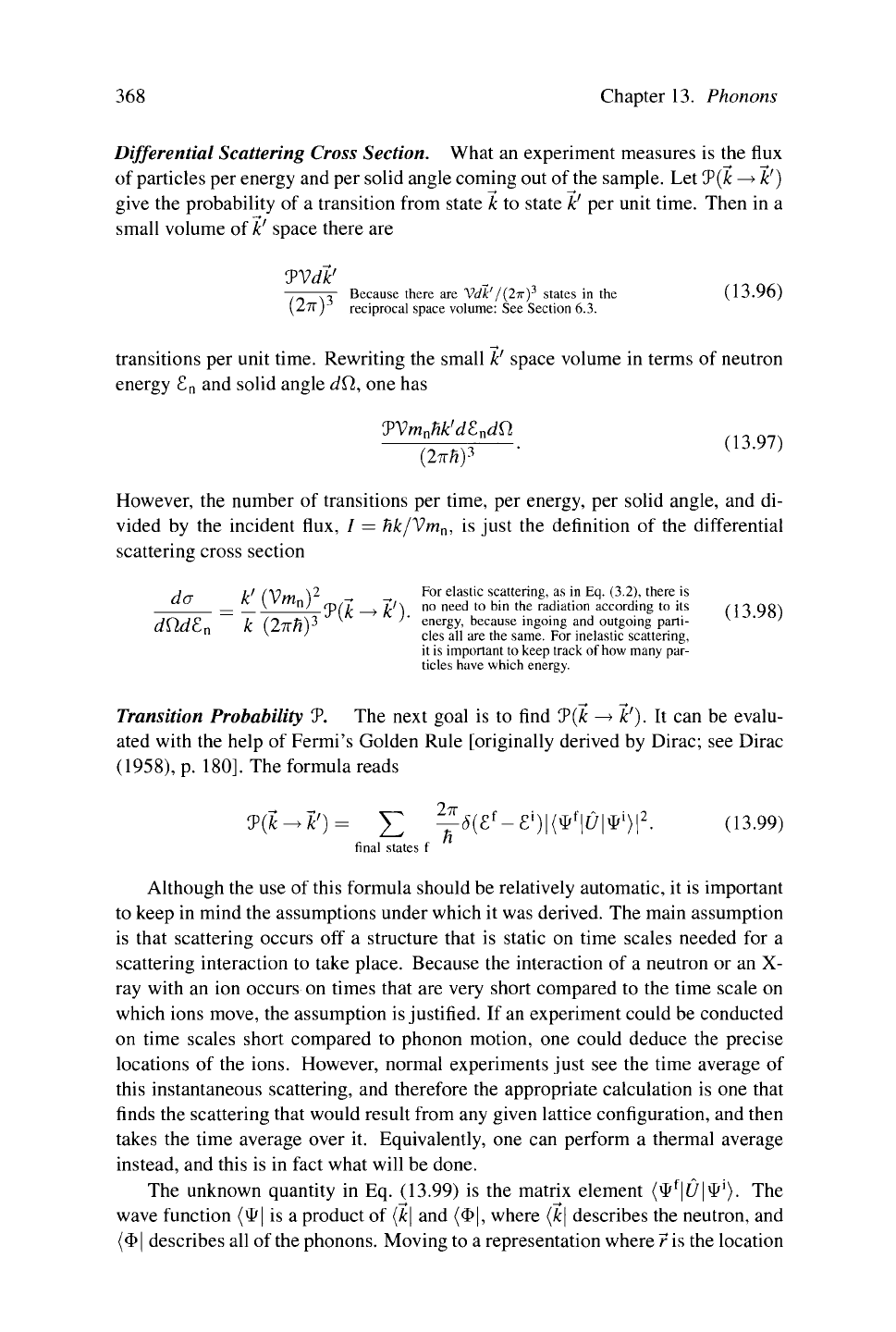
Differential Scattering Cross Section. What an experiment measures is the flux
of particles per energy and per solid angle coming out of the sample. Let 7{k
—>
k')
give the probability of a transition from state k to state k' per unit time. Then in
a
small volume of V space there are
Well·
———rr" Because there are Vdk'/(2π)
3
states
in
the (13.96)
(27Tj reciprocal space volume: See Section 6.3.
transitions per unit time. Rewriting the small k! space volume in terms of neutron
energy £
n
and solid angle
dQ,,
one has
yvm
n
hk'd£
nC
m
ii^hy
·
(13
·
97)
However, the number of transitions per time, per energy, per solid angle, and di-
vided by the incident flux,
/ =
hk/Vm
n
, is just the definition
of
the differential
scattering cross section
j y (\>
m
\2 _^
For elastic scattering, as in Eq. (3.2), there
is
\
n
/
<Τ>(Ϊ ^
Χ'\
no need to bin the radiation according
to
its
π-i no\
*.
''
pnprov hp.ransR inaninp and niitpnino
narti-
^ ' ^
dildE,
k
(2ΤΓΗ)^
energy, because ingoing and outgoing parti-
n
\ '
cles all are the same. For inelastic scattering,
it is important to keep track of how many par-
ticles have which energy.
Transition Probability
7.
The next goal
is
to find 7{k
—>
kf).
It
can be evalu-
ated with the help of Fermi's Golden Rule [originally derived by Dirac; see Dirac
(1958),
p. 180]. The formula reads
y(k^k')=
Σ -j-o{Ì
f
-£})\{¥\Ù\¥)\
2
.
(13.99)
final states
f
Although the use of this formula should be relatively automatic, it is important
to keep in mind the assumptions under which it was derived. The main assumption
is that scattering occurs
off a
structure that
is
static on time scales needed for
a
scattering interaction to take place. Because the interaction of a neutron or an X-
ray with an ion occurs on times that are very short compared to the time scale on
which ions move, the assumption is justified. If an experiment could be conducted
on time scales short compared to phonon motion, one could deduce the precise
locations of the ions. However, normal experiments just see the time average of
this instantaneous scattering, and therefore the appropriate calculation is one that
finds the scattering that would result from any given lattice configuration, and then
takes the time average over it. Equivalently, one can perform
a
thermal average
instead, and this is in fact what will be done.
The unknown quantity
in
Eq. (13.99)
is
the matrix element (Φ
ί
|ί/|Φ
1
).
The
wave function (Φ| is a product of
(k\
and (Φ|, where (k\ describes the neutron, and
(Φ j
describes all of the phonons. Moving to a representation where r is the location
Inelastic Scattering from Phonons 369
of the neutron,
one
obtains
2πΗ
a
dr{k'\r){r\{&\
V
^±^5(R-R
l
-u
l
)\k)\&) (13.100)
=
f
^-*Η(φί|^ £$(?_# _ß<)|<|>i)
(13
.
101)
=
Ι^
^y^'M«)^).
(13102)
V
m
n
^
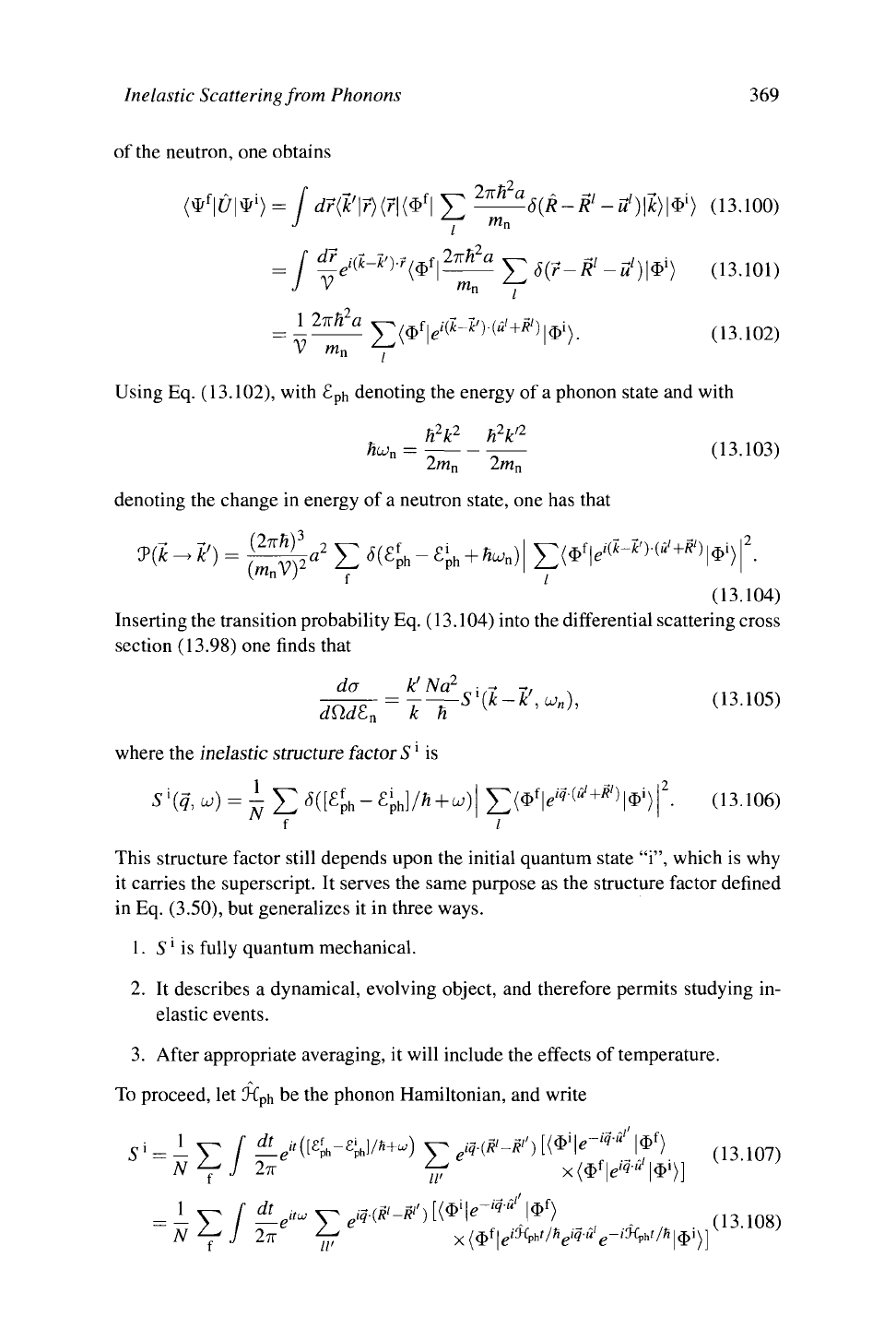
Using Eq. (13.102), with
S
p
h
denoting
the
energy
of
a phonon state
and
with
h
2
k
2
h
2
k'
2
Κω
η
=
-^-
η
-^- (13.103)
Zm
n
2m
n
denoting
the
change
in
energy
of
a neutron state,
one has
that
v
&^
=
Ê%
a2
Σ
δ^-ε^+πω^ί
Σ,&\^-*
Ηύ+
*Ψ)\
2
.
(13.104)
Inserting the transition probability Eq. (13.104) into the differential scattering cross
section (13.98)
one
finds that
tin
k'
Nn
2
■
-, -,
a
S\k-kf,u
n
),
(13.105)
dfld£
n
k H
where
the
inelastic structure factor S
' is
S\q^)
=
^ô([E
i
ph
-i
i
ph
]/h +
u)\
J2(^\e
iHÛ
'
+âl)
m\
2
- (13-106)
f
/
This structure factor still depends upon
the
initial quantum state "i", which
is why
it carries
the
superscript.
It
serves
the
same purpose
as the
structure factor defined
in Eq. (3.50),
but
generalizes
it in
three ways.
1.
S ' is
fully quantum mechanical.
2.
It
describes
a
dynamical, evolving object,
and
therefore permits studying
in-
elastic events.
3.
After appropriate averaging,
it
will include
the
effects
of
temperature.
To proceed,
let Ä
p
h be the
phonon Hamiltonian,
and
write
s
-
1=
]_ r dij'^-E^/n+u) y- ^(tf-^K^k-'^V)
(13 107)
N
^ J 2π jf
χ(Φ
ί
\β
ί
^'\Φ
ί
)}
370
Chapter 13. Phonons
1
^ r
dt
~N
J2
f
—e
ituJ
Σ
β
|
9-^-*
,
')(Φ
ΐ
|β-'9·
ΰ
''|Φ
Γ
)(Φ
ί
|β
,
9-
ΰ
'(
,
)|φΐ) (13.109)
= Jj
I ^ Σ S^^'^\e-^S^W)- co™ettTf
a
(13.110)
J
Ζ7Γ ^,
phonon states.
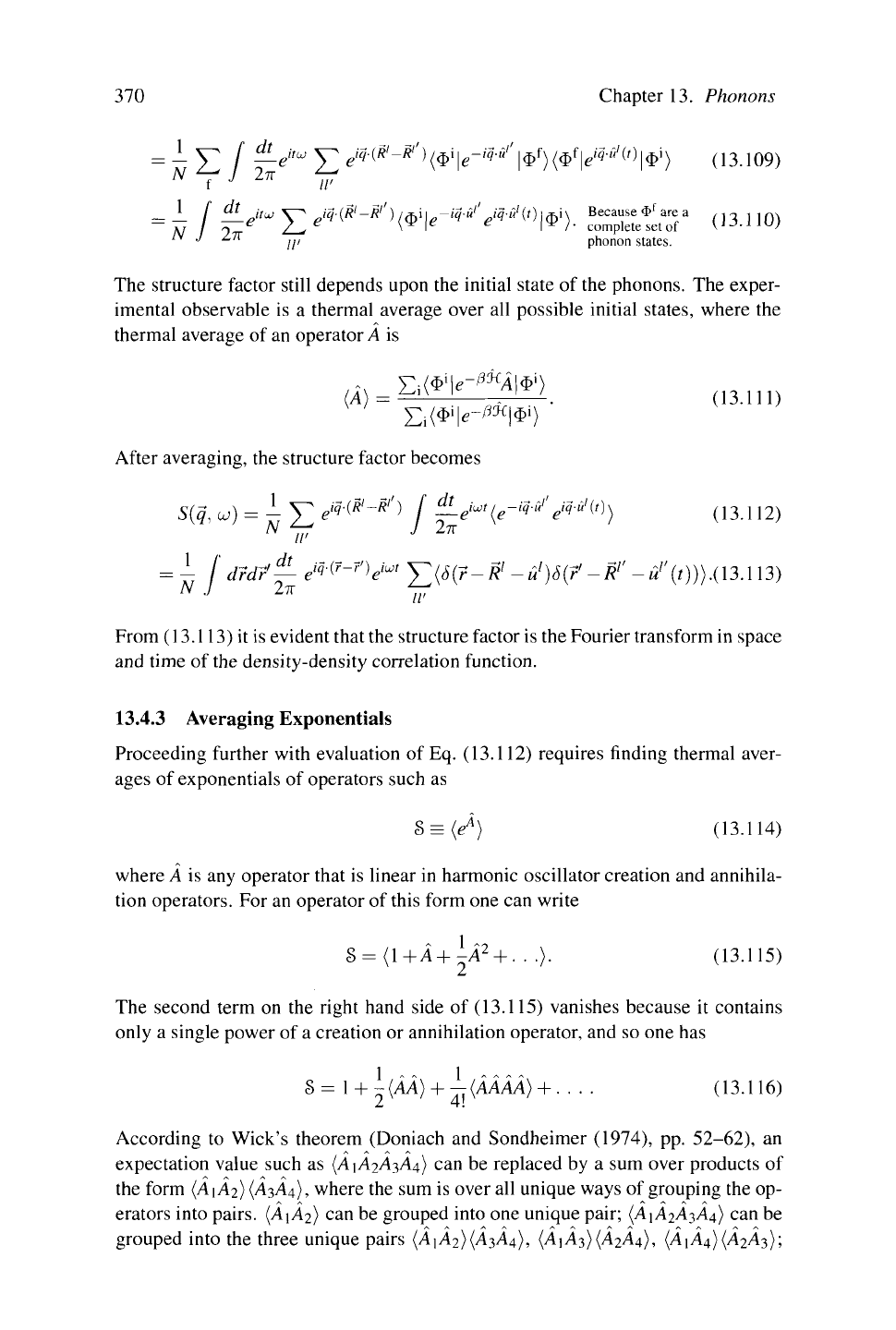
The structure factor still depends upon the initial state of the phonons. The exper-
imental observable is a thermal average over all possible initial states, where the
thermal average of an operator A is
(Α)
=
^
Λ
' ί^-Α
(13.111)
Σΐ(φΐ|β-^|φΐ)
After averaging, the structure factor becomes
S(q, ω) =
-Υ
e
"H"') [ ÉL
e
^(
e
-^'
e
^('))
(13.112)
N
w
J 2vr
1
/'
j^j^dt
N
I drdr'—
e
>H?-T')
e
iut
y
($(?_# -ΰ')δ{Ϋ -R
1
' -/(/))).(13.113)
From
(
13.113) it is evident that the structure factor is the Fourier transform in space
and time of the density-density correlation function.
13.4.3 Averaging Exponentials
Proceeding further with evaluation of Eq. (13.112) requires finding thermal aver-
ages of exponentials of operators such as
§Ξ(/)
(13.114)
where A is any operator that is linear in harmonic oscillator creation and annihila-
tion operators. For an operator of this form one can write
§ = (l
+
i
+
Ii
2
+
.
.
.). (13.115)
The second term on the right hand side of (13.115) vanishes because it contains
only a single power of a creation or annihilation operator, and so one has
8=1 + ί(Α4) + 1(ΛΛΛΛ) +
.
. ..
(13.116)
According to Wick's theorem (Doniach and Sondheimer (1974), pp. 52-62), an
expectation value such as (Â1Â2Â3Â4) can be replaced by a sum over products of
the form (AxÂjj^Aé), where the sum is over all unique ways of grouping the op-
erators into pairs. (Â1Â2) can be grouped into one unique pair; (Â1Â2Â3Â4) can be
grouped into the three unique pairs
{A\A2}
(Ατ,Α^),
{Α\Ατ,)
{Α2Α4),
(AyÂ^^Â?,);
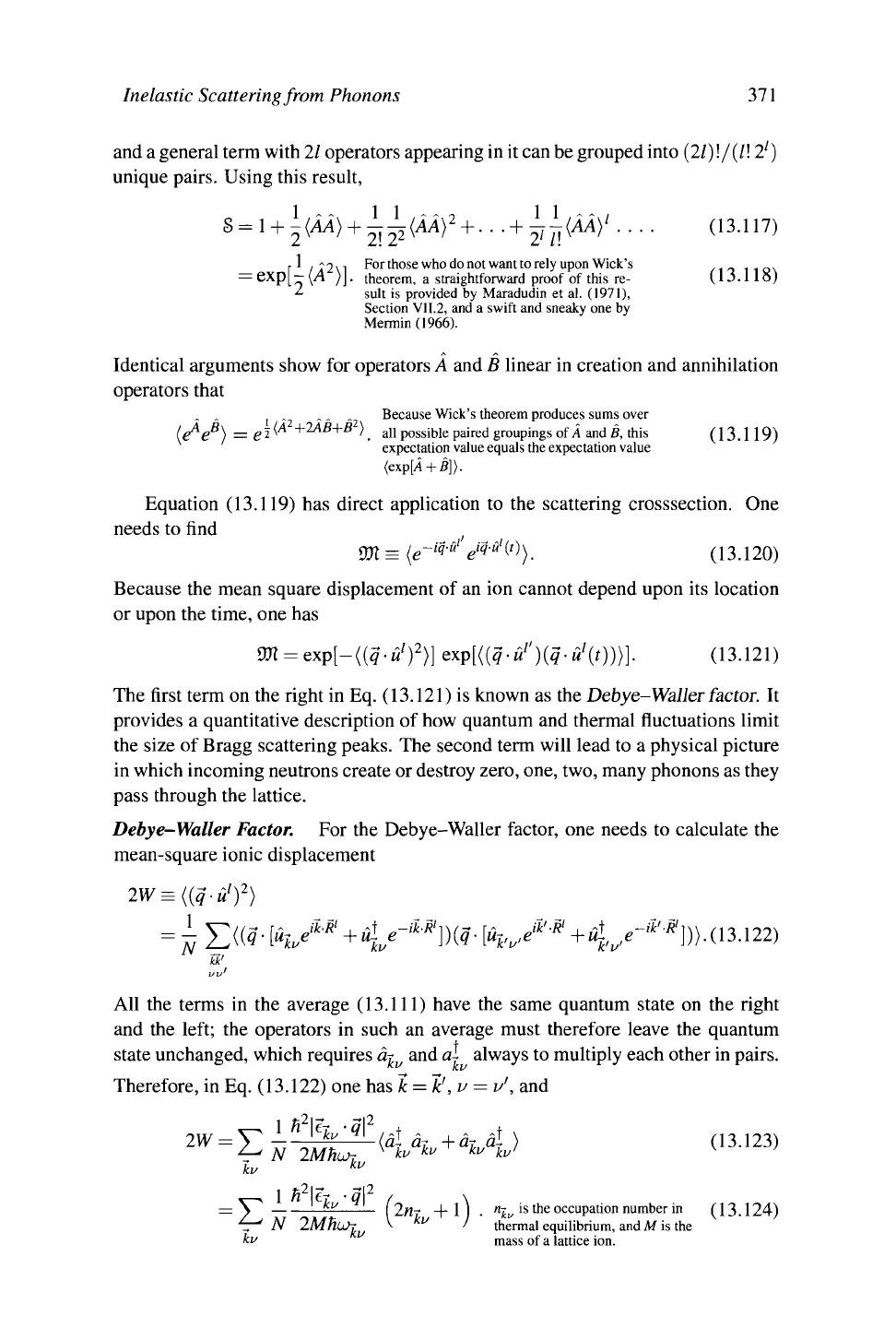
Inelastic Scattering from Phonons 371
and a general term with 2/ operators appearing in it can be grouped into (2/)!/(/! 2
l
)
unique pairs. Using this result,
S
=
\+
l
-(ÂÂ)
+
~(ÂÂ}
2
+
.
.
■
+
^(ÂÂ)
1
....
(13.117)
ri
/î2\i
For those who do not want to rely upon Wick's
=exp[—
\A
)\. theorem,
a
straightforward proof
of
this re- (13.11ο)
■^ suit
is
provided by Maradudin
et
al. (1971),
Section VII.2, and
a
swift and sneaky one by
Mermin(1966).
Identical arguments show for operators A and B linear in creation and annihilation
operators that
„
„ „
~
„
_
Because Wick's theorem produces sums over
(e
A
e
B
)
= e
2
^
2
+
2AB
+
ß2
> _
all possible paired groupings of
Â
and B, this (13.119)
expectation value equals the expectation value
(exp[A+ß]>.
Equation (13.119) has direct application to the scattering crosssection.
One
needs to find
m={e^-
ül
'
e^
ä
'^).
(13.120)
Because the mean square displacement of an ion cannot depend upon its location
or upon the time, one has
m = exp[-((q-û
1
)
2
)} exp[({q-û
l
')(q-Û
l
{t)))}. (13.121)
The first term on the right in Eq. (13.121) is known as the Debye-Waller
factor.
It
provides
a
quantitative description of how quantum and thermal fluctuations limit
the size of Bragg scattering peaks. The second term will lead to a physical picture
in which incoming neutrons create or destroy zero, one, two, many phonons as they
pass through the lattice.
Debye-Waller
Factor.
For the Debye-Waller factor, one needs to calculate the
mean-square ionic displacement
2W = ((q-û
1
)
2
)
vv
1
All the terms
in
the average (13.111) have the same quantum state on the right
and the left; the operators
in
such an average must therefore leave the quantum
state unchanged, which requires
â-
kv
and al always to multiply each other in pairs.
Therefore, in Eq. (13.122) one has
k
= k',
v
= u', and
Σ
1 H le? -q\
2
,
+
+
,
1 kv
fi /gt
â +a
£
(13.123)
M ΊΜΐ,,.ν,
N
kv kv kv i
v
l
v
'
N IMhüJr
N
kv *"
kv
*"'
kv
Σ
ι
n e?
·
q\ / \
ι_κν
'_ i 2
n
^
_|_
J j n^
is the occupation number in (13.124)
_
N
2MHu^
\ kv j
thermal equilibrium, and M is the
kv
KV
mass of a lattice ion.
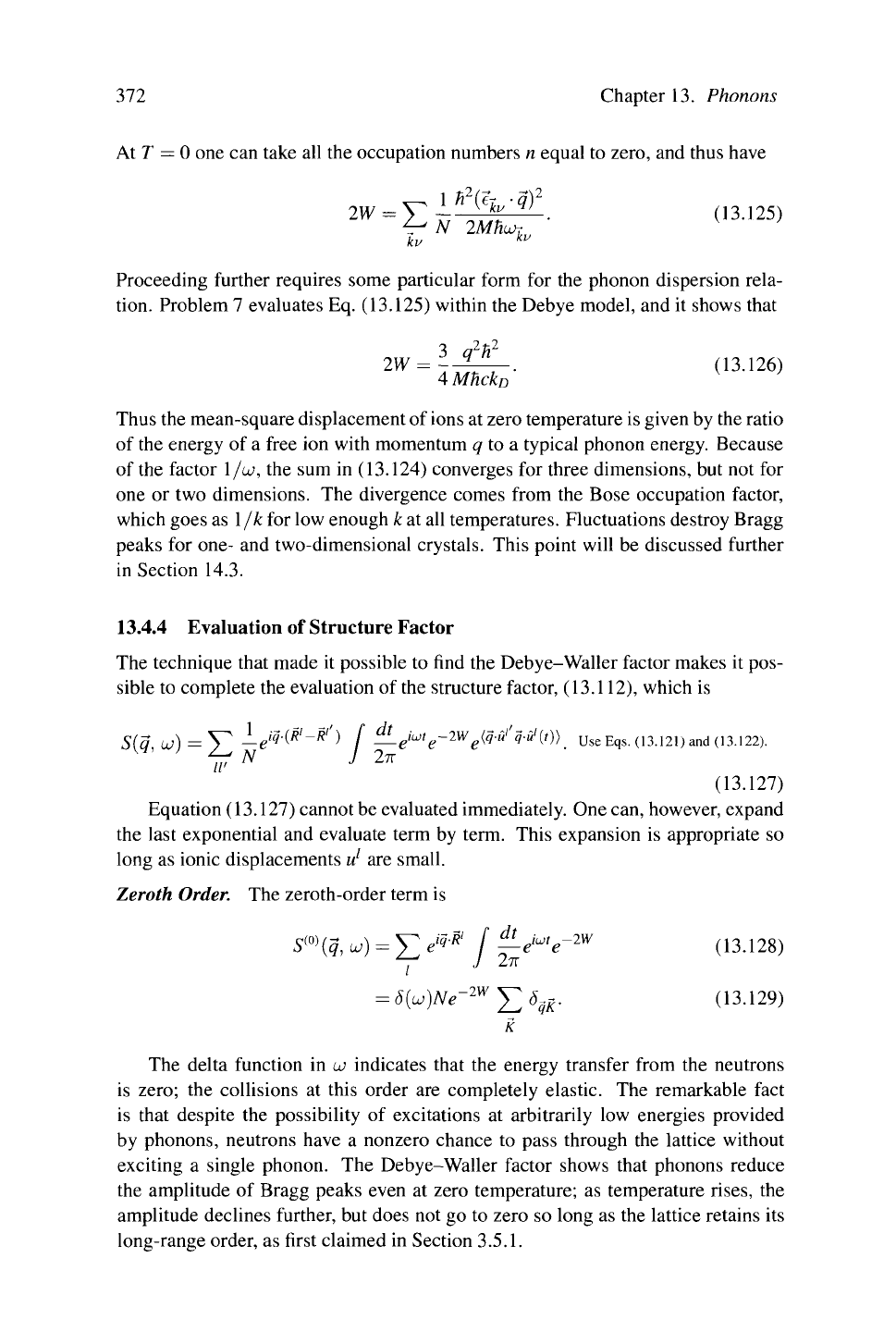
372
Chapter 13. Phonons
At T = 0 one can take all the occupation numbers n equal to zero, and thus have
^ 1 H
2
(er -a)
2
2W = Y
V
*"
H
. (13.125)
4^
N 2Mhu>r
kv
kv
Proceeding further requires some particular form for the phonon dispersion rela-
tion. Problem 7 evaluates Eq. (13.125) within the Debye model, and it shows that
3 q
2
%
2
2W = —- . (13.126)
4 Mhck
D
Thus the mean-square displacement of ions at zero temperature is given by the ratio
of the energy of a free ion with momentum q to a typical phonon energy. Because
of the factor I/o;, the sum in (13.124) converges for three dimensions, but not for
one or two dimensions. The divergence comes from the Bose occupation factor,
which goes as
1
jk for low enough k at all temperatures. Fluctuations destroy Bragg
peaks for one- and two-dimensional crystals. This point will be discussed further
in Section 14.3.
13.4.4 Evaluation of Structure Factor
The technique that made it possible to find the Debye-Waller factor makes it pos-
sible to complete the evaluation of the structure factor, (13.112), which is
S(q,u) = y* —^<
ä
'-
W
') [ —
e
i
"
t
e
-
2w
e
{<i-"
l
'<i-û'(t))_ Use Eqs. (13.121) and (13.122).
~^ N J 2π
(13.127)
Equation (13.127) cannot be evaluated immediately. One can, however, expand
the last exponential and evaluate term by term. This expansion is appropriate so
long as ionic displacements u
l
are small.
Zeroth Order. The zeroth-order term is
K
The delta function in ω indicates that the energy transfer from the neutrons
is zero; the collisions at this order are completely elastic. The remarkable fact
is that despite the possibility of excitations at arbitrarily low energies provided
by phonons, neutrons have a nonzero chance to pass through the lattice without
exciting a single phonon. The Debye-Waller factor shows that phonons reduce
the amplitude of Bragg peaks even at zero temperature; as temperature rises, the
amplitude declines further, but does not go to zero so long as the lattice retains its
long-range order, as first claimed in Section
3.5.1.