
Marder M.P. Condensed Matter Physics
Подождите немного. Документ загружается.

Two-Dimensional Dislocations and Hexatic Phases 393
Experimental Observations. The two-dimensional crystals in which bond-ori-
entational order is observed would be triangular lattices at zero temperature, and
therefore they are known as hexatics. It is not easy to observe hexatic ordering
in atomic scale systems, because free-standing films one atom thick are hard to
make. It has been observed in liquid crystal films only a few monolayers high by
Pindak et al. (1981). Bond-orientational order has also been observed in colloidal
suspensions, where latex spheres of about a micron in diameter are placed in a
micron-thick bath of water. The spheres interact through electrostatic repulsion.
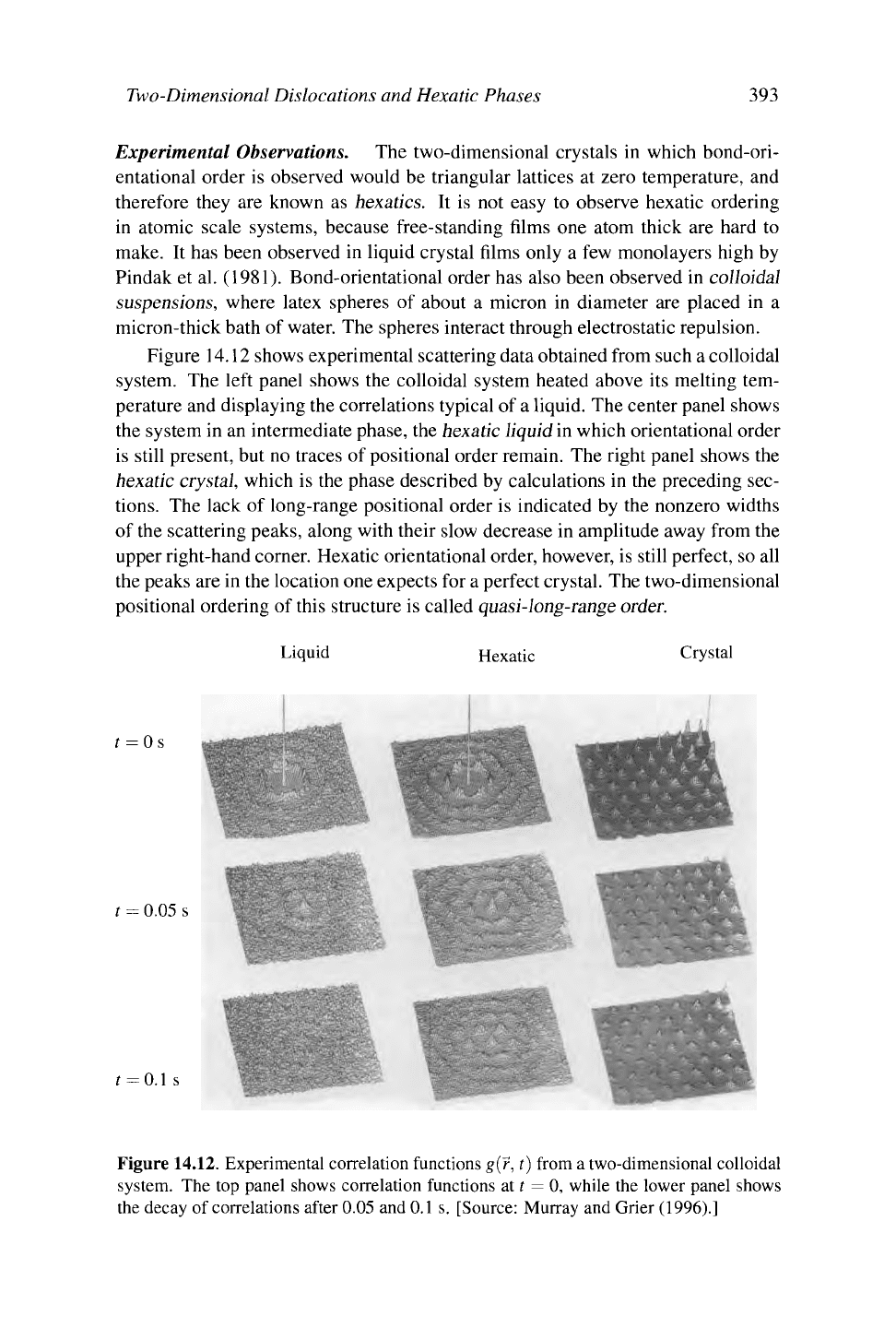
Figure 14.12 shows experimental scattering data obtained from such a colloidal
system. The left panel shows the colloidal system heated above its melting tem-
perature and displaying the correlations typical of a liquid. The center panel shows
the system in an intermediate phase, the hexatic liquid in which orientational order
is still present, but no traces of positional order remain. The right panel shows the
hexatic crystal, which is the phase described by calculations in the preceding sec-
tions.
The lack of long-range positional order is indicated by the nonzero widths
of the scattering peaks, along with their slow decrease in amplitude away from the
upper right-hand corner. Hexatic orientational order, however, is still perfect, so all
the peaks are in the location one expects for a perfect crystal. The two-dimensional
positional ordering of this structure is called quasi-long-range order.
Liquid Hexatic Crystal
t = 0s
r = 0.05s
i = 0.1 s
Figure 14.12. Experimental correlation functions g(r, t) from a two-dimensional colloidal
system. The top panel shows correlation functions at t = 0, while the lower panel shows
the decay of correlations after 0.05 and 0.1 s. [Source: Murray and Grier
(
1996).]
394 Chapter 14. Dislocations and Cracks
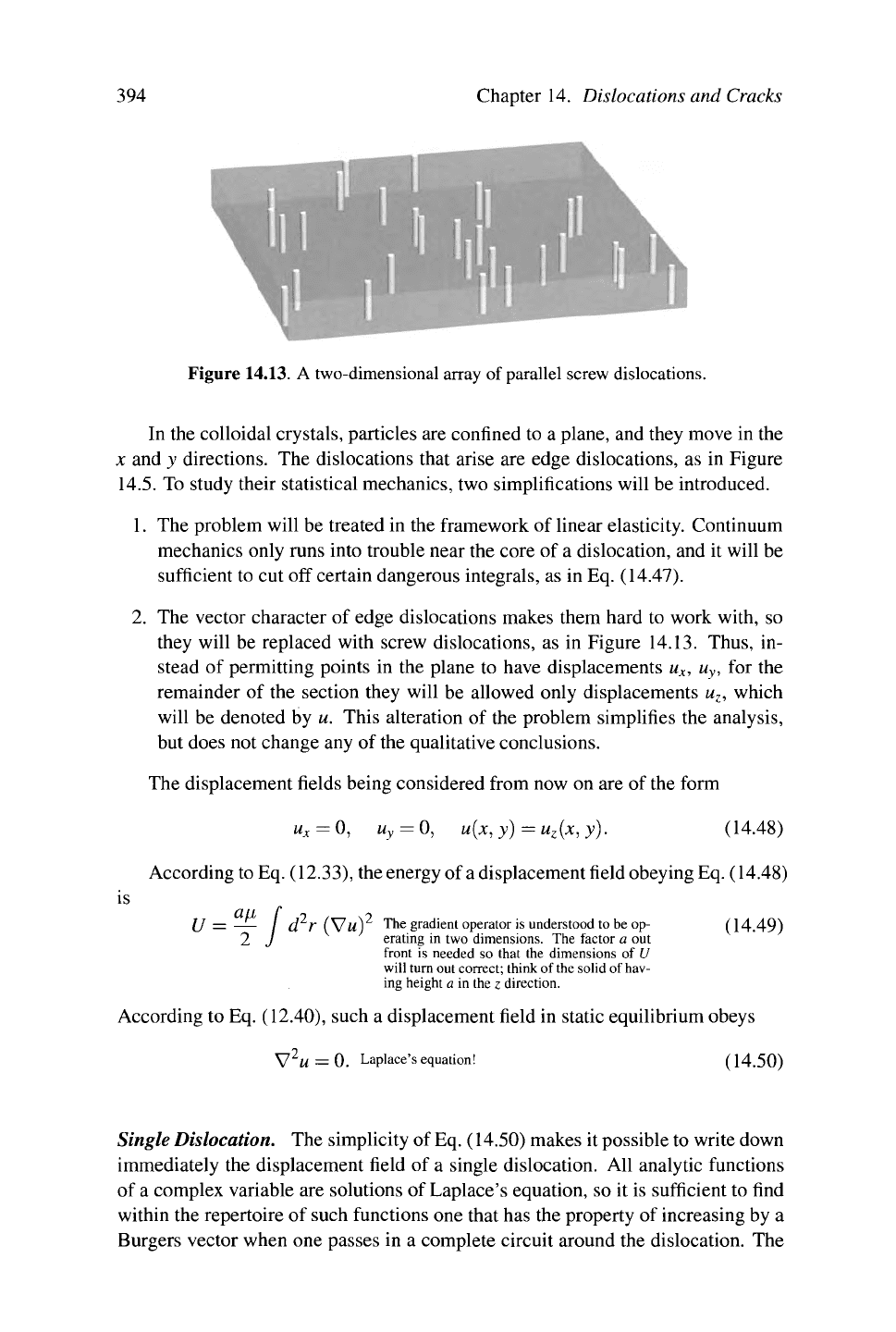
Figure 14.13. A two-dimensional array of parallel screw dislocations.
In the colloidal crystals, particles are confined to a plane, and they move in the
x and y directions. The dislocations that arise are edge dislocations, as in Figure
14.5.
To study their statistical mechanics, two simplifications will be introduced.
1.
The problem will be treated in the framework of linear elasticity. Continuum
mechanics only runs into trouble near the core of a dislocation, and it will be
sufficient to cut off certain dangerous integrals, as in Eq. (14.47).
2.
The vector character of edge dislocations makes them hard to work with, so
they will be replaced with screw dislocations, as in Figure
14.13.
Thus, in-
stead of permitting points in the plane to have displacements u
x
, u
y
, for the
remainder of the section they will be allowed only displacements u
z
, which
will be denoted by u. This alteration of the problem simplifies the analysis,
but does not change any of the qualitative conclusions.
The displacement fields being considered from now on are of the form
u
x
= 0,
Uy
= 0, u(x,y) = u
z
(x,y). (14.48)
According to Eq. (12.33), the energy of
a
displacement field obeying Eq. (14.48)
is
U = -tl I d r (S7u) The gradient operator is understood to be op- (14.49)
2 J erating in two dimensions. The factor a out
front is needed so that the dimensions of U
will turn out correct; think of
the
solid of hav-
ing height a in the z direction.
According to Eq. (12.40), such a displacement field in static equilibrium obeys
V
2
M = 0. Laplace's equation! (14.50)
Single Dislocation. The simplicity of
Eq.
( 14.50) makes it possible to write down
immediately the displacement field of a single dislocation. All analytic functions
of a complex variable are solutions of Laplace's equation, so it is sufficient to find
within the repertoire of such functions one that has the property of increasing by a
Burgers vector when one passes in a complete circuit around the dislocation. The
Two-Dimensional Dislocations and Hexatic Phases 395
logarithm is the simplest complex function this property; \og(x + iy) increases by
2πί for any path that loops once about the origin. A dislocation at the origin with
Burgers vector a is described by
u(x,y)
=—lmln[x
+
iy\.
(14.51)
Ζ7Γ
What is the potential energy cost of introducing such a dislocation into a solid?
Placing Eq. (14.51) into Eq. (14.49) gives
-τ(έ)7<Η-^Γ+[^]
2
2
an ( a \
2
f
R
1
I I / dr
ΊτΤΓ—
The limits a and R are introduced by hand to (14.53)
2 \ 27Γ / Ja i keep
tne
integral from diverging, as discussed
below.
(aß) In I — 1 -\-W.
w K
added by hand to account for the energy (14.54)
47Γ y
O.
) °f the core of the dislocation.
The passage from Eq. (14.52) to Eq. (14.54) is not completely direct. There is
the problem that the integral over r diverges both at large and short lengths. The
solution at large lengths is to cut the integral off at a system size R (taking the
dislocation to sit at the center of a cylinder). At short lengths, the integral must
be cut off at the scale of the lattice spacing a, where continuum mechanics breaks
down. To compensate for the very crude treatment of short lengths, it is necessary
to add to Eq. (14.55) an additional energy w, which describes the energy needed
to form the core of the dislocation, meaning those fine adjustments on the atomic
scale that
Eq.
(14.54) has gotten wrong. This energy w will be added to the energies
of all dislocations from now on.
Two Dislocations. The displacement field of two dislocations with equal and
opposite Burgers vectors separated by distance
XQ
along the x axis is
u(x, y) = — Im {ln[x +
/_y]
- In[X
—
XQ
+'iy}}
■
(14.55)
27Γ
Using the divergence theorem and some properties of complex functions, Problem
2 shows that the energy of such a configuration is
2q
2
In (^) +2«, with q
2
= ^. (14.56)
\a J 4π
The notation of Eq. (14.56) is meant to suggest an analogy with two-dimensional
electrostatics. The analogy is almost perfect. The dislocations obey exactly the
same equations as lines of charge
q:
The displacement u serve as the electrostatic
potential, and the gradients of u are equivalent to the electrical field. The advan-
tage of employing this analogy is that it permits the use of a subtle quantity, usually
taken for granted, the dielectric constant e. There is a slight flaw in the analogy,
which emerges as soon as one draws the field lines Vw that should correspond to
396
Chapter 14. Dislocations and Cracks
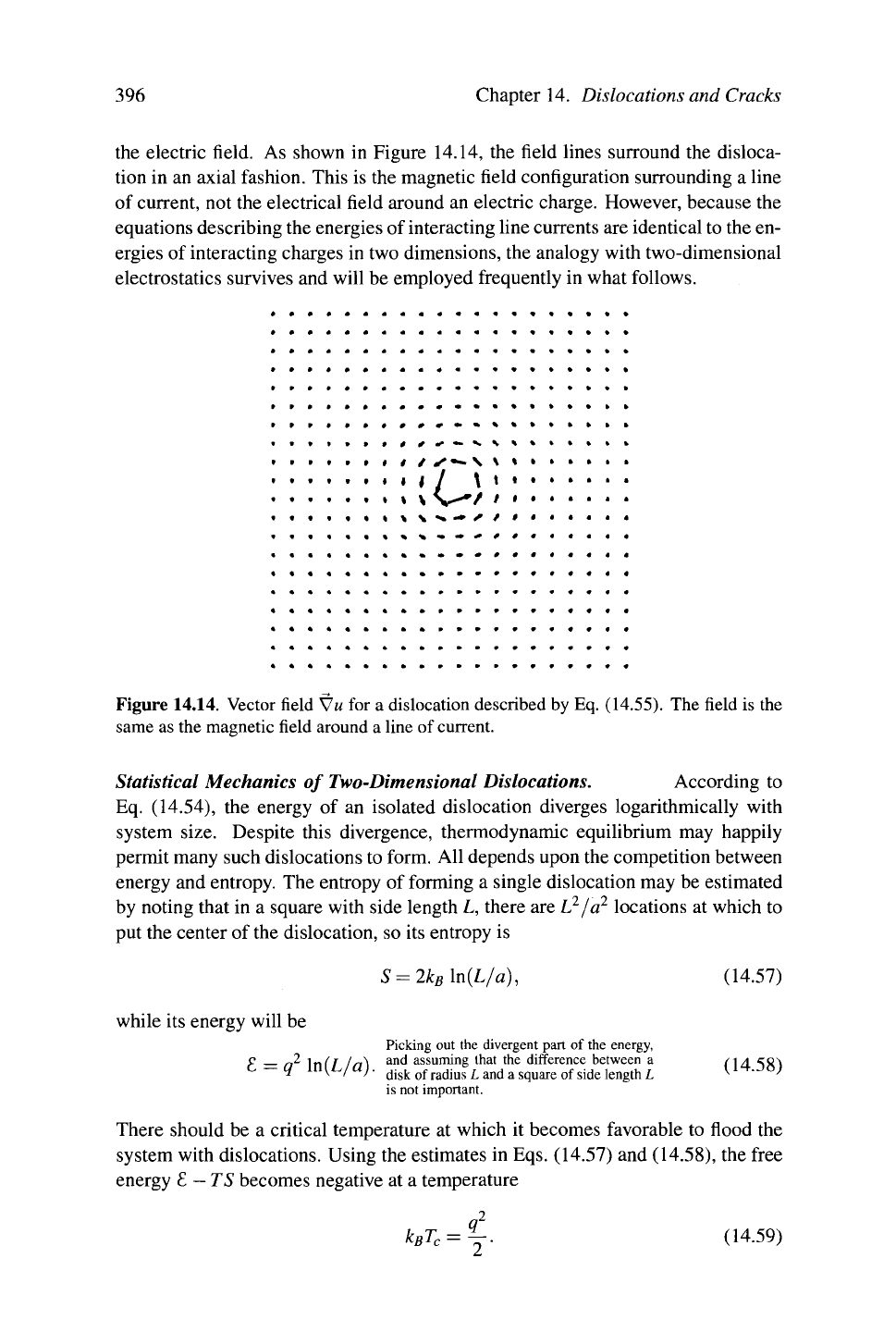
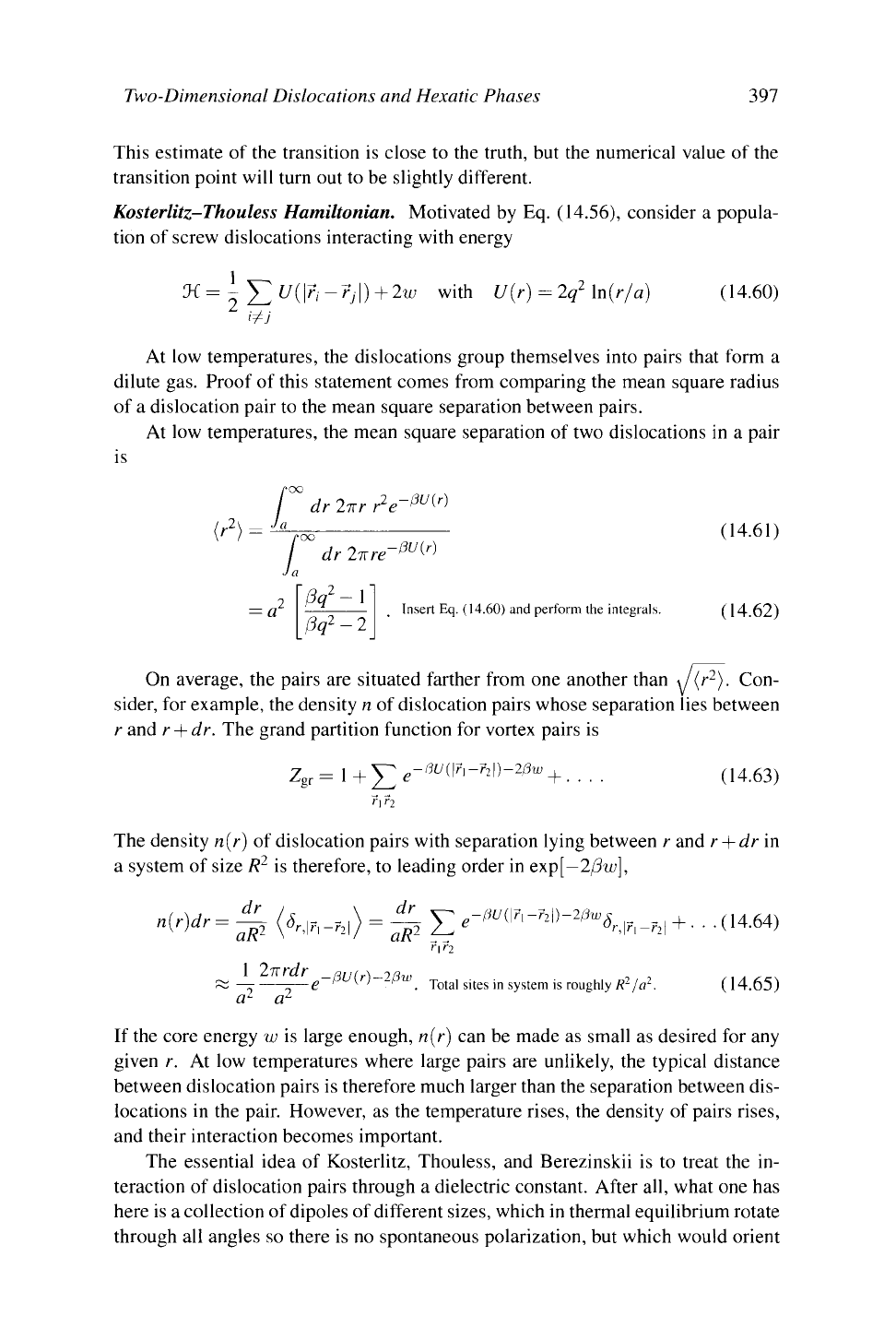
the electric field. As shown in Figure 14.14, the field lines surround the disloca-
tion in an axial fashion. This is the magnetic field configuration surrounding a line
of current, not the electrical field around an electric charge. However, because the
equations describing the energies of interacting line currents are identical to the en-
ergies of interacting charges in two dimensions, the analogy with two-dimensional
electrostatics survives and will be employed frequently in what follows.
# *> » * %
^ ..
—
«. \
• * / \ « ·
\ ». -» x /
% m ~ + *
Figure 14.14. Vector
field
VM
for a dislocation described by Eq. (14.55). The
field
is the
same as the magnetic
field
around a line of current.
Statistical Mechanics of Two-Dimensional Dislocations. According to
Eq. (14.54), the energy of an isolated dislocation diverges logarithmically with
system size. Despite this divergence, thermodynamic equilibrium may happily
permit many such dislocations to form. All depends upon the competition between
energy and entropy. The entropy of forming a single dislocation may be estimated
by noting that in a square with side length L, there are
L
2
/a
2
locations at which to
put the center of the dislocation, so its entropy is
S = 2k
B
ln(L/a), (14.57)
while its energy will be
Picking out the divergent part of the energy,
c _ „2 \
n
(T IQ\ and assuming that the difference between a ΙΛΑ <Q\
y v / / · disk of radius L and a square of side length L \ ■ )
is not important.
There should be a critical temperature at which it becomes favorable to flood the
system with dislocations. Using the estimates in Eqs. (14.57) and (14.58), the free
energy
8,
—
TS becomes negative at a temperature
q
2
k
B
T
c
= ^. (14.59)
Two-Dimensional Dislocations and Hexatic Phases 397
This estimate of the transition is close to the truth, but the numerical value of the
transition point will turn out to be slightly different.
Kosterlitz-Thouless Hamiltonian. Motivated by Eq. (14.56), consider a popula-
tion of screw dislocations interacting with energy
<
K=-Y^U{\r
i
-r
j
\)+2w with U{r) = 2q
2
ln(r/a) (14.60)
At low temperatures, the dislocations group themselves into pairs that form a
dilute gas. Proof of this statement comes from comparing the mean square radius
of a dislocation pair to the mean square separation between pairs.
At low temperatures, the mean square separation of two dislocations in a pair
is
(r
2
>
= ^
(14.61)
/•oc
/ dr
2-nr
Ja
poo
/
dr
a
2
~ßq
2
ßq
2
r
2
e
-ßU(r)
2nre
-f
-2
-ßU(r)
Insert Ec
Insert Eq. (14.60) and perform the integrals. (14.62)
On average, the pairs are situated farther from one another than
W
(r
2
). Con-
sider, for example, the density n of dislocation pairs whose separation lies between
r and
r
+ dr. The grand partition function for vortex pairs is
V-
(
,-ßU(\7
l
-r
2
\)-2ßw
_
Z
ër
=\+^e-
l1u
^-
r
^-^
w
+
.
. . .
(14.63)
The density n(r) of dislocation pairs with separation lying between r and r + dr in
a system of size R
2
is therefore, to leading order in exp[—2ßw],
<r)dr=^
2
(*
r
,
M|
)
=
^ E
e-^'-™-
2
^,,,,-*,
+ ·
· -(14.64)
% -r-
e
-ß
u
(
r
)-~
2
ß
u
\ Total sites in system is roughly/?
2
/a
2
· (14.65)
a
1
a
1
If the core energy w is large enough, n{r) can be made as small as desired for any
given r. At low temperatures where large pairs are unlikely, the typical distance
between dislocation pairs is therefore much larger than the separation between dis-
locations in the pair. However, as the temperature rises, the density of pairs rises,
and their interaction becomes important.
The essential idea of Kosterlitz, Thouless, and Berezinskii is to treat the in-
teraction of dislocation pairs through a dielectric constant. After all, what one has
here is a collection of dipoles of different sizes, which in thermal equilibrium rotate
through all angles so there is no spontaneous polarization, but which would orient
398
Chapter 14. Dislocations and Cracks
and create a polarization P in the presence of any electric field
E.
This situation is
just what the theory of dielectrics was created to handle. In a dielectric medium, the
interaction energy of
two
charges is not U = 2q
2
\n(r/a), it is
i/
e
ff
=
2q
2
ln(r/a)/e,
and so interactions between many different dipoles can be accommodated by using
i/
e
ff
instead of U.
However, there
is
an interesting complication. As the phase transition point
is approached, dipoles of larger and larger sizes are created, while simultaneously
the number of very small dipoles grows rapidly. The very smallest dipoles do not
know they are sitting in a dielectric medium because their charges are much closer
together than the distance to any other dipole. The appropriate dielectric constant
for them must be 1. Very large dipoles may have large numbers
of
small dipoles
in between them, and therefore they can have
a
dielectric constant e
>
1. So the
dielectric constant must be taken
to
depend upon scale. When the dislocations
become numerous, they can be assigned to dipoles by grouping every dislocation
with the nearest other dislocation that does not already have a partner, starting with
the closest dislocations and moving away
in
distance. The idea
of
constructing
a scaling theory in which the results
at
one length scale are formulated in terms
of the results
at a
smaller length scale
is
the basic idea
of
the renormalization
group. Similar ideas appear also in the study of metal-insulator transitions (Section
18.5.2),
of critical phenomena (Section 24.6), and in the study of the Kondo effect
(Section 26.6).
Adopting now completely the language of electrostatics (equivalently, magne-
tostatics), focus on
a
dislocation dipole of separation
r
but arbitrary orientation
Θ.
When placed in an electric field,
it
will tend to orient itself along the field.
The
polarizability a(r) of a dipole
p
of size
r
is given by
p —
aE =
rq((cOS
Θ, sin
Θ))
Taking
È
to point along 0
=
0.
(14.66)
=
f d±
e
-ßU(r)-2ß
W+ß
E
q
rcos θ^^ ^
sm Q) {Η6η)
J
2π
=
—
ßq r E.
Expand the exponential in powers of
£
up to
(14.68)
2
linear order and perform average over
Θ.
So the contribution to the dielectric susceptibility
d\{r)
from dislocation pairs of
size between
r
and r + dr is, from Eqs. (14.65) and (14.68),
d
x
(r)
= n(r) dr a(r)
=
\ßq
2
(-Y
2
^L
e
-ßvl<r)-2
ßw
_
(U
69)
2
\aj a
1
In order to determine e, make the assumption that all dipoles smaller than
r
contribute to the dielectric constant screening the interactions
at
scale
r,
and all
larger ones are irrelevant. This point is the crucial junction where results
at
one
length scale determine an effective theory
at
larger scales. So, remembering the
result from electrostatics that e
=
1
+
4πχ, one now has
e(r) =
l+4n
ί
ί/χ=1+4π
ί
dr'n(r')a{r')
(14.70)
Cracks
399
de(r)
dr
de(x)
dx
■
4n
2
ßq
2
-ßU(r)/e(r)-2ßw
(14.71)
:
4π W-*·
2
Y
3-2ßc,
2
/e(x)~2ßw
. Withx = r/a, and using Eq. (14.60). (14.72)
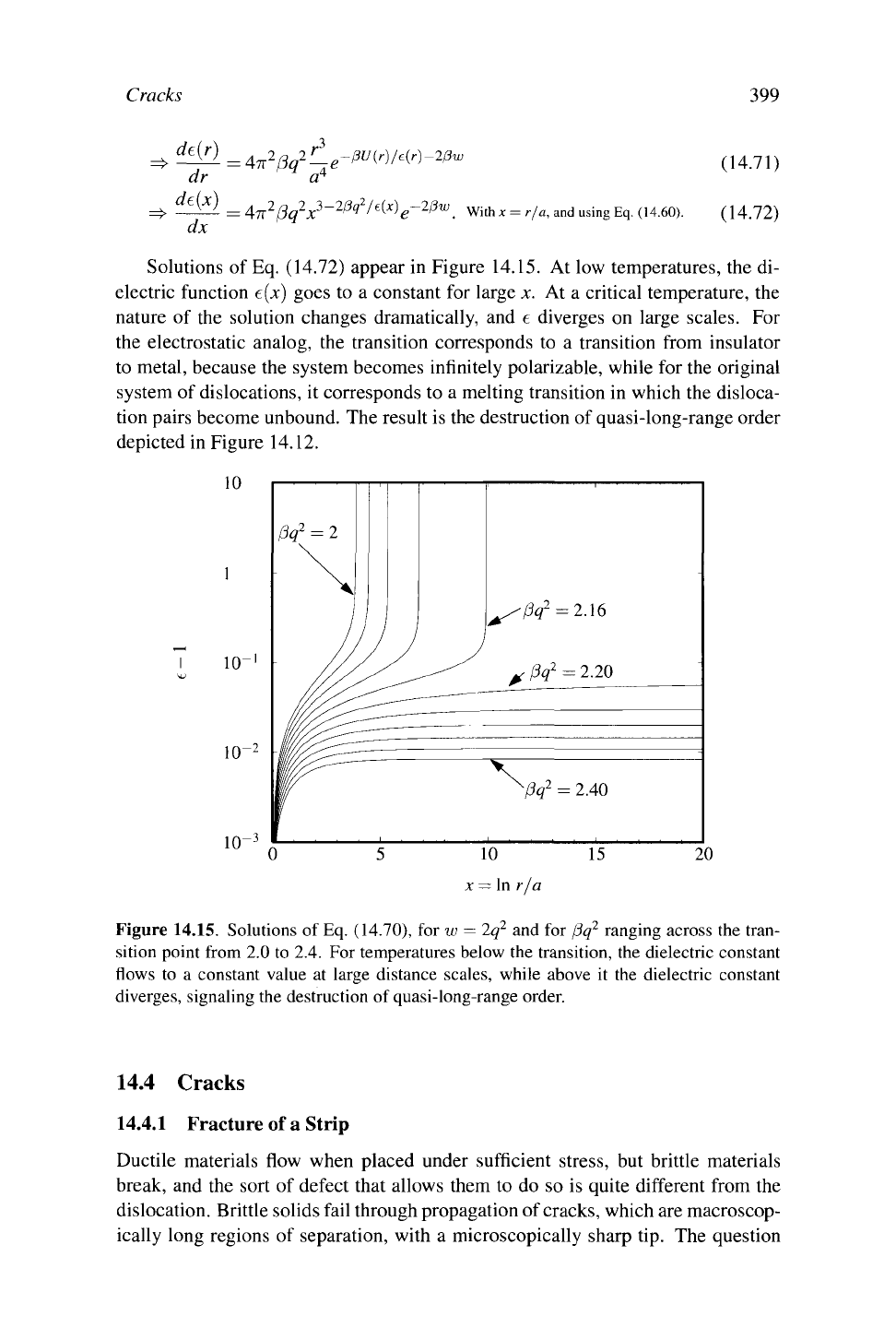
Solutions of Eq. (14.72) appear in Figure 14.15. At low temperatures, the di-
electric function e(x) goes to a constant for large x. At a critical temperature, the
nature of the solution changes dramatically, and e diverges on large scales. For
the electrostatic analog, the transition corresponds to a transition from insulator
to metal, because the system becomes infinitely polarizable, while for the original
system of dislocations, it corresponds to a melting transition in which the disloca-
tion pairs become unbound. The result is the destruction of quasi-long-range order
depicted in Figure 14.12.
10
10
10
-i
2
-3
/V =
2
^ßq
2
= 2A6
f ßq
2
= 2.20
W 7?<?
2
= 2.40
10
x = In r/a
15
20
Figure 14.15. Solutions of Eq. (14.70), for w = 2q
2
and for ßq
2
ranging across the tran-
sition point from 2.0 to 2.4. For temperatures below the transition, the dielectric constant
flows to a constant value at large distance scales, while above it the dielectric constant
diverges, signaling the destruction of quasi-long-range order.
14.4 Cracks
14.4.1 Fracture of a Strip
Ductile materials flow when placed under sufficient stress, but brittle materials
break, and the sort of defect that allows them to do so is quite different from the
dislocation. Brittle solids fail through propagation of cracks, which are macroscop-
ically long regions of separation, with a microscopically sharp tip. The question
400
Chapter 14. Dislocations and Cracks
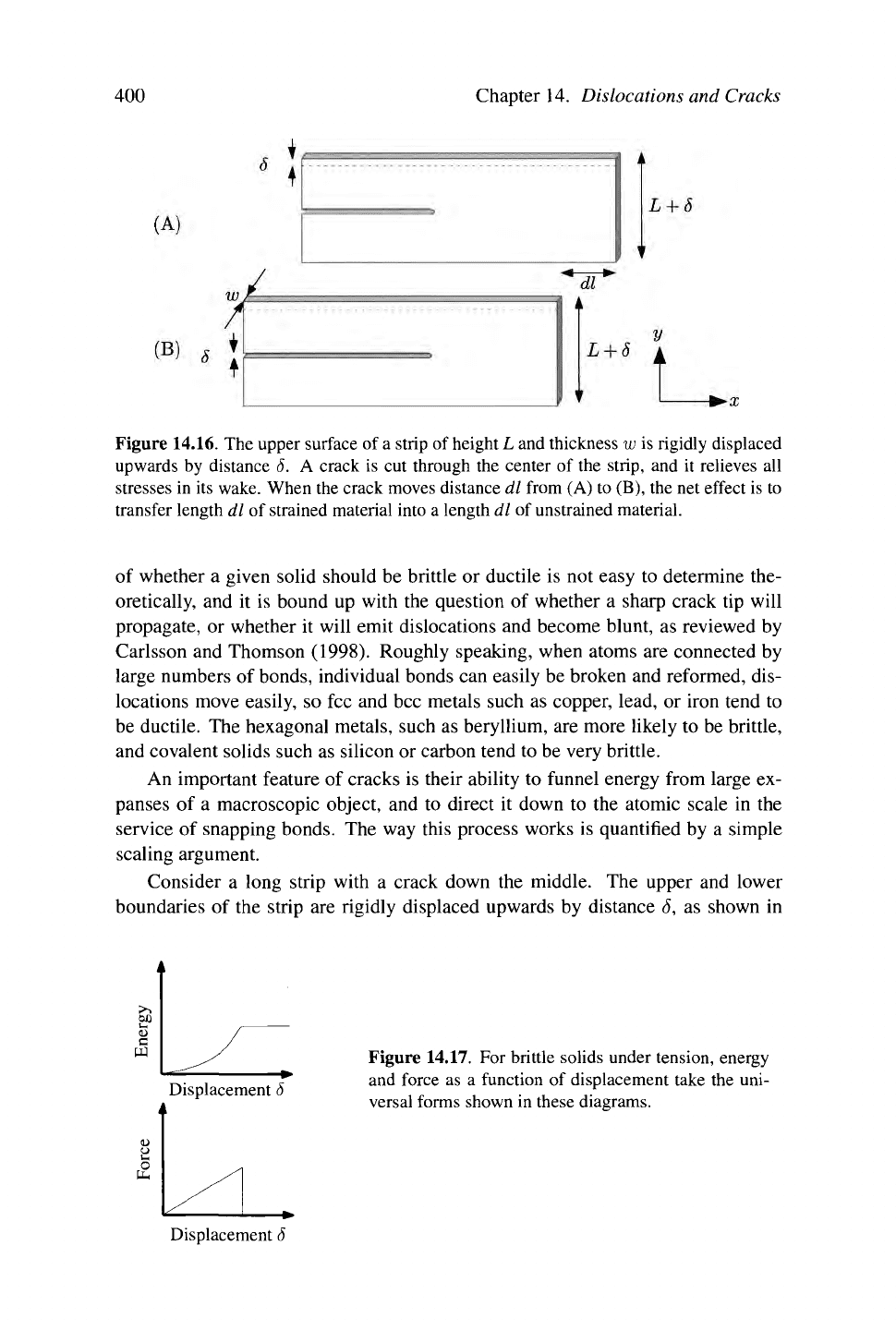
Figure 14.16. The upper surface of
a
strip of height L and thickness w is
rigidly
displaced
upwards by distance δ. A crack is cut through the center of the strip, and it relieves all
stresses in its wake. When the crack moves distance dl from (A) to (B), the net effect is to
transfer length dl of strained material into a length dl of unstrained material.
of whether a given solid should be brittle or ductile is not easy to determine the-
oretically, and it is bound up with the question of whether a sharp crack tip will
propagate, or whether it will emit dislocations and become blunt, as reviewed by
Carlsson and Thomson (1998). Roughly speaking, when atoms are connected by
large numbers of bonds, individual bonds can easily be broken and reformed, dis-
locations move easily, so fee and bec metals such as copper, lead, or iron tend to
be ductile. The hexagonal metals, such as beryllium, are more likely to be brittle,
and covalent solids such as silicon or carbon tend to be very brittle.
An important feature of cracks is their ability to funnel energy from large ex-
panses of a macroscopic object, and to direct it down to the atomic scale in the
service of snapping bonds. The way this process works is quantified by a simple
scaling argument.
Consider a long strip with a crack down the middle. The upper and lower
boundaries of the strip are rigidly displaced upwards by distance δ, as shown in
1>
c
ω
A
o
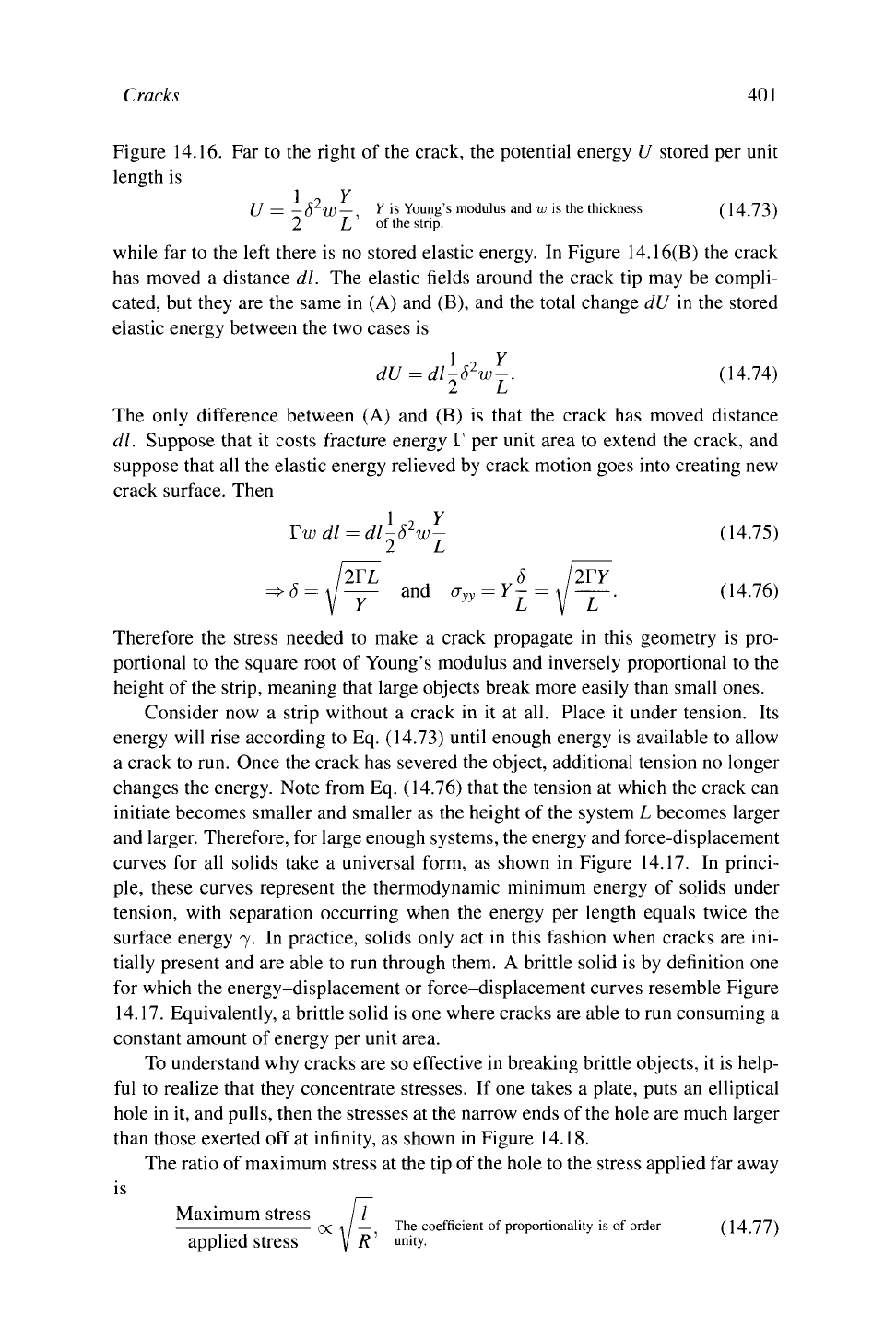
Figure 14.17. For brittle solids under tension, energy
ΤΓ. ', ~1Γ and force as a function of displacement take the uni-
Displacement
ò _
_ , · , ,·
versai forms shown in these diagrams.
Displacement δ
Cracks 401
Figure 14.16. Far to the right of the crack, the potential energy U stored per unit
length is
1
?
Y
U = —δ W—
K
is Young's modulus and
u>
is the thickness (14.73)
2 L of the strip.
while far to the left there is no stored elastic energy. In Figure 14.16(B) the crack
has moved a distance dl. The elastic fields around the crack tip may be compli-
cated, but they are the same in (A) and (B), and the total change dU in the stored
elastic energy between the two cases is
dU = dl-5
2
w-. (14.74)
2 L
The only difference between (A) and (B) is that the crack has moved distance
dl. Suppose that it costs fracture energy Γ per unit area to extend the crack, and
suppose that all the elastic energy relieved by crack motion goes into creating new
crack surface. Then
i _ v
(14.75)
1
2
Y
Tu> dl = dl-δ w —
2 L
δ=
ν
Y
and
Gyy
'
=
Y
i
=
2ΓΥ
V
L '
(14.76)
Therefore the stress needed to make a crack propagate in this geometry is pro-
portional to the square root of Young's modulus and inversely proportional to the
height of the strip, meaning that large objects break more easily than small ones.
Consider now a strip without a crack in it at all. Place it under tension. Its
energy will rise according to Eq. (14.73) until enough energy is available to allow
a crack to run. Once the crack has severed the object, additional tension no longer
changes the energy. Note from Eq. (14.76) that the tension at which the crack can
initiate becomes smaller and smaller as the height of the system L becomes larger
and larger. Therefore, for large enough systems, the energy and force-displacement
curves for all solids take a universal form, as shown in Figure 14.17. In princi-
ple,
these curves represent the thermodynamic minimum energy of solids under
tension, with separation occurring when the energy per length equals twice the
surface energy 7. In practice, solids only act in this fashion when cracks are ini-
tially present and are able to run through them. A brittle solid is by definition one
for which the energy-displacement or force-displacement curves resemble Figure
14.17.
Equivalently, a brittle solid is one where cracks are able to run consuming a
constant amount of energy per unit area.
To understand why cracks are so effective in breaking brittle objects, it is help-
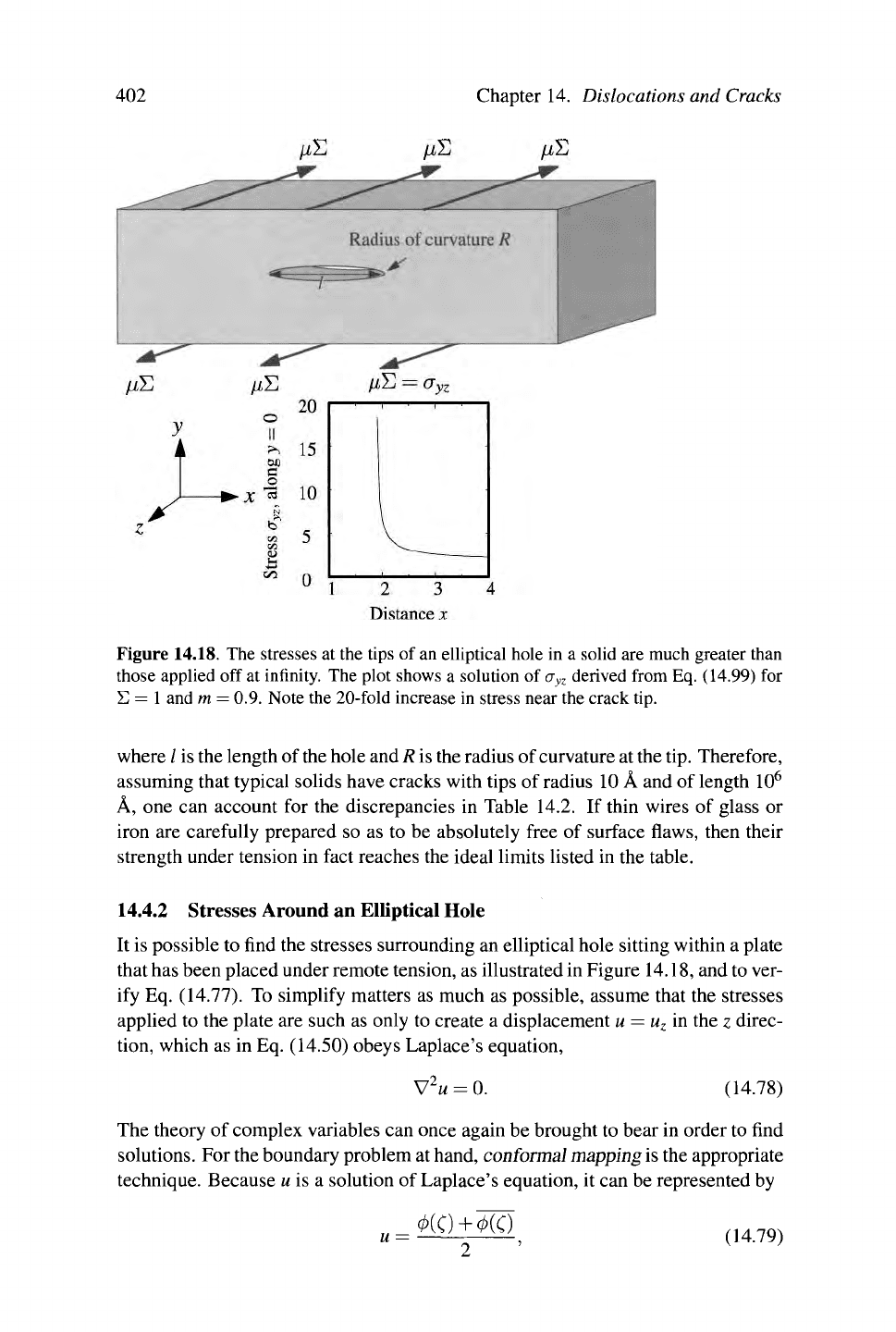
ful to realize that they concentrate stresses. If one takes a plate, puts an elliptical
hole in it, and pulls, then the stresses at the narrow ends of the hole are much larger
than those exerted off at infinity, as shown in Figure 14.18.
The ratio of maximum stress at the tip of the hole to the stress applied far away
is
Maximum stress / / ,
„
„
Oc \ — The coefficient of proportionality is of order (14.77)
applied stress y R
'
unity.
402
Chapter 14. Dislocations and Cracks
Figure 14.18. The stresses at the tips of
an
elliptical hole in a solid are much greater than
those applied off at infinity. The plot shows a solution of a
yz
derived from
Eq.
(14.99) for
Σ =
1
and m = 0.9. Note the 20-fold increase in stress near the crack tip.
where / is the length of
the
hole and R is the radius of curvature at the
tip.
Therefore,
assuming that typical solids have cracks with tips of radius 10 Â and of length 10
6
Â, one can account for the discrepancies in Table 14.2. If thin wires of glass or
iron are carefully prepared so as to be absolutely free of surface flaws, then their
strength under tension in fact reaches the ideal limits listed in the table.
14.4.2 Stresses Around an Elliptical Hole
It is possible to find the stresses surrounding an elliptical hole sitting within a plate
that has been placed under remote tension, as illustrated in Figure 14.18, and to ver-
ify Eq. (14.77). To simplify matters as much as possible, assume that the stresses
applied to the plate are such as only to create a displacement u = u
z
in the z direc-
tion, which as in Eq. (14.50) obeys Laplace's equation,
V
2
w = 0. (14.78)
The theory of complex variables can once again be brought to bear in order to find
solutions. For the boundary problem at hand, conformai mapping
is
the appropriate
technique. Because u is a solution of Laplace's equation, it can be represented by
Φ(0
+
Φ(0
(14.79)